
Nighttime vs. night time is one of those English spelling questions that looks simple until you stop and think about it. Should you write nighttime, night time, or perhaps night-time?
In modern US English, nighttime is generally the best choice when you mean the period of darkness or the part of the day associated with night. Major dictionaries recognize nighttime as an established noun. Cambridge defines it as the time in each 24-hour period when it is dark, while Merriam-Webster defines it as the time from dusk to dawn.
However, the story doesn’t end there.
You may still see night time written as two words. You may also encounter night-time, particularly in British English and other editorial contexts. Oxford Advanced Learner’s Dictionary, for example, lists night-time as a noun and gives examples such as “night-time curfew” and “night-time entertainment.”
So, which one should you use?
For most modern American writing, choose “nighttime.” The two-word form isn’t simply a spelling mistake in every conceivable context, but it isn’t normally the preferred form when you’re naming the period of night.
Nighttime or Night Time: Which One Is Correct?
The short answer is straightforward:
Use “nighttime” as the standard one-word form in modern US English.
Nighttime is an established compound noun. It refers to the period when it is dark, generally from evening or dusk until morning. Cambridge lists nighttime as an uncountable noun in both its general English and American English entries.
For example:
- “The streets become quieter at nighttime.”
- “Some animals are most active during nighttime.”
- “She enjoys taking nighttime walks.”
- “The temperature drops sharply during nighttime.”
- “The city has a completely different atmosphere at nighttime.”
By contrast, night time consists of two separate words. You may encounter it in older writing, stylistically marked writing, or situations where night and time retain a more independent relationship.
That distinction matters because English doesn’t treat every combination of two words the same way.
Quick Comparison
| Form | General status | Example |
| nighttime | Standard closed compound in modern US English | “Nighttime can be peaceful.” |
| night time | Open phrase; less common for the general concept | Context-dependent |
| night-time | Hyphenated variant, especially found in British usage | “night-time entertainment” |
If you’re writing an article, email, report, essay, or website copy for an American audience, nighttime is usually the safest and most natural choice.
What Does “Nighttime” Mean?
Nighttime means the period associated with night, especially the hours when it is dark.
Cambridge defines it as “the time in every 24-hour period when it is dark.” Merriam-Webster gives the closely related definition “the time from dusk to dawn.”
Those definitions reveal something important: nighttime isn’t necessarily one precise clock period everywhere in the world.
Sunset and sunrise change according to location, season, latitude, and other factors. Consequently, nighttime doesn’t always begin or end at a fixed hour.
For example, saying:
“The animals are active at nighttime.”
doesn’t mean they’re active from exactly 6:00 p.m. to 6:00 a.m.
It simply places their activity within the period generally understood as night.
Nighttime vs. Evening
Evening and nighttime overlap, but they’re not identical.
Evening usually refers to the later part of the day after afternoon and before the deeper night. Nighttime focuses more directly on the period of darkness or night.
Consider these sentences:
- “We had dinner in the evening.”
- “The animals became active at nighttime.”
The first sentence describes a general part of the day. The second emphasizes the period associated with night.
Nighttime vs. Overnight
These terms are even easier to confuse.
Nighttime names a period.
Overnight often describes something that happens or continues from one evening through the following morning.
Compare:
- “The temperature falls during nighttime.”
- “The storm caused overnight damage.”
- “We stayed at the hotel overnight.”
You wouldn’t normally replace overnight with nighttime in the second or third sentence without changing the meaning.
Why Is “Nighttime” Written as One Word?
The answer lies in the way English develops compound words.
English frequently combines two words to create a new lexical unit. Sometimes the result remains open:
- ice cream
- high school
- post office
Sometimes the combination becomes hyphenated:
- well-known
- long-term
- mother-in-law
And sometimes the words eventually become a closed compound:
- bedroom
- daytime
- bedtime
- nighttime
- weekend
Nighttime belongs to this last group.
The words night and time have been associated for centuries. Over time, the combination became established strongly enough to function as a single lexical item.
That’s why modern dictionaries can list nighttime as its own word rather than merely treating it as an accidental combination of night and time.
Merriam-Webster currently lists nighttime as a dictionary entry and gives its first known use as the 14th century.
That historical detail is useful because it shows that nighttime isn’t a recent internet invention or a modern shortcut.
It has a long history in English.
Is “Nighttime” a Compound Word?
Yes. Nighttime is a closed compound word.
A closed compound combines two elements without a space or hyphen.
The structure is easy to see:
night + time → nighttime
The individual words already have meanings of their own. Together, however, they create a conventional expression for the period associated with night.
You can see the same pattern in several familiar compounds:
| Compound | Components |
| daytime | day + time |
| nighttime | night + time |
| bedtime | bed + time |
| lunchtime | lunch + time |
| springtime | spring + time |
| summertime | summer + time |
English doesn’t turn every X + time combination into one word. That’s an important point.
For example, free time remains two words. You wouldn’t normally write freetime in standard American English.
The spelling depends on whether the combination has become an established lexical compound.
Why Do People Write “Night Time”?
If nighttime is standard, why does night time keep appearing?
There are several reasons.
First, English has a long history of shifting compound forms. Words can exist as separate units before becoming hyphenated or closed compounds. Even after one spelling becomes more established, older or alternative forms can continue appearing.
Second, the phrase is intuitively understandable. A writer who sees night and time as two ordinary nouns may naturally write them separately.
Third, spelling habits vary between regions and publications.
Finally, digital writing creates its own complications. Search engines, spell-checkers, websites, old documents, and user-generated content can expose readers to multiple spellings.
That doesn’t mean every form has equal status.
A word can be understandable and still be less standard for a particular variety of English.
The History of “Nighttime” vs. “Night Time”
The history of nighttime vs. night time illustrates a broader feature of English: compound words don’t always become standardized overnight.
Merriam-Webster records the first known use of nighttime in the 14th century.
That’s significant because it demonstrates that the closed form has deep roots.
English spelling, however, has never been perfectly uniform. Historical texts often used spaces, hyphens, and compounds differently from modern publications.
The modern spelling reflects a long process in which frequently used combinations become increasingly familiar as single lexical units.
Early Uses of “Night Time”
Historically, English writers could represent related concepts in more than one way.
The existence of older two-word constructions doesn’t make them the preferred spelling today. Historical English isn’t a style manual for modern American writing.
This distinction matters when reading older books or historical documents.
A form that looks unusual today may have been perfectly ordinary in its original period.
The Rise of “Nighttime”
Frequent compounds often become more compact as speakers and writers recognize them as stable units.
Nighttime follows that pattern.
Today, dictionaries such as Cambridge and Merriam-Webster treat nighttime as an established word.
That dictionary status is stronger evidence for current usage than simply counting isolated examples of night time online.
What Do Dictionaries Say About “Nighttime” and “Night Time”?
Dictionary evidence strongly supports nighttime as an established word.
Cambridge lists nighttime as a noun and defines it as the time in every 24-hour period when it is dark. Its American Dictionary also gives nighttime as a noun.
Merriam-Webster likewise lists nighttime as a noun and records its first known use in the 14th century. Its entry also gives nighttime an adjective use in its Kids Definition.
Oxford takes a slightly different editorial approach in its Advanced Learner’s Dictionary. It lists night-time as an uncountable noun and uses examples such as “night-time curfew,” “night-time entertainment,” and “during the night/night-time.”
This is a useful lesson:
Different dictionaries can represent the same English concept with different spelling conventions.
Therefore, don’t assume that seeing night-time in a reputable dictionary means nighttime is incorrect.
It often reflects differences in editorial conventions, regional usage, or dictionary policy.
Dictionary Comparison
| Dictionary | Listed form | Grammatical classification |
| Cambridge Dictionary | nighttime | Noun |
| Merriam-Webster | nighttime | Noun |
| Oxford Advanced Learner’s Dictionary | night-time | Noun |
The important point for a US English writer is that nighttime is firmly established in American English dictionaries.
American English vs. British English: Nighttime or Night Time?
Regional English can complicate spelling questions.
American and British English share most of their vocabulary, but they don’t always follow identical spelling or hyphenation conventions.
For nighttime, modern American sources strongly support the closed form.
British-oriented dictionaries may also recognize the hyphenated form night-time. Oxford Advanced Learner’s Dictionary currently lists night-time as its headword.
Cambridge, meanwhile, uses nighttime in its main entry while providing both UK and US pronunciation information.
So the practical rule is simple:
Writing for a US audience? “Nighttime” is the clearest default.
If you’re following a particular British publication’s house style, check its spelling conventions before changing every instance.
US English Usage
In contemporary American writing, nighttime is the natural closed compound.
Examples include:
- nighttime driving
- nighttime temperatures
- nighttime activities
- nighttime wildlife
- nighttime routine
- nighttime photography
- nighttime curfew
Cambridge’s American Dictionary includes examples such as nighttime curfews, nighttime rally, and nighttime activities.
British English Usage
British English can favor night-time in some dictionaries and publications.
Oxford’s entry provides examples such as:
- night-time curfew
- night-time raid
- night-time visit
- night-time entertainment
This doesn’t mean British speakers universally reject nighttime. English usage isn’t divided by a rigid border.
Style varies.
International English
Readers around the world may encounter all three forms:
- nighttime
- night-time
- night time
The safest approach is to follow the variety and style guide relevant to your audience.
For general US English, however, nighttime is the strongest default.
How to Use “Nighttime” Correctly in a Sentence

Once the spelling is settled, the next question is grammar.
Nighttime primarily functions as a noun.
It can also appear before another noun in combinations such as nighttime routine or nighttime temperatures.
“Nighttime” as a Noun
Here are several natural examples:
- “I enjoy the quiet of nighttime.”
- “The roads are less crowded at nighttime.”
- “Many desert animals become active during nighttime.”
- “Nighttime can feel colder than expected.”
- “The park closes before nighttime.”
Notice that the word names a period.
You can use common prepositions with it:
- at nighttime
- during nighttime
- by nighttime
For example:
“The temperature will fall considerably by nighttime.”
However, ordinary English often uses at night or during the night instead. Don’t force nighttime into every sentence simply because it is the target word.
Natural writing matters more than repetition.
“Nighttime” as a Modifier
You may also see nighttime before another noun:
- nighttime routine
- nighttime driving
- nighttime temperatures
- nighttime activities
- nighttime wildlife
- nighttime photography
- nighttime curfew
In these phrases, nighttime tells the reader what kind of routine, driving, temperatures, activities, wildlife, photography, or curfew you’re discussing.
For example:
“Her nighttime routine begins around 10 p.m.”
Here, nighttime modifies routine.
Is “Nighttime” an Adjective?
This question requires a little nuance.
Dictionaries primarily identify nighttime as a noun. Cambridge, for example, labels it a noun.
Yet English nouns frequently appear before other nouns and act as attributive modifiers.
Consider:
- chicken soup
- school bus
- summer vacation
- nighttime routine
In nighttime routine, the word nighttime tells you what type of routine you’re talking about.
So it’s more useful to distinguish grammatical category from function within a noun phrase than to simply declare that every word before a noun is an adjective.
Common Phrases With “Nighttime”
Some combinations occur frequently in everyday and professional writing.
Nighttime Hours
“The store operates reduced hours during nighttime.”
Nighttime Routine
“A consistent nighttime routine can make the evening feel more organized.”
Nighttime Activities
“The city offers plenty of nighttime activities.”
Nighttime Temperatures
“Nighttime temperatures can fall rapidly in desert regions.”
Nighttime Driving
“Nighttime driving requires extra attention to visibility.”
Nighttime Wildlife
“The researchers studied nighttime wildlife activity.”
Nighttime Sky
“Clouds covered the nighttime sky.”
Nighttime Photography
“The photographer specializes in nighttime photography.”
These combinations demonstrate why the closed form is useful. Once nighttime has become a familiar compound, it fits naturally into larger noun phrases.
Nighttime vs. Related Expressions
Understanding nearby words makes the spelling distinction much easier.
Nighttime vs. Night
Night is the broader and more common word.
Cambridge defines night as the part of a 24-hour period when it is dark and also recognizes an evening-related sense.
You might say:
“I work at night.”
You could also say:
“I work during nighttime hours.”
The second version sounds more specific or descriptive.
Night is usually the more natural choice in everyday speech.
Nighttime becomes particularly useful when you’re naming the period as a concept or modifying another noun.
Nighttime vs. Night-Time
These forms generally refer to the same concept.
The major difference is spelling convention.
American English commonly uses:
nighttime
Some British English sources use:
night-time
Oxford’s Advanced Learner’s Dictionary uses the hyphenated form as its headword.
So this isn’t primarily a meaning problem. It’s a matter of regional and editorial convention.
Nighttime vs. Night Time
Here the difference is more interesting.
Nighttime is the established compound.
Night time treats night and time as separate words.
For ordinary modern US writing, the closed form is preferable when you mean the general period of night.
Nighttime vs. Overnight
These words aren’t interchangeable.
Nighttime describes a period.
Overnight often describes an event or condition that lasts through the night.
Compare:
| Word | Typical meaning | Example |
| nighttime | Period associated with night | “The park is beautiful at nighttime.” |
| overnight | Happening or lasting through the night | “The temperature dropped overnight.” |
| midnight | Specific point around the middle of the night | “The store closes at midnight.” |
| evening | Later part of the day | “We went out in the evening.” |
| night | General period of darkness or evening | “I sleep at night.” |
Common Mistakes With “Nighttime”
The biggest mistakes usually involve assuming that spelling is more complicated than it really is.
Mistake: Assuming “Night Time” Is Always Wrong
It’s better not to make absolute claims about every possible sentence.
Nighttime is the standard compound in modern US English. However, the two-word sequence can appear when the writer intends night and time to remain separate.
The important question is whether you’re naming the established period called nighttime.
If you are, use the closed compound.
Mistake: Using “Night-Time” Everywhere
The hyphenated spelling isn’t inherently incorrect.
However, if you’re writing in modern US English and don’t have a house style requiring the hyphen, nighttime is usually cleaner.
Consistency matters too.
Don’t write nighttime in one paragraph and night-time in the next unless there’s a specific reason for the change.
Mistake: Treating “Nighttime” and “Overnight” as Synonyms
They overlap in meaning but perform different grammatical jobs.
Compare:
“Nighttime temperatures are low.”
with:
“Temperatures fell overnight.”
The first describes a category of temperatures.
The second describes when the temperature change occurred.
Mistake: Confusing “Nighttime” With “Midnight”
Midnight refers to a specific point in time.
Nighttime covers a much broader period.
So:
“The restaurant is busy at nighttime.”
and:
“The restaurant closes at midnight.”
aren’t saying the same thing.
Nighttime vs. Night Time Examples
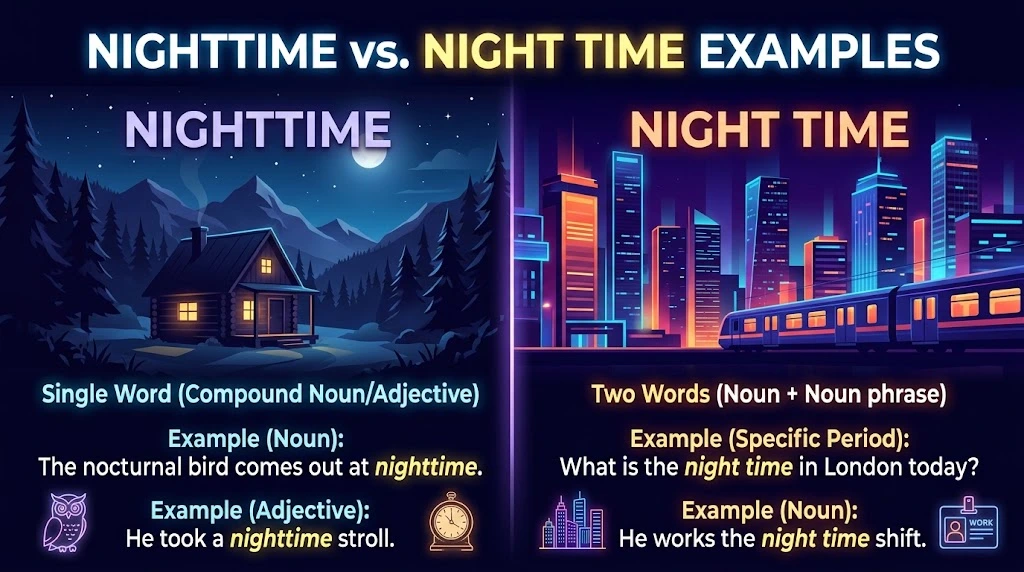
Examples make the distinction easier to remember.
Everyday Conversation
- “I don’t like driving at nighttime.”
- “The neighborhood is much quieter at nighttime.”
- “The kids have a nighttime routine.”
- “The temperature gets surprisingly low at nighttime.”
- “Some animals only come out at night.”
Notice that night often sounds more natural in casual speech.
That’s completely fine.
You don’t need to replace every instance of night with nighttime.
Academic and Professional Writing
Professional writing often uses nighttime when a writer needs a precise category.
For example:
“The study compared daytime and nighttime temperatures.”
Here, daytime and nighttime form a neat semantic pair.
Another example:
“Researchers recorded nighttime activity among several nocturnal species.”
The compound works particularly well when it modifies another noun.
Creative Writing and Literature
Creative writing allows more flexibility.
A novelist might choose night, nighttime, after dark, in the night, or another expression based on rhythm and mood.
For example:
“By nighttime, the old house had fallen silent.”
This sounds different from:
“By night, the old house seemed abandoned.”
The grammar isn’t the only factor. Word choice affects atmosphere.
That’s why good writing isn’t simply a hunt for the shortest dictionary-approved form.
A Practical Nighttime vs. Night Time Usage Table
| Expression | Recommended in US English? | Meaning |
| nighttime | Yes | Standard compound referring to the period of night |
| night time | Usually not preferred for this meaning | Separate words |
| night-time | Style-dependent | Hyphenated variant |
| at nighttime | Yes | During the nighttime period |
| during nighttime | Yes, though sometimes less natural than “during the night” | Throughout the nighttime period |
| nighttime hours | Yes | Hours associated with night |
| nighttime routine | Yes | A routine performed at night |
| nighttime activities | Yes | Activities occurring at night |
| overnight | Yes | Happening or lasting through the night |
| at night | Yes | Very common everyday expression |
Read More :MK Meaning: What It Means in Text and Online Slang
A Simple Rule to Remember
Here’s the easiest rule:
If you’re referring to the period associated with night, use “nighttime” in modern US English.
Think of it like daytime.
You naturally write:
“The daytime temperature was high.”
You don’t normally need to write day time.
The same compound pattern applies to:
“The nighttime temperature was low.”
This simple parallel makes the spelling easier to remember:
daytime ↔ nighttime
Both are established closed compounds.
A Quick Editing Test
When you’re unsure about nighttime vs. night time, ask yourself:
- Am I referring to the period of night?
- Am I using the word as an established compound?
- Am I writing in modern US English?
- Does my publication have a specific style guide?
- Am I actually talking about overnight or midnight instead?
If you’re naming the general nighttime period, nighttime is usually the right answer.
Frequently Asked Questions About Nighttime vs. Night Time
Is it “nighttime” or “night time”?
Nighttime is the standard one-word form in modern US English when referring to the period of night. Major American dictionary sources such as Cambridge and Merriam-Webster recognize it as a noun.
Is “nighttime” one word?
Yes. Nighttime is a closed compound word.
It combines night and time into one established lexical unit.
Is “night time” grammatically wrong?
Not necessarily in every context. However, when you’re simply referring to the period of night, nighttime is the standard choice for modern US English.
Is “night-time” correct?
Yes, night-time is an established spelling, particularly in British English and certain editorial styles. Oxford Advanced Learner’s Dictionary lists night-time as its headword.
For general US English, however, nighttime is usually the better choice.
What part of speech is “nighttime”?
Nighttime is primarily a noun. Cambridge explicitly classifies it as a noun.
It can also appear before another noun as an attributive modifier, as in nighttime routine or nighttime temperatures.
Can “nighttime” be used as an adjective?
In phrases such as nighttime activities, it modifies another noun. Some dictionaries recognize adjective use, while others primarily classify the word as a noun. Merriam-Webster’s entry includes an adjective definition in its Kids Definition.
For ordinary grammar analysis, it’s often clearest to describe nighttime as a noun functioning attributively when it appears before another noun.
What is the difference between nighttime and night?
Night is the broader and more common word. Nighttime specifically emphasizes the period associated with darkness or night.
For example:
- “I work at night.”
- “Nighttime temperatures can be surprisingly low.”
Both are correct, but they have slightly different uses and emphasis.
What is the difference between nighttime and overnight?
Nighttime identifies a period.
Overnight usually describes something that happens or continues throughout the night.
For example:
- “Nighttime is quiet here.”
- “The storm caused overnight damage.”
Is “nighttime” more common in American English?
The closed spelling nighttime is well established in American English dictionaries. Cambridge’s American Dictionary lists it as a noun, while Merriam-Webster also has a dedicated nighttime entry.
What are synonyms for nighttime?
Depending on context, possible alternatives include:
- night
- dark
- darkness
- night hours
- hours of darkness
- nightfall
- evening
- overnight — in some contexts, though it isn’t a direct synonym
- nocturnal period — more specialized
Merriam-Webster’s thesaurus lists related terms including night, dark, midnight, evening, dusk, darkness, nightfall, twilight, and gloaming.
Final Verdict: Nighttime or Night Time?
When choosing between nighttime vs. night time, modern US English makes the decision fairly simple.
Nighttime is the standard closed compound when you mean the period of night.
It appears naturally in phrases such as:
- nighttime routine
- nighttime activities
- nighttime temperatures
- nighttime driving
- nighttime wildlife
- nighttime photography
- nighttime hours
Major dictionary sources support the word. Cambridge defines nighttime as the time when it is dark, while Merriam-Webster lists it as a noun and traces its first known use to the 14th century.
The spelling night-time is also legitimate in certain varieties and style systems. Oxford Advanced Learner’s Dictionary, for instance, uses the hyphenated form.
As for night time, don’t treat it as a universal grammatical disaster. English compounds have complicated histories, and separate-word constructions can appear in particular contexts. Still, if you’re writing ordinary modern American English and you’re simply naming the period when it is dark, nighttime is the clear default.
The easiest memory trick is this:
Daytime is one word. Nighttime is one word.
Once that pattern sticks, the nighttime vs. night time question becomes much less mysterious.