
If you’ve ever paused over hassle vs. hastle, you’re not alone. The two spellings look close enough to cause a quick second guess, especially because English contains plenty of words with unexpected letter combinations.
The answer, however, is straightforward: hassle is the standard spelling when you mean a problem, inconvenience, annoyance, argument, or unwanted bother. Hastle is generally a misspelling of hassle in standard English.
That distinction matters because hassle is a common word in everyday American English. You can use it as both a noun and a verb, and it appears in expressions such as a hassle, avoid the hassle, not worth the hassle, hassle-free, and stop hassling me. Major dictionaries recognize these uses.
This guide explains the spelling difference, the meaning of hassle, its grammatical forms, common expressions, etymology, examples, and the easiest ways to remember the correct spelling.
Hassle vs. Hastle: What’s the Correct Spelling?
The correct spelling is hassle.
The word contains two s’s and no t:
H-A-S-S-L-E
By contrast:
H-A-S-T-L-E
is generally incorrect when the intended meaning is trouble, inconvenience, annoyance, or bother.
| Spelling | Standard word? | Meaning |
| hassle | Yes | Trouble, inconvenience, annoyance, argument, or unwanted bother |
| hastle | No, in this intended sense | Usually a misspelling of hassle |
For example:
- Correct: The paperwork is such a hassle.
- Incorrect: The paperwork is such a hastle.
The correct form also works as a verb:
- Correct: Stop hassling me about it.
- Incorrect: Stop hastling me about it.
Cambridge defines hassle as a difficulty, trouble, or situation that causes difficulty. As a verb, it means to annoy someone, particularly by repeatedly asking them for something.
Why Is “Hassle” Correct?
English spelling doesn’t always provide an obvious clue about pronunciation. Still, once you know the established spelling, there’s no standard spelling rule that turns hassle into hastle.
The dictionary form is hassle. Its common grammatical forms include hassles, hassled, and hassling. Merriam-Webster lists the noun and verb separately and gives the first known use of the noun as 1945.
So if you’re writing an email, essay, article, report, or social media post, choose hassle.
Why Do People Spell “Hassle” as “Hastle”?
The mistake makes sense once you look at how people learn and remember words. English spelling often depends on visual memory rather than pronunciation alone.
Phonetic Confusion
When spoken naturally, hassle can sound like a compact two-syllable word. The middle ss doesn’t necessarily feel prominent to someone who has only heard the word.
That can lead a listener to reconstruct the spelling incorrectly.
Someone might hear the word and mentally produce something closer to has-tle. Once that spelling takes root, it can feel perfectly reasonable even though it isn’t the standard form.
Familiar English Word Patterns
English contains many words with st sequences:
- castle
- whistle
- hustle
- fasten
- listen
That visual familiarity can influence spelling guesses.
A person who remembers the general sound but not the exact spelling might unconsciously insert t because st is a familiar English letter pattern.
The problem is that spelling by sound alone doesn’t always work in English.
Typing Errors
Sometimes the explanation is much less complicated.
You simply type the wrong letter.
When someone writes quickly, the fingers can produce an extra t or substitute it for another consonant. If the writer doesn’t reread the sentence, the error remains.
This becomes more likely when:
- You’re typing quickly.
- You’re using a phone keyboard.
- You rarely write the word.
- You’re distracted.
- You rely heavily on predictive text.
Autocorrect and Spell-Checker Effects
Technology can also muddy the waters.
A spell-checker may flag an unusual word without explaining why. Predictive keyboards can make unexpected suggestions. In other cases, users become accustomed to seeing strange spellings in messages and posts.
Still, automated suggestions aren’t a substitute for a dictionary.
When accuracy matters, hassle is the spelling to use.
Repeated Online Misspellings
A spelling mistake can become visually familiar when you see it often.
Suppose someone repeatedly encounters hastle in comments, forums, or informal posts. After enough exposure, the incorrect version may stop looking wrong.
That phenomenon is one reason spelling mistakes can spread.
Search results don’t automatically validate a spelling. Social media posts don’t either. A standard dictionary is a much better authority for deciding whether a word belongs in formal writing.
What Does “Hassle” Mean?
Hassle has several closely related meanings.
As a noun, it can refer to a difficulty, inconvenience, annoyance, argument, or troublesome situation. As a verb, it means to annoy, bother, pressure, argue with, or repeatedly trouble someone.
The exact meaning depends on context.
Consider these sentences:
- The paperwork is a hassle.
- Traveling during the holiday season can be a hassle.
- Stop hassling me about the money.
- The two men got into a hassle over the parking space.
The first three examples focus on inconvenience or unwanted pressure. The last one uses an older but still recognized sense involving an argument or physical confrontation. Merriam-Webster includes meanings such as argument, fight, confusion, turmoil, and an annoying or troublesome concern.
Hassle as a Noun
As a noun, hassle usually describes something that creates unnecessary difficulty or irritation.
For example:
Getting a refund turned into a huge hassle.
The sentence doesn’t necessarily mean the refund was impossible. It means the process became frustrating, complicated, or inconvenient.
That distinction is important.
A problem can be serious. A hassle often emphasizes how irritating or inconvenient the problem is.
You might say:
- “My car broke down.”
That’s a problem.
You might say:
- “Getting the car towed was such a hassle.”
That emphasizes the effort and frustration surrounding the problem.
Hassle as a Verb
As a verb, hassle means to bother, annoy, pressure, or repeatedly trouble someone.
For example:
The salesperson kept hassling me to buy the extended warranty.
Here, hassling describes repeated unwanted pressure.
Cambridge specifically notes the use of hassle for annoying someone, especially through repeated requests.
Hassle vs. Similar Words
Although hassle has many synonyms, they aren’t interchangeable in every sentence.
| Word | Main idea | Typical tone |
| Hassle | Annoying difficulty or inconvenience | Informal |
| Trouble | Difficulty or problems in general | Neutral |
| Inconvenience | Something that disrupts comfort or plans | More formal |
| Annoyance | Something that irritates you | Neutral |
| Nuisance | Something persistently bothersome | Neutral |
| Problem | Something that needs solving | Very broad |
| Harass | Repeatedly bother, pressure, or intimidate | Stronger |
For example, you could say:
The airport security process was a hassle.
You could make the sentence more formal:
The airport security process was an inconvenience.
Both work. The first sounds more conversational.
How to Use “Hassle” as a Noun
The noun form is especially common in everyday English.
“A Hassle”
Use a hassle when you’re talking about one particular annoying situation.
- Finding parking was a hassle.
- Moving to a new apartment can be a hassle.
- Returning the damaged product became a hassle.
- Setting up the new system was a hassle.
The phrase often suggests that something requires more effort than it should.
“The Hassle”
Use the hassle when both the speaker and listener understand the troublesome situation being discussed.
- I don’t want to deal with the hassle.
- The convenience isn’t worth the hassle.
- We avoided the hassle by booking online.
“A Lot of Hassle”
This phrase emphasizes the amount of difficulty involved.
Moving all that furniture was a lot of hassle.
You’ll also hear the plural:
We had to deal with several hassles during the trip.
“Not Worth the Hassle”
This is one of the most useful expressions with hassle.
It means that the expected benefit isn’t large enough to justify the inconvenience.
For example:
The discount was only five dollars, so it wasn’t worth the hassle.
The phrase works because hassle focuses on the effort involved rather than the problem itself.
“Without the Hassle”
This expression highlights convenience.
You can renew your membership online without the hassle of visiting the office.
Businesses use this wording frequently because customers generally want fewer steps, fewer delays, and less effort.
How to Use “Hassle” as a Verb
The verb is also common, especially in informal conversation.
“Hassle Someone”
The simplest pattern is:
hassle + person
Examples:
- Don’t hassle your brother.
- The reporters hassled the actor.
- The children kept hassling their parents.
- Customers shouldn’t have to hassle employees for basic information.
The exact tone depends on context.
Sometimes hassle means mild annoyance. In other situations, it can suggest persistent unwanted pressure.
“Hassle Someone About Something”
Another useful pattern is:
hassle + someone + about + something
Examples:
- My manager keeps hassling me about the report.
- They hassled him about the missing payment.
- She kept hassling her brother about cleaning his room.
This construction usually suggests repeated pressure.
“Hassling”
When hassle takes the -ing ending, the spelling becomes hassling, not hasseling.
Compare:
- hassle → hassling
- hassle → hassled
- hassle → hassles
Cambridge lists hassling as the present participle and hassled as the past form.
Hassle vs. Harass: Are They the Same?
These words overlap, but they aren’t identical.
Hassle often sounds lighter and more conversational.
My friends keep hassling me about getting a new phone.
Harass can describe more serious, persistent, or threatening behavior.
The employee reported that a coworker had been harassing her.
You shouldn’t automatically replace harass with hassle in serious contexts.
Likewise, hassle is often the better choice when you simply mean inconvenience:
Getting a parking permit is such a hassle.
Calling the permit process “harassment” would change the meaning considerably.
Hassle in American English: Tone and Register
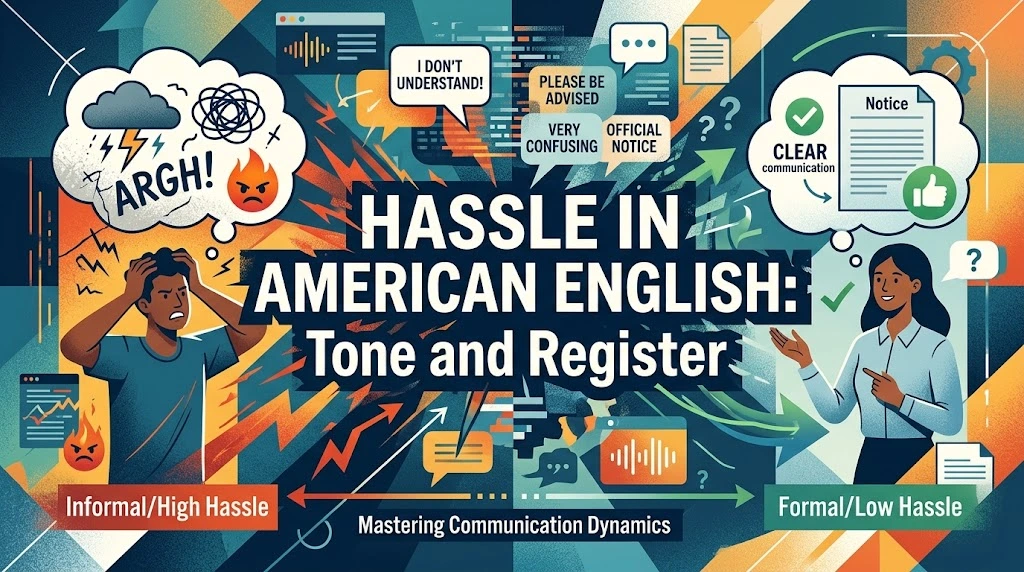
Hassle is an informal word.
That doesn’t mean it’s incorrect or unsuitable for all writing. It simply means that it has a conversational quality.
It fits naturally in:
- Everyday conversations
- Blogs
- Consumer articles
- Reviews
- Marketing copy
- Informal emails
- General-interest writing
- Casual business communication
For highly formal documents, another word may sometimes fit better.
For example:
Conversational:
The application process is a hassle.
More formal:
The application process creates unnecessary inconvenience.
The second sentence sounds more institutional. The first sounds like something a person would naturally say.
Hassle-Free and Other Common Expressions
The word appears in several fixed or semi-fixed expressions.
Hassle-Free
Hassle-free means involving little or no difficulty, inconvenience, or trouble.
Examples include:
- hassle-free returns
- hassle-free installation
- hassle-free booking
- hassle-free cancellation
- hassle-free payment
- hassle-free service
A company might advertise:
Enjoy hassle-free returns within 30 days.
The phrase tells the customer that the process should be simple.
Avoid the Hassle
Order online to avoid the hassle of waiting in line.
This expression focuses on preventing inconvenience.
Not Worth the Hassle
Saving two dollars isn’t worth the hassle.
This means the effort or annoyance outweighs the benefit.
Give Someone Hassle
In informal English, especially in some varieties of British English, give someone hassle can mean to bother or annoy them.
Cambridge includes examples of give someone hassle and get hassle among common uses.
Hassle vs. Hastle in Real Sentences
Seeing the words inside actual sentences makes the distinction easier to remember.
Correct Examples With “Hassle”
- The paperwork was a hassle.
- Finding a parking space became a hassle.
- I don’t want the hassle of moving again.
- The return process was more trouble than it was worth.
- Traveling with three children can be a hassle.
- We found a way to avoid the hassle.
- The new system takes away much of the hassle.
- It wasn’t worth the hassle for such a small discount.
- All the extra forms created unnecessary hassle.
- The airport delays caused several hassles.
Incorrect “Hastle” Examples
These sentences contain the common spelling mistake:
- ❌ The paperwork was a hastle.
- ❌ Parking downtown is such a hastle.
- ❌ I don’t want the hastle of returning it.
- ❌ It wasn’t worth the hastle.
- ❌ Stop hastling me.
The corrected versions are:
- ✅ The paperwork was a hassle.
- ✅ Parking downtown is such a hassle.
- ✅ I don’t want the hassle of returning it.
- ✅ It wasn’t worth the hassle.
- ✅ Stop hassling me.
Common Grammar and Usage Mistakes With “Hassle”
Mistake: Writing “Hastle”
This is the most obvious error.
Remember:
Hassle = H-A-S-S-L-E
There is no T.
Mistake: Using the Wrong Verb Form
Because hassle ends in -le, learners sometimes hesitate when adding endings.
The standard forms are:
| Form | Example |
| Base form | hassle |
| Third-person singular | hassles |
| Past tense | hassled |
| Present participle | hassling |
| Past participle | hassled |
For example:
She hassles me about my schedule.
She hassled me yesterday.
She is hassling me again.
Mistake: Confusing “Hassle” With “Problem”
The two words overlap, but hassle carries a particular feeling.
A problem may be serious, minor, technical, financial, or personal.
A hassle usually emphasizes annoyance, inconvenience, effort, or unwanted trouble.
That difference gives your writing more precision.
How to Remember the Spelling “Hassle”
Spelling becomes easier when you attach the word to a simple mental image.
Remember the Double S
The most reliable visual trick is simple:
Ha + ss + le
The middle contains SS.
If you’re tempted to type hastle, stop and look for the missing double S.
Remember: “No T in Hassle”
This is even simpler:
Hassle has no T.
That quick reminder directly targets the common error.
Connect It With “Hassle-Free”
If you already know the phrase hassle-free, use it as your spelling anchor.
Write:
- hassle
- hassle-free
- hassle-free service
- hassle-free returns
The repeated visual pattern reinforces the correct spelling.
Use Common Phrases
Instead of memorizing the word in isolation, learn it inside phrases:
- a hassle
- the hassle
- no hassle
- less hassle
- avoid the hassle
- not worth the hassle
- hassle-free
Phrase-based learning gives you a stronger memory hook.
Where Did the Word “Hassle” Come From?
The history of hassle is surprisingly modern compared with many everyday English words.
Merriam-Webster gives 1945 as the first known use of hassle as a noun and 1951 for its verb use. Its etymology section says the word may be a blend of harass and hustle.
The Online Etymology Dictionary gives a different set of possibilities. It records hassle in American English in 1945 and notes possible connections with a Southern dialect word meaning to pant or breathe noisily or with an older word related to harassing. The exact origin remains uncertain.
That uncertainty is worth highlighting.
There Is No Simple, Certain Origin Story
It can be tempting to claim that hassle definitely came from one particular older word. The evidence doesn’t support such certainty.
The responsible explanation is that the word appeared in American English in the 1940s and its precise etymological origin remains debated.
That makes hassle an interesting example of how modern informal vocabulary can emerge without leaving a perfectly clear paper trail.
How the Meaning Developed
Modern dictionaries preserve several senses.
Merriam-Webster includes meanings involving arguments and fights as well as confusion, turmoil, and an annoying or troublesome concern.
Today, however, the everyday sense most readers encounter is usually the annoying difficulty or inconvenience sense.
The verb developed from the noun. Merriam-Webster dates the verb to 1951.
Hassle in Everyday Life
The word works especially well when something isn’t necessarily disastrous but is irritating enough to make you wish it were easier.
Travel
Travel provides endless examples:
- Airport security
- Flight delays
- Lost luggage
- Long lines
- Complicated transfers
- Parking
- Hotel check-in
- Travel paperwork
You might say:
Finding parking near the airport was a huge hassle.
The word captures both the practical difficulty and the frustration.
Shopping
Shopping creates another natural setting for hassle.
Returning the shoes was a hassle.
The shoes may have been inexpensive. The return policy may simply have required too many steps.
Technology
Technology can produce plenty of everyday hassles:
- Password resets
- Software updates
- Account verification
- Broken connections
- Complicated settings
- Repeated login requests
For example:
Setting up the new printer was more of a hassle than expected.
Work
At work, hassle often describes unnecessary administrative effort.
Filling out three forms for a simple request is a hassle.
The sentence doesn’t necessarily criticize the entire organization. It highlights the annoying process.
Hassle in Business and Marketing

Businesses understand the emotional appeal of hassle-free language.
Customers generally want products and services that require less effort. That’s why phrases such as hassle-free returns and hassle-free installation appear so often in consumer writing.
Why “Hassle-Free” Works
The phrase promises more than convenience.
It suggests:
- Fewer steps
- Less waiting
- Less paperwork
- Fewer complications
- Easier decisions
- Lower frustration
Consider the difference:
Easy returns.
and:
Hassle-free returns.
The second phrase creates a stronger emotional contrast. It suggests that returning a product won’t become a drawn-out headache.
Formal Alternatives
In a formal report, you might replace hassle with:
- inconvenience
- administrative burden
- complication
- difficulty
- unnecessary effort
- procedural complexity
For example:
Casual:
The process is a hassle.
Professional:
The process creates unnecessary administrative burden.
Neither is universally better. The right choice depends on your audience and tone.
Read More : WSG Meaning: What It Means in Text & Slang
Hassle vs. Related Expressions
Hassle vs. Trouble
Trouble is broader.
We had trouble finding the address.
This could describe genuine difficulty.
Finding the address was a hassle.
This emphasizes the inconvenience involved.
Hassle vs. Inconvenience
Inconvenience sounds more formal.
We apologize for the inconvenience.
This phrase is common in customer-service and institutional communication.
You would rarely replace it with:
We apologize for the hassle.
That sentence is possible in a friendly brand voice, but the register changes.
Hassle vs. Nuisance
A nuisance is something that causes annoyance or inconvenience.
The constant notifications are a nuisance.
A hassle often focuses more strongly on the effort required to deal with something.
Turning off all those notifications is a hassle.
Hassle vs. Problem
A problem is the broadest option.
The payment failed. That’s a problem.
A hassle focuses on the experience surrounding the difficulty:
Fixing the failed payment was a hassle.
The distinction is subtle but useful.
Realistic Usage Scenarios
Scenario: Returning an Online Purchase
Imagine ordering a jacket online. The jacket doesn’t fit, but the retailer requires you to print a form, visit a shipping center, and wait several weeks for a refund.
You could say:
Returning the jacket was a hassle.
The jacket itself isn’t the hassle. The return process is.
Scenario: Traveling During a Busy Weekend
A traveler arrives at the airport and encounters a long security line, a delayed flight, and a gate change.
A natural description would be:
The whole trip was a hassle.
Here, the word summarizes a collection of small difficulties.
Scenario: Workplace Administration
Suppose an employee needs one simple document approved. Instead, the request requires multiple forms and several signatures.
The employee might say:
Getting the approval was such a hassle.
Again, the word captures unnecessary effort and frustration.
Scenario: Repeated Requests
A friend repeatedly asks you to lend them money.
You might say:
Stop hassling me about it.
Here, hassle shifts from an inconvenient situation to repeated unwanted pressure.
Hassle Sentence Examples
Noun Examples
- The paperwork was a hassle.
- Parking downtown is always a hassle.
- I don’t need the hassle of changing hotels.
- The return process was more of a hassle than expected.
- We had several hassles during the trip.
- It wasn’t worth the hassle.
- The new system removed much of the hassle.
- Moving can be a major hassle.
- I want to avoid the hassle of waiting in line.
- Dealing with the paperwork was a real hassle.
Verb Examples
- Stop hassling me about my decision.
- The children kept hassling their parents for another toy.
- The reporter hassled the actor with repeated questions.
- Don’t hassle the customer over a minor issue.
- My coworkers have been hassling me about the deadline.
- He felt that the salesperson was hassling him.
- They kept hassling us for an answer.
- She doesn’t like being hassled while shopping.
Hassle-Free Examples
- The company offers hassle-free returns.
- We provide hassle-free installation.
- Booking online makes the process hassle-free.
- Customers want a hassle-free experience.
- The new system makes payment almost hassle-free.
Case Study: Customer Service Hassle
Consider a customer who receives the wrong product.
The initial mistake is a problem. The complicated return process becomes the hassle.
The customer has to contact support, wait for a response, print a shipping label, visit a courier office, and then wait for a refund.
A natural summary would be:
The wrong item was a problem, but getting it replaced was a hassle.
That sentence demonstrates the difference between the two words particularly well.
Case Study: Travel Hassle
Imagine a traveler with a connecting flight.
The first flight arrives late. The passenger must rush across the terminal, find the new gate, and wait for another security check.
Nothing catastrophic has happened. Still, the experience is frustrating.
The connection was a hassle.
That’s exactly the kind of everyday inconvenience the word describes.
Case Study: Workplace Hassle
Imagine a workplace that requires employees to submit separate forms for tasks that could be completed through one digital request.
An employee might say:
The approval process is such a hassle.
A formal report might instead say:
The approval process creates unnecessary administrative work.
The meaning is similar. The register differs.
Quick Spelling Test: Hassle or Hastle?
Choose the correct spelling in each sentence.
The paperwork was a major ______.
- A. hastle
- B. hassle
Answer: B. hassle
I don’t want the ______ of returning it.
- A. hassle
- B. hastle
Answer: A. hassle
Stop ______ me about the deadline.
- A. hastling
- B. hassling
Answer: B. hassling
The company promises ______-free service.
- A. hassle
- B. hastle
Answer: A. hassle
The key pattern is consistent:
H-A-S-S-L-E
No T.
Hassle vs. Hastle: Quick Facts
| Fact | Answer |
| Correct spelling | Hassle |
| Common incorrect spelling | Hastle |
| Part of speech | Noun and verb |
| Noun meaning | Difficulty, inconvenience, annoyance, argument, or troublesome situation |
| Verb meaning | To annoy, bother, pressure, or repeatedly trouble |
| Common adjective | Hassle-free |
| Past tense | Hassled |
| Present participle | Hassling |
| Plural noun | Hassles |
| First known noun use | 1945 |
| First known verb use | 1951 |
| Register | Generally informal |
Merriam-Webster dates the first known noun use to 1945 and the verb to 1951.
Frequently Asked Questions About Hassle vs. Hastle
Is “hastle” a real English word?
Hastle is generally not the standard spelling when you mean hassle. In ordinary English writing, use hassle for a difficulty, inconvenience, annoyance, or unwanted bother.
A word appearing in an online post doesn’t automatically establish it as standard English.
Is “hassle” or “hastle” correct?
Hassle is correct.
The standard spelling is:
H-A-S-S-L-E
There is no T.
What does “hassle” mean?
As a noun, hassle means an annoying difficulty, inconvenience, troublesome situation, argument, or similar problem.
As a verb, it means to annoy, bother, pressure, or repeatedly trouble someone.
Why do people confuse “hassle” and “hastle”?
The confusion probably comes from a combination of pronunciation, spelling expectations, typing mistakes, and repeated exposure to incorrect forms.
The words look close, but only hassle is the standard spelling for the intended meaning.
Is “hassle” a noun or a verb?
It can be both.
As a noun:
The paperwork is a hassle.
As a verb:
Stop hassling me.
What is the plural of “hassle”?
The plural is hassles.
For example:
We encountered several hassles during our trip.
What are the past and present forms of “hassle”?
The main forms are:
- hassle
- hassles
- hassled
- hassling
For example:
She hassled me yesterday.
She is hassling me again.
Cambridge lists hassling as the present participle and hassled as the past tense and past participle.
What does “hassle-free” mean?
Hassle-free means involving little or no trouble, inconvenience, or unwanted difficulty.
For example:
The website offers hassle-free returns.
The phrase commonly appears in advertising and customer-service language.
Is “hassle” formal or informal?
Hassle is generally informal.
It’s perfectly normal in conversation and everyday writing. In a highly formal report, words such as inconvenience, difficulty, or administrative burden may fit better.
What is another word for “hassle”?
The best synonym depends on the context.
Possible alternatives include:
- trouble
- inconvenience
- annoyance
- nuisance
- problem
- difficulty
- complication
- bother
- burden
However, these words don’t have exactly the same meaning or tone.
Conclusion: Hassle vs. Hastle
When choosing between hassle vs. hastle, the answer is simple: hassle is the correct standard spelling.
The word contains double S and no T:
H-A-S-S-L-E
Hassle can function as both a noun and a verb. As a noun, it describes an annoying difficulty, inconvenience, troublesome situation, argument, or unwanted problem. As a verb, it means to bother, annoy, pressure, or repeatedly trouble someone.
The word also appears in useful expressions such as hassle-free, avoid the hassle, not worth the hassle, and without the hassle.
Its history is relatively recent. Merriam-Webster dates the first known noun use to 1945 and the verb use to 1951. Its precise origin remains uncertain, although one proposed explanation connects it with harass and hustle.
So the next time you hesitate, remember the simplest rule:
Hassle has double S. Hassle has no T.
That’s all you need to keep hastle out of your writing.