
If you’ve ever paused before writing “What happen?” or “What happened?”, you’re not alone. The two phrases look almost identical. Yet that small -ed ending changes the tense and can completely change whether the sentence works grammatically.
For most questions about an event that already took place, the correct expression is “What happened?”
For example:
What happened at the meeting?
What happened to your phone?
What happened after the storm?
The reason isn’t simply that happened sounds more natural. It has a specific grammatical job: happened is the simple past form of happen. Cambridge Dictionary identifies happened as both the past simple and past participle of happen.
However, there’s an important detail that often gets missed. “Happen” isn’t an incorrect word. In fact, it’s perfectly correct in many structures:
- What will happen next?
- What can happen if we ignore the warning?
- What might happen tomorrow?
- What did happen at the party?
- What happens when the temperature drops?
So the real question isn’t simply whether you should use happen or happened. The better question is:
What tense or grammatical structure does the sentence require?
Let’s break it down clearly.
What Is the Difference Between “What Happen” and “What Happened”?
The simplest distinction is grammatical tense.
Happen is the base form of the verb. Happened is its simple past form. The verb happen means that an event or situation occurs or comes into existence.
Consider these examples:
| Expression | Verb form | Meaning |
| What happen? | Base form | Usually incorrect as a standalone question |
| What happened? | Simple past | Asks about a completed past event |
| What happens? | Present form | Asks about a general, repeated, or current situation |
| What will happen? | Future | Asks about a future event |
| What can happen? | Modal + base form | Asks about possibility |
| What did happen? | Auxiliary + base form | Usually adds emphasis to a past question |
This distinction becomes much easier once you stop treating happen and happened as interchangeable vocabulary choices.
They aren’t.
The form of the verb tells the reader when or under what conditions the event occurs.
A quick comparison
Past:
What happened last night?
Present or general:
What happens when you press this button?
Future:
What will happen tomorrow?
Possibility:
What could happen if we leave early?
The same basic idea appears in all four sentences. The verb structure changes because the meaning changes.
Why “What Happened?” Is Usually the Correct Question
When someone asks “What happened?”, they normally want information about an event that has already occurred.
Maybe your friend looks upset.
You might ask:
What happened?
Perhaps a computer suddenly stopped working.
You could ask:
What happened to the computer?
Or maybe you arrive at a meeting after an argument has taken place.
You might say:
What happened here?
In each case, the speaker is asking about something that has already occurred. The simple past happened therefore fits naturally.
Cambridge provides examples using happened for completed events and situations, including questions about accidents and events that occurred suddenly.
Why does “What happen?” sound incomplete?
The problem is that happen by itself is the base form. In a normal standalone question about a completed event, English needs a past-tense form.
Compare:
❌ What happen yesterday?
✓ What happened yesterday?
The first sentence gives no grammatical signal that the event occurred in the past.
The second sentence does.
That’s why the difference may look tiny on the page while sounding significant in a complete sentence.
Understanding the Verb “Happen”
Before looking deeper into the grammar, it helps to understand what happen actually means.
Happen is an intransitive verb. In its most common sense, it means to occur or take place. Cambridge also notes that it commonly describes something occurring by chance.
For example:
- An accident happened yesterday.
- Something strange happened at work.
- Problems sometimes happen unexpectedly.
- What will happen next?
- Anything could happen.
Because happen is intransitive, you don’t normally use it with a direct object in the same way you use verbs such as eat, write, or build.
You can say:
The accident happened.
You can also say:
The accident happened to Maria.
But you wouldn’t normally say:
Maria happened the accident.
That structure doesn’t work because happen describes an event occurring rather than someone directly performing the event.
Forms of “happen”
| Verb form | Example |
| Base form | happen |
| Present, third-person singular | happens |
| Simple past | happened |
| Past participle | happened |
| Present participle | happening |
The regular -ed ending creates both the simple past and past participle forms:
happen → happened
That’s why “What happened?” works when the question concerns a completed event.
Why “What Happen?” Is Incorrect as a Standalone Past-Event Question
The phrase “What happen?” is usually incorrect when you’re asking about something that already occurred.
For example:
❌ What happen at school yesterday?
✓ What happened at school yesterday?
The word yesterday makes the past time especially clear. The verb must match that time reference.
Here’s another example:
❌ What happen to your car?
✓ What happened to your car?
The second sentence asks about a past event affecting the car.
However, it’s important not to turn this into an overly simple rule such as “Never use what happen.” That rule would be wrong.
The base form happen becomes completely correct when another word controls the verb structure.
For example:
What will happen?
What can happen?
What might happen?
What did happen?
The auxiliary or modal verb changes the structure.
That distinction is one of the most important points in understanding “what happen” vs. “what happened.”
When “Happen” Is Actually Correct After “What”
The phrase “what happen” can appear correctly when happen follows an auxiliary or modal verb that requires the base form.
This is where many simplified grammar explanations fall short.
“What Will Happen?”
When talking about the future, use:
What will happen?
For example:
What will happen if the company raises its prices?
What will happen after the test?
What will happen next?
After the modal auxiliary will, English uses the base form:
will + happen
Not:
❌ will happened
The same principle applies to many other modal structures.
“What Can Happen?”
Use can + happen to discuss possibility.
What can happen if you don’t back up your files?
What can happen during a severe storm?
What can happen when the battery overheats?
Here, can carries the modal meaning. The following verb remains in its base form.
“What Could Happen?”
Could often discusses possible outcomes or hypothetical situations.
What could happen if we cancel the project?
What could happen during the next stage?
What could happen if the temperature rises?
Again, happen remains in the base form because it follows the modal could.
“What Might Happen?”
Might expresses possibility.
What might happen if nobody responds?
What might happen after the deadline?
What might happen during the next few hours?
The structure is:
what + might + happen
Not:
❌ What might happened?
“What Did Happen?”
Here’s another interesting structure.
You can say:
What did happen?
This is grammatically correct.
Why?
Because did carries the past tense. After did, the main verb returns to its base form.
Compare:
What happened?
What did happen?
Both can refer to a past event. However, the second version often adds emphasis, surprise, correction, or contrast.
For example:
“You said nothing went wrong.”
“That’s not true. What did happen?”
The speaker isn’t simply asking for information. The speaker is emphasizing the question.
This creates a useful contrast:
What happened? → ordinary past question
What did happen? → emphatic past question
“What Happened?” vs. “What Happens?” vs. “What Will Happen?”
These three questions look similar but refer to different time frames.
| Question | Time or meaning | Example |
| What happened? | Completed past event | What happened yesterday? |
| What happens? | General, habitual, or present situation | What happens when the alarm rings? |
| What will happen? | Future event | What will happen tomorrow? |
| What might happen? | Possible future event | What might happen if we delay? |
| What happened? | Past result/event | What happened after the call? |
“What happened?”
Use it when you want to know about something that occurred.
What happened at the airport?
“What happens?”
Use it when discussing what normally occurs or what occurs under certain conditions.
What happens when you restart the computer?
This doesn’t necessarily ask about one particular past event. It asks about a process or general outcome.
“What will happen?”
Use it for the future.
What will happen if the weather gets worse?
The difference is straightforward once you identify the time reference.
Past → happened
General/present → happens
Future → will happen
Subject Questions vs. Questions With “Did”
Understanding subject questions makes “What happened?” much easier.
In “What happened?”, the word what functions as the subject of the verb.
Think of the underlying idea:
Something happened.
Now replace something with what:
What happened?
That’s why you don’t need did in the ordinary version.
Compare this with:
You saw something.
If you ask about the object, you get:
What did you see?
Here, you is the subject and what is the object.
The structures are different.
Subject question
Something happened.
→ What happened?
Object question
You saw something.
→ What did you see?
This difference explains why “What happened?” doesn’t need the auxiliary did.
Why “What did happen?” is still possible
The emphatic version changes the focus.
What did happen?
The auxiliary did carries the past tense while happen stays in its base form.
This follows a common English pattern:
did + base verb
For example:
- Did you go?
- Did she call?
- Did they leave?
- What did happen?
Not:
- ❌ Did you went?
- ❌ Did she called?
- ❌ Did they left?
- ❌ What did happened?
The rule is consistent.
Common Structures With “What Happened”
Once you understand the basic form, you’ll notice what happened in many everyday expressions.
“What Happened to…?”
This asks about an event affecting someone or something.
What happened to your old laptop?
What happened to Sarah?
What happened to the restaurant?
Cambridge specifically recognizes the construction happen to someone or something, where an event affects that person or thing.
The phrase can sometimes carry concern or surprise.
For example:
What happened to your jacket?
This could mean the speaker notices that the jacket is torn, dirty, missing, or otherwise different.
“What Happened When…?”
This asks about a particular point in a sequence.
What happened when you arrived?
What happened when the lights went out?
What happened when the manager called?
It’s especially useful when discussing stories, incidents, experiments, or personal experiences.
“What Happened After…?”
This focuses on the next event.
What happened after the meeting?
What happened after the police arrived?
What happened after you pressed the button?
“What Happened Before…?”
This asks about an earlier event.
What happened before the accident?
What happened before everyone left?
These structures are common because happened anchors the question in a past sequence.
“What Happened” in Direct and Indirect Questions
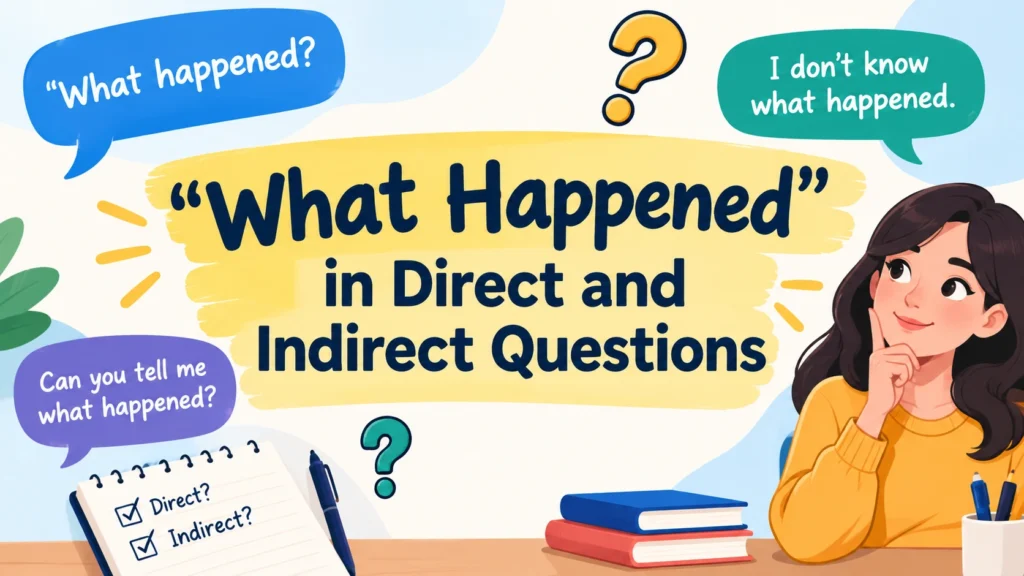
The expression remains correct when the question becomes part of a longer sentence.
Direct question:
What happened?
Indirect question:
I don’t know what happened.
Another example:
Can you tell me what happened?
Notice something important.
The indirect question doesn’t become:
❌ I don’t know what did happen.
In ordinary indirect questions, English normally uses statement word order rather than direct-question inversion.
Compare:
What happened?
and:
I don’t know what happened.
The structure remains clear because what is still the subject of happened.
More examples
She explained what happened.
Nobody knows what happened.
We need to understand what happened.
Tell me what happened after lunch.
These sentences all use what happened naturally.
Common Mistakes With “What Happen”
The following mistakes appear frequently because learners often focus on the meaning rather than the grammatical structure.
Mistake: “What happen yesterday?”
Correct:
What happened yesterday?
The event occurred in the past.
Mistake: “What happen to him?”
Correct:
What happened to him?
If you’re asking about something that already affected him, use the past form.
Mistake: “What happen last night?”
Correct:
What happened last night?
The phrase last night establishes a completed past time.
Mistake: “What did happened?”
Correct:
What did happen?
The auxiliary did already marks the past. The main verb must return to its base form.
Mistake: “What will happened?”
Correct:
What will happen?
The modal will requires the base form.
Mistake: “What can happened?”
Correct:
What can happen?
Again, can is followed by the base form.
Mistake: “What happen every Friday?”
Correct:
What happens every Friday?
This sentence describes a regular occurrence. The present-tense third-person singular form happens is appropriate.
Real-Life Examples: Correct vs. Incorrect Usage
A comparison table makes the pattern easier to recognize.
| Incorrect | Correct | Why? |
| What happen yesterday? | What happened yesterday? | Past event |
| What happen last night? | What happened last night? | Past event |
| What happen to your phone? | What happened to your phone? | Past event affecting the phone |
| What did happened? | What did happen? | Did takes the base form |
| What will happened? | What will happen? | Will takes the base form |
| What can happened? | What can happen? | Can takes the base form |
| What might happened? | What might happen? | Might takes the base form |
| What happen every morning? | What happens every morning? | General/repeated action |
| I don’t know what did happen. | I don’t know what happened. | Normal indirect-question structure |
| What happened next? | What happened next? | Correct past question |
Notice the bigger lesson: you shouldn’t simply replace every occurrence of “happen” with “happened.”
Sometimes happen is exactly right.
Case Study: Asking About an Accident
Imagine a car accident occurred outside a store.
A witness arrives afterward.
The natural question is:
What happened?
The witness describes the event:
A driver lost control and hit a parked car.
Now imagine you’re discussing a possible future situation:
What will happen if the road freezes?
The answer might involve road conditions, traffic delays, or safety risks.
The word happen remains unchanged because will establishes the future structure.
Now imagine you’re discussing possibility:
What could happen if the driver loses control?
Again, could + happen is correct.
Three questions. Three meanings:
- What happened? → past event
- What will happen? → future possibility or prediction
- What could happen? → hypothetical possibility
The verb changes because the time and grammatical structure change.
Case Study: Workplace Conversations
Imagine an employee returns to the office and notices that an important meeting has ended.
The employee asks:
What happened?
A coworker explains:
The client arrived early, so the manager started the meeting without you.
Later, the employee asks about the next meeting:
What will happen if the client cancels?
A manager answers:
We might move the presentation to Friday.
Now consider a general workplace process:
What happens when a customer submits a complaint?
That question isn’t about one completed incident. It’s about the usual procedure.
The three forms serve different purposes:
| Situation | Natural question |
| One completed incident | What happened? |
| Standard procedure | What happens? |
| Future possibility | What will happen? |
This pattern appears everywhere, from casual conversations to formal workplace communication.
Why Native Speakers Sometimes Seem to Say “What Happen”
Spoken English can make grammar harder to hear than written English.
People speak quickly. Sounds connect. Words get reduced. Speakers may also restart sentences or leave phrases unfinished.
For example, someone might begin:
“What happen—”
and then immediately correct themselves:
“What happened?”
That doesn’t make “What happen?” the standard form for a completed past question.
Speech also contains regional accents and informal patterns. What you hear may not always map neatly onto the spelling you would use in formal writing.
For professional emails, school assignments, reports, articles, and other edited writing, use the standard grammatical structure.
A Simple Decision Rule for “Happen” or “Happened”
When you’re unsure, don’t stare at the two words in isolation.
Look at the entire sentence.
Ask yourself these questions:
Did the event already happen?
Use happened.
What happened yesterday?
Is the event happening generally or repeatedly?
Use happens.
What happens when the machine overheats?
Are you talking about the future?
Use will happen.
What will happen next?
Are you discussing possibility?
Use a modal + happen.
What could happen?
What might happen?
What can happen?
Does “did” already appear?
Use the base form happen.
What did happen?
Is “happen” part of an indirect question?
Choose the form according to the meaning.
I don’t know what happened.
I don’t know what will happen.
I don’t know what might happen.
This approach is much more reliable than memorizing one isolated rule.
Read More :
A Quick Grammar Diagram
Think of the sentence as a timeline.
PAST
↓
What happened?
↓
A completed event
PRESENT / GENERAL
↓
What happens?
↓
A regular, typical, or current process
FUTURE
↓
What will happen?
↓
An expected future event
POSSIBILITY
↓
What could/might/can happen?
↓
A possible event
EMPHATIC PAST
↓
What did happen?
↓
A past event with emphasis
This simple diagram captures the main distinction.
How to Avoid the “What Happen” Mistake
You don’t need to memorize dozens of complicated grammar rules. A few habits can make the distinction automatic.
Identify the time first
Before choosing the verb, ask:
Past, present, or future?
If you’re asking about something that already occurred, happened will often be the right choice.
Look for auxiliary verbs
Words such as will, can, could, may, might, and did affect the form of the following verb.
For example:
will + happen
can + happen
might + happen
did + happen
The base form follows these auxiliaries and modals.
Don’t add “did” unnecessarily
Many learners assume every past question needs did.
That’s not true.
Compare:
What happened?
with:
What did you see?
The first is a subject question. The second asks about an object.
Practice contrasts instead of isolated words
Instead of memorizing happen = present and happened = past, practice complete patterns:
What happened?
What happens?
What will happen?
What could happen?
What did happen?
This builds a stronger grammatical instinct.
Read More : Linchpin vs. Lynchpin: The Real Difference, Correct Spelling, Meaning, and Examples
Facts About “Happen” Worth Remembering
A few details make the word easier to understand.
- Happen is a verb.
- It is commonly used to mean occur.
- It is an intransitive verb in its ordinary use.
- Happened is its simple past and past participle form.
- Happens is the third-person singular present form.
- Happening is the present participle.
- Modal verbs such as can, could, may, might, and will are followed by the base form.
- Did is followed by the base form in standard questions.
- What happened? normally asks about a completed event.
- What happens? commonly asks about a general or repeated situation.
- What will happen? asks about the future.
- What could happen? asks about a possible outcome.
Cambridge’s grammar guidance describes happen as meaning “occur” and gives examples such as “What will happen if it rains?” and “Will someone tell me what’s happened?”
Common Questions About “What Happen” vs. “What Happened”
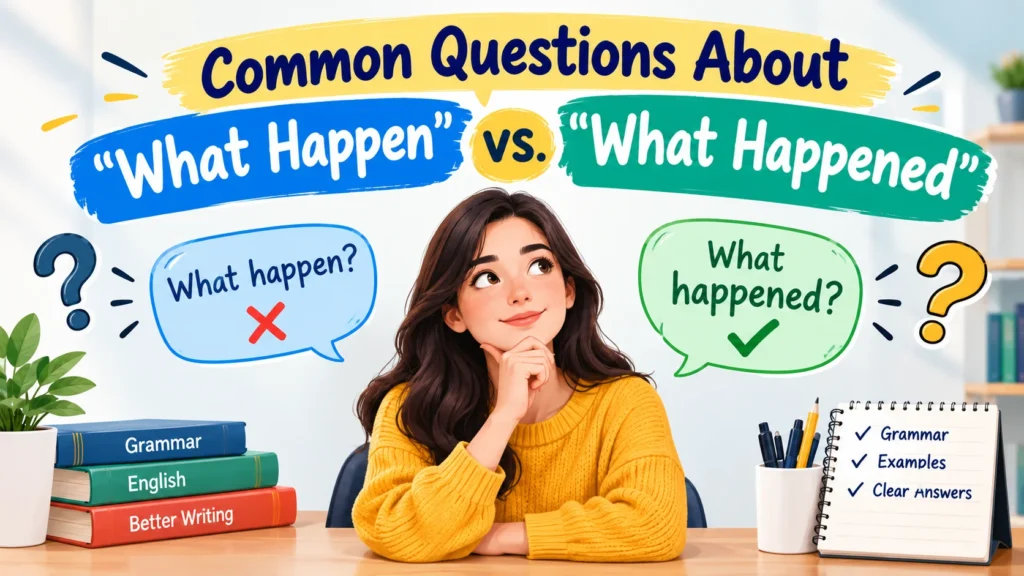
Is “What happen?” grammatically correct?
Not as a normal standalone question about a completed past event.
The standard form is:
What happened?
However, happen can absolutely be correct after auxiliary or modal verbs:
What will happen?
What can happen?
What might happen?
What did happen?
So calling what happen universally incorrect would oversimplify the grammar.
Should I say “What happened?” or “What happen?”
If you’re asking about an event that already occurred, use:
What happened?
For example:
What happened at the office?
What happened after the game?
What happened to your computer?
Why is “What happen?” incorrect for a past event?
Because happen is the base form while happened marks the simple past.
If the question refers to a completed event, the verb needs to fit that past-time meaning.
❌ What happen yesterday?
✓ What happened yesterday?
The problem isn’t the word what. It’s the verb form.
Can “What happen” ever be correct?
Yes, when the grammar requires the base form.
Examples include:
What will happen?
What can happen?
What could happen?
What might happen?
What did happen?
In these sentences, another verb or modal carries the grammatical information that allows happen to remain in its base form.
Is “What happens?” correct?
Yes.
What happens? commonly asks about something that occurs regularly, generally, or under a particular condition.
For example:
What happens when you restart the computer?
This asks about a process or result rather than necessarily asking about one completed past event.
Is “What will happen?” correct?
Yes.
Use what will happen when asking about the future.
What will happen if we miss the deadline?
What will happen next?
What will happen after the meeting?
The modal will is followed by the base form happen.
What’s the difference between “What happened?” and “What did happen?”
Both can refer to the past.
What happened? is the ordinary form.
What did happen? adds emphasis and can be used when correcting information, expressing surprise, or insisting on an explanation.
For example:
“Nothing unusual happened.”
“Then what did happen?”
The second question has stronger emphasis.
How can I remember whether to use “happen” or “happened”?
Use this compact rule:
Past event → happened
Modal or auxiliary + base verb → happen
General present → happens
So:
What happened?
What will happen?
What could happen?
What happens?
Once you see the structure, the choice becomes much easier.
Final Takeaway: “What Happen” or “What Happened”?
The correct choice depends on tense and sentence structure, not simply on the word what.
When you’re asking about a completed event, use:
What happened?
When you’re asking about a general or repeated situation, use:
What happens?
When you’re asking about the future, use:
What will happen?
When you’re asking about possibility, use:
What could happen?
And when did already carries the past tense, use the base form:
What did happen?
The biggest mistake is treating “what happen” as automatically wrong in every context. It isn’t. The base form happen is completely grammatical after modal and auxiliary verbs in the right structures.
The better rule is simple:
Past event: “What happened?”
General situation: “What happens?”
Future: “What will happen?”
Possibility: “What could/might/can happen?”
Emphatic past: “What did happen?”
Once you understand that pattern, the confusion between “what happen” and “what happened” largely disappears. You aren’t memorizing an arbitrary spelling choice. You’re matching the verb form to the grammar and meaning of the sentence.