
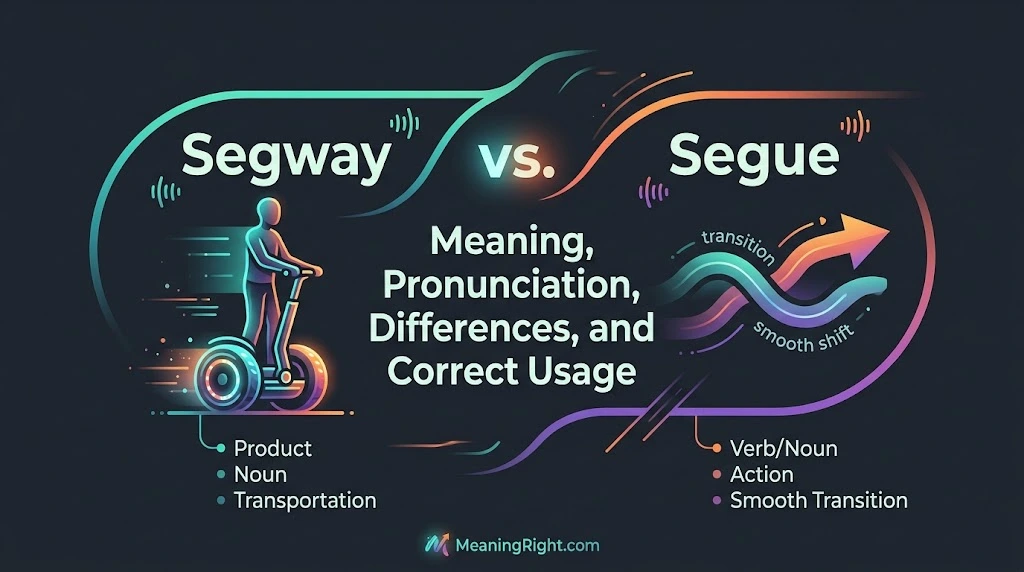
Have you ever written Segway when you actually meant segue? You’re not alone. The confusion between Segway vs. Segue is surprisingly common because both words are pronounced almost exactly the same way: “SEG-way.” However, their meanings, uses, and grammatical roles are completely different.
Segway is primarily associated with a personal transportation device made by the Segway company. It is a brand name and is normally capitalized. On the other hand, segue is an English word that means a smooth transition from one subject, idea, scene, or activity to another. You’ll often see it in writing, public speaking, presentations, conversations, music, and film.
Understanding the difference between these two commonly confused words can help you avoid an embarrassing spelling mistake in professional or academic writing. The pronunciation can make the distinction tricky, but the meaning provides a useful clue.
In this guide, we’ll explore Segway meaning, segue meaning, Segway pronunciation, segue pronunciation, correct spelling, word usage, grammar, and common English language mistakes. You’ll also see clear examples showing when to use Segway and when segue is the correct choice.
By the end, remembering the difference should be easy: Segway relates to a vehicle, while segue means a smooth transition.
What Does “Segue” Mean?
The word segue describes a smooth movement from one thing to another. Most often, it refers to moving from one topic, idea, section, activity, or subject to another without an abrupt break.
For example:
“The presenter used the customer’s complaint as a segue into a discussion about product quality.”
Here, the complaint creates a natural bridge to the next subject.
Segue can function as both a noun and a verb, which makes it especially useful in professional and conversational English.
The Definition of Segue
As a noun, segue means a smooth transition.
“Her question provided a natural segue into the next part of the presentation.”
As a verb, segue means to move smoothly from one subject, activity, or section to another.
“The speaker segued from the company’s history into its plans for the future.”
The central idea remains the same in both cases: one thing follows another in a connected or smooth way.
A segue doesn’t necessarily mean that two subjects are identical. Instead, there is usually some logical, thematic, or conversational connection between them.
How “Segue” Works in English
When segue functions as a verb, English speakers commonly use it with prepositions such as into, from, and sometimes to.
Examples include:
- “The discussion segued into a debate about pricing.”
- “She segued from marketing into customer retention.”
- “The interview segued into a conversation about education.”
- “The presentation segued from background information to practical examples.”
The word can also appear as a noun with modifiers such as natural, smooth, easy, or perfect.
For example:
- “That was a natural segue into the next topic.”
- “The question created a smooth segue into the conclusion.”
- “His joke provided the perfect segue to the next segment.”
The word works particularly well when you’re describing a deliberate connection between two parts of a conversation or presentation.
Segue vs. Transition
Segue and transition overlap in meaning, but they aren’t always interchangeable in tone.
Transition is the broader and more common word. It can describe almost any movement or change from one state, stage, place, or subject to another.
Segue usually emphasizes a smooth connection between two things.
| Word | Main idea | Example |
| Segue | A smooth or connected shift | “That question was a good segue into the next topic.” |
| Transition | A change or movement from one thing to another | “The transition between sections was clear.” |
You can think of a transition as the general category and a segue as a particularly smooth or connected transition.
Where Did “Segue” Come From?
The unusual spelling of segue makes much more sense when you look at its history.
Italian Origins of “Segue”
English borrowed segue from Italian. The Italian verb seguire means “to follow,” and segue is a form of that verb meaning roughly “follows” or “it follows.”
The English musical use developed from the idea that one musical passage should follow another smoothly.
That history explains why the English spelling looks unusual to many readers. It isn’t an English word built according to ordinary modern spelling patterns. Its form reflects its Italian origin.
The concept of following smoothly also explains its modern figurative meaning.
When someone says:
“That segues nicely into our next point.”
the underlying idea is that one subject follows naturally from another.
How the Meaning Developed in English
The term became associated with music before expanding into broader communication.
In musical contexts, a performer could move directly from one section into another without a noticeable interruption. English speakers later extended the idea beyond music.
Today, segue can describe transitions in:
- Conversations
- Presentations
- Interviews
- Articles
- Essays
- Podcasts
- Television programs
- Speeches
- Meetings
- Music
The meaning remains remarkably consistent: one thing leads smoothly into another.
How Do You Pronounce “Segue”?
One reason Segway vs. segue causes so many mistakes is simple: the words sound alike.
In standard American English, segue is pronounced like “SEG-way.”
That means:
- segue → sounds like “Segway”
- Segway → sounds like “Segway”
The pronunciation doesn’t tell you which spelling you need.
The Correct Pronunciation of “Segue”
You can think of the pronunciation as:
SEG-way
The first syllable sounds like seg, followed by way.
The pronunciation can seem surprising when you first encounter the written word. Someone who sees segue without hearing it may try to pronounce every letter individually.
That’s not how English treats the word.
Why “Segue” and “Segway” Sound the Same
The confusion isn’t caused by sloppy pronunciation. The two words genuinely have the same pronunciation in ordinary American English.
That’s what makes this pair different from many spelling mistakes.
Consider these examples:
“Let’s segue into the next subject.”
and:
“We took a Segway tour through the city.”
When spoken aloud, the crucial distinction disappears. Only the context reveals which word the speaker means.
This creates an important writing lesson:
Some spelling differences cannot be solved by listening. You have to know the meaning.
What Is a “Segway”?
A Segway is a brand name associated with self-balancing personal transportation devices.
Unlike segue, which is an ordinary English word, Segway is a proper name.
The distinction is important because capitalization carries meaning.
Segway as a Brand Name
The Segway personal transporter became widely known in the early 2000s. The original device used two wheels arranged side by side and a self-balancing system that allowed the rider to control movement by shifting body weight.
The company introduced the product as a new form of personal mobility.
The name Segway was deliberately chosen to sound like segue, which reflects the idea of moving from one place to another.
That branding choice arguably helped create the modern spelling confusion. The brand’s name sounds exactly like the established English word segue.
What a Segway Device Is
The original Segway Personal Transporter was a two-wheeled, self-balancing electric vehicle.
Rather than sitting inside it like a car, the rider stood upright on a platform between the wheels.
The system used sensors and electronic controls to maintain balance and respond to the rider’s movements.
In simplified terms:
- Lean forward → move forward.
- Lean backward → slow down or move backward.
- Turn the handlebar or control system → change direction.
Modern personal mobility products have evolved considerably since the original Segway appeared. However, the brand remains strongly associated with the two-wheeled transporter that made it famous.
The History of the Segway
The Segway became one of the most heavily discussed consumer technology products of its era.
How the Segway Was Introduced
The original Segway was developed by inventor Dean Kamen and his team.
It was introduced publicly in 2001 after considerable anticipation.
The product attracted extraordinary media attention because it represented a novel approach to personal transportation. Rather than functioning like a conventional bicycle, motorcycle, or scooter, it relied on electronic self-balancing technology.
The machine itself was technically interesting, but its cultural reputation grew even larger because of the expectations surrounding it.
What People Expected
Before the product became widely available, some media coverage presented the invention as potentially transformative.
The excitement went beyond simply introducing another vehicle. Some reports and commentators imagined that self-balancing personal transporters might change how people moved through cities.
That level of anticipation created a difficult benchmark.
A product doesn’t need to be unsuccessful simply because it doesn’t transform an entire industry. However, the Segway became a famous example of the gap that can exist between technological novelty and widespread adoption.
What Actually Happened
The Segway found practical uses, particularly in tourism, security, policing, property management, and other settings where short-distance mobility was useful.
However, it did not replace cars, bicycles, or public transportation on the scale that some early commentary had imagined.
The Segway became much more recognizable as a specialized mobility product and cultural icon than as a universal replacement for existing transportation.
That history also produced an interesting linguistic side effect: the brand name became so recognizable that people sometimes used Segway when they actually meant the unrelated word segue.
Key Facts About the Segway Device
Several facts help distinguish Segway from the ordinary word segue.
| Fact | Segway |
| Type | Personal mobility device/brand |
| Famous original design | Two-wheeled, self-balancing transporter |
| Publicly introduced | 2001 |
| Associated with | Personal transportation and mobility |
| Name type | Brand/proper name |
| Pronunciation | Same as “segue” |
| Meaning | A physical product, not a conversational transition |
The distinction is straightforward once you focus on the subject.
If someone says:
“The guide rode a Segway through the historic district.”
they’re talking about transportation.
If someone says:
“The guide used the history of the district as a segue into the next topic.”
they’re talking about communication.
The pronunciation stays the same. The meaning changes completely.
Where People See Segways Today
Although the original Segway did not become a universal replacement for everyday transportation, Segway-branded devices have appeared in several practical settings.
Common Modern Uses
Depending on the product and location, Segway-style or Segway-branded devices may be associated with:
- Guided city tours
- Tourist attractions
- Large properties
- Security operations
- Patrol activities
- Warehouses and facilities
- Recreational use
- Personal mobility
Tour companies have especially helped make the word Segway familiar to the public.
You may have seen advertisements for a “Segway tour” in a major tourist destination. In that phrase, Segway is absolutely correct because the company is referring to the vehicle.
Segue vs. Segway: The Core Differences
The easiest way to understand Segway vs. segue is to put the two words side by side.
| Feature | Segue | Segway |
| Meaning | Smooth transition | Brand associated with personal transporters |
| Word type | Common English word | Proper name/brand |
| Typical role | Noun or verb | Noun |
| Capitalization | Usually lowercase | Usually capitalized |
| Pronunciation | “SEG-way” | “SEG-way” |
| Used in conversation? | Yes | Yes |
| Used in writing? | Yes | Yes |
| Connected with ideas? | Yes | No |
| Connected with transportation? | No | Yes |
Here’s the simplest distinction:
A segue connects ideas. A Segway carries people.
That single sentence can eliminate most confusion.
Why People Confuse “Segue” and “Segway”
The spelling problem has several causes.
Identical Pronunciation
This is the biggest factor.
If you’ve only heard the word segue, you might reasonably assume it’s spelled Segway.
After all, English contains plenty of words whose spelling is difficult to predict from pronunciation.
The Unusual Spelling of “Segue”
The spelling segue doesn’t look intuitive to many English speakers.
The sequence -gue appears in other English words, but the entire spelling isn’t immediately obvious from the pronunciation.
When someone hears “SEG-way,” the spelling Segway feels natural because the letters appear to represent the sounds directly.
Unfortunately, that’s the wrong spelling when you’re talking about a transition.
Familiarity With the Segway Brand
The brand Segway is visually memorable.
People have encountered the name in news stories, advertisements, travel websites, videos, and tourism businesses. That familiarity can make Segway the first spelling that comes to mind.
Ironically, the brand name itself was designed to echo the word segue.
Common “Segue” Spelling and Usage Mistakes
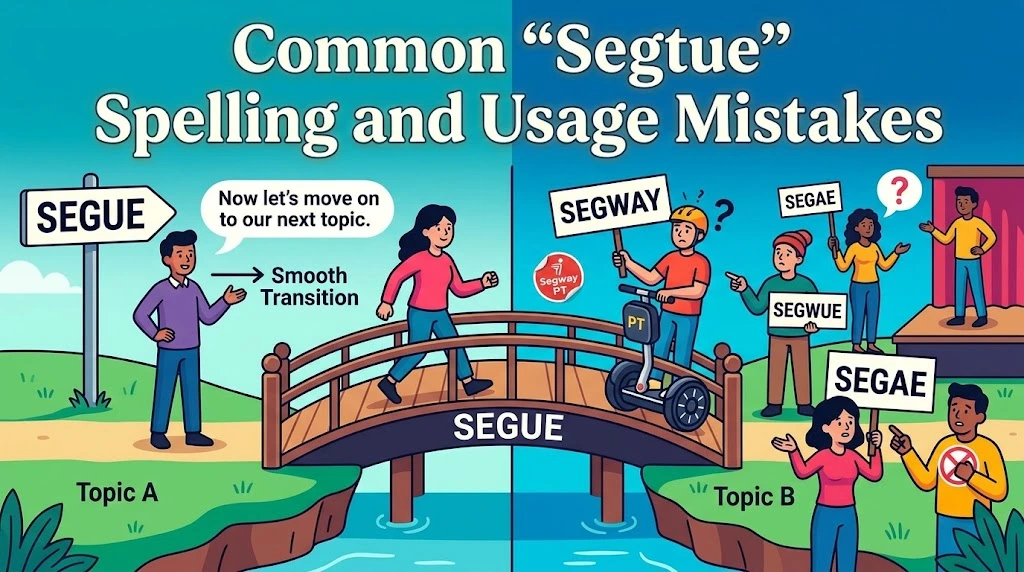
Using “Segway” for a Transition
This is the most common mistake.
Incorrect:
“Let’s segway into the next part of the presentation.”
Correct:
“Let’s segue into the next part of the presentation.”
The second sentence uses segue because the speaker is moving from one subject to another.
Treating “Segue” Only as a Noun
Some writers know segue as a noun but don’t realize it also functions as a verb.
Both are correct.
Noun:
“That story was a useful segue into the discussion.”
Verb:
“The speaker segued into the discussion.”
The verb form changes according to tense:
- Present: segue
- Third-person singular: segues
- Past: segued
- Present participle: segueing
For example:
“The host segued into the final question.”
Confusing a Topic Change With a Segue
Not every topic change is a segue.
If someone suddenly jumps from discussing tax policy to talking about their favorite pizza without any connection, calling it a smooth segue would be misleading.
A segue generally implies some relationship or logical bridge.
For example:
“Since we’re discussing customer satisfaction, let’s look at our support response times.”
That’s a clear conversational connection.
The second subject follows naturally from the first.
How to Use “Segue” Correctly
Using segue well isn’t only about spelling it correctly. The surrounding sentence should also make sense.
Using “Segue” as a Verb
The verb form is useful when describing the act of moving between topics.
Examples:
“The interviewer segued from the candidate’s education to her professional experience.”
“After discussing the problem, the manager segued into possible solutions.”
“The article segues from basic grammar rules into advanced examples.”
Notice that each sentence describes a movement between subjects.
Using “Segue” as a Noun
The noun form describes the transition itself.
Examples:
“That question created a natural segue into the next section.”
“The anecdote provided a perfect segue to the main argument.”
“The host found an easy segue from sports into business.”
This structure is especially common in presentations, interviews, articles, and public speaking.
Using “Segue” in Professional Communication
In professional settings, segue can be useful because it describes a smooth rhetorical connection in a concise way.
For example:
“That brings us to our next point.”
is perfectly natural.
So is:
“That provides a natural segue into our next point.”
The first version is simpler. The second has a slightly more polished or rhetorical tone.
You shouldn’t force segue into every transition. Sometimes plain English works better.
If you’re writing for a broad audience, phrases such as “move to,” “turn to,” “next,” or “this leads us to” may sound more direct.
Segue in Writing vs. Speaking
Using “Segue” in Writing
Writers use segue when one part of a text leads naturally into another.
For example:
“The introduction establishes the problem. This provides a natural segue into the proposed solution.”
You might encounter the word in:
- Essays
- Editorials
- Business reports
- Magazine articles
- Speeches
- Scripts
- Presentations
- Books
It can be particularly useful when explaining the structure of an argument.
Using “Segue” in Conversation
The word also appears frequently in spoken English.
Imagine two coworkers discussing a project:
“We’ve talked about the design. That’s a good segue into the budget.”
The speaker isn’t talking about a vehicle. They’re using segue to signal that the current subject naturally leads to another one.
Another common phrase is:
“That’s a great segue into…”
This phrase is common in interviews, podcasts, presentations, and panel discussions.
Using “Segue” in Music
The musical sense is important because it connects directly to the word’s history.
A musical segue occurs when one piece, section, or movement leads directly into another.
For example:
“The band segued from the ballad into an upbeat song.”
Here, the transition happens through music rather than conversation.
That original musical sense helps explain why the word carries such a strong idea of continuity.
Real-World Examples of Segue
The best way to understand segue vs. Segway is to see the words operating in realistic sentences.
Correct Examples With “Segue”
Business meeting:
“That sales data gives us a good segue into next quarter’s strategy.”
Interview:
“The host used the guest’s childhood story as a segue into her career.”
Presentation:
“Now that we’ve discussed the problem, let’s segue into the proposed solution.”
Article:
“The final example creates a useful segue into the grammar rules.”
Podcast:
“That’s an interesting point and a perfect segue into our next question.”
Music:
“The pianist segued smoothly from the first movement into the second.”
Correct Examples With “Segway”
Tourism:
“The visitors joined a Segway tour of the historic district.”
Transportation:
“He learned how to operate a Segway during the tour.”
Brand reference:
“The company used Segway personal transporters for guided tours.”
In each case, Segway refers to the product or brand.
Before-and-After Examples of Segue Errors
| Incorrect | Correct | Why? |
| “Let’s segway into the next topic.” | “Let’s segue into the next topic.” | The sentence describes a topic transition. |
| “That was a great Segway into the issue.” | “That was a great segue into the issue.” | The word refers to a smooth connection. |
| “The speaker segwayed into the conclusion.” | “The speaker segued into the conclusion.” | Segued is the past-tense verb. |
| “We took a segue tour.” | “We took a Segway tour.” | The sentence refers to the vehicle. |
| “She rode a segue through the park.” | “She rode a Segway through the park.” | A person can ride the transportation device. |
These examples reveal an important point: context determines the spelling.
When “Segway” Is Actually Correct
It would be a mistake to treat Segway as an incorrect word.
It’s perfectly correct when you’re talking about the brand or its products.
Talking About the Vehicle
Examples include:
“We rented a Segway for the city tour.”
“The guide explained how the Segway works.”
“Several tourists were riding Segways through the area.”
Here, replacing Segway with segue would completely change the meaning.
Proper Names and Brand References
Because Segway functions as a brand name, capitalization matters.
Compare:
“The speaker made a smooth segue into the next topic.”
with:
“The tourists rode a Segway along the waterfront.”
The lowercase segue refers to an abstract transition.
The capitalized Segway refers to the brand.
A Quick Decision Guide: Segue or Segway?
When you’re unsure, don’t focus on pronunciation. Ask what the sentence means.
If You’re Talking About Ideas
Use segue.
“The presenter segued into the next topic.”
If You’re Talking About a Vehicle
Use Segway.
“The visitors rode Segways around the city.”
If You’re Talking About a Smooth Transition
Use segue.
“That question provides a natural segue into the final section.”
If You’re Talking About the Brand
Use Segway.
“The tour company offers Segway experiences.”
A useful mental test is this:
Can the thing in your sentence carry a person?
If yes and you’re referring to the personal transporter, Segway may be the word you need.
If you’re describing a movement between ideas, subjects, or activities, choose segue.
Read More : Drove vs. Driven: The Complete Guide to Using These Words Correctly
A Simple Memory Trick for Segway vs. Segue
Try remembering this:
Segue connects. Segway transports.
Or make the contrast even more visual:
Ideas → segue → next idea
Person → Segway → next location
The spellings may be confusing, but the meanings are worlds apart.
Another useful trick is to associate segue with the phrase “smoothly follows.”
If one idea smoothly follows another, you’re probably dealing with a segue.
Case Study: A Spelling Error in a Professional Document

Imagine that a marketing manager prepares a presentation for a client.
The presentation contains this sentence:
“Now let’s segway into the customer retention strategy.”
At first glance, the mistake might go unnoticed. The sentence sounds perfectly natural when read aloud.
That’s exactly why the error is so persistent.
The Mistake
The writer chose segway because the word sounds like “SEG-way.”
However, the sentence doesn’t discuss transportation. It describes a transition from one business topic to another.
Therefore, the correct version is:
“Now let’s segue into the customer retention strategy.”
Why the Error Looks Plausible
Three factors make the mistake easy to understand:
- Segue and Segway sound alike.
- Segway looks more intuitive based on pronunciation.
- The brand name is widely recognized.
The writer hasn’t misunderstood the sentence’s meaning. The problem lies in matching the spoken sound with the correct written form.
The Correction
Once the meaning becomes the deciding factor, the answer is straightforward.
| Question | Answer |
| Is the sentence about transportation? | No |
| Is it about moving between ideas? | Yes |
| Is the word a brand name? | No |
| Correct spelling | segue |
This is why proofreading by sound alone isn’t enough.
Common Questions About Segue vs. Segway
Is “segue” pronounced like “Segway”?
Yes. In standard American English, segue is pronounced like “SEG-way.” That’s also why the spelling causes so much confusion.
What is the simplest definition of “segue”?
A segue is a smooth transition from one subject, idea, activity, or section to another.
For example:
“That question is a good segue into our next topic.”
Is “Segway” ever correct in writing?
Yes. Segway is correct when referring to the brand or its personal transportation products.
For example:
“The tourists took a Segway tour.”
Can “segue” be used as a noun?
Yes.
“That story provided a natural segue into the next topic.”
Here, segue is a noun because it names the transition.
Can “segue” be used as a verb?
Yes.
“The speaker segued into the next subject.”
Here, segue is a verb describing the action of moving smoothly between subjects.
Why is “segue” spelled that way?
Segue comes from Italian and is connected with the Italian verb seguire, meaning “to follow.” Its historical connection with music and smooth transitions also influenced its English meaning.
Is “segway” a correct spelling of “segue”?
When you’re referring to a transition, the standard spelling is segue, not segway.
Segway is the brand name associated with personal transportation devices.
What’s the difference between a segue and a transition?
A transition is a broad term for a change or movement from one thing to another. A segue usually emphasizes a smooth, connected movement between subjects or sections.
Why do people confuse segue and Segway?
The main reason is pronunciation. The two words sound the same in ordinary American English. Their meanings and spellings, however, are completely different.
Is “segue” formal or informal?
Segue can work in both professional and everyday communication. It’s especially common when discussing presentations, interviews, writing, music, or conversations.
That said, simpler alternatives such as “move to,” “turn to,” or “lead into” may sometimes sound more natural.
What is the plural of Segway?
When referring to multiple vehicles, Segways is the usual plural form.
For example:
“The tour company has several Segways available for customers.”
What is the past tense of segue?
The standard past tense is segued.
For example:
“The discussion segued into a debate about technology.”
The spelling may look strange, but segued is the normal past-tense form.
Segue vs. Segway: The Difference in One Table
| Segue | Segway |
| Means a smooth transition | Refers to a brand |
| Can be a noun | Typically used as a proper noun |
| Can be a verb | Refers to personal transportation products |
| Usually lowercase | Usually capitalized |
| Used with ideas and subjects | Used with vehicles and products |
| “The speaker segued into the next topic.” | “They rode a Segway.” |
| Connected to Italian seguire | Brand introduced its famous transporter in 2001 |
| Pronounced “SEG-way” | Pronounced “SEG-way” |
Final Tips for Remembering Segue vs. Segway
If the two spellings still blur together, keep these rules handy:
- Use segue for a transition.
- Use Segway for the brand or vehicle.
- Segue can be a noun or a verb.
- Segway is a proper name.
- Both words sound the same.
- Context determines which spelling you need.
- A segue connects ideas.
- A Segway transports people.
The most useful memory sentence is simple:
“A segue moves your conversation forward; a Segway moves you forward.”
Once you connect each spelling to its meaning, the confusion becomes much easier to avoid.
Conclusion
The difference between Segway vs. segue comes down to meaning, not pronunciation.
A segue is a smooth transition. You use it when one idea, subject, activity, section, or musical passage naturally leads into another. It can function as both a noun and a verb:
“That example provides a useful segue into the next topic.”
“The speaker segued into the final part of the presentation.”
A Segway, by contrast, is a brand name associated with personal transportation devices. When you see the capital S, you’re dealing with the brand rather than a conversational transition.
The tricky part is that both words sound the same. That’s why someone can know exactly what they want to say and still choose the wrong spelling.
When you’re writing, ignore the sound and focus on the meaning. If you’re moving from one idea to another, use “segue.” If you’re referring to the personal transporter or brand, use “Segway.”
Once that distinction sticks, Segway vs. segue becomes one of those English questions you won’t have to second-guess again.