
“Good morning” is simple, polite, and almost impossible to get wrong. Still, saying the same two words every day can feel a little repetitive.
Sometimes you want to sound casual with a friend. At other times, you need a polished greeting for a client, coworker, teacher, or manager. Maybe you want something warmer for someone you love. Or perhaps you simply want to start a conversation instead of offering a standard greeting.
That’s where other ways to say “good morning” become useful.
The best alternative depends on more than the time of day. Your relationship with the person, the setting, the communication channel, and the tone you want all matter. “Morning!” feels relaxed. “Hello” is more neutral. “Rise and shine!” is playful. “I hope your morning is going well” sounds thoughtful and professional.
There’s an important distinction, too. Not every alternative is a direct synonym for “good morning.” Some phrases greet someone. Others wish them well. A few invite further conversation.
This guide breaks down the most useful alternatives so you can choose the right expression without sounding forced.
What Does “Good Morning” Mean?
Simple Definition of “Good Morning”
“Good morning” is a polite greeting used when you meet or address someone during the morning.
Cambridge Dictionary describes it as something said to greet someone politely in the morning. Oxford similarly identifies it as a polite way to say hello when people first see each other in the morning.
The phrase can work in countless situations:
- Face-to-face conversations
- Workplace meetings
- Classrooms
- Phone calls
- Text messages
- Emails
- Customer service
- Group announcements
- Social gatherings
For example:
“Good morning, Sarah. How are you?”
The greeting itself is neutral. The rest of the sentence determines whether the message feels formal, friendly, warm, or casual.
Grammar and Usage of “Good Morning”
“Good morning” functions as an interjection or greeting rather than an ordinary statement about the quality of the morning.
You don’t normally mean that the morning itself has received a good grade. Instead, you’re using a conventional expression to greet someone.
The phrase consists of two separate words:
- Good
- Morning
When it begins a sentence or stands alone as a greeting, capitalize Good.
Examples:
- Good morning!
- Good morning, everyone.
- Good morning, David.
- She wished me a good morning.
When the phrase appears inside a sentence as a noun phrase, lowercase may be appropriate:
“He gave everyone a cheerful good morning.”
Punctuation also changes the feel slightly.
“Good morning!” sounds energetic or warm.
“Good morning.” can sound calm, formal, or even slightly cold depending on context.
That doesn’t mean the period is rude. Tone comes from the entire interaction.
When Does “Good Morning” Stop Being Appropriate?
“Good morning” belongs to the morning. That’s its biggest limitation.
If you meet someone at 2:00 p.m., “Good afternoon” is normally more natural. Later in the day, “Good evening” takes its place.
However, exact boundaries aren’t always rigid. People don’t suddenly switch greetings at one universal minute of the day.
Your location and the other person’s location can also matter in digital communication. A colleague in another country may be starting their day while you’re finishing yours.
For asynchronous email, a neutral greeting such as “Hello, Maria” can sometimes be safer because the recipient may read the message hours later.
When Should You Say “Good Morning”?
In Everyday Conversations
“Good morning” works naturally with people you see regularly.
You can use it with:
- Friends
- Family members
- Neighbors
- Coworkers
- Classmates
- Teachers
- Acquaintances
- Store employees
- Service workers
For example:
“Good morning, Mike. Did you sleep well?”
It’s polite without creating unnecessary distance.
At Work or School
In professional and educational settings, “good morning” is one of the safest greetings available.
A manager can say:
“Good morning, everyone. Let’s get started.”
A student can say:
“Good morning, Professor.”
A receptionist might say:
“Good morning. How can I help you?”
The phrase works because it doesn’t assume too much familiarity.
In Text Messages and Online Chats
Texting gives you more freedom.
You might send:
“Morning! How’s everything going?”
Or:
“Good morning 😊 Hope you slept well.”
With close friends, “Morning!” often sounds more natural than a carefully written “Good morning.”
The relationship determines the register.
In Emails
“Good morning” can work well in professional emails, particularly when you’re sending the message early in the recipient’s day.
For example:
Good morning, Jennifer.
I wanted to follow up on the proposal we discussed yesterday.
However, email creates a special problem: you don’t always know when someone will read your message.
If you’re sending an email late at night that someone may open the next afternoon, “Hello, Jennifer” can be more time-neutral.
For global teams, this matters even more.
Is “Good Morning” Professional and Polite?
Yes. “Good morning” is both polite and professional in most workplace situations.
Cambridge specifically describes the phrase as a polite morning greeting. Collins also classifies it as a conventional greeting used in the morning.
It’s particularly useful because it sits comfortably between stiff formality and excessive familiarity.
Compare these:
“Yo, Mike!”
“Good morning, Mike.”
“Greetings, esteemed colleague.”
The first may be too casual for some workplaces. The last sounds theatrical in ordinary business communication.
“Good morning” lands in the middle.
When “Good Morning” Sounds Too Formal
The phrase can feel slightly formal in a very casual relationship.
Imagine texting your best friend:
“Good morning, James. I hope this message finds you well.”
Technically, nothing is wrong with it. Socially, it sounds like you’re writing a business letter.
A simple:
“Morning!”
would probably feel more natural.
When “Good Morning” Is Better Than a Casual Greeting
The reverse is also true.
If you’re meeting a new client, greeting a senior colleague, or addressing a professional group, “Morning!” may sound too relaxed.
Compare:
“Morning, Mr. Carter.”
with:
“Good morning, Mr. Carter.”
The second option establishes more respectful distance.
How to Choose the Right Alternative to “Good Morning”
Choosing among other ways to say “good morning” becomes easier when you consider four things:
Who are you talking to?
A close friend gives you more freedom than a client.
Where are you talking?
A text message allows more informality than a formal presentation.
What tone do you want?
Warm, playful, professional, romantic, neutral, or energetic greetings create different impressions.
Do you want to start a conversation?
A simple greeting acknowledges someone. A question invites them to respond.
Here’s a quick guide:
| Situation | Good Choice |
| Close friend | “Morning!” |
| Coworker | “Good morning!” |
| Client | “Good morning, [Name].” |
| Group meeting | “Good morning, everyone.” |
| Casual text | “Hey!” |
| Friendly message | “Hi there!” |
| Romantic message | “Good morning, love.” |
| Conversation starter | “How’s your morning going?” |
| Professional email | “Good morning, [Name].” |
| General email | “Hello, [Name].” |
| Playful situation | “Rise and shine!” |
20+ Other Ways to Say “Good Morning”
Not every phrase below carries exactly the same meaning. That’s intentional.
Some are direct greetings. Some are good wishes. Others open the door to a conversation.
“Morning!”
“Morning!” is probably the easiest casual alternative to “good morning.”
Oxford lists “morning” as an informal greeting.
It feels quick, relaxed, and natural.
Example:
“Morning! How did the meeting go yesterday?”
Use it with:
- Friends
- Coworkers you know well
- Family
- Familiar acquaintances
Avoid it when you’re trying to create a particularly formal impression.
“Hello!”
“Hello” isn’t specifically a morning greeting. That’s exactly why it’s useful.
You can use it at almost any time of day.
Example:
“Hello, Mr. Wilson. It’s nice to see you.”
It works especially well when you’re unsure whether “good morning” still fits.
“Hi!”
“Hi!” is shorter and more casual than “hello.”
It’s ideal for:
- Friends
- Coworkers
- Classmates
- Casual emails
- Text messages
Example:
“Hi! Hope you’re doing well.”
If you don’t need to emphasize the time of day, “hi” is often enough.
“Hi There!”
“Hi there!” adds a little more warmth than a plain “hi.”
It’s friendly without becoming overly personal.
Example:
“Hi there! How’s your morning going?”
You might hear it in casual customer service interactions, friendly emails, and everyday conversations.
“Hey!”
“Hey!” is extremely casual.
It works best when you already have some familiarity with the person.
Example:
“Hey! Are you free for coffee this morning?”
It’s not necessarily rude. Context controls the tone.
A friendly “Hey!” can sound warm. A flat “Hey.” can sound annoyed or distant.
“Hey There!”
“Hey there!” combines the relaxed quality of “hey” with the friendliness of “there.”
Example:
“Hey there! Ready for breakfast?”
It’s especially natural in casual conversation.
“Good Day”
“Good day” is a legitimate greeting, but it isn’t a perfect replacement for “good morning.”
It’s broader and can sound more formal or old-fashioned in American English.
Example:
“Good day, everyone. Thank you for joining us.”
Use it when you deliberately want a formal or stylized tone.
For ordinary American workplace conversation, “Good morning” usually sounds more natural.
“Rise and Shine!”
“Rise and shine!” is cheerful and playful.
Cambridge defines it as a humorous expression used to tell someone to wake up and get out of bed.
That’s an important distinction.
It isn’t simply a polished substitute for “good morning.”
It’s more like saying:
“Wake up! Let’s get moving!”
Example:
“Rise and shine! Breakfast is ready.”
It works especially well with children, family members, close friends, or someone who has just woken up.
It may sound inappropriate in a formal office email.
“Top of the Morning!”
“Top of the morning!” is one of the most recognizable alternatives, but it deserves a warning label.
Cambridge identifies it as an Irish English expression that historically meant “good morning.” It also notes that the phrase is now generally used humorously when referring to Irish people.
So if you’re writing normal American English, don’t treat it as the everyday Irish equivalent of “good morning.”
Example:
“Top of the morning! Ready for your adventure?”
That works when you’re intentionally being playful.
In an ordinary professional email, however, “Good morning” is much safer.
“Have a Great Morning!”
This phrase shifts from greeting to good wish.
Instead of simply acknowledging someone, you’re wishing them a pleasant morning.
Example:
“Thanks for your help. Have a great morning!”
It’s especially useful when ending a conversation.
You can also use it in messages:
“Good luck with your presentation. Have a great morning!”
“Hope You’re Having a Great Morning”
This is warmer and more conversational than a standard greeting.
It works particularly well in email and workplace messaging.
Example:
“Hope you’re having a great morning. I wanted to ask about the updated schedule.”
The phrase shows consideration without becoming overly personal.
“Hope Your Morning Is Going Well”
This version sounds slightly more polished.
Example:
“Hi Daniel, I hope your morning is going well. Could you send me the revised document?”
It’s a useful choice when you want warmth without sounding overly cheerful.
“How’s Your Morning Going?”
This greeting does something “good morning” doesn’t do by itself.
It invites an answer.
Example:
“Hey, how’s your morning going?”
The person can respond with anything from “Great!” to “Honestly, it’s been hectic.”
That makes the phrase useful when you genuinely want to start a conversation.
“How’s Your Morning?”
This is a shorter version of the same idea.
It sounds natural in casual conversations and texts.
Example:
“How’s your morning?”
It’s direct without being intrusive.
“Wishing You a Wonderful Morning”
This phrase feels warmer and more deliberate.
Example:
“Wishing you a wonderful morning and a productive day ahead.”
It works well in:
- Personal messages
- Greeting cards
- Thoughtful notes
- Social media captions
- Warm professional communication
It isn’t as natural for a quick hallway greeting.
“Have a Wonderful Start to Your Day”
This phrase focuses on the beginning of someone’s day rather than the greeting itself.
Example:
“Thank you for taking the time to speak with me. Have a wonderful start to your day.”
It’s polished and positive.
“Wishing You a Bright Start to the Day”
This is more expressive than everyday speech.
Example:
“Wishing you a bright start to the day and plenty of success with your project.”
It’s best for thoughtful written messages rather than routine workplace greetings.
“What a Beautiful Morning!”
This isn’t technically a greeting.
Instead, it’s an expression of appreciation for the morning.
Example:
“What a beautiful morning! Let’s take the dogs for a walk.”
You can use it to create a conversation about the weather, scenery, or mood.
“A Beautiful Morning to You”
This is a warm and slightly poetic greeting.
Example:
“A beautiful morning to you! I hope everything goes smoothly today.”
It works better in personal or creative writing than standard business communication.
“Happy Morning!”
“Happy morning” is understandable, but it isn’t among the most natural everyday greetings in American English.
A native speaker would usually choose:
- “Good morning!”
- “Morning!”
- “Have a great morning!”
- “Hope you’re having a great morning!”
The distinction matters because grammatically possible doesn’t always mean idiomatic.
“Good Morning, Everyone!”
This is especially useful for groups.
Example:
“Good morning, everyone. Thanks for being here.”
It’s appropriate for:
- Meetings
- Presentations
- Classrooms
- Team chats
- Announcements
- Events
“Good Morning, Team!”
“Good morning, team!” combines a traditional greeting with a group-oriented address.
Example:
“Good morning, team! Let’s review today’s priorities.”
It sounds professional while still feeling friendly.
“Good Morning, [Name]”
Sometimes the best alternative isn’t replacing “good morning” at all.
Adding the person’s name makes the greeting more personal.
Example:
“Good morning, Olivia.”
The name creates a sense of direct attention.
In professional communication, this format is often stronger than using an unusual synonym simply to avoid repetition.
Best Alternatives to “Good Morning” by Situation
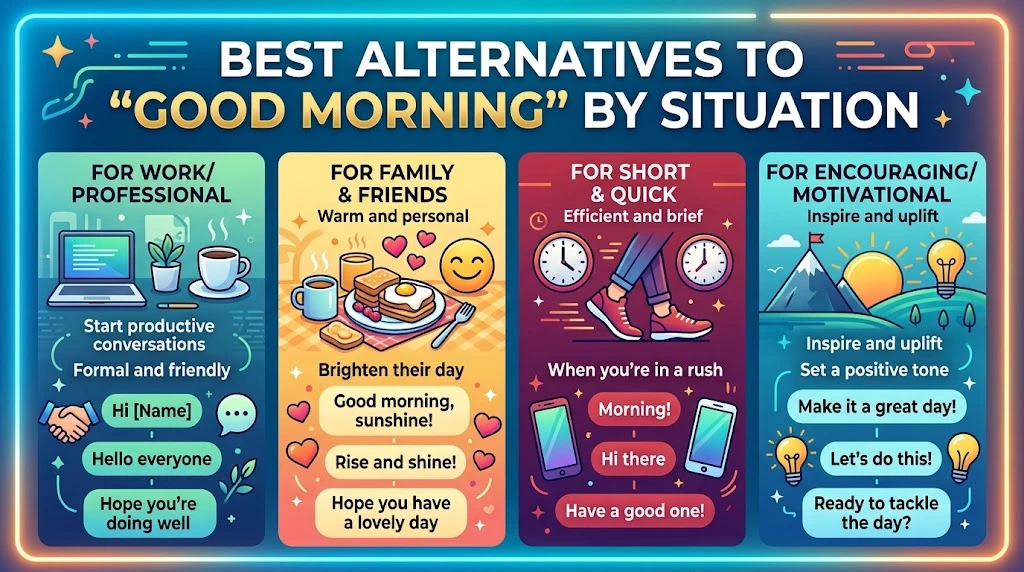
The perfect greeting changes with the relationship.
For Professional Emails
Use:
- Good morning, [Name].
- Hello, [Name].
- Good morning, everyone.
- I hope your morning is going well.
- Hope you’re having a great morning.
The safest option is usually the simplest.
For Coworkers
Try:
- Morning!
- Good morning!
- Hi!
- Hey!
- How’s your morning going?
Your existing relationship determines how casual you can be.
For Friends
Friends give you more room to experiment.
Try:
- Morning!
- Hey!
- Hey there!
- Rise and shine!
- How’s your morning?
For Romantic Partners
A romantic greeting can be more personal.
Examples include:
- Good morning, love.
- Morning, beautiful.
- Good morning, sweetheart.
- Hope you have a beautiful morning.
- Wishing you a wonderful morning.
The right choice depends on the relationship and your normal communication style.
For Group Messages
Use:
- Good morning, everyone!
- Good morning, team!
- Morning, everyone!
- Good morning, all!
- Hope everyone is having a great morning!
A group greeting should acknowledge everyone rather than addressing only one person.
Professional Alternatives to “Good Morning” in an Email
Email greetings deserve special attention because the reader can’t hear your tone.
Formal Options
For a formal professional message:
Good morning, Ms. Carter.
or:
Hello, Dr. Williams.
These greetings establish respectful distance.
Friendly Professional Options
If you already know the recipient:
Good morning, James. Hope your morning is going well.
Or:
Hi Sarah, I hope you’re having a great morning.
The second option feels warmer and less formal.
Email Examples
Formal:
Good morning, Mr. Adams.
I’m writing to follow up on our discussion regarding the project timeline.
Professional and friendly:
Good morning, Jessica.
I hope your morning is going well. I wanted to check whether you had a chance to review the proposal.
Casual workplace message:
Morning, Alex!
Do you have a few minutes to discuss the new schedule?
Group email:
Good morning, everyone.
Thanks for joining today’s meeting. Here are the documents we’ll be reviewing.
The key is consistency. Your greeting should match the rest of the message.
Casual and Friendly Alternatives to “Good Morning”
Casual greetings work best when they sound effortless.
| Greeting | Feeling | Best Context |
| Morning! | Relaxed | Friends, familiar coworkers |
| Hey! | Very casual | Friends |
| Hey there! | Warm and casual | Friends, acquaintances |
| Hi! | Friendly | Most casual situations |
| Hi there! | Friendly | Casual conversations |
| How’s your morning going? | Conversational | Friends, coworkers |
| Rise and shine! | Playful | Family, close friends |
One useful rule is simple:
The closer the relationship, the more freedom you usually have with the greeting.
That isn’t absolute. Workplace culture varies widely. Still, it’s a useful starting point.
Warm and Thoughtful Alternatives to “Good Morning”
Sometimes the goal isn’t merely to say hello.
You want the other person to feel remembered.
That’s when these expressions work well:
- Wishing you a wonderful morning.
- Hope your morning is going well.
- Have a great morning!
- Hope you have a beautiful day.
- Wishing you a bright start to the day.
- Have a wonderful start to your day.
These phrases work especially well in personal messages because they communicate goodwill.
For example:
“Good luck with your interview today. Wishing you a wonderful morning!”
The message does more than greet someone. It recognizes what they’re facing.
Alternatives That Can Sound Unnatural or Overly Dramatic
Not every phrase that resembles “good morning” belongs in everyday American English.
“Top of the Morning”
As mentioned earlier, this phrase is now commonly associated with a humorous or stereotyped Irish voice rather than ordinary modern Irish speech. Cambridge explicitly notes this usage shift.
Use it for humor rather than as your default greeting.
“Happy Morning”
It’s understandable, but it doesn’t sound as natural as “good morning” or “have a great morning.”
“Greetings!”
“Greetings!” is grammatically fine. Yet it can sound theatrical in an ordinary conversation.
For example:
“Greetings, coworker!”
That’s likely to get a laugh rather than a professional nod.
“Rise and Shine!”
This is useful when someone is waking up. Cambridge describes it specifically as an expression telling someone to wake up and get out of bed.
It isn’t the best choice for greeting a client at 9:00 a.m.
“Good Morning” Alternatives: Comparison Table
| Alternative | Tone | Formality | Best For | Example |
| Morning! | Casual | Low | Friends, coworkers | “Morning! How are you?” |
| Hello! | Neutral | Medium | Work, everyday use | “Hello! How can I help?” |
| Hi! | Friendly | Low | Friends, coworkers | “Hi! How’s everything?” |
| Hi there! | Warm | Low–Medium | Casual conversations | “Hi there! How’s your morning?” |
| Hey! | Very casual | Low | Friends | “Hey! Ready for breakfast?” |
| Good day | Formal | Medium–High | Formal or stylized settings | “Good day, everyone.” |
| Rise and shine! | Playful | Low | Family, friends | “Rise and shine!” |
| Have a great morning! | Positive | Medium | Messages, farewells | “Have a great morning!” |
| Hope you’re having a great morning | Warm | Medium | Emails, messages | “Hope you’re having a great morning.” |
| How’s your morning going? | Conversational | Low–Medium | Friends, coworkers | “How’s your morning going?” |
| Wishing you a wonderful morning | Warm | Medium | Personal messages | “Wishing you a wonderful morning.” |
| Good morning, everyone | Professional | Medium | Meetings, groups | “Good morning, everyone.” |
| Good morning, team | Professional-friendly | Medium | Workplaces | “Good morning, team!” |
| What a beautiful morning! | Expressive | Low | Personal conversations | “What a beautiful morning!” |
| Top of the morning! | Playful | Low | Humor | “Top of the morning!” |
“Good Morning” vs. “Morning!” vs. “Hello” vs. “Hi”
These four expressions cover a huge portion of everyday situations.
“Good Morning”
Choose it when you want to be clearly polite and specifically acknowledge the morning.
“Good morning, Mr. Lee.”
Best for: professional, polite, neutral situations.
“Morning!”
Choose it when you want the same basic greeting with less formality.
“Morning! How’s it going?”
Best for: casual workplace conversations and friends.
“Hello”
Choose it when you want a neutral greeting that isn’t tied to the time.
“Hello, Sarah.”
Best for: professional communication and situations where the time may be uncertain.
“Hi”
Choose it when you want something friendly and uncomplicated.
“Hi, Sarah!”
Best for: casual and moderately professional communication.
Common Mistakes When Choosing a Morning Greeting

Using Too-Casual Language in Professional Emails
A greeting like “Yo!” might work perfectly between close friends. It can create the wrong impression with a client.
When professionalism matters, choose:
“Good morning, David.”
rather than:
“Yo, David!”
Using Overly Formal Language With Close Friends
The opposite mistake can sound funny.
If your best friend receives:
“Greetings, Daniel. I trust you are enjoying the morning.”
they may wonder whether you’ve been replaced by a Victorian butler.
A simple:
“Morning!”
does the job.
Treating Every Alternative as a Direct Synonym
“Have a great morning” and “good morning” aren’t identical.
The first expresses a wish.
The second functions primarily as a greeting.
Likewise, “How’s your morning going?” is a question that starts a conversation.
Understanding these differences helps your English sound natural rather than translated.
Assuming “Top of the Morning” Is a Normal Irish Greeting
This is a common cultural misconception.
The phrase has historical roots as a morning greeting, but modern dictionary guidance notes its humorous association with Irish stereotypes.
Use it knowingly rather than assuming it’s the standard phrase Irish people use every morning.
Using a Greeting That Doesn’t Match Your Personality
Language shouldn’t feel like a costume.
If you never say “A beautiful morning to you,” suddenly using it with coworkers may sound unnatural.
The strongest greeting is usually one that fits both the situation and your normal way of speaking.
Read More : It Worth It or It Is Worth It? The Correct Grammar Explained
Case Study: Choosing the Right Greeting at Work
Imagine three employees arriving at an office on Monday morning.
Employee A walks into a meeting and says:
“Hey, guys!”
That may be perfectly acceptable in a relaxed team.
Employee B says:
“Good morning, everyone.”
This sounds neutral, confident, and professional.
Employee C says:
“Top of the morning, esteemed colleagues!”
The sentence is grammatically understandable. It also sounds deliberately humorous.
None of these greetings is inherently wrong.
The difference comes from context and intention.
If the workplace culture is relaxed, Employee A may fit perfectly. If the meeting includes executives or clients, Employee B is safer. Employee C works only if the speaker intentionally wants to create a joke.
That’s the central lesson behind choosing other ways to say “good morning.”
Correct English isn’t always the same thing as natural English.
Case Study: Choosing a Greeting for Email
Consider a message sent to a client:
“Morning! Can you send me the contract?”
It’s understandable. However, it may sound abrupt.
A better version is:
“Good morning, Alex. Could you please send me the updated contract when you have a chance?”
Now consider an email sent to a coworker you know well:
“Good morning, Alex. I hope this message finds you well.”
That isn’t wrong either. It may simply sound more formal than necessary.
A natural alternative could be:
“Morning, Alex! Could you send me the updated contract when you get a chance?”
The best wording isn’t just grammatically correct. It matches the relationship.
A Simple Formula for Better Morning Greetings
When you’re unsure what to say, use this formula:
Greeting + Name + Optional question or good wish
For example:
Good morning + Sarah + How are you?
Result:
“Good morning, Sarah. How are you?”
Or:
Morning + Mike + How’s your day going?
Result:
“Morning, Mike! How’s your day going?”
For professional emails:
Good morning + Name + Purpose
Result:
“Good morning, David. I’m following up about tomorrow’s meeting.”
For a warm personal message:
Greeting + Good wish
Result:
“Good morning, love. I hope you have a wonderful day.”
This simple structure gives you dozens of natural combinations.
Frequently Asked Questions About Other Ways to Say “Good Morning”
What are the best other ways to say “good morning”?
The best choice depends on the situation.
For casual conversations, “Morning!”, “Hi!”, and “Hey!” work well.
For professional settings, “Good morning, [Name]” and “Hello, [Name]” are strong choices.
For warm messages, try “Hope you’re having a great morning” or “Wishing you a wonderful morning.”
What is a professional way to say “good morning”?
The simplest professional option is:
“Good morning, [Name].”
You can also use:
“Good morning, everyone.”
For a less time-specific email, “Hello, [Name]” is another professional choice.
What is a casual way to say “good morning”?
“Morning!” is one of the most natural casual alternatives.
You can also say:
- “Hey!”
- “Hi!”
- “Hey there!”
- “How’s your morning going?”
Is “Morning!” rude or polite?
“Morning!” is generally polite but informal.
It’s common among friends, coworkers, and familiar acquaintances. It can sound too casual in certain formal situations.
For example, “Good morning, Professor” is more respectful than “Morning, Professor.”
Can I say “Good morning” in a professional email?
Yes.
“Good morning” is a standard professional greeting.
For example:
“Good morning, Jennifer. I’m writing to follow up on our conversation.”
However, remember that email may be read much later. If timing is uncertain, “Hello, Jennifer” avoids tying the greeting to a specific part of the day.
What is a more friendly way to say “good morning”?
Try:
- “Morning!”
- “Hi there!”
- “Hey!”
- “Hope you’re having a great morning!”
- “How’s your morning going?”
The last two are particularly useful because they encourage a response.
What is a romantic way to say “good morning”?
Romantic options include:
- “Good morning, love.”
- “Morning, beautiful.”
- “Good morning, sweetheart.”
- “I hope you have a beautiful morning.”
- “Wishing you a wonderful morning.”
Choose wording that matches the relationship rather than forcing a dramatic expression.
Is “Good day” the same as “Good morning”?
Not exactly.
“Good morning” specifically identifies the morning.
“Good day” is broader and can sound more formal or old-fashioned in American English.
If you’re greeting someone at 9 a.m., “Good morning” is usually more natural.
Is “Rise and shine” appropriate for adults?
Yes, but it’s playful.
The expression is commonly used to tell someone to wake up and get out of bed.
It works well with friends, partners, family members, and children.
It usually isn’t appropriate for a formal business email.
Is “Top of the morning” commonly used in American English?
Americans recognize the phrase, but it often sounds humorous, theatrical, or stereotypically Irish.
Cambridge notes that the expression was used especially in Ireland in the past and is now commonly used humorously when referring to Irish people.
For ordinary American English, “Good morning” is the more natural choice.
Can “Hello” replace “Good morning”?
Yes.
“Hello” works at virtually any time of day, which makes it useful when the exact timing isn’t important.
For example:
“Hello, Ms. Carter. Thank you for calling.”
It sounds neutral and professional.
What is the most formal alternative to “good morning”?
There isn’t one universal “most formal” replacement.
In many professional situations, “Good morning, [Name]” is already formal enough.
For very formal written communication, the appropriate salutation may depend on the recipient and purpose of the letter rather than the time of day.
Final Takeaway: Choose a Greeting That Fits the Moment
There are plenty of other ways to say “good morning,” but the goal isn’t to replace the phrase every time you use it.
Sometimes “Good morning” is exactly right.
Use “Morning!” when you want something relaxed. Choose “Hello” when you want a neutral greeting that works beyond the morning. Try “Hi there!” when you want warmth without much formality. Use “How’s your morning going?” when you want to start a real conversation.
For professional communication, don’t underestimate the power of simplicity:
“Good morning, Sarah.”
It’s polite, clear, and natural.
For personal messages, you have more freedom. A thoughtful “Wishing you a wonderful morning” can feel warmer than a routine greeting. Meanwhile, “Rise and shine!” adds playful energy when the relationship allows it.
The biggest lesson is simple: don’t search for the fanciest synonym. Search for the phrase that fits the moment.
A good greeting should feel effortless. When the words match the relationship, setting, and mood, even a two-word greeting can make the conversation start on the right foot.