You receive a message that ends with “JS.” Two letters. No explanation. Suddenly, you’re wondering whether the person is making a casual comment, being sarcastic, or talking about JavaScript.
In most casual texting situations, JS means “just saying.” People use it to add an opinion, observation, suggestion, or criticism without making the statement sound overly serious. It can feel friendly and playful. In the right context, though, it can also sound blunt or passive-aggressive.
Context is the real key.
If someone writes, “You should probably get some sleep, JS,” they’re probably using JS to mean “just saying.” If a developer writes, “I need to debug the JS,” the meaning is completely different. There, JS means JavaScript, the programming language.
This guide explains the JS meaning in text, how people use it on WhatsApp, Instagram, TikTok, and Snapchat, what “JS 😂” can imply, how to reply, and how to distinguish texting slang from technical language.
What Does JS Mean in Text?
The most common JS meaning in text is “just saying.”
People use the abbreviation to attach a casual remark to a conversation. It often appears after an opinion or observation, although you can also see it at the beginning or middle of a message.
For example:
“You could’ve told me earlier, JS.”
This essentially means:
“You could’ve told me earlier. I’m just saying.”
The sender isn’t necessarily demanding an apology. Instead, they’re putting forward a thought while making it sound less formal or forceful.
That’s why JS works as a conversational softener. The phrase “just saying” itself has long been used in English to make criticism or complaints sound less direct. Cambridge describes “I’m just saying” as an informal expression used when making criticism or complaints while trying to reduce the chance of offending someone.
However, “softener” doesn’t always mean “friendly.”
Consider these two messages:
- “You should get some rest, JS.”
- “You really need to learn how to be on time, JS.”
The first sounds concerned. The second could easily sound irritated.
The abbreviation hasn’t changed. The sentence around it has.
Simple JS Example
Imagine this conversation:
Alex: “Should I buy these shoes?”
Sam: “They’re nice, but the other pair looked better, JS.”
Here, JS means “just saying.” Sam is giving an opinion without presenting it as an absolute fact.
Another example:
“You two would actually make a cute couple, JS 👀”
That version may sound teasing or suggestive rather than critical.
What Does JS Stand For?
In casual texting, JS stands for “just saying.”
It’s essentially a shortened form of the spoken phrase “I’m just saying.”
| Term | Meaning |
| JS | Just saying |
| Full phrase | I’m just saying |
| Type | Informal texting abbreviation |
| Typical purpose | Adding an opinion, observation, suggestion, or criticism |
| Common tone | Casual, playful, blunt, teasing, or mildly defensive |
| Formal writing? | Generally no |
The phrase can serve several purposes at once.
Someone might use JS to:
- Share an opinion.
- Make an observation.
- Give unsolicited advice.
- Soften criticism.
- Point out something obvious.
- Tease a friend.
- Add a little sarcasm.
- Distance themselves from a strong statement.
That last point matters.
Sometimes “just saying” gives the sender a little conversational escape hatch. They can make a pointed comment and then frame it as nothing more than an observation.
“I’m not saying you were wrong. JS.”
That message doesn’t necessarily feel neutral. In fact, it may suggest the opposite.
What Does “Just Saying” Mean in a Conversation?
The phrase “just saying” doesn’t simply mean “I am speaking.”
It often tells the listener how the speaker wants the previous statement to be interpreted.
Think of it like a small cushion placed around a sharp comment.
Without the phrase:
“That wasn’t a good decision.”
With the phrase:
“That wasn’t a good decision, just saying.”
The second version can feel less formal and less authoritative. Yet it can still carry criticism.
Cambridge’s definition specifically connects “I’m just saying” with criticism and complaints. That makes sense in everyday conversation because the expression often appears when someone wants to make a potentially uncomfortable point without sounding overly confrontational.
JS Can Signal an Opinion
“That movie was overrated, JS.”
The sender is sharing an opinion.
JS Can Signal Advice
“You should probably talk to her, JS.”
The sender is offering a suggestion.
JS Can Signal an Observation
“You’ve been quiet today, JS.”
The sender is pointing something out.
JS Can Signal Criticism
“You could’ve planned this better, JS.”
The sender is criticizing while trying to keep the comment casual.
JS Can Signal Teasing
“You’re definitely obsessed with him, JS 😂”
Here, the abbreviation helps create a playful tone.
Where Did JS Come From?
The exact origin of the JS texting abbreviation isn’t firmly established by a single documented first use.
That’s important because online explanations sometimes claim that JS began on a particular platform or in a specific year. There isn’t strong evidence for treating one such date as the definitive birth of the slang.
The phrase “just saying” itself is much older than texting.
People have long used “I’m just saying” in spoken English after making a criticism, suggestion, or observation. Digital communication simply gave people a faster way to type the phrase.
As texting, instant messaging, forums, and social media became more abbreviation-friendly, longer expressions naturally became shorter. The same general process produced countless familiar forms such as:
- LOL
- BTW
- IMO
- TBH
- IDK
- FYI
JS fits that broader pattern of compressing a familiar phrase into a quick digital shorthand.
So the safest explanation is simple:
“JS” is a modern shorthand for the already-established phrase “just saying.”
How People Use JS in Daily Conversations
The beauty of JS is its flexibility.
You can place it after a compliment, criticism, suggestion, joke, or observation. The surrounding sentence determines the emotional color.
JS at the End of a Message
This is one of the clearest patterns:
“That restaurant is seriously expensive, JS.”
The sender is essentially saying, “That’s my observation. Take it as you will.”
Another example:
“You look better in the blue shirt, JS.”
Here, the message could be completely friendly.
JS at the Beginning of a Message
Although less necessary, some people may use it at the beginning:
“JS, I think you should wait until tomorrow.”
The meaning remains “just saying.”
It introduces the speaker’s opinion before the main statement.
JS After a Compliment
JS isn’t restricted to negative comments.
“You actually look amazing in that outfit, JS.”
This could sound playful, flirtatious, or simply enthusiastic.
JS After Criticism
This is where the abbreviation becomes more interesting.
“You were late again, JS.”
The message may be mild. It may also carry a clear hint of annoyance.
The phrase doesn’t erase the criticism. It simply changes how the sender frames it.
JS Meaning Across WhatsApp, Instagram, TikTok & Snapchat
The JS meaning in WhatsApp, Instagram, TikTok, and Snapchat is usually the same in ordinary social conversations: “just saying.”
The platform doesn’t automatically change the definition. What changes is the way people use and interpret it.
JS Meaning on WhatsApp
WhatsApp conversations often move quickly, especially in group chats.
Someone might write:
“You could’ve invited me too, JS 😂”
Here, the emoji makes the complaint feel lighter.
Another example:
“JS, I think we should leave earlier.”
That’s straightforward advice.
In a group chat, JS can also make an opinion sound less like an attempt to control everyone.
JS Meaning on Instagram
Instagram users may use JS in:
- DMs
- Comments
- Replies
- Captions
- Story responses
For example:
“JS, you two look good together 👀”
The phrase could be playful or flirtatious.
A comment such as:
“The old version was better, JS.”
is more clearly an opinion.
Instagram also relies heavily on visual context. A short comment can carry more meaning because the photo, video, caption, or previous conversation supplies the missing context.
JS Meaning on TikTok
TikTok comments often rely on very short expressions. JS can therefore fit naturally into a quick opinion.
For example:
“This version is better, JS.”
Or:
“JS but the original still wins.”
In these examples, the abbreviation doesn’t introduce a completely new meaning. It simply packages an opinion in casual internet language.
JS Meaning on Snapchat
If you’re wondering what JS means on Snapchat, the answer is usually “just saying.”
Snapchat conversations tend to be informal and fast-moving, which makes short abbreviations useful.
For example:
“You left me on delivered all day, JS.”
Depending on the relationship, that could be playful teasing or genuine frustration.
Another example:
“JS you looked really good today.”
That could be a compliment with a slightly shy or understated tone.
How to Tell Which Meaning of JS Someone Intended
Because JS has more than one meaning, don’t interpret it in isolation.
Instead, look at three things: context, surrounding words, and platform.
Look at the Conversation Topic
If you’re discussing relationships, school, clothes, food, or plans, JS probably means “just saying.”
If you’re discussing websites, programming, software, or code, JS probably means JavaScript.
Compare:
“JS, you should apologize.”
versus:
“This bug is coming from the JS.”
The first is texting slang.
The second is programming terminology.
Look at the Words Around JS
Certain words make the intended meaning obvious.
Words such as:
- code
- function
- browser
- script
- framework
- debugging
- Node.js
strongly suggest JavaScript.
On the other hand, words involving:
- opinions
- relationships
- jokes
- advice
- criticism
- personal observations
make “just saying” more likely.
Consider the Audience
A developer talking to another developer may use JS without any slang meaning at all.
A friend sending a Snapchat message is much more likely to mean “just saying.”
The same two letters can belong to completely different conversational worlds.
JS Meaning in Other Fields: JavaScript
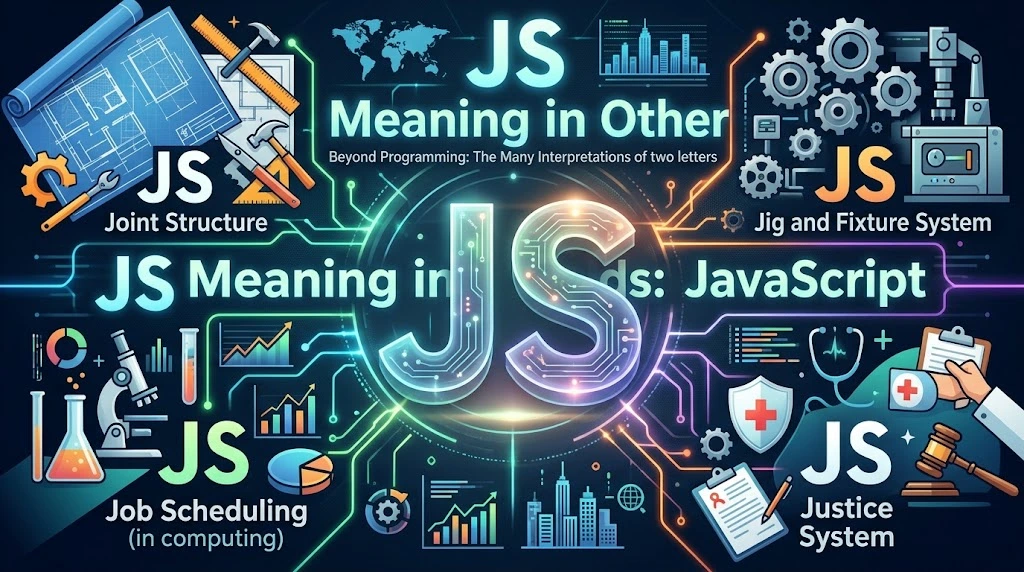
The other major meaning of JS is JavaScript.
JavaScript is a general-purpose programming language best known for adding behavior and interactivity to websites. It also runs in environments outside browsers, including server-side runtimes such as Node.js.
MDN explicitly uses JS as the abbreviation for JavaScript.
For example:
“I’m learning JS.”
In a programming conversation, nobody is talking about “just saying.”
They mean:
“I’m learning JavaScript.”
What Does JavaScript Do?
JavaScript can power interactive features such as:
- Form validation
- Dynamic page updates
- Interactive menus
- Animations
- Browser-based games
- Data fetching
- User-interface behavior
- Web applications
Modern JavaScript also operates outside the browser. Runtimes such as Node.js allow JavaScript to handle server-side tasks.
The core language is standardized as ECMAScript. Ecma International’s current standard is ECMAScript 2026, the 17th edition of ECMA-262, published in June 2026.
So when a developer says “JS,” the abbreviation may refer to a major programming language rather than internet slang.
Common Mistakes When Interpreting JS
A tiny abbreviation can create a surprisingly large misunderstanding.
Thinking JS Always Means JavaScript
This is probably the easiest mistake to make when you spend time around technology.
If your friend says:
“JS, you should take a jacket.”
they aren’t discussing programming.
They mean:
“Just saying.”
Assuming JS Is Always Friendly
Not necessarily.
“You might want to check your facts, JS.”
That sounds sharper.
The abbreviation doesn’t magically make criticism polite.
Assuming JS Is Always Rude
The opposite mistake is just as common.
“You look great today, JS 😊”
That’s hardly an insult.
Tone comes from the entire message.
Confusing JS With “IJS”
IJS commonly means “I’m just saying.”
It serves a very similar function.
| Abbreviation | Meaning | Typical role |
| JS | Just saying | Casual opinion or observation |
| IJS | I’m just saying | More explicit version |
| IMO | In my opinion | Clearly labels an opinion |
| TBH | To be honest | Signals candidness |
| NGL | Not gonna lie | Introduces a frank statement |
| FYI | For your information | Provides information |
These expressions overlap, but they’re not identical.
IMO openly labels a statement as an opinion. JS often feels more indirect. TBH emphasizes honesty. NGL often signals that the next statement may be unusually candid.
Is JS Rude, Sarcastic, or Passive-Aggressive?
JS isn’t inherently rude.
Its tone depends on what surrounds it.
Consider:
“You should get some sleep, JS.”
That sounds caring.
Now compare:
“Maybe show up on time for once, JS.”
That sounds sarcastic or irritated.
The abbreviation hasn’t changed. The emotional payload has.
Friendly JS
“JS, I think you two would get along really well.”
Playful JS
“You’re definitely addicted to that game, JS 😂”
Blunt JS
“That wasn’t your best idea, JS.”
Passive-Aggressive JS
“Must be nice to ignore everyone’s messages, JS.”
That final example demonstrates an important point: “just saying” can soften the packaging without softening the message itself.
It’s like putting a sharp object inside a paper envelope. The envelope looks harmless. The object can still poke you.
What Does JS Mean From a Girl or a Guy?
The JS meaning does not change based on whether the sender is a girl or a guy.
There isn’t a separate male or female definition of the abbreviation.
If a girl texts:
“JS, you looked really good today.”
the abbreviation still means “just saying.”
If a guy sends:
“JS, you should probably text her back.”
it means the same thing.
What can change is the social context.
For example, “JS” after a compliment might make the sender sound slightly less direct. If the message concerns dating or attraction, the sender may be testing the waters without making a strong declaration.
Still, the abbreviation alone doesn’t prove flirting.
Look at the rest of the message.
What Does “JS 😂” Mean?
When someone writes “JS 😂,” the laughing emoji usually adds playfulness.
It may suggest:
- “I’m only saying this as a joke.”
- “Don’t take this too seriously.”
- “You know I’m right.”
- “I’m teasing you.”
- “This is funny, but I kind of mean it.”
For example:
“You really need to stop buying coffee every day, JS 😂”
That sounds more playful than:
“You really need to stop buying coffee every day, JS.”
The emoji changes the emotional temperature.
Compare These Versions
| Message | Possible tone |
| “JS.” | Neutral or blunt |
| “JS 😂” | Playful |
| “JS lol” | Casual |
| “JS 👀” | Teasing or suggestive |
| “JS 😭” | Dramatic or humorous |
| “JS…” | Potentially hesitant or pointed |
These aren’t rigid rules. Digital tone is contextual. Still, punctuation and emojis can provide useful clues.
Read More : In the Street vs. On the Street: Meaning, Differences, Examples, and Correct Usage
Real Chat Situations Using JS
The best way to understand JS meaning in text is to see it in realistic conversations.
Case Study: Friendly Advice
Mia: “Should I apply for the job?”
Lena: “Honestly, you should. JS, you have nothing to lose.”
Here, JS softens the advice.
Lena isn’t ordering Mia to apply. She’s encouraging her.
Case Study: Mild Criticism
Ryan: “I don’t know why she got upset.”
Chris: “You did cancel on her twice, JS.”
Here, JS introduces an uncomfortable observation.
It doesn’t erase the criticism. It makes the comment sound more conversational.
Case Study: Flirty Hint
Emma: “Who would you actually date here?”
Noah: “You’d be near the top of the list, JS 👀.”
Here, JS creates plausible deniability while still delivering a fairly obvious hint.
Case Study: Programming Context
Developer A: “The page isn’t loading.”
Developer B: “Check the JS console for errors.”
Here, JS means JavaScript, not “just saying.”
The technical vocabulary makes the meaning unmistakable.
How to Reply When Someone Says JS
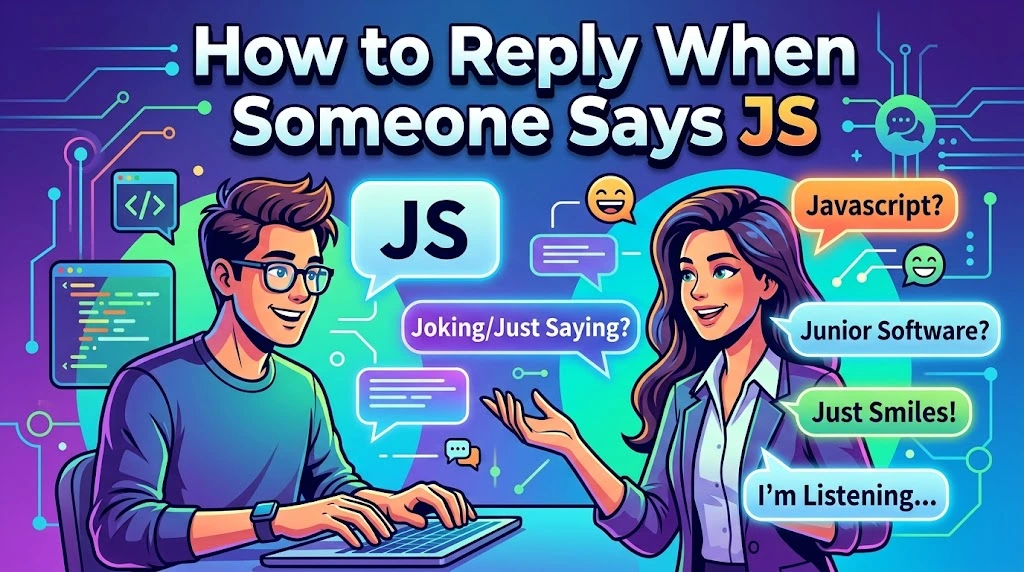
Usually, you don’t need to respond to the abbreviation itself.
Respond to the actual message.
Casual Replies to JS
If someone says:
“You should probably leave earlier next time, JS.”
You could answer:
- “Fair point.”
- “Yeah, you’re probably right.”
- “I know 😂.”
- “Noted.”
- “I’ll keep that in mind.”
Friendly Replies
If the comment is supportive:
“JS, I think you should go for it.”
You could say:
- “Thanks. I appreciate that.”
- “Honestly, I needed to hear that.”
- “You might be right.”
- “That’s actually helpful.”
Funny Replies
If a friend is teasing you:
“You’re obsessed with that show, JS 😂.”
Try:
- “And I’m not denying it.”
- “You caught me.”
- “At least I have good taste.”
- “That’s rich coming from you 😂.”
- “I said what I said.”
When JS Sounds Critical
If the message feels passive-aggressive, don’t get distracted by the abbreviation.
Address the actual issue.
For example:
“What do you mean by that?”
or:
“Are you trying to tell me something?”
Sometimes a direct question clears up a tone problem faster than guessing.
JS vs. Similar Texting Abbreviations
Although several slang terms perform similar jobs, they aren’t interchangeable.
| Abbreviation | Full form | Main purpose |
| JS | Just saying | Adds a casual opinion or observation |
| IJS | I’m just saying | Makes the same idea more explicit |
| IMO | In my opinion | Clearly identifies a personal opinion |
| TBH | To be honest | Signals a candid statement |
| NGL | Not gonna lie | Introduces something frank or surprising |
| JK | Just kidding | Signals that something was a joke |
| BTW | By the way | Introduces an additional point |
| FYI | For your information | Gives information or a reminder |
The distinction between JS and JK is particularly important.
“You really need a vacation, JS.”
means the speaker is probably serious.
“You really need a vacation, JK.”
means the speaker is taking the statement back as a joke.
One letter can completely change the message.
Is JS Still Popular in 2026?
JS remains recognizable as casual internet shorthand for “just saying.” Current slang-reference sites continue to document the expression as a texting and social-media abbreviation.
However, it would be misleading to claim that JS has a universally measured growth rate across every platform. Public platforms don’t provide a single authoritative statistic showing exactly how many people use the abbreviation each year.
That distinction matters.
Internet slang changes rapidly. Some expressions surge through a particular community, while others remain quietly useful for years.
JS falls into the latter category because its underlying phrase is already familiar.
Where You’re Most Likely to See JS
You may encounter the slang meaning in:
- Text messages
- WhatsApp chats
- Instagram DMs
- Instagram comments
- Snapchat messages
- TikTok comments
- Group chats
- Gaming conversations
- Informal online discussions
In programming communities, meanwhile, JS usually means JavaScript.
Quick Facts About JS Meaning in Text
| Fact | Answer |
| Most common texting meaning | Just saying |
| Full form | Just saying / I’m just saying |
| Main use | Opinions, observations, suggestions, and criticism |
| Is it formal? | No |
| Can it sound rude? | Yes, depending on context |
| Can it sound friendly? | Yes |
| Can it be sarcastic? | Yes |
| Does gender change its meaning? | No |
| Can JS mean JavaScript? | Yes |
| Best clue for meaning | The surrounding conversation |
| Common social platforms | Snapchat, TikTok, Instagram, WhatsApp, and messaging apps |
Frequently Asked Questions About JS Meaning in Text
What does JS mean on Snapchat?
On Snapchat, JS usually means “just saying.” Someone may use it after an opinion, observation, suggestion, compliment, or criticism.
For example:
“You looked really good today, JS.”
The abbreviation makes the message feel casual.
What does JS mean in a text message?
In ordinary texting, JS usually stands for “just saying.”
It tells the reader that the sender is sharing a thought without necessarily demanding agreement.
Is JS rude?
JS isn’t automatically rude.
The tone depends on the message around it. A compliment followed by JS can sound friendly. A criticism followed by JS may sound blunt or passive-aggressive.
What does JS mean from a girl?
JS has the same basic meaning regardless of the sender’s gender: “just saying.”
If the message appears in a romantic conversation, it may carry a playful or flirtatious undertone. The abbreviation itself doesn’t prove romantic interest.
What does JS mean from a guy?
It generally means “just saying.”
The surrounding words and relationship between the people matter more than the sender’s gender.
Does JS always mean “just saying”?
No.
In casual conversations, it usually means “just saying.” In programming discussions, JS commonly means JavaScript.
Context determines which meaning makes sense.
What does “JS 😂” mean?
“JS 😂” usually means “just saying” with a playful or humorous tone.
The laughing emoji can make a potentially blunt comment feel lighter.
Is JS old slang?
The underlying phrase “just saying” is much older than modern texting. The abbreviated form fits the broader pattern of shortening familiar phrases for digital communication.
It’s better to think of JS as an established piece of informal internet shorthand rather than a term tied to one specific generation.
What does JS mean in TikTok comments?
In TikTok comments, JS can mean “just saying.”
For example:
“The original was better, JS.”
The commenter is expressing an opinion casually.
Does JS mean JavaScript in texting?
Usually not in ordinary personal texting.
If the conversation involves programming, websites, code, frameworks, browsers, or software development, JS almost certainly refers to JavaScript.
What’s the difference between JS and IJS?
JS means “just saying,” while IJS means “I’m just saying.”
They serve almost the same conversational purpose. IJS simply spells out the subject more explicitly.
How should you respond when someone texts JS?
Focus on the statement rather than the abbreviation.
If it’s friendly, respond naturally. If it’s advice, acknowledge it. If it sounds sarcastic or unclear, ask what the person means.
Final Takeaway: What Does JS Mean in Text?
So, what does JS mean in text?
In most casual conversations, JS means “just saying.”
People use it to share an opinion, observation, suggestion, compliment, criticism, or joke without making the statement sound overly formal. Sometimes it genuinely softens a message. Other times, it adds a little sarcasm or gives the sender room to retreat behind “I was just saying.”
The surrounding words matter most.
If you see:
“JS, you should get some rest.”
you’re probably looking at “just saying.”
If you see:
“There’s an error in the JS.”
you’re almost certainly looking at JavaScript.
That’s the easiest rule to remember:
Casual conversation + JS = usually “just saying.”
Programming conversation + JS = usually JavaScript.
Once you look at the context instead of the abbreviation alone, the meaning becomes much easier to spot.