Have you received a text that says “STSU” and wondered whether the sender was joking or telling you to be quiet? Those four letters can make a conversation confusing, especially when you don’t know the person’s tone.
STSU is an informal slang abbreviation commonly associated with “Shut That Sh*t Up” or a similar “shut up” expression. People may use it to react to surprising news, express disbelief, tease a friend, or show annoyance. The exact wording isn’t standardized, so the surrounding conversation matters.
For example, imagine telling your best friend that your favorite celebrity followed you on Instagram. They might respond with “STSU 😭” because they can’t believe it. In another conversation, someone might send the same abbreviation during an argument to tell you to stop talking.
The letters haven’t changed, but the message feels completely different.
In this guide, you’ll learn the STSU meaning in text, how people use it on social media, how it differs from STFU, and how to respond when someone sends it to you. You’ll also see realistic examples that help you interpret the abbreviation without jumping to conclusions.
What Does STSU Mean in Text?
In informal online slang, STSU is commonly associated with “Shut That Sht Up” or “Shut The Sht Up.” Some people use it as a variation of the more familiar abbreviation STFU.
The expression contains profanity, so it can sound harsh when someone uses it literally. However, friends sometimes use similar “shut up” expressions as exaggerated reactions to unbelievable news, funny stories, or unexpected surprises.
Think of the difference between these two messages:
- “STSU 😂 You actually met him?”
- “STSU. I’m tired of hearing you complain.”
The first message may express surprise or playful disbelief. The second sounds dismissive and could be intended to silence the other person.
STSU isn’t a universally standardized texting abbreviation. Its precise expansion and intended tone can vary between users, so you shouldn’t assume every sender means exactly the same thing.
STSU Meaning at a Glance
| Detail | Explanation |
| Abbreviation | STSU |
| Common slang interpretation | “Shut That Sh*t Up” or a similar “shut up” expression |
| Main conversational functions | Disbelief, surprise, teasing, annoyance, or telling someone to stop talking |
| Tone | Playful, sarcastic, aggressive, or unclear |
| Where it may appear | Text messages, private chats, comments, and group conversations |
| Is it formal? | No. It’s informal slang that can include profanity |
| Does it always mean anger? | No. The surrounding conversation helps determine the tone |
| Is the full form standardized? | No. Variations and personal interpretations exist |
What Does STSU Stand For?
The most common slang interpretation connects STSU with a phrase beginning with “shut,” followed by “that” or “the,” and a profane word ending in “up.”
Online slang references, including Urban Dictionary’s STSU entries, contain variations of this expression. Because those entries are user-submitted, they demonstrate how people use the abbreviation rather than establish an official definition.
You may also encounter someone using STSU as personal shorthand, an inside joke, or a typo. That possibility matters when the abbreviation appears in an unfamiliar conversation.
The safest interpretation is to treat STSU as a context-dependent, informal expression rather than an acronym with one guaranteed meaning.
Does STSU Mean “Shut Up” or “No Way”?
It can communicate either idea, depending on how the sender uses it.
Literally, the phrase associated with STSU sounds like a command to stop talking. In casual conversation, however, people sometimes use similar expressions to mean “No way!” or “You’re kidding!”
Consider this example:
Friend A: I just won two concert tickets!
Friend B: STSU 😭 How did you get them?
Friend B probably isn’t asking Friend A to be quiet. The response expresses disbelief and excitement.
Now compare it with this exchange:
Person A: You need to listen to my side of the story.
Person B: STSU. I’m done talking.
Here, the abbreviation sounds hostile or dismissive.
When you’re trying to understand STSU, look at the message before it, the relationship between the people, and what happens afterward. Those clues often reveal more than the four letters themselves.
How Is STSU Used in Texting and Online Conversations?
STSU can function as a reaction, a joke, or an expression of frustration. The intended meaning depends on what happened immediately before the sender typed it.
STSU as a Reaction to Surprising News
People sometimes use exaggerated language when they hear something unexpected. Similar expressions can communicate shock more dramatically than a simple “Really?”
For example:
Mia: Guess what? I got accepted into my dream university!
Alex: STSU 😭 ARE YOU SERIOUS?
Alex is probably celebrating Mia’s achievement rather than insulting her. The emotional reaction makes sense because the news is exciting and unexpected.
In this situation, phrases such as “No way!” or “You’re kidding!” would communicate a similar reaction without the profanity.
STSU as a Joke Between Friends
Close friends often develop their own style of banter. They may use blunt expressions that would sound rude coming from a stranger.
For example:
Jay: I ate the entire pizza by myself.
Chris: STSU 💀 You didn’t even save me a slice?
The message may be playful because Chris is exaggerating his reaction. The joking complaint and familiar relationship help establish the tone.
Still, don’t assume every friend enjoys this type of humor. Some people dislike profanity, even when the sender intends it as a joke.
STSU to Express Annoyance or Frustration
STSU can also sound like a genuine demand for someone to stop talking. This interpretation becomes more likely when the conversation already contains arguments, insults, or repeated complaints.
For example:
Person A: You keep interrupting me.
Person B: STSU. Nobody asked you.
This exchange doesn’t sound playful. The second person appears dismissive and unwilling to continue the discussion respectfully.
If you receive a message like this, pay attention to the broader conversation instead of treating STSU as harmless slang automatically.
STSU in Flirty or Playful Conversations
Sometimes, people use dramatic expressions while teasing someone they like. A surprised reaction might follow a compliment, a bold message, or a playful confession.
For example:
Sam: You looked really cute in that picture.
Taylor: STSU 😭 you’re making me blush.
Taylor may be embarrassed in a playful way rather than offended.
However, STSU doesn’t inherently mean flirting or romantic interest. A person can use it with a friend, sibling, partner, or stranger. The rest of the conversation provides the necessary clues.
What Does STSU Mean on WhatsApp, Instagram, TikTok, and Snapchat?
The meaning of STSU doesn’t automatically change from one social media platform to another. The same abbreviation can appear in private messages, public comments, and group chats.
What changes is the context in which you encounter it.
STSU on WhatsApp
WhatsApp conversations often involve friends, family members, coworkers, and group chats. If someone sends STSU after surprising news, they may be reacting with disbelief.
For example:
You: My brother just announced that he’s getting married!
Friend: STSU 😂 When did this happen?
The response suggests surprise and excitement.
In a family group or professional conversation, however, the same expression might seem disrespectful. Consider your relationship with the sender and the general tone of the chat.
STSU on Instagram and in DMs
On Instagram, you might encounter STSU in direct messages or comment threads. It may appear when someone reacts to a surprising story, an unexpected announcement, or a funny post.
For example:
You: Shares a picture with a famous singer.
Friend: STSU 😭 HOW DID YOU MEET HER?
The friend is probably expressing disbelief.
A comment such as “STSU, you’re so annoying” may carry a different tone. Read the surrounding comments and consider whether the people involved are joking or arguing.
There isn’t a separate, universally accepted Instagram definition of STSU. The platform itself doesn’t determine what the sender means.
STSU on TikTok
TikTok conversations can involve videos, comments, livestreams, and direct messages. An abbreviation may appear as a reaction to a surprising story or an unexpected moment in a video.
For example:
Creator: I found my childhood best friend after 15 years!
Commenter: STSU 😭 this is actually so wholesome.
The commenter may be reacting emotionally to the story.
However, a short comment doesn’t always reveal the writer’s intention. Sarcasm, criticism, and inside jokes can be difficult to distinguish without more context.
Don’t assume STSU is a TikTok-specific trend simply because you see it under a video. Its use in a comment doesn’t establish how widespread it is.
STSU on Snapchat
Snapchat messages often rely on brief replies, emojis, photos, and ongoing conversations between friends. In that setting, STSU may be an exaggerated response to something unexpected.
For example:
You: Sends a snap showing a new haircut.
Friend: STSU 😭 You actually did it!
The friend probably means something like “No way!” or “I can’t believe you did that.”
On the other hand, a blunt STSU sent during a disagreement can sound like an insult. Snapchat doesn’t give the abbreviation a special official meaning.
Quick tip: Whether you see STSU on WhatsApp, Instagram, TikTok, or Snapchat, interpret the message through context rather than the app name alone.
Is STSU Rude, Offensive, or Just Playful?
STSU can be rude, but it isn’t automatically hostile in every conversation. Its tone depends on the expression behind the letters, the sender’s intention, and the relationship between the people involved.
Because the common expansion includes profanity, it’s riskier than neutral reactions such as “Wow!” or “Seriously?”
When STSU Sounds Harmless
The abbreviation may sound playful when:
- Close friends regularly tease each other.
- The sender reacts to surprising or exciting news.
- The conversation already has a joking tone.
- The message includes laughing or crying emojis that support a playful reading.
- The sender follows up with a friendly question or positive comment.
For example:
You: I finally asked my crush out.
Friend: STSU 😭 WHAT DID THEY SAY?
The friend seems surprised and eager to hear the story. The expression is dramatic, but the overall response feels supportive.
When STSU Sounds Aggressive
The abbreviation may be disrespectful when:
- Someone uses it to end a serious discussion.
- The message appears alongside insults or threats.
- The sender repeatedly tells you to stop talking.
- The conversation already involves anger or personal conflict.
- You and the sender don’t have a relationship that makes blunt teasing comfortable.
For example:
You: Can you explain why you said that?
Them: STSU. Leave me alone.
This sounds dismissive. Even if the sender is upset, the message doesn’t invite a productive conversation.
How Emojis and Punctuation Change the Tone
Emojis and punctuation can provide useful clues, although neither guarantees the sender’s intention.
| Message | Possible interpretation |
| “STSU 😂” | Playful disbelief or teasing |
| “STSU 😭” | Dramatic surprise or an emotional reaction |
| “STSU???” | Shock, disbelief, or frustration |
| “STSU.” | Potentially blunt or dismissive, depending on context |
| “STSU, I’m serious.” | More likely to be a genuine demand to stop talking |
These are possibilities, not strict rules. Someone might use a laughing emoji sarcastically, while another person might type a period without intending to sound angry.
If the message leaves you uncomfortable, you don’t have to dismiss that feeling just because the sender included an emoji.
STSU vs. STFU and Other Similar Texting Abbreviations
STSU can be confused with STFU because both are associated with telling someone to stop talking. However, they aren’t necessarily interchangeable in every conversation.
STSU vs. STFU
STFU is a widely recognized internet abbreviation for “Shut the F*** Up.” It’s commonly used as a blunt command, although friends sometimes use it jokingly to express disbelief.
STSU is less standardized. Online slang references associate it with variations of a “shut up” expression, but its exact expansion isn’t as consistently established.
| Expression | Common interpretation | Tone | Important distinction |
| STSU | A variation of a “shut up” expression | Context-dependent; may be playful or rude | The full form varies between sources and users |
| STFU | “Shut the F*** Up” | Blunt, vulgar, sometimes playful | More widely recognizable as an abbreviation |
| OMG | “Oh my God” | Surprise, excitement, concern | Usually doesn’t tell someone to stop talking |
| WTF | “What the F***” | Confusion, shock, anger, or disbelief | Often expresses a reaction rather than a direct command |
| STHU | Commonly interpreted as “Shut the Hell Up” | Blunt or teasing | Uses a different abbreviation and expansion |
| “No way!” | An expression of disbelief | Usually neutral or positive | Clearer and less likely to sound offensive |
STSU vs. OMG
OMG usually expresses surprise, excitement, concern, or disbelief. It doesn’t inherently tell anyone to stop speaking.
For example:
Friend: I got tickets to the sold-out show!
You: OMG! That’s amazing!
STSU could also appear as a dramatic reaction in a similar situation, but its profanity makes it more informal and potentially offensive.
STSU vs. WTF
WTF often communicates shock, confusion, frustration, or disbelief. Its exact tone depends on the context.
For example:
Friend: I accidentally sent the message to the wrong group chat.
You: WTF 😭 How did that happen?
The response expresses shock about the mistake.
STSU could be used by someone reacting to equally surprising news, but it carries a different literal sense. The two abbreviations don’t have identical meanings.
STSU vs. “No Way” and “Stop It”
These expressions are useful alternatives when you want to react without using profanity.
- “No way!” — Use it when something sounds unbelievable.
- “Stop it!” — Use it playfully when someone is teasing you or sharing surprising news.
- “You’re kidding!” — Use it when you need confirmation.
- “Seriously?” — Use it to express surprise or ask whether something is true.
- “Be quiet!” — Use it when you genuinely need someone to lower their voice or stop talking, although a polite request is often better.
Choose your words according to the situation. A reaction that works in a private joke may not work in a serious conversation.
STSU Examples in Realistic Text Conversations
Examples make slang easier to understand because the same abbreviation can communicate different emotions. The following scenarios show how someone might use STSU in everyday conversations.
These are illustrative examples, not verified transcripts of actual private messages.
STSU After Unexpected News
Conversation:
Emma: I just found out I’m moving to New York next month.
Lily: STSU 😭 You’re actually moving?
Emma: Yes! My dad got a new job there.
What it means: Lily is expressing surprise. Her follow-up question suggests that she wants to confirm the news rather than silence Emma.
A neutral alternative would be “Wait, seriously?”
STSU in a Group Chat
Conversation:
Noah: I finished the entire project in one night.
Ava: STSU 💀 How did you even manage that?
Noah: Three coffees and zero sleep.
What it means: Ava is reacting to something she finds unbelievable. The humorous reply keeps the exchange lighthearted.
The abbreviation works as exaggerated banter here, although some people may still find its language offensive.
STSU During Friendly Teasing
Conversation:
Ryan: Your favorite team lost again.
Jordan: STSU 😂 Don’t remind me.
Ryan: Sorry, I had to say it.
What it means: Jordan is responding to friendly teasing. The laughing emoji and follow-up suggest that the reply isn’t meant as a serious insult.
However, teasing depends on mutual comfort. If Jordan were genuinely upset, the same message might carry more frustration.
STSU During an Argument
Conversation:
Maya: You promised you’d help me yesterday.
Alex: I said I’d try.
Maya: You didn’t even call.
Alex: STSU. I’m not discussing this.
What it means: Alex appears to be shutting down the conversation. Here, STSU sounds dismissive rather than playful.
This example highlights an important distinction: an abbreviation’s intended meaning can change with the emotional direction of the conversation.
STSU Without Any Context
Imagine receiving this message from someone you don’t know very well:
Them: STSU
You don’t have enough information to identify the intended tone confidently. The sender might be reacting to an earlier message, using personal shorthand, or expecting you to recognize a joke.
Rather than guessing, you could respond:
- “Wait, what does STSU mean?”
- “I’m not sure I understand. What do you mean?”
- “Are you joking or being serious?”
A quick clarification can prevent an awkward misunderstanding.
How to Reply When Someone Texts You STSU
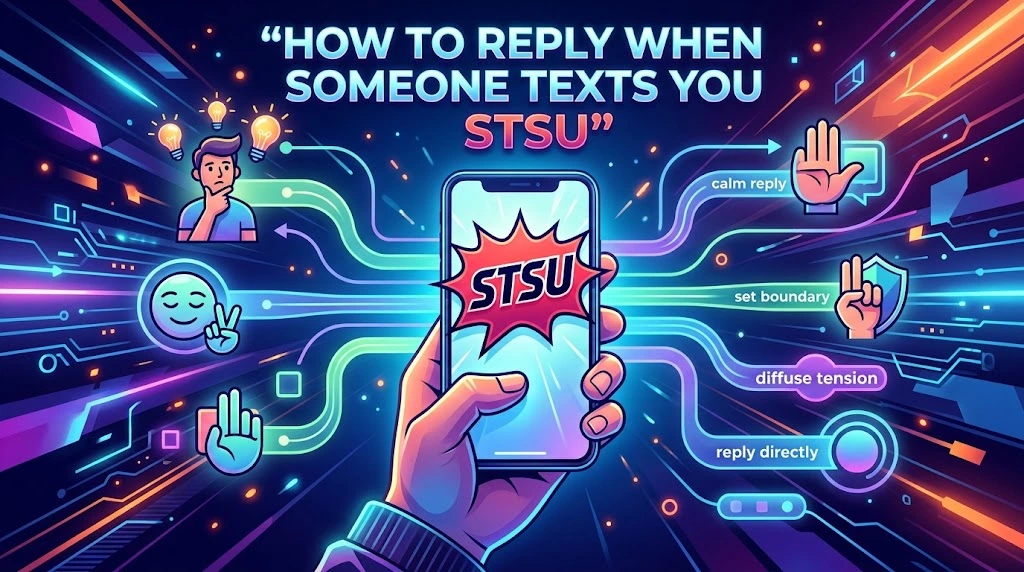
The best reply depends on what the sender appears to mean. If the message sounds playful, you can respond casually. If it feels hostile, you can ask for clarification or set a boundary.
Casual Replies to STSU
If a friend uses STSU after surprising news, you can keep the conversation moving with a simple response.
Examples include:
- “I’m serious 😂”
- “I know, right?”
- “Believe it!”
- “That’s exactly what I thought.”
- “Wait until you hear the rest.”
Example:
You: I ran into my favorite actor yesterday.
Friend: STSU 😭
You: I’m serious! We even took a picture.
This response confirms the news and invites the conversation to continue.
Funny Replies to STSU
If the sender is clearly joking, a humorous response can match their energy.
Try these examples:
- “I wish I were lying 💀”
- “You heard me!”
- “Let me cook 😂”
- “The truth is hard to accept.”
- “I said what I said.”
Use humor when you understand the other person’s tone. A sarcastic reply might make an already tense conversation worse.
Friendly Replies to STSU
Sometimes the easiest response is to acknowledge the person’s surprise and give them more information.
For example:
Friend: I heard you got the job. STSU!
You: Haha, it’s true! I start next Monday.
Other friendly replies include:
- “Yep, it finally happened!”
- “I still can’t believe it either.”
- “I’ll tell you everything later.”
- “I know, it’s a little crazy.”
These responses work when the sender appears excited or surprised.
What to Say When STSU Seems Rude
You don’t need to laugh off a message that feels disrespectful. If the sender seems angry, respond calmly or explain what you’re comfortable with.
Consider these options:
- “There’s no need to be rude.”
- “Can we talk about this respectfully?”
- “I’m happy to discuss it, but not if we’re insulting each other.”
- “If you need space, just tell me.”
- “I’m going to step away from this conversation for now.”
The right response depends on your relationship and the seriousness of the situation. You don’t have to escalate an argument just because someone sends an aggressive message.
How to Ask What STSU Means
When you’re unsure, asking directly is often the most effective option.
You can say:
“Hey, what do you mean by STSU? I’ve seen different explanations.”
Or keep it even simpler:
“Wait, what does that stand for?”
This approach is especially useful when the sender is an acquaintance, coworker, or someone who uses slang differently from you.
Read More : HMB Meaning in Text: What It Means, Examples, Replies, and Online Usage
Can STSU Have Other Meanings?
Yes, STSU can have different interpretations depending on the person, community, and subject being discussed. However, it’s important to separate documented slang usage from guesses about what each letter might represent.
Personal Shorthand and Inside Jokes
Friends sometimes create abbreviations that make sense only within their group. A phrase that one person uses regularly might be unfamiliar to everyone else.
For example, two friends might agree to use a particular abbreviation for an ongoing joke. That doesn’t mean the abbreviation has the same definition across the internet.
If STSU appears in a conversation about a shared memory, a game, or a private joke, the sender’s personal meaning may differ from the common slang interpretation.
Possible Typos or Misread Abbreviations
People type quickly, use autocorrect, and make mistakes. If STSU appears in an unusual sentence, consider whether the sender intended another abbreviation.
For example, STFU is a more widely recognized expression. Someone unfamiliar with STSU might wonder whether the sender mistyped a similar phrase.
Still, don’t automatically correct the message in your head. The sender may have deliberately chosen STSU.
How to Identify the Intended Meaning
Use these clues to work out what the sender probably means:
- Read the previous message. Was it surprising, funny, frustrating, or serious?
- Look at the relationship. Do you normally joke with this person?
- Check the tone. Are they laughing, arguing, teasing, or asking you to stop?
- Consider the setting. Is this a private chat, a public comment, or a professional discussion?
- Ask if necessary. A direct question is more reliable than guessing.
Don’t assume STSU means “Same to You,” “Stay True, Stay You,” or another suggested expansion simply because a website lists it. Those interpretations need supporting context before you can confidently apply them to a specific message.
Is STSU Still Popular in 2026?
STSU appears in online slang references and discussions, but that alone doesn’t establish how popular it is among everyday texters in 2026.
Unlike highly recognizable abbreviations such as LOL, OMG, and BRB, STSU has a less consistent meaning across online sources. That makes it harder to measure its use or determine whether it is gaining popularity.
Where You Might Encounter STSU
You may come across STSU in:
- Private text messages.
- Group chats with friends.
- Social media comments and direct messages.
- Informal conversations involving teasing or surprise.
- Online communities with their own slang.
These are plausible settings for informal abbreviations, not evidence that STSU is common on every platform.
Is STSU Common Among Younger Users?
It’s difficult to establish which age group uses STSU most without reliable survey data or platform-specific usage statistics.
Young people often participate in fast-moving online conversations, but that general observation doesn’t prove that STSU is especially popular among teenagers or young adults.
The abbreviation may be familiar to some social circles and completely unfamiliar to others. Online slang isn’t a universal language, even among people of similar ages.
The practical takeaway: Understand STSU as informal, context-dependent slang. Don’t assume that everyone recognizes it or that it represents a major social media trend.
Frequently Asked Questions About STSU
What Does STSU Mean in Text?
STSU is commonly associated with “Shut That Sh*t Up” or a similar “shut up” expression. Depending on the conversation, it may communicate surprise, disbelief, teasing, annoyance, or a demand to stop talking. Its exact expansion isn’t universally standardized.
What Does STSU Mean on Snapchat?
On Snapchat, STSU may be used as an informal reaction to surprising news, an unexpected photo, or a friend’s message. It can express playful disbelief or sound rude, depending on the conversation. Snapchat doesn’t give STSU a unique official meaning.
What Does STSU Mean on TikTok?
On TikTok, STSU may appear in comments, direct messages, or discussions about videos. Some users associate it with an exaggerated “shut up” reaction to surprising or unbelievable content. However, you should consider the comment’s context before deciding what the sender intended.
Is STSU Rude?
STSU can be rude because its common slang interpretation involves profanity and telling someone to stop talking. Friends may also use it jokingly when reacting to surprising news. The relationship, tone, and surrounding messages help determine whether it sounds playful or disrespectful.
What Does STSU Mean From a Girl?
If a girl sends STSU, she may be expressing surprise, teasing you, reacting to something unbelievable, or telling you to stop talking. The abbreviation alone doesn’t reveal whether she’s flirting, joking, or angry. Read the conversation and ask for clarification if you’re unsure.
What Does STSU Mean From a Guy?
If a guy texts STSU, the same general interpretations apply. He may be reacting dramatically to news, joking with a friend, or expressing frustration. STSU doesn’t automatically indicate attraction, anger, or any particular intention based on the sender’s gender.
Is STSU the Same as STFU?
No. STFU is a widely recognized abbreviation for “Shut the F*** Up,” while STSU is associated with variations of a similar expression. Their meanings can overlap, but STSU has less standardized wording. Both can sound offensive when used seriously.
Can STSU Have More Than One Meaning?
Yes. STSU may have different interpretations depending on the conversation, the sender’s personal shorthand, or the community using it. Its common slang association is a “shut up” expression, but not every occurrence necessarily carries that meaning. Context helps you distinguish between possibilities.
Should You Use STSU in Professional Messages?
It’s best to avoid STSU in professional communication. The abbreviation can be unclear and may carry an offensive meaning. In a work chat, use direct and respectful alternatives such as “Could we pause this discussion?” or “Let’s focus on the main issue.”
Conclusion: Understanding STSU in Text Messages
The STSU meaning in text is most commonly associated with “Shut That Sh*t Up” or a similar “shut up” expression. However, its wording isn’t standardized, and the tone can range from playful disbelief to genuine annoyance.
When a friend responds with STSU after surprising news, they may simply mean “No way!” During an argument, the same letters can sound dismissive or hostile.
Remember these three points:
- Check the context: The previous message often reveals the intended reaction.
- Consider the tone: A playful exchange differs from a serious argument.
- Ask when you’re unsure: A quick clarification beats an awkward misunderstanding.
Once you understand how the abbreviation works, it’s easier to interpret STSU without reading too much into four letters. And when you’re the one sending a message, choose wording that matches your audience and the situation.