
ISTG Meaning is commonly linked to I swear to God, an informal texting acronym used for emphasis, seriousness, surprise, or telling the truth. It often appears in text messages, social media, and online communication, especially when someone feels agitated, frustration, exasperation, or disbelief. The all-caps form “ISTG!!!” can add a stronger tone during emotional conversations or funny arguments.
People use it casually on TikTok, Instagram, Twitter/X, X, WhatsApp, and Snapchat, often among friends in casual chats. The primary meaning remains I swear to God, though niche expansions like I Stay on The Grind exist. Because it may sound like a literal religious oath, ISTG can seem inappropriate or offensive in some religious contexts. Therefore, avoid it in formal contexts, professional emails, or settings that require formal language.
This guide covers its origin, use, examples, common mistakes, and how to reply naturally when the phrase appears in chatting online. Understanding its emotional meanings can make internet slang less confusing and clarify why people type it differently depending on the situation. Related meanings, uses, messages, and similar slang expressions can also appear in everyday texting.
Quick Answer
ISTG meaning is “I swear to God.” In the USA, it usually signals strong sincerity, frustration, disbelief, or emphasis, although it can also be playful or exaggerated online.
TL;DR
- ISTG stands for “I swear to God.”
- Americans commonly use it in texts and social media.
- Its tone can be serious, annoyed, humorous, or dramatic.
- The underlying oath tradition is centuries old.
- Modern users don’t necessarily intend a religious statement.
- Context determines whether ISTG feels sincere or playful.
What Does ISTG Stand For?
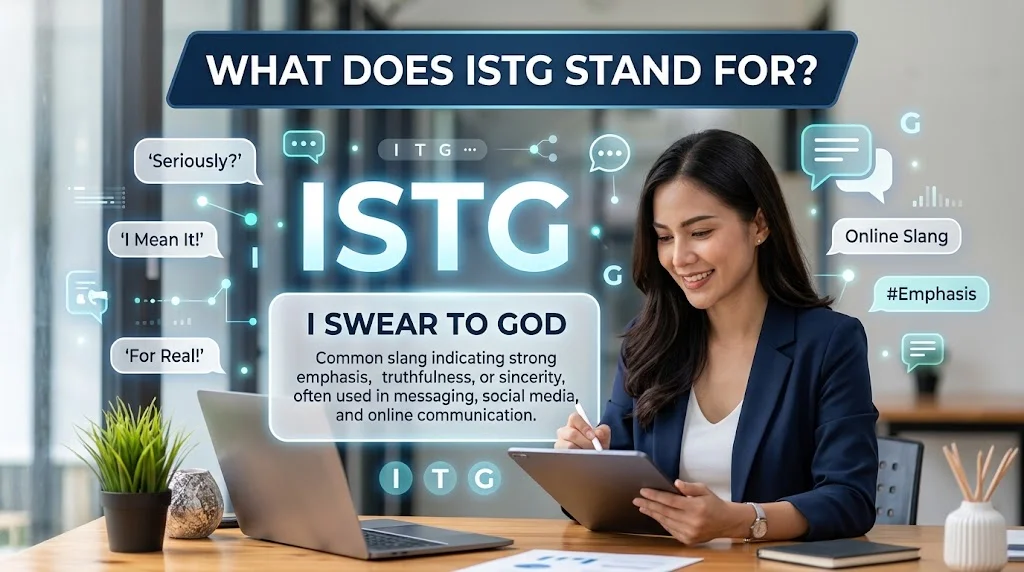
ISTG is an initialism formed from the first letters of “I Swear To God.” It became especially useful as digital communication made short expressions popular.
Unlike a traditional abbreviation, ISTG usually preserves the sound and emotional force of the original phrase. It lets someone type a strong reaction without writing the entire sentence.
The basic meaning
At its simplest, ISTG communicates something like:
- “I’m being completely serious.”
- “You need to believe me.”
- “I’m extremely frustrated.”
- “I can’t believe this happened.”
- “I strongly promise this is true.”
The exact meaning changes with context. For example, “ISTG I didn’t do it” sounds defensive and sincere. Meanwhile, “ISTG this cat is trying to kill me 😂” can be completely humorous.
Why the abbreviation works
Digital conversation often rewards speed and emotional shorthand. Therefore, ISTG works much like other initialisms that became common through texting and social media.
The abbreviation also preserves a recognizable cultural phrase. Most American English speakers can understand it immediately, even when they don’t personally use the expression.
What Does “I Swear to God” Mean?

The full phrase is an oath. Traditionally, an oath calls upon a divine authority to reinforce the truth of a statement or promise.
In everyday American English, though, “I swear to God” has several meanings. Sometimes it is a serious declaration. Other times, it simply adds emotional intensity.
Sincerity and emphasis
When someone says, “I swear to God, that’s what happened,” they’re usually emphasizing that they want to be believed.
The speaker may feel misunderstood or accused of lying. The religious reference gives the statement extra weight, even when the speaker isn’t making a formal religious oath.
Frustration and exasperation
The phrase can also introduce a complaint.
For example, someone might write, “ISTG, my Wi-Fi always stops working during meetings.” Here, the speaker isn’t making a formal promise. Instead, the phrase communicates strong irritation.
Humor and exaggeration
Online culture has expanded the phrase even further. ISTG can introduce an obviously exaggerated statement for comic effect.
That flexibility explains why the abbreviation appears in casual conversations among friends, memes, comments, and short-form social posts.
History of Swearing Oaths
The history behind ISTG reaches far beyond smartphones. Calling on a deity when making a serious statement is an ancient human practice.
Across many societies, people have treated certain promises and statements as especially important when connected to divine authority. The underlying idea is simple: invoking something sacred makes the speaker’s words carry greater moral weight.
Ancient roots
Ancient Mediterranean societies used various forms of oath-taking. Greek and Roman traditions, for example, included oaths connected with gods and sacred objects.
These practices weren’t identical to modern American expressions. However, they share an important pattern: a speaker invokes a higher power to strengthen a promise or claim.
Similar oath traditions also appeared in other parts of the ancient world. Their forms differed, but religious authority often played a role in establishing trust and accountability.
Jewish and Christian traditions
The phrase “I swear to God” also fits within a long history of biblical and Christian discussions about oaths.
Christian traditions inherited ideas about truthful speech, promises, and invoking God as a witness. At the same time, Christian teachings have sometimes warned against careless or unnecessary oaths.
Over centuries, these ideas became woven into English-speaking culture. As English-speaking societies developed, religious oath language could move from formal settings into ordinary conversation.
From formal oath to everyday expression
Oaths were historically important in courts, government, contracts, and personal promises. However, phrases involving God gradually became common figures of speech.
That shift matters when understanding ISTG today. The modern abbreviation is usually informal rather than ceremonial.
ISTG Meaning in American Culture
In the United States, ISTG reflects the country’s long relationship with both religious language and casual speech.
America has historically used religious language in formal settings. At the same time, everyday American English often turns serious phrases into conversational expressions.
Common American uses
ISTG may appear when someone wants to communicate:
- Strong personal sincerity
- Irritation with a repeated problem
- Surprise at an unexpected event
- Frustration during an argument
- Playful exaggeration between friends
- Confidence that a claim is true
The abbreviation therefore works across several emotional situations.
Why context matters
American communication tends to be highly informal in texting. People often communicate tone through capitalization, punctuation, emojis, repetition, and timing.
For instance, “ISTG.” can sound dramatically frustrated. “istg lol” may feel much lighter.
Likewise, “ISTG I’m telling the truth” is more serious than “ISTG this homework is destroying me.”
The words remain the same, but the social meaning changes.
Spiritual Meaning of “I Swear to God”
The phrase has a genuine religious dimension, but ISTG isn’t automatically a religious symbol.
For religious speakers, invoking God can still represent accountability, truthfulness, or the seriousness of a promise. However, many secular speakers use the expression as an established English idiom.
A distinction worth remembering
There is a difference between religious meaning and religious language.
A person can use religious language without intending a theological statement. Therefore, seeing ISTG in a text doesn’t tell you what the writer believes about religion.
Broader spiritual parallels
Oath-taking has appeared in many cultural and religious traditions. Different societies have used sacred names, objects, witnesses, or ceremonies to reinforce important promises.
These traditions shouldn’t be treated as identical. Still, they share the broader human idea that truth and promises can be connected to something considered higher or more binding than ordinary speech.
Emotional and Psychological Meaning of ISTG
ISTG is often less about literal theology and more about emotional intensity.
The phrase can act as a verbal signal that says, “Pay attention. I really mean this.”
What ISTG can signal
Depending on context, it may communicate:
- Sincerity when the speaker feels doubted
- Frustration when something goes wrong repeatedly
- Disbelief after something surprising
- Determination during an argument
- Amusement when exaggerating for comedy
- Emotional closeness among friends
Because of this range, ISTG is best understood as an intensity marker.
Why strong language feels powerful
People often use stronger expressions when ordinary wording doesn’t match their emotional state.
“I told you” is relatively neutral. “I swear to God, I told you” sounds much more emotionally charged.
ISTG compresses that emotional force into four letters. That makes it especially effective in fast-moving digital conversations.
ISTG in Texting and Social Media
Texting helped transform ISTG from a spoken phrase into a recognizable digital expression.
Unlike speech, text doesn’t automatically provide vocal tone. Therefore, users often rely on abbreviations to communicate emotion quickly.
Texting examples
The same abbreviation can take several forms:
| Context | Meaning in the USA | Common Association | Tone |
| “ISTG I didn’t do it” | Strong denial | Defensiveness | Serious |
| “ISTG this traffic” | Strong frustration | Daily annoyance | Exasperated |
| “ISTG that’s hilarious” | Strong emphasis | Excitement | Playful |
| “istg 😂” | Dramatic reaction | Friendly humor | Light |
| “ISTG, listen to me” | Demand to be believed | Conflict | Intense |
Punctuation and surrounding words often matter as much as the abbreviation itself.
Social media and memes
On social platforms, ISTG frequently appears in captions, comments, reaction posts, and memes. It works well because users can understand it quickly without a long explanation.
Additionally, internet humor often relies on deliberate exaggeration. ISTG fits that style naturally.
A post about a broken coffee machine might use ISTG as though the machine committed a personal betrayal. The humor comes from treating a small inconvenience as something dramatically serious.
ISTG in American Identity and Everyday Speech
ISTG isn’t an American national symbol in the traditional sense. Still, it reflects several characteristics of modern American communication.
American English frequently blends formal expressions with casual humor. Serious words can become everyday slang, while older religious phrases can survive in secular conversations.
From sacred language to casual language
This doesn’t necessarily mean the original meaning has disappeared. Instead, meanings can layer over one another.
For one speaker, “I swear to God” may feel spiritually significant. For another, it may simply mean “I seriously mean this.”
Both interpretations can exist in American English at the same time.
Generational differences
Younger Americans are particularly familiar with internet-based abbreviations. Older speakers may recognize the full phrase but not use ISTG themselves.
However, digital abbreviations increasingly cross age groups. Their use depends more on online habits and social circles than on age alone.
Read More: MBN Meaning: What This Slang Really Means
Is ISTG a Religious Expression?
ISTG can be religious language, but it isn’t necessarily a religious expression in practice.
The abbreviation comes directly from a phrase that invokes God. However, contemporary speakers often use it as an idiom rather than as a formal declaration of faith.
Religious and secular interpretations
A religious speaker might view the phrase as a serious appeal to divine witness. A secular speaker may use exactly the same words as an emotional intensifier.
Neither interpretation should automatically be assumed from the abbreviation alone.
That distinction is especially useful in diverse American communities. The United States includes people with many religious beliefs, as well as people who are nonreligious.
Misunderstandings and Controversies Around ISTG
Because ISTG invokes God, some people consider it inappropriate, disrespectful, or too casual.
Others view it as ordinary slang with little religious intent. Both reactions can occur depending on personal beliefs and social setting.
Taking God’s name casually
Some religious traditions place special importance on how God’s name is used. From that perspective, casually saying “I swear to God” can feel disrespectful.
The concern isn’t necessarily about the abbreviation itself. Instead, it comes from the religious meaning of invoking God’s name in everyday speech.
Why context prevents confusion
ISTG should not automatically be interpreted as a formal oath.
A courtroom oath, religious vow, and joking text message operate in very different settings. Treating them as identical would miss the important difference between formal symbolism and casual slang.
When ISTG may be a poor choice
In professional, formal, or highly religious settings, the abbreviation may sound overly casual or emotionally charged.
A simple statement such as “I can confirm that happened” may communicate the same information more appropriately.
How the Meaning of ISTG Has Changed
The underlying phrase is old, but its digital form is relatively recent.
This is a good example of how language changes without completely abandoning its past.
Earlier meaning
Historically, oath language emphasized truth, promises, and accountability. Religious references could make a statement feel binding or solemn.
Modern meaning
Today, ISTG often works as an emotional shortcut.
Its meaning can range from “I genuinely promise” to “I am extremely annoyed” or “This is ridiculously funny.”
What has stayed the same
One element remains remarkably stable: intensity.
Whether the speaker is serious, angry, or joking, ISTG usually tells the reader that the statement carries extra emotional weight.
ISTG Tattoos, Decor, and Personal Expression
ISTG is less common as a traditional tattoo symbol than visual symbols such as crosses, hearts, stars, or religious imagery. However, some people use short phrases and abbreviations as personal statements.
A tattoo featuring ISTG could have very different meanings depending on the person.
Possible personal meanings
Someone might associate it with:
- A memorable phrase shared with close friends
- A personal promise or life event
- A humorous reference to internet culture
- A reminder to remain truthful
- A private joke with emotional significance
Unlike established religious symbols, ISTG has no single universal tattoo meaning.
Therefore, the person’s story matters more than a fixed symbolism dictionary.
What Does ISTG Say About the Person Using It?
An ISTG message doesn’t reveal someone’s personality with certainty. Still, its use can signal how someone wants their message to feel.
Usually, the writer wants stronger emphasis than ordinary wording provides.
Common social signals
An ISTG user may be trying to sound:
- Direct rather than formal
- Emotionally expressive
- Dramatic for comic effect
- Convincing during disagreement
- Familiar with internet slang
- Comfortable using informal language
However, context always matters more than the abbreviation itself.
A single ISTG message shouldn’t be treated as a personality test or statement about someone’s beliefs.
Conclusion
ISTG Meaning is most often I swear to God, a common texting slang acronym used to show seriousness, frustration, surprise, or emphasis. Its meaning depends on the tone, situation, and context of the conversation. While it works well in casual chats with friends, it may not fit formal contexts or professional emails because of its religious wording.
FAQs
What does ISTG mean in texting?
ISTG usually means I swear to God. People use it in text messages to express seriousness, truth, frustration, or disbelief.
What does ISTG mean on social media?
On social media, ISTG generally means I swear to God. It commonly appears on TikTok, Instagram, Snapchat, WhatsApp, and X.
Is ISTG considered rude?
It can be viewed as offensive or inappropriate by some people because it uses religious language. The reaction depends on the person and context.
Can I use ISTG in professional emails?
It’s better to avoid ISTG in professional emails and other situations requiring formal language. A clearer, more professional phrase is usually better.
What does “ISTG!!!” mean?
“ISTG!!!” is an all-caps version that adds strong emphasis. It may show exasperation, surprise, frustration, or that someone is especially serious.
How should I reply to ISTG?
Your reply should match the tone of the conversation. In a casual conversation, you can respond naturally based on whether the person is making a promise, expressing disbelief, or showing frustration.