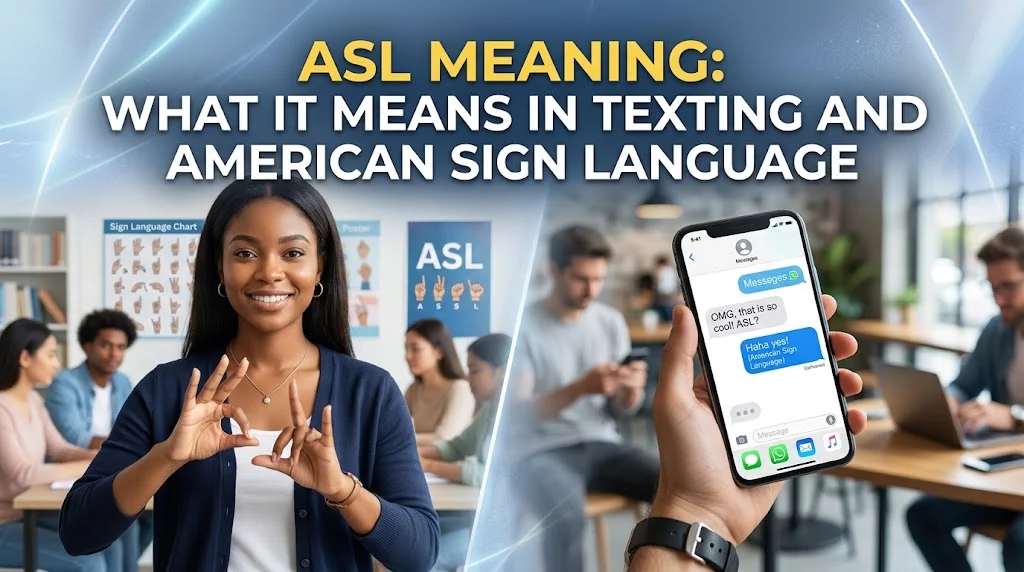
Understanding ASL Meaning can be useful when you see this abbreviation in texts, social media, or everyday conversations. ASL commonly refers to American Sign Language, a complete visual language used by many people in the United States and parts of Canada. It can also appear as “as hell” in informal internet slang, so the intended meaning depends on the context.
When discussing American Sign Language, ASL involves hand signs, facial expressions, body movements, and visual communication. It has its own grammar, vocabulary, and sentence structure, rather than being a signed version of spoken English. People may encounter ASL through deaf culture, sign language interpretation, education, accessibility, and online content.In texting, however, ASL can have a completely different meaning. Someone might use ASL slang, texting abbreviations, or internet shorthand to express strong emotion.
Older online conversations may also use ASL to mean “age, sex, location,” especially in chat rooms.Knowing these different meanings helps prevent confusion. Whether you’re researching ASL language, learning about signing, or trying to understand online slang, the surrounding words usually reveal what ASL means.
Quick Answer
ASL meaning in the United States usually refers to American Sign Language, a visual language with its own grammar and vocabulary. In older online slang, ASL can also mean “age, sex, location,” although that usage is much less common today.
TL;DR
- ASL most commonly means American Sign Language in the United States.
- American Sign Language is a complete natural language.
- ASL has its own grammar, vocabulary, and cultural history.
- Online slang once used ASL for “age, sex, location.”
- Context determines which ASL meaning someone intends.
- Modern digital use often relates to Deaf culture and accessibility.
What Does ASL Stand For?
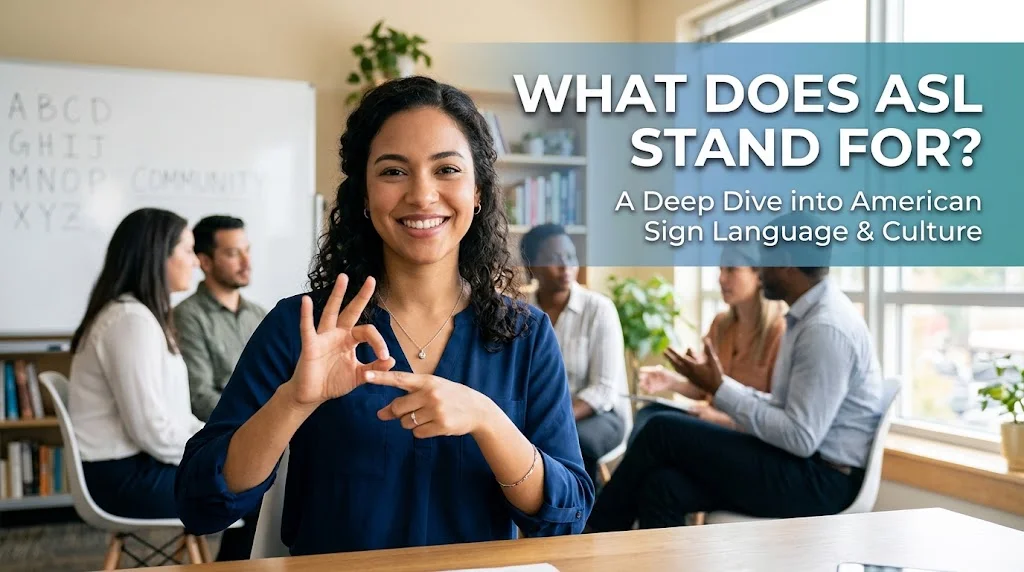
ASL has two major meanings that readers may encounter. The first is American Sign Language, while the second is the older internet abbreviation for “age, sex, location.”
American Sign Language
American Sign Language is a visual language expressed through the hands, face, body, and space. It isn’t simply English spoken with hand movements.
Instead, ASL has its own grammatical rules and ways of organizing ideas. Signers can express complex thoughts, emotions, questions, stories, and abstract concepts.
ASL also has regional variations and natural changes, just like spoken languages.
ASL in Online Slang
In older internet chat culture, “ASL?” often meant:
- Age
- Sex
- Location
Someone might type “ASL?” when meeting another person online. The question was especially associated with chatrooms, instant messaging, and early social websites.
Today, however, this meaning feels dated in many online spaces. People are more likely to ask those questions directly or share information through profiles.
What Is American Sign Language?
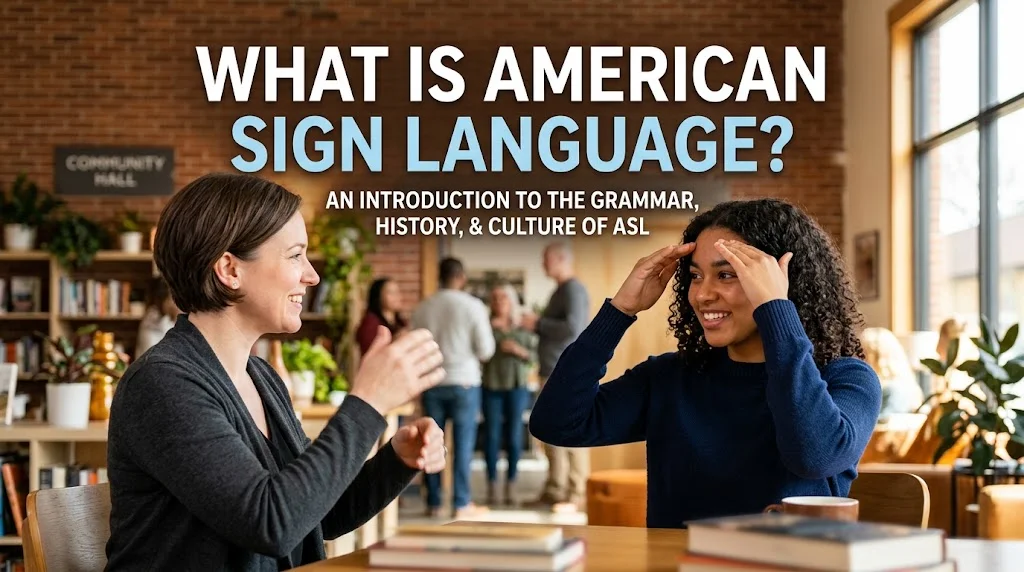
American Sign Language is a natural language primarily used in the United States and parts of Canada. It developed within Deaf communities and became an important part of American Deaf culture.
More Than Hand Gestures
One common misunderstanding is that ASL is a signed version of spoken English. It isn’t.
ASL has its own:
- Grammar and sentence structure
- Vocabulary and signs
- Facial expressions
- Body movements
- Spatial relationships
- Regional variations
Facial expressions can even help communicate grammatical information. Therefore, a signer’s face can be as meaningful as their hands.
A Living Language
ASL continues to change as its users change. New expressions, slang, abbreviations, and signs can emerge naturally.
Like spoken languages, ASL can vary between communities and generations. Younger signers may use expressions that older generations don’t use as often.
That flexibility is an important part of understanding ASL as a real language rather than a collection of gestures.
Read More:TBH Meaning: What “To Be Honest” Really Means
The History of American Sign Language
The history of ASL is closely connected with the development of Deaf education in America. Its story also reaches beyond the United States.
Early Roots
Before formal Deaf schools existed, Deaf people in different communities developed signs for communication. However, these local systems weren’t necessarily the same as modern ASL.
A major turning point came in the early 19th century. French educator Laurent Clerc came to the United States with Thomas Hopkins Gallaudet.
In 1817, they helped establish the American School for the Deaf in Hartford, Connecticut. The school became a major center in the development and spread of American Sign Language.
French Sign Language Influence
French Sign Language played an important role in ASL’s early development. Clerc brought knowledge of French signing traditions to the United States.
At the same time, American Deaf communities already had their own local signing systems. These influences interacted over time.
As a result, modern ASL developed through contact between different signing traditions.
Growth Through Deaf Communities
Schools helped spread signing between Deaf students from different regions. Students brought local signs with them and learned from one another.
Over generations, these interactions helped shape a shared language. Deaf communities then became central to maintaining and developing ASL.
The history also shows why language and culture cannot always be separated neatly. ASL became both a means of communication and a major part of Deaf identity.
ASL Meaning in American Culture
In the United States, ASL has a strong connection with Deaf culture, community, education, and accessibility. Its meaning goes beyond individual hand signs.
Language and Identity
For many ASL users, signing can be an important part of cultural identity. Deaf communities have developed traditions, humor, storytelling styles, and social networks around shared language.
However, not every Deaf person has the same relationship with ASL. Individual experiences vary widely.
Some people learn ASL later in life. Others grow up signing with Deaf family members or attend schools where signing is central.
Accessibility in Everyday Life
ASL is increasingly visible in American public life. It may appear in educational programs, community events, entertainment, workplaces, and accessibility services.
You may also see ASL interpretation at public gatherings. These interpreters help make spoken information available to people who communicate through signing.
| Context | ASL Meaning in the USA | Common Association | Important Note |
| Deaf communities | American Sign Language | Language and culture | A complete natural language |
| Education | American Sign Language | Learning and communication | Used in schools and programs |
| Accessibility | Sign language interpretation | Inclusion | Helps provide communication access |
| Social media | American Sign Language | Deaf creators and education | Usage varies by platform |
| Older chatrooms | Age, sex, location | Online introductions | Largely dated slang |
How ASL Differs From Other Sign Languages
ASL isn’t a universal sign language. Different countries and communities have developed their own sign languages.
ASL and British Sign Language
One surprising fact is that ASL and British Sign Language are quite different. English-speaking countries don’t necessarily share the same sign language.
ASL has historical links with French Sign Language. British Sign Language developed through different historical pathways.
Therefore, knowing ASL doesn’t automatically mean someone can understand British Sign Language.
Sign Languages Around the World
Other countries have their own established sign languages. These languages can have distinct grammar, vocabulary, and cultural traditions.
That diversity is similar to spoken languages. A person who speaks American English doesn’t automatically understand every other English variety perfectly.
The same principle applies to signed languages.
The Spiritual and Cross-Cultural Meaning of ASL
ASL itself isn’t a spiritual symbol. It’s a language used by people with many different beliefs and backgrounds.
Communication and Connection
Because signing relies heavily on visual communication, people sometimes associate it with ideas such as connection, expression, and accessibility.
These are broad symbolic associations rather than formal meanings of ASL.
Different Cultural Traditions
Sign languages appear in many societies, including communities with different religious and cultural traditions. Their meanings depend on the people using them.
It’s therefore better to avoid treating ASL as a universal spiritual code. Its primary meaning is linguistic and cultural.
The Emotional Meaning of ASL
ASL can carry strong emotional associations because language is closely connected with relationships and identity.
Common Associations
For people familiar with ASL, signing may evoke:
- Community and belonging
- Visual communication
- Self-expression
- Accessibility and inclusion
- Cultural identity
- Connection across communication differences
These associations aren’t universal. Someone learning ASL as a second language may experience it very differently.
Why Facial Expression Matters
ASL communication uses more than the hands. Facial expressions, posture, and movement can contribute important information.
Consequently, signing can appear highly expressive to people encountering it for the first time.
However, describing ASL simply as “expressive gestures” misses its linguistic structure. It’s a language, not theatrical movement.
ASL Meaning in Texting and Social Media
Digital communication has created another layer of meaning for ASL. Today, the abbreviation can appear in posts, comments, captions, profiles, and private messages.
When ASL Means American Sign Language
Context usually makes the intended meaning clear.
For example:
“I’m learning ASL this semester.”
Here, ASL clearly means American Sign Language.
Similarly:
“Can you recommend an ASL interpreter?”
Again, the meaning is connected to signing and accessibility.
When ASL Means “Age, Sex, Location”
The older slang meaning appears differently:
“ASL?”
In this setting, the person is asking for age, sex, and location.
This abbreviation became especially recognizable during early online chat culture. Today, it can sound nostalgic, outdated, or suspicious depending on the situation.
Modern Digital Context
Social media has also helped increase public exposure to ASL. Deaf creators and educators use online platforms to share language lessons, stories, humor, history, and everyday experiences.
As a result, many younger users encounter “ASL” primarily through Deaf culture rather than old chatroom slang.
ASL in Tattoos, Art, and Design
ASL can appear in visual art and personal designs, although its meaning depends on the specific image.
Hands as Visual Symbols
Hands have long carried symbolic meanings in art. They can represent communication, action, greeting, work, or connection.
When a tattoo incorporates an ASL sign, the intended meaning may be deeply personal.
For example, someone might choose a sign connected with family, love, resilience, or a meaningful relationship.
Important Cultural Context
Using an ASL sign as decoration isn’t automatically the same as understanding ASL. A single hand shape may have a specific linguistic meaning that differs from what outsiders assume.
Therefore, people choosing ASL-inspired designs should consider accuracy and cultural context.
Why People Learn ASL Today
ASL learning has grown beyond traditional Deaf education settings. Americans may study it for personal, educational, professional, or community reasons.
Common Motivations
People may learn ASL because they:
- Want to communicate with Deaf family members
- Work in education or public service
- Have Deaf friends or coworkers
- Enjoy learning another language
- Want greater communication accessibility
- Are interested in Deaf history and culture
Learning ASL can therefore serve both practical and social purposes.
ASL as a Second Language
For hearing Americans, learning ASL can provide a different experience from studying a spoken language.
Students must learn visual vocabulary, grammar, spatial concepts, and culturally appropriate communication habits.
Practice also involves paying attention to facial expressions and body movement.
Common Misunderstandings About ASL
Because ASL is often unfamiliar to non-signers, several misconceptions persist.
“ASL Is Universal”
It isn’t. Many countries have their own sign languages.
“ASL Is Just English on the Hands”
It isn’t a word-for-word translation of English. Its grammar and vocabulary are distinct.
“Every Deaf Person Uses ASL”
Not necessarily. Deaf people have different communication backgrounds and preferences.
“ASL Only Means Sign Language”
Not in every context. In older internet slang, “ASL” can mean “age, sex, location.”
Context remains the most reliable way to interpret the abbreviation.
Controversies and Changing Meanings
ASL doesn’t have one fixed public meaning. Its interpretation has changed as technology and culture have changed.
The Decline of “ASL?” as Chat Slang
Early online chat made short abbreviations extremely useful. Typing “ASL?” saved time when users wanted basic personal information.
Modern social platforms changed that pattern. Profiles, usernames, images, and direct messaging make the old three-letter question less necessary.
As a result, the slang meaning is now often associated with older internet culture.
Cultural Appropriation and Misuse
ASL belongs to a living linguistic and cultural community. Problems can arise when signs are copied without understanding their meaning or cultural context.
That doesn’t mean outsiders cannot learn or use ASL. In fact, learners are an important part of the language community.
The key distinction is respectful learning versus treating a living language as a decorative trend.
How the Meaning of ASL Has Shifted Over Time
The abbreviation ASL demonstrates how language changes with technology and culture.
From Language to Internet Slang
American Sign Language predates the internet by many generations. Yet online communities later gave the same three letters another meaning.
For a time, “ASL?” became a recognizable online introduction.
Today, that usage has declined while awareness of American Sign Language has grown.
A Modern Perspective
For many Americans today, ASL first brings to mind Deaf communication, accessibility, and language education.
Older internet users may remember a different meaning. Younger users may never have encountered the slang version.
Both meanings exist, but they occupy very different cultural spaces.
Why Context Matters When Reading ASL
A three-letter abbreviation can’t always be understood in isolation. The surrounding words provide the strongest clue.
Context Clues
Consider these examples:
“ASL classes begin Monday.”
This almost certainly refers to American Sign Language.
“What’s your ASL?”
This could be old internet slang, depending on the conversation.
“ASL interpreter needed for the event.”
Here, the meaning is clearly American Sign Language.
Understanding context prevents unnecessary confusion.
Read More:WYLL Meaning: What It Means in Texting
ASL Meaning in American Life Today
ASL represents more than a collection of signs. In the United States, it connects language, community, history, education, and accessibility.
Everyday Visibility
Today, Americans may encounter ASL in classrooms, workplaces, online videos, public events, and community organizations.
Its visibility has also increased through digital media. Deaf creators can communicate directly with broad audiences without relying entirely on traditional media.
A Language Still Evolving
ASL continues to develop alongside its users. New technology creates new ways to communicate, while communities continue passing language between generations.
That ongoing change is normal for a living language.
Conclusion
The meaning of ASL depends heavily on where and how it appears. Most often, American Sign Language refers to a visual language with its own grammar and cultural identity. In casual texting, ASL can instead mean “as hell” or, in older online contexts, “age, sex, location.” Looking at the conversation, platform, and surrounding words can help you identify the correct ASL meaning quickly.
FAQs
What does ASL mean in texting?
In texting, ASL can mean “as hell.” For example, someone might say “tired ASL” to mean “extremely tired.” The exact meaning depends on the conversation.
What does ASL stand for in sign language?
ASL stands for American Sign Language. It’s a complete visual language with its own grammar, vocabulary, and rules.
Is ASL the same as English?
No. American Sign Language isn’t simply English represented with hand movements. It has its own linguistic structure and grammar.
What does ASL mean on social media?
On social media, ASL may refer to American Sign Language or informal slang such as “as hell.” Context determines the intended meaning.
What did ASL mean in old chat rooms?
In older internet chat rooms, ASL commonly meant “age, sex, location.” People used it to ask basic personal information from another person.
How can I tell which ASL meaning someone intends?
Look at the surrounding words and the platform. Discussions about deaf culture or signing usually indicate American Sign Language, while casual slang often points to another meaning.