
At first glance, how-to looks like a simple phrase. Then you try to write about several of them and suddenly the apostrophe appears: how-to’s, how to’s, or how-tos?
That tiny punctuation mark causes a surprisingly large amount of confusion.
The good news is that the basic rule is straightforward. When how-to functions as a noun meaning an instructional guide or piece of practical advice, its standard plural form is how-tos. When how to introduces an infinitive, however, it normally stays open as two words.
Compare these sentences:
- “She learned how to bake bread.”
- “She wrote a how-to about baking bread.”
- “The website contains dozens of how-tos.”
- “She published a how-to guide for beginners.”
The words look similar, but they perform different grammatical jobs.
Understanding that difference will help you choose the right spelling every time. It also explains why how to’s is generally not the preferred plural and why how-to’s can mean something different when the apostrophe actually indicates possession.
What Does “How-To” Mean?
The first step is separating the ordinary phrase how to from the compound how-to.
English often turns familiar phrases into compound nouns and modifiers. Once that happens, punctuation can signal a change in grammatical function. How-to is one example.
Modern dictionaries recognize how-to as both a noun and an adjective. As a noun, it refers to a guide or instructional piece. As an adjective, it describes something that provides practical instructions.
That gives us two important forms:
- how to — an ordinary grammatical construction
- how-to — a compound noun or modifier
The difference may look small on the page, but it matters.
“How to” as a Verb Phrase
When how to appears before a base verb, it normally functions as part of an infinitive construction.
For example:
- “I don’t know how to fix the sink.”
- “She learned how to use the software.”
- “Can you show me how to open the file?”
- “They explained how to prepare the equipment.”
In these sentences, how to isn’t a noun meaning “instructional guide.” Instead, it introduces the method or manner of performing an action.
You wouldn’t normally hyphenate it.
So these are standard:
“He taught me how to drive.”
“I need to learn how to install the program.”
Not:
“He taught me how-to drive.”
The hyphen would change the visual and grammatical structure of the expression.
“How-To” as a Noun
Now consider this sentence:
“I found a useful how-to online.”
Here, how-to itself represents an instructional resource. You could replace it with guide, tutorial, or set of instructions without changing the basic meaning.
For example:
- “I found a useful how-to.”
- “I found a useful guide.”
- “I found a useful tutorial.”
That’s why the hyphenated form makes sense.
The noun how-to can describe instructional material in many formats, including an article, video, book, or other resource.
“How-To” as a Modifier
The same compound can appear before another noun:
- how-to guide
- how-to article
- how-to book
- how-to video
- how-to manual
- how-to tutorial
In these expressions, how-to tells you what kind of guide, article, book, or video you’re dealing with.
For example:
“She published a how-to article about repairing bicycles.”
The phrase how-to acts as a compound modifier. The hyphen helps show that the two words work together to modify article.
Without the hyphen, the structure becomes less clear:
“She published a how to article.”
Although readers may understand the intended meaning, how-to article is the cleaner standard form.
How to Decide Between “How to” and “How-To”
The easiest way to choose the correct form is to ask what role the words play.
If how to is followed by a verb and expresses the method of doing something, leave it open.
If how-to means an instructional resource or modifies another noun, use the hyphen.
Use “How to” for an Infinitive Construction
Use how to when you’re talking about learning, explaining, discovering, or understanding a method.
Examples include:
- “She learned how to swim.”
- “I don’t know how to solve this problem.”
- “The instructor explained how to operate the machine.”
- “They showed us how to make the recipe.”
- “He discovered how to improve the process.”
Here, how to connects naturally with the following verb.
Use “How-To” as a Noun
When you’re naming the instructional material itself, use how-to.
Examples:
- “I read a helpful how-to.”
- “The magazine published a new how-to.”
- “This how-to explains the process clearly.”
- “She specializes in writing how-tos.”
A useful test is substitution.
If you can replace how-to with guide or tutorial, you’re probably dealing with the noun.
For example:
“I found a helpful how-to.”
Becomes:
“I found a helpful guide.”
That works perfectly.
Try the same test here:
“I learned how to swim.”
Replacing how to with guide doesn’t work. That’s a clue that you’re dealing with the ordinary grammatical construction rather than the noun.
Use “How-To” Before Another Noun
When how-to directly modifies another noun, the hyphenated form is generally the clearest choice.
Examples:
- how-to guide
- how-to article
- how-to book
- how-to video
- how-to manual
- how-to course
Consider the difference between these sentences:
“I found a guide explaining how to repair the door.”
and:
“I found a how-to guide for repairing the door.”
Both can work. The first treats how to repair as part of the sentence’s grammatical structure. The second uses how-to as a compound modifier.
Is “How-To” Always Hyphenated?
No. This is one of the most important points to remember.
The hyphen doesn’t belong to every appearance of the words how to. It belongs to the compound how-to when that compound functions as a noun or modifier.
When “How-To” Takes a Hyphen
Use how-to when it functions as an established compound noun or modifier.
Examples:
- “I downloaded a how-to.”
- “The magazine offers several how-to articles.”
- “She watched a how-to video.”
- “We need a detailed how-to guide.”
The hyphen tells the reader that how-to operates as one compound unit.
When “How To” Stays Open
Keep the words separate when how to introduces an infinitive.
Examples:
- “I learned how to cook.”
- “She knows how to fix computers.”
- “They explained how to apply the formula.”
- “Do you know how to change the settings?”
Don’t automatically insert a hyphen just because the words appear next to each other.
Why Context Matters
Context determines the correct form.
Compare:
“She explained how to write a good headline.”
with:
“She published a how-to guide about writing headlines.”
In the first sentence, how to write introduces an action.
In the second, how-to describes the type of guide.
The distinction becomes even clearer when you compare these:
| Expression | Function | Correct? |
| how to write | Infinitive construction | Yes |
| how-to guide | Compound modifier | Yes |
| how-to | Noun | Yes |
| how-tos | Plural noun | Yes |
| how to’s | Attempted plural | Generally no |
| how-to’s | Usually incorrect as a plural | No |
What Is the Correct Plural: “How-Tos” or “How To’s”?
Here’s the answer most writers are looking for:
The standard plural of “how-to” is “how-tos.”
Both Cambridge Dictionary and Oxford Advanced Learner’s Dictionary list how-tos as the plural form of the noun how-to.
That matters because dictionaries aren’t merely guessing how people might write the word. They record established usage and grammatical forms.
So if you’re referring to several instructional guides, write:
“The website contains dozens of how-tos.”
Not:
“The website contains dozens of how-to’s.”
And not:
“The website contains dozens of how to’s.”
Why “How-Tos” Is the Preferred Plural
The reason is simple: how-to is already functioning as a compound noun.
When you pluralize it, you add -s to the end:
how-to → how-tos
The same basic pattern appears in many other compound nouns:
| Singular | Plural |
| follow-up | follow-ups |
| check-in | check-ins |
| setup | setups |
| backup | backups |
| how-to | how-tos |
You don’t normally need an apostrophe to make these nouns plural.
The apostrophe isn’t a decoration. It has a job.
Why “How To’s” Creates Confusion
The spelling how to’s creates two problems.
First, it removes the compound’s hyphen.
Second, it uses an apostrophe as a plural marker.
That second point is particularly important.
In standard English, apostrophes generally mark possession or contractions, not ordinary plurals.
For example:
- “the writer’s guide” — possession
- “the guide’s introduction” — possession
- “don’t” — contraction of do not
- “how-tos” — plural
The apostrophe in how to’s doesn’t indicate possession. It simply tries to make the expression plural.
That’s why the form is generally avoided in edited standard English.
What About “How-To’s”?
You may also see how-to’s.
This spelling is especially tempting because the hyphen makes the compound look neat and the apostrophe seems to signal that an s has been added.
However, if you’re simply forming the plural, the cleaner standard form is:
how-tos
The apostrophe isn’t necessary.
“How-Tos” vs. “How-To’s”: A Crucial Distinction
There’s one subtle point worth understanding.
An apostrophe isn’t always wrong after how-to. It can be correct when it expresses possession.
Compare:
“The website contains five how-tos.”
Here, how-tos means multiple instructional pieces.
Now compare:
“The how-to’s introduction was unusually detailed.”
Here, how-to’s can be interpreted as the possessive form of the singular noun how-to.
The meaning is completely different.
Plural
“The company published three how-tos.”
Meaning: three instructional pieces.
Possessive
“The how-to’s author added several diagrams.”
Meaning: the author of the how-to.
The apostrophe now has a legitimate grammatical purpose.
This distinction is important because saying “never use how-to’s” without explaining possession oversimplifies the issue.
The real rule is:
Use “how-tos” for the plural. Use an apostrophe only when you actually need the possessive form.
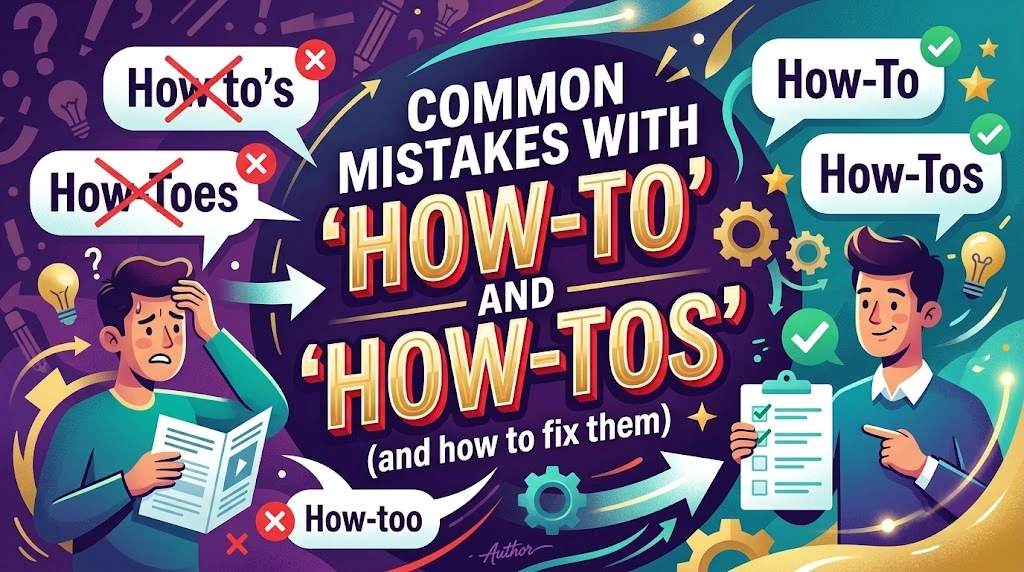
Common Mistakes With “How-To” and “How-Tos”
These forms often get mixed up because English doesn’t always make compound words visually predictable.
Mistake: Hyphenating Every “How To”
Incorrect:
“I learned how-to cook.”
Correct:
“I learned how to cook.”
The phrase how to cook contains an infinitive. It isn’t a compound noun.
Mistake: Writing “How To’s” for the Plural
Incorrect:
“The site has hundreds of how to’s.”
Preferred:
“The site has hundreds of how-tos.”
The plural doesn’t require an apostrophe.
Mistake: Writing “How-To’s” as the Default Plural
Less appropriate:
“We added five new how-to’s.”
Preferred:
“We added five new how-tos.”
Again, the plural needs only -s.
Mistake: Confusing the Noun With the Modifier
Consider:
“I found a useful how-to.”
Here, how-to is a noun.
Now:
“I found a useful how-to article.”
Here, how-to modifies article.
The spelling remains the same because the compound remains intact. The grammatical function changes.
Mistake: Assuming Every Instructional Resource Is a “How-To”
Not every instructional resource has to be called a how-to.
A long technical document may be better described as a manual.
A guided learning resource might be a tutorial.
A short set of directions might simply be instructions.
Choosing the right noun can make your writing more precise.
How Apostrophes Actually Work in “How-Tos”
Apostrophes cause trouble because writers sometimes learn an overly broad rule: “Add an apostrophe when you add s.”
That’s not how standard English works.
Apostrophes Usually Show Possession
Examples include:
- the teacher’s manual
- the writer’s article
- the guide’s introduction
- the tutorial’s final section
In each case, the apostrophe shows a relationship of possession or association.
Apostrophes Also Mark Contractions
Examples include:
- don’t
- can’t
- isn’t
- it’s
- you’re
Here, the apostrophe represents omitted letters.
Apostrophes Don’t Normally Make Ordinary Plurals
These forms don’t need apostrophes:
- books
- guides
- tutorials
- videos
- articles
- how-tos
Therefore:
one how-to → several how-tos
That’s the cleanest rule.
How “How-To” Works as a Noun Modifier
The compound how-to has become especially useful in digital publishing because instructional content appears in countless formats.
You might encounter:
- how-to articles
- how-to videos
- how-to books
- how-to guides
- how-to courses
- how-to manuals
- how-to resources
- how-to websites
In each case, how-to describes the type of material.
“How-To Guide”
The phrase how-to guide is extremely common.
Some writers wonder whether it sounds redundant because both words suggest instructions.
It isn’t grammatically wrong.
A how-to identifies instructional content while guide identifies the resource as a guide. Together, they create a familiar and immediately understandable phrase.
For example:
“The company published a how-to guide for new employees.”
That’s perfectly natural.
“How-To Article”
A how-to article is generally an article that explains how to perform a task.
For example:
“The magazine published a how-to article about growing tomatoes.”
The compound modifier tells the reader exactly what kind of article it is.
“How-To Video”
The same pattern applies to video content:
“The website contains a how-to video showing beginners how to replace a faucet.”
Notice that the sentence contains both forms:
- how-to video — compound modifier
- how to replace — ordinary grammatical construction
That’s an excellent example of why context matters.
“How-To” vs. “Tutorial” vs. “Guide”
Writers sometimes use these terms interchangeably, but they can carry slightly different implications.
A how-to usually focuses on practical instructions.
A tutorial often implies a teaching sequence that helps someone develop a skill.
A guide can be broader. It may explain a process, provide background information, compare options, or offer instructions.
For example:
| Term | Typical emphasis |
| how-to | Practical instructions for doing something |
| tutorial | Teaching a skill or process |
| guide | Broader explanation or practical reference |
| manual | Detailed formal instructions or operating information |
| instructions | Direct steps for completing a task |
| walkthrough | Step-by-step explanation, often in sequence |
The terms overlap. Still, choosing the most precise one can make your writing stronger.
“How-Tos” in Real-World Writing
The word how-tos works naturally across many industries.
Technology
Technology websites frequently publish instructional content.
Examples:
“The support center contains how-tos for common software problems.”
“Our library includes how-tos for setting up new devices.”
Cooking
Food publishers can use the term when referring to instructional resources.
“The website features how-tos on preparing fresh pasta.”
Home Improvement
DIY content provides another natural setting:
“The magazine publishes how-tos on basic home repairs.”
Education
Educational websites may organize practical resources as how-tos:
“The teacher created several how-tos for using the new classroom platform.”
Business
Companies can also use the term internally:
“The training portal includes how-tos for completing common administrative tasks.”
The word isn’t limited to casual writing. Its usefulness comes from its concise meaning.
A Practical Case Study: Editing a Website’s Content Library

Imagine a website that has published 50 instructional articles.
Its category page originally says:
“Browse our How To’s.”
The editor wants the wording to follow standard modern usage more closely.
A simple revision would be:
Browse our How-Tos
Why?
The site isn’t asking readers to learn how to do something within that phrase. It is naming a collection of instructional resources.
The compound noun is therefore how-to, and its plural is how-tos.
The editor could also avoid the issue completely:
Browse Our Guides
or:
Browse Our How-To Guides
Each version works. The best choice depends on the site’s tone and naming system.
This illustrates an important writing principle: sometimes the cleanest correction isn’t merely changing punctuation. It’s choosing the most natural expression for the audience.
When You Can Avoid Pluralizing “How-To”
You don’t always need to use how-tos.
If the term begins to feel repetitive, several alternatives can make your writing smoother.
Use “Guides”
Instead of:
“The website contains hundreds of how-tos.”
You could write:
“The website contains hundreds of guides.”
This is especially useful in formal or professional writing.
Use “Tutorials”
For educational or technical content:
“The platform offers dozens of tutorials.”
This can sound more specific than how-tos when the material teaches a skill progressively.
Use “Instructions”
For direct procedural material:
“Follow the instructions provided by the manufacturer.”
This is often preferable when you’re discussing a specific task rather than a category of content.
Use “How-To Articles”
If the audience might misunderstand how-tos, expand the term:
“The site publishes new how-to articles every week.”
This eliminates ambiguity while retaining the familiar expression.
Read More : Family & Friends or Friends & Family? Meaning, Usage, and Which Comes First?
Capitalization of “How-To”
Capitalization depends on where the term appears.
In ordinary prose, lowercase is usually appropriate:
“I found a useful how-to guide.”
At the beginning of a sentence, capitalize the first word:
“How-to guides can make complicated tasks easier.”
In titles and headings, capitalization depends on the chosen title style.
For example:
How-To Guides for Beginners
or:
How-Tos for New Employees
The important point is consistency.
If a website uses How-To as a branded category name, its capitalization may reflect house style rather than a universal grammar rule.
How to Remember the Difference
Here’s a simple mental shortcut.
Ask: “Is It an Action?”
If how to is followed by a verb describing an action, keep it open.
“I learned how to paint.”
Ask: “Is It a Thing?”
If how-to names an instructional resource, use the hyphen.
“I read a how-to.”
Ask: “Are There Several?”
If you’re talking about multiple instructional resources, use:
how-tos
Ask: “Does the Apostrophe Show Ownership?”
If yes, an apostrophe may be appropriate.
“The how-to’s author.”
If no, don’t use one merely to form the plural.
Quick Reference: How-To vs. How-Tos
| Form | Function | Example |
| how to | Infinitive construction | I learned how to swim. |
| how-to | Singular instructional noun | I found a useful how-to. |
| how-to | Compound modifier | She wrote a how-to article. |
| how-tos | Plural instructional noun | The site offers several how-tos. |
| how-to’s | Possessive singular | The how-to’s author revised it. |
| how to’s | Nonstandard plural in ordinary edited writing | Avoid it. |
Common Questions About “How-To” and “How-Tos”
What Is the Correct Plural of “How-To”?
The standard plural is how-tos.
For example:
“The website publishes several how-tos each month.”
Is “How-To’s” Ever Acceptable?
It can appear as a possessive form when the apostrophe genuinely marks possession:
“The how-to’s introduction is easy to follow.”
However, how-to’s should not be used merely to make the noun plural. For a plural, use how-tos.
Is “How To” Always Written Without a Hyphen?
No.
How to remains open when it functions as part of an infinitive construction:
“She knows how to swim.”
How-to takes the hyphen when it functions as a noun or compound modifier:
“She wrote a how-to guide.”
Why Is “How-Tos” Preferred Over “How To’s”?
Because how-to is an established compound noun, and its plural is formed by adding -s.
The apostrophe isn’t needed to indicate plurality.
Can “How-To” Be a Noun?
Yes.
A how-to can mean a guide or other instructional resource that explains how to perform a task.
Is “How-To Guide” Redundant?
Not necessarily.
How-to guide is a well-established expression. It combines the idea of instructional content with the broader noun guide.
Still, you can sometimes use guide or how-to alone when the meaning is already clear.
Should “How-Tos” Be Capitalized?
Not usually in ordinary prose.
Use lowercase unless capitalization is required by sentence position, title style, or a specific house style.
Can I Avoid Using “How-Tos”?
Absolutely.
Depending on the context, you can use:
- guides
- tutorials
- instructions
- walkthroughs
- manuals
- how-to articles
- step-by-step guides
Choose the term that best describes the material.
Final Takeaways: How-To vs. How-Tos
The difference between how to, how-to, and how-tos becomes much easier once you focus on grammatical function.
How to is normally an open phrase used with a verb:
“I learned how to cook.”
How-to works as a noun when it names an instructional resource:
“I found a useful how-to.”
It also works as a compound modifier:
“She wrote a how-to article.”
When you need the plural noun, the standard form is:
how-tos
Not:
how to’s
And generally not:
how-to’s
The apostrophe belongs only when it has a grammatical job such as showing possession.
So the easiest rule to remember is this:
If you’re talking about the action, use “how to.” If you’re naming the instructional resource, use “how-to.” If you’re talking about several instructional resources, use “how-tos.”
Once that distinction clicks, the punctuation stops being a guessing game.
Sources and Further Reading
- Cambridge Dictionary — how-to definition and plural usage
- Oxford Advanced Learner’s Dictionary — how-to noun and how-tos plural
- Merriam-Webster — how-to usage and related vocabulary
- Associated Press Stylebook — guidance on apostrophes and plural forms