
Afterward vs. afterwards is one of those English word choices that looks more complicated than it really is. At first glance, the extra -s seems as if it should change the meaning. It doesn’t.
Both afterward and afterwards function as adverbs that mean at a later time or after something has happened. The main difference comes down to regional preference. Afterward is especially common in American English while afterwards is especially common in British English. Both forms are standard.
That distinction matters because writers sometimes treat one form as correct and the other as an error. That’s too simple. A US writer who uses afterwards hasn’t suddenly broken an English grammar rule. Likewise, a British writer who chooses afterward hasn’t used an incorrect word.
There is another word that causes even more trouble: afterword. Despite its similar appearance, afterword has a completely different meaning. It refers to a section at the end of a book or other written work.
So, if you’ve ever wondered whether you should write “We went home afterward” or “We went home afterwards,” you’re dealing with a genuine variation in English usage rather than two words with different definitions.
Afterward vs. Afterwards: The Core Difference
The simplest way to understand afterward vs. afterwards is to start with their definitions.
What Does “Afterward” Mean?
Afterward is an adverb meaning later, subsequently, or after the event or time being discussed.
For example:
We finished dinner and went for a walk afterward.
The word afterward tells you when the walk happened. First came dinner. The walk came later.
You can also place afterward at the beginning of a sentence:
Afterward, we discussed what had happened.
In this sentence, the reader already knows what event came first. Afterward establishes the next point in the timeline.
Cambridge Dictionary defines afterward as meaning “after the time mentioned” and identifies it as the US form. It also lists afterwards as a mainly British alternative.
What Does “Afterwards” Mean?
Afterwards carries essentially the same meaning.
We finished dinner and went for a walk afterwards.
Nothing important changes when you replace afterward with afterwards. The sequence remains exactly the same.
You can also write:
Afterwards, we discussed what had happened.
The added s doesn’t turn the word into a different part of speech. Both forms work as adverbs.
Cambridge identifies afterwards as a mainly UK form and notes that US English usually prefers afterward.
Are “Afterward” and “Afterwards” Interchangeable?
In ordinary usage, yes.
Consider these two sentences:
- We went to the restaurant afterward.
- We went to the restaurant afterwards.
Both mean that the restaurant visit happened after an earlier event.
The choice doesn’t normally change the time relationship. It mainly signals a preference associated with the variety of English you’re using.
| Word | Basic meaning | Common regional preference |
| afterward | At a later time | Especially common in US English |
| afterwards | At a later time | Especially common in UK English |
This is similar to other English variations such as toward/towards and backward/backwards. English sometimes maintains two closely related forms even when speakers use them in essentially the same way.
Afterward vs. Afterwards in American and British English
Regional usage is the most useful distinction to remember.
“Afterward” in American English
American English generally favors afterward.
You might see sentences such as:
We went home afterward.
She called me afterward to explain the situation.
The company issued a statement shortly afterward.
I regretted the decision afterward.
This form works comfortably in casual conversation, journalism, business writing, academic prose, and other standard forms of American English.
It also appears in formal writing without sounding unusual.
For a US audience, therefore, afterward is usually the easiest default.
That doesn’t mean American English bans afterwards. Cambridge’s American Dictionary explicitly lists afterwards as another US form. The important distinction is preference rather than grammatical validity.
“Afterwards” in British English
British English commonly favors afterwards.
For example:
We went home afterwards.
She called me afterwards to explain the situation.
The company issued a statement shortly afterwards.
I regretted the decision afterwards.
To a British reader, afterwards can feel completely ordinary. In fact, it may sound more natural than afterward depending on the speaker’s regional background and writing style.
Cambridge labels afterwards as “mainly UK” and identifies afterward as the form usually preferred in the United States.
What About Canadian, Australian, and Other English Varieties?
The English-speaking world doesn’t divide neatly into two boxes.
Writers in Canada, Australia, New Zealand, Ireland, and other English-speaking regions may encounter or use both forms. Local habits can vary by publication, speaker, education, and exposure to American or British media.
That’s why it’s better to describe afterward and afterwards as regional preferences rather than rigid national rules.
A style guide may prefer one form. A newspaper may consistently use another. An individual writer may switch depending on the audience.
Afterward vs. Afterwards: Regional Usage Table
| Variety or context | Common tendency |
| American English | afterward is generally preferred |
| British English | afterwards is generally preferred |
| Canadian English | Both forms occur |
| Australian English | Both forms occur |
| International English | Either form may be appropriate |
| US professional writing | afterward is a safe default |
| UK professional writing | afterwards is a natural default |
The key word here is tendency. These aren’t laws.
The Grammar of Afterward and Afterwards
Understanding their grammatical role makes the comparison much easier.
Both Words Are Adverbs
Afterward and afterwards are adverbs.
They provide information about when something happens.
Consider:
We met for lunch.
Now add afterward:
We met for lunch and talked about the project afterward.
The adverb tells you when the second action occurred.
The same applies to afterwards:
We met for lunch and talked about the project afterwards.
Both words connect one event to a later event.
Where Can You Place “Afterward” or “Afterwards”?
The most natural positions are often at the beginning or end of a sentence.
At the beginning:
Afterward, the manager reviewed the report.
At the end:
The manager reviewed the report afterward.
The same pattern works with afterwards:
Afterwards, the manager reviewed the report.
The manager reviewed the report afterwards.
You can sometimes place the adverb in the middle of a sentence. However, that placement can sound more formal or awkward.
For example:
We afterward discussed the results.
This isn’t necessarily ungrammatical. However, most modern writers would probably choose:
We discussed the results afterward.
Natural writing isn’t only about grammatical possibility. Placement affects rhythm and readability.
What Does “Afterward” Refer To?
Afterward usually points back to an event, action, period, or situation that the reader can identify from context.
For example:
Maria took the exam. She felt relieved afterward.
What happened first? Maria took the exam.
What happened later? She felt relieved.
The word creates a simple timeline:
Exam → afterward → relief
That’s why afterward often works particularly well when the earlier event has already appeared in the sentence or paragraph.
Common Grammatical Mistakes
Several errors occur because writers misunderstand what kind of word afterward is.
Treating “afterward” as a noun
Standard modern usage treats afterward as an adverb.
Instead of trying to use it as a noun, restructure the sentence:
We discussed the afterward.
That construction doesn’t work in ordinary modern English.
Depending on the intended meaning, you might use:
We discussed what happened afterward.
or:
We discussed the events that followed.
Confusing “afterward” with “afterword”
This is one of the most common spelling traps.
The author explained the novel’s themes in the afterword.
Here afterword is a noun because it names a section of the book.
But:
The author spoke to readers afterward.
Here afterward is an adverb because it describes when the author spoke.
The History of “Afterward” and “Afterwards”
The difference between these forms becomes more interesting when you look at their history.
Where Does “Afterward” Come From?
The history of afterward reaches back to Old English.
The Online Etymology Dictionary traces modern afterward to Old English æfterwearde, meaning something like “behind,” “in back,” or “in the rear.” The word combines the idea represented by after with the directional suffix -weard.
The suffix -ward has long expressed direction or movement toward a point.
You can see the same idea in words such as:
- forward
- backward
- toward
- upward
- downward
- homeward
- eastward
Over time, afterward developed its modern temporal sense: at a time following something else.
The basic concept remains surprisingly intuitive. Instead of moving physically toward a place, the word describes moving forward along a timeline.
Where Does “Afterwards” Come From?
Afterwards developed from afterward with an additional -s.
The Online Etymology Dictionary dates afterwards to around the late 13th or early 14th century and describes the -s as an adverbial genitive ending.
That history helps explain something important: the extra s isn’t a modern attempt to create a new meaning.
It belongs to an older pattern in English.
Similar variation appears in words such as:
- toward / towards
- forward / forwards
- backward / backwards
- upward / upwards
- downward / downwards
English has preserved both forms in many cases.
Why Do Both Forms Still Exist?
Language doesn’t always eliminate duplicate forms just because they mean the same thing.
Different regions develop different habits. Those habits become familiar through speech, books, newspapers, schools, television, and publishing. Eventually, a form can become strongly associated with a particular variety of English.
That’s what happened with afterward and afterwards.
The distinction isn’t a modern invention. Both forms have deep historical roots.
Afterward vs. Afterwards in Real Sentences
Seeing the words in context makes the distinction much easier.
Everyday Examples
We watched a movie and ordered pizza afterward.
We went shopping afterwards.
She called her sister afterward.
They went out for coffee afterwards.
I didn’t think much about it at first. I regretted it afterward.
Notice how naturally both forms connect an earlier event with a later one.
Professional Writing Examples
Both forms also work in professional contexts.
The committee reviewed the proposal and issued a recommendation afterward.
The committee reviewed the proposal and issued a recommendation afterwards.
The company experienced rapid growth afterward.
The company experienced rapid growth afterwards.
The regional preference remains the same. The level of formality doesn’t suddenly determine which spelling is correct.
Academic Writing Examples
Academic writers can use either form depending on the variety of English and style being followed.
For example:
The researchers repeated the experiment afterward.
Or:
The researchers repeated the experiment afterwards.
However, academic writing sometimes benefits from more precise alternatives.
Compare:
The researchers discovered the error afterward.
with:
The researchers subsequently discovered the error.
The second sentence sounds more formal. It may also suggest a more detached chronological relationship.
Beginning vs. Ending a Sentence
Both words work naturally at the beginning or end.
| Position | Example |
| Beginning | Afterward, we reviewed the evidence. |
| End | We reviewed the evidence afterward. |
| Beginning | Afterwards, we reviewed the evidence. |
| End | We reviewed the evidence afterwards. |
The choice between afterward and afterwards doesn’t change the sentence’s basic meaning.
Afterward vs. Afterwards vs. Later vs. Subsequently
One reason writers struggle with these words is that English has several ways to describe later events.
They aren’t always interchangeable.
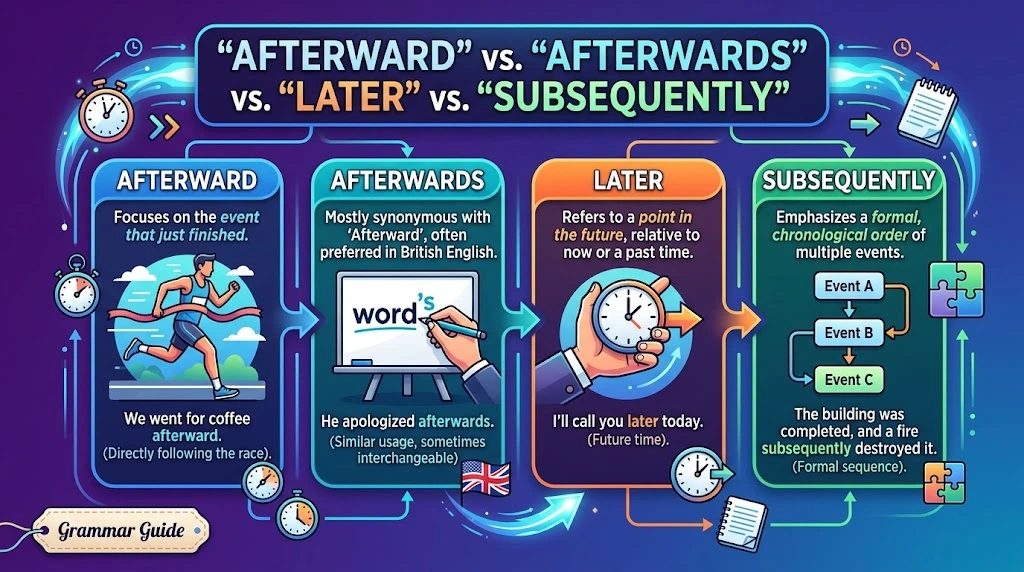
Afterward vs. Later
Later has a broader meaning than afterward.
Consider:
I’ll call you later.
This sentence doesn’t necessarily identify an earlier event that the call follows. It simply says the call will happen at a later time.
Now compare:
We finished dinner and went for a walk afterward.
Here afterward clearly connects the walk to dinner.
Cambridge makes a similar distinction. It notes that later often refers to a later time while afterward and after can emphasize that a second event follows a first event.
A useful rule is:
Use “later” for a general later time. Use “afterward” when you want to connect the later action to an earlier event.
Afterward vs. Subsequently
Subsequently also means at a later time. However, it often sounds more formal.
Compare:
We talked afterward.
We subsequently discussed the matter.
The first sounds conversational.
The second sounds more like academic, legal, technical, or formal business writing.
Neither is automatically better. The right choice depends on the voice you want.
Afterward vs. Then
Then can describe sequence:
We had dinner. Then we watched a movie.
Then has many other meanings as well. It can refer to a particular time, introduce a consequence, or organize a sequence.
Afterward is more specific about the relationship between two events.
We watched a movie afterward.
The word directly signals that the movie followed something already mentioned.
Afterward vs. Afterword: The Spelling Trap
Few comparisons are more important than afterward vs. afterword.
They look almost identical. Their meanings couldn’t be much more different.
What Does “Afterword” Mean?
An afterword is a section that appears at the end of a book or other written work.
It may contain:
- The author’s reflections
- Historical background
- Commentary on the work
- Information about how the book came to be written
- A discussion of the book’s themes or impact
- Additional context for the reader
For example:
The historian included an afterword discussing the events that followed the period covered in the book.
The word afterword is literally built from after + word.
The Online Etymology Dictionary records afterword from 1879 and describes it as an English substitute for epilogue.
Why Do Writers Confuse Them?
The spelling creates the trap:
- afterward
- afterwards
- afterword
Only one letter changes between afterward and afterword. Meanwhile, afterwards sounds similar to after words when spoken.
That makes proofreading especially important.
Side-by-Side Examples
| Word | Meaning | Part of speech | Example |
| afterward | At a later time | Adverb | We talked afterward. |
| afterwards | At a later time | Adverb | We talked afterwards. |
| afterword | A closing section of a book | Noun | The author wrote an afterword. |
A simple memory device works well:
An afterword contains words. Afterward describes time.
That distinction can prevent an embarrassing typo in an article, manuscript, or book.
How to Choose Between Afterward and Afterwards
If you’re writing for a US audience, the choice is straightforward.
Choose “Afterward” for US English
Use afterward as your default when writing standard American English.
For example:
The team met afterward to discuss the results.
She apologized afterward.
We can talk about it afterward.
It looks natural to American readers and works across formal and informal settings.
Choose “Afterwards” for British English
If you’re writing specifically for a British audience, afterwards is a natural choice.
For example:
The team met afterwards to discuss the results.
She apologized afterwards.
We can talk about it afterwards.
British English commonly uses the form with -s.
Follow Your Publication’s Style
If you’re writing for a newspaper, university, company, website, or publisher, consistency matters.
Suppose an American publication uses afterward throughout its editorial style. A writer shouldn’t randomly switch to afterwards halfway through an article.
Likewise, a British publication may consistently prefer afterwards.
A house style provides consistency for readers.
Don’t Change the Word Just to Sound Formal
Some writers assume afterwards sounds more sophisticated because it contains an extra letter.
That’s not how the distinction works.
Neither word is inherently more formal.
We discussed the matter afterward.
and
We discussed the matter afterwards.
Both can appear in serious writing.
The real difference is regional preference, not social status or formality.
Common Mistakes With Afterward and Afterwards
Knowing what not to do can be just as useful as knowing the rule.
Mistake: Treating One Form as Incorrect
It’s incorrect to claim that afterwards is always wrong in American English.
It’s also inaccurate to claim that British English requires afterwards.
Both forms are standard.
Mistake: Using “Afterword” for Time
Don’t write:
We went home afterword.
If you mean that you went home later, write:
We went home afterward.
Or:
We went home afterwards.
Mistake: Writing “After Words” When You Mean Later
The phrase after words can technically occur when you literally mean words that come later.
For example:
Look for the definition after the words in bold.
But that’s different from afterward.
If you mean later, use the adverb.
Mistake: Assuming the Extra S Changes the Meaning
It doesn’t normally.
The s primarily reflects a historical and regional variant.
Read More : Nighttime vs. Night Time: Which Spelling Is Correct?
A Practical Decision Guide
When you’re editing your sentence, ask three quick questions.
Are you talking about something that happens later?
If yes, afterward or afterwards may be appropriate.
Are you writing for a US audience?
If yes, afterward is generally the safest default.
Are you writing for a British audience?
If yes, afterwards is generally the natural default.
Then check one final thing:
Do you mean a section at the end of a book?
If so, you need afterword.
Afterward vs. Afterwards: Quick Reference Table
| Feature | Afterward | Afterwards |
| Meaning | At a later time | At a later time |
| Part of speech | Adverb | Adverb |
| US usage | Common and preferred | Correct but less typical |
| UK usage | Used | Common and preferred |
| Formality | Neutral | Neutral |
| Can start a sentence? | Yes | Yes |
| Can end a sentence? | Yes | Yes |
| Is it a noun? | No in standard modern usage | No |
| Confused with | Afterword | Afterword |
| Example | We left afterward. | We left afterwards. |
A Mini Case Study: Choosing a House Style
Imagine an American software company preparing its documentation for a US audience.
The writers have three sentences:
Restart the application afterward.
The system will perform a check afterward.
Contact support afterward if the problem continues.
Now imagine that another editor changes two of those sentences to afterwards.
Nothing becomes grammatically wrong. However, the document now contains inconsistent regional styling.
The editor has two sensible options:
- Keep afterward throughout because the documentation targets US users.
- Adopt afterwards throughout if the company intentionally follows another English variety.
The important lesson is that consistency is a style decision rather than a grammar correction.
A good editor doesn’t change correct wording merely because another version also exists.
Memory Tricks for Afterward vs. Afterwards
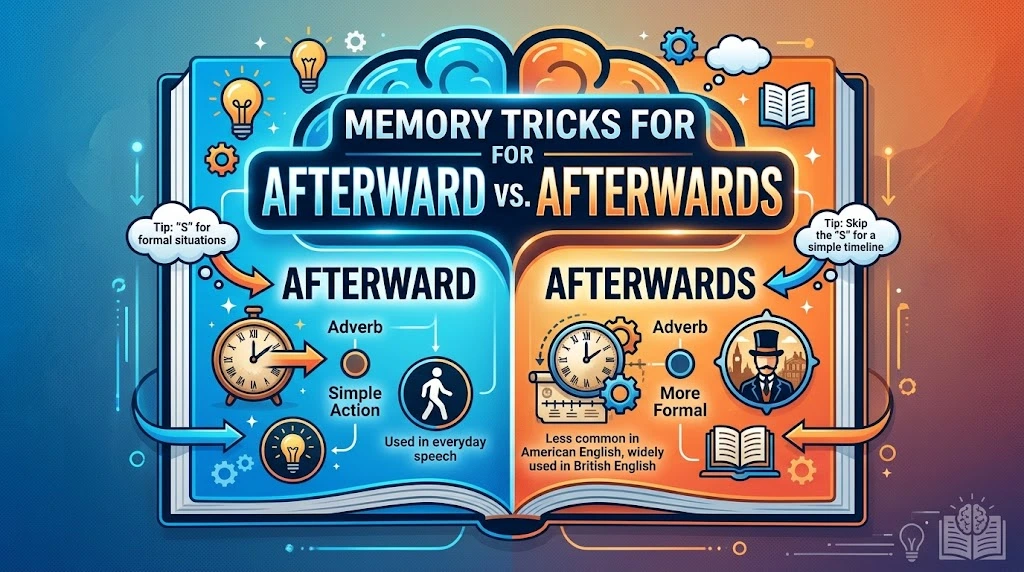
You don’t need five complicated tricks to remember this distinction. A few simple ones will do.
Remember “After + Later”
When you see afterward, think:
After the event → later
That captures the word’s central meaning.
Remember the Extra “S”
If you’re working in British English, afterwards is the familiar form.
The extra s can remind you of the British preference. Just don’t turn that memory trick into a false grammar rule.
Remember “Afterword Has a Word”
This is the most useful trick for spelling.
Afterword = a word section at the end of a book.
Afterward = later in time.
Think in Timelines
Imagine a simple timeline:
Event → later event
If you’re describing the second point, afterward or afterwards may fit.
For example:
The meeting ended → afterward → everyone went home.
This mental picture makes the meaning almost impossible to confuse.
Frequently Asked Questions About Afterward vs. Afterwards
What Is the Difference Between “Afterward” and “Afterwards”?
In standard modern English, afterward and afterwards generally mean the same thing: at a later time.
The main difference is regional preference. American English generally favors afterward while British English commonly favors afterwards.
Is “Afterwards” Correct in American English?
Yes.
Afterwards is a legitimate English word and appears in American usage. However, afterward is generally the more common American form.
So if you’re writing specifically for US readers, afterward is usually the better default.
Is “Afterward” Correct in British English?
Yes.
British English commonly uses afterwards, but afterward is not inherently ungrammatical.
Regional preference shouldn’t be confused with a strict correctness rule.
Which Should You Use in Professional Writing?
For US professional writing, use afterward as the straightforward default.
For British professional writing, afterwards is a natural choice.
If a company or publication has a house style, follow it.
Are “Afterward” and “Afterword” the Same?
No.
Afterward means at a later time.
Afterword means a section at the end of a book or other written work.
For example:
We spoke afterward.
The author included an afterword.
Can “Afterward” Be Used as a Noun?
In standard modern English, afterward functions as an adverb rather than an ordinary noun.
If you need a noun, rewrite the sentence using an expression such as:
- the aftermath
- the period afterward
- what happened afterward
- the events that followed
Can “Afterwards” Start a Sentence?
Yes.
For example:
Afterwards, we went back to the hotel.
The same applies to afterward:
Afterward, we went back to the hotel.
Both forms can work naturally at the beginning of a sentence.
Is “Afterward” One Word or Two?
Afterward is normally written as one word.
The same applies to afterwards.
Don’t split them into after word or after wards when you mean the temporal adverbs.
Is “Afterwards” More Formal Than “Afterward”?
No.
The extra s doesn’t make the word more formal.
The difference primarily reflects regional usage and historical development. Both forms can appear in casual and formal writing.
Afterward vs. Afterwards: The Bottom Line
The afterward vs. afterwards debate becomes much easier once you separate grammar from regional preference.
Both words are adverbs. Both mean at a later time. Both can describe an event that follows something already mentioned.
The major distinction is where each form is most strongly preferred.
American English generally favors afterward.
British English generally favors afterwards.
Neither form is automatically wrong simply because it isn’t the regional favorite.
For US English writing, afterward is the safest default:
We discussed the issue afterward.
For British English, afterwards is often the more natural choice:
We discussed the issue afterwards.
Above all, don’t confuse either one with afterword. That word refers to a closing section of a book.
If you remember just one rule, make it this:
Afterward and afterwards describe time. Afterword describes part of a book.
Once that distinction is clear, there’s very little left to worry about.