
Dammit and damn it look almost identical when you see them on the page. Both can express frustration, irritation, anger, disappointment, or sudden annoyance. So why does English have two forms?
The answer is simpler than it first appears. “Dammit” is the established one-word form of the spoken expression “damn it,” while “damn it” retains the original two-word spelling. In many everyday situations, the two forms communicate essentially the same idea.
The difference becomes more interesting when you look at grammar, history, pronunciation, register, and writing style. The word damn has a long history that reaches back to medieval English and ultimately to Latin. The spelling dammit, meanwhile, developed much later as a written representation of how the phrase was commonly pronounced.
That distinction matters because these forms aren’t simply a case of one spelling being “right” and the other being “wrong.”
This guide explains dammit vs. damn it in detail. You’ll learn what each form means, where it came from, how to use it, how offensive it can sound, and which version works best in different types of writing.
Dammit vs. Damn It: What’s the Difference?
The quickest answer is this:
“Dammit” is a one-word informal interjection derived from the spoken form of “damn it.” “Damn it” is the traditional two-word form.
Both expressions can function as emotional outbursts.
Consider these examples:
- “Dammit! I forgot my wallet.”
- “Damn it! I forgot my wallet.”
The emotional meaning is practically identical. In both sentences, the speaker expresses frustration about forgetting the wallet.
The difference lies primarily in spelling and grammatical presentation, not in the basic emotion.
| Feature | Dammit | Damn it |
| Spelling | One word | Two words |
| Basic meaning | Frustration, annoyance, anger | Frustration, annoyance, anger |
| Typical function | Interjection | Interjectional phrase |
| Register | Informal | Informal |
| Profanity | Mild profanity | Mild profanity |
| Common in dialogue | Yes | Yes |
| Suitable for formal writing | Generally no | Generally no |
| Historical relationship | Developed from the phrase | Original two-word expression |
The important point is that dammit isn’t merely a typo. It has become an established informal form in English. The Online Etymology Dictionary dates this one-word representation to 1908 and describes it as a representation of the oath “damn it!” as it is usually sounded.
What Does “Dammit” Mean?
Dammit is an informal interjection used to express strong emotion, especially frustration or annoyance.
You might say it when something goes wrong unexpectedly:
“Dammit! The computer crashed again.”
You aren’t literally asking someone to condemn a computer. The word simply communicates an emotional reaction.
That distinction is important because interjections often work differently from ordinary vocabulary. They don’t necessarily contribute grammatical information to the sentence. Instead, they signal the speaker’s emotional response.
For example:
- “Dammit!” expresses frustration.
- “Wow!” can express surprise.
- “Ouch!” can express pain.
- “Hey!” can attract attention.
- “Damn!” can express anger, surprise, admiration, or emphasis depending on context.
“Dammit” as an Interjection
When dammit appears by itself, it functions very clearly as an interjection.
“Dammit!”
It can also appear at the beginning or end of a larger sentence:
“Dammit, I knew this would happen.”
“I forgot the tickets, dammit.”
The surrounding sentence provides the factual information. Dammit supplies the emotional reaction.
That’s why it often appears in dialogue. A character doesn’t need to explain that they’re frustrated when a short exclamation can show it immediately.
What Does “Damn It” Mean?
Damn it commonly expresses frustration, anger, annoyance, disappointment, or impatience.
For example:
“Damn it! We missed the last train.”
Here, damn it works as an emotional exclamation. Modern speakers usually don’t interpret the phrase as a literal theological or judicial command.
The expression has developed a conventional use. When someone says it after making a mistake, the listener normally understands the speaker’s emotion rather than analyzing the grammar word by word.
That’s a common feature of language. Expressions can develop meanings that aren’t simply the sum of their individual words.
Is “Damn It” Literally a Verb Plus an Object?
Historically and grammatically, damn can function as a verb and it can function as its object.
The verb damn originally carried meanings connected with condemning or judging someone. Its history goes back through Middle English to Old French damner and ultimately Latin damnare. The Latin verb carried meanings such as “to condemn” or “to adjudge guilty.”
However, in the modern exclamation “damn it!”, speakers generally aren’t consciously constructing a literal command such as “condemn this object.”
The phrase has become an established emotional expression.
That distinction helps explain why calling damn it simply “verb + object” can be misleading in everyday usage. Its historical structure matters, but its modern function is often interjectional.
Dammit vs. Damn It: One Word or Two?
The most obvious difference is visual:
Dammit = one word
Damn it = two words
But the story behind that difference is more interesting.
When people speak quickly, words can become compressed. Sounds run together across word boundaries. English has many examples of this phenomenon.
For damn it, the spoken phrase can sound like a single unit. Over time, speakers and writers represented that familiar pronunciation with the spelling dammit.
The history of the word supports this explanation. The Online Etymology Dictionary records dammit from 1908 as a representation of “damn it!” as it usually is sounded.
So the one-word spelling isn’t random.
Why Does “Dammit” Have No Space?
The spelling reflects a process called lexicalization.
Lexicalization happens when a frequently used expression develops into a more fixed linguistic unit. English contains many words and expressions that have changed their spelling or structure over time because speakers repeatedly used them together.
In the case of dammit, the spoken form became closely associated with the emotional expression. Writers eventually used a one-word spelling to represent that form.
You can think of it as the difference between:
a phrase people repeatedly say together
and
a word people recognize as a single informal unit
The modern spelling reflects the second pattern.
The Etymology of “Damn” and the History of the Expression
The history of dammit vs. damn it becomes much clearer when you understand the history of damn itself.
Where Does “Damn” Come From?
The English verb damn dates to the late 13th century. Early uses referred to condemning someone, declaring someone guilty, or pronouncing judgment.
The word came into Middle English as forms such as dampnen, damnen, and dammen. It developed from Old French damner, which came from Latin damnare.
The Latin root is connected with judgment, condemnation, loss, and penalty.
The spelling and pronunciation changed over centuries. One notable development was the disappearance of the p from the older forms.
The modern English word therefore has a much older history than its role as a casual swear word might suggest.
From Condemnation to Exclamation
Originally, damn carried serious legal and theological meanings.
Over time, English speakers expanded its use.
The word came to appear in expressions of dislike, anger, emphasis, and frustration. The Online Etymology Dictionary records the noun sense referring to an utterance of the word damn by the early 17th century. It also records expressions such as “not worth a damn” from the early 19th century.
That evolution illustrates an important feature of profanity: words can move from serious literal meanings into everyday emotional language.
How “Damn It” Became an Emotional Outburst
The phrase damn it can be understood historically as an imperative expression involving the verb damn and the pronoun it.
But modern speakers generally use the entire phrase as a fixed exclamation.
For example:
“Damn it! I broke the key.”
The speaker isn’t normally issuing a literal theological judgment against the key. The phrase simply signals irritation.
This is why modern usage is better understood through function and context rather than literal word-by-word translation.
How “Dammit” Developed From “Damn It”
The one-word form dammit represents the way the phrase sounds when spoken as a tightly connected expression.
This is a useful example of how speech can influence spelling.
Language isn’t created only by dictionaries. People speak first. Writers then develop conventions for representing those sounds.
In this case:
damn + it → spoken together → dammit
That doesn’t mean every speaker pronounces the phrase exactly the same way. Accents and speech rates vary. It simply explains why English developed a recognized one-word spelling.
The recorded date is particularly useful: 1908 is an early documented point for the one-word form.
Is “Dammit” Correct English?
Yes. Dammit is an established English word.
Calling it “incorrect” simply because it lacks a space misses how English spelling works.
However, correct English doesn’t mean appropriate in every situation.
That’s an important distinction.
A word can be grammatically established while still being unsuitable for academic, professional, or formal communication.
For example, dammit can be perfectly natural in a novel:
“Dammit! We don’t have enough time.”
But the same word probably doesn’t belong in a formal business report.
The issue isn’t that the spelling suddenly becomes grammatically wrong. The issue is register.
Is “Damn It” Also Correct?
Yes.
Damn it is the established two-word form and remains common in modern English.
There’s no general rule saying that writers must always replace it with dammit.
Likewise, there’s no grammatical rule saying that dammit must be expanded into damn it.
When the phrase functions as an emotional outburst, either form can be appropriate in informal writing.
Compare:
“Dammit! I left the door open.”
and:
“Damn it! I left the door open.”
Both are natural.
The choice is largely stylistic.
Dictionary Recognition and Accepted Usage
Dictionaries matter because they document how English speakers actually use words.
The important point here is that dammit has moved beyond being an accidental spelling variant. Its documented history as a one-word representation of the spoken expression demonstrates that it has an established place in English usage.
At the same time, dictionary recognition doesn’t remove its informal character.
A dictionary can recognize a word while labeling it informal, offensive, slang, or otherwise restricted.
That’s why you should consider two separate questions:
- Is this form established English?
- Is this form appropriate for this audience?
For dammit, the answer to the first question is yes. The second depends on the situation.
Is “Dammit” a Swear Word?
Generally, yes. Dammit is a mild form of profanity or swearing.
However, its perceived offensiveness varies considerably.
A teenager talking with friends might use it casually. A speaker addressing a formal audience might avoid it completely.
The word damn itself has historically carried religious associations. That history helps explain why some speakers still regard it as offensive or inappropriate in certain settings.
At the same time, modern English often treats damn as relatively mild compared with stronger profanity.
How Offensive Is “Dammit”?
There isn’t a universal numerical scale for profanity.
Still, in contemporary American English, dammit is generally viewed as relatively mild.
Its effect depends on:
- The audience.
- The setting.
- The speaker’s age.
- Cultural expectations.
- Religious or personal beliefs.
- The surrounding language.
- Whether the word appears once or repeatedly.
- Whether the setting has explicit language rules.
For instance, one “Dammit!” in a dramatic movie scene can feel ordinary. Repeated profanity during a formal presentation can feel disruptive.
Where Is “Dammit” Usually Acceptable?
It can appear naturally in:
- Casual conversation.
- Text messages between friends.
- Informal online communication.
- Fictional dialogue.
- Screenplays.
- Personal writing.
- Some entertainment aimed at mature audiences.
Even in these contexts, audience expectations still matter.
Where Should You Avoid “Dammit”?
Avoid it when you need a clearly formal tone, such as:
- Academic essays.
- Formal business letters.
- Professional reports.
- Official applications.
- Government documents.
- Formal presentations.
- Customer-service communication.
- Most workplace correspondence.
If you’re unsure, choose a neutral alternative.
American English vs. British English
Neither dammit nor damn it belongs exclusively to American English.
Both forms can appear across major varieties of English.
The bigger differences involve frequency, personal style, cultural attitudes toward profanity, and local speech patterns.
American English has a particularly strong tradition of using damn in casual speech and expressions of emphasis. British English also uses the word widely, although individual speakers may differ significantly in how often they use it.
It’s therefore misleading to say:
“Americans use dammit while British speakers use damn it.”
Real usage is much less tidy.
Both forms can occur in both varieties.
Grammar and Punctuation: How to Write “Dammit” and “Damn It”
Punctuation helps show how the expression fits into the sentence.
“Dammit” as an Interjection
When it stands alone, an exclamation mark is common:
“Dammit!”
At the beginning of a sentence, a comma may follow it:
“Dammit, I forgot the keys.”
It can also appear at the end:
“I forgot the keys, dammit.”
The punctuation depends on how the writer wants the sentence to sound.
“Damn It” as an Interjection
The same patterns work with the two-word form:
“Damn it!”
“Damn it, I forgot the keys.”
“I forgot the keys, damn it.”
Again, the phrase generally functions as an emotional interruption rather than an ordinary part of the sentence’s factual content.
Capitalization
Neither expression needs unusual capitalization.
At the beginning of a sentence:
“Dammit, we’re late.”
Inside a sentence:
“I can’t believe it, dammit.”
In dialogue, capitalize according to normal sentence rules.
Dammit vs. Damn It in Formal and Informal Writing
The biggest practical issue isn’t which spelling is “correct.” It’s whether you should use the expression at all.
| Context | Dammit | Damn it | Better choice |
| Text message to a close friend | ✓ | ✓ | Either |
| Fictional dialogue | ✓ | ✓ | Either |
| Screenplay | ✓ | ✓ | Depends on style |
| Personal journal | ✓ | ✓ | Either |
| Social media | ✓ | ✓ | Audience-dependent |
| News article | Usually avoid | Usually avoid | Neutral wording |
| Academic essay | Avoid | Avoid | Neutral wording |
| Business email | Avoid | Avoid | Neutral wording |
| Official document | Avoid | Avoid | Neutral wording |
A formal setting changes the question.
Instead of asking, “Which form is grammatically correct?” ask:
“Would this expression sound appropriate to my reader?”
That question usually leads to the right decision.
Common Mistakes With “Dammit” and “Damn It”
Treating “Dammit” as a Typo
This is one of the most common misunderstandings.
Because damn it contains two words, readers sometimes assume dammit must be an error.
It isn’t.
The one-word form has an established history. Its documented use as a representation of the spoken expression dates to 1908.
Assuming “Damn It” Is Always More Correct
The two-word form has a strong historical basis, but that doesn’t make dammit incorrect.
Both forms exist in modern English.
Using “Dammit” in Formal Writing
The problem here is usually register, not grammar.
A formal report can be grammatically flawless while still sounding inappropriate if it includes casual profanity.
Assuming “Dammit” and “Damn It” Always Have Different Meanings
In their common interjectional use, they usually don’t.
Consider:
“Dammit! The printer jammed again.”
“Damn it! The printer jammed again.”
The speaker’s frustration remains the same.
The spelling changes the visual presentation more than the core meaning.
Confusing the Interjection With Other Uses of “Damn”
The word damn has several functions.
It can be a verb:
“They damn the policy as unfair.”
It can also appear as an adjective or adverb in informal expressions:
“That was a damn good performance.”
It can function as an interjection:
“Damn!”
These uses shouldn’t be treated as identical.
Dammit vs. Damn It: Real-Life Examples
The following examples show how both forms work naturally.
Expressing frustration
“Dammit! I missed the bus.”
“Damn it! I missed the bus.”
Reacting to a mistake
“Dammit, I sent the wrong file.”
“Damn it, I sent the wrong file.”
Reacting to unexpected damage
“Dammit! I cracked the screen.”
“Damn it! I cracked the screen.”
Expressing disappointment
“We were so close. Dammit.”
“We were so close. Damn it.”
Emphasizing irritation
“Just listen to me, dammit.”
“Just listen to me, damn it.”
In all these examples, the emotional function remains essentially the same.
Case Study: Emotional Dialogue
Imagine a character drops a glass of water during an important meeting.
The character could say:
“Dammit!”
That choice feels short, immediate, and conversational.
The same character could say:
“Damn it!”
The meaning remains almost unchanged.
Now compare both with:
“Oh, no.”
or:
“I can’t believe I just did that.”
These alternatives create different emotional effects.
| Expression | Emotional force | Tone |
| Dammit! | Strong | Frustrated |
| Damn it! | Strong | Frustrated |
| Dang it! | Moderate | Mild frustration |
| Darn it! | Mild | Euphemistic |
| Oh, no! | Mild | Neutral |
| I can’t believe I did that. | Moderate | Reflective |
This demonstrates why writers shouldn’t choose words only by dictionary definition.
Dialogue carries character.
A calm professional, an angry teenager, and a sarcastic comedian may react to the same mistake in completely different ways.
Dammit vs. Damn It in Creative Writing
Writers often use profanity because it communicates emotion quickly.
Instead of writing:
“The character was extremely frustrated because the machine had stopped working.”
A scene might simply contain:
“Dammit!”
The dialogue lets the reader experience the frustration instead of receiving a description of it.
However, profanity works best when it serves a purpose.
If every character says dammit every few lines, the expression can lose its impact. Repetition turns an emotional spike into background noise.
When “Dammit” Works Well in Dialogue
Use it when you want to show:
- Frustration.
- Anger.
- Impatience.
- Disappointment.
- Pain.
- Sudden realization.
- Emotional pressure.
When to Choose a Different Expression
Choose something else when:
- The character would naturally avoid profanity.
- The story targets children.
- The scene requires restraint.
- You want a calmer emotional tone.
- The character’s personality doesn’t fit the expression.
Good dialogue isn’t about adding more strong language. It’s about choosing language that sounds believable for the character.
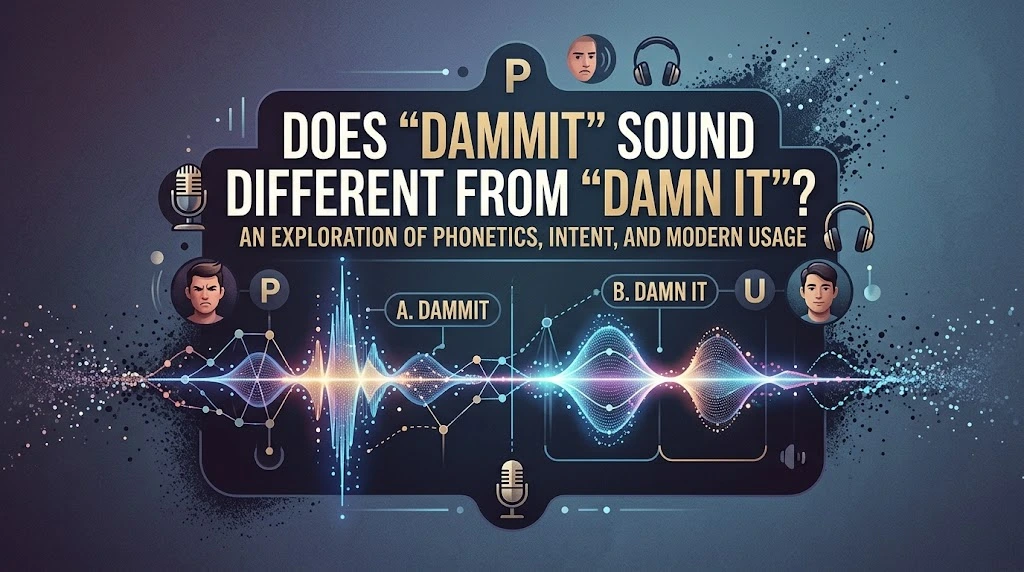
Does “Dammit” Sound Different From “Damn It”?
The answer depends on the speaker.
In careful speech, a speaker may articulate damn it as two recognizable words.
In rapid conversational speech, however, the words can become tightly connected. That connected pronunciation helps explain why dammit emerged as a written representation.
This is a broader pattern in English.
Spoken language often reduces sounds, joins words, and changes rhythm. Writers sometimes represent those spoken forms in spelling.
Dammit is an especially clear example because the emotional expression is frequently uttered quickly.
Still, don’t assume that every speaker pronounces the two forms identically. Regional accents, speaking speed, and individual habits can all affect pronunciation.
Which Form Should You Use?
The easiest rule is to consider tone first.
Choose “Dammit” When…
Use dammit when you want:
- A compact informal interjection.
- Natural conversational dialogue.
- A strongly emotional outburst.
- A casual written voice.
- A spelling that reflects the conventional one-word form.
For example:
“Dammit, we’re out of gas.”
Choose “Damn It” When…
Use damn it when:
- You prefer the traditional two-word spelling.
- You’re preserving an author’s established style.
- You want the phrase to remain visually distinct.
- You’re discussing its historical or grammatical structure.
For example:
“Damn it, we need another plan.”
When Either Form Works
In ordinary informal dialogue, you can often choose either one.
The key is consistency.
If a particular publication, character, or style guide consistently prefers one spelling, follow that convention.
Alternatives to “Dammit” and “Damn It”
Sometimes you need the emotional impact without the profanity.
Fortunately, English gives you plenty of choices.
Mild Alternatives
- Darn it
- Dang it
- Shoot
- Oh, no
- Ugh
- Drat
These work well when you want frustration without stronger language.
Neutral Alternatives
- That’s frustrating.
- What a mistake.
- I can’t believe that happened.
- This is ridiculous.
- We’re in trouble.
- I really messed that up.
These expressions fit professional and family-friendly situations more easily.
Why “Darn” and “Dang” Exist
English has a long tradition of creating minced oaths, which are softened forms of stronger expressions.
Both darn and dang have historical connections to damn. The Online Etymology Dictionary records darn as a euphemistic form of damn from the late 18th century and records dang as a minced euphemism from 1781.
So alternatives such as darn it aren’t random substitutes. They belong to a broader linguistic tradition of softening profanity.
A Closer Look at “Damn” as a Verb
Understanding the verb helps explain why damn it originally has a recognizable grammatical structure.
The verb damn historically meant to condemn or pronounce judgment.
For example:
“The court’s decision damned him in the eyes of the public.”
Here, damn doesn’t mean “express frustration.”
It’s a verb describing condemnation.
Another modern use appears in expressions such as:
“Critics damned the proposal as unrealistic.”
The meaning is still connected to strong condemnation.
The emotional exclamation “Damn it!” developed in a different direction. It became an established way to express the speaker’s own reaction.
That semantic shift explains why modern speakers can use the phrase without thinking about its original literal meaning.
A Closer Look at “Dammit” as a Fixed Expression
The one-word form has gone through an additional step.
Instead of treating the expression as:
damn + it
speakers can treat it as:
dammit
That change is primarily lexical and orthographic.
The emotional meaning remains connected to the older phrase. The spelling simply presents the expression as a single informal unit.
This makes dammit particularly useful in dialogue because it visually resembles a quick emotional burst.
Compare:
“Dammit!”
with:
“I am extremely frustrated by this situation.”
The first is immediate. The second is explanatory.
Neither is inherently better. They perform different jobs.
Quick Comparison: Dammit vs. Damn It
| Question | Dammit | Damn It |
| Is it established English? | Yes | Yes |
| Is it one word? | Yes | No |
| Is it informal? | Yes | Yes |
| Can it express frustration? | Yes | Yes |
| Can it express anger? | Yes | Yes |
| Can it express disappointment? | Yes | Yes |
| Is it profanity? | Generally considered mild profanity | Generally considered mild profanity |
| Can it appear in dialogue? | Yes | Yes |
| Can it appear in casual messages? | Yes | Yes |
| Is it ideal for academic writing? | No | No |
| Is one universally more correct? | No | No |
| Historical relationship | Derived from spoken form of the phrase | Original two-word expression |
The practical takeaway is simple:
Use the form that matches your style and audience.
Dammit vs. Damn It: Which One Is More Common?
There isn’t a useful universal rule that makes one form “the correct common version” everywhere.
Usage varies by writer, publication, region, genre, and context.
What matters more is understanding that the forms aren’t unrelated words.
Dammit developed from the spoken expression represented by “damn it.”
The historical record makes that connection unusually clear. The one-word form is documented from 1908 specifically as a representation of how the phrase was ordinarily sounded.
Why Profanity Changes Over Time
The history of dammit also shows something broader about English.
Words that once carried strong religious or social force can gradually become ordinary expressions of emotion.
The history of damn illustrates this clearly. It entered English with serious legal and theological meanings and later developed broader uses involving condemnation, emphasis, dislike, and emotional expression.
That doesn’t mean everyone now considers the word harmless.
Instead, it means offensiveness is partly a social question.
A word’s history can influence how people perceive it. At the same time, current usage determines how strongly most speakers react to it.
Read More : MK Meaning: What It Means in Text and Online Slang
Practical Rules for Using Dammit vs. Damn It
If you want a quick decision guide, remember these points:
- Dammit is a recognized one-word informal form.
- Damn it is the traditional two-word form.
- Both can express frustration or anger.
- Neither form is automatically a grammatical mistake.
- Dammit developed as a representation of the spoken phrase.
- The one-word spelling is documented from 1908.
- Damn itself has medieval English roots and ultimately comes from Latin.
- Both forms are generally informal.
- Both can be mildly offensive.
- Formal writing usually benefits from a neutral alternative.
- In creative dialogue, either spelling can work.
- Context and audience matter more than choosing one spelling as universally “correct.”
Frequently Asked Questions About Dammit vs. Damn It
Is “Dammit” a real word?
Yes. Dammit is an established informal English word used mainly as an interjection. Its documented history as a one-word representation of damn it dates to 1908.
Is “Damn It” one word or two?
Damn it is written as two words. The expression contains the word damn followed by the pronoun it.
Are “Dammit” and “Damn It” interchangeable?
In their common use as emotional exclamations, yes, they can often be used interchangeably. The difference is mainly spelling and stylistic presentation.
Is “Dammit” grammatically correct?
Yes. Dammit is an established informal interjection. However, grammatical correctness doesn’t automatically make it appropriate for every setting.
Is “Dammit” considered profanity?
Generally, yes. It is usually considered mild profanity. People’s reactions vary depending on culture, setting, personal beliefs, and audience.
Which is more formal: “Dammit” or “Damn It”?
Neither is particularly formal. If you need professional or academic language, it’s usually better to replace both with a neutral expression.
Why is “Dammit” spelled as one word?
The spelling developed as a written representation of the way damn it is commonly pronounced as a connected expression. The one-word form is documented from 1908.
Does “Dammit” have the same meaning as “Damn It”?
Usually, yes. Both commonly express frustration, irritation, anger, or disappointment.
Can “Dammit” be used in professional writing?
It’s possible from a purely grammatical perspective, but it’s usually a poor stylistic choice. Professional writing generally calls for neutral language.
Should “Dammit” be capitalized?
Only according to normal capitalization rules. Capitalize it at the beginning of a sentence or when required by a specific writing context. Don’t capitalize it merely because it’s an interjection.
Conclusion: Dammit vs. Damn It
The difference between dammit vs. damn it is much less complicated than it may seem.
Dammit is the established one-word informal form that developed from the spoken expression damn it. Damn it retains the traditional two-word spelling. Both can function as emotional exclamations that express frustration, annoyance, anger, or disappointment.
The history behind the two forms is worth remembering. Damn entered English centuries ago with meanings connected to condemnation and judgment. It ultimately traces back through Old French to Latin damnare.
Much later, dammit emerged as a spelling that represented the way damn it was commonly pronounced in connected speech. The documented one-word form dates to 1908.
So if you’re wondering whether dammit is wrong because it doesn’t have a space, the answer is no.
If you’re wondering whether damn it is outdated or incorrect, the answer is also no.
The better question is: Which form fits the context?
For casual conversation, personal writing, and realistic dialogue, either can work. For formal, academic, or professional writing, neither is usually the best choice.
In short, remember this:
Dammit and damn it usually express the same emotion. The main difference is that one is written as a single word while the other remains a two-word phrase.
That simple distinction covers most everyday uses of dammit vs. damn it.