The terms mother tongue and native language sound like perfect synonyms. In many everyday conversations, they are. However, linguists, educators, governments, and multilingual families often use these expressions to describe slightly different things.
That difference becomes important when a person grows up speaking two languages, moves to another country, loses fluency in a childhood language, or speaks a heritage language at home while using another language at school.
Your mother tongue often carries a sense of family, childhood, and cultural identity. Your native language usually points more directly to a language you acquired naturally during early childhood. Meanwhile, first language (L1) gives linguists a more technical way to discuss early language acquisition.
The three concepts overlap, but they aren’t always identical.
This guide explains mother tongue vs. native language in detail, including their meanings, differences, cultural associations, multilingual situations, education, language loss, and practical usage.
Mother Tongue vs. Native Language: What Do They Really Mean?
Before comparing the terms, it helps to understand what each expression emphasizes.
A person’s linguistic background isn’t always a neat box containing one language. Someone might hear Urdu from grandparents, Punjabi from parents, English at school, and Arabic through religious education. Over time, one language might become much stronger than the others.
That’s why the question isn’t always simply, “What’s your first language?”
Instead, you may need to ask:
- Which language did you acquire first?
- Which languages did you hear from birth?
- Which language did your family use at home?
- Which language are you most proficient in?
- Which language do you identify with culturally?
- Which language do you use most often today?
The answers can be different.
Mother Tongue Explained
Mother tongue is a common expression for the language a person learned during early childhood, particularly within their family or community.
The term often carries a strong cultural and emotional meaning. It can refer to the language associated with childhood memories, family traditions, stories, songs, and a person’s cultural background.
Despite the name, your mother tongue doesn’t have to be the language your mother speaks.
For example, suppose a child is adopted by an English-speaking family shortly after birth. The child grows up speaking English and never develops the language spoken by their biological parents. English can reasonably be described as the child’s first or native language.
Likewise, a child may hear different languages from different caregivers.
The expression can also become complicated in multilingual societies because governments and organizations sometimes define “mother tongue” differently. A census might ask which language a person learned first, while another survey might focus on the language normally spoken at home.
So the context matters.
Native Language Explained
A native language generally means a language acquired naturally during early childhood rather than one learned later through formal study.
A native language develops through ordinary interaction. A child hears people speaking, begins recognizing patterns, learns words, and gradually develops grammar without sitting down for traditional language lessons.
For example:
A child who grows up hearing and speaking Spanish from infancy can naturally be described as a native Spanish speaker.
The term focuses more strongly on natural early acquisition than on the speaker’s emotional connection to the language.
However, native language doesn’t mean “perfect language.”
Native speakers can make grammatical mistakes, have limited vocabulary in specialized subjects, or struggle with formal writing. Native acquisition describes how a person acquired the language, not whether they have mastered every variety of it.
First Language (L1): Where It Fits
First language (L1) is a technical term widely used in linguistics and language education.
It usually refers to a language acquired first or among the earliest languages during childhood.
L1 becomes especially useful when discussing bilingualism. A child can acquire two languages from birth, which means both languages can be described as early-acquired languages rather than forcing one into the role of “the only first language.”
For example, imagine a child whose parents consistently speak Mandarin and English from infancy. Both languages may function as L1 languages depending on the specific linguistic framework being used.
This is one reason researchers often prefer L1 over “mother tongue.” It can be more precise in academic discussions.
Mother Tongue vs. Native Language: Key Differences at a Glance
The following table captures the main distinction:
| Term | Main emphasis | Typical use | Can refer to multiple languages? |
| Mother tongue | Family, childhood, cultural connection | Everyday and cultural contexts | Yes |
| Native language | Natural early acquisition | General and linguistic contexts | Yes |
| First language (L1) | Earliest language acquisition | Linguistics and education | Yes |
| Home language | Language used within the household | Education and family contexts | Yes |
| Heritage language | Language connected to family or cultural heritage | Multilingual and cultural contexts | Yes |
| Dominant language | Language currently strongest or most frequently used | Linguistics and multilingual settings | Usually one at a given time |
The most useful distinction is simple:
Mother tongue often emphasizes background and identity. Native language emphasizes early natural acquisition. L1 emphasizes language acquisition in a technical sense.
These categories can overlap heavily.
A Simple Example
Suppose Maria grew up in Mexico speaking Spanish at home. She moved to the United States at age eight and became highly proficient in English.
- Spanish may be her mother tongue.
- Spanish is her first language (L1).
- Spanish is her native language.
- English is a later-acquired language.
- English might eventually become her dominant language.
Now change the situation. Suppose Maria had spoken Spanish and English from birth.
The answer becomes less straightforward. Both languages could be considered native or L1 languages depending on the definition and context.
Mother Tongue and Native Language in Multilingual Families
Multilingual families demonstrate why these terms shouldn’t be treated as rigid labels.
Growing Up With Two or More Languages
Children can acquire multiple languages naturally during early childhood.
This differs from the common image of a child learning one language first and then studying another at school. Some children experience two languages from their earliest years.
For instance:
- One parent speaks French.
- Another parent speaks English.
- Grandparents speak Arabic.
- School operates in English.
- Friends speak English and French.
The child doesn’t necessarily have one neatly defined linguistic identity.
Their language proficiency can also vary by skill. They might speak French comfortably but read English better. They might understand Arabic but struggle to speak it.
That pattern is completely possible in multilingual development.
When Parents Speak Different Languages
Families sometimes intentionally use different languages with children.
A parent may speak Spanish while another speaks English. The child receives regular exposure to both languages and gradually learns to communicate in each.
However, exposure isn’t the only factor.
The amount and quality of interaction matter. School, friends, media, siblings, and the wider community can dramatically influence which language becomes stronger.
A child who hears Spanish at home but spends eight hours each weekday in an English-speaking school may eventually become more academically proficient in English.
Community Language vs. Home Language
A home language refers to a language used within the household. It isn’t necessarily the same as a person’s dominant or native language.
Consider a family that speaks Punjabi at home while children attend an English-medium school.
Punjabi may remain the family’s home language. English may become the children’s strongest language for reading, academic writing, and professional communication.
This distinction matters because language ability develops through different environments and different types of exposure.
Cultural and Emotional Dimensions of Mother Tongue
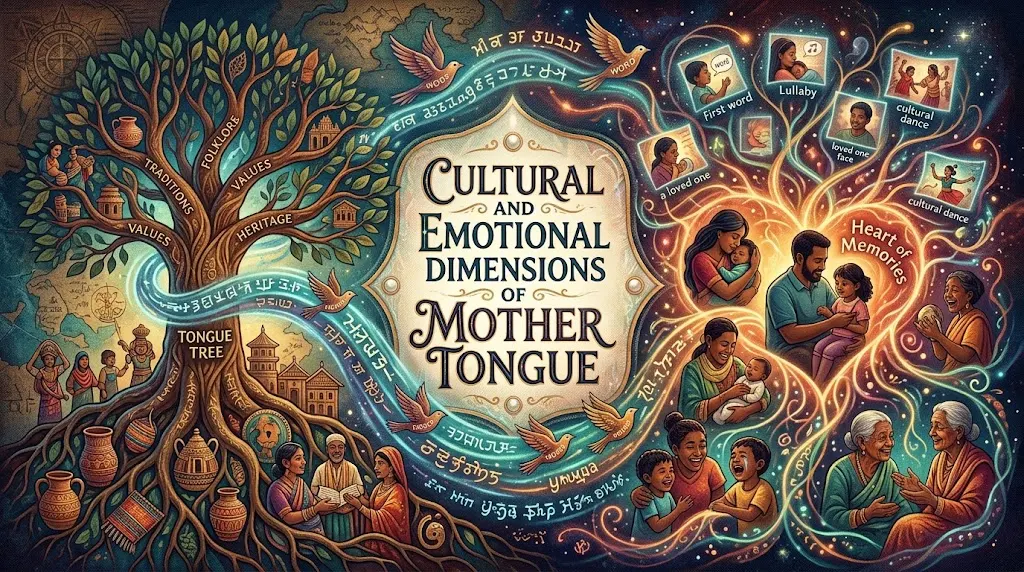
Language isn’t just a communication system. For many people, it’s also a container for memory and identity.
Why Mother Tongue Can Feel Personal
The phrase mother tongue often evokes childhood.
Think about the language used when someone first heard bedtime stories, family jokes, childhood nicknames, or affectionate expressions. Those words can carry emotional weight that a later-learned language may not immediately reproduce.
This explains why someone can lose fluency in a childhood language while still feeling deeply connected to it.
A person might say:
“I don’t speak it very well anymore, but it’s still my mother tongue.”
That statement makes sense because linguistic history and current proficiency aren’t the same thing.
Native Language and Cultural Identity
A native language can contribute strongly to cultural identity, but it doesn’t determine identity by itself.
Someone can speak a language natively while identifying with more than one culture. Conversely, someone can feel culturally connected to a language they learned later in life.
Language, nationality, ethnicity, and culture should therefore remain separate concepts.
A person’s passport doesn’t determine their native language.
Neither does their ancestry.
Their linguistic history involves actual exposure and acquisition.
Heritage Language vs. Mother Tongue
A heritage language is generally a language connected to a person’s family or cultural heritage, especially when it differs from the dominant language of the surrounding society.
Heritage speakers often have uneven skills.
For example, someone might understand their grandparents’ language but rarely speak it. They may recognize common expressions yet struggle to write a paragraph.
This creates an important distinction:
You can have a heritage connection to a language without having native-like proficiency in every area.
Geographic and Sociopolitical Influences
Language terminology doesn’t exist in a vacuum. Governments, schools, communities, and historical events shape how people describe their languages.
How Different Regions Use These Terms
The phrase mother tongue appears frequently in everyday speech and official language discussions around the world. Yet the exact definition varies.
One organization might interpret it as the first language learned. Another might define it according to the language normally spoken at home.
That creates problems when comparing statistics across countries.
For example, two surveys can ask about “mother tongue” while measuring different things.
If you need reliable data, always check the survey’s actual definition rather than assuming every source uses the term identically.
The Sociopolitics of Being a “Native Speaker”
The label native speaker can carry social assumptions.
People sometimes treat native speakers as automatically more authoritative, more intelligent, or better teachers. Linguistically, those assumptions don’t hold up.
Native acquisition tells you something about a person’s language background. It doesn’t automatically tell you:
- How well they write.
- How broad their vocabulary is.
- How well they understand grammar terminology.
- How effectively they teach.
- How familiar they are with formal registers.
- How well they communicate in professional settings.
A highly proficient second-language speaker may communicate more effectively in a particular professional context than a native speaker who lacks specialized knowledge.
Language, Power, and Minority Languages
The distinction also matters when discussing minority and Indigenous languages.
A dominant national language can become increasingly important in education, employment, government, and media. Families may gradually use it more often, especially with younger generations.
Over time, children may understand a heritage language without speaking it fluently.
This process is commonly called language shift.
When a community stops transmitting a language to younger generations, the language can face serious long-term pressure.
Historical Origins and Evolution of the Terms
Where “Mother Tongue” Comes From
The expression mother tongue uses kinship as a metaphor for language transmission.
The basic idea connects language with the language learned through one’s earliest social environment. Historically, “mother” could symbolize the person or community through which language was passed on.
That doesn’t mean modern speakers should interpret the phrase literally.
The expression survived because language and family remained closely connected in everyday experience.
The Development of “Native Language”
The word native relates to birth, origin, or belonging to a particular place or environment.
When applied to language, it developed the sense of a language naturally acquired from one’s early environment.
Modern usage, however, isn’t restricted to birthplace.
A person born in one country can have a native language associated with another linguistic community if that language was acquired naturally during childhood.
Why Linguists Use More Precise Terms
Modern linguistic research often needs distinctions that ordinary conversation doesn’t require.
Researchers may discuss:
- L1: first language
- L2: additional or later-acquired language
- Heritage language: language connected to family or cultural heritage
- Dominant language: strongest or most frequently used language in a particular context
- Home language: language used in the household
- Additional language: another language acquired beyond the initial language(s)
These terms help researchers describe multilingual experiences without forcing every person into a single-language category.
Family Structure and Language Transmission
How Caregivers Shape Early Language
Children don’t inherit a language genetically.
They acquire language through interaction and exposure.
Parents play an important role, but so do siblings, grandparents, childcare providers, teachers, neighbors, and the wider community.
That’s why calling a language someone’s “mother tongue” shouldn’t imply that the mother alone determines the child’s language.
The linguistic environment is much broader.
The Concept of “Father Tongue”
The expression father tongue has appeared in linguistic and cultural discussions as a counterpart to mother tongue.
It can refer to language associated with paternal transmission or a father’s linguistic community.
However, father tongue isn’t a standard everyday synonym for first language or native language.
The broader lesson is more important: language transmission doesn’t depend on one parent.
Different members of a family can contribute different languages.
Adoption and Non-Traditional Families
Adoption provides another useful example.
Imagine a child born into a Korean-speaking biological family and adopted by an English-speaking family during infancy.
The child’s biological ancestry doesn’t automatically make Korean the child’s first or native language.
If the child acquires English from infancy and never acquires Korean, English becomes the central language of early development.
This demonstrates why language acquisition cannot be determined solely by ancestry.
Real-World Scenarios Where the Terms Differ
Immigrant Families
Consider a family that moves from Pakistan to the United States.
The parents may continue speaking Urdu at home. Their children may speak Urdu with relatives while using English at school and with friends.
After several years, English may become the children’s dominant language.
Their linguistic profile might look like this:
| Category | Possible language |
| Early family language | Urdu |
| Mother tongue | Urdu |
| First language | Urdu |
| Native language | Urdu |
| School language | English |
| Dominant language later | English |
| Heritage language | Urdu |
The labels describe different dimensions of the same person’s linguistic experience.
Multilingual Households
Imagine a child who hears German, Turkish, and English from early childhood.
The child may develop different strengths in each language.
Perhaps German becomes the strongest language for conversation. English becomes strongest for reading. Turkish remains closely associated with grandparents and family traditions.
Asking for “one native language” may fail to capture that reality.
Language Loss and Language Shift
Language ability can change dramatically over a lifetime.
A child who moves countries at age five may initially speak one language best. By adulthood, another language might dominate nearly every part of daily life.
This process can involve language attrition, meaning a reduction in access to a language because regular use decreases.
Language attrition doesn’t necessarily erase every connection.
Someone may still recognize familiar sounds, expressions, songs, or childhood phrases even after losing substantial speaking ability.
Moving to a New Country as a Child
Age matters because language exposure changes with development.
A child who moves at age three may develop the new community language extremely naturally. A child who moves at age fifteen usually has a much longer established linguistic history.
Neither experience makes one person “more legitimate.”
They simply represent different acquisition paths.
Mother Tongue vs. Native Language in Education
Education is one area where terminology needs extra care.
How Schools Use These Terms
Schools may ask about a student’s:
- First language
- Home language
- Native language
- Mother tongue
- Heritage language
- Language spoken with parents
These questions aren’t necessarily asking the same thing.
For example, a school interested in supporting multilingual learners may need to know which language the student uses at home rather than which language they learned first.
Clear wording produces better information.
Language Learning and L1
In second-language acquisition research, L1 usually identifies a learner’s first language or early-acquired language.
The additional language may be described as L2, even if the learner studies it years later.
A learner’s L1 can influence the acquisition of another language.
For example, languages differ in:
- Word order
- Verb systems
- Pronunciation
- Articles
- Gender
- Sentence structure
- Writing systems
These differences can affect how learners approach a new language.
Why “Native Speaker” Isn’t a Perfect Standard
A native speaker can have excellent conversational ability but limited formal writing experience.
Another person may have learned a language later but developed exceptional academic proficiency.
Therefore, education should assess the specific language skills required, not rely solely on the native/non-native distinction.
Mother Tongue vs. Native Language in Professional Communication
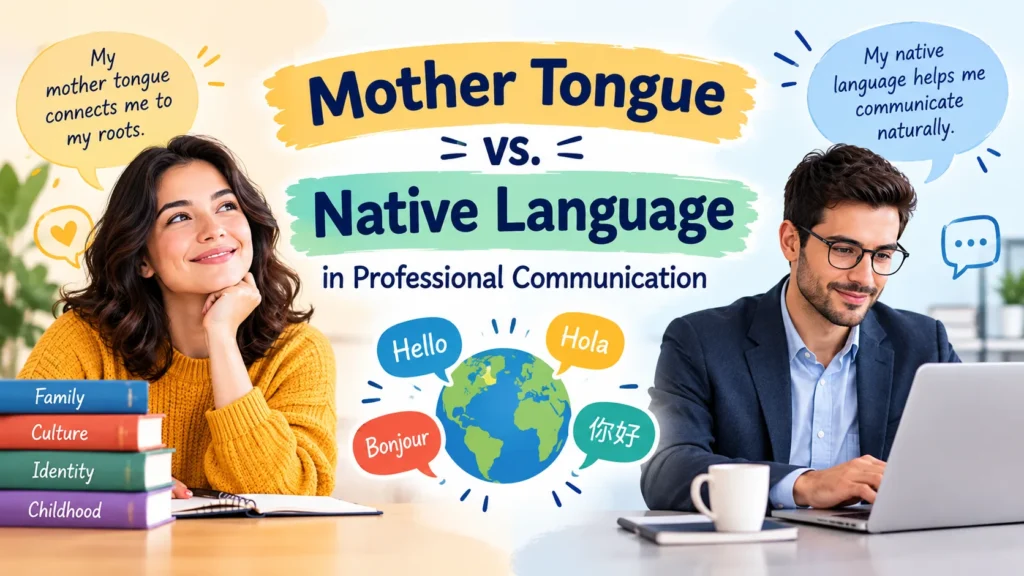
The term you choose can change the meaning of a question.
Choosing the Right Term in Professional Writing
Use mother tongue when the context centers on:
- Family background
- Cultural identity
- Childhood language
- Personal connection
Use native language when discussing:
- Natural early acquisition
- Native-speaker status
- Contrast with later language learning
Use first language (L1) when writing about:
- Linguistics
- Second-language acquisition
- Language education
- Academic research
When precision matters, alternatives may work even better.
Everyday Communication
Suppose someone asks:
“What’s your native language?”
They probably want to know which language you grew up speaking naturally.
If someone asks:
“What’s your mother tongue?”
They may be asking about your family or cultural language.
In casual conversation, most people won’t insist on a technical distinction.
Still, multilingual speakers may give a more complicated answer.
Forms, Surveys, and Language Questions
Poorly worded forms can create confusing data.
Instead of asking:
“What is your mother tongue?”
a researcher might ask:
“Which language did you learn first?”
Or:
“Which language do you primarily speak at home?”
Or:
“Which language are you most proficient in?”
Each question measures something different.
That’s the key.
Mother Tongue, Native Language, and Language Proficiency
Native Does Not Mean Perfect
A native speaker can make mistakes.
Children acquire language naturally, but adults continue learning vocabulary, styles, registers, and specialized terminology throughout life.
Someone can speak English natively yet struggle with legal English.
Another person can learn English as an adult and become highly skilled at academic writing.
Acquisition history and proficiency are related, but they aren’t identical.
Dominant Language vs. Native Language
Your dominant language is generally the language you use most effectively or frequently in a particular area of life.
It can change.
A child might begin with Spanish as their strongest language. After years of English-medium education, English may become dominant for academic and professional communication.
Spanish remains part of the person’s linguistic history.
The dominant language simply describes the current balance.
Can Your Native Language Change?
This question requires careful wording.
If “native language” means the language acquired naturally during early childhood, your historical acquisition doesn’t change.
However, your proficiency and language dominance can change dramatically.
You can forget vocabulary. You can lose fluency. You can develop a stronger language.
So it’s more accurate to say that a person’s linguistic abilities can change than to say their childhood acquisition history changes.
Which Term Should You Use?
Choosing the right expression depends on what you want to communicate.
When “Mother Tongue” Fits Best
Choose mother tongue when discussing:
- Cultural identity
- Family language
- Childhood memories
- Heritage
- Personal linguistic background
Example:
“Punjabi is her mother tongue, and she grew up speaking it with her grandparents.”
This sounds natural when the cultural or family connection matters.
When “Native Language” Fits Better
Use native language when the focus is natural early acquisition.
Example:
“Spanish is his native language, although he now uses English more often at work.”
That sentence clearly separates early acquisition from current usage.
When “First Language (L1)” Works Best
First language (L1) works especially well in academic and technical writing.
Example:
“The study examines how a learner’s L1 influences the acquisition of English pronunciation.”
This wording avoids some ambiguity associated with “mother tongue.”
When Another Term Is More Precise
Sometimes none of the three is ideal.
Use home language when you mean the language used in the household.
Use heritage language when discussing a language connected to family or cultural heritage.
Use dominant language when describing the language a multilingual person currently uses most effectively or frequently.
The best term isn’t necessarily the most familiar one.
It’s the one that accurately describes the situation.
Read More : Family & Friends or Friends & Family? Meaning, Usage, and Which Comes First?
Common Misconceptions About Mother Tongue and Native Language
“Your Mother Tongue Must Be Your Mother’s Language”
Not necessarily.
Children acquire languages from their entire linguistic environment.
A mother may speak one language while the child grows up primarily speaking another.
The term is metaphorical rather than a strict biological rule.
“Everyone Has Only One Native Language”
That’s too simplistic.
Some people grow up with two or more languages from infancy.
Depending on the definition, both can qualify as native or first languages.
“Native Language Means the Language of Your Country”
No.
Countries can contain many languages.
A person’s citizenship doesn’t determine their native language.
Someone can be a native speaker of a minority language while living in a country where another language dominates public life.
“Your First Language Must Always Be Your Strongest Language”
Not at all.
Language dominance can shift because of:
- Immigration
- Schooling
- Work
- Marriage
- Community changes
- Reduced family-language use
- Social environment
Your first language describes an acquisition history. Your strongest language describes current ability.
“Native Speakers Always Know the Correct Grammar”
Native speakers acquire the grammar of their speech communities naturally.
Formal grammar rules are a different matter.
A native speaker may use an informal construction that differs from a prescriptive grammar rule. That doesn’t mean the speaker lacks grammatical knowledge.
Language has varieties, registers, dialects, and contexts.
Mother Tongue vs. Native Language: Practical Case Studies
Case Study: One Language From Birth
James grows up in an English-speaking household and attends an English-speaking school.
English is his:
- Mother tongue
- Native language
- First language
- Home language
In this case, the terms overlap almost completely.
Case Study: Two Languages From Birth
Sofia’s mother speaks Spanish and her father speaks English. Both languages surround her from infancy.
She grows up speaking both.
Here, calling Spanish her only “first language” could oversimplify her experience. Depending on the linguistic framework, both Spanish and English can be described as early-acquired or native languages.
Case Study: An Immigrant Child
Ahmed learns Arabic at home during early childhood. His family later moves to Canada.
English becomes the language of school, friendships, university, and work.
By adulthood:
- Arabic remains his early-acquired language.
- English may become his dominant language.
- Arabic may function as a heritage language.
- His proficiency can differ sharply across speaking, reading, and writing.
Nothing contradictory exists here.
The labels simply describe different dimensions.
Case Study: Heritage Language Loss
Elena hears Polish from her grandparents throughout childhood. She uses English almost everywhere else.
As she grows older, her Polish speaking ability declines.
She may still consider Polish part of her cultural and family identity even though English has become her strongest language.
This is one of the clearest examples of why identity, acquisition, and proficiency should not be collapsed into one category.
Case Study: Adult Language Learner
Daniel learns Japanese at age twenty-five.
Even if he eventually reaches near-native proficiency, Japanese normally isn’t described as his native language because he didn’t acquire it naturally during early childhood.
His achievement can still be remarkable.
Native status isn’t the same thing as proficiency.
A Useful Way to Think About the Difference
Imagine three overlapping circles:
MOTHER TONGUE
Family • Identity • Heritage
______
.-‘ ‘-.
.’ ‘.
/ L1 \
| Early |
| Acquisition |
\ /
‘. .’
‘-.______.-‘
NATIVE
Natural Early
Acquisition
The circles overlap because one language can satisfy all three descriptions.
But multilingual experiences can push the categories apart.
For example, your home language might be different from your strongest school language. Your heritage language might differ from your dominant language. Your first-acquired language might no longer be the language you use most often.
That isn’t an exception to language development.
It’s part of how multilingualism works.
Mother Tongue vs. Native Language: The Bottom Line
The debate over mother tongue vs. native language doesn’t have one universal answer because the terms aren’t perfectly standardized.
For many people, they refer to the same language.
For others, the distinction becomes meaningful.
Mother tongue tends to highlight family, childhood, culture, and personal identity. Native language tends to emphasize natural early acquisition. First language (L1) provides a more technical term for discussing early language development.
The safest approach is to look at what you’re actually trying to describe.
If you’re talking about family and cultural background, mother tongue may fit naturally. If you’re discussing early natural acquisition, native language may be clearer. If you’re writing about linguistics or language learning, first language (L1) usually offers greater precision.
Most importantly, don’t assume that every person has one language that neatly fits every category.
A multilingual person’s linguistic life can be layered, shifting, and surprisingly complex. One language may belong to childhood. Another may dominate adulthood. A third may connect them to family history.
Those differences don’t make the terminology useless.
They show why choosing the right term matters.
Frequently Asked Questions About Mother Tongue vs. Native Language
What Is the Main Difference Between a Mother Tongue and a Native Language?
A mother tongue often emphasizes a person’s family, cultural, and childhood language background. A native language generally emphasizes a language naturally acquired during early childhood. In everyday usage, however, the two terms often refer to the same language.
Can Someone Have More Than One Mother Tongue?
Yes. A person raised with two languages from early childhood may identify both as mother tongues. The answer can depend on how the individual and the relevant institution define the term.
Can Someone Have Two Native Languages?
Yes. Children can acquire multiple languages naturally from infancy. Such individuals are often described as simultaneous bilinguals.
Is First Language the Same as Mother Tongue?
Not always. First language (L1) is generally a more technical term describing language acquisition. Mother tongue often carries additional family or cultural meaning. For many people, however, both terms refer to the same language.
Can Your Native Language Be Different From Your Strongest Language?
Yes. A person’s dominant or strongest language can change over time. Immigration, schooling, work, and social environment can make a later-acquired language stronger than an early-acquired one.
Can You Lose Your Mother Tongue?
You can lose substantial fluency in a childhood language through reduced use. You may experience language attrition while retaining an emotional or cultural connection to that language.
Can Your First Language Change?
Your historical first language doesn’t change. However, your proficiency, frequency of use, and language dominance can change considerably throughout life.
Does Your Mother Tongue Have to Be Your Mother’s Language?
No. The term doesn’t literally require the language spoken by your biological mother. Children acquire languages through broader social and family environments.
Is a Heritage Language the Same as a Mother Tongue?
Not necessarily. A heritage language is connected to a person’s family or cultural heritage. Someone can have a heritage connection to a language without speaking it fluently or acquiring it first.
Is “Native Speaker” Better Than “First-Language Speaker”?
Neither term is universally better. Native speaker is common and widely understood, while first-language speaker can be more precise in some academic contexts. The appropriate choice depends on what you want to describe.
What Term Should You Use in Academic Writing?
First language (L1) is often the safest choice when discussing language acquisition or multilingualism academically. However, define the term if the distinction matters to your research.
Conclusion
The difference between mother tongue vs. native language is subtle because the expressions overlap in everyday English.
For one person, all three labels may describe the same language. For another, they may point to different parts of a complicated multilingual background.
Think of mother tongue as a term often tied to family, identity, and cultural roots. Think of native language as a term centered more on natural early acquisition. Think of L1 as the technical linguistic label used to discuss a person’s earliest language acquisition.
Once you separate acquisition, identity, home use, heritage, proficiency, and language dominance, the apparent confusion becomes much easier to understand.
The right term depends on the question.
If you want to know which language someone learned first, ask about their first language. If you want to understand their family or cultural background, mother tongue may be more appropriate. If you’re describing natural early acquisition, native language is often the clearest choice.
Language doesn’t always fit into tidy categories. Your terminology shouldn’t force it to.