
When you compare serpent vs. snake, the first thing to know is that the two words usually refer to the same kind of animal. A snake is a limbless, elongated reptile, and Serpentes is the scientific suborder that contains snakes.
So why do English speakers have two words?
The answer isn’t zoological. It’s largely linguistic, historical, stylistic, and cultural. Snake is the ordinary modern English word you hear in conversation, wildlife reporting, and general science writing. Serpent, by contrast, often sounds more literary, formal, historical, religious, or symbolic.
That difference becomes especially noticeable when you read mythology, religious texts, poetry, or fiction. A writer might describe an animal as a snake when giving a straightforward description but call it a serpent when the creature represents temptation, danger, mystery, or an ancient power.
In other words, the choice isn’t simply about finding a synonym. The word you choose can change the tone of the sentence.
Serpent vs. Snake: The Core Difference
The simplest distinction is this:
Snake is the normal modern word for the animal, while serpent is a more marked word that often carries literary, historical, religious, or symbolic associations.
Neither word normally identifies a completely separate type of reptile. The scientific group is Serpentes, a suborder within the order Squamata. The Integrated Taxonomic Information System lists Serpentes as a valid suborder and gives “snakes” as its English common name.
Here’s the practical difference:
| Feature | Snake | Serpent |
| Basic meaning | A limbless reptile | A snake or snake-like creature |
| Everyday use | Very common | Less common |
| Modern tone | Neutral and familiar | Formal, literary, or dramatic |
| Scientific writing | Commonly preferred | Usually not the ordinary choice |
| Religious writing | Possible | Strong historical association |
| Mythology | Used | Especially common |
| Poetry | Common | Often preferred for elevated imagery |
| Figurative meaning | Common | Often strongly symbolic |
| Modern conversation | Natural | Can sound unusual or old-fashioned |
There is one important qualification. Serpent isn’t merely a fancy word that always means something mythical. It can describe an actual snake. The context determines whether the word feels literal, poetic, religious, or symbolic.
What Does “Snake” Mean?
The word snake has a broad but straightforward modern meaning.
In biology, snakes are elongated, limbless reptiles belonging to the suborder Serpentes. Modern taxonomy recognizes Serpentes within Squamata.
Snakes include many different families and species. Cobras, vipers, pythons, boas, mambas, rattlesnakes, and numerous other reptiles belong to this broad group.
The ordinary English word snake therefore works well when you’re talking about the actual animal.
What “Snake” Means Today
In modern English, snake is the default term for the animal.
You’d naturally say:
- “I saw a snake in the garden.”
- “The snake disappeared into the grass.”
- “That species of snake is venomous.”
- “The zoo has several species of snakes.”
- “A snake crossed the road.”
None of these sentences needs the more elevated word serpent.
In fact, replacing snake with serpent in an ordinary sentence can make the writing sound unnecessarily dramatic:
“I saw a serpent in the garden.”
That sentence isn’t wrong. It simply creates a different atmosphere.
You might imagine a dark forest, an old legend, or a Gothic story. With snake, the sentence sounds like an ordinary report.
Snake as a Noun
The most familiar use of snake is as a noun for the animal.
For example:
“The snake curled beneath the rock.”
Here, the word performs a simple descriptive job. It identifies the creature without adding much stylistic baggage.
That makes snake especially useful in:
- Biology articles
- Wildlife guides
- News reports
- School textbooks
- Nature documentaries
- General-interest articles
- Everyday conversation
Snake as a Verb
Snake can also function as a verb.
When something snakes through an area, it moves in a winding or twisting path.
For example:
- “The road snakes through the mountains.”
- “A narrow stream snakes between the fields.”
- “The trail snakes through the forest.”
This figurative use comes from the characteristic winding movement associated with snakes.
The noun and verb therefore share a useful visual connection: something that snakes doesn’t necessarily contain a snake. It simply follows a twisting or sinuous path.
Common Contexts for “Snake”
You’ll see snake in several broad contexts.
Literal animal use
“The snake rested beneath a fallen branch.”
Scientific use
“The researchers recorded several snake species in the region.”
Figurative movement
“The highway snakes along the coastline.”
Negative metaphor
“He called the dishonest businessman a snake.”
That final use shows that snake can carry strong emotional meaning. The word itself isn’t always neutral. Context controls the connotation.
What Does “Serpent” Mean?
Serpent is an older English word for a snake or snake-like creature. Its history reaches through Old French to Latin serpens, related to serpere, meaning “to creep.” English has used serpent since the Middle English period.
Unlike snake, however, serpent developed particularly strong connections with religious language, literature, mythology, and symbolic imagery.
That history still affects how modern readers perceive it.
What “Serpent” Really Means
At its most basic level, serpent can simply mean a snake.
For example:
“The serpent slid silently across the stone.”
The creature could be a completely real snake.
However, the word creates a different mood from:
“The snake slid silently across the stone.”
The second sentence sounds factual.
The first sounds more evocative. It could belong in a myth, fantasy novel, poem, religious discussion, or historical narrative.
That’s the key distinction.
The Etymology of “Serpent”
The history of serpent helps explain its modern flavor.
The word entered English from Old French serpent or sarpent. Those forms came from Latin serpens, meaning a snake or creeping thing. Latin serpens comes from serpere, “to creep.”
The word’s association with the biblical serpent also became important in English. Etymological records note the use of serpent in connection with the tempter in Genesis from the early history of the English word.
That religious history helped give serpent a set of associations that snake doesn’t always carry as strongly.
Key Characteristics of “Serpent”
In modern writing, serpent often suggests one or more of these qualities:
- Ancientness
- Mystery
- Danger
- Deception
- Religious symbolism
- Mythology
- Power
- Elegance
- Menace
- Poetic imagery
Not every use contains all these meanings. Sometimes serpent simply means snake.
Still, these associations explain why writers continue to choose the word.
Examples of “Serpent”
Consider these examples:
“The serpent guarded the entrance to the ancient temple.”
“The hero faced a gigantic serpent beneath the mountain.”
“The poem describes the river as a silver serpent.”
“The biblical serpent has become an enduring symbol in Western art.”
Each sentence gives serpent a slightly elevated or symbolic quality.
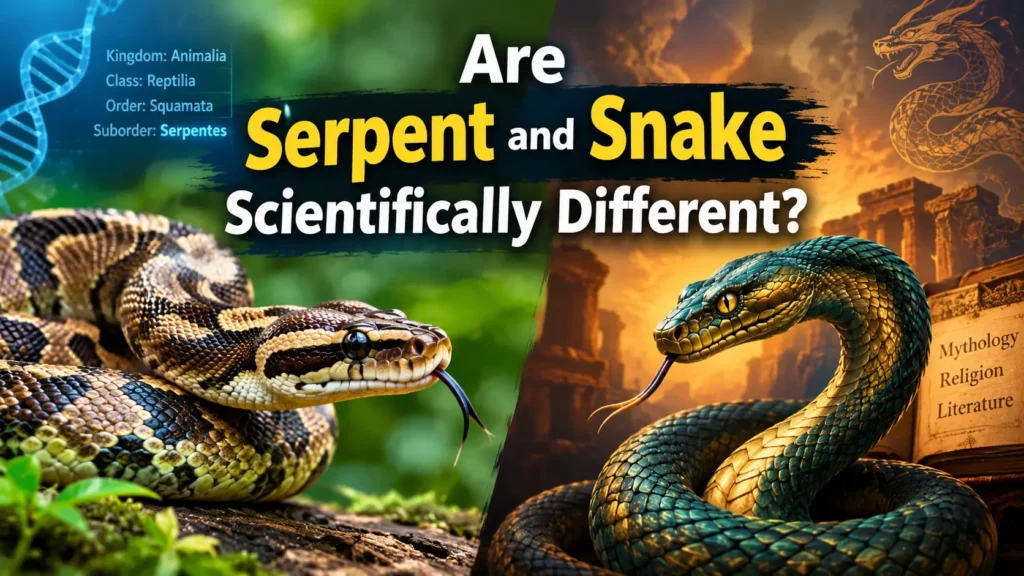
Are Serpent and Snake Scientifically Different?
This is where many explanations go wrong.
There isn’t a separate scientific group called “serpents” that stands apart from snakes in the ordinary sense.
The formal taxonomic name Serpentes refers to snakes. ITIS identifies Serpentes as a valid suborder within Squamata and lists snakes as its English common name.
The Scientific Reality
The scientific classification can be simplified like this:
Kingdom: Animalia
↓
Class: Reptilia
↓
Order: Squamata
↓
Suborder: Serpentes
↓
Families and genera: Many different groups of snakes
The exact classification of snake families can change as researchers revise evolutionary relationships. However, the key point remains: Serpentes is the scientific taxonomic name for the group commonly called snakes.
Why Science Uses “Snake” More Often in General Writing
Scientific writing values consistency and precision.
A zoologist may write about Serpentes when discussing taxonomy. In general educational writing, however, snake is perfectly appropriate.
If a biology textbook says:
“Snakes are limbless reptiles in the suborder Serpentes.”
the terminology is clear.
If it says:
“Serpents are a mysterious group of ancient reptiles.”
the sentence sounds much more literary and less taxonomically precise.
That’s why context matters.
Serpentes Is Not the Same as “Serpent”
This distinction deserves special attention.
Serpentes is a formal taxonomic name.
serpent is an English common noun.
They are historically related in form, but they don’t have the same grammatical or scientific status.
You shouldn’t assume that because scientists use Serpentes, the ordinary word serpent is itself a scientific classification.
It isn’t.
Snake vs. Serpent in Modern English Usage
The biggest practical difference appears in everyday usage.
Spoken English
In normal conversation, snake is overwhelmingly the more natural choice.
Imagine someone sees a snake on a hiking trail. They might say:
“Watch out! There’s a snake.”
Almost nobody needs the word serpent in that situation.
Using serpent isn’t automatically incorrect. It simply sounds more deliberate or stylized.
Written English
Writing gives you more freedom.
A wildlife guide might say:
“The snake feeds mainly on small mammals.”
A fantasy novel might say:
“The ancient serpent emerged from the ruined temple.”
Both sentences are grammatically sound. Their purposes are different.
The first prioritizes information.
The second prioritizes atmosphere.
Snake for Clarity
If you’re writing for a broad audience, snake is usually the safest choice when you simply mean the animal.
It’s familiar. It’s direct. Readers don’t have to interpret the tone.
Serpent for Style
Serpent becomes useful when you want the noun itself to contribute to the mood.
Compare:
“A snake wrapped around the statue.”
with:
“A serpent coiled around the ancient statue.”
The second version immediately feels more legendary.
That’s not because the animal changed. The framing changed.
Tone and Connotation: Why Word Choice Matters
Words don’t only carry dictionary definitions. They also carry associations.
That’s particularly obvious with snake and serpent.
Snake: Familiar and Usually Neutral
In literal contexts, snake is straightforward.
It doesn’t automatically suggest mythology or ancient religion.
You can write:
“The snake has adapted to dry desert conditions.”
The sentence sounds factual.
However, snake can also become strongly negative in figurative language.
Calling someone “a snake” often suggests dishonesty, betrayal, or treachery.
Serpent: Literary and Symbolic
Serpent carries more historical baggage.
It can suggest a creature that belongs to an older world: temples, myths, sacred texts, legends, curses, or epic stories.
That doesn’t make the word inherently negative.
In different cultural traditions, serpent imagery can represent different ideas, including wisdom, renewal, fertility, protection, danger, or divine power.
Side-by-Side Example
| Sentence | Likely effect |
| “A snake moved through the grass.” | Factual |
| “A serpent moved through the grass.” | Literary |
| “The snake attacked its prey.” | Scientific/naturalistic |
| “The serpent struck without warning.” | Dramatic |
| “The snake appeared in the garden.” | Ordinary |
| “The serpent appeared in the garden.” | Symbolic or biblical tone |
The underlying animal can be identical. The reader’s expectations aren’t.
Serpent vs. Snake in Religion
Few contexts have shaped the word serpent more strongly than religion.
Why Religious Texts Often Use “Serpent”
Older religious English frequently uses serpent where modern readers might naturally say snake.
This is partly a matter of translation tradition and partly a matter of historical vocabulary.
The word became especially prominent through the biblical account of Genesis, where the serpent is associated with temptation.
That association has had an enormous influence on English literature and Western art.
The Serpent in Genesis
Genesis describes a serpent in the story of Adam and Eve.
Because English religious traditions have often used serpent in this passage, the word developed a powerful symbolic association with temptation, deception, and evil.
That doesn’t mean every biblical serpent reference has exactly the same theological meaning.
Nor does it mean every snake in every culture symbolizes evil.
The important point is that English religious tradition gave “serpent” a particularly strong symbolic life.
Why Translation Matters
Different Bible translations make different lexical choices.
Some retain serpent because it preserves traditional wording or literary tone. Others may use snake in contexts where modern readers benefit from a more familiar term.
Therefore, if you’re discussing a specific biblical passage, it’s better to identify the translation rather than claiming that English Bibles universally use one word.
Serpent vs. Snake in Mythology and Folklore
Mythology provides another major home for serpent.
Across different cultures, snake-like creatures appear in stories about creation, destruction, fertility, wisdom, protection, transformation, and the natural world.
However, these traditions aren’t interchangeable.
Jörmungandr
In Norse mythology, Jörmungandr, the Midgard Serpent, is a gigantic serpent associated with the world and Ragnarök.
Calling it a “snake” wouldn’t necessarily be incomprehensible. Yet serpent better matches the traditional literary register of the creature.
Nāgas
South and Southeast Asian traditions include nāgas, often represented as serpent-like beings.
Their meanings vary by tradition. They can have associations with water, fertility, protection, power, and sacred places.
Reducing all serpent symbolism to “evil” would therefore give a misleading picture of global traditions.
Quetzalcoatl
Mesoamerican traditions include Quetzalcoatl, commonly translated as “Feathered Serpent.”
Here, serpent works particularly well because the creature is not simply an ordinary snake. The term communicates its mythological and symbolic status.
Why “Serpent” Fits Mythology
Mythological writing often needs language that feels larger than everyday life.
Serpent provides that elevated register.
It can make a creature sound ancient, mysterious, or legendary without requiring the writer to explain the atmosphere directly.
Common Expressions Using “Snake”
The word snake appears in many established English expressions.
Snake in the Grass
A snake in the grass refers to a hidden or deceptive person.
The image works because a snake can remain concealed until it strikes.
Example:
“The manager seemed helpful, but he turned out to be a snake in the grass.”
Snake Oil
Snake oil originally referred to supposed medicinal products associated with deceptive sales practices.
Today, snake oil often describes a product, claim, or solution presented as effective despite lacking convincing evidence.
Example:
“The website promised instant results, but the treatment looked like snake oil.”
Snake Eyes
Snake eyes refers to rolling two ones with a pair of dice.
The phrase has also developed broader associations in gambling and popular culture.
Snake Pit
A snake pit can literally describe an enclosure containing snakes.
Figuratively, it can describe a chaotic, hostile, or dangerous environment.
Snake Charmer
A snake charmer traditionally refers to someone who appears to control snakes, often in a performance involving music.
The term has strong cultural and historical associations, so writers should avoid treating stereotypical portrayals as universal descriptions of snake-handling traditions.
Expressions and Symbolism Using “Serpent”
Serpent appears in fewer ordinary idioms than snake, but its symbolic reach is considerable.
Serpent’s Tongue
A serpent’s tongue can describe malicious, deceitful, or venomous speech.
The expression builds on old symbolic associations between serpents and dangerous speech.
Historical etymological records also connect serpent’s tongue with an old misconception about the snake’s tongue being a “sting.”
Sea Serpent
A sea serpent can mean a legendary sea creature resembling a huge snake.
This is important because sea serpent and sea snake aren’t interchangeable.
A sea snake is a real group of marine snakes.
A sea serpent commonly refers to a legendary or folkloric creature.
That one-word difference can completely change what the reader thinks you’re describing.
Serpent Imagery
Writers often use serpent imagery to suggest:
- Temptation
- Hidden danger
- Transformation
- Ancient power
- Mystery
- Deception
- Wisdom
- Renewal
- Death or rebirth
The meaning depends on the culture and story.
Sea Snake vs. Sea Serpent
This is one of the clearest examples of why word choice matters.
What Is a Sea Snake?
A sea snake is a real marine snake belonging to snake lineages adapted to life in the ocean.
These animals have specialized adaptations for marine environments.
Therefore:
“The researchers observed a sea snake near the reef.”
sounds like a scientific or wildlife observation.
What Is a Sea Serpent?
A sea serpent usually refers to a legendary creature reported in folklore, maritime stories, and popular culture.
The phrase evokes enormous, mysterious creatures that supposedly inhabit the sea.
Therefore:
“Sailors claimed they had seen a sea serpent.”
immediately sounds like a story about a legendary creature rather than ordinary zoology.
The distinction is useful:
| Term | Typical meaning |
| Sea snake | Real marine snake |
| Sea serpent | Legendary or folkloric creature |
Snake vs. Serpent in Different Types of Writing
The best word often depends on the kind of writing you’re producing.
Scientific Writing
Choose snake for general references to the animals and use precise taxonomic terminology when needed.
For example:
“Snakes are members of the suborder Serpentes.”
That’s clear and scientifically appropriate.
When discussing a particular species, use its accepted common name or scientific name rather than relying on an ornamental synonym.
Journalism
News writing generally favors snake because journalists usually prioritize clarity.
For example:
“A snake was found inside a home on Tuesday.”
That’s more natural than:
“A serpent was found inside a home on Tuesday.”
The second sentence sounds unnecessarily dramatic unless the article intentionally uses a literary style.
Educational Writing
For children and general learners, snake is usually easier.
For example:
“Snakes use their tongues to collect chemical information from the environment.”
Once students encounter literature, mythology, or religious texts, serpent becomes useful as a vocabulary word with additional connotations.
Fiction and Storytelling
Fiction gives writers more freedom.
A children’s adventure story might use snake:
“The snake slithered across the path.”
A dark fantasy novel might use serpent:
“The ancient serpent awakened beneath the ruins.”
The second word helps establish scale and atmosphere.
Poetry
Poetry often depends on sound, rhythm, imagery, and association.
Serpent can work beautifully in poetic language because it has a long literary history.
But snake can be equally powerful when a poem needs something blunt, familiar, or unsettling.
The better word is the one that serves the poem.
Case Study: One Animal, Three Writing Styles
Imagine that a writer sees a large snake near an old stone temple.
Scientific Report
“A large snake was observed near the eastern wall of the temple.”
This version prioritizes factual clarity.
News Article
“Visitors spotted a large snake near the temple on Saturday.”
Again, snake is the natural choice.
Fantasy Novel
“An enormous serpent coiled around the temple ruins.”
Now serpent makes sense because the writer wants the creature to feel mysterious and legendary.
The animal hasn’t changed. The communicative purpose has.
That’s one of the most useful lessons in the entire serpent vs. snake debate.
Common Mistakes and Misconceptions
Mistake: Serpent and Snake Are Completely Different Animals
This is the biggest misconception.
In ordinary English, both words can refer to snakes.
Scientifically, Serpentes is the taxonomic suborder containing snakes.
So don’t treat serpent as the name of a separate biological group.
Mistake: Serpent Always Means a Mythical Creature
Not true.
A real snake can be called a serpent.
For example:
“The serpent moved beneath the leaves.”
Without additional context, that sentence doesn’t prove that the creature is mythical.
The word simply carries a more literary flavor.
Mistake: Snake Is Too Informal for Serious Writing
It isn’t.
Snake is entirely appropriate in formal scientific and educational writing when used accurately.
In fact, clarity often makes it the better choice.
Mistake: Serpent Is Always More Sophisticated
More unusual doesn’t automatically mean better.
Consider:
“The biologist examined the serpent’s feeding behavior.”
The sentence isn’t grammatically wrong. But if the article is a straightforward scientific report, snake may be more natural and precise.
A sophisticated writer doesn’t use the rarest available synonym. A sophisticated writer chooses the word that fits.
Mistake: Snake Symbolism Always Means Evil
Snake imagery has many meanings.
Some traditions connect snakes with deception or danger. Others associate them with healing, wisdom, fertility, renewal, protection, or transformation.
The symbolism depends on the cultural and narrative context.
How to Choose the Right Word Every Time

You don’t need to overthink this.
Ask yourself three questions.
Is This a Factual Description?
If you’re simply identifying the animal, choose snake.
“The snake lives in rocky habitats.”
That’s clean and direct.
Is the Context Historical, Religious, or Mythological?
If you’re discussing a traditional story or symbolic creature, serpent may fit better.
“The serpent appears as a powerful figure in the myth.”
The elevated register supports the subject.
Is Tone More Important Than Neutrality?
If you want the sentence to feel ancient, mysterious, poetic, or dramatic, serpent can contribute to that effect.
Compare:
“A snake guarded the doorway.”
with:
“A serpent guarded the doorway.”
The second sentence feels more like the beginning of a legend.
Is Your Audience Looking for Clarity?
When clarity matters most, snake is usually the safer default.
This applies especially to:
- How-to articles
- Scientific explanations
- News stories
- General educational content
- Wildlife guides
- Everyday communication
Read More : In Process vs. In Progress: Meaning, Difference, and Correct Usage
Why Writers Still Use “Serpent” Today
If snake is simpler, why hasn’t serpent disappeared?
Because language isn’t only about efficiency.
Some words survive because they offer a particular tone or cultural resonance.
Serpent carries centuries of literary and religious associations. It can evoke ancient stories in a single word.
A fantasy writer doesn’t necessarily want:
“A large snake appeared.”
That sounds ordinary.
The writer might prefer:
“A colossal serpent emerged from the darkness.”
Now the creature feels extraordinary.
Likewise, a poet might use serpent to create an image of something winding through a landscape:
“The river became a silver serpent beneath the moon.”
The river isn’t literally a reptile. The metaphor works because readers already understand the serpent’s winding shape and cultural associations.
Quick Comparison: Serpent vs. Snake
| Question | Snake | Serpent |
| Does it refer to a real snake? | Yes | Yes |
| Is it a separate biological category? | No | No |
| Is it the common everyday word? | Yes | No |
| Is it common in science writing? | Yes | Less common |
| Does it have literary associations? | Some | Strong |
| Does it have religious associations? | Some | Strong |
| Does it work in mythology? | Yes | Especially well |
| Does it sound dramatic? | Sometimes | Often |
| Is it suitable for conversation? | Yes | Sometimes |
| Is it suitable for poetry? | Yes | Very often |
| Is it suitable for factual writing? | Yes | Sometimes |
| Can it describe a symbolic creature? | Yes | Especially common |
Practical Examples: Snake or Serpent?
Here are some side-by-side examples to make the difference easier to see.
Example: Wildlife
Natural:
“The snake feeds on small rodents.”
More literary:
“The serpent hunted beneath the moonlight.”
Both can describe a real animal. The second creates more atmosphere.
Example: Mythology
Possible:
“The snake guarded the sacred temple.”
More fitting for elevated mythological prose:
“The serpent guarded the sacred temple.”
The second better signals that the creature belongs to a legendary world.
Example: Science
Best choice:
“The researchers studied the snake’s feeding behavior.”
Less natural:
“The researchers studied the serpent’s feeding behavior.”
The second isn’t necessarily impossible. It simply sounds more stylized.
Example: Religion
Traditional style:
“The serpent tempted Eve.”
Here, serpent immediately signals the traditional biblical context.
Example: Everyday Conversation
Natural:
“There’s a snake outside.”
Marked:
“There’s a serpent outside.”
The first sounds like something someone would naturally say in an urgent situation.
A Simple Decision Guide
When you’re unsure whether to write snake or serpent, use this shortcut:
Real animal + ordinary context = snake
Scientific discussion = snake or precise taxonomic terminology
Mythology = serpent often works best
Traditional religious context = serpent often works best
Poetry = either, depending on imagery
Fantasy = serpent often creates a stronger atmosphere
Everyday speech = snake
Straightforward journalism = snake
Symbolic writing = serpent often adds useful weight
This isn’t an absolute grammatical rule. It’s a practical style guide.
FAQs About Serpent vs. Snake
Is a serpent the same thing as a snake?
Usually, yes. In ordinary English, serpent can mean a snake. The main difference lies in usage and connotation, not in the basic animal being described.
Snake is the normal everyday word. Serpent often sounds more literary, formal, historical, religious, or symbolic.
Is a serpent a different species of snake?
No.
Serpent does not identify a separate species.
Scientifically, Serpentes is the suborder containing snakes. ITIS classifies Serpentes under Squamata and lists “snakes” as its English common name.
Why does the Bible say “serpent” instead of “snake”?
Traditional English Bible translations have often used serpent, particularly in the account of Genesis.
The word has a long history in English religious vocabulary. That history helped strengthen its associations with temptation, deception, and evil in Christian cultural traditions.
However, Bible translations differ, so it’s better to check the specific translation when discussing exact wording.
Can “serpent” be used in modern English?
Absolutely.
The word remains part of modern English.
You’ll see it in:
- Literature
- Poetry
- Fantasy
- Mythology
- Religious writing
- Historical discussions
- Symbolic descriptions
- Expressions such as “sea serpent”
It simply appears less frequently in ordinary conversation than snake.
Is “serpent” a scientific term?
Serpent itself is not the usual scientific common noun for a separate animal category.
However, Serpentes is a formal taxonomic name for the snake suborder. ITIS lists Serpentes as a valid suborder of Squamata.
That’s an important distinction.
Is “snake” more formal than “serpent”?
In modern factual writing, snake can actually be the better formal choice.
Scientific and educational writing values clear terminology. If you’re discussing the animal itself, snake is familiar and precise.
Serpent is more elevated in style, but elevated doesn’t necessarily mean more formal or more scientifically accurate.
Does “serpent” always have a negative meaning?
No.
Although English religious and literary traditions often connect serpents with temptation, danger, or deception, serpent symbolism varies widely.
Different cultures have associated serpent-like beings with:
- Wisdom
- Protection
- Fertility
- Renewal
- Healing
- Transformation
- Water
- Power
- Danger
Context matters more than any single symbolic definition.
Can you call a real snake a serpent?
Yes.
A real snake can be called a serpent. The word doesn’t automatically turn the animal into a mythical creature.
The difference is mainly stylistic.
Which word is better for clear writing?
Snake is usually better when clarity and familiarity are the main goals.
Use serpent when the historical, literary, religious, mythological, or symbolic associations add something useful.
A good rule is simple:
Choose “snake” for straightforward identification. Choose “serpent” when its extra tone or symbolism serves the sentence.
Final Thoughts: Snake or Serpent?
The serpent vs. snake distinction is much more interesting than a simple synonym debate.
At the biological level, there isn’t a separate class of animals called serpents that differs from snakes. Serpentes is the scientific suborder containing snakes.
At the language level, however, the two words have developed different personalities.
Snake is familiar, direct, modern, and practical. It’s the natural choice for everyday conversation, factual descriptions, journalism, wildlife writing, and most educational material.
Serpent carries more history. Its roots reach back through French and Latin, while centuries of religious, literary, and mythological usage have given it a richer set of associations.
That’s why a writer might choose serpent when describing a mythological guardian, a biblical figure, a poetic image, or an ancient creature.
Neither word is automatically better.
The right choice depends on what you want the reader to hear in the sentence. If you want simple identification, snake usually wins. If you want mystery, antiquity, symbolism, or literary weight, serpent may be the stronger word.
So when you’re deciding between them, don’t ask only, “Are these two words synonyms?”
Ask a better question:
“What should this word make the reader feel?”
That’s where the real difference between serpent and snake begins.