If you’ve seen “BBW” in a text message, dating profile, social media post, or online comment, you may have paused for a moment and wondered what those three letters mean.
In most conversations about dating, body image, attraction, or online communities, BBW means “Big Beautiful Woman.” It’s an informal acronym used to describe a woman with a larger or fuller body while emphasizing attractiveness or beauty.
However, knowing the full form doesn’t tell you everything.
The same acronym can sound complimentary in one conversation and uncomfortable in another. A woman might proudly describe herself as a BBW. Someone else might use the same label without being invited to do so. In some online spaces, especially dating and adult-oriented communities, the term can also carry a distinctly sexual meaning.
That’s why BBW meaning in text depends heavily on context.
Who wrote it? Who received it? What were they discussing? Was it part of a dating profile, a joke between friends, or a comment from a stranger? Those details can change how the word should be understood.
This guide breaks down the meaning of BBW in text, its history, modern usage, tone, examples, related terms, and the situations in which using it may or may not be appropriate.
What Does BBW Mean in Text?
In texting and casual online communication, BBW usually stands for “Big Beautiful Woman.”
The acronym generally describes a woman with a larger, fuller, or plus-size body. The word “beautiful” gives the expression a positive or appreciative framing.
For example:
“She proudly identifies as a BBW.”
Here, BBW functions as a self-description.
Compare that with:
“BBW is my type.”
In this case, the acronym describes a dating or physical preference.
You might encounter BBW in:
- Text messages
- Dating apps
- Dating profiles
- Social media posts
- Online forums
- Personal ads
- Body-positive communities
- Casual conversations
- Search terms and hashtags
- Some adult-oriented online spaces
The acronym is informal. It generally belongs to casual internet language rather than professional or academic writing.
What Does Each Part of BBW Mean?
The full phrase has three simple components:
| Letter | Word | Meaning |
| B | Big | Refers broadly to a larger or fuller body |
| B | Beautiful | Adds a positive judgment about appearance |
| W | Woman | Identifies the person being described |
There’s an important detail here: “big” doesn’t represent a precise measurement.
BBW isn’t a standardized clothing size, medical classification, or exact body-weight category. One person may use it for herself while another person with a similar body type may prefer terms such as plus-size, curvy, or no body-size label at all.
That distinction matters because body descriptions aren’t purely mathematical. They’re also personal and cultural.
The Primary Meaning of BBW: Big Beautiful Woman
The most established meaning of BBW in this context is Big Beautiful Woman.
The expression combines a reference to body size with an explicitly positive description. In that sense, it differs from terms that simply describe weight or body shape without making an assessment about attractiveness.
The phrase has also been used in body-positive settings where people wanted to challenge the idea that larger women couldn’t fit conventional ideas of beauty.
According to historical references on the term, Carole Shaw is credited with coining “Big Beautiful Woman” in 1979 when she launched BBW Magazine, a fashion and lifestyle publication aimed at plus-size women. The phrase later spread into personal ads, dating communities, and internet culture.
That history helps explain why the term has two important sides today.
On one side, BBW can represent confidence, attraction, and positive self-identification.
On the other, decades of dating and sexualized online use have given it additional connotations.
Where Did the BBW Term Come From?
BBW predates modern social media.
The expression emerged in the late 1970s and became associated with publications and communities serving larger women. Its original use wasn’t dependent on Instagram, TikTok, or dating apps because none of those platforms existed at the time.
The internet later gave the acronym a much wider audience.
As forums, chat rooms, dating sites, and online communities developed during the 1990s and 2000s, abbreviations became increasingly useful. Typing BBW was faster than repeatedly writing Big Beautiful Woman.
The term eventually became common in several overlapping spaces:
- Plus-size communities
- Online dating
- Personal advertisements
- Body-positive discussions
- Social media
- Adult-oriented websites
Dictionary.com describes BBW as an informal acronym for Big Beautiful Women, while noting that its meaning is not presented as a formal dictionary definition.
So although the acronym looks like typical internet slang, its underlying phrase has a considerably longer history.
How Is BBW Used Today?
Modern usage generally falls into a few categories.
Self-description is one of the most straightforward uses.
“I’m a BBW who loves fashion and travel.”
Here, the woman has chosen the label for herself.
Dating preference is another common use.
“He says BBWs are his type.”
The term describes the type of woman someone finds attractive.
Body-positive discussion offers another possibility.
“BBW fashion deserves more representation.”
In this example, the focus is representation rather than dating.
Finally, sexualized usage can occur in certain online environments. In those spaces, BBW may function as a category describing sexual attraction to larger women.
The acronym therefore remains fairly stable in its basic meaning while its social meaning changes according to context.
Is BBW a Compliment?
BBW can absolutely function as a compliment.
The word “beautiful” is built directly into the phrase. When someone uses BBW positively and the person being described welcomes the term, it can communicate attraction, admiration, or confidence.
For example:
“She calls herself a BBW and looks incredibly confident.”
The speaker isn’t necessarily criticizing or mocking her body. The acronym can be part of an affirming description.
Still, there’s an important difference between intended meaning and received meaning.
Someone can intend to compliment another person while accidentally making that person uncomfortable.
That’s because body labels are personal.
When BBW Is Usually Taken Positively
The term is more likely to be received positively when:
- A person uses BBW to describe herself.
- Someone has already indicated that she likes the term.
- The conversation concerns body positivity.
- The term appears in a dating profile written by the person herself.
- The surrounding language is respectful.
- The speaker isn’t reducing the person entirely to her body.
A useful rule is simple:
If someone chooses the label for herself, that’s stronger evidence than assuming she would like the label.
Personal preference matters more than the acronym’s dictionary meaning.
When BBW Can Feel Offensive
A term doesn’t have to be inherently insulting to become offensive in a particular situation.
BBW can feel uncomfortable when someone applies it to another person without invitation. Imagine meeting someone for the first time and immediately commenting on her body. Even if the speaker intends the word beautiful positively, the interaction may still feel intrusive.
The problem may not be the acronym itself. The problem can be unwanted attention to someone’s body.
Context becomes even more important when the speaker is a stranger.
For example:
“You’re such a BBW.”
Depending on the relationship, tone, and setting, this could sound flattering, flirtatious, objectifying, or inappropriate.
Now consider:
“I’m proud to be a BBW.”
That statement is self-directed. The person is choosing the label rather than receiving it from someone else.
Those two uses may involve exactly the same acronym. Yet they can produce completely different reactions.
Intent Doesn’t Always Determine Impact
This is one of the most useful communication lessons surrounding BBW slang.
A speaker may think:
“I was complimenting her.”
The recipient may think:
“Why is this stranger commenting on my body?”
Both perspectives can exist at the same time.
Good communication therefore requires more than understanding vocabulary. It requires reading the situation.
How Context Changes the Meaning of BBW
Context acts like a filter.
Without context, BBW tells you the likely phrase. Context tells you what the speaker actually means by using it.
Consider these examples:
| Message | Likely Context |
| “I’m a proud BBW.” | Self-identification |
| “BBW fashion has improved.” | Plus-size fashion |
| “He dates BBWs.” | Dating preference |
| “She identifies as BBW.” | Personal description |
| “BBW is my favorite category.” | Likely sexualized context |
| “Why did he call her a BBW?” | Discussion of labeling |
The letters don’t change.
The conversation does.
BBW in Private Text Messages
Private messages can make BBW seem more casual because people often use abbreviations freely with friends or romantic partners.
For example:
“She told me she identifies as a BBW.”
This is relatively neutral reporting.
A romantic message may be more personal:
“You’re gorgeous. I love your curves.”
If both people are comfortable discussing bodies, the conversation may feel natural.
However, familiarity doesn’t automatically grant permission to use every label. Even close friends and partners can have different preferences about words describing their bodies.
BBW in Public Comments
Public comments require more caution.
Calling someone a BBW under a photograph can draw attention to her body in front of everyone who sees the post.
Compare:
“Love this outfit!”
with:
“You look like a beautiful BBW!”
The second comment makes body size part of the public discussion.
Some people may welcome that. Others may find it intrusive.
The safest approach is to consider whether the person has already used the term herself and whether the conversation actually calls for it.
BBW on Dating Apps
Dating apps are one of the places where the acronym appears most naturally.
Someone might write:
“BBW looking for someone who enjoys good food and long walks.”
Here, the person is using BBW as part of her self-description.
Another person might write:
“I’m attracted to BBWs.”
That usage expresses a dating preference.
These statements are different.
The first tells you how someone identifies. The second tells you what someone else prefers.
Why Dating Context Changes the Tone
Dating naturally involves attraction and physical preferences. As a result, BBW can sound more expected on a dating platform than it would in a workplace email.
However, dating context doesn’t remove the need for respect.
A profile can mention BBW because the user deliberately selected that identity. A stranger sending an unsolicited message about someone’s body is a different situation.
That distinction prevents a common mistake: assuming that because BBW appears on dating platforms, everyone is comfortable being called BBW.
BBW on Social Media and Online Communities
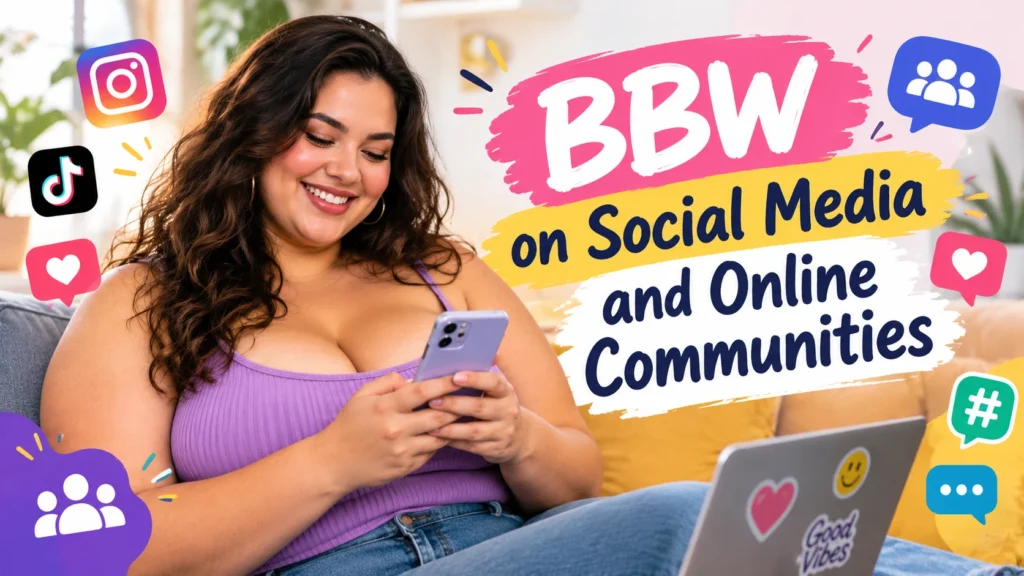
Social media has expanded the term far beyond private texting.
You may encounter BBW in:
- Usernames
- Hashtags
- Captions
- Dating profiles
- Fashion content
- Body-positive posts
- Community discussions
- Personal advertisements
On social platforms, the acronym can serve as a searchable category as well as a description.
A creator may use it to help like-minded audiences discover her content. Another person may use it to describe a fashion niche.
The surrounding content is therefore essential.
BBW Hashtags and Online Communities
Hashtags turn words into searchable labels.
A BBW-related hashtag might connect content involving body confidence, plus-size fashion, dating, or sexual material. These categories can overlap, which makes it especially important not to assume that every use carries the same tone.
The acronym’s presence alone doesn’t tell you whether a post is:
- Fashion-focused
- Body-positive
- Dating-related
- Personal
- Sexual
- Humorous
You need to examine the surrounding content.
BBW and Sexual Context
One of the biggest reasons people search for BBW meaning in text is that the acronym appears in sexual or adult-oriented online spaces.
The basic expansion remains Big Beautiful Woman. However, the context can make the term explicitly sexual.
For instance, a dating conversation about physical attraction may use BBW as a preference label.
An adult-oriented website may use BBW as a category or search term.
These uses aren’t necessarily identical to the body-positive meaning found in a fashion or self-confidence discussion.
Why Sexual Context Matters
Sexualized language can change how a body-related term feels.
Someone may proudly identify as a BBW without wanting strangers to sexualize her. Another person may deliberately use BBW in a sexual context.
Neither preference should automatically be imposed on the other.
This distinction is especially important online because platforms bring people with very different expectations into the same conversation.
BBW vs. Plus-Size
BBW and plus-size aren’t perfect synonyms.
Plus-size often functions as a broader descriptive term, particularly in fashion and retail.
BBW contains the word beautiful, which gives it a stronger emphasis on attractiveness. It can also carry dating or sexual associations depending on where you encounter it.
Consider these examples:
“The store expanded its plus-size collection.”
This is a fashion-related statement.
“I’m a BBW and I love fashion.”
This is a personal identity statement.
Both may involve larger body sizes. Their social meanings differ.
BBW vs. Curvy
Curvy is another related term, but it doesn’t mean exactly the same thing.
A curvy person may have a pronounced waist, hips, or bust without necessarily identifying as plus-size. BBW more directly communicates a larger-bodied identity.
Again, these categories aren’t strict scientific measurements.
Body shapes exist on a spectrum, and people choose labels based on their own experiences and preferences.
BBW vs. Fat
The word fat has a complicated history.
Some people use it neutrally or as a reclaimed identity term. Others experience it as insulting because of how people have historically used it to shame larger bodies.
BBW approaches the subject differently because it explicitly includes a positive statement about beauty.
Still, neither term is automatically right for every person.
The best label is often the one someone chooses for herself.
BBW vs. Big Girl
Big girl is much more dependent on tone and context.
Among friends, it might be casual. In another situation, it could sound patronizing or insulting.
BBW has a more recognizable connection to dating, body identity, and online culture. Big girl doesn’t necessarily carry the same meaning.
That difference is another reason context matters.
Common Mistakes People Make When Using BBW
Even when someone understands the definition, they can still misuse the acronym.
Here are the most common mistakes.
Assuming BBW Is Always a Compliment
The word beautiful doesn’t guarantee that the recipient will appreciate the label.
A person can dislike being categorized by body size regardless of the speaker’s intention.
Assuming BBW Is Always Sexual
BBW can appear in sexual contexts, but it isn’t limited to them.
It can also occur in:
- Fashion discussions
- Body-positive conversations
- Personal profiles
- Casual chats
- Community discussions
Context determines the tone.
Calling a Stranger BBW
This can be risky because you don’t know the person’s preferences.
If someone uses BBW in her own profile, that’s clear evidence that she accepts the term for herself. Without that signal, caution makes more sense.
Using BBW in Professional Writing
BBW is informal.
A workplace report, academic essay, business proposal, or formal letter generally isn’t the right place for this acronym unless you’re specifically discussing the term itself.
Clear, conventional language works better in formal communication.
Treating BBW as a Precise Body Category
BBW doesn’t correspond to one universal weight, height, clothing size, or body measurement.
It’s a social descriptor rather than a technical classification.
Should You Use BBW in a Text Message?
There isn’t one universal answer.
The better question is: Does the person and context support using it?
When Using BBW May Be Appropriate
Using BBW may make sense when:
- Someone uses the term to describe herself.
- You’re discussing a relevant online community.
- You’re talking about plus-size representation.
- You’re communicating within a dating context where the term is already established.
- The recipient has indicated that she likes the label.
- You’re explaining the acronym itself.
For example:
“You mentioned BBW in your profile, so I wanted to make sure I understood what you meant.”
That’s much safer than simply assigning the label to someone.
When You Should Avoid Using BBW
Avoid using it when:
- You’re commenting on a stranger’s body.
- The person hasn’t indicated that she likes the term.
- The setting is professional.
- The word could introduce an unwanted sexual implication.
- You’re using it as a joke.
- You’re trying to insult someone.
- The body description isn’t relevant to the conversation.
When in doubt, leave the label out.
How to Respond When Someone Calls You BBW
If someone calls you BBW, your response can depend entirely on how you feel about the term.
If You Like the Term
You can simply accept it or continue the conversation.
For example:
“Yes, I use BBW to describe myself.”
That establishes that the label is one you personally accept.
If You Don’t Like the Term
You can set a simple boundary.
For example:
“I don’t really use that term for myself.”
There’s no need for a lengthy explanation.
If You’re Unsure What They Mean
Ask.
“What do you mean by BBW?”
That’s particularly useful when the message lacks context.
A short clarification can prevent a much bigger misunderstanding.
Real-World BBW Text Examples
The best way to understand BBW meaning in text is to see how the acronym behaves in different situations.
Example: Self-Identification
Text: “I’m a BBW and I love experimenting with fashion.”
Meaning: The sender is describing herself as a Big Beautiful Woman.
Tone: Positive and self-affirming.
Here, the sender has chosen the term herself. There’s little reason to interpret it as an insult.
Example: Dating Preference
Text: “I’m attracted to BBWs.”
Meaning: The speaker is expressing attraction toward larger-bodied women.
Tone: Romantic or physical.
The context is clearly about dating or attraction.
Example: Fashion Discussion
Text: “BBW fashion has become much more diverse.”
Meaning: The conversation concerns fashion for larger women.
Tone: Descriptive.
Nothing about this sentence necessarily makes the term sexual.
Example: Unwanted Label
Text: “You’re a BBW, right?”
If the person hasn’t discussed body size, the question may feel intrusive.
The speaker may be curious rather than malicious. Still, the topic is personal.
Example: Sexual Context
Text: “BBW is one of the categories he searches for.”
Here, the surrounding language makes the sexual or attraction-based meaning clear.
The acronym itself hasn’t changed. The context has.
A Practical BBW Context Guide
| Situation | Likely Meaning | Appropriate Use |
| Self-description | Big Beautiful Woman | Usually appropriate |
| Dating profile | Body type or identity | Common |
| Dating preference | Attraction to larger women | Common |
| Fashion discussion | Plus-size identity/fashion | Possible |
| Body-positive community | Affirming identity | Common |
| Private romantic conversation | Attraction or description | Depends on consent |
| Public comment about a stranger | Body label | Potentially uncomfortable |
| Workplace communication | Informal acronym | Usually inappropriate |
| Adult-oriented content | Sexual category | Context-specific |
Is BBW Formal or Informal Language?
BBW is informal language.
It’s an acronym associated strongly with internet culture, dating, personal profiles, and casual communication.
That makes it suitable for certain contexts but awkward in others.
For example:
“The campaign features BBW models.”
This could work in an informal discussion about the terminology. In a formal report, however, you might choose a more precise phrase depending on the subject.
The key isn’t that BBW is “wrong.” It’s that register matters.
Formal writing usually rewards clarity and specificity. Informal texting allows more abbreviations and shorthand.
Why Tone Matters More Than the Acronym
Three letters can carry a surprising amount of social meaning.
Compare these messages:
“I’m a BBW and proud of it.”
“I prefer dating BBWs.”
“You’re such a BBW.”
The first is self-identification.
The second expresses a dating preference.
The third directly labels another person.
Those sentences aren’t interchangeable.
Tone also comes from everything surrounding the acronym. Emojis, punctuation, previous messages, relationship history, and even the platform can influence interpretation.
A heart emoji may make a message feel affectionate. A laughing emoji could make it playful or mocking. In another conversation, the same emoji could be interpreted differently.
That’s why decoding slang isn’t simply a matter of looking up a definition.
A Simple Rule for Using BBW Respectfully
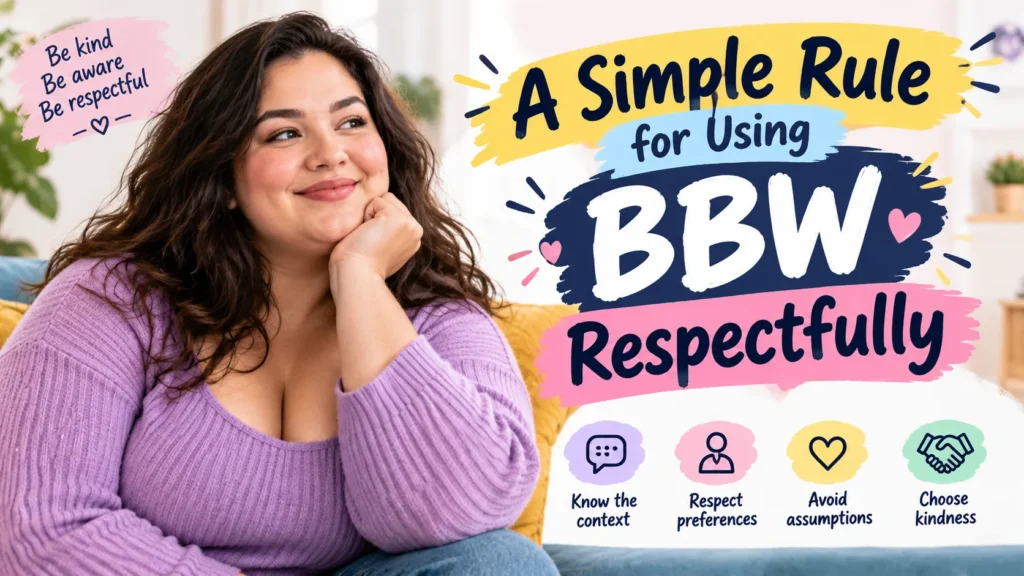
The easiest guideline is this:
Follow the person’s language rather than assigning your own label to them.
If someone describes herself as BBW, you know she uses that term.
If someone says she prefers plus-size, use plus-size.
If she says she doesn’t like body labels, don’t use one.
This approach avoids unnecessary assumptions.
Four Practical Rules
Follow their lead.
If someone uses BBW for herself, you have useful information about her preferred terminology.
Consider relevance.
If body size has nothing to do with the conversation, there may be no reason to mention it.
Watch the setting.
A dating conversation differs greatly from a workplace discussion.
Respect boundaries.
If someone dislikes the term, don’t keep using it simply because you believe it sounds positive.
Read More : MK Meaning: What It Means in Text and Online Slang
Why Understanding BBW Slang Matters
Internet language isn’t just about saving keystrokes.
Words such as BBW can carry information about identity, attraction, community, and personal preference. Misreading them can therefore lead to awkward or uncomfortable conversations.
Understanding the acronym helps you recognize what someone may be saying. Understanding the context helps you recognize how they’re saying it.
That’s the more important skill.
A dictionary can tell you that BBW means Big Beautiful Woman. Context tells you whether the person is discussing fashion, dating, body confidence, or sexual attraction.
Both pieces of information matter.
Frequently Asked Questions About BBW in Text
What does BBW mean in text messages?
In most texting, dating, and social-media contexts, BBW means “Big Beautiful Woman.” It generally refers to a larger or plus-size woman while emphasizing attractiveness or beauty.
What does BBW stand for?
BBW stands for “Big Beautiful Woman.” The acronym is used primarily in informal online communication, dating, body-positive discussions, and some adult-oriented contexts.
Is BBW a compliment?
It can be. The phrase contains the word beautiful, and many people use BBW positively or as a self-description. However, not everyone likes being described with the term, so the recipient’s preference matters.
Can BBW be offensive?
Yes, depending on how it’s used. Calling someone BBW without knowing whether they welcome the label can feel intrusive or objectifying. Tone, relationship, setting, and intent all influence how the term is received.
Does BBW always have a sexual meaning?
No. BBW can appear in dating, body-positive, fashion, and casual conversations. However, it also has established use in sexual or adult-oriented online contexts. The surrounding conversation determines which interpretation makes sense.
Is BBW appropriate for dating apps?
Yes. BBW is commonly used in dating profiles and dating-related conversations. Someone may use it to describe herself or another person may use it to express a dating preference.
Can someone use BBW to describe herself?
Absolutely. Self-identification is one of the clearest and least ambiguous uses of the term. If someone describes herself as BBW, she’s indicating that she accepts or prefers that label.
Is BBW formal or informal language?
BBW is informal language. It’s common in texting, online profiles, social media, dating communities, and casual conversation. It generally doesn’t belong in formal writing unless you’re discussing the term itself.
What is the difference between BBW and plus-size?
Plus-size is a broader descriptive term often associated with fashion and body sizing. BBW adds the idea of beauty or attractiveness and can carry stronger dating or sexual associations.
Should you call someone BBW?
Only when the context supports it and the person is comfortable with the term. If you’re unsure, don’t assume. Following someone’s preferred terminology is usually the most respectful approach.
Final Thoughts: BBW Meaning in Text Depends on Context
The most common BBW meaning in text is straightforward: Big Beautiful Woman.
Yet the acronym carries more nuance than its three letters suggest.
It can be a proud self-description, a dating preference, a body-positive label, a fashion-related term, or a sexual category. None of those interpretations should automatically be applied to every message.
The smartest way to understand BBW is to look beyond the acronym.
Consider who used it, who received it, where it appeared, and what the surrounding conversation was about. Those clues usually reveal the intended meaning.
Most importantly, remember that body-related language is personal. A term that feels empowering to one person may feel uncomfortable to another.
So if someone uses BBW for herself, follow her lead. If you’re unsure whether someone welcomes the label, there’s no harm in choosing different wording or simply asking.
In online communication, context is often the difference between understanding what someone wrote and understanding what they actually meant.