If you’ve ever typed “thats” and wondered whether the apostrophe really matters, you’re not alone. This tiny punctuation mark causes a surprisingly common spelling mistake.
The good news? The rule is simple.
That’s is the standard form when you mean “that is” or “that has.” The apostrophe isn’t optional in those contractions. Thats, without the apostrophe, isn’t the standard spelling of the contraction.
For example:
- Correct: That’s a great idea.
- Incorrect: Thats a great idea.
- Correct: That’s been a difficult week.
- Incorrect: Thats been a difficult week.
The tricky part is that that’s has two different meanings. It can represent that is or that has, and you need to use context to determine which one fits.
Cambridge Dictionary defines that’s as the short form of both that is and that has.
So, whether you’re writing a text, email, blog post, school assignment, or professional document, understanding the difference between that’s vs. thats will help you avoid an easy-to-fix mistake.
That’s vs. Thats at a Glance
Here’s the answer before getting into the details:
| Form | Correct? | Meaning | Example |
| that’s | Yes | That is | That’s my phone. |
| that’s | Yes | That has | That’s changed recently. |
| thats | Generally no | — | ❌ Thats my phone. |
| that is | Yes | Full form | That is my phone. |
| that has | Yes | Full form | That has changed recently. |
The key distinction is the apostrophe.
When that’s is used as a contraction, the apostrophe signals that part of another word has been omitted. Without it, thats doesn’t function as the standard contraction.
The Simple Rule for That’s vs. Thats
Use that’s when you can expand it to:
that is
or
that has
For example:
That’s a beautiful house.
Expand it:
That is a beautiful house.
The sentence still works, so that’s is correct.
Now try:
That’s changed a lot.
Expand it:
That has changed a lot.
Again, it works.
That simple replacement test solves most that’s vs. thats questions in seconds.
What Does “That’s” Mean?
That’s is a contraction. It combines that with either is or has.
English uses contractions constantly. Think about familiar forms such as:
- it’s = it is / it has
- he’s = he is / he has
- she’s = she is / she has
- what’s = what is / what has
- there’s = there is / there has
- that’s = that is / that has
The apostrophe tells the reader that letters have been left out.
The contraction that’s therefore isn’t simply an alternative spelling of that. It represents a grammatical combination of words.
That’s = That Is
This is probably the meaning you encounter most often.
When that’s means “that is,” it can introduce a description, identification, explanation, opinion, or conclusion.
Consider these examples:
- That’s my car.
- That’s a good question.
- That’s the problem.
- That’s exactly what I wanted.
- That’s why we left early.
- That’s not what I said.
- That’s the restaurant we visited last year.
Each sentence allows a simple expansion.
| Contraction | Full form |
| That’s my car. | That is my car. |
| That’s a good question. | That is a good question. |
| That’s the problem. | That is the problem. |
| That’s why we left. | That is why we left. |
The meaning doesn’t change. The contraction simply makes the sentence shorter and more natural.
How “That’s” Works in a Sentence
When that’s means that is, the is functions as the verb.
For example:
That’s difficult.
Here, that’s means:
That is difficult.
The word difficult describes the subject represented by that.
The same pattern appears in:
That’s interesting.
That’s unusual.
That’s important.
That’s enough.
That’s ridiculous.
The contraction makes these statements sound natural in everyday English.
Examples of That’s Meaning “That Is”
Here are some common examples you can use as a reference:
That’s the answer I was looking for.
That’s a much better option.
That’s not a problem.
That’s exactly what happened.
That’s my favorite part of the book.
That’s the reason I called you.
That’s one way to solve the problem.
That’s what makes this example interesting.
In every case, replace that’s with that is and the sentence remains grammatical.
That’s in Spoken vs. Written English
Contractions are especially common in conversation because spoken English tends to favor shorter forms.
Compare:
That is a great idea.
with:
That’s a great idea.
Both are grammatically correct. The second usually sounds more relaxed and conversational.
However, the full form can create emphasis.
For example:
That is exactly what I meant.
The speaker may stress is to emphasize the statement.
So the choice isn’t simply about correctness. It can also involve tone, emphasis, and context.
When That’s Means “That Has”
Here’s where things get slightly more interesting.
That’s can also mean “that has.”
This use commonly appears in the present perfect construction.
For example:
That’s changed a lot.
means:
That has changed a lot.
Similarly:
That’s happened before.
means:
That has happened before.
Cambridge Dictionary specifically recognizes that’s as a contraction of that has as well as that is.
The Structure of “That’s” = “That Has”
A useful pattern is:
that’s + past participle
For example:
- that’s been
- that’s changed
- that’s happened
- that’s gone
- that’s started
- that’s become
- that’s improved
- that’s worked
These forms can often be expanded into that has + past participle.
| That’s sentence | Expanded form |
| That’s been difficult. | That has been difficult. |
| That’s changed recently. | That has changed recently. |
| That’s happened before. | That has happened before. |
| That’s gone too far. | That has gone too far. |
| That’s become a problem. | That has become a problem. |
| That’s improved significantly. | That has improved significantly. |
Examples of That’s Meaning “That Has”
Consider this sentence:
That’s been the plan from the beginning.
The full version is:
That has been the plan from the beginning.
Another example:
That’s happened more than once.
The expansion is:
That has happened more than once.
And:
That’s changed everything.
becomes:
That has changed everything.
The apostrophe remains exactly where it belongs.
A Useful Signal: Look at the Next Verb
One practical clue can make this distinction much easier.
When that’s is followed by a past participle, it often means “that has.”
For example:
- That’s happened
- That’s changed
- That’s been
- That’s improved
- That’s started
- That’s stopped
However, don’t treat this as an absolute rule based only on the next word. Context still matters.
The safest method remains the replacement test.
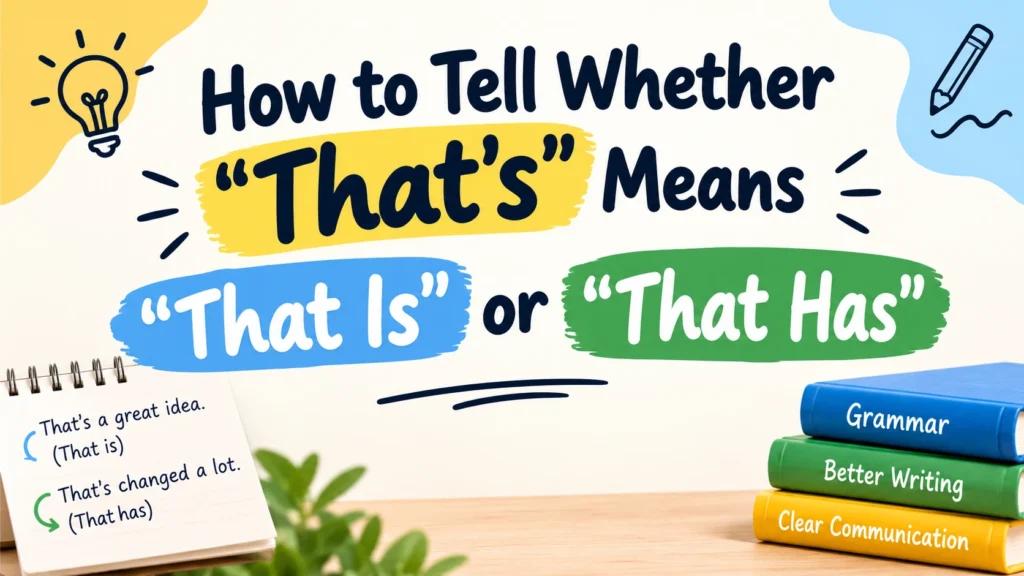
How to Tell Whether “That’s” Means “That Is” or “That Has”
You don’t need to memorize complicated grammar terminology.
Instead, use a simple two-step test.
The Replacement Test
Take the sentence:
That’s the main issue.
Try that is:
That is the main issue.
It works.
Therefore:
That’s = that is.
Now try:
That’s happened before.
Replace it with that is:
That is happened before. ❌
That doesn’t work.
Try that has:
That has happened before. ✅
Therefore:
That’s = that has.
This test works because the contraction itself doesn’t tell you which meaning it carries. The surrounding sentence does.
More Replacement-Test Examples
| Original | Expansion | Meaning |
| That’s my jacket. | That is my jacket. | That is |
| That’s a strange idea. | That is a strange idea. | That is |
| That’s the problem. | That is the problem. | That is |
| That’s been difficult. | That has been difficult. | That has |
| That’s happened before. | That has happened before. | That has |
| That’s changed recently. | That has changed recently. | That has |
| That’s exactly right. | That is exactly right. | That is |
The more examples you see, the more automatic the distinction becomes.
Why “Thats” Is Usually Incorrect
Now we can answer the central question directly.
If you mean “that is” or “that has,” write “that’s,” not “thats.”
The apostrophe is part of the contraction.
Writing thats removes the punctuation that marks the contraction. In standard English writing, that makes the form incorrect when it is intended to represent that is or that has.
For example:
❌ Thats a great idea.
✅ That’s a great idea.
And:
❌ Thats been happening for years.
✅ That’s been happening for years.
The mistake is small, but it can stand out because apostrophes have a specific grammatical role.
Why the Apostrophe Matters
Apostrophes aren’t decorative marks added whenever a word feels shortened.
They communicate information.
In a contraction, an apostrophe indicates omitted letters.
For example:
| Full form | Contraction |
| that is | that’s |
| that has | that’s |
| it is | it’s |
| she is | she’s |
| he is | he’s |
| what is | what’s |
| do not | don’t |
| cannot | can’t |
Once you understand this pattern, thats looks less like an alternative spelling and more like an unfinished contraction.
Why Autocorrect Doesn’t Always Fix “Thats”
Typing habits can make this mistake surprisingly persistent.
On phones and laptops, writers often type quickly. Apostrophes require an extra keystroke or keyboard action, so they can disappear during fast typing.
Autocorrect systems also don’t catch every punctuation error. A spelling checker may recognize the sequence of letters thats without correctly interpreting what the writer intended.
That’s why a quick proofreading pass still matters.
A useful editing trick is to search your document for:
thats
If you intended the contraction, replace it with:
that’s
This is particularly helpful when editing long articles, reports, emails, or manuscripts.
Is “Thats” Ever Correct in English?
This question needs a little nuance.
When thats is intended as the ordinary contraction of that is or that has, it is not the standard form.
However, strings of letters can appear in names, usernames, brand identities, titles, or other deliberately stylized names. In such cases, the spelling belongs to the name rather than functioning as the ordinary English contraction.
For example, if an organization officially chose Thats as part of its name, changing its spelling would change the name.
That’s different from writing:
❌ Thats the answer.
when you mean:
That is the answer.
Proper Names and Brand Names
Names don’t always follow ordinary vocabulary conventions.
A company may intentionally omit punctuation from a name for branding or technical reasons. A username might also contain thats because usernames often have restrictions on punctuation.
That doesn’t make thats the standard grammatical replacement for that’s.
Think of it this way:
Grammar controls ordinary words. Names can have their own established spellings.
So if Thats appears in an official name, preserve the official spelling. If you’re writing an ordinary sentence and mean that is or that has, use that’s.
A Practical Test
Ask yourself:
Is “thats” functioning as an ordinary contraction?
If yes, use that’s.
If it is part of an official name, title, username, or other fixed identifier, check the established spelling.
This distinction prevents an unusual name from being mistaken for a grammar rule.
Common Misconceptions About That’s vs. Thats
Several misconceptions make this error more common than it needs to be.
Misconception: Apostrophes Are Optional in Informal Writing
They’re not automatically optional just because you’re texting.
Informal writing often ignores some punctuation. People may leave out periods, capitalize inconsistently, or use abbreviations.
But if you’re using standard English, that’s remains the standard contraction.
Compare:
Thats awesome
with:
That’s awesome.
The first may be understandable in a casual message, but the second follows standard written English.
Misconception: Texting Rules Apply Everywhere
Digital communication has created plenty of shorthand.
You might see:
- u instead of you
- r instead of are
- idk instead of I don’t know
- thats instead of that’s
These forms may occur in informal online communication. Their presence doesn’t mean they belong in polished writing.
A text message and a business proposal have different expectations.
Knowing the difference between informal habits and standard usage is an important writing skill.
Misconception: The Apostrophe Shows Possession
This is another common misunderstanding.
Apostrophes have multiple functions. They can show possession, but they can also mark contractions.
For example:
Sarah’s laptop
Here, Sarah’s indicates possession.
But:
Sarah’s working today.
Here, Sarah’s means Sarah is.
The same principle applies to that’s.
It isn’t showing possession.
That’s means:
- that is, or
- that has
It does not mean something belongs to that.
That’s vs. That Is vs. That Has: How to Choose
All three forms can be correct. The choice depends on meaning and style.
Use “That’s” for the Contraction
Use that’s when you want the natural shortened form.
That’s the best option.
That’s what I expected.
That’s changed since last year.
These sentences sound natural in everyday English.
Use “That Is” for the Full Form
The full form that is can be useful when you want emphasis.
Compare:
That’s the point.
with:
That is the point.
The second version can sound more deliberate or emphatic.
Formal writing may also favor fewer contractions depending on the publication, institution, or style requirements. The important point is that that’s isn’t grammatically inferior.
Use “That Has” When the Grammar Requires It
When has functions as an auxiliary verb, the full form can be written as that has.
For example:
That has changed considerably.
The contracted version is:
That’s changed considerably.
Both are grammatical.
That’s vs. Thats in Professional Writing
Apostrophe mistakes can become more noticeable in professional contexts because readers often associate accurate punctuation with careful editing.
Consider a workplace email:
That’s exactly what we need for the next stage.
The contraction sounds natural and professional.
You could also write:
That is exactly what we need for the next stage.
The second version adds a little emphasis.
What you shouldn’t write in standard professional prose is:
❌ Thats exactly what we need.
The issue isn’t the level of formality. It’s the missing apostrophe.
That’s vs. Thats in Academic Writing
Academic writing often favors a more formal tone, but conventions vary between disciplines and style guides.
If the context calls for a formal register, you might choose:
That is the primary reason for the difference.
Instead of:
That’s the primary reason for the difference.
However, if a contraction is acceptable under the relevant style requirements, that’s remains grammatically correct.
The key distinction is:
“That’s” can be grammatically correct even when “that is” may be stylistically preferable.
That’s an important difference. Don’t confuse a preference for formality with a grammar rule.
Real-World Examples of That’s vs. Thats
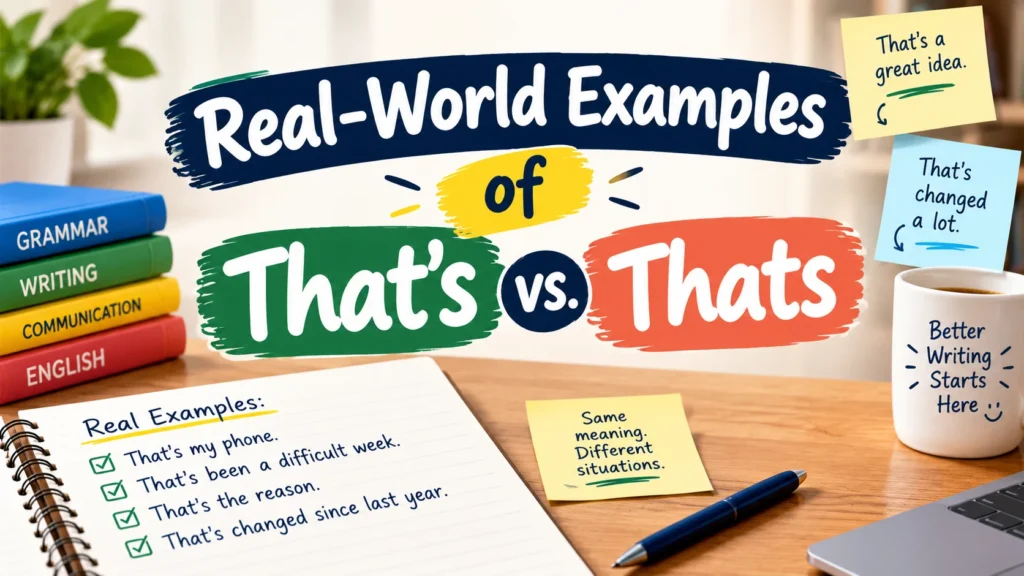
The easiest way to make this rule stick is to see it in context.
Casual Conversation
That’s great!
That’s not what I meant.
That’s your choice.
That’s a good point.
These examples use that’s = that is.
Now consider:
That’s happened to me before.
Here, that’s = that has.
Text Messages
That’s perfect.
That’s fine with me.
That’s what I was thinking.
Even though text messages are informal, the standard spelling still uses the apostrophe.
Emails
That’s exactly what the report shows.
That’s the information we needed.
That’s been updated in the latest version.
The contraction works naturally in many professional emails.
Academic and Formal Contexts
That is the primary difference between the two forms.
That is why the distinction matters.
The full form can provide a more formal tone.
However:
That’s the primary difference.
is not inherently grammatically wrong.
Common “That’s” Mistakes
The missing apostrophe isn’t the only mistake worth watching.
Mistake: Writing “Thats”
❌ Thats a useful example.
✅ That’s a useful example.
The intended meaning is that is.
Mistake: Using “That” Instead of “That’s”
❌ That the problem.
✅ That’s the problem.
The word that by itself doesn’t replace that’s.
Mistake: Using “That’s” Before the Wrong Verb Form
Consider:
❌ That’s went too far.
The intended meaning appears to be that has gone too far.
Correct:
✅ That’s gone too far.
The present-perfect construction requires has + past participle.
Compare:
- has gone ✅
- has changed ✅
- has happened ✅
- has improved ✅
Not:
- has went ❌
The contraction doesn’t remove the need for correct verb grammar.
That’s vs. Its vs. It’s
Another useful comparison involves that’s, its, and it’s.
| Word | Meaning | Example |
| that’s | that is / that has | That’s my seat. |
| it’s | it is / it has | It’s raining. |
| its | possession | The dog wagged its tail. |
This distinction is worth learning because its is a possessive form without an apostrophe.
For example:
The company changed its policy.
Here, its shows possession.
But:
It’s changed its policy.
The first it’s means it has. The second its is possessive.
Apostrophes don’t simply mean “ownership.” Context determines their function.
Why Using “That’s” Correctly Matters
A single missing apostrophe rarely destroys meaning.
If someone writes:
Thats my bag.
most readers will understand the intended message.
Still, correct punctuation matters because writing isn’t only about whether readers can decode your meaning. It also communicates care, consistency, and control of standard written English.
In professional or academic writing, small errors can distract readers.
Compare:
That’s the conclusion supported by the evidence.
with:
Thats the conclusion supported by the evidence.
The second version contains an avoidable error. There’s no benefit to leaving the apostrophe out.
Good writing removes unnecessary distractions.
Read More : Dammit vs. Damn It: The Complete Difference, Meaning, Usage, and Examples
A Simple Way to Remember “That’s”
Try this mental shortcut:
If you can put “that is” or “that has” there, you need “that’s.”
For example:
That’s amazing.
→ That is amazing. ✅
That’s happened before.
→ That has happened before. ✅
Thats amazing.
→ The intended meaning is “that is,” so the apostrophe is missing. ❌
You can also remember that the apostrophe represents the missing letters in the contraction.
Contraction Patterns
| Full form | Contraction |
| that is | that’s |
| that has | that’s |
| it is | it’s |
| it has | it’s |
| who is | who’s |
| who has | who’s |
| she is | she’s |
| she has | she’s |
Seeing the broader pattern makes the spelling easier to remember.
Case Study: Editing a Short Paragraph
Consider this poorly edited paragraph:
Thats the main reason the project failed. I think thats something we should discuss. Thats also happened with other teams before.
Three instances contain the same problem.
A corrected version reads:
That’s the main reason the project failed. I think that’s something we should discuss. That’s also happened with other teams before.
Now expand each contraction:
- That’s the main reason → That is the main reason.
- I think that’s something → I think that is something.
- That’s also happened → That has also happened.
Notice how the same spelling, that’s, represents two different meanings in the paragraph.
That’s why memorizing one fixed expansion isn’t enough.
Case Study: A Professional Email
Imagine receiving this email:
Thats a good suggestion. I think thats exactly what we need. Thats changed the way we should approach the project.
The intended meanings are clear, but the missing apostrophes create three errors.
A polished version is:
That’s a good suggestion. I think that’s exactly what we need. That’s changed the way we should approach the project.
Now expand them:
- That is a good suggestion.
- That is exactly what we need.
- That has changed the way we should approach the project.
The correction takes only a few seconds, yet it makes the writing noticeably cleaner.
Quick “That’s vs. Thats” Checklist
Before you finish writing, run through this short checklist.
- Do you mean “that is”? Use that’s.
- Do you mean “that has”? Use that’s.
- Did you write “thats” as a contraction? Add the apostrophe.
- Is “Thats” part of an official name? Check the established spelling.
- Are you confusing possession with contraction? Remember that that’s does not show possession.
- Are you unsure whether “that’s” means “that is” or “that has”? Try both expansions.
- Are you writing formally? Decide whether that is or that has better suits the desired tone.
- Are you proofreading a long document? Search for thats to catch accidental omissions.
A five-second search can save several small errors.
Frequently Asked Questions About That’s vs. Thats
What Is the Difference Between “That’s” and “Thats”?
That’s is the standard contraction of that is or that has.
Thats without an apostrophe is not the standard contraction.
For example:
That’s my book.
means:
That is my book.
And:
That’s changed.
means:
That has changed.
Is “Thats” Ever Correct in English?
Not when it is being used as the ordinary contraction of that is or that has.
However, Thats could appear as part of an official name, username, title, or other deliberately established name. In that situation, its spelling comes from the name itself rather than from standard contraction rules.
How Do I Know If “That’s” Means “That Is” or “That Has”?
Use the replacement test.
Try that is first.
If it works:
That’s the answer.
→ That is the answer.
Then that’s = that is.
If it doesn’t work, try that has:
That’s happened before.
→ That has happened before.
Then that’s = that has.
Can “That’s” Mean “That Has”?
Yes.
For example:
That’s been difficult.
means:
That has been difficult.
Other examples include:
- That’s changed.
- That’s happened before.
- That’s gone too far.
- That’s become a problem.
Is “That’s” Possessive?
No.
That’s is a contraction of that is or that has.
The apostrophe in this word doesn’t indicate possession.
For example:
That’s my car.
means:
That is my car.
Should You Use “That’s” in Formal Writing?
You can use that’s in standard English. However, some formal contexts may favor the full forms that is or that has for a more formal tone.
Always follow the specific style requirements of the publication, institution, or document you’re writing for.
Why Do People Write “Thats”?
The most common reasons are simple:
- Fast typing
- Forgetting punctuation
- Keyboard habits
- Autocorrect behavior
- Informal digital writing
- Repeated exposure to unpunctuated text
The fact that people frequently type thats online doesn’t make it the standard spelling.
How Can I Stop Writing “Thats”?
Use one habit consistently:
Expand the word in your head.
If you mean:
that is
or:
that has
write:
that’s
You can also use your word processor’s search function to look for thats during proofreading.
That’s vs. Thats: Final Verdict
The difference between that’s vs. thats comes down to one small punctuation mark, but that apostrophe has a real grammatical job.
That’s is the standard contraction of:
- that is
- that has
For example:
That’s a great idea.
= That is a great idea.
And:
That’s changed considerably.
= That has changed considerably.
By contrast, thats isn’t the standard spelling when you intend either contraction.
The easiest rule is also the most useful:
If you can replace “that’s” with “that is” or “that has,” keep the apostrophe.
Don’t let the tiny size of the apostrophe fool you. In written English, small marks can carry big grammatical information.
When you’re proofreading, look for thats without the apostrophe. If it means that is or that has, change it to that’s.
Once the replacement test becomes a habit, the that’s vs. thats confusion becomes almost effortless to solve.