
The difference between “in process” and “in progress” looks tiny, but the two phrases don’t always do the same job. Both can describe something unfinished. The real distinction lies in what you want to emphasize.
If a project has started and people are working on it, in progress is usually the natural choice. Merriam-Webster defines in progress as “going on” or “occurring,” which explains its broad everyday use.
If you want to describe something moving through a particular procedure, workflow, or production stage, in process can fit. In specialized manufacturing language, in-process has an even more specific meaning for goods that are between raw materials and finished products.
That small difference matters. Saying “The construction is in progress” sounds perfectly natural. Saying “The construction is in process” may be understood, but it isn’t the usual choice in everyday American English.
This guide breaks down in process vs. in progress with clear definitions, examples, comparisons, grammar rules, industry-specific uses, common mistakes, and practical alternatives.
In Process vs. In Progress: The Quick Answer
Here’s the simplest way to remember the difference:
In progress usually describes something that is happening or being worked on.
In process can describe something moving through a particular process or procedure.
Consider these examples:
- The renovation is in progress.
- The investigation is in progress.
- Your application is being processed.
- The materials are in-process.
The first two sentences focus on ongoing activity. The third focuses on handling. The fourth uses a specialized manufacturing term.
| Expression | Main idea | Typical context | Example |
| In progress | Happening or continuing | Projects, activities, events, work | “The repairs are in progress.” |
| In process | Moving through a process | Formal, technical, operational contexts | “The request is in process.” |
| Being processed | Being handled | Applications, payments, orders, requests | “Your payment is being processed.” |
| Underway | Already started and continuing | Projects, investigations, events | “The investigation is underway.” |
| Ongoing | Continuing over time | Research, discussions, investigations | “The review is ongoing.” |
The practical rule is straightforward: when in doubt about ordinary ongoing activity, “in progress” is usually the better choice.
What Does “In Progress” Mean?
In progress means that something has started but hasn’t finished. It emphasizes an activity, event, task, or project that is currently happening.
Merriam-Webster defines the phrase as “going on” or “occurring.” Its related noun progress means forward or onward movement toward an objective or goal.
That’s why the phrase works so naturally with activities:
- The meeting is in progress.
- The investigation is in progress.
- The repairs are in progress.
- Construction is in progress.
- The software update is in progress.
- The negotiations are in progress.
Notice the common thread. Each sentence describes something that is currently happening.
In Progress Means “Not Finished Yet”
The phrase doesn’t necessarily tell you how quickly something is moving. It simply tells you that the activity has begun and remains unfinished.
For example:
The renovation is in progress.
This sentence doesn’t say whether the renovation is going well. It doesn’t tell you whether workers have completed 20% or 80% of the work.
It simply tells you that the renovation hasn’t finished.
That’s one reason in progress is so versatile.
Common Things That Can Be “In Progress”
You can use the expression for:
- Projects
- Meetings
- Investigations
- Construction
- Repairs
- Discussions
- Negotiations
- Research
- Development
- Events
- Reviews
- Updates
- Writing
- Design work
For example:
The research project is still in progress.
The building repairs are currently in progress.
The review is in progress and should finish soon.
These sentences sound natural because in progress fits activities that unfold over time.
What Does “In Process” Mean?
In process can describe something that is undergoing or moving through a particular process. The expression appears more often in formal, technical, administrative, and operational contexts than in ordinary conversation.
However, there’s an important detail here: “in process” isn’t simply a formal replacement for “in progress.”
That’s where many writers go wrong.
Compare:
The project is in progress.
with:
The project is in process.
Both sentences can be understood. The first one is much more natural when you simply mean that people are working on the project.
By contrast, in process becomes more useful when a specific procedure or production stage matters.
Examples of “In Process”
You may encounter sentences such as:
- “The application is in process.”
- “The order is in process.”
- “The request is in process.”
- “The materials are in process.”
- “The production batch is in process.”
Some of these sound more natural in particular organizations or industries than they do in general American English.
That’s an important point about language: a phrase can be grammatically possible without being the most idiomatic choice in every situation.
“In-Process” Has a Specialized Meaning
The hyphenated adjective in-process has a more specific technical use.
Merriam-Webster defines in-process as relating to or describing goods in manufacture that are neither raw materials nor finished products.
For example:
The factory tracks its in-process inventory separately from finished goods.
Here, in-process isn’t merely saying that something is happening.
It identifies the status of goods within a manufacturing system.
That’s a much narrower meaning.
In Progress vs. In Process: The Main Difference
The easiest way to understand in process vs. in progress is to ask what the sentence emphasizes.
“In Progress” Focuses on Activity
The software development is in progress.
The focus is on the development work that is happening.
“In Process” Can Focus on Procedure
The application is in process.
The wording can emphasize that the application has entered a procedure or workflow.
“Being Processed” Focuses on Handling
The application is being processed.
This tells the reader that a person, department, or system is handling the application.
These distinctions become clearer in a table:
| Expression | Main focus | What the reader learns |
| In progress | Activity | Something is happening |
| In process | Process or workflow | Something is within a procedure |
| Being processed | Handling | Someone or something is processing it |
| Underway | Ongoing activity | Something has started |
| Ongoing | Continuation | Something continues over time |
Think of it this way:
Progress is about movement toward an outcome. Process is about the steps used to reach an outcome.
That distinction isn’t absolute in every use. English has plenty of overlap. Still, it gives you a reliable starting point.
“In Process” vs. “In Progress” in Real Sentences
Context often makes the correct choice obvious.
Example: A Project
The project is in progress.
This is the natural choice when you mean that the project has started and people are working on it.
You could say the project is in process in some contexts. However, it sounds less idiomatic when no particular process is being highlighted.
A better alternative might also be:
The project is underway.
Example: An Application
Now consider an application:
Your application is being processed.
This is extremely clear. The application is going through an administrative system.
You might also see:
Your application is in process.
That can work as organizational or administrative terminology. Yet being processed often tells the reader exactly what is happening.
Example: An Investigation
Consider:
The investigation is in progress.
This sounds natural because the investigation itself is an ongoing activity.
You could also say:
The investigation is underway.
Both choices work well.
By contrast, the investigation is in process isn’t the normal choice when you’re simply telling someone that investigators are still working.
Example: An Order
An online store might display:
Order in process
as a status label.
However, customer-facing prose could say:
Your order is being processed.
Or:
Your order is currently being prepared.
The best wording depends on whether you’re writing a system status, an internal label, or a natural sentence for a customer.
Example: Construction
This one is easy:
Construction is in progress.
That’s the standard expression.
You can also say:
Construction is underway.
“Construction is in process” isn’t the natural everyday choice.
When Should You Use “In Progress”?
Use in progress when you want to communicate that an activity has started and remains unfinished.
Use “In Progress” for Ongoing Activities
The phrase works especially well with:
- Projects
- Tasks
- Investigations
- Construction
- Repairs
- Meetings
- Events
- Discussions
- Negotiations
- Research
- Writing
- Development
For example:
The new website is in progress.
The repairs are still in progress.
The investigation remains in progress.
The meeting is currently in progress.
Natural Sentence Patterns
Several structures are especially common:
Something + is in progress
The renovation is in progress.
Something + remains in progress
The investigation remains in progress.
Something + is still in progress
The negotiations are still in progress.
Something + is currently in progress
The review is currently in progress.
These patterns work because in progress functions naturally after forms of be.
“In Progress” Doesn’t Guarantee Successful Progress
There’s a subtle point worth remembering.
If you say:
The project is in progress.
you don’t necessarily mean:
The project is progressing well.
The first sentence only tells us that the project is underway.
The second comments on how the project is advancing.
So don’t assume that in progress means making good progress.
Those are different ideas.
When Should You Use “In Process”?
Use in process when the sentence genuinely benefits from emphasizing a defined process, workflow, procedure, or production stage.
However, don’t force it into ordinary sentences simply to sound professional.
Administrative Workflows
Some organizations use in process for:
- Applications
- Requests
- Claims
- Approvals
- Orders
- Reviews
- Internal workflows
For example:
The request is in process with the compliance team.
This can work as organizational terminology.
Yet:
The request is being processed by the compliance team.
may be clearer for a general audience.
Manufacturing
Manufacturing provides a stronger case.
A factory distinguishes between materials that have entered production and goods that have reached completion.
For example:
The company monitors in-process inventory throughout production.
Here, in-process has a defined technical role.
Technical Systems
Software systems often divide operations into stages:
Submitted → In Process → Completed
In such an interface, in process may function as a formal status label.
That doesn’t mean the phrase is the best choice in every sentence describing the same event.
Interface language and ordinary prose serve different purposes.
Is “In Process” Grammatically Correct?
Yes. “In process” is a real English expression.
The issue isn’t whether the phrase exists. The issue is where it sounds natural and what meaning it conveys.
Merriam-Webster lists in-process as an adjective with a specialized manufacturing meaning.
Meanwhile, Cambridge lists work in process as a US expression and points readers to work in progress.
This shows why a simple “correct versus incorrect” rule doesn’t work very well.
Consider these sentences:
The painting is in progress.
Natural.
The painting is in process.
Understandable but less natural in ordinary English.
Now consider:
The components are in-process inventory.
That can be technically appropriate in manufacturing.
The surrounding context changes everything.
Grammatical Doesn’t Always Mean Idiomatic
English learners often face this problem.
A sentence may follow grammatical rules while still sounding unusual to a native speaker.
For example:
The project is in process.
The reader understands the meaning. But if you simply mean that people are working on the project, in progress is the more idiomatic choice.
Good writing isn’t only about avoiding grammatical errors. It also involves choosing expressions that fit the context naturally.
“In the Process of” vs. “In Process”
This distinction deserves special attention because these phrases look almost identical.
In the process of is a separate construction.
It commonly appears before a gerund:
We are in the process of reviewing the application.
The company is in the process of updating its policy.
They are in the process of rebuilding the website.
This construction explicitly introduces an activity or change that is underway.
Don’t automatically shorten it to:
We are in process reviewing the application.
That structure is incorrect.
The standard pattern is:
in the process of + noun or -ing form
For example:
- in the process of changing
- in the process of moving
- in the process of reviewing
- in the process of developing
- in the process of building
Compare the Three Expressions
| Expression | Example | Main meaning |
| In progress | “The review is in progress.” | The review is happening |
| In process | “The request is in process.” | The request is within a process |
| In the process of | “We are in the process of reviewing it.” | We are currently carrying out an action |
This is one of the most useful distinctions in the entire topic.
“In Progress” vs. “Underway” vs. “Being Processed”
Sometimes neither in progress nor in process is the best option.
A more precise alternative can make the sentence much clearer.
In Progress
Use it for a broad statement about ongoing activity.
The investigation is in progress.
Underway
Use it when you want to emphasize that something has started.
The investigation is underway.
Ongoing
Use ongoing when continuity matters.
The investigation is ongoing.
Being Processed
Use this when a person, system, or organization is actively handling something.
Your refund is being processed.
This can be much clearer than:
Your refund is in process.
Quick Comparison
| Situation | Best choice |
| Construction has started | Construction is in progress. |
| A meeting is happening | The meeting is in progress. |
| An investigation continues | The investigation is ongoing. |
| A search has started | The search is underway. |
| An application is handled by a department | The application is being processed. |
| Goods are between production stages | The goods are in-process. |
Precision wins here.
“Work in Progress” vs. “Work in Process”
Work in progress is a well-established phrase for something that isn’t finished.
Merriam-Webster defines work in progress as a project that isn’t yet finished.
For example:
The novel is still a work in progress.
The painting remains a work in progress.
The website is a work in progress.
Cambridge also notes that US English uses work in process as a variant. It gives both the general meaning of something still being developed and the accounting meaning involving partly completed products.
So work in process isn’t simply wrong.
However, there’s an important contextual split:
- Creative or general unfinished work: work in progress is the familiar choice.
- US accounting/manufacturing: work in process can be a technical term.
For example:
The manuscript is a work in progress.
sounds completely natural.
In accounting:
The company reported its work-in-process inventory.
has a specialized business meaning.
How Different Industries Use “In Process” and “In Progress”
Different fields develop their own terminology. That’s why you’ll sometimes encounter in process in places where everyday English would normally favor in progress.
Technology and Software Development
Software teams commonly describe tasks as:
- Not started
- In progress
- Blocked
- Completed
For example:
The feature is in progress.
The deployment is in progress.
The bug fix is in progress.
Here, in progress clearly communicates active development.
A system may separately use processing to describe a backend operation:
Your file is being processed.
That’s a more specific technical meaning.
Business and Administration
Businesses often process:
- Applications
- Purchase orders
- Claims
- Approvals
- Requests
- Documents
You may see in process in internal terminology.
Still, customer-facing communication often benefits from more direct language:
Your application is being reviewed.
or:
Your application is being processed.
These sentences tell the reader more than a vague status label.
Customer Service
Imagine a customer checking a refund.
The system might display:
Refund: In Process
That’s understandable as a workflow status.
A customer email could say:
Your refund is currently being processed.
That’s more conversational and precise.
If the refund itself is taking place as an ongoing event, in progress can also work:
Your refund is in progress.
The best wording depends on whether you’re describing the event or the processing procedure.
Manufacturing and Supply Chain
This is where in-process becomes especially important.
A product may move through several stages:
Raw materials → Processing → Assembly → Inspection → Finished goods
Materials between the starting and finishing points can be described as in-process.
Merriam-Webster specifically defines in-process in relation to goods in manufacture that aren’t raw materials or finished products.
This is a genuine technical distinction rather than stylistic decoration.
Academia and Research
For academic work, in progress is usually natural:
The study is in progress.
The research is still in progress.
Data collection is in progress.
You can also say:
The research is ongoing.
Creative Industries
Writers, artists, designers, and filmmakers commonly use work in progress.
For example:
The screenplay is still a work in progress.
The illustration is a work in progress.
The design remains a work in progress.
This usage has become so established that work in progress can describe not only unfinished work but also something still developing or improving.
Grammar and Sentence Construction
Both phrases generally appear after a form of be when they describe a subject’s current state.
Common “In Progress” Structures
The project is in progress.
The repairs are in progress.
The investigation was in progress.
The negotiations remain in progress.
You can also modify the phrase:
- currently in progress
- still in progress
- already in progress
- now in progress
- actively in progress
Common “In Process” Structures
The request is in process.
The order was in process.
The materials are in process.
The application remains in process.
However, don’t confuse grammatical structure with preferred style. In progress is generally more natural for broad statements about ongoing activity.
Common Mistakes With “In Process” vs. “In Progress”
Treating Them as Perfect Synonyms
This is the biggest mistake.
They overlap, but context changes the better choice.
The project is in progress.
is natural.
The project is in process.
is less natural if you simply mean that work has begun.
Using “In Process” to Sound More Professional
Formal doesn’t automatically mean better.
The report is in process.
may sound more bureaucratic than:
The report is in progress.
Or even:
The team is working on the report.
Professional writing should prioritize clarity over ceremony.
Using “In Progress” for Every Kind of Processing
Consider:
Your application is in progress.
This can mean the application-related activity is underway.
But:
Your application is being processed.
clearly communicates that an organization or system is handling the application.
If the reader needs to know what is happening to the item, being processed may be better.
Confusing “In Process” With “In the Process Of”
These aren’t interchangeable.
Correct:
We are in the process of reviewing the contract.
Correct:
The review is in progress.
Possible in a specialized context:
The request is in process.
Incorrect:
We are in process reviewing the contract.
The construction in the process of + -ing requires the word the and the preposition of.
Read More : People Do or People Does? The Correct Grammar Explained
A Simple Decision Guide for “In Process” vs. “In Progress”
When you’re unsure, ask what your sentence is really trying to say.
Is something happening right now?
Use in progress.
The repairs are in progress.
Has something started and continues?
Use in progress, ongoing, or underway.
The investigation is ongoing.
Is something moving through an established procedure?
In process may fit, especially in specialized terminology.
The materials are in-process.
Is an organization handling something?
Use being processed when that meaning matters.
The application is being processed.
Are you describing unfinished creative or general work?
Use work in progress.
The novel is a work in progress.
Are you describing a manufacturing or accounting category?
Work in process may be appropriate in US business terminology.
Quick Memory Trick for “In Process” vs. “In Progress”
Here’s a simple way to remember the distinction:
Progress = moving forward.
Process = moving through steps.
Imagine a runner.
If you’re describing the runner’s movement toward the finish line, think progress.
If you’re describing the organized sequence of checkpoints the runner must pass, think process.
The analogy isn’t a rigid grammar rule. It’s a memory aid.
Another Easy Test
Replace the phrase with “happening now.”
If the sentence still makes sense, in progress is probably the better choice.
The construction is happening now.
So:
The construction is in progress.
Now try:
The application is happening now.
That sounds odd.
Instead:
The application is being processed.
The replacement test won’t solve every case, but it can quickly expose awkward usage.
Practice: Choose “In Process” or “In Progress”
Try these sentences before checking the answers.
Practice Sentences
- The road repairs are ___.
- The investigation is still ___.
- Your application is being ___.
- The manuscript is a work ___.
- The factory tracks its ___ inventory.
- The meeting is currently ___.
- The research project is ___.
- The request is moving through the approval ___.
Answers
The road repairs are in progress.
The sentence describes ongoing physical work.
The investigation is still in progress.
The investigation has started but hasn’t finished.
Your application is being processed.
This emphasizes administrative handling.
The manuscript is a work in progress.
This is the established phrase for unfinished creative work.
The factory tracks its in-process inventory.
Here, in-process has a specialized manufacturing meaning.
The meeting is currently in progress.
The meeting is happening now.
The research project is in progress.
The research has started and remains unfinished.
The request is moving through the approval process.
This wording is often clearer than forcing in process into the sentence.
Case Study: A Technical Team Miscommunicates
Imagine a software company where an internal dashboard uses three statuses:
Not Started → In Process → Completed
A project manager sees that a customer request is marked In Process.
She interprets that status as:
“An employee is actively working on this request right now.”
However, the system designer intended it to mean:
“The request has entered the workflow but hasn’t reached completion.”
Those interpretations aren’t identical.
The request might be waiting for:
- automated validation
- manager approval
- payment confirmation
- database processing
- manual review
The phrase in process doesn’t necessarily tell the manager which stage the request has reached.
A better status system might use:
Submitted → Under Review → Processing → Awaiting Approval → Completed
The lesson is bigger than this one phrase:
Status labels should describe the actual state of a workflow rather than rely on vague language.
For customer-facing communication, even clearer wording works better:
Your request is currently under review.
That’s more useful than:
Your request is in process.
Case Study: Manufacturing Confusion
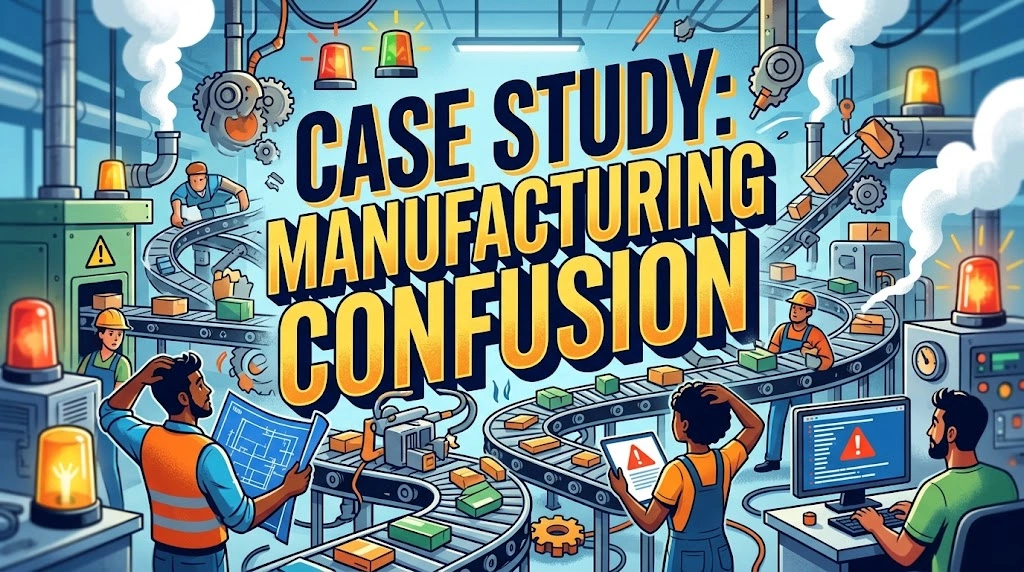
Consider a manufacturing plant producing electronic components.
The factory receives raw materials first. Those materials then move through cutting, assembly, testing, and packaging.
A supervisor asks:
“Which units are finished?”
A worker replies:
“The finished units are ready. The others are in-process.”
Here, in-process has a precise operational meaning. The products have moved beyond raw materials but haven’t reached their finished state.
A simplified production model looks like this:
Raw Materials
↓
Processing
↓
Assembly
↓
Testing
↓
In-Process Goods
↓
Finished Goods
The phrase isn’t simply describing an activity happening.
It identifies where the goods stand within a production system.
That’s why technical vocabulary sometimes preserves distinctions that everyday conversation doesn’t need.
Helpful Quotes and Rules to Remember
A useful way to remember the central distinction is:
“In progress” describes something happening. “In process” can describe something moving through a process.
Another practical rule:
Activity → in progress. Procedure → in process.
And when an organization or system is actively handling an item:
Handling → being processed.
These aren’t absolute laws of English. They’re practical decision rules that help you choose naturally in most situations.
FAQs About “In Process” vs. “In Progress”
What does “in progress” mean?
In progress means something has started and is still happening or hasn’t been completed. Merriam-Webster defines it as “going on” or “occurring.”
For example:
The investigation is in progress.
What does “in process” mean?
In process can describe something that is moving through a process, procedure, or workflow. It appears more often in formal or specialized contexts.
In manufacturing, the related adjective in-process can specifically describe goods that are somewhere between raw materials and finished products.
Is “in process” grammatically correct?
Yes. In process is a legitimate expression. However, it isn’t interchangeable with in progress in every context.
For ordinary ongoing activities, in progress is usually more natural.
Is “in progress” more common in everyday English?
Yes. In progress is the standard everyday expression for something currently happening or unfinished.
For example:
The meeting is in progress.
Construction is in progress.
The repairs are in progress.
Can a refund be “in progress”?
Yes. A refund is in progress can describe a refund that is currently underway.
However, your refund is being processed may be more precise when you mean that a bank, merchant, or payment system is handling the refund.
Should I say “in process” or “being processed” for an application?
Usually, being processed is clearer when the application is currently being handled.
Your application is being processed.
This tells the reader exactly what is happening.
Is “in the process of” the same as “in process”?
No.
In the process of normally introduces an action:
We are in the process of reviewing the application.
In process can describe something’s status within a process:
The application is in process.
The first construction is much more common in ordinary sentences.
Is “work in progress” or “work in process” correct?
Work in progress is the familiar general expression for unfinished work.
However, work in process is also used in US accounting and manufacturing terminology. Cambridge recognizes both and specifically discusses work in process in relation to partly completed products.
Is “in progress” the same as “ongoing”?
They often overlap.
The investigation is in progress.
The investigation is ongoing.
Both indicate that the investigation continues.
However, ongoing is an adjective that emphasizes continuation, while in progress is a phrase describing something as currently happening.
Is “underway” the same as “in progress”?
In many contexts, yes.
The negotiations are underway.
The negotiations are in progress.
Both indicate that the negotiations have started and are continuing.
Can “in progress” describe a project?
Absolutely.
The website redesign is in progress.
This is one of the most natural uses of the phrase.
Can “in process” describe a project?
It can occur, but it usually isn’t the best choice if you simply mean that work on the project has begun.
Use:
The project is in progress.
If you mean the project is moving through a defined series of procedures, explain that process directly.
Conclusion
The difference between “in process” and “in progress” becomes much easier once you stop treating them as exact synonyms.
In progress is the broad, natural choice for something that has started and is still happening. Use it for projects, investigations, meetings, repairs, construction, research, development, and many other ongoing activities.
In process has a more context-dependent role. It can describe something moving through a defined procedure or workflow. In technical manufacturing language, in-process can specifically identify goods that are neither raw materials nor finished products.
When you’re writing ordinary American English, the safest practical rule is simple:
If something is happening, use “in progress.”
If something is moving through a defined process, “in process” may fit.
And when an organization or system is actively handling an item, don’t overlook the clearer alternative:
being processed
Finally, remember that “in the process of” is its own construction. It works especially well when you want to describe an action that is currently underway.
Good word choice isn’t about choosing the fanciest expression. It’s about choosing the expression that tells your reader exactly what you mean. In the in process vs. in progress debate, that usually means reaching for in progress when you’re describing ongoing activity and using in process only when the process itself matters.