
If you’ve ever wondered whether the correct Spanish word is hola or ola, you’re dealing with one of the simplest-looking but most common spelling questions in Spanish. The two words sound the same in standard Spanish, yet their meanings couldn’t be more different.
Hola means “hello” or “hi.”
Ola means “wave.”
The only visible difference is the letter h, but that silent letter matters when you write the word. Spanish speakers don’t pronounce the h in hola, so a listener can’t normally tell whether you mean hola or ola from sound alone. Writing, however, removes the ambiguity.
For example:
¡Hola, Ana! — Hello, Ana!
La ola es enorme. — The wave is huge.
Both words have the same basic pronunciation, but they serve completely different grammatical and semantic roles. Hola functions as a greeting or interjection, while ola is a feminine noun referring primarily to a wave. Spanish-language reference material specifically warns learners not to confuse these two homophones.
This guide explains hola vs. ola in detail, including their meanings, pronunciation, spelling, grammar, history, everyday usage, common mistakes, and practical examples.
Hola vs. Ola: The Quick Answer
The easiest way to remember the difference is this:
| Word | Meaning | Grammar | Pronunciation | Example |
| hola | hello, hi | Interjection/greeting | Same as ola | Hola, ¿cómo estás? |
| ola | wave | Feminine noun | Same as hola | La ola es grande. |
So, if you’re greeting someone, write hola.
If you’re talking about a wave, write ola.
There is no interchangeable spelling here. Writing ola when you mean “hello” is a spelling error. Likewise, writing hola when you mean “wave” changes the word into something else entirely.
The tricky part comes from pronunciation. Spanish generally treats the h in hola as silent. The Royal Spanish Academy’s language guidance describes Spanish h as a letter that normally has no sound of its own.
That gives us this basic rule:
Hola = greeting.
Ola = wave.
Once that distinction becomes familiar, the confusion largely disappears.
What Does “Hola” Mean in Spanish?
Hola is the ordinary Spanish word for “hello” or “hi.” It’s used when you greet another person and can stand by itself or appear as part of a longer greeting.
For example:
- ¡Hola! — Hi!
- Hola, María. — Hello, María.
- Hola, ¿cómo estás? — Hi, how are you?
- Hola, ¿qué tal? — Hi, how’s it going?
- Hola a todos. — Hello, everyone.
Unlike some greetings that depend heavily on the time of day, hola can be used throughout the day. You can say it in the morning, afternoon, evening, or late at night.
It also works in a wide range of ordinary social situations. You might say hola to a friend, coworker, acquaintance, store employee, neighbor, or someone you’re meeting for the first time.
The level of formality comes largely from what follows hola and how you address the person.
For example:
Hola, ¿cómo estás?
uses the informal second-person form estás.
Meanwhile:
Hola, ¿cómo está usted?
uses the formal usted construction.
The greeting itself hasn’t changed. The surrounding language establishes the social tone.
Is “Hola” Only an Informal Greeting?
Not exactly.
Hola is often described as a familiar or everyday greeting. However, that doesn’t mean you must avoid it whenever a situation becomes professional or polite.
Consider a workplace conversation:
Hola, buenos días. ¿Cómo está?
That can sound perfectly natural and courteous.
In a very formal setting, buenos días, buenas tardes, or another context-appropriate greeting may be preferred. Still, hola itself isn’t inherently rude or inappropriate.
The important distinction is between the greeting word and the level of formality expressed by the complete sentence.
What Does “Ola” Mean in Spanish?
Ola means “wave.” It is a feminine noun and most commonly refers to a wave formed on the surface of water.
For example:
- La ola es grande. — The wave is big.
- Una ola golpeó la costa. — A wave hit the coast.
- Las olas están fuertes hoy. — The waves are strong today.
- El barco pasó entre las olas. — The boat passed between the waves.
The plural is olas.
Unlike hola, ola isn’t a greeting. If you write:
¡Ola! ¿Cómo estás?
you’re using the wrong spelling for “hello.”
The correct version is:
¡Hola! ¿Cómo estás?
This distinction becomes especially important in written Spanish because pronunciation won’t help you choose the correct spelling.
Can “Ola” Have a Figurative Meaning?
Yes.
Just as English uses wave figuratively, Spanish can use ola in broader expressions describing a surge or movement.
For example, a writer might describe an ola de calor, meaning a heat wave.
Other contexts can use ola for a large, spreading movement or surge. The exact meaning comes from the noun phrase surrounding it.
That makes ola much more than a word used only for ocean water. Still, its central dictionary meaning remains wave.
Hola vs. Ola: The Key Difference
The central distinction can be summarized in one table:
| Feature | Hola | Ola |
| Meaning | Hello, hi | Wave |
| Word type | Interjection | Noun |
| Gender | Not applicable as an interjection | Feminine |
| Plural | Usually unchanged as a greeting | olas |
| Main use | Greeting someone | Describing a wave or surge |
| Initial H | Written but silent | No H |
| Sound | Same as ola | Same as hola |
| Example | Hola, Carlos. | La ola es enorme. |
The spelling difference is tiny. The semantic difference is enormous.
Think of it like two doors with nearly identical signs. One leads to a greeting and the other leads to the ocean.
“Hola” = Hello
Use hola whenever the intended meaning is a greeting.
Hola, ¿cómo estás?
¡Hola! Mucho gusto.
Hola, chicos.
“Ola” = Wave
Use ola when you mean a physical or figurative wave.
La ola llegó hasta la playa.
Vi una ola enorme desde el barco.
La ciudad enfrentó una ola de calor.
A Simple Memory Trick
Here’s an easy way to remember it:
H = Hello → Hola
The H helps you remember that hola is the greeting.
Then:
Ola = Ocean wave
The word without h can remind you of an ocean wave.
It isn’t an etymological rule. It’s simply a useful learner’s mnemonic.
How Do You Pronounce “Hola”?
For English speakers, hola can feel slightly strange at first because the written h tempts you to pronounce it.
Don’t.
In standard Spanish, the h in hola is silent. Spanish pronunciation references describe the ordinary Spanish h as lacking its own phonemic sound in most words.
The word has two syllables:
ho-la
But the initial h doesn’t produce the English h sound.
The result is essentially the same pronunciation as ola.
This is why hola and ola are homophones in standard Spanish.
The Spanish “O” Sound
The o in hola is not pronounced exactly like every English version of the letter o.
Spanish vowels tend to have more stable sounds than their English counterparts. The Spanish o remains relatively consistent rather than shifting through the many sounds associated with English o.
For learners, the bigger point is simple: don’t pronounce the h.
Common Pronunciation Mistake
One frequent beginner mistake is treating the Spanish word as though it were English and saying the initial h.
That creates an English-style sound that Spanish speakers don’t expect.
A second mistake involves putting too much stress on the second syllable. Spanish hola normally carries its natural stress on the first syllable.
Listening to native speakers helps enormously because Spanish rhythm and vowel quality can differ from what an English speaker expects from the spelling.
Why Is the H in “Hola” Silent?
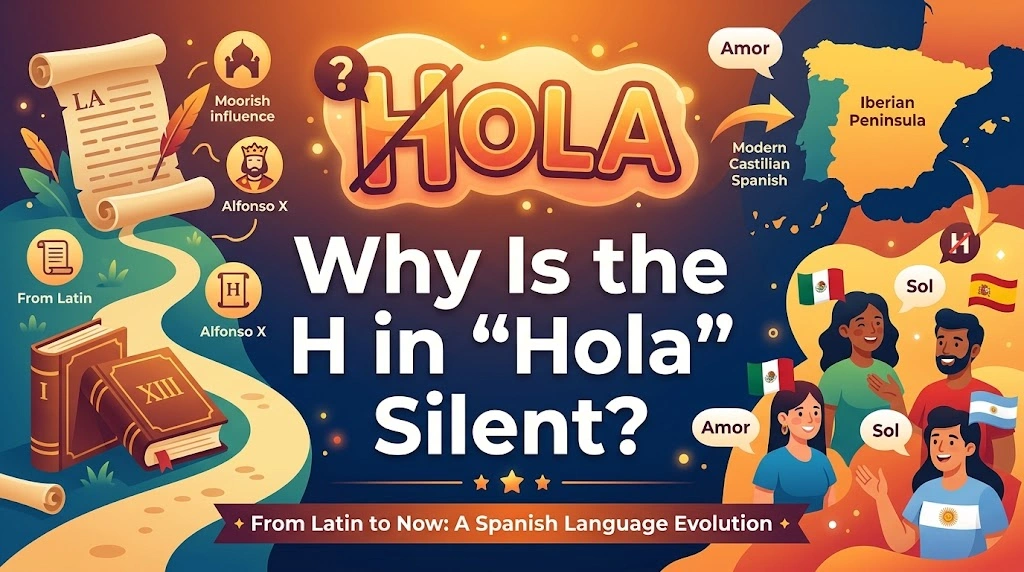
The silent h isn’t a special feature invented for hola. It’s part of a much larger pattern in Spanish spelling.
The h is unusual because it generally doesn’t represent a spoken phoneme in ordinary modern Spanish words. The Royal Spanish Academy’s El buen uso del español explains that the letter h normally has no phonetic value in Spanish, although certain loanwords can behave differently.
You’ll see this pattern in many familiar words:
- hola
- hombre
- hacer
- hablar
- hora
- hijo
- harina
For example:
Hola.
has a silent h.
So does:
Hoy hace frío.
The h in hoy doesn’t produce an English-style h sound.
Why Does Spanish Keep the Letter?
Spanish spelling reflects layers of linguistic history. In many cases, the presence of h relates to the historical form or origin of a word rather than a sound speakers pronounce today.
The RAE notes several historical reasons for Spanish h, including inherited spelling traditions and words whose Latin ancestors contained an initial f that later disappeared from pronunciation in Spanish.
That historical relationship explains why modern Spanish can preserve a letter after its sound has disappeared.
However, the exact history of hola itself is less straightforward.
The History and Origin of “Hola”
The etymology of hola has attracted considerable debate.
That matters because it’s tempting to find a neat origin story and present it as settled fact. The evidence doesn’t support that level of certainty.
Historical sources have connected hola with expressive calls used to attract attention. Older Spanish dictionaries also associated the word with calling or addressing someone.
Modern discussions of the word’s history continue to examine several competing explanations. One recent academic study revisited the etymology and argued for an Arabic origin, while other traditional explanations have linked hola with expressive forms related to hello, hallo, or similar calls.
The safest conclusion is that the precise etymology of hola remains disputed.
That’s more useful than pretending there’s a single universally accepted explanation.
From Attention-Getting Expression to Greeting
One interesting linguistic possibility is that hola developed from an expression used to get someone’s attention and later became a conventional greeting.
A 2024 study on the history of Spanish hola argues that the word may have moved through stages involving astonishment and attention-getting before becoming established as a salutation.
That kind of semantic development isn’t unusual.
Languages often turn expressive sounds into conventional words. A cry used to attract someone can gradually become associated with meeting or addressing that person.
So today’s simple “hello” may preserve traces of a much older conversational function.
How to Use “Hola” in Real Spanish Conversations
The easiest way to master hola is to see it in realistic contexts.
Greeting One Person
Hola, Juan.
This simply means:
Hello, Juan.
You can also add a question:
Hola, Juan. ¿Cómo estás?
The greeting establishes contact before the conversation continues.
Greeting Several People
Hola doesn’t need a special plural form.
You can say:
Hola a todos.
That means:
Hello, everyone.
You might also hear:
Hola, chicos.
or:
Hola, amigos.
The noun or pronoun tells you who you’re addressing. Hola itself stays the same.
Starting a Conversation
Spanish speakers can use hola before a request or question.
For example:
Hola, ¿me puede ayudar?
This means:
Hello, can you help me?
Or in a more informal situation:
Hola, ¿tienes un minuto?
That means:
Hi, do you have a minute?
This structure is useful because it shows that hola isn’t limited to friendly small talk. It can naturally open practical conversations too.
Hola With Other Spanish Greetings
Spanish speakers frequently combine hola with another greeting.
Common combinations include:
| Spanish | English |
| Hola, buenos días. | Hello, good morning. |
| Hola, buenas tardes. | Hello, good afternoon. |
| Hola, buenas noches. | Hello, good evening/night. |
| Hola, ¿qué tal? | Hi, how’s it going? |
| Hola, ¿cómo estás? | Hi, how are you? |
These combinations don’t sound redundant in ordinary conversation.
In English, saying “Hello, good morning” can sometimes feel more marked. In Spanish, hola + a time-specific greeting can be perfectly natural.
Is “Hola” Formal or Informal?
The answer requires a little nuance.
Hola is generally an everyday greeting rather than a highly formal formula. However, its use isn’t restricted to close friends.
Imagine entering a workplace and greeting a colleague:
Hola, buenos días.
Nothing about that sentence is inherently inappropriate.
Now imagine addressing a customer:
Hola, ¿en qué puedo ayudarle?
The polite ayudarle construction contributes to the formal tone.
This reveals an important language-learning principle:
Formality often comes from the entire expression rather than one isolated word.
So don’t treat hola as a word that must be reserved for friends.
Hola vs. Ola as Spanish Homophones
A homophone is a word that sounds the same as another word but has a different meaning or spelling.
That describes hola and ola.
When spoken, they are normally indistinguishable:
hola → greeting
ola → wave
The listener relies on context.
Imagine someone says:
La ___ es muy grande.
If the next part of the conversation concerns the beach, the listener will naturally understand ola.
Now imagine someone says:
___, ¿cómo estás?
The greeting context makes hola obvious.
Written Spanish removes that uncertainty because the spelling shows which word the writer intended.
WordReference specifically identifies hola and ola as homophones and distinguishes hola as a familiar greeting from ola as a word for a wave.
Why Spanish Has Homophones Like Hola and Ola
Languages don’t always maintain a one-sound-one-letter relationship.
Sound changes happen over centuries. Spelling can preserve older distinctions even after pronunciation changes erase them.
In the case of hola, the written h has no ordinary spoken value. As a result, the word becomes phonetically identical to ola.
This creates a useful example of how orthography and pronunciation can evolve at different speeds.
The spelling preserves a distinction that speech no longer expresses.
That’s why a learner can hear a Spanish speaker say something that sounds like ola and still need context to know whether the speaker means “hello” or “wave.”
Common Mistakes With Hola and Ola
The spelling looks deceptively simple. Here are the mistakes worth avoiding.
Writing “Ola” as a Greeting
This is the biggest mistake.
Incorrect:
Ola, ¿cómo estás?
Correct:
Hola, ¿cómo estás?
The missing h changes the written word.
Pronouncing the H
Another common error is giving hola an English-style h sound.
Remember:
Spanish h is normally silent.
Assuming Similar Sound Means Similar Meaning
Hola and ola sound alike, but that doesn’t make them variants of the same word.
They have different meanings and grammatical roles.
Assuming Every Spanish H Is Pronounced
The pattern is broader than hola.
Spanish learners should recognize h as a letter that is usually silent. Still, foreign words and some borrowed vocabulary can behave differently.
Hola vs. Hello: Are They Used the Same Way?
At the basic level, hola corresponds to English hello or hi.
But language isn’t a mathematical substitution system.
For example, English speakers can use “hello” to greet someone, answer a phone call, express surprise, or get someone’s attention depending on context. Spanish hola has its own range of conversational uses.
The safest translation depends on the situation:
| Spanish | Natural English equivalent |
| ¡Hola! | Hi! / Hello! |
| Hola, Ana. | Hi, Ana. |
| Hola a todos. | Hello, everyone. |
| Hola, ¿qué tal? | Hi, how’s it going? |
Don’t feel that every hola must become “hello.” In casual English, hi is often the more natural translation.
How English Speakers Can Use “Hola” Naturally

English speakers sometimes use hola inside English conversations.
For example:
“Hola! How are you?”
That can work when the speaker wants to add a little Spanish flavor, address a Spanish-speaking person, or use a familiar bilingual expression.
However, context matters.
If every sentence contains random Spanish words without a reason, the result can sound forced.
A natural use usually has a clear purpose:
- Speaking with a Spanish speaker
- Practicing Spanish
- Using a familiar bilingual greeting
- Reflecting a multilingual environment
- Referring to Spanish culture or language
The key is not to treat hola as a decorative word. Use it because it fits the conversation.
Hola in Text Messages and Social Media
Digital communication has made hola extremely familiar to English speakers.
You’ll see forms such as:
- Hola!
- ¡Hola!
- Hola 😊
- Hola, ¿cómo estás?
- ¡Hola a todos!
The spelling remains hola regardless of whether the message appears in a text, email, social media post, or handwritten note.
Spanish punctuation can also matter. In standard Spanish, an exclamation mark can appear at both the beginning and end of an exclamatory sentence:
¡Hola!
The opening ¡ is part of standard Spanish punctuation.
In informal digital communication, however, people may omit punctuation or use simplified styles. That’s a feature of casual online writing rather than a reason to change the spelling of hola.
Hola Around the Spanish-Speaking World
Hola is broadly understood across the Spanish-speaking world.
That makes it one of the safest Spanish greetings for learners.
You can use it in Spain, Mexico, Colombia, Argentina, Chile, Peru, and other Spanish-speaking communities without needing to memorize a different word for “hello” in each country.
Regional differences often appear in the greeting that follows hola, the pronoun used, vocabulary, or the level of familiarity.
For example:
| Region | Common greeting pattern |
| Spain | Hola, ¿qué tal? |
| Mexico | Hola, ¿cómo estás? |
| Argentina | Hola, ¿cómo estás? |
| Colombia | Hola, ¿cómo estás? |
| Chile | Hola, ¿cómo estás? |
| Peru | Hola, ¿cómo estás? |
These examples aren’t rigid regional rules. People within every country use many different greetings depending on age, relationship, setting, and personal style.
The important takeaway is simpler:
You don’t need a country-specific replacement for hola to greet Spanish speakers.
How to Use “Ola” Correctly
Because ola has a concrete noun meaning, it often appears with articles and adjectives.
For example:
La ola es enorme.
The article la agrees with the feminine noun ola.
Plural:
Las olas son enormes.
Notice the change:
- la ola = the wave
- las olas = the waves
You can also use indefinite articles:
- una ola = a wave
- unas olas = some waves
This grammatical behavior helps distinguish ola from hola.
You wouldn’t say la hola when using hola as a greeting.
Instead, you simply say:
Hola.
That’s another useful clue: ola behaves like a noun, while hola functions as a greeting expression.
Hola vs. Ola in Everyday Examples
The following examples show how context determines the correct spelling.
| Sentence | Correct Word | Translation |
| Hola, Marta. | Hola | Hello, Marta. |
| La ola era enorme. | Ola | The wave was huge. |
| ¡Hola! ¿Cómo estás? | Hola | Hi! How are you? |
| Una ola golpeó el barco. | Ola | A wave hit the boat. |
| Hola a todos. | Hola | Hello, everyone. |
| Las olas cubrieron la playa. | Olas | The waves covered the beach. |
| Hola, buenos días. | Hola | Hello, good morning. |
| La ola llegó hasta la orilla. | Ola | The wave reached the shore. |
Notice how the grammar gives ola away.
When you see la ola, una ola, or las olas, you’re dealing with the noun.
When you see hola at the beginning of a conversation, you’re looking at the greeting.
A Practical Case Study: Why Context Solves the Confusion

Consider this short exchange:
Speaker A: “Hola, ¿cómo estás?”
Speaker B: “Muy bien, gracias.”
There’s no ambiguity. The conversation clearly involves a greeting.
Now consider a beach conversation:
Speaker A: “¡Mira esa ola!”
Speaker B: “¡Es enorme!”
Again, context makes the meaning obvious.
Now imagine hearing only the sound:
“Ola.”
Without context, a learner might wonder whether the speaker said hola or ola.
That’s why listening alone isn’t enough when learning these words. Context and spelling complete the picture.
This is a useful lesson for Spanish learners more generally. When two words sound identical, don’t panic. Look at the surrounding words and the situation.
Related Spanish Words Worth Learning
Learning hola becomes more useful when you pair it with other common greetings.
Greetings Related to Hola
- hola — hello, hi
- buenos días — good morning
- buenas tardes — good afternoon
- buenas noches — good evening/night
- ¿cómo estás? — how are you?
- ¿qué tal? — how’s it going?
- adiós — goodbye
- hasta luego — see you later
For ola, useful related vocabulary includes:
- mar — sea
- océano — ocean
- playa — beach
- agua — water
- costa — coast
- arena — sand
- barco — boat
Knowing these surrounding words makes the distinction easier to recognize in real conversations.
Hola vs. Ola in English Writing
When discussing the Spanish word in an English article, dictionary entry, or language lesson, hola should normally remain recognizable as a Spanish term.
Depending on the publication’s style guide, foreign words that aren’t fully naturalized into English may be italicized:
The Spanish greeting hola means “hello.”
But once the word is being used directly as part of an example, you can simply write:
¡Hola!
The same principle applies to ola:
The Spanish noun ola means “wave.”
The important thing is to preserve the spelling accurately.
Don’t change hola to ola simply because the words sound identical.
A Quick Practice Exercise: Hola or Ola?
Choose the correct word in each sentence.
- ___, ¿cómo estás?
- La ___ es muy alta.
- ___, María.
- Una ___ golpeó la costa.
- ___ a todos.
- Las ___ son fuertes hoy.
Answers
- Hola, ¿cómo estás?
- La ola es muy alta.
- Hola, María.
- Una ola golpeó la costa.
- Hola a todos.
- Las olas son fuertes hoy.
Here’s the rule behind every answer:
Greetings use hola. Waves use ola.
Easy Ways to Remember Hola vs. Ola
If the distinction keeps slipping your mind, use these three tricks.
Remember the H for Hello
H → Hello → Hola
The English word “hello” starts with h, just like hola.
Again, this is a memory trick rather than a historical explanation.
Think of the Ocean
Ola → ocean → wave
If you’re talking about water moving across the surface, think ola.
Look at the Grammar
If the word appears with an article such as la, una, or las, you’re probably dealing with the noun ola:
la ola
una ola
las olas
If the word opens a conversation, it’s probably:
hola
These three clues make the distinction remarkably easy.
Read More : WSG Meaning: What It Means in Text & Slang
The Most Important Facts About Hola vs. Ola
Here are the facts worth remembering:
- Hola means “hello” or “hi.”
- Ola means “wave.”
- Hola and ola are pronounced alike in standard Spanish.
- The h in hola is silent.
- Hola functions as a greeting or interjection.
- Ola is a feminine noun.
- The plural of ola is olas.
- Hola is widely understood across Spanish-speaking regions.
- You cannot use ola as the standard spelling of the greeting.
- You cannot use hola when you mean a physical wave.
- The exact historical origin of hola remains debated.
Hola vs. Ola: Quick Reference Guide
| Question | Answer |
| What does hola mean? | Hello or hi |
| What does ola mean? | Wave |
| Do they sound the same? | Yes, in standard Spanish |
| Is the H in hola pronounced? | No |
| Is ola a noun? | Yes |
| Is hola a greeting? | Yes |
| What’s the plural of ola? | olas |
| Can ola mean hello? | No |
| Can hola mean wave? | No |
| Is hola widely used across Spanish-speaking regions? | Yes |
| Why are they confusing? | Their pronunciation is the same while their spelling and meanings differ |
Frequently Asked Questions About Hola vs. Ola
Is it “hola” or “ola” for hello?
The correct spelling is hola.
Use hola when you mean “hello” or “hi.” The h is silent, but you still need to write it.
¡Hola!
What does “ola” mean in Spanish?
Ola means “wave.” It usually refers to a wave on water, especially the sea.
La ola es grande.
That means:
The wave is big.
Are “hola” and “ola” pronounced the same?
Yes. In standard Spanish, the h in hola is silent, so hola and ola are homophones.
Their meanings and spellings remain different even though their pronunciation matches.
Why is the H silent in hola?
Spanish h normally has no spoken sound in ordinary words. Its presence often reflects historical spelling rather than modern pronunciation. The RAE describes Spanish h as generally lacking phonetic value.
Is hola formal or informal?
Hola is primarily an everyday greeting, but it isn’t restricted to close friends.
You can use it with acquaintances, coworkers, and strangers. The surrounding words and the way you address someone determine much of the formality.
Can I use hola in an English conversation?
Yes.
English speakers sometimes use hola naturally when speaking with Spanish speakers, practicing Spanish, or using a familiar bilingual expression.
For example:
“Hola! How are you?”
The key is to use it naturally rather than adding Spanish words simply for decoration.
How do you pronounce hola correctly?
The h is silent, and the word has two syllables. Its pronunciation is therefore essentially the same as ola in standard Spanish.
Is hola used throughout the Spanish-speaking world?
Yes. Hola is broadly understood and widely used across Spanish-speaking communities. Regional differences usually involve other parts of the greeting rather than replacing hola with a completely different standard word.
What is the difference between hola and hello?
Both can function as everyday greetings.
Hola is Spanish, while hello is English. Depending on context, hola can translate naturally as either “hello” or the more casual “hi.”
How can I remember the difference between hola and ola?
Use this simple memory trick:
H = Hello = Hola
Then associate ola with an ocean wave.
It isn’t complicated once the spelling becomes automatic.
Conclusion: Remember the One-Letter Difference
The hola vs. ola question comes down to one silent letter and two completely different meanings.
Hola means “hello” or “hi.” It’s the Spanish greeting you’ll use when starting a conversation, acknowledging someone, or simply saying hello.
Ola means “wave.” It’s a feminine noun used for waves on the sea and, in broader contexts, for figurative waves or surges.
The confusing part is pronunciation. Because the h in hola is silent, the two words sound the same in standard Spanish. That makes them homophones, but it doesn’t make them interchangeable.
When speaking, context usually tells the listener which word you mean. When writing, however, the spelling has to do the work.
So keep one rule in mind:
Hola = hello. Ola = wave.
Once you remember that H stands for “hello,” this common Spanish spelling trap becomes much easier to avoid.
Sources and Further Reading
- Real Academia Española / ASALE — El buen uso del español — Useful reference for the Spanish letter h and its pronunciation.
- WordReference — “hola, ola” — Provides a direct grammatical distinction between the two homophones.
- Etymonline — “hello” etymology — Useful background on related attention-getting expressions and greeting forms.