
If you’ve ever paused before writing “Please respond to my email” or “Please send a response to my email,” you’re not alone. Respond vs. response can be confusing because the two words come from the same word family and share almost the same meaning.
The important difference is grammatical: respond is a verb, while response is a noun. In simple terms, you respond when you perform the action. You give, receive, or make a response when you’re talking about the answer or reaction itself.
For example:
- Please respond to my message.
- I haven’t received your response yet.
Both sentences describe communication. However, respond names the action of answering while response names the answer.
Once you understand that distinction, choosing between these words becomes much easier. This guide explains respond vs. response, their meanings, sentence patterns, common mistakes, related words such as reply and reaction, and examples from everyday, professional, academic, medical, and scientific contexts.
Respond vs. Response: The Basic Difference
The quickest way to understand respond vs. response is to identify each word’s part of speech.
| Word | Part of Speech | Meaning | Example |
| Respond | Verb | To answer, react, or take action | “Please respond to my email.” |
| Response | Noun | An answer, reaction, or reply | “I received your response.” |
A verb tells you what someone does. A noun names a person, place, thing, idea, answer, or event.
That’s why you can say:
She responded to the question.
But you can’t replace responded with response and keep the same grammar:
❌ She response to the question.
The correct noun construction would be:
She gave a response to the question.
Here’s another useful comparison:
The doctor responded quickly.
The doctor’s response was quick.
The meaning remains closely related, but the grammatical structure changes.
The Simplest Rule for Respond vs. Response
Remember this simple formula:
Respond = action
Response = answer or reaction
When someone responds, they’re doing something. When you talk about their response, you’re naming what they said, did, or how they reacted.
For example:
- The customer responded to the complaint.
- The customer’s response was polite.
- The company responded immediately.
- The company’s response came within an hour.
This action-versus-thing distinction solves most respond vs. response questions.
What Does “Respond” Mean?
Respond is a verb that means to answer, react, or take action because something happened.
You can respond to a question, message, request, person, event, situation, treatment, stimulus, or problem.
The response doesn’t have to involve words. Someone can respond physically, emotionally, behaviorally, or medically.
For example:
- She responded to my text.
- He responded calmly to the criticism.
- The patient responded well to treatment.
- The emergency team responded quickly.
- Plants respond to changes in light.
In each sentence, respond describes an action or reaction.
Respond as a Verb
Because respond functions as a verb, it can change according to tense and subject.
| Tense | Example |
| Present | She responds quickly. |
| Past | She responded quickly. |
| Present participle | She is responding quickly. |
| Infinitive | She wants to respond quickly. |
| Perfect | She has responded already. |
The word can therefore fit naturally into many sentence structures.
For example:
I need to respond to this email before noon.
Here, respond follows to and acts as the main verb.
Common Uses of “Respond”
You can use respond in several common situations.
Communication
- respond to a question
- respond to an email
- respond to a text
- respond to a request
- respond to a letter
Behavior
- respond to criticism
- respond to pressure
- respond to a challenge
- respond to someone’s actions
Medical and scientific contexts
- respond to treatment
- respond to medication
- respond to a stimulus
- respond to environmental changes
Emergencies
- respond to an accident
- respond to a fire
- respond to an emergency call
- respond to a crisis
The underlying idea remains the same: something happens and a person, group, organism, or system reacts to it.
Examples of “Respond” in Sentences
Here are examples across different situations:
- Please respond to my question.
- Maria responded to the email this morning.
- The manager responded professionally to the complaint.
- The police responded to the emergency call.
- The child responded with a smile.
- The patient responded well to the new treatment.
- The company responded by changing its policy.
- The software responds quickly to user input.
Notice that the word doesn’t always mean speak. In “The child responded with a smile,” the response happens through facial expression rather than words.
Common Verb Patterns With “Respond”
Several structures appear frequently with respond.
Respond to + Noun
This is one of the most common patterns.
She responded to the question.
They responded to the customer’s complaint.
He didn’t respond to my message.
Here, to introduces the thing or person receiving the response.
Respond with + Noun
Use respond with when you want to identify what someone used as their answer or reaction.
She responded with a smile.
He responded with a short explanation.
The company responded with a public statement.
Respond by + -ing
Use respond by when you explain the action someone took in response to something.
The company responded by offering refunds.
She responded by asking another question.
The team responded by increasing production.
This structure is especially useful in formal and analytical writing.
What Does “Response” Mean?
Response is primarily a noun. It refers to an answer, reply, reaction, or result that occurs after something prompts it.
For example:
I received a response from the manager.
The word response names the answer.
It can also describe reactions that aren’t verbal:
The medicine caused a strong response.
The audience’s response was enthusiastic.
The body’s immune response helps fight infection.
So response has a broader meaning than simply reply.
Response as a Noun
Because response is a noun, it can appear after articles and determiners.
Examples include:
- a response
- the response
- your response
- their response
- this response
- several responses
It can also become plural:
We received three responses.
That’s an important grammatical clue. Response can be plural because it’s a countable noun when you’re referring to individual answers or reactions.
Common Uses of “Response”
The noun response appears in many settings.
Communication
“I received a response to my email.”
Customer service
“The company’s response addressed the complaint.”
Medicine
“The patient showed a positive response to treatment.”
Psychology
“Fear can trigger a physical response.”
Science
“The organism showed a response to the stimulus.”
Politics and public affairs
“The government issued a response to the report.”
In every case, response names the reaction or answer rather than describing the act of responding.
Examples of “Response” in Sentences
- Her response surprised everyone.
- We are still waiting for a response.
- The manager gave a detailed response.
- His response to the criticism was calm.
- The treatment produced a positive response.
- The public response was mixed.
- The emergency response was immediate.
- Scientists observed a measurable response to the stimulus.
Respond vs. Response: Grammar Patterns Compared
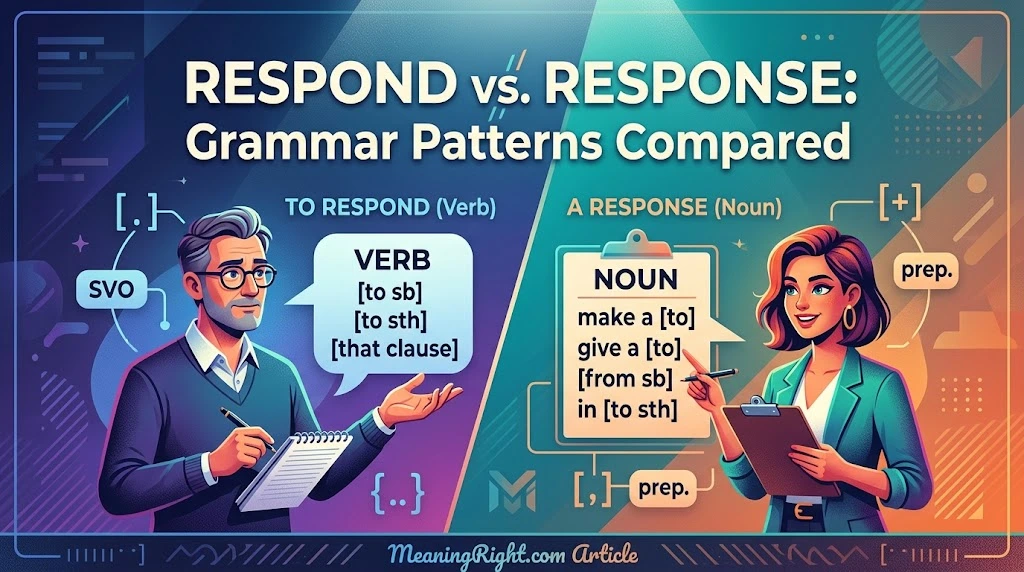
The best way to master respond vs. response is to compare their sentence patterns.
Sentence Patterns With “Respond”
A common structure is:
Subject + respond + to + object
Examples:
She responded to the email.
They responded to the request.
He responded to the criticism.
Another useful pattern is:
Subject + respond + with + noun
She responded with a smile.
You can also use:
Subject + respond + by + -ing
The company responded by changing its policy.
These patterns help you recognize respond as a verb.
Sentence Patterns With “Response”
A common structure is:
Subject + receive + a response
I received a response from the manager.
Another is:
Subject + give + a response
She gave a response to the question.
You can also use:
a response to + noun
His response to the criticism was thoughtful.
And:
in response to + noun
The company changed its policy in response to customer complaints.
These structures clearly identify response as a noun.
Respond vs. Response: Action vs. Thing
A useful grammar test is to ask what the sentence needs.
If you need an action, use respond.
If you need the answer or reaction itself, use response.
Compare:
Please respond to this message.
Here, the reader needs to perform an action.
Now compare:
Please send a response to this message.
Here, response names the thing being sent.
Both sentences work. They simply use different grammatical structures.
A Simple Substitution Test
Look at the word before the blank.
If the sentence needs a verb, respond may fit:
“Please ___ to my email.”
Respond works.
If the sentence needs a noun, response may fit:
“I haven’t received your ___.”
Response works.
Words such as a, an, the, your, my, his, her, their, several, and many often signal that a noun may follow.
For example:
“I received your response.”
But:
“Please respond.”
The first sentence needs a noun. The second needs a verb.
Why Both Words Can Appear Together
There’s nothing grammatically wrong with using both words in one sentence.
For example:
She responded with a detailed response.
The first responded describes the action. The second response names what she provided.
Still, repeating the same word family isn’t always the most elegant choice. Depending on the context, you might write:
She answered with a detailed explanation.
Good writing isn’t only about grammatical correctness. It also considers rhythm, clarity, and repetition.
Respond vs. Response in Different Contexts
The difference becomes even clearer when you see these words in real situations.
Respond vs. Response in Everyday Communication
Everyday conversations use both words constantly.
Why didn’t you respond to my text?
Here, respond describes the action of answering.
I haven’t received a response yet.
Here, response refers to the answer itself.
You can also say:
She responded immediately.
or:
Her response was immediate.
The meaning stays similar while the grammatical structure changes.
Respond vs. Response in Professional Communication
Business writing often uses both terms.
For example:
Please respond to the client’s request by Friday.
The writer asks someone to take action.
A related sentence might say:
We need your response by Friday.
Here, the writer needs the answer itself.
Consider another example:
The company responded to the complaint.
versus:
The company’s response to the complaint was professional.
The first sentence focuses on what the company did. The second evaluates the answer or reaction.
Respond vs. Response in Academic Writing
Academic writing frequently uses response when discussing answers, arguments, or reactions to ideas.
Examples include:
- The student’s response addressed the question directly.
- The author responded to earlier criticism.
- The essay provides a detailed response to the argument.
- Researchers responded to the findings by conducting another study.
The distinction remains grammatical rather than mysterious.
Respond vs. Response in Emotional and Behavioral Contexts
People don’t respond only with words.
Someone might:
- respond with anger
- respond with laughter
- respond calmly
- respond physically
- respond emotionally
The noun form describes the reaction:
- an angry response
- a physical response
- an emotional response
- a calm response
Compare:
He responded angrily to the news.
His emotional response was intense.
The first sentence describes how he reacted. The second names the reaction itself.
Respond vs. Response in Medical and Scientific Contexts
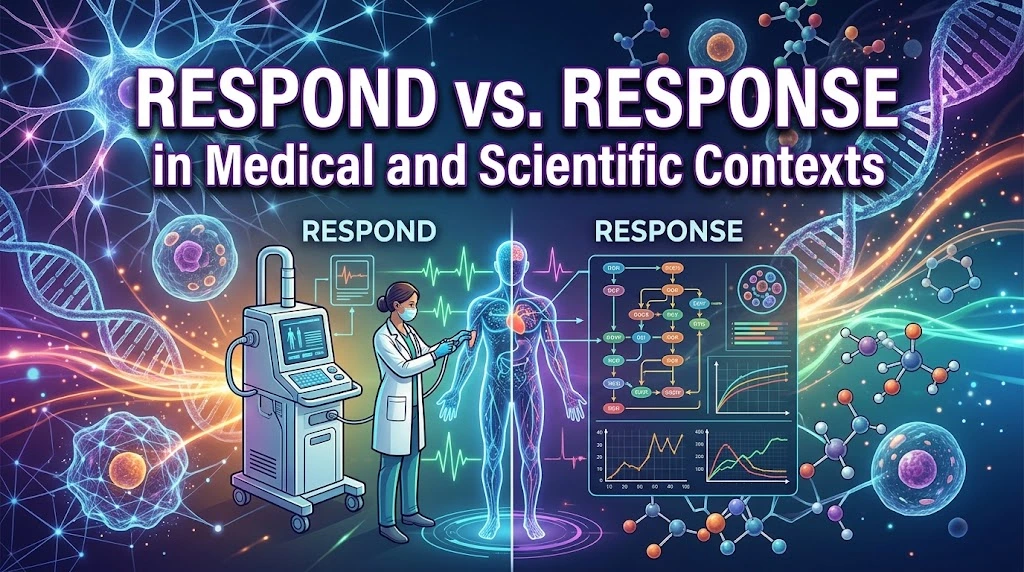
The word response appears frequently in medicine and science because professionals often need to describe reactions to treatments, stimuli, conditions, or changes.
For example:
The patient responded well to treatment.
Here, responded is a verb.
Now consider:
The patient showed a positive response to treatment.
Here, response is a noun.
The distinction matters because scientific writing often separates an observed action from the measured outcome.
Medical Examples
- The patient responded well to the medication.
- The patient showed a strong response to the medication.
- Researchers observed how cells responded to the stimulus.
- The immune response helps protect the body.
- The treatment produced a measurable response.
These sentences demonstrate how the same basic concept can shift between verb and noun forms.
A Medical Scenario
Imagine a patient begins a new treatment.
After several weeks, the doctor observes improvement. The doctor might write:
The patient responded well to treatment.
That sentence focuses on the patient’s reaction.
A clinical report might instead state:
The patient demonstrated a positive response to treatment.
That version focuses on the observed outcome.
The distinction becomes useful in professional writing because respond describes what the patient or system does while response identifies the reaction being evaluated.
Respond vs. Response in Emergency Situations

Emergency language provides another clear contrast.
Consider:
Firefighters responded to the emergency within minutes.
The sentence describes an action.
Now look at:
The emergency response began within minutes.
The sentence names the organized reaction to the emergency.
You might also see:
Police responded to the incident.
and:
The police response was immediate.
Again, the basic difference remains unchanged.
Respond = act.
Response = the action or reaction being discussed as a noun.
Respond vs. Response vs. Reply
People often confuse respond, response, and reply because all three relate to answering or reacting.
However, they don’t work exactly the same way.
| Word | Part of Speech | Typical Meaning |
| Respond | Verb | Answer or react |
| Response | Noun | Answer, reaction, or result |
| Reply | Noun/Verb | Answer someone, especially in communication |
Reply tends to focus on communication.
For example:
She replied to my email.
You can also say:
She responded to my email.
Both are natural.
However, response can describe many reactions that aren’t communicative:
The patient had a strong response to the medication.
You wouldn’t normally replace response with reply in that sentence.
Respond vs. Reply
Respond has a broader range of meanings.
You can respond to:
- a question
- an email
- criticism
- treatment
- danger
- pressure
- an emergency
- environmental changes
Reply usually concerns communication.
For example:
He replied to my message.
But:
The plant responded to changes in temperature.
The second sentence requires responded, not replied.
Common Errors With Respond and Response
Even though the distinction looks simple, several mistakes appear regularly.
Using “Response” Where a Verb Is Needed
Incorrect:
❌ Please response to my email.
Correct:
✅ Please respond to my email.
Why? The sentence asks someone to perform an action. Therefore, it needs the verb respond.
Using “Respond” Where a Noun Is Needed
Incorrect:
❌ I haven’t received your respond.
Correct:
✅ I haven’t received your response.
The word your modifies a noun here. Response fits that grammatical role.
Confusing “Respond to” and “Response to”
Both structures are correct.
She responded to the question.
Her response to the question was accurate.
The difference comes from the part of speech.
Respond to uses a verb.
Response to uses a noun.
Is “Respond Back” Correct?
You may hear people say:
Please respond back when you can.
This expression appears in informal speech and writing. However, respond already contains the idea of answering or reacting, so back is often unnecessary.
In most polished writing, prefer:
Please respond when you can.
Instead of:
Please respond back when you can.
That said, respond back is common enough in casual conversation that calling every use grammatically impossible would be misleading. The issue is mainly one of redundancy and style.
Respond vs. Response: Quick Decision Guide
When you’re unsure, use this checklist.
Use “Respond” When:
- You need a verb.
- Someone performs an action.
- Someone answers a question.
- Someone reacts to an event.
- Someone takes action because of a situation.
Examples:
Please respond to the invitation.
The team responded quickly.
She responded by asking another question.
Use “Response” When:
- You need a noun.
- You’re naming an answer.
- You’re describing a reaction.
- You’re discussing an outcome or effect.
- The word follows an article or possessive such as a, the, your, or their.
Examples:
I received a response.
Her response was thoughtful.
The treatment produced a positive response.
The Easiest Memory Trick
You respond. You give, receive, or make a response.
That short rule handles most everyday situations.
Respond vs. Response: Real-World Examples
Texting and Messaging
Respond:
“Please respond to my message.”
Response:
“I haven’t received your response.”
Workplace Communication
Respond:
“The manager responded to the client’s complaint.”
Response:
“The manager’s response addressed every concern.”
School and College
Respond:
“Students must respond to all three questions.”
Response:
“Write a 200-word response to the article.”
Customer Service
Respond:
“The company responded to the customer’s complaint.”
Response:
“The company’s response included an apology and a refund.”
Medical Context
Respond:
“The patient responded well to treatment.”
Response:
“The patient showed a positive response to treatment.”
Public Statements
Respond:
“The spokesperson responded to the allegations.”
Response:
“The spokesperson’s response was released later that day.”
Common Phrases With “Respond”
Learning common collocations makes the distinction easier to remember.
Common “Respond” Expressions
- respond to a question
- respond to an email
- respond to a request
- respond to criticism
- respond to pressure
- respond quickly
- respond positively
- respond negatively
- respond appropriately
- respond with a smile
- respond by taking action
For example:
The manager responded appropriately to the complaint.
Common “Response” Expressions
- a response to a question
- a response to criticism
- a response from the company
- a positive response
- a negative response
- an immediate response
- a strong response
- a delayed response
- in response to
- a written response
- a public response
- a medical response
For example:
The company issued a public response to the allegations.
Respond vs. Response: Important Grammar Clues
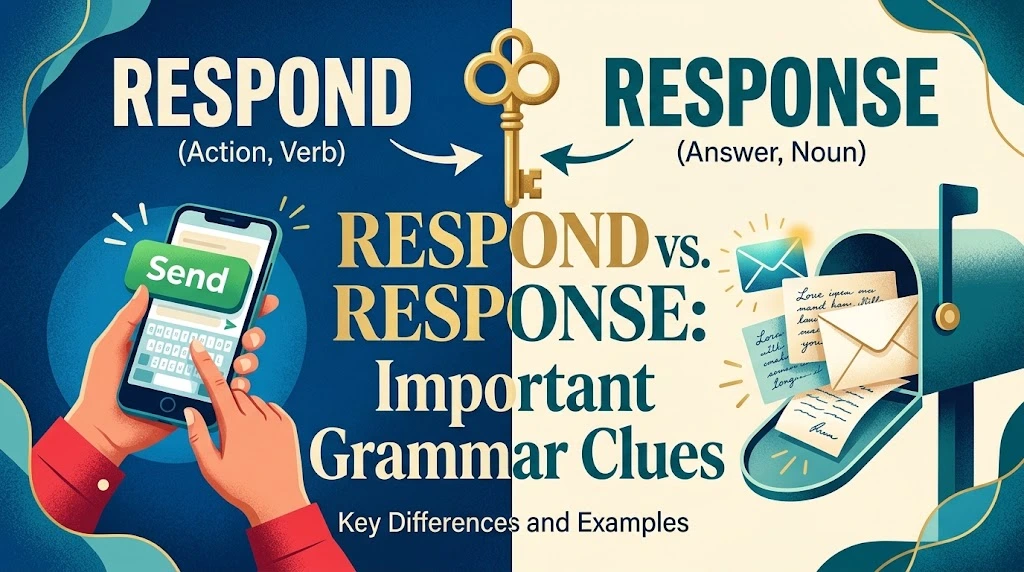
Certain words can help you identify which form belongs in a sentence.
| Grammar Clue | Likely Choice | Example |
| Please ___ | Respond | “Please respond.” |
| to ___ | Depends on structure | “Respond to him.” / “response to him” |
| a ___ | Response | “a response” |
| your ___ | Response | “your response” |
| they ___ | Respond | “they respond” |
| has ___ | Responded | “has responded” |
| several ___ | Responses | “several responses” |
| in ___ to | Response | “in response to” |
One particularly useful clue is “a.”
You can say:
a response
You cannot say:
❌ a respond
That immediately tells you that response functions as the noun.
Similarly, after to in a phrase such as please ___ to my message, you need the verb:
Please respond to my message.
Respond vs. Response: Practice Test
Test your understanding with these sentences.
Choose “Respond” or “Response”
Please ___ to the email before Friday.
We haven’t received a ___ yet.
The patient ___ well to the treatment.
Her ___ to the question was excellent.
The company ___ to the complaint immediately.
The company’s ___ was carefully worded.
The team ___ by changing its strategy.
The public ___ was overwhelmingly positive.
Answers
| Sentence | Correct Word | Why? |
| Please ___ to the email. | respond | The sentence needs a verb. |
| We haven’t received a ___. | response | The sentence needs a noun. |
| The patient ___ well. | responded | The sentence describes an action. |
| Her ___ was excellent. | response | “Her” modifies a noun. |
| The company ___ immediately. | responded | The word acts as a verb. |
| The company’s ___ was careful. | response | The sentence names the reaction. |
| The team ___ by changing its strategy. | responded | “Responded by” introduces an action. |
| The public ___ was positive. | response | The sentence names the reaction. |
Respond vs. Response: A Practical Case Study
Imagine a customer emails a company about a damaged product.
The customer expects the company to respond.
The customer asked the company to respond to the complaint within three business days.
The company then sends an email.
The company sent a detailed response to the complaint.
Later, a manager describes what happened:
The company responded by offering a replacement.
A report might summarize the outcome:
The customer’s response to the offer was positive.
Notice how naturally the word family changes according to grammar:
- respond = take action
- response = answer or reaction
The situation stays the same. The grammatical role changes.
Read More : Annunciate vs. Enunciate: Meaning, Differences, and How to Use Them Correctly
Respond vs. Response: Key Facts to Remember
Here are the most important points at a glance:
- Respond is a verb.
- Response is a noun.
- Respond means to answer, react, or take action.
- Response means an answer, reaction, or result.
- Respond to is a common verb structure.
- A response to is a common noun structure.
- Respond with identifies what someone uses as a reply or reaction.
- Respond by + -ing explains the action someone takes.
- In response to is a common noun phrase.
- Responses is the plural form of response.
- Respond back is often redundant because respond already implies answering or reacting.
- Response can describe verbal, emotional, physical, behavioral, medical, and scientific reactions.
- Reply is narrower and usually focuses on communication.
Frequently Asked Questions About Respond vs. Response
How Do I Quickly Tell the Difference Between “Respond” and “Response”?
Think action versus answer.
Use respond when someone performs the action of answering or reacting.
Please respond to my message.
Use response when you name the answer or reaction.
I received your response.
Is “Response” a Noun or a Verb?
Response is a noun.
It names an answer, reaction, or result.
Her response was helpful.
The plural form is responses.
We received several responses.
Is “Respond” a Noun or a Verb?
Respond is a verb.
It describes the action of answering or reacting.
Please respond to the question.
Its forms include respond, responds, responded, and responding.
Can “Response” Be Plural?
Yes. The plural form is responses.
For example:
The survey produced 500 responses.
We received several responses to the announcement.
Is “Respond Back” Correct?
Respond back appears in informal English, but back is usually unnecessary.
Because respond already means to answer or react, polished writing generally favors:
Please respond when you can.
rather than:
Please respond back when you can.
What Preposition Comes After “Respond”?
The most common structure is respond to.
She responded to the question.
You can also use respond with:
He responded with a smile.
And respond by + -ing:
The company responded by offering a refund.
What Is the Difference Between “Respond to” and “Response to”?
Respond to contains a verb.
She responded to the complaint.
Response to contains a noun.
Her response to the complaint was professional.
Both can refer to the same situation, but their grammar differs.
Can “Response” Mean a Reaction?
Yes. Response can mean much more than a verbal answer.
For example:
The body produced an immune response.
His emotional response was understandable.
The audience had a strong response to the performance.
Is a Response Always Verbal?
No. A response can be verbal, written, physical, emotional, behavioral, medical, or scientific.
Someone can respond with a smile. A patient can show a response to treatment. A plant can respond to changes in light.
What Is the Difference Between “Respond” and “Reply”?
Both can describe answering someone.
She replied to my email.
She responded to my email.
However, respond has a wider meaning. You can respond to treatment, danger, pressure, criticism, or environmental changes. Reply usually relates to communication.
Respond vs. Response: Final Comparison
| Respond | Response |
| Verb | Noun |
| Describes an action | Names an answer or reaction |
| Respond to a question | A response to a question |
| “She responded quickly.” | “Her response was quick.” |
| “They responded to the complaint.” | “Their response addressed the complaint.” |
| “He responded with a smile.” | “His response was a smile.” |
| “The patient responded well.” | “The patient showed a positive response.” |
Conclusion: Respond or Response?
The difference between respond vs. response becomes straightforward once you focus on grammar.
Respond is a verb. It describes the act of answering, reacting, or taking action.
Response is a noun. It names the answer, reaction, or outcome.
Compare these two sentences one last time:
Please respond to my email.
I haven’t received your response.
The first sentence asks someone to perform an action. The second talks about the answer itself.
When you’re unsure, remember the simplest rule:
You respond. You give, receive, or make a response.
That small distinction will help you choose the right word in emails, essays, conversations, professional writing, academic work, and everyday English.