
English spelling can be surprisingly tricky, especially when two words look almost identical but follow slightly different spelling conventions. A good example is combating vs. combatting. Both forms come from the verb combat, meaning to fight against, resist, or work to stop something. So, if you’ve ever wondered whether to write combating climate change or combatting climate change, you’re not alone.
The difference mainly comes down to English spelling rules, regional usage, and how different varieties of English handle words ending in -t. Combating is especially common in American English, while combatting is also widely used, particularly in British English and other varieties. Neither spelling automatically changes the meaning of the word.
Understanding this distinction can make your professional writing, academic writing, articles, reports, and everyday communication more consistent. It also helps you avoid unnecessary grammar mistakes and spelling errors when choosing between the two forms.
In this guide, you’ll learn the meaning of combating, the meaning of combatting, their pronunciation and usage, the relevant spelling pattern, and practical examples that show when each form works naturally.
Combating vs. Combatting at a Glance
Here’s the short version:
| Feature | Combating | Combatting |
| Base word | combat | combat |
| Form | Present participle / gerund | Present participle / gerund |
| Basic meaning | Fighting or opposing something | Fighting or opposing something |
| US English | Standard choice | Less common |
| British English | Used | Established variant |
| Meaning difference | None | None |
| Pronunciation | Same basic verb form | Same basic verb form |
| Best US choice | Yes | Usually not |
| Style-guide dependent | Sometimes | Often |
Collins explicitly lists both combating and combatting as present-participle forms. Its American English entry also gives both forms while noting that -batted, -batting forms are especially British in one of its dictionary treatments.
That gives us an important starting point:
Combating and combatting are spelling variants of the same verb form, not two words with different meanings.
Understanding the Root Word “Combat”
Before comparing combating vs. combatting, it helps to understand the word they both come from.
Combat can function as both a noun and a verb.
As a noun, it refers to a fight, battle, struggle, or conflict:
The soldiers entered combat at dawn.
The word also has a broader figurative sense:
The debate became an intellectual combat between competing ideas.
As a verb, combat means to fight against, oppose, resist, or work to stop something. Collins defines the verb in terms of fighting or struggling against something and gives examples involving efforts to combat crime.
Modern English often uses the verb for problems that aren’t physical battles at all.
You can:
- combat crime
- combat disease
- combat poverty
- combat misinformation
- combat corruption
- combat fraud
- combat climate change
- combat cybercrime
In each case, the idea is essentially the same: actively work against something undesirable.
The Word Forms of “Combat”
The verb produces several familiar forms:
| Grammatical form | Example |
| Base form | combat |
| Third-person singular | combats |
| Past tense | combated / combatted |
| Present participle | combating / combatting |
| Gerund | combating / combatting |
Collins records the two -ing forms and both corresponding past forms.
The spelling question therefore appears when you add -ing to combat.
Why Do Both “Combating” and “Combatting” Exist?
Here’s where English spelling gets a little untidy.
When you add -ing to a verb, English sometimes doubles the final consonant.
For example:
- run → running
- sit → sitting
- stop → stopping
- plan → planning
- admit → admitting
That pattern makes this look logical:
combat → combatting
And historically, that doubled form has certainly been used.
Yet English also established:
combat → combating
Both forms survived.
The important lesson is that English spelling rules describe patterns, not flawless mathematical equations. A rule can explain why a spelling looks plausible without proving that every competing form is wrong.
That’s exactly what happened with combat.
A Useful Way to Think About It
Imagine English spelling as a road system built over centuries.
Some roads were planned carefully. Others grew organically around older paths. A few eventually merged.
Combating and combatting are a good example of those overlapping paths.
The spelling difference doesn’t indicate a difference in meaning. It reflects competing conventions that became established in English.
The Historical Roots of “Combat”
The history of combat also explains why the word doesn’t behave like a neatly isolated English invention.
Collins traces combat through French combattre and ultimately to Latin roots associated with fighting and striking. The English word entered the language centuries ago and developed both noun and verb uses.
That history matters because English spelling has never been completely uniform.
Words entered English from:
- French
- Latin
- Greek
- Norse
- Germanic languages
- Other languages and dialects
Once those words entered English, speakers and writers adapted them to existing spelling habits.
Over centuries, dictionaries and publishers helped stabilize many forms. However, variation didn’t disappear entirely.
Combatting is therefore not a modern typo created by someone accidentally hitting the t key twice.
It’s an established form with dictionary support. Cambridge explicitly identifies combatting as the present participle of combat and provides examples from its corpus and other published sources.
Combating in American English
“Combating” Is the Practical US Choice
If you’re writing American English, combating is the form to reach for first.
It’s familiar, concise, and consistent with the standard US spelling pattern used in contemporary writing.
Consider:
The agency is combating financial fraud.
Researchers are combating antibiotic resistance.
The company is combating online scams.
Communities are combating homelessness.
None of these sentences needs the second t.
For a US audience, combating is usually the cleanest choice.
Where You’ll See “Combating”
The single-t spelling works naturally across many forms of American writing:
- Academic papers
- Business reports
- News articles
- Government documents
- Healthcare communication
- Technology writing
- Environmental reports
- Educational materials
- Marketing content
- Everyday correspondence
The spelling doesn’t make the sentence more or less formal.
The surrounding vocabulary determines the tone.
Compare:
We are combating fraud.
with:
The organization has implemented a comprehensive framework for combating sophisticated financial fraud networks.
The second sentence sounds more formal because of its vocabulary and structure. The spelling of combating hasn’t changed its register.
Is “Combatting” Wrong in American English?
This question deserves a careful answer.
Combatting is an established English spelling. It isn’t accurate to call it universally wrong.
However, that doesn’t mean it’s equally natural in every variety of English.
For American writing, combating is generally the safer and more familiar choice.
This distinction is useful:
| Statement | Accurate? |
| “Combatting exists in English.” | Yes |
| “Combatting has the same meaning as combating.” | Yes |
| “Combatting is used in British English.” | Yes |
| “Combating is standard for US writing.” | Yes |
| “Combatting is impossible in American English.” | Too absolute |
| “Combating and combatting have different meanings.” | No |
The safest editorial rule is therefore not “combatting is wrong.”
It’s:
If you’re writing standard US English, use combating unless a specific style requirement says otherwise.
Combatting in British English
“Combatting” Is an Established British Form
British English provides a particularly interesting part of this spelling debate.
Combatting appears in British usage and is recognized by major dictionary sources.
Cambridge defines combatting directly as the present participle of combat. Its examples include phrases involving combatting violence, product theft, and other problems.
That means a British writer who uses combatting isn’t simply making a spelling error.
The doubled t is a legitimate form.
But “Combating” Is Also Used in British English
This is where many quick grammar guides oversimplify the issue.
It’s tempting to say:
American English = combating
British English = combatting
That’s a useful shortcut, but it isn’t the whole story.
Collins lists combating and combatting as present-participle forms.
British writing can therefore contain either form.
The choice may depend on:
- Publisher preference
- House style
- Dictionary preference
- Existing document conventions
- Editorial consistency
- Writer preference
So don’t assume every British publication requires combatting.
How Pronunciation Affects “Combating” vs. “Combatting”
Pronunciation is part of the story, but it doesn’t settle the spelling question.
Collins gives the verb combat with pronunciation information that varies by English variety and records more than one pronunciation pattern for the word.
That matters because some simplified explanations claim the spelling is determined entirely by stress.
It isn’t that simple.
English spelling and pronunciation influence one another, but they aren’t locked together like gears.
The Stress Pattern
In one common verb pronunciation, the stress falls on the final syllable:
com-BAT
Other recorded pronunciations place stress differently. Collins lists multiple pronunciations for the verb in its American English entry and provides separate British and American pronunciation information.
So it’s risky to claim:
“The word is always stressed on the first syllable, therefore the t cannot double.”
That’s too rigid.
Likewise, it’s too simple to say:
“The final syllable is stressed, therefore the t must double.”
Established English usage doesn’t work that neatly.
The better explanation is:
Pronunciation and stress help explain consonant-doubling patterns, but established dictionary usage ultimately tells us which spellings exist.
Understanding “Combating” and “Combatting” as Verb Forms

The spelling difference doesn’t affect grammar.
Both forms can serve the same grammatical functions.
“Combating” and “Combatting” as Present Participles
A present participle commonly appears in progressive verb constructions.
For example:
The organization is combating online fraud.
Or:
The organization is combatting online fraud.
Both sentences describe an ongoing action.
The auxiliary verb is combines with the -ing form to create the present progressive.
More examples include:
- Researchers are combating drug-resistant infections.
- Officials are combatting illegal dumping.
- Engineers are combating network attacks.
- Communities are combating food insecurity.
“Combating” and “Combatting” as Gerunds
The same -ing forms can also function as nouns.
For example:
Combating misinformation requires careful source checking.
Here, combating misinformation functions as the subject of the sentence.
The alternative works in exactly the same grammatical position:
Combatting misinformation requires careful source checking.
The spelling changes.
The grammar doesn’t.
The Key Point
Don’t treat combating and combatting as separate vocabulary items.
Think of them as:
combat → combating / combatting
The two forms represent the same action.
Real-World Usage Examples
The easiest way to understand the distinction is to see how each spelling works in actual sentences.
American-Style Examples
The company introduced new measures for combating financial fraud.
Scientists are combating antibiotic resistance through new treatment strategies.
Schools are developing programs for combating misinformation.
The organization focuses on combating cybercrime.
Public agencies are working together on combating human trafficking.
For US-focused content, the single-t spelling is the natural default.
British-Style Examples
The organization is combatting financial crime.
The campaign focuses on combatting illegal dumping.
New measures were introduced for combatting youth crime.
At the same time, British writing can also use combating.
The organization is combating financial crime.
There is no semantic difference between these examples.
Case Study: “Combating Climate Change” vs. “Combatting Climate Change”
Few phrases make the issue clearer than combating climate change.
The expression appears naturally in formal writing because combat frequently describes efforts to resist large-scale social, environmental, and health problems.
US-Focused Example
A US publication might write:
Governments are investing in new technologies for combating climate change.
Here, combating follows the standard American preference.
UK-Focused Example
A British publication might write:
Governments are investing in new technologies for combatting climate change.
The doubled form fits established British usage.
However, a British publication could also write:
Governments are investing in new technologies for combating climate change.
That is why the regional distinction shouldn’t become an ironclad rule.
What This Case Study Teaches
The important issue isn’t whether one spelling changes the environmental meaning.
It doesn’t.
The real editorial question is:
Which spelling fits the English variety and style of the document?
That’s a much more useful question.
Historical Development of the Two Spellings
The existence of two forms isn’t surprising when you look at how English spelling developed.
English has accumulated spelling conventions rather than receiving one complete spelling system at a single point in history.
The history of combat itself reaches through French and Latin. Collins identifies the word as coming through French combattre, with deeper roots connected to Latin com- and battuere.
Over time, English speakers formed derivatives according to different spelling conventions.
One path produced:
combat → combating
Another preserved:
combat → combatting
Neither spelling requires a completely different meaning.
Historical Influences on the Variation
Several forces can shape spelling variation:
- Regional pronunciation
- Consonant-doubling conventions
- Historical spelling habits
- Dictionary standardization
- British publishing traditions
- American spelling preferences
- House styles
- Frequency of use
This is why trying to explain every spelling difference with one rule often creates more confusion than clarity.
English has rules.
English also has history.
History occasionally refuses to behave.
Common Consonant-Doubling Rules
The combating vs. combatting debate becomes easier when you understand the broader spelling pattern.
When English Commonly Doubles a Final Consonant
English often doubles the final consonant before -ing when certain conditions are met.
Examples include:
- run → running
- stop → stopping
- sit → sitting
- plan → planning
- admit → admitting
- prefer → preferring
The exact rule involves factors such as:
- Number of syllables
- Final consonant
- Vowel pattern
- Stress
- Word origin
- English variety
That’s already more nuanced than the classroom shortcut of “double the final consonant.”
Do Not Double Every Final Consonant
Consider these examples:
| Base verb | Correct -ing form |
| open | opening |
| visit | visiting |
| offer | offering |
| enter | entering |
| happen | happening |
| listen | listening |
Writing openning, visitting, or offerring would be incorrect.
So consonant doubling depends on the structure of the particular word.
Where “Combat” Fits
Combat is unusual because established English usage permits both forms:
combating
and
combatting
The doubled version can be understood through consonant-doubling conventions. The single-t version is also firmly established.
That means you shouldn’t try to “derive” the only acceptable spelling from the doubling rule alone.
Dictionary evidence matters more than a simplified formula.
Combating vs. Combatting: A Consonant-Doubling Comparison
The following examples show why spelling conventions vary.
| Base Word | Form With -ing | What Happens |
| run | running | Final consonant doubles |
| stop | stopping | Final consonant doubles |
| sit | sitting | Final consonant doubles |
| open | opening | No doubling |
| visit | visiting | No doubling |
| combat | combating | Single t |
| combat | combatting | Established variant |
The last row is the interesting one.
Combat is not a good word to use when teaching an absolute “one rule fits all” approach to consonant doubling.
It’s a case where established variation matters.
Combating vs. Combatting in Formal Writing
Neither spelling is inherently more formal.
That’s worth emphasizing because writers sometimes assume that the doubled form looks more sophisticated.
It doesn’t.
Compare:
The department is combating fraud.
The department is combatting fraud.
The sentences have the same grammatical structure and meaning.
The spelling difference is regional or stylistic.
Academic Writing
Academic writers should follow the English variety required by their institution or publication.
If the paper follows US English, combating is a sensible default.
If the journal follows British English, check its style requirements before making a choice.
Business Writing
Business communication benefits from consistency.
A US company might naturally write:
We remain committed to combating workplace harassment.
A British organization might use:
We remain committed to combatting workplace harassment.
The key is not to alternate randomly.
Journalism
News organizations commonly maintain internal style rules.
If the publication consistently uses one form, follow that convention.
The same principle applies to:
- Corporate style guides
- University style guides
- Government publications
- Marketing departments
- Editorial teams
House style beats personal preference.
Common Mistakes With “Combating” and “Combatting”
Treating “Combatting” as Automatically Wrong
This is probably the most common oversimplification.
Combatting is an established English form.
Cambridge explicitly lists it as the present participle of combat. Collins likewise recognizes it alongside combating.
Treating “Combating” as Exclusively American
That’s also too absolute.
British English uses combating as well.
The relationship isn’t a simple geographical switch.
Assuming the Two Forms Have Different Meanings
They don’t.
Both forms describe the act of fighting, resisting, opposing, or working against something.
Switching Spellings in One Article
Suppose an article begins:
Scientists are combating antibiotic resistance.
Later, it says:
Governments are combatting the same problem.
If there isn’t a deliberate reason for the change, readers may assume the inconsistency is an editing mistake.
Pick one form and stay with it.
Applying the Consonant-Doubling Rule Mechanically
The rule is useful.
It isn’t absolute.
If every spelling question could be solved by one formula, dictionaries wouldn’t need to exist.
How to Choose the Correct Spelling
Choosing between combating and combatting becomes simple once you identify three things:
- Your English variety
- Your audience
- Your style guide
Choose “Combating” When:
Use combating when:
- You’re writing standard American English.
- Your readers are primarily in the United States.
- Your organization follows US spelling.
- You’re writing a US-focused academic paper.
- You’re creating American business content.
- You want the familiar single-t form.
For most US-focused writing, this is the easiest answer:
Use combating.
Choose “Combatting” When:
Use combatting when:
- Your publication specifically prefers it.
- You’re following a British editorial convention that uses it.
- You’re maintaining consistency with an existing document.
- Your organization’s established style uses the doubled form.
Choose “Combating” in British English When:
Don’t hesitate to use combating in British English when your style guide or publication uses it.
British usage isn’t obligated to double the t every time.
For an International Audience
If no house style applies, combating is a practical general-purpose choice.
However, don’t describe combatting as an error merely because your publication chooses combating.
That distinction keeps your editing accurate.
A Simple Decision Guide for Combating vs. Combatting
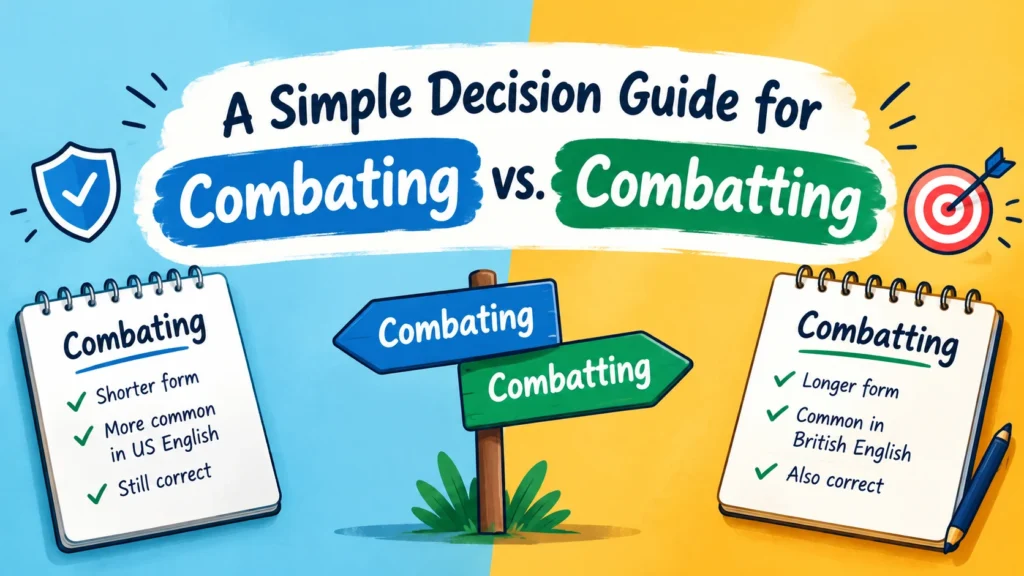
Use this quick decision tree:
What English are you using?
|
┌────────────┴────────────┐
| |
US English British English
| |
COMBATING Check the style guide
|
┌─────────┴─────────┐
| |
COMBATING COMBATTING
If you’re writing for a US audience, the decision is usually immediate.
Combating.
If you’re writing for a British audience, check the publication’s preferred convention.
A Practical Editing Checklist
Before publishing an article containing combating or combatting, ask:
- Which English variety does the article use?
- Does the publication have a style guide?
- Have I used the same spelling consistently?
- Am I treating a regional variant as an error without evidence?
- Have I confused spelling with meaning?
- Have I applied a consonant-doubling rule too rigidly?
- Does the spelling match the surrounding document?
This takes less than a minute.
It can also save you from repeatedly changing the same word during editing.
Read More : Unaccessible vs. Inaccessible: Which One Is Correct in English?
Combating vs. Combatting in Everyday Examples
Fighting Crime
Combating:
The city launched a new program for combating organized crime.
Combatting:
The city launched a new program for combatting organized crime.
Fighting Disease
Combating:
Researchers are combating antibiotic resistance with new approaches.
Combatting:
Researchers are combatting antibiotic resistance with new approaches.
Fighting Misinformation
Combating:
Media literacy can help with combating misinformation.
Combatting:
Media literacy can help with combatting misinformation.
Fighting Fraud
Combating:
Banks are investing in new technology for combating financial fraud.
Combatting:
Banks are investing in new technology for combatting financial fraud.
The meaning remains unchanged in every pair.
Combating vs. Combatting and Other British-American Differences
The spelling issue becomes easier to understand when you compare it with other familiar differences between American and British English.
| American English | British English |
| traveling | travelling |
| canceled | cancelled |
| labeled | labelled |
| modeled | modelled |
| dialing | dialling |
| combating | combating / combatting |
These examples show that consonant doubling can vary between English varieties.
However, don’t assume every word follows the exact same historical rule.
English spelling is a system of patterns with plenty of individual histories.
Why Consistency Matters More Than Tiny Spelling Differences
Imagine reading a 5,000-word report.
On page one, you see:
Combating financial crime is a priority.
On page twelve, you see:
The agency is combatting fraud.
On page twenty, the report switches back to:
New strategies for combating cybercrime are being developed.
The reader may not consciously notice every occurrence. Still, inconsistent spelling can make the document feel less polished.
Consistency signals control.
That’s particularly important in:
- Academic writing
- Legal documents
- Corporate reports
- Government publications
- Professional websites
- Books
- Long-form journalism
A spelling variant isn’t necessarily a problem.
Unexplained inconsistency is.
Frequently Asked Questions About Combating vs. Combatting
Is “combating” or “combatting” correct?
Both are established English spellings.
Collins lists both as present-participle forms of combat, while Cambridge directly defines combatting as the present participle of the verb.
For standard American English, combating is the practical default.
Is “combating” the standard spelling in American English?
Yes. Combating is the form most appropriate as a default for US-focused writing.
If you’re writing for an American publication, organization, or academic audience, combating is the straightforward choice.
Is “combatting” a British spelling?
Combatting is strongly associated with British usage, and British sources clearly use and recognize it.
However, British English also uses combating, so it would be inaccurate to claim that British writers must use combatting.
Is “combating” acceptable in British English?
Yes.
British English contains both forms. Collins lists combating alongside combatting, and Cambridge’s corpus contains examples of the doubled form while other British writing uses the single form.
Is “combatting” wrong in American English?
It is better to call it less typical in standard American writing rather than universally wrong.
If you’re writing for a US audience, combating is the safer choice.
Why does “combatting” have two t’s?
The doubled spelling reflects an established consonant-doubling pattern in English.
However, spelling rules alone don’t explain the entire history. Combatting became an established variant while combating also became standard usage.
Why isn’t the final “t” always doubled?
English doesn’t double every final consonant before -ing.
The rule depends on factors such as the word’s structure, stress, vowel pattern, and spelling history.
Words such as run and stop double the consonant:
- run → running
- stop → stopping
Others don’t:
- open → opening
- visit → visiting
Combat is unusual because both combating and combatting are established.
Does pronunciation determine the spelling?
No.
Pronunciation and stress can help explain consonant-doubling patterns, but they don’t determine the spelling by themselves.
Dictionary sources record multiple pronunciation possibilities for combat, further showing why a simplistic pronunciation-only rule doesn’t work.
Do “combating” and “combatting” have different meanings?
No.
Both mean fighting against, opposing, resisting, or working to reduce something.
The difference is spelling rather than meaning.
Which spelling should I use for an international audience?
If no specific style guide applies, combating is a practical default because it is broadly familiar.
However, combatting is also legitimate English.
The most important thing is to choose a consistent style.
Can I use both spellings in the same article?
Technically, you can.
Editorially, you usually shouldn’t unless you’re specifically discussing the spelling difference.
Choose one form for the article and maintain it consistently.
Are there other English words with British-American consonant differences?
Yes.
Examples include:
- traveling / travelling
- canceled / cancelled
- labeled / labelled
- modeled / modelled
- dialed / dialled
The exact pattern differs from word to word, so don’t assume one universal rule governs all of them.
Final Takeaway: Combating vs. Combatting
The combating vs. combatting debate looks more complicated than it really is.
Both forms come from the same verb, combat. Both describe the act of fighting, resisting, opposing, or trying to stop something. Both have established usage.
The main issue is spelling convention.
| Situation | Best practical choice |
| Standard US English | combating |
| British English | combating or combatting, depending on style |
| US academic writing | combating |
| US business writing | combating |
| British publication with a house style | Follow the house style |
| International writing without a style guide | Combating is a practical default |
| Article discussing both variants | Explain both and distinguish their usage |
The easiest rule to remember is:
Use “combating” for standard US English. Recognize “combatting” as an established variant, particularly in British usage.
Most importantly, don’t confuse spelling variation with grammatical error.
Once you know your audience and style guide, the choice becomes straightforward. Pick the appropriate form, use it consistently, and move on to the part of writing that actually matters: making your point clear.