
Have you ever written timeslot and wondered whether it should actually be time slot? You’re not alone. The two forms look almost identical, yet they don’t carry the same status in standard English. When you’re writing about an appointment, schedule, booking, or available period, choosing the right form can make your writing look much more polished.
The standard form is time slot, an open compound noun used for a specific period reserved for an activity, meeting, event, appointment, broadcast, or service. You might select a time slot for a doctor’s visit, reserve a time slot for a conference presentation, or choose a delivery time slot online.
Meanwhile, timeslot does appear in software, apps, websites, databases, and informal digital writing. Technical systems often remove spaces when creating field names, URLs, or identifiers. That doesn’t automatically make the closed form the preferred spelling in ordinary English.
Understanding the difference becomes easier when you know how compound nouns, hyphenation, formal writing, and technical terminology work. Once you learn the basic rule, choosing between timeslot vs. time slot becomes surprisingly simple.
Timeslot vs. Time Slot: The Quick Answer
The standard form is time slot.
It is an open compound noun made from time and slot. Major dictionaries treat time slot as two words. For example, Cambridge Dictionary defines time slot as a period when something is scheduled to happen.
Quick comparison
| Form | Standard status | Typical use |
| time slot | Standard | General, professional, academic, and formal writing |
| timeslot | Common in some contexts but not the usual standard form | Software, informal writing, technical naming, URLs, identifiers |
| time-slot | Generally unnecessary as the noun | Occasional compound-modifier contexts depending on style |
So if you’re writing a sentence such as:
Please choose a time slot for your appointment.
Time slot is the form to use.
Likewise:
The television network gave the show a prime time slot.
Again, the two-word form is standard.
The important point is that timeslot appears in real-world English, but frequency alone doesn’t automatically make a spelling the preferred form in edited prose.
What Does “Time Slot” Mean?
A time slot is a particular period set aside for an activity or event.
Think of a schedule as a row of empty boxes. Each box represents a period during which something can happen. One of those boxes is a time slot.
For example, a doctor’s office might divide its afternoon into several appointments:
- 1:00–1:30 p.m.
- 1:30–2:00 p.m.
- 2:00–2:30 p.m.
- 2:30–3:00 p.m.
Each available period can be described as a time slot.
The expression doesn’t necessarily refer to a specific length. A time slot might last 15 minutes, 30 minutes, two hours, or much longer depending on the situation.
Common meanings of “time slot”
You can use time slot in many scheduling contexts.
Appointments
I booked a 10:30 a.m. time slot with the dentist.
Meetings
We have an open time slot on Thursday afternoon.
Television
The network moved the program to a later time slot.
Radio
She hosts the station’s morning time slot.
Deliveries
Customers can select a two-hour delivery time slot.
Classes
Students must register for a laboratory time slot.
Events
Each speaker has a 20-minute time slot.
Work schedules
The manager assigned me the evening time slot.
Across all these examples, the basic idea remains the same: a period allocated for something to happen.
Time Slot Examples in Real Sentences
Seeing the expression in context makes its function easier to understand.
Here are several natural examples:
- Please select a time slot before completing your registration.
- The doctor has one available time slot this afternoon.
- Our team needs a time slot for the weekly meeting.
- The program received an earlier time slot this season.
- You can choose a delivery time slot during checkout.
- Each presenter has a 15-minute time slot.
- The interview was scheduled for the first available time slot.
- Several students requested the same exam time slot.
- The conference schedule includes a separate time slot for questions.
- I couldn’t find an open time slot on Friday.
Notice something important: time slot functions as a single concept even though it contains two separate words.
That’s perfectly normal in English.
Why “Timeslot” Looks Right but Isn’t Usually the Preferred Form
If time slot means one concept, why not write timeslot?
That’s a reasonable question.
English contains thousands of closed compound words. Consider:
- bedroom
- notebook
- website
- keyboard
- football
- timesheet
- timeline
Because English frequently combines words into compounds, timeslot looks as though it should follow the same pattern.
But English doesn’t have a universal rule saying that two words forming one idea must become one word.
That’s where things get messy.
Compare these examples
| Open compound | Closed compound |
| time slot | timesheet |
| post office | notebook |
| high school | bedroom |
| data point | database |
| meeting room | classroom |
The fact that timesheet exists doesn’t mean time slot must become timeslot.
Compound spelling develops through usage, convention, editorial practice, and historical change. Writers can’t simply combine two words whenever the meaning feels unified.
That’s why time slot remains the conventional choice.
Understanding Compound Nouns in Simple Terms
A compound noun combines two or more words to create a noun with a particular meaning.
For example:
coffee + shop = coffee shop
The two words work together as a unit.
Compound nouns generally appear in three broad forms:
Open compounds
The words remain separate.
Examples:
- time slot
- ice cream
- post office
- school bus
- coffee shop
Hyphenated compounds
The words are connected with a hyphen.
Examples include:
- mother-in-law
- check-in
- runner-up
- well-being
Closed compounds
The words combine into one word.
Examples:
- bedroom
- notebook
- website
- sunlight
- classroom
The tricky part is that English doesn’t always provide an obvious rule for deciding which category a particular compound belongs to.
That’s why dictionaries and established editorial conventions matter.
Why “Time Slot” Stays Open
The expression time slot has an established open-compound spelling.
The first word, time, modifies the second word, slot.
A slot can mean an available position or opening. When you add time, you specify that the opening exists within a schedule.
In simple terms:
time + slot → a period available for a scheduled activity
The fact that the phrase has a unified meaning doesn’t require the words to merge.
This distinction matters because English readers recognize many familiar expressions as units even though the individual words remain separate.
Consider meeting room.
Nobody needs to interpret it as two unrelated concepts. Yet we don’t normally write meetingroom.
The same principle applies to time slot.
A useful rule
Don’t ask:
“Do these two words create one idea?”
Instead, ask:
“What spelling does standard English use for this compound?”
That approach prevents many compound-word mistakes.
When Is “Time-Slot” Correct?
For the ordinary noun, time slot is normally preferable to time-slot.
For example:
Please select a time slot.
Not:
Please select a time-slot.
The hyphen isn’t needed simply because time and slot function together.
Why do hyphens cause confusion?
Hyphens often connect words when those words work together as a compound modifier before another noun.
For example:
a 30-minute meeting
Here, 30-minute functions together as a modifier.
Compare that with:
The meeting lasted 30 minutes.
The hyphen disappears because the expression is no longer functioning as the same compound modifier.
This broader grammatical pattern explains why writers sometimes feel tempted to insert a hyphen into time slot. However, the ordinary noun remains time slot.
Correct usage
I reserved a time slot for the interview.
The system displays all available time slots.
We need another time slot for the workshop.
Generally unnecessary
I reserved a time-slot for the interview.
The system displays available time-slots.
Unless a particular publication, technical system, or specialized style guide requires otherwise, the open form is the safer choice.
Time Slot vs. Time-Slot: Don’t Confuse Nouns With Modifiers
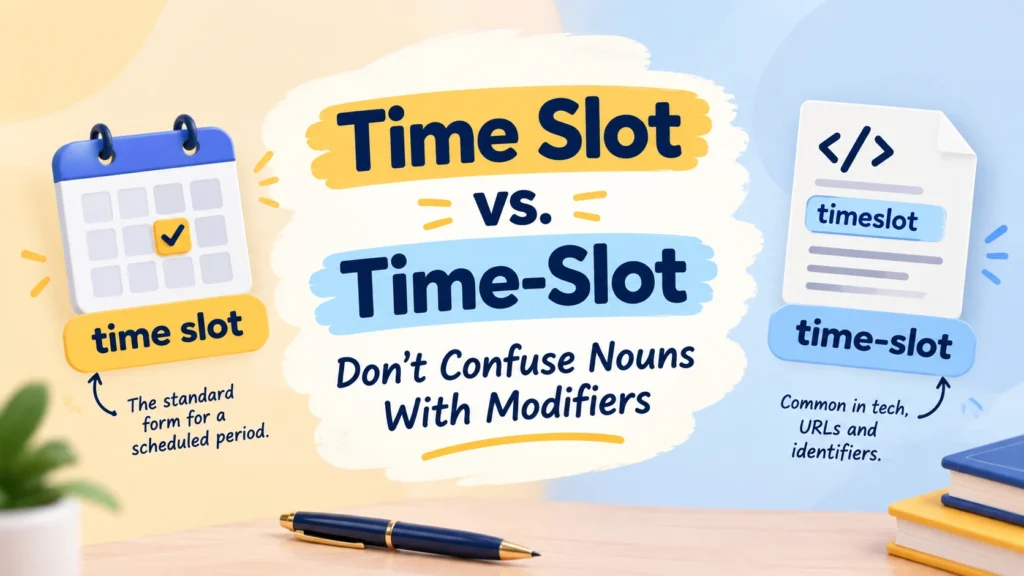
One reason compound spelling becomes difficult is that the same words can behave differently depending on their grammatical role.
Compare:
We selected a time slot.
Here, time slot is a noun.
Now consider a more complex expression:
The time-slot allocation changed after the meeting.
A writer might encounter situations like this where multiple words combine into a larger modifier. Some style guides may recommend hyphenation to improve readability.
However, this doesn’t mean the noun itself should routinely become time-slot.
The key question is:
What job are the words performing in the sentence?
If you’re simply naming the scheduled period, use:
time slot
If you’re creating a complex modifier, check the relevant style guide and consider whether a hyphen improves clarity.
Timeslot vs. Time Slot in Formal Writing
For formal writing, time slot is the safest and most conventional choice.
That applies to:
- Business documents
- Academic writing
- Professional emails
- Reports
- News articles
- Public notices
- Event programs
- Official schedules
- Applications
- Customer instructions
For example:
Please indicate your preferred time slot on the registration form.
This looks natural in professional communication.
By contrast:
Please indicate your preferred timeslot on the registration form.
The meaning is still obvious. However, the closed form can look less conventional in carefully edited prose.
Why consistency matters
Imagine a university registration system using all three forms:
Select a time slot.
Available timeslots are listed below.
Your time-slot confirmation will arrive by email.
The reader can understand all three sentences. Still, the inconsistent spelling makes the document look poorly edited.
A professional document should normally choose one established style.
For ordinary English prose, that means time slot.
Why Informal Writing Uses “Timeslot”
You may encounter timeslot surprisingly often.
That’s especially true online.
Search results, applications, scheduling platforms, software documentation, and internal business systems may use the closed spelling. Several factors can encourage this.
Digital naming conventions
Software systems often prefer compact identifiers.
For example, a programmer might create fields such as:
timeslot
start_time
end_time
appointment_id
A database field can’t always contain spaces in the same way ordinary prose can. Developers therefore use conventions such as:
- timeslot
- time_slot
- timeSlot
- time-slot
These are technical identifiers, not necessarily examples of standard English spelling.
URLs
Web addresses also discourage spaces.
A page might use a URL such as:
example.com/timeslot
That doesn’t establish timeslot as the preferred spelling in ordinary writing.
The same thing happens with countless other words and phrases. A website’s URL structure follows technical requirements and naming choices rather than every rule of conventional prose.
Product and brand names
A company can also intentionally choose Timeslot as a product name, feature name, or service label.
Proper names follow their owners’ chosen spelling.
If a company officially calls a feature Timeslot, reproducing that name as Timeslot may be correct even though ordinary prose uses time slot.
Timeslot vs. Time Slot in Different Contexts
Context makes a significant difference.
| Context | Recommended form | Explanation |
| Everyday writing | time slot | Standard open compound |
| Formal writing | time slot | Conventional edited form |
| Academic writing | time slot | Standard noun form |
| Business communication | time slot | Clear and professional |
| News writing | time slot | Established expression |
| Television scheduling | time slot | Standard usage |
| Appointment booking | time slot | Standard noun |
| Database field | timeslot or time_slot | Technical naming convention |
| URL | timeslot may appear | Spaces aren’t normally used |
| Product name | Depends on official name | Proper names follow their own conventions |
| Informal digital writing | timeslot may appear | Common variation |
| Ordinary noun with hyphen | time-slot generally unnecessary | Open form is preferred |
This table highlights an important distinction:
Technical usage and ordinary English aren’t always governed by the same conventions.
How English Compound Words Evolve
English compounds have a habit of changing shape over time.
A phrase may begin as two words. As speakers use it repeatedly, the spelling can change.
A simplified progression sometimes looks like this:
open compound → hyphenated compound → closed compound
But this isn’t a fixed law.
Some compounds remain open for centuries. Others close. Some forms vary by region, dictionary, publication, or context.
Examples of compound development
Words such as website and database are now firmly established as closed compounds.
Historically, however, English has often used different forms for emerging compounds. Older texts can show variation such as:
- web site / website
- data base / database
That historical variation helps explain why modern writers shouldn’t assume every compound must eventually close.
What determines the standard form?
Several forces influence compound spelling:
- Frequency of use
- Long-term usage patterns
- Dictionary treatment
- Editorial conventions
- Regional English
- Industry terminology
- Branding
- Technical requirements
- Changes in meaning
This is why time slot shouldn’t be changed to timeslot merely because the latter appears frequently online.
A Closer Look at “Time Slot” in American English
In US English, time slot is widely established as an open compound.
The phrase appears naturally in contexts involving television, radio, appointments, scheduling, and organized activities.
For example:
The network changed the show’s time slot.
I can offer you a morning time slot.
The conference assigned each speaker a time slot.
American readers generally have no difficulty recognizing the two-word form.
The same basic form also appears in major English-language dictionaries. Merriam-Webster and Cambridge Dictionary provide dictionary resources that can help verify compound-word usage.
When writing for a US audience, time slot is therefore the practical default.
Time Slot vs. Appointment, Time Frame, and Schedule
Another common problem is using time slot when a related expression would be more accurate.
These terms overlap, but they aren’t identical.
| Term | Meaning | Example |
| time slot | A specific period allocated for an activity | Choose a 2:00 p.m. time slot. |
| appointment | An arranged meeting or service | I have a doctor’s appointment. |
| time frame | A broader period during which something should happen | The project has a two-week time frame. |
| schedule | A plan showing when activities happen | Check the conference schedule. |
| duration | The length of time something lasts | The meeting has a 45-minute duration. |
| deadline | The latest time by which something must happen | Friday is the submission deadline. |
Example
Suppose a delivery company tells you:
“Choose a two-hour time slot.”
That refers to the period available for delivery.
The entire delivery process might have a:
“three-day time frame.”
And the date and time recorded on your order form become part of your:
“delivery schedule.”
These expressions describe related ideas without being interchangeable.
Common Mistakes With Timeslot and Time Slot
Even simple spelling questions can produce several recurring errors.
Mistake: Writing “timeslot” in formal prose
Please select your preferred timeslot.
Preferred:
Please select your preferred time slot.
The closed form may appear in informal or technical contexts. The open form remains the standard choice for ordinary edited prose.
Mistake: Adding a needless hyphen
Select a time-slot.
Preferred:
Select a time slot.
A hyphen isn’t necessary merely because two words form a compound noun.
Mistake: Assuming all compounds close
English doesn’t work that way.
Time slot can function as one meaningful unit while remaining two words.
Mistake: Treating software terminology as general spelling
A database field called timeslot doesn’t prove that the English noun should be written timeslot.
Technical identifiers follow their own rules.
Mistake: Mixing forms
Avoid switching between:
time slot
timeslot
time-slot
within the same article or document unless there’s a clear contextual reason.
Consistency makes writing easier to read and edit.
Why Choosing the Right Form Matters
At first glance, timeslot vs. time slot might seem like a tiny spelling issue.
It is.
But small details influence how polished writing feels.
Readers rarely stop to analyze every compound noun. Instead, they process familiar patterns automatically. When a sentence uses a less familiar form, the reader may notice it even if the meaning remains obvious.
This becomes particularly important in:
- Professional communication
- Academic writing
- Website content
- Marketing copy
- Technical documentation
- Public information
- Editorial publishing
Choosing the conventional form reduces friction.
It’s similar to using a familiar road sign. You don’t want the reader wondering whether the unusual spelling means something different.
Case Study: Scheduling a Medical Appointment

Consider an online medical booking page.
Less conventional prose
Choose your preferred timeslot for your appointment.
Standard prose
Choose your preferred time slot for your appointment.
Both sentences communicate the same basic idea.
However, the second follows the conventional open-compound spelling.
Now imagine the website’s database uses:
patient_id
appointment_date
timeslot
doctor_id
There’s nothing wrong with that technical identifier.
The database doesn’t need to mirror the exact spelling used in customer-facing prose.
This is an important distinction between language and system design.
Case Study: Television Scheduling
The expression time slot has a particularly well-established meaning in broadcasting.
A television network divides its programming schedule into periods.
For example:
| Period | Possible programming |
| Morning time slot | News or breakfast programming |
| Afternoon time slot | Talk shows or daytime programming |
| Early evening time slot | News or family programming |
| Prime-time slot | High-audience programming |
| Late-night time slot | Late-night programming |
A program can be moved from one time slot to another without changing the program itself.
For example:
The network moved the series to a later time slot.
Here, time slot clearly refers to a scheduled position within a broadcasting timetable.
Case Study: Conference Scheduling
The same expression works in professional events.
Suppose a conference schedule contains:
| Time | Session |
| 9:00–9:30 | Opening remarks |
| 9:30–10:00 | Keynote |
| 10:00–10:30 | Panel discussion |
| 10:30–11:00 | Break |
Each period can be described as a time slot.
A conference organizer might write:
Each speaker receives a 20-minute time slot.
The phrase works naturally because the schedule divides time into designated periods.
How to Choose the Correct Form Every Time
When you’re unsure about timeslot vs. time slot, use this simple process.
Are you writing ordinary English?
Use:
time slot
Are you writing formal or professional content?
Use:
time slot
Are you writing an academic paper?
Use:
time slot
unless your required style guide explicitly says otherwise.
Are you naming a database field?
Technical conventions may allow:
timeslot
or:
time_slot
That’s a naming decision rather than an ordinary spelling decision.
Are you creating a URL?
A closed form may appear because URLs don’t normally contain ordinary spaces.
That doesn’t change the standard prose form.
Is it a registered product or feature name?
Follow the official spelling.
For example, if a software company deliberately brands a feature Timeslot, reproducing that name may be appropriate.
Are you tempted to add a hyphen?
Don’t add one automatically.
For the ordinary noun, use:
time slot
Timeslot vs. Time Slot: Quick Comparison
Here’s the entire issue at a glance:
| Form | Use it? | Example |
| time slot | Yes, normally | Choose a time slot. |
| timeslot | Sometimes, depending on context | The app uses timeslot as a field name. |
| time-slot | Usually not as the ordinary noun | Avoid unnecessary hyphenation. |
The distinction is simple once you separate standard prose from technical naming.
Is “Timeslot” Ever Correct?
Yes, timeslot can occur legitimately in certain contexts.
It may appear as:
- A software identifier
- A database field
- A URL
- A product or feature name
- Informal digital writing
- Industry-specific terminology
However, that doesn’t mean it is the preferred spelling for the ordinary noun in carefully edited English.
If you’re writing a blog article, business report, academic assignment, email, or formal document, time slot is the safer standard choice.
Should I Hyphenate “Time Slot”?
Normally, no.
Write:
time slot
rather than:
time-slot
The noun is conventionally written as an open compound.
Hyphens have specific grammatical jobs. They aren’t simply punctuation marks that connect words whenever two words work together.
If you’re dealing with an unusual compound modifier, consult the relevant style guide. Context can affect hyphenation.
Read More : Soo vs. So: Meaning, Correct Usage, Informal Spelling, and Common Mistakes
Can “Time Slot” and “Timeslot” Be Used Interchangeably?
They can often be understood to mean the same thing. However, understandable doesn’t necessarily mean equally standard.
In ordinary edited writing, choose time slot.
In a software environment, timeslot might be the exact name of a field or feature. In that situation, changing it could actually make the technical reference inaccurate.
So the best choice depends on what you’re writing.
Why Do Apps Prefer “Timeslot”?
Apps and software systems often use compact naming conventions.
A programmer might choose:
timeslot
because the identifier is easier to type or because the project’s naming convention uses closed compound names.
Another developer might use:
time_slot
Still another might use:
timeSlot
These differences have more to do with programming conventions than English orthography.
The same principle applies to URLs.
A website might have:
/book-timeslot
while the visible page text says:
Select your time slot.
There’s no contradiction.
Will “Timeslot” Become Standard English?
English compound words can change over time. Some open compounds eventually become closed compounds.
However, predicting exactly when a particular spelling will become standard is unreliable.
For now, time slot remains the established form for ordinary English usage.
A future dictionary edition could document additional forms if usage changes substantially. Until such a change becomes established, writers shouldn’t assume that frequent online appearances automatically make timeslot the preferred general spelling.
The practical rule remains straightforward:
Use “time slot” in standard English unless a specific technical or naming convention requires something else.
Is “Time Slot” One Word or Two?
It’s normally two words.
Correct:
time slot
Incorrect or nonstandard for ordinary prose:
timeslot
The two words form an open compound noun.
That’s why the expression can represent one idea while still appearing as two separate words.
What Is the Plural of “Time Slot”?
The plural is:
time slots
Only slot takes the plural ending.
Examples:
The system offers five available time slots.
All morning time slots are currently full.
We opened additional time slots for registration.
You don’t normally write:
times slots
or:
time slotses
The structure is simply:
time slot → time slots
Should “Time Slot” Be Capitalized?
In ordinary sentences, use lowercase:
Please select a time slot.
In a title, capitalization depends on the title style you’re using.
For example, in title case:
Timeslot vs. Time Slot: Which Form Is Correct?
In sentence case:
Timeslot vs. time slot: Which form is correct?
The expression itself isn’t a proper noun. It doesn’t require capitalization merely because it appears in a heading.
If Timeslot is part of an official product or feature name, however, follow that organization’s official capitalization.
A Simple Visual Guide to Time Slot Usage
TIME SLOT
│
┌──────────┴──────────┐
│ │
Standard noun Technical context
│ │
“time slot” “timeslot” may appear
│ │
Formal writing Apps / databases
Academic writing URLs / identifiers
Business writing Product naming
General English
The distinction becomes much easier when you think about context rather than appearance.
Frequently Asked Questions About Timeslot vs. Time Slot
Is “timeslot” ever correct?
It can appear in technical, informal, branded, or digital contexts. For ordinary standard English prose, however, time slot is the conventional form.
Should I write “time slot” or “time-slot”?
Use time slot for the ordinary noun.
Please choose a time slot.
The hyphen is generally unnecessary.
Can “time slot” and “timeslot” be used interchangeably?
They can often communicate the same meaning, but they don’t have exactly the same status in every context. Time slot is the standard choice in ordinary edited writing.
Why do apps and websites use “timeslot”?
Software developers may use closed forms for database fields, code identifiers, URLs, labels, or product features. Technical naming conventions don’t always follow ordinary prose conventions.
Is “timeslot” becoming standard English?
English compounds can evolve. However, time slot remains the established standard form for ordinary writing. Increased online use alone doesn’t establish a new standard.
Is “time slot” one word or two?
It’s normally two words.
time slot
It is an open compound noun.
What is the plural of “time slot”?
The plural is time slots.
The website offers several time slots.
Should “time slot” be hyphenated?
Usually not. Write time slot when you’re using it as the ordinary noun.
Can I use “timeslot” in a blog post?
You can encounter and understand the form in online writing. However, if you’re aiming for conventional edited US English, time slot is the better choice.
What does “time slot” mean?
A time slot is a particular period reserved or allocated for an event, appointment, activity, broadcast, or another scheduled purpose.
Is “time slot” formal?
Yes. Time slot works comfortably in professional, academic, business, journalistic, and everyday writing.
Is “time slot” the same as “time frame”?
No.
A time slot usually identifies a particular scheduled period. A time frame describes a broader period during which something is expected or intended to happen.
For example:
The appointment has a 30-minute time slot.
But:
The project has a six-month time frame.
Final Takeaway: Use “Time Slot” in Standard Writing
The timeslot vs. time slot question looks complicated because English compounds don’t follow a single spelling rule.
Yet the practical answer is simple.
Time slot is the standard open compound used for a specific period allocated to an activity. It works naturally in conversations about appointments, meetings, television, radio, deliveries, classes, conferences, and other schedules.
Timeslot appears in real-world usage, particularly in software, URLs, technical identifiers, informal digital writing, and some product names. Its presence in those environments doesn’t mean you should automatically use it in formal prose.
Time-slot is generally unnecessary when you’re simply using the expression as a noun.
The easiest rule to remember is this:
When you’re writing ordinary English, choose “time slot.”
If you’re dealing with a technical field name, URL, product name, or another specialized convention, follow that system’s official spelling instead.
In other words, don’t let the compact look of timeslot fool you. Sometimes two words belong together perfectly well while still keeping a little breathing room between them.