

Gases or gasses—which spelling should you use? If you’ve ever paused while writing about air, oxygen, carbon dioxide, or other chemical substances, you’re not alone. These two spellings look almost identical, but their usage can depend on whether you’re discussing the plural of gas or using a related verb form.
In standard American English, gases is the usual and preferred plural of gas. For example, “Several gases are present in the atmosphere.” The word commonly appears in science writing, chemistry, physics, environmental studies, and everyday discussions about air pollution and greenhouse gases.
The spelling gasses also exists, but it is much less common as a plural noun. It can also function as a verb, particularly in the sense of exposing someone or something to gas. For example, “The chemical gasses the insects.”
Knowing the difference between gases and gasses can help you avoid a common spelling mistake and make your writing more precise. In this guide, you’ll learn the correct spelling, meaning, pronunciation, plural form, and practical rules for choosing between these two words.
Gases vs. Gasses: The Core Difference
The simplest way to remember the difference is this:
Gases is usually the plural noun of gas. Gasses is primarily a verb form.
Here is the distinction at a glance:
| Word | Grammatical role | Meaning | Example |
| gases | Plural noun | More than one gas or multiple types of gas | Different gases have different properties. |
| gasses | Third-person singular verb | Exposes, treats, fills, or affects with gas, depending on context | The equipment gasses the chamber. |
| gas | Singular noun | A substance in the gaseous state | Hydrogen is a gas. |
| gas | Verb | The base form of the verb | Workers gas the chamber. |
The important point is that gases and gasses aren’t interchangeable plural spellings.
If you’re writing about oxygen, carbon dioxide, helium, nitrogen, or other substances, you’ll normally need gases.
If you’re describing an action performed by a singular subject, gasses may be appropriate.
A Fast Grammar Test
When you’re unsure, ask yourself:
Am I naming more than one gas?
If yes, use gases.
Scientists studied several gases.
Am I describing an action performed by he, she, it, or another singular subject?
If yes, gasses may be the correct verb form.
The device gasses the container.
This quick test solves most cases.
Gases: The Plural Noun of Gas
The word gas has several meanings in English, but one of its most important meanings refers to a state of matter or a substance that exists in that state.
When you need the plural, the standard spelling is gases.
For example:
- One gas → gases? No. That’s singular.
- Two gases → gases
- Several gases → gases
- Different gases → gases
- Atmospheric gases → gases
A sentence such as:
The laboratory identified three gases.
uses gases as a plural noun because the sentence refers to three different substances or gaseous samples.
What Does “Gases” Mean?
Gases is the plural of gas when gas functions as a noun.
The word can refer to:
- Different gaseous substances
- Multiple samples of gas
- Several gases present in a mixture
- Gases found in the atmosphere
- Industrial gases
- Fuel gases
- Gases produced by chemical reactions
The exact meaning comes from context.
For example:
The atmosphere contains several important gases.
Here, gases refers to different substances present in Earth’s atmosphere.
Likewise:
The technician tested the gases inside the cylinder.
Here, gases refers to gaseous substances or samples being tested.
Gases in Science
The plural gases appears constantly in scientific writing because science often deals with multiple gaseous substances.
Chemistry provides an obvious example. Scientists study substances such as:
- Oxygen
- Nitrogen
- Hydrogen
- Carbon dioxide
- Helium
- Neon
- Argon
- Methane
- Ozone
- Water vapor
These substances can exist in different contexts and conditions. When the discussion involves more than one of them, gases is the normal plural noun.
For example:
Oxygen and nitrogen are gases at ordinary room conditions.
Another example:
The experiment measured the pressure of several gases.
In both sentences, gases names multiple substances. It isn’t describing an action.
Gases and the States of Matter
In basic science, matter is commonly introduced through three familiar states:
| State | General characteristic | Example |
| Solid | Has a definite shape and volume | Ice |
| Liquid | Has a definite volume but takes the shape of its container | Water |
| Gas | Expands to fill its container | Water vapor |
A gas consists of particles that generally move much more freely than particles in a solid. The particles are also much farther apart under comparable conditions.
That physical behavior explains why gases can expand and compress much more readily than solids and liquids.
When you’re talking about several substances in this state, the plural is gases.
Different gases behave differently under changing temperature and pressure.
The spelling has nothing to do with how scientific the sentence sounds. It simply follows the grammatical role of the word.
Gases in Everyday Language
You don’t need to work in a laboratory to encounter gases.
The word appears in everyday discussions about:
- Cooking
- Heating
- Fuel
- Vehicle emissions
- Indoor air quality
- Air pollution
- Fire safety
- Refrigeration
- Weather
- Environmental science
For example:
Certain gases can accumulate in poorly ventilated areas.
Or:
Household appliances may use different fuel gases.
Or:
Greenhouse gases affect Earth’s climate system.
In each example, gases is a plural noun.
Greenhouse Gases as a Familiar Example
The phrase greenhouse gases is especially common in environmental and climate discussions.
Carbon dioxide, methane, nitrous oxide, and certain other gases contribute to the greenhouse effect because they absorb and emit infrared radiation.
The grammatical point is simple: the phrase refers to multiple types of gas, so gases is the correct plural form.
Carbon dioxide and methane are greenhouse gases.
Writing greenhouse gasses in that sentence would normally be incorrect because gasses isn’t being used as a verb.
Gasses: The Verb Form
Now we reach the form that causes most of the confusion.
Gasses can be a legitimate English word. However, its grammatical function differs from gases.
In standard usage, gasses can function as the third-person singular present-tense form of the verb gas.
The pattern looks like this:
| Subject | Verb |
| I | gas |
| You | gas |
| He | gasses |
| She | gasses |
| It | gasses |
| We | gas |
| They | gas |
Notice what happens.
I gas the chamber.
They gas the chamber.
But:
The machine gasses the chamber.
The spelling changes because English verbs generally take a third-person singular -s or related ending in the present tense.
What Does “Gasses” Mean as a Verb?
The verb gas can have several meanings depending on context.
One relevant meaning involves treating, filling, or exposing something to gas. The third-person singular form can therefore be gasses.
For example:
The equipment gasses the container before the next production stage.
Here, gasses describes what the equipment does.
It doesn’t mean “multiple gases.”
That distinction matters.
Is “Gasses” a Correct Word?
Yes. Gasses is a legitimate English word when it functions as a verb in an appropriate context.
The mistake is assuming that because gasses is a real word, it must also be the ordinary plural of gas.
It isn’t.
Compare:
The room contains several gases.
with:
The machine gasses the room.
The first sentence identifies substances. The second describes an action.
When Should You Use “Gasses”?
Use gasses when the sentence needs the third-person singular form of the verb gas.
Look for a singular subject such as:
- The machine
- The device
- The system
- The process
- The treatment
- He
- She
- It
For example:
The machine gasses the chamber automatically.
The subject is machine, which is singular. The verb therefore takes the third-person singular form gasses.
Change the subject to plural and the verb changes:
The machines gas the chambers automatically.
Not:
The machines gasses the chambers automatically.
This subject-verb relationship provides a useful way to identify the correct spelling.
Gases vs. Gasses in Real Sentences
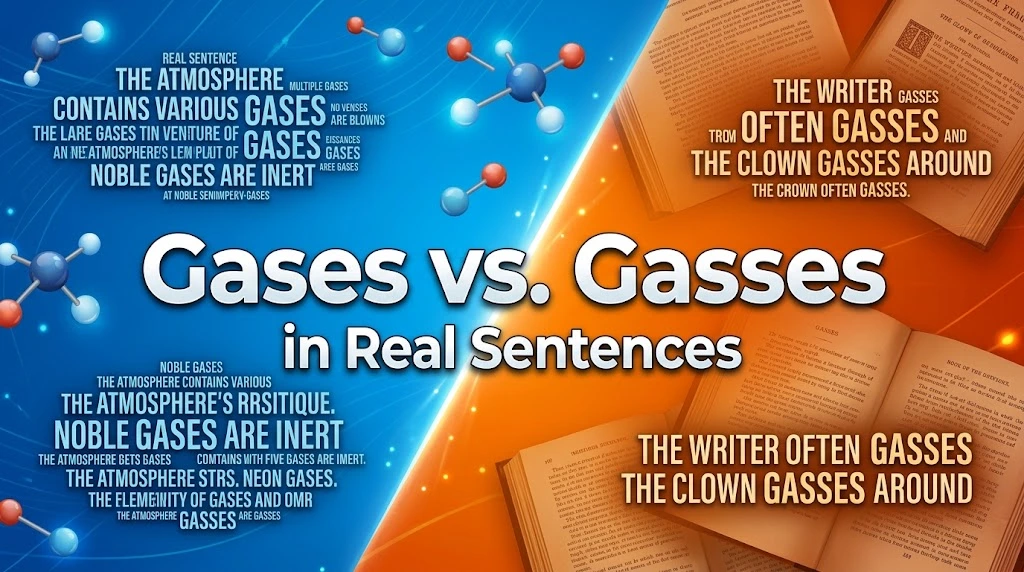
Seeing the two forms side by side makes the difference much clearer.
Scientific Examples
Scientists analyzed several gases.
Why? Gases is a plural noun.
The researchers compared the properties of different gases.
Why? The sentence refers to multiple gaseous substances.
The reaction produced several gases.
Why? Multiple gaseous products are being identified.
Now compare those with the verb:
The apparatus gasses the sample chamber.
Why? Gasses describes an action performed by the singular apparatus.
The treatment system gasses the material under controlled conditions.
Again, gasses is a verb.
Everyday Examples
Cars can release different gases through their exhaust systems.
Here, gases is a noun.
Several gases can build up in enclosed spaces.
Again, gases is plural.
A verb example might look like this:
The specialized system gasses the chamber during processing.
The context determines the word.
Correct Verb Usage
Consider this mini case study:
Case: A factory operates one machine that treats an enclosed chamber with gas.
Correct:
The machine gasses the chamber.
Now imagine the factory operates several machines.
Correct:
The machines gas the chambers.
The number of machines changes the verb form.
It doesn’t turn gasses into the plural of gas.
Why Does “Gasses” Have Two S’s?
The spelling makes more sense when you look at the verb formation.
The base verb is:
gas
When English adds the third-person singular ending to certain words ending in s, spelling conventions can require an additional s.
Thus:
gas → gasses
This prevents the resulting spelling from becoming awkward or ambiguous.
The noun plural follows a different pattern:
gas → gases
That’s why the two forms look almost identical while serving different grammatical purposes.
Why “Gases” Has Only One S After the A
Gases is formed as the plural noun.
The spelling is:
gas + es → gases
The added e helps preserve the pronunciation and follows the conventional spelling pattern for nouns ending in s.
The result is visually close to gasses, but the grammatical roles remain different.
| Base word | Function | Form |
| gas | Singular noun | gas |
| gas | Plural noun | gases |
| gas | Base verb | gas |
| gas | Third-person singular verb | gasses |
This is one of those moments when English spelling looks more complicated than the underlying rule.
The History and Origin of “Gas”
The word gas has an interesting history.
The modern scientific term is generally traced to the Flemish chemist Jan Baptist van Helmont, who used the term gas in the early seventeenth century. He described a substance that did not behave like ordinary solid or liquid matter and associated the word with the Greek concept of chaos.
Over time, gas became established in scientific English and eventually entered ordinary everyday language.
Today, the noun has several meanings.
It can refer to:
- A state of matter
- A gaseous substance
- Fuel used for heating or cooking
- Gasoline in some varieties of English, especially US English
- Intestinal gas
- A vapor or gaseous mixture in certain contexts
Context determines which meaning applies.
How the Plural Developed
As English speakers needed to refer to multiple gases, gases became the standard plural noun form.
That spelling follows a familiar English pattern in which nouns ending in s often form plurals with -es.
For example:
- gas → gases
- class → classes
- bus → buses
- glass → glasses
The exact pronunciation can vary between words and dialects. The spelling pattern, however, is well established.
Gases or Gasses: Why the Difference Matters
A single letter can change the grammatical function of a word.
Compare:
The laboratory detected several gases.
and:
The system gasses the chamber.
The first word answers the question what?
The second answers the question what does the system do?
That’s the heart of the distinction.
A Simple Mental Model
Think of gases as a collection of things.
Think of gasses as an action.
You might picture it like this:
More than one gas
↓
gases
A singular subject performs the action of gassing
↓
gasses
This isn’t a substitute for understanding grammar, but it’s a useful proofreading shortcut.
Common Mistakes With Gases and Gasses
Mistake: Using “Gasses” as the Plural of Gas
Incorrect:
The atmosphere contains several different gasses.
Standard correction:
The atmosphere contains several different gases.
Why? The word identifies multiple types of gas. It isn’t a verb.
Mistake: Assuming “Gases” Is Always Correct
The opposite mistake also occurs.
Consider:
The machine gases the chamber.
In this sentence, gases would not normally serve as the intended third-person singular form of gas. The appropriate spelling is gasses.
Correct:
The machine gasses the chamber.
Mistake: Choosing by Appearance Alone
It’s tempting to think:
“Gasses has two s’s, so it must mean many gases.”
English doesn’t work that way here.
The spelling reflects grammar, not quantity.
A noun can be plural without using the visually longer form. Likewise, a verb can contain two s’s without referring to multiple things.
Mistake: Thinking Scientific Context Automatically Means “Gases”
Scientific writing strongly favors gases when the word functions as a plural noun.
However, scientific context doesn’t automatically determine the spelling.
For example:
The device gasses the chamber before testing.
That’s still scientific writing. The word is simply functioning as a verb.
Gases vs. Gasses: A Quick Reference Table
| If you mean… | Use | Example |
| More than one gas | gases | Several gases were identified. |
| Different types of gas | gases | Noble gases have distinctive properties. |
| Multiple gas samples | gases | The gases were analyzed separately. |
| A singular subject performing an action involving gas | gasses | The system gasses the chamber. |
| Multiple subjects performing that action | gas | The systems gas the chambers. |
| One gas as a noun | gas | Oxygen is a gas. |
This table captures the central rule without requiring you to memorize complicated terminology.
Gases and Gasses: Side-by-Side Examples
Here are several pairs that show how the meaning changes.
| Gases | Gasses |
| Several gases escaped from the container. | The system gasses the container. |
| Scientists studied the gases. | The equipment gasses the chamber. |
| Different gases react differently. | The device gasses the sample. |
| The mixture contains two gases. | The process gasses the material. |
The pattern is easy to spot once you focus on the role of the word.
Gases names substances.
Gasses describes an action.
Usage in Academic and Scientific Writing
In academic writing, precision matters because readers often interpret individual terms literally.
Suppose a chemistry paper states:
The experiment produced three different gases.
The reader understands that three gaseous substances or products were produced.
Now consider:
The apparatus gasses the reaction chamber.
The reader understands that the apparatus performs an action involving gas.
These sentences may appear in the same technical document. The correct spelling depends on grammar rather than subject matter.
Chemistry Example
Imagine a reaction that produces hydrogen and another gaseous product.
You could write:
The reaction produces multiple gases under the experimental conditions.
Here, gases is the plural noun.
If a device then introduces gas into a chamber:
The device gasses the chamber before the reaction begins.
Now gasses is the verb.
The distinction is subtle but precise.
Usage in Technical and Industrial Writing

Technical documents often contain both forms because industrial processes can involve gases as substances and gas-related actions.
For example:
The facility stores several industrial gases.
Here, gases refers to substances.
A separate instruction might say:
The automated system gasses the chamber before processing.
Here, gasses describes what the system does.
This distinction becomes especially important in operating procedures, equipment manuals, laboratory instructions, and safety documentation.
A spelling error can sometimes create genuine ambiguity.
Read More : Agreed vs. Agree: What’s the Real Difference?
A Practical Editing Checklist
When proofreading gases or gasses, use this checklist:
- Is the word naming multiple gases? Use gases.
- Is the word functioning as a verb? Check whether gasses fits.
- Is the subject singular? A third-person singular verb may require gasses.
- Is the subject plural? The base verb is generally gas.
- Can you replace the word with “substances”? If yes, gases may be correct.
- Can you replace it with an action such as “treats with gas”? If yes, gasses may fit.
The substitution trick works surprisingly well.
For example:
The machine gasses the chamber.
Try:
The machine treats the chamber with gas.
The meaning is action-based, so the verb form makes sense.
Now:
The machine contains several gases.
Try:
The machine contains several substances.
That confirms the noun function.
Gases or Gasses: The Easiest Rule to Remember
If you’re still unsure, remember this:
Gases = more than one gas.
Gasses = a verb describing an action performed by a singular subject.
For example:
Oxygen and nitrogen are gases.
But:
The equipment gasses the chamber.
One is a thing. The other is an action.
A One-Second Memory Trick
Think:
Gases → things
Gasses → action
Then check the sentence.
If you’re naming substances, choose gases.
If you’re describing what something does, investigate whether gasses is the appropriate verb form.
Frequently Asked Questions About Gases vs. Gasses
Is It “Gases” or “Gasses” in Science?
Gases is normally correct when you’re referring to more than one gas or multiple types of gas.
For example:
Scientists analyzed several gases.
However, scientific writing can also contain gasses when the word functions as a verb.
The apparatus gasses the chamber.
So the subject matter doesn’t decide the spelling. Grammar does.
Is “Gasses” a Correct Word?
Yes. Gasses is a legitimate word when used as the appropriate verb form.
For example:
The machine gasses the chamber.
It isn’t normally the standard plural noun of gas in US English.
What Does “Gasses” Mean as a Verb?
Gasses is the third-person singular present form of the verb gas in relevant senses.
Depending on context, the verb can describe treating, filling, or exposing something to gas.
For example:
The system gasses the chamber before the process begins.
Why Does “Gas” Become “Gasses”?
The verb gas takes a third-person singular form ending in -es, producing gasses.
The noun follows a different plural spelling pattern:
gas → gases
The two spellings therefore reflect different grammatical functions.
Is “Gasses” the Plural of “Gas”?
In standard US English, gases is the normal plural noun.
For example:
The atmosphere contains many gases.
Gasses is generally used as a verb rather than as the ordinary plural noun.
What Is the Plural of “Gas”?
The standard plural is gases.
Examples include:
- one gas
- two gases
- several gases
- different gases
- atmospheric gases
- industrial gases
Can “Gases” Be a Verb?
In ordinary modern usage, gases is primarily recognized as the plural noun of gas. When you need the third-person singular verb form of gas, gasses is the standard spelling in the relevant sense.
Therefore:
The atmosphere contains several gases.
But:
The machine gasses the chamber.
How Can I Remember Gases vs. Gasses?
Use the simplest distinction:
Gases = plural noun.
Gasses = verb.
Then check the sentence’s subject and meaning.
If you’re talking about oxygen, nitrogen, carbon dioxide, helium, or several other gaseous substances, gases is almost certainly what you need.
If you’re describing what a singular machine, system, or other subject does, check whether gasses is the appropriate verb.
Final Takeaway: Gases vs. Gasses
The difference between gases and gasses looks tiny, but grammar gives each spelling a different job.
Use gases when gas is a plural noun:
Several gases were detected.
Use gasses when gas functions as a verb in the third-person singular:
The machine gasses the chamber.
The easiest memory rule is short and reliable:
Gases are things. Gasses describe an action.
When you’re proofreading your sentence, don’t simply count the letters. Look at what the word is doing.
If it names multiple gases, write gases. If it describes what a singular subject does with gas, gasses may be the form you need.
Once you spot that grammatical difference, this particular spelling trap becomes much easier to avoid.