
Choosing between Resetted or Reset can be surprisingly tricky, especially when you’re talking about past tense, past participles, or computer settings. At first glance, resetted seems logical because many English verbs form their past tense by adding -ed. Yet reset follows a different pattern. It remains reset in the present, past, and past participle forms.
For example, you can say, “I reset the password yesterday,” not “I resetted the password yesterday.” The same rule applies to phrases such as reset a device, reset a password, reset settings, and reset an account.
Understanding this distinction becomes even more useful in technical writing, software instructions, customer support, and everyday communication. The verb reset is an example of an irregular verb whose form doesn’t change when describing a completed action.
This guide explains reset vs. resetted, including the correct verb form, past tense of reset, past participle of reset, and common mistakes. You’ll also see practical examples that make the rule easy to remember.
Resetted or Reset: Which Form Is Correct?
Let’s settle the central question first.
Reset is correct. Resetted is not the standard past-tense form.
Consider these examples:
- Correct: I reset the router yesterday.
- Incorrect in standard English: I resetted the router yesterday.
- Correct: She reset her password last night.
- Incorrect in standard English: She resetted her password last night.
- Correct: We have reset the system.
- Incorrect in standard English: We have resetted the system.
The important detail is that reset doesn’t change its spelling when it moves from the present to the simple past or past participle.
| Verb form | Correct form | Example |
| Base form | reset | Please reset the device. |
| Third-person singular | resets | The system resets automatically. |
| Simple past | reset | I reset the device yesterday. |
| Past participle | reset | I have reset the device. |
| Present participle | resetting | She is resetting the device. |
This pattern is confirmed by Cambridge Dictionary, which identifies resetting as the present participle and reset as both the past tense and past participle.
A quick rule to remember
When you’re choosing between resetted or reset, choose:
reset
For example:
“I reset my password this morning.”
Not:
“I resetted my password this morning.”
The same spelling works even when the grammatical tense changes. Context does the heavy lifting.
Understanding the Verb “Reset”
Before looking deeper into its grammar, it helps to understand what reset actually means.
The verb generally means to set something again, return it to a particular condition, or change it back to a defined setting.
Its meaning depends heavily on context.
Cambridge Dictionary gives several uses, including returning electronic equipment to working or original settings, changing controls, changing details such as a password, adjusting levels, and starting again after a period of change or rest.
What Does “Reset” Mean?
In technology, reset often means returning a device or system to a particular state.
For example:
“I reset the router after it stopped connecting to the internet.”
Here, the speaker changed the router’s state to make it operate properly again.
You can also reset specific settings:
“She reset the clock after the power outage.”
Or:
“He reset the thermostat before leaving.”
The verb isn’t limited to electronics, though.
You can reset:
- a password
- a timer
- an alarm
- a thermostat
- a device
- an account
- a counter
- a system
- a setting
- a target
- expectations
- a strategy
- a routine
In figurative language, a person can even reset after a difficult period:
“After the long vacation, she felt ready to reset and start fresh.”
That figurative meaning has become especially common in modern English.
“Reset” as a Transitive Verb
A transitive verb takes a direct object.
With reset, the object is the thing being changed.
Examples include:
- “I reset the password.”
- “She reset the timer.”
- “They reset the thermostat.”
- “We reset the router.”
- “He reset the account.”
The structure is simple:
Subject + reset + object
For example:
“Maria reset the alarm.”
Maria is the subject.
Reset is the verb.
The alarm is the object.
“Reset” as an Intransitive Verb
Reset can also work without a direct object.
In that case, something changes or returns to a particular state by itself.
For example:
“The system reset automatically.”
Here, the system performs the grammatical role of subject. There is no direct object after reset.
Cambridge provides examples of machines and systems that reset automatically, demonstrating this intransitive use.
The Past Tense of “Reset”
The simple past form of reset is simply reset.
That’s the key fact to remember.
Present: I reset the device every morning.
Past: I reset the device yesterday.
The spelling stays the same. The time reference changes.
Simple Past: Reset
Use reset when describing an action that happened in the past.
Examples:
- “I reset my password yesterday.”
- “She reset the clock last night.”
- “We reset the router two hours ago.”
- “He reset the machine before the meeting.”
- “They reset the system after the error occurred.”
Notice something important: reset doesn’t need an extra ending to show past tense.
The surrounding sentence supplies the clues.
Words such as these can make the past meaning obvious:
- yesterday
- last night
- last week
- earlier
- previously
- two hours ago
- this morning
- before the meeting
For example:
“I reset the thermostat yesterday.”
There’s no question that reset refers to a completed past action.
Past Participle: Reset
The past participle is also reset.
This form appears with auxiliary verbs such as have, has, and had.
Examples:
- “I have reset the password.”
- “She has reset the timer.”
- “They had reset the system before we arrived.”
- “We have already reset the device.”
It can also appear in passive constructions:
“The system has been reset.”
Again, the word itself doesn’t change.
Complete Verb-Form Table
| Form | Word | Example |
| Base form | reset | I need to reset the device. |
| Present, third person | resets | The system resets every night. |
| Simple past | reset | I reset the device yesterday. |
| Past participle | reset | I have reset the device. |
| Present participle | resetting | I am resetting the device. |
This unchanged past form is not a mistake. It’s the established conjugation of the verb.
Why “Reset” Does Not Become “Resetted”
Here’s where the grammar gets interesting.
English contains many verbs whose past forms don’t follow the simple base + -ed pattern. Reset is one of them.
More importantly, reset is closely connected in form and grammar to set.
Look at this pattern:
set → set → set
Now add the prefix re-:
reset → reset → reset
The prefix doesn’t create a regular -ed past form.
That’s why the past tense isn’t resetted.
Reset as an Unchanged-Form Verb
Some English verbs use the same written form for their base, simple past, and past participle.
For example:
| Base | Past | Past participle |
| set | set | set |
| put | put | put |
| cut | cut | cut |
| hit | hit | hit |
| shut | shut | shut |
| reset | reset | reset |
These verbs don’t all have exactly the same history or grammatical behavior in every respect. However, they share a useful feature for learners: their past forms don’t gain a regular -ed ending.
That makes reset easier to understand.
Instead of trying to memorize an unusual spelling such as resetted, memorize the three-part pattern:
reset — reset — reset
Once that pattern sticks, the problem largely disappears.
“Resetted” vs. “Reset”: Why the Mistake Happens
If resetted isn’t standard, why does it sound so tempting?
The answer lies in one of the strongest patterns in English grammar: the regular past-tense -ed ending.
Consider these common verbs:
- call → called
- clean → cleaned
- change → changed
- open → opened
- reset → ?
A learner may naturally think:
reset + ed = resetted
That reasoning works beautifully with thousands of regular verbs.
Unfortunately, English doesn’t always play by the same rules.
The “Add -ed” Pattern
When a regular verb forms its simple past, it generally takes -ed or an orthographic variation of that ending.
For example:
walk → walked
wash → washed
start → started
But reset doesn’t follow that regular pattern.
Its established past form is:
reset
not:
resetted
This is why grammar rules based purely on “add -ed to the verb” can cause trouble. They’re useful general rules, but they’re not universal rules.
Why “Resetted” Sounds Natural to Some Speakers
Language learners often build new words by analogy.
If someone knows:
restart → restarted
they may naturally expect:
reset → resetted
But the two verbs have different established conjugations.
Restart is a regular verb:
restart → restarted → restarted
Reset has an unchanged past and past participle:
reset → reset → reset
Cambridge identifies restarted as the past simple and past participle of restart, while it lists reset as the corresponding forms for reset.
Is “Resetted” Ever Acceptable?
You may encounter resetted in informal online writing, learner English, technical discussions, or other nonstandard contexts.
Seeing a form in use doesn’t automatically make it the standard form.
For polished writing, professional communication, academic work, and standard US English, use reset.
So write:
“The administrator reset the password.”
rather than:
“The administrator resetted the password.”
Pronunciation of “Reset,” “Resets,” and “Resetting”
Pronunciation adds another useful layer to this discussion.
Cambridge gives the US pronunciation of the verb reset as /ˌriːˈset/. The stress falls on the second syllable.
The verb has two syllables:
re + set
The second part receives the main stress.
How to Pronounce the Different Forms
The main forms are:
- reset
- resets
- reset
- resetting
The simple past doesn’t suddenly acquire an additional syllable because there is no -ed ending.
That’s another reason resetted is misleading. A speaker might expect a regular past-tense ending, but standard English doesn’t use one here.
Why Pronunciation Can Reinforce the Confusion
Many regular past-tense verbs contain an audible ending:
- wanted
- needed
- started
Others have a shorter t or d sound:
- walked
- played
- washed
Because learners associate past tense with an additional sound, an unchanged form like reset can seem unusual.
But English tense doesn’t always require an obvious spelling or sound change.
Compare:
“I set the alarm.”
with:
“I set the alarm yesterday.”
The verb set remains unchanged even though the second sentence clearly describes a past action.
Reset works in the same basic way.
Reset in Different Verb Tenses
Understanding the full tense system makes the resetted or reset question much easier.
Present Tense
Use reset for the base form and resets with third-person singular subjects.
Examples:
“I reset my alarm every evening.”
“They reset the system each morning.”
“The device resets automatically.”
The last sentence uses resets because the subject device is singular.
Simple Past
The past form remains reset:
“I reset my alarm last night.”
“She reset the password yesterday.”
“The technician reset the router.”
No -ed is required.
Present Perfect
Use has/have + reset:
“I have reset the settings.”
“She has reset her password.”
“They have reset the account.”
The past participle remains reset.
Past Perfect
Use had + reset:
“I had reset the device before the technician arrived.”
“She had already reset the password.”
Again, nothing changes.
Future
Use will + reset:
“I will reset the router tonight.”
“We will reset the system after the update.”
The base form follows will.
Continuous Forms
This is where the spelling changes.
The present participle is:
resetting
not reseting.
Examples:
“I am resetting the router.”
“She is resetting the password.”
“They were resetting the system.”
The t is doubled before -ing.
Common Mistakes With “Reset”
Knowing the correct rule is useful. Recognizing common mistakes is even better.
Mistake 1: Using “Resetted” for the Simple Past
Incorrect:
“I resetted my phone yesterday.”
Correct:
“I reset my phone yesterday.”
The word yesterday tells us that the action happened in the past. The verb itself still remains reset.
Mistake 2: Using “Resetted” After “Have” or “Had”
Incorrect:
“She has resetted the password.”
Correct:
“She has reset the password.”
Likewise:
“They had reset the system.”
Not:
“They had resetted the system.”
Mistake 3: Writing “Reseting”
This is another common spelling mistake.
The correct present participle is:
resetting
The t is doubled.
Compare:
- reset → resetting
- sit → sitting
- run → running
So:
“The technician is resetting the router.”
is correct.
Mistake 4: Confusing “Reset” and “Restart”
These verbs overlap in technology, but they aren’t identical.
Restart generally means starting something again.
Reset often means returning something to a particular setting, condition, or state.
For example:
“Restart the computer after installing the update.”
means turn the computer’s operating process off and start it again.
By contrast:
“Reset the router to its factory settings.”
can involve returning configuration settings to their original state.
Cambridge defines restart as starting something again, while its entry for reset includes returning equipment to a particular or original setting.
Reset vs. Restart vs. Restore
These three words often appear together in technical writing.
However, they don’t always mean the same thing.
| Word | General idea | Example |
| Reset | Return something to a defined state or change its settings | Reset the router. |
| Restart | Start something again | Restart the computer. |
| Restore | Return something to an earlier or saved condition | Restore the previous backup. |
Reset
You might reset a device, password, timer, counter, or configuration.
“Reset the network settings.”
Restart
You restart a running system or process.
“Restart your computer after installing the software.”
Restore
You restore something from an earlier state.
“Restore the deleted files from the backup.”
The distinctions aren’t absolute in every technical environment. Product documentation may use these terms in specialized ways. Still, the general difference is useful for everyday English.
Real-World Uses of “Reset”
The word reset has become remarkably versatile.
Technology and Devices
Technology provides some of the most common examples.
You might:
- reset a router
- reset a phone
- reset a computer
- reset a smart device
- reset network settings
- reset a device to factory settings
For example:
“The technician reset the router after diagnosing the connection problem.”
Passwords and Accounts
Digital services frequently use reset when a user creates a new password or changes account credentials.
Examples:
“I reset my password after receiving the security alert.”
“She reset her account credentials.”
The verb focuses on changing the existing configuration rather than simply beginning an activity again.
Clocks, Timers, and Controls
You can also reset physical or digital controls:
“I reset the microwave clock.”
“He reset the timer.”
“She reset the thermostat.”
Cambridge specifically includes examples involving clocks, thermostats, and passwords.
Business and Finance
The verb has broader applications too.
People can talk about:
- resetting expectations
- resetting targets
- resetting prices
- resetting rates
- resetting a strategy
For example:
“The company reset its sales targets after reviewing the new data.”
Here, nobody is pressing a physical button. Reset means changing an existing level or expectation.
Sports and Strategy
The word also works naturally in sports and competition:
“The team needed to reset after conceding an early goal.”
Here, reset has a figurative meaning. The team isn’t literally returning a machine to factory settings. Instead, it is mentally or strategically starting from a new position.
Figurative and Everyday English
Modern English frequently uses reset as a metaphor for beginning again.
You might hear:
“I need to reset after a stressful week.”
Or:
“The vacation gave her a chance to reset.”
Cambridge includes this broader sense, describing a person as resetting after a period of rest or change.
The metaphor works because the original technological meaning is easy to understand: something stops, changes state, and begins again under a different set of conditions.
Examples of “Reset” in Sentences
Seeing the verb in different contexts makes the pattern easier to remember.
Everyday Examples
- “I reset my alarm before going to bed.”
- “She reset the clock after the power came back.”
- “He reset the timer for another ten minutes.”
- “We reset the thermostat before leaving.”
- “I accidentally changed the setting, so I reset it.”
Technology Examples
- “The technician reset the router.”
- “I reset the phone to its factory settings.”
- “She reset her network configuration.”
- “The device reset automatically.”
- “The administrator reset the account.”
Workplace Examples
- “The manager reset the team’s quarterly targets.”
- “We need to reset expectations before the project begins.”
- “The company reset its pricing strategy.”
- “The team reset its priorities after the meeting.”
Figurative Examples
- “I needed a weekend to reset.”
- “The break helped everyone reset.”
- “After the setback, the team reset and focused on the next match.”
- “The new schedule gave her a chance to reset her routine.”
Different Tenses
Present:
“I reset my password regularly.”
Simple past:
“I reset my password yesterday.”
Present perfect:
“I have reset my password.”
Past perfect:
“I had reset my password before the account locked.”
Future:
“I will reset my password tonight.”
Present continuous:
“I am resetting my password now.”
Notice the pattern:
reset → reset → reset → resetting
That sequence is worth memorizing.
A Practical Case Study: Choosing Between “Resetted” and “Reset”
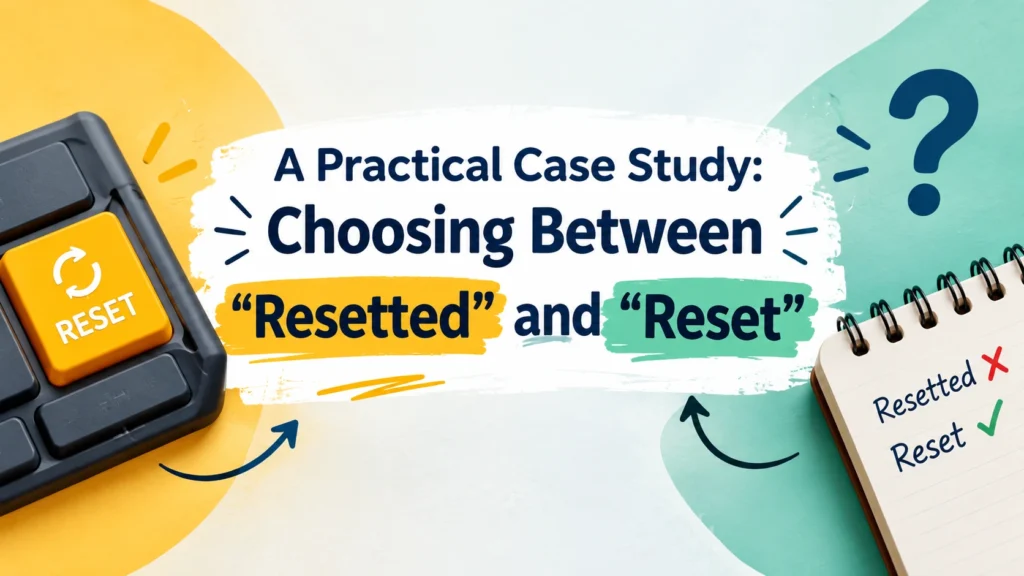
Imagine that a support employee is writing an incident report.
The employee wants to say that a router was configured again yesterday.
A first draft says:
“The technician resetted the router yesterday.”
The problem isn’t the meaning. The reader understands the sentence immediately. The problem is the verb form.
The corrected sentence is:
“The technician reset the router yesterday.”
Now consider a second sentence:
“The technician has resetted the router.”
Again, the standard form is:
“The technician has reset the router.”
Finally, suppose the action is happening right now:
“The technician is resetting the router.”
This example shows why the three forms need to stay separate:
| Situation | Correct form |
| Completed past action | reset |
| Action completed with have/has/had | reset |
| Action happening now | resetting |
Once you recognize the tense, choosing the correct form becomes much easier.
How to Remember the Correct Form
Grammar becomes easier when you attach a difficult rule to something familiar.
Use the “Set” Connection
Think:
set → set → set
Then remember:
reset → reset → reset
The shared ending makes the relationship easy to recall.
Look for the Time Marker
When you see words such as yesterday, last night, or two hours ago, don’t automatically add -ed.
Instead, ask:
“What is the established past form of this verb?”
For reset, the answer is still reset.
For example:
“I reset the settings yesterday.”
The word yesterday already establishes the past context.
Memorize the Three-Part Pattern
A useful memory shortcut is:
reset — reset — reset
Then remember the separate -ing form:
resetting
That’s enough to handle most everyday situations.
Read More : Its Self or Itself? The Complete Guide to Correct Usage
Related Verbs With Unchanged Past Forms
If reset feels unusual, compare it with other verbs that also keep the same written form.
| Base form | Simple past | Past participle |
| set | set | set |
| put | put | put |
| cut | cut | cut |
| hit | hit | hit |
| shut | shut | shut |
| reset | reset | reset |
For example:
“I put the book on the table.”
and:
“I put the book on the table yesterday.”
The verb put doesn’t change.
Likewise:
“I reset the device.”
and:
“I reset the device yesterday.”
The unchanged form isn’t a grammatical shortcut or a mistake. It’s simply how the verb is conjugated.
Reset vs. Resetted: Quick Comparison
If you need a fast reference, keep this table handy.
| Question | Answer |
| Is reset a verb? | Yes |
| What is the simple past of reset? | reset |
| What is the past participle? | reset |
| Is resetted the standard past form? | No |
| What is the present participle? | resetting |
| Does the past form add -ed? | No |
| Does reset change spelling in the past? | No |
| Is resets correct for third-person singular present? | Yes |
| Is reseting correct? | No |
| What is the correct spelling? | resetting |
The shortest possible rule is:
Reset has the same spelling in the base, past, and past participle forms.
Frequently Asked Questions About “Resetted or Reset”
What Is the Past Tense of “Reset”?
The past tense of reset is reset.
For example:
“I reset the router yesterday.”
Not:
“I resetted the router yesterday.”
Cambridge Dictionary explicitly identifies reset as the past tense of the verb.
Is “Resetted” Ever Correct?
Resetted is not the standard past-tense or past-participle form in standard English.
You may encounter it in informal or nonstandard writing, but it should generally be avoided in polished English.
Use:
“She reset the password.”
rather than:
“She resetted the password.”
Why Doesn’t “Reset” Change in the Past Tense?
Reset belongs to a group of verbs whose past form remains unchanged.
Its pattern is:
reset → reset → reset
The form is closely related to the unchanged pattern of set.
Is “Reset” Both the Past Tense and Past Participle?
Yes.
You can say:
“I reset the device yesterday.”
Here, reset is the simple past.
You can also say:
“I have reset the device.”
Here, reset is the past participle.
The spelling stays exactly the same.
Is “Resetting” or “Reseting” Correct?
Resetting is correct.
The final t is doubled before -ing:
reset → resetting
So write:
“The system is resetting.”
Not:
“The system is reseting.”
Cambridge lists resetting as the present participle.
What Is the Difference Between Reset and Restart?
Reset generally means returning something to a particular state, setting, or condition.
Restart means starting something again.
For example:
“Restart the computer.”
means start the computer’s operation again.
“Reset the router.”
can mean returning its settings or operating state to a particular condition.
The exact distinction can vary by device and technical context.
Can “Reset” Be Used as a Noun?
Yes.
Reset can also function as a noun.
For example:
“The device needs a factory reset.”
“Press the reset button.”
“The system required a full reset.”
Cambridge lists noun uses referring to returning equipment to its original settings, changing details, and starting again after a period of change.
What Is the Easiest Way to Remember “Reset”?
Use this simple formula:
reset → reset → reset
Then add:
resetting
for the present participle.
If you’re unsure whether to write resetted, stop and remember set → set → set. That connection usually makes the correct answer obvious.
Quick Reference Cheat Sheet
Here’s the entire rule at a glance:
| Form | Correct? | Example |
| reset | ✅ | Please reset the device. |
| resets | ✅ | The system resets automatically. |
| reset | ✅ | I reset it yesterday. |
| reset | ✅ | I have reset the settings. |
| resetting | ✅ | She is resetting the router. |
| resetted | ❌ | Use reset instead. |
| reseting | ❌ | Use resetting instead. |
The One-Line Rule
The standard forms are reset, reset, reset, and resetting.
That small sentence solves most questions about resetted or reset.
Conclusion
The resetted or reset debate has a surprisingly simple answer: reset is the standard form.
Whether you’re using the verb in the simple past or as a past participle, the spelling stays unchanged:
reset → reset → reset
The present participle is different:
resetting
That’s why these sentences are correct:
- “I reset the router yesterday.”
- “She has reset her password.”
- “They had reset the system.”
- “He is resetting the device.”
The temptation to write resetted comes from a perfectly understandable English pattern. Many verbs form their past tense by adding -ed. However, English has plenty of verbs that don’t follow that regular formula.
Think of reset as an extension of the familiar set pattern. Once you remember set → set → set, the correct form becomes much easier to recall.
So when you’re writing an email, article, report, support ticket, or everyday message, there’s no need to wrestle with the extra -ed.
Choose “reset,” not “resetted.”
And when the action is ongoing, remember the other important spelling:
resetting, with a double t.
That distinction is small. It can make a big difference in polished English.