
Anyone has or anyone have”—which one sounds right? This small grammar question can cause a surprisingly big headache. The confusion usually comes from treating anyone like a plural word because it refers to an unspecified person or group. However, anyone is grammatically singular, so it normally takes a singular verb agreement form.
That means “anyone has” is generally correct when you use the present tense. For example, “Does anyone have a pen?” is correct because the auxiliary verb “does” already carries the singular form, while “have” stays in its base form. But in a statement such as “Anyone has the right to ask questions,” the verb changes to has.
Understanding this distinction becomes easier once you learn how indefinite pronouns, subject-verb agreement, and singular subjects work together. The same rule applies to words such as someone, everyone, and nobody.
In this guide, you’ll learn when to use anyone has, when anyone have can appear in a sentence, and why questions often create confusion. You’ll also see clear grammar examples, common mistakes, and simple rules you can remember.
Quick Answer: Anyone Has vs. Anyone Have
In a normal present-tense statement or clause, use has with anyone.
- Anyone has the right to ask questions.
- If anyone has a problem, let me know.
- Anyone who has relevant experience can apply.
But use have after an auxiliary or modal verb.
- Does anyone have a question?
- Did anyone have trouble finding the building?
- Can anyone have access to this file?
- Will anyone have enough time?
- Should anyone have concerns, contact the office.
The important pattern is:
Anyone + has when anyone directly controls the present-tense verb.
Auxiliary/modal + anyone + have when the auxiliary or modal controls the verb form.
There’s also an informal spoken construction such as “Anyone have a question?” This is an abbreviated question. In formal writing, “Does anyone have a question?” is the safer choice.
The fastest rule to remember
| Sentence structure | Correct form | Example |
| Ordinary present statement | has | Anyone has access. |
| If-clause | has | If anyone has questions, ask me. |
| Relative clause | has | Anyone who has experience may apply. |
| Does-question | have | Does anyone have a question? |
| Did-question | have | Did anyone have a problem? |
| Modal construction | have | Can anyone have access? |
| Informal shortened question | have | Anyone have a question? |
That distinction solves most “anyone has or anyone have” problems.
The Core Grammar Rule: Anyone Is Singular
The first fact to lock into place is that anyone is grammatically singular.
Anyone is an indefinite pronoun. It refers to an unspecified person or any person within an open group. The word may involve hundreds, thousands, or even millions of possible people. Grammatically, however, it behaves as a singular pronoun.
Consider these examples:
- Anyone is welcome.
- Anyone knows that rule.
- Anyone has the opportunity to participate.
- Anyone who wants to join can register.
The possible number of people doesn’t change the grammatical number of anyone.
A useful mental trick is to think of anyone as “any one person.”
That doesn’t mean you are talking about one specific individual. It means the grammar treats each possible individual as a singular unit.
Why “Anyone” Is Singular
Compare anyone with an unmistakably plural noun:
- People have questions.
- Anyone has a question.
People is plural, so it takes have.
Anyone is singular, so it takes has when it directly controls the present-tense verb.
The same pattern appears with other indefinite pronouns:
| Singular indefinite pronoun | Correct example |
| someone | Someone has the key. |
| somebody | Somebody has an answer. |
| everyone | Everyone has a role. |
| everybody | Everybody has a chance. |
| nobody | Nobody has permission. |
| no one | No one has the information. |
| anyone | Anyone has access. |
Cambridge specifically states that anyone, anybody, and anything are used with singular verbs.
A Small but Important Nuance
Although “anyone has” is grammatically possible, it isn’t always the most natural way to express a general idea.
For example:
Anyone has the ability to learn.
This can be grammatically analyzed as singular agreement, but many speakers would naturally choose:
Anyone can learn.
Likewise, instead of:
Anyone has the right to enter.
a writer might choose:
Anyone can enter.
So grammar and style aren’t always the same thing. A sentence can satisfy subject-verb agreement while still having a more natural alternative.
That’s an important distinction when writing polished English.
When “Anyone Has” Is Correct
The form “anyone has” is correct when anyone directly functions as the subject of a present-tense verb.
Affirmative Statements
Here are straightforward examples:
- Anyone has the opportunity to participate.
- Anyone who has a valid ticket can enter.
- If anyone has questions, please contact the office.
- Anyone who has experience with the software may apply.
In each case, anyone is singular.
However, some affirmative sentences sound more natural with a modal or another construction:
Anyone can participate.
rather than:
Anyone has the opportunity to participate.
Both can work depending on the intended meaning. The second focuses on possession of an opportunity. The first focuses on possibility or permission.
“Anyone Has” in Clauses
You’ll often encounter anyone has inside a larger sentence.
For example:
If anyone has a question, raise your hand.
Here, anyone is the subject of the conditional clause. The verb is has.
Another example:
Anyone who has a valid membership can enter.
The relative clause who has a valid membership describes anyone. Since who refers back to the singular indefinite pronoun anyone, the verb appears as has.
This pattern is extremely useful:
Anyone who has…
Examples:
- Anyone who has a ticket may enter.
- Anyone who has questions should speak now.
- Anyone who has experience can apply.
- Anyone who has seen the document should respond.
Don’t let the meaning of anyone trick you into using have here.
When “Anyone Have” Is Correct
Now comes the part that causes most of the confusion.
“Anyone have” can be completely correct.
The secret is that have often appears after an auxiliary or modal verb.
For example:
Does anyone have a question?
This sentence doesn’t violate the rule that anyone is singular.
Instead, does carries the present-tense and third-person-singular marking. The main verb therefore stays in its base form: have.
Does Anyone Have…?
This is the most common pattern.
Correct:
Does anyone have a pen?
Incorrect:
Does anyone has a pen?
Why?
Because English uses the base form of the main verb after does.
Compare:
- She has a pen.
- Does she have a pen?
And:
- Anyone has a pen.
- Does anyone have a pen?
The grammatical principle is exactly the same.
Did Anyone Have…?
The same thing happens with did.
Correct:
Did anyone have a problem?
Not:
Did anyone had a problem?
The auxiliary did already marks the past tense. The main verb therefore returns to its base form.
Compare:
- She had a problem.
- Did she have a problem?
And:
- Anyone had a problem.
- Did anyone have a problem?
The pattern is consistent.
Modal Verbs + Anyone + Have
Modal verbs also take the base form of the following verb.
Examples include:
- Can anyone have access to this system?
- Could anyone have predicted the outcome?
- Will anyone have enough time?
- Would anyone have a problem with that?
- Should anyone have questions, contact the administrator.
- Might anyone have additional information?
In each example, have remains unchanged because a modal precedes it.
This is why the simplified rule “anyone always takes has” isn’t quite enough. The better rule is:
Anyone is singular, but the form of the verb depends on the grammatical structure.
Why “Anyone Have” Can Be Correct Even Though Anyone Is Singular
This is the heart of the entire anyone has or anyone have question.
Verb agreement and verb form aren’t always controlled by the same visible word.
Consider:
She has a car.
Here, she directly controls the present-tense verb. Therefore, we use has.
Now turn it into a question:
Does she have a car?
She is still singular.
Nothing about she became plural. Instead, does now carries the tense and agreement. The main verb returns to its base form, have.
The same transformation works with anyone:
Anyone has a question.
becomes:
Does anyone have a question?
Think of the auxiliary as taking the grammatical workload.
The Basic Transformation
Anyone has a question.
↓
Does anyone have a question?
The has → have change doesn’t mean anyone changed from singular to plural.
It means the sentence changed from a simple statement to a question formed with do-support.
That’s the piece many learners miss.
“Does Anyone Have” vs. “Does Anyone Has”
This deserves special attention because “does anyone has” is one of the most common errors.
The correct form is:
Does anyone have a question?
The incorrect form is:
Does anyone has a question?
Why does the second version fail?
Because English doesn’t normally put the third-person singular -s marking on both the auxiliary and the main verb.
Compare:
- He has a car.
- Does he have a car?
Not:
- Does he has a car? ❌
The same rule applies to other verbs:
- She likes coffee.
- Does she like coffee?
Not:
- Does she likes coffee? ❌
So the rule isn’t unique to have.
Does + subject + base verb
That gives you:
- Does anyone have…?
- Does anyone know…?
- Does anyone want…?
- Does anyone need…?
- Does anyone understand…?
The same structure works every time.
Anyone Has vs. Anyone Have in Conditional Sentences
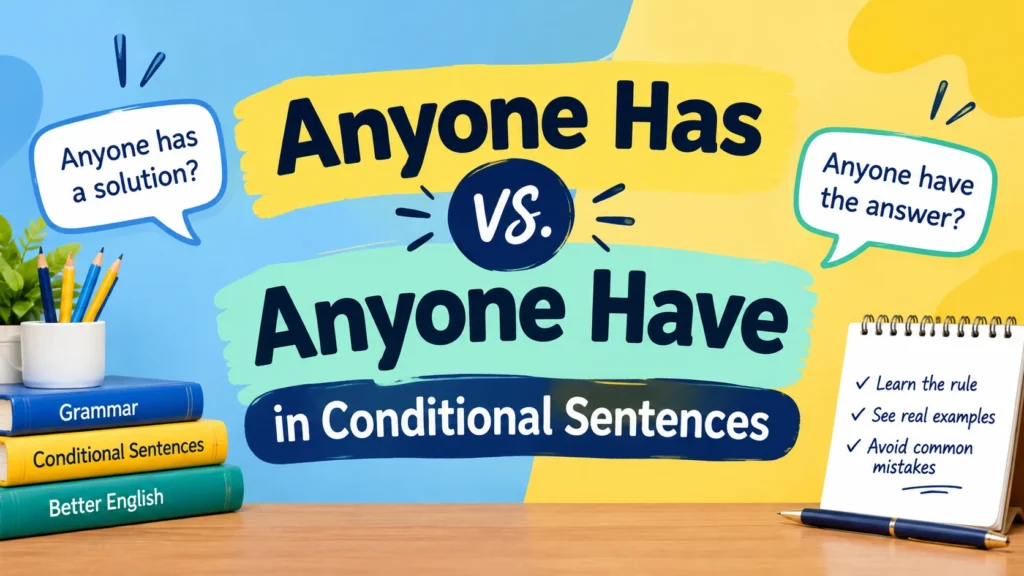
Conditional sentences add another useful layer to the grammar.
If Anyone Has…
When anyone directly controls the verb inside an ordinary if-clause, use has.
Examples:
- If anyone has questions, please ask.
- If anyone has information, contact the police.
- If anyone has a problem, tell the manager.
- If anyone has concerns, they can raise them during the meeting.
The structure is:
If + anyone + has…
No auxiliary appears before has, so the singular present form remains.
Should Anyone Have…
Now compare that with a more formal construction:
Should anyone have questions, please contact the office.
Here, should is a modal verb. Therefore, the main verb takes its base form:
should + have
This construction has roughly the same practical meaning as:
If anyone has questions, please contact the office.
The version with should sounds more formal and is common in notices, professional writing, policies, and official communication.
What About “If Anyone Have…”?
In standard modern English, this is generally not the form you want:
If anyone have questions, please ask. ❌
Use:
If anyone has questions, please ask. ✅
But notice the difference:
Should anyone have questions, please ask. ✅
The auxiliary or modal changes the verb form.
That’s why context matters more than simply memorizing has = singular.
Anyone Has vs. Anyone Have in Indirect and Embedded Questions
Direct and indirect questions create another common trap.
Consider the direct question:
Does anyone have the report?
Now put that question inside another sentence:
I wonder whether anyone has the report.
Notice what happened.
The direct question uses:
Does anyone have…?
The embedded question uses:
whether anyone has…
Why?
Because the embedded question follows statement-like word order. It doesn’t use the same question structure as the direct question.
Direct Question
Does anyone have the answer?
Embedded Question
I don’t know whether anyone has the answer.
Another example:
Did anyone see the accident?
becomes:
She asked whether anyone had seen the accident.
The word order changes, and the tense may change depending on the reporting context.
A Common Error
Incorrect:
I wonder if anyone have the answer. ❌
Standard form:
I wonder if anyone has the answer. ✅
The auxiliary does has disappeared from the embedded clause. Consequently, the singular form has returns.
Anyone Has vs. Anyone Have in Different Tenses
The same principle becomes clearer when you examine complete verb phrases.
| Structure | Example |
| Present statement | Anyone has enough information. |
| Present question | Does anyone have enough information? |
| Past statement | Anyone had enough information. |
| Past question | Did anyone have enough information? |
| Future | Will anyone have enough information? |
| Modal | Could anyone have enough information? |
| Present perfect | Has anyone had enough information? |
| Past perfect | Had anyone had enough information? |
Notice something important: the word anyone itself hasn’t changed.
The surrounding verb phrase changes.
Present Tense
Anyone has access.
Present-Simple Question
Does anyone have access?
Past Tense
Anyone had access.
Past-Simple Question
Did anyone have access?
Future
Will anyone have access?
The more complete your understanding of verb phrases becomes, the less mysterious anyone has or anyone have becomes.
Anyone vs. Anybody: Is There a Difference?
Anyone and anybody generally have the same meaning and grammatical behavior.
Cambridge describes them as having no difference in meaning while noting that anybody can sound a little less formal and anyone is more common in writing.
Compare:
Does anyone have a question?
and:
Does anybody have a question?
Both are grammatically correct.
Likewise:
Anyone who has experience can apply.
and:
Anybody who has experience can apply.
Both follow the same agreement pattern.
Anyone vs. Anybody Table
| Word | Grammatical number | Example |
| Anyone | Singular | Anyone has the right to ask. |
| Anybody | Singular | Anybody has the right to ask. |
The difference is mainly one of style and usage, not basic grammar.
For formal writing, anyone often fits especially well. In relaxed conversation, anybody can sound more casual.
Anyone Has vs. Anyone Have in Negative Constructions
Negative sentences deserve care because simply adding not doesn’t always produce the most natural English.
Consider:
Anyone does not have access.
This construction can be grammatical in a particular context, but it often sounds awkward because the intended scope of not is unclear.
If the intended meaning is that not everybody has access, the natural sentence is:
Not everyone has access.
If the intended meaning is that nobody has access, use:
No one has access.
If you’re asking whether there is even one person with access, you might say:
Does anyone have access?
These sentences express different meanings.
Compare the Meanings
| Sentence | Meaning |
| Not everyone has access. | At least one person lacks access. |
| No one has access. | Nobody has access. |
| Does anyone have access? | The speaker asks whether at least one person has access. |
| If anyone has access, let me know. | If there is any person with access, tell me. |
This is a good example of why grammar and meaning need to work together.
Don’t mechanically replace has with have simply because the sentence becomes negative.
Why People Keep Getting “Anyone Has or Anyone Have” Wrong

The confusion usually comes from one of three sources.
Meaning Looks Plural
Anyone can refer to a huge number of possible people.
That makes have feel tempting.
But grammatical number doesn’t depend on how many people could potentially fit the description. Anyone remains singular.
Questions Change the Verb Form
English questions often introduce do, does, or did.
That changes the main verb:
- has → have
- likes → like
- wants → want
- knows → know
So speakers learn:
Does anyone have…?
Then they see anyone elsewhere and assume have must always be correct.
It isn’t.
Spoken English Drops Words
In conversation, you may hear:
Anyone have a question?
The complete version is:
Does anyone have a question?
The shorter form is an elliptical question. Speakers understand the missing structure from context.
That doesn’t mean anyone suddenly takes a plural verb.
Read More : Me Too vs. Me as Well vs. I as Well: The Complete Guide to Correct Usage in English
“Anyone Have a Question?”: Is It Correct?
Yes, “Anyone have a question?” can be correct in informal conversation.
Imagine a teacher finishing a presentation and asking a room full of students:
Anyone have a question?
That sounds natural in casual speech.
The complete version is:
Does anyone have a question?
For formal writing, professional correspondence, academic work, and exams, the complete form is usually the better choice.
Formal vs. Informal
| Context | Natural choice |
| Casual conversation | Anyone have a question? |
| Group chat | Anyone have the notes? |
| Workplace meeting | Does anyone have any questions? |
| Formal email | Does anyone have any questions? |
| Academic writing | Does anyone have evidence supporting this claim? |
| Exam writing | Does anyone have…? |
This distinction is about register, not whether anyone is singular.
Common Mistakes With Anyone Has and Anyone Have
Mistake: “Does Anyone Has…?”
❌ Does anyone has a pen?
✅ Does anyone have a pen?
Reason: Does already carries the present-tense agreement.
Mistake: “Did Anyone Had…?”
❌ Did anyone had trouble?
✅ Did anyone have trouble?
Reason: Did already marks the past tense.
Mistake: “If Anyone Have…”
❌ If anyone have questions, ask me.
✅ If anyone has questions, ask me.
Reason: There is no auxiliary before has in the ordinary conditional clause.
Mistake: “Anyone Have” in a Formal Statement
❌ Anyone have access to the database.
✅ Anyone has access to the database.
However, if you’re asking a casual question:
✅ Anyone have access to the database?
The punctuation and sentence structure matter.
Mistake: Carrying “Have” Into an Embedded Question
❌ I don’t know whether anyone have the answer.
✅ I don’t know whether anyone has the answer.
The embedded question doesn’t use the same auxiliary structure as the direct question.
A Practical Decision Guide for Anyone Has or Anyone Have
When you’re unsure, don’t guess. Walk through these steps.
Step One: Find “Anyone”
Identify whether anyone is functioning as the subject.
Step Two: Look for an Auxiliary
Check whether does, did, can, could, will, would, should, may, might or another auxiliary/modal appears before the main verb.
Step Three: Check the Verb
If anyone directly takes the present-tense verb:
Anyone has…
If an auxiliary or modal requires the base form:
…anyone have…
Step Four: Check Whether It’s an Embedded Question
If you have:
I wonder whether…
or:
I don’t know if…
normal statement word order usually applies:
I wonder whether anyone has…
Step Five: Check the Register
If you wrote:
Anyone have a question?
ask whether you’re intentionally using an informal elliptical question.
For formal writing, use:
Does anyone have a question?
Anyone Has vs. Anyone Have: Real-World Examples
Everyday Conversation
At a meeting:
“Does anyone have a charger?”
At a party:
“Does anyone have a phone charger?”
In a classroom:
“Does anyone have a question?”
In casual speech:
“Anyone have a question?”
Each question uses have because the complete grammatical structure contains does.
Workplace Communication
A manager might write:
If anyone has questions about the new schedule, please contact HR.
During a meeting, the manager might ask:
Does anyone have questions about the new schedule?
Notice the difference.
The conditional clause uses has.
The direct question uses have after does.
Academic and Exam Writing
In formal writing, clarity matters more than conversational shortcuts.
Prefer:
If anyone has additional evidence, it should be submitted with the application.
over an elliptical construction such as:
Anyone have additional evidence?
Similarly:
Does anyone have an alternative explanation?
is appropriate as a complete question.
Case Study: One Word Changes Because the Structure Changes
Consider three sentences:
Anyone has access to the document.
Does anyone have access to the document?
I don’t know whether anyone has access to the document.
At first glance, the changing verb may seem inconsistent.
It isn’t.
Sentence A: Statement
Anyone has access.
Anyone directly controls the present-tense verb.
Sentence B: Direct Question
Does anyone have access?
Does carries the grammatical marking. Have stays in its base form.
Sentence C: Embedded Question
I don’t know whether anyone has access.
The auxiliary does disappears because this is an embedded question. The clause returns to statement-like word order, so has appears.
This three-sentence comparison captures the entire issue better than memorizing isolated examples.
A Simple Diagram to Remember the Rule
ANYONE
│
Is it directly taking
a present-tense verb?
│
┌──────┴──────┐
YES NO
│ │
↓ ↓
USE HAS Look for an
auxiliary/modal
│
┌────────┴────────┐
↓ ↓
DOES/DID MODAL
│ │
↓ ↓
use HAVE use HAVE
Examples:
Anyone has a question.
↓
Does anyone have a question?
Anyone had a problem.
↓
Did anyone have a problem?
If anyone has concerns…
↓
Should anyone have concerns…
Once you see the structure, the choice becomes much easier.
Quick Comparison: Anyone Has vs. Anyone Have
| Form | Correct? | Example | Explanation |
| Anyone has | ✅ | Anyone has access. | Singular subject directly takes the verb |
| Anyone have | ⚠️ | Anyone have a question? | Informal elliptical question |
| Does anyone have | ✅ | Does anyone have access? | Does takes the agreement |
| Does anyone has | ❌ | Does anyone has access? | Incorrect double marking |
| Did anyone have | ✅ | Did anyone have access? | Did carries past tense |
| Did anyone had | ❌ | Did anyone had access? | Incorrect double marking |
| If anyone has | ✅ | If anyone has questions… | Singular subject in an ordinary clause |
| Should anyone have | ✅ | Should anyone have questions… | Should takes the base form |
| Anyone who has | ✅ | Anyone who has experience… | Singular anyone controls the clause |
| Whether anyone has | ✅ | I wonder whether anyone has… | Embedded question uses statement word order |
A Useful Memory Trick
When you’re stuck between anyone has or anyone have, don’t ask:
“Does anyone mean many people?”
Ask:
“What word is carrying the tense?”
If anyone directly controls the present-tense verb, use has.
If does, did, can, could, will, would, should, or another construction requires the base form, use have.
For example:
Anyone has
Does anyone have
Did anyone have
Can anyone have
Should anyone have
That little pattern is worth remembering.
Quick Grammar Checklist
Before publishing or submitting a sentence containing anyone, check these points:
- Is anyone the subject?
- Is the sentence a normal present-tense statement?
- Use has.
- Does does appear before anyone?
- Use have.
- Does did appear?
- Use have.
- Does a modal appear?
- Use have.
- Is the clause embedded inside another sentence?
- Check whether normal statement word order applies.
- Is “Anyone have…?” an intentionally informal question?
- It can work in casual speech.
- Is the writing formal?
- Prefer the complete question “Does anyone have…?”
FAQs About Anyone Has or Anyone Have
When do I use “anyone has”?
Use “anyone has” when anyone directly functions as the subject of a present-tense verb.
Examples:
- If anyone has questions, let me know.
- Anyone who has experience can apply.
- Anyone has the opportunity to participate.
The first two examples are especially natural because has appears inside a conditional or relative clause.
When should I use “anyone have”?
Use “anyone have” after an auxiliary or modal that requires the base form of the verb.
Examples include:
- Does anyone have a question?
- Did anyone have a problem?
- Can anyone have access to the system?
- Should anyone have concerns, contact us.
It can also appear in informal elliptical questions such as “Anyone have a question?”
Is “Anyone have a question?” correct?
Yes. It is a common informal shortened question.
The complete form is:
Does anyone have a question?
In casual conversation, speakers often omit does because the intended meaning remains obvious. In formal writing, however, the complete version is generally preferable.
Why does anyone take a singular verb?
Because anyone is a singular indefinite pronoun.
Although anyone can refer to any person within a large or unlimited group, the pronoun itself has singular grammatical behavior. Cambridge Grammar explicitly identifies anyone as an indefinite pronoun used with a singular verb.
That’s why you get:
- Anyone is welcome.
- Anyone has the right to ask.
- Anyone can participate.
What’s the difference between anyone and anybody?
In most contexts, there is no meaningful difference in basic meaning or grammar.
Both refer to an unspecified person or any person in a relevant group.
- Does anyone have a question?
- Does anybody have a question?
Both are correct.
Anybody can sound slightly more conversational, while anyone is often preferred in writing.
Is “Does anyone has a question?” correct?
No.
The standard form is:
Does anyone have a question?
The auxiliary does already carries the present-tense and singular agreement. Therefore, the main verb must remain in its base form, have.
Is “If anyone have questions” correct?
No, not in standard modern English.
Use:
If anyone has questions, please ask.
But compare:
Should anyone have questions, please ask.
The second sentence uses have because should is a modal verb.
Is “Anyone has a question” natural English?
It can be grammatically formed because anyone is singular, but the sentence may sound unnatural depending on what you mean.
For a general possibility, “Anyone can have a question” or “If anyone has a question…” may communicate the intended idea more naturally.
The grammar of has isn’t the only issue. Meaning and idiomatic usage matter too.
Final Takeaway: Anyone Has or Anyone Have?
The confusion around “anyone has or anyone have” disappears once you stop treating has and have as simple alternatives.
Anyone is singular. When it directly takes a present-tense verb, use has:
If anyone has a question, please ask.
But when an auxiliary or modal carries the grammatical marking, the main verb uses have:
Does anyone have a question?
The same principle explains:
- Did anyone have a problem?
- Can anyone have access?
- Will anyone have enough time?
- Should anyone have concerns, contact us.
And there’s one informal exception worth recognizing:
Anyone have a question?
That’s a shortened conversational question. In formal writing, “Does anyone have a question?” is the clearer choice.
The simplest rule to keep in your head is this:
Anyone is singular, but auxiliary verbs can change the form of the following verb.
Once you understand that distinction, anyone has vs. anyone have stops being a guessing game. The surrounding sentence tells you which form belongs there.