
English often turns two or three simple words into a surprisingly tricky grammar question. Me too, me as well, and I as well all seem to express the same idea, but they don’t function in exactly the same way. If you’ve ever wondered whether me too vs. me as well has a real grammatical difference, or why I as well sounds awkward on its own, you’re not alone.
The key lies in understanding English pronouns, subject pronouns, object pronouns, and ellipsis. In everyday conversation, me too is a natural way to show agreement or say that the same feeling, opinion, experience, or action applies to you. Me as well can serve a similar purpose, although its tone may feel slightly more measured in some situations.
The confusing option is I as well. Unlike a short response such as me too, this construction usually needs a verb or auxiliary verb to form a complete clause. For example, you can say I do as well, I am as well, or I will as well, depending on the original sentence.
Once you understand these grammar rules, choosing the right expression becomes much easier.
What Does “Me Too” Mean?
“Me too” means “the same is true for me” or “I have the same feeling, opinion, experience, or intention.”
It usually responds directly to something another person has said.
For example:
“I love Italian food.”
“Me too.”
The second speaker doesn’t need to repeat the entire sentence. Everyone already knows what they mean:
“I love Italian food.”
“I love Italian food too.”
The shorter version, “Me too,” is natural because English frequently leaves out information that listeners can easily recover from context.
The Meaning of “Me Too”
Consider this conversation:
Sarah: “I’m tired today.”
Mike: “Me too.”
Mike isn’t literally saying only the two words me too in isolation from meaning. The full idea is:
“I’m tired too.”
Or:
“I am tired as well.”
The expression therefore works as a context-dependent response.
It can communicate agreement with:
- Feelings
- Opinions
- Preferences
- Experiences
- Actions
- Plans
- Conditions
- Desires
For example:
“I want some coffee.”
“Me too.”
“I’ve visited New York.”
“Me too.”
“I’m nervous about the interview.”
“Me too.”
“I’d like to join the meeting.”
“Me too.”
The exact underlying sentence changes according to the first speaker’s statement.
Why “Me Too” Works as a Standalone Response
At first glance, “me” might seem grammatically wrong because me isn’t normally the subject of a standard declarative sentence.
You wouldn’t normally say:
❌ “Me like pizza.”
You’d say:
✔ “I like pizza.”
So why does “Me too” work?
The answer is ellipsis.
Ellipsis occurs when words are left out because the surrounding context makes their meaning obvious. English uses this feature constantly in conversation.
Consider:
“Who wants dessert?”
“Me.”
Nobody expects “Me” to be a complete traditional subject-verb sentence. The implied meaning might be:
“I want dessert.”
Likewise:
“I love hiking.”
“Me too.”
The complete meaning is understood without repeating every word.
“Me Too” vs. a Full Sentence
| Short response | Full equivalent |
| Me too. | I do too. |
| Me too. | I am too. |
| Me too. | I have too. |
| Me too. | I will too. |
| Me too. | I can too. |
The appropriate full sentence depends on the original verb.
For example:
“I am hungry.”
“Me too.”
The fuller response is:
“I am hungry too.”
But:
“I like jazz.”
“Me too.”
can become:
“I like jazz too.”
The short response avoids repeating information that everyone already understands.
Examples of “Me Too” in Real Conversations
“Me too” appears naturally in casual English because it is quick, clear, and highly familiar.
Talking About Preferences
Emma: “I love chocolate cake.”
Daniel: “Me too.”
Talking About Experiences
Emma: “I’ve been to Chicago.”
Daniel: “Me too.”
Talking About Feelings
Emma: “I’m worried about the results.”
Daniel: “Me too.”
Talking About Plans
Emma: “I’m going to the concert Friday.”
Daniel: “Me too.”
Talking About Desires
Emma: “I want to go home.”
Daniel: “Me too.”
The important point is that “me too” doesn’t have one fixed grammatical expansion. The omitted words depend on the sentence that came before it.
How Formal Is “Me Too”?
“Me too” is neutral to informal in everyday use.
It’s completely normal in conversation, text messages, chats, and informal emails.
For example:
“I’m excited about the trip.”
“Me too!”
That’s perfectly natural.
However, a professional document or academic paper usually benefits from complete sentences rather than conversational fragments.
Instead of writing:
“The researchers support this approach.”
“Me too.”
a formal writer might write:
“I support this approach as well.”
The difference isn’t that “me too” is grammatically bad. The difference is register.
Where “Me Too” Works Well
- Casual conversations
- Text messages
- Social media
- Friendly emails
- Informal discussions
- Everyday spoken English
Where a Full Sentence May Be Better
- Academic essays
- Formal reports
- Legal documents
- Formal business correspondence
- Research writing
- Official statements
Context always matters.
What Does “Me as Well” Mean?
“Me as well” generally means the same thing as “me too.”
It indicates that the speaker shares the quality, action, opinion, experience, or intention mentioned by someone else.
For example:
“I enjoyed the movie.”
“Me as well.”
This means:
“I enjoyed the movie too.”
The expression is grammatically possible because it functions as an elliptical response, just as “me too” does.
The Meaning of “Me as Well”
The phrase as well is an additive expression. It means something similar to also or too.
Compare:
“I enjoyed the movie too.”
“I enjoyed the movie as well.”
Both sentences communicate that the speaker also enjoyed the movie.
In a shortened response:
“Me too.”
and
“Me as well.”
can communicate essentially the same idea.
When to Use “Me as Well”
“Me as well” works when the context clearly establishes what you are agreeing with.
For example:
“I’m interested in photography.”
“Me as well.”
The listener understands:
“I am interested in photography as well.”
It can work with many kinds of statements.
Opinions
“I think the proposal needs more work.”
“Me as well.”
Experiences
“I’ve worked with that software before.”
“Me as well.”
Feelings
“I’m nervous about tomorrow.”
“Me as well.”
Preferences
“I prefer tea.”
“Me as well.”
Plans
“I’ll attend the event.”
“Me as well.”
That said, “me too” is generally more common and more immediately conversational.
“Me as Well” in Polite Sentences
“As well” becomes especially useful when you move from a short response into a complete sentence.
Compare:
“I enjoyed the presentation too.”
with:
“I enjoyed the presentation as well.”
Both are grammatically complete.
The second can sound slightly more measured depending on the context.
For example, in a workplace conversation:
“I agree with the proposed changes as well.”
sounds more complete than:
“Me too.”
Neither is inherently wrong. The choice depends on the level of formality and the sentence structure.
Me Too vs. Me as Well: What’s the Difference?
The basic meaning of “me too” and “me as well” is usually the same.
The biggest difference is style and naturalness in context.
| Feature | Me too | Me as well |
| Basic meaning | Same applies to me | Same applies to me |
| Grammar | Elliptical response | Elliptical response |
| Common in conversation | Very common | Less common |
| Tone | Casual and natural | Neutral, sometimes more polished |
| Can stand alone? | Yes | Yes, when context is clear |
| Equivalent complete form | I do/am/have/will too | I do/am/have/will as well |
“Me Too” Is Usually More Conversational
Imagine two friends talking:
“I need a vacation.”
“Me too.”
That’s extremely natural.
Now compare:
“I need a vacation.”
“Me as well.”
The second is grammatical and understandable. It simply sounds somewhat less spontaneous in many everyday American English conversations.
“Me as Well” Can Sound More Measured
“As well” often fits comfortably into complete sentences:
“I would like to thank the team as well.”
“She attended the conference as well.”
“The second proposal deserves consideration as well.”
In these cases, as well isn’t functioning as a standalone response. It’s part of a complete clause.
“I as Well”: Why Is It Usually Incomplete?
Here’s where the biggest grammatical confusion appears.
Someone might hear:
“Me too.”
and:
“Me as well.”
Then logically conclude:
“I as well.”
But English doesn’t work by simply replacing me with I.
The pronouns I and me have different grammatical functions.
- I is a subject pronoun.
- Me is an object pronoun.
For example:
I like music.
But:
She called me.
You can’t normally swap the two:
❌ “Me like music.”
❌ “She called I.”
The same principle helps explain “I as well.”
The Grammar Problem Behind “I as Well”
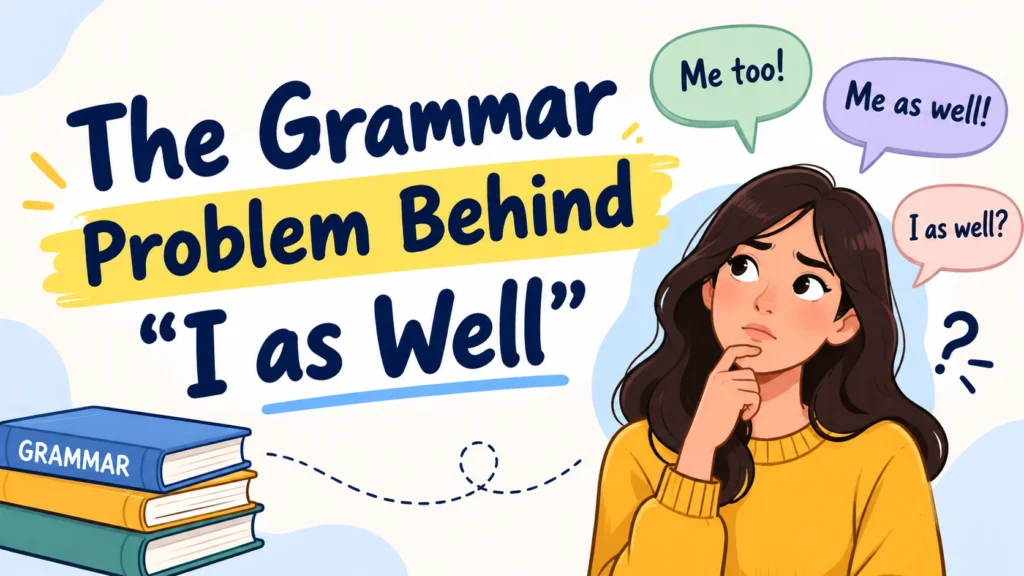
“I as well” usually lacks the verb or auxiliary needed to form a complete clause.
Consider:
“I like jazz.”
If you want to express the same idea with as well, you can say:
“I like jazz as well.”
The subject I is followed by the verb like.
If you shorten the response, you can say:
“Me as well.”
But simply saying:
“I as well.”
doesn’t normally provide enough grammatical material.
That’s why it sounds incomplete as a standalone response.
Can “I as Well” Ever Be Correct?
Yes. This distinction is important.
It would be misleading to claim that the sequence “I as well” can never occur in English.
The problem is primarily with using it alone as a response.
For example:
“I as well as my brother enjoy hiking.”
Here, “I as well as my brother” forms part of a larger grammatical structure.
Likewise:
“I will attend as well.”
Here, I is the subject and will attend provides the predicate.
Or:
“I am interested as well.”
Again, the sentence has a verb.
So the useful rule is:
“I as well” is not normally a complete standalone equivalent of “me too.”
The Missing Verb Problem
The easiest way to understand the issue is to look at the verb in the original statement.
Original: “I am tired.”
Correct responses:
“Me too.”
“Me as well.”
“I am too.”
“I am as well.”
The last two contain the verb am.
Original: “I like coffee.”
Correct responses:
“Me too.”
“Me as well.”
“I do too.”
“I do as well.”
Here, do can act as an auxiliary substitute for the previously mentioned verb.
Original: “I have finished.”
Correct responses:
“Me too.”
“Me as well.”
“I have too.”
“I have as well.”
Original: “I will go.”
Correct responses:
“Me too.”
“Me as well.”
“I will too.”
“I will as well.”
The pattern becomes much clearer when you focus on the verb, rather than simply memorizing pronouns.
Correct Alternatives to “I as Well”
If you want to use I rather than me, choose a complete grammatical construction.
“I Do as Well”
Use do when it can stand in for an earlier action.
“I enjoy swimming.”
“I do as well.”
A more conversational alternative is:
“I do too.”
The auxiliary do represents the earlier verb phrase.
“I Am as Well”
Use am when the original statement uses be in the relevant structure.
“I’m tired.”
“I am as well.”
This is grammatical, although “I’m tired too” or “Me too” may sound more natural in casual conversation.
Another example:
“I’m excited about the trip.”
“I am as well.”
“I Have as Well”
When have is the relevant auxiliary, it can remain in the response.
“I’ve already finished the assignment.”
“I have as well.”
The same idea can be expressed casually:
“Me too.”
“I Will as Well”
For future actions, will can carry the response.
“I’ll attend the meeting.”
“I will as well.”
Or:
“Me too.”
The first version is a complete clause. The second is an elliptical response.
Other Useful Forms
The same principle applies to other auxiliary verbs.
| Original statement | Complete response |
| “I can swim.” | “I can as well.” |
| “I did finish it.” | “I did as well.” |
| “I would help.” | “I would as well.” |
| “I should go.” | “I should as well.” |
| “I have seen it.” | “I have as well.” |
However, not every sentence naturally invites every possible auxiliary construction. The original clause determines what sounds grammatical and natural.
Subject Pronouns vs. Object Pronouns
Understanding I vs. me makes the entire topic easier.
“I” as a Subject
Use I when the pronoun performs or experiences the action as the grammatical subject.
I like pizza.
I work here.
I understand.
I am tired.
“Me” as an Object
Use me when the pronoun functions as an object.
She called me.
He helped me.
They invited me.
Give me the book.
So why does “me too” use an object pronoun?
Because the phrase isn’t functioning like an ordinary complete sentence such as:
“I like pizza.”
Instead, “me too” is an elliptical conversational response. The omitted structure supplies the grammatical relationship.
Ellipsis: The Secret Behind “Me Too”
Ellipsis isn’t unusual or sloppy English. It’s a normal part of the language.
People regularly remove repeated words when everyone understands what’s missing.
Consider:
“Who wants coffee?”
“I do.”
The second speaker doesn’t repeat:
“I want coffee.”
Likewise:
“Are you coming?”
“Yes, I am.”
The verb phrase is understood from the question.
With “me too,” the omitted structure can be even greater:
“I love this song.”
“Me too.”
The listener reconstructs:
“I love this song too.”
This is one reason spoken English often feels much shorter than textbook examples.
Me Too vs. I Too
Another common question is whether “I too” is correct.
Yes, “I too” can be grammatically correct, but it usually needs to appear within an appropriate sentence.
For example:
“I too enjoyed the concert.”
Here, I is the subject of enjoyed.
The phrase means:
“I also enjoyed the concert.”
You can also use it for emphasis:
“I too have faced this problem.”
That’s different from the standalone response:
“Me too.”
So don’t think of “me too” as proof that “I too” is wrong. They perform different grammatical jobs.
Me Too vs. Me as Well in Complete Sentences
The words too and as well can both appear in complete clauses.
With “Too”
“I like this restaurant too.”
“She wants to come too.”
“They have seen the movie too.”
With “As Well”
“I like this restaurant as well.”
“She wants to come as well.”
“They have seen the movie as well.”
Both structures are grammatical.
In many American English contexts, too tends to feel more natural in casual speech. As well can sound slightly more polished or restrained.
Common Mistakes With Me Too, Me as Well, and I as Well
Mistake: “I as well” as a Standalone Response
❌ “I as well.”
Better:
✔ “Me too.”
✔ “Me as well.”
✔ “I do too.”
✔ “I do as well.”
The best choice depends on the original statement.
Mistake: Assuming “Me” Is Always Correct
Because “me too” is correct, some learners start using me wherever agreement is involved.
That’s not how English works.
❌ “Me like this movie.”
✔ “I like this movie.”
But:
✔ “I like this movie.”
“Me too.”
The first sentence needs a subject. The second is a shortened response.
Mistake: Assuming “As Well” Is Always More Formal
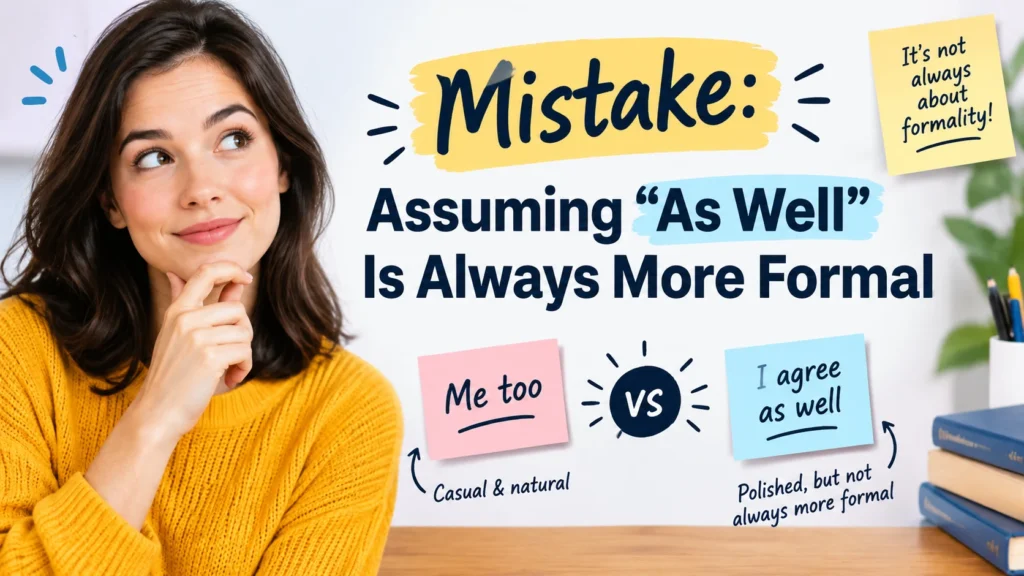
“As well” can sound somewhat more polished in certain contexts. However, it isn’t automatically formal.
For example:
“Me as well!”
can still sound conversational.
Meanwhile:
“I agree with your assessment as well.”
sounds more formal because the whole sentence is formal, not simply because it contains as well.
Mistake: Treating “Too” and “As Well” as Completely Identical
Their core additive meaning overlaps heavily, but sentence placement and emphasis can differ.
For example:
“I too agree.”
puts emphasis on I.
Compare:
“I agree too.”
This usually sounds more conversational.
And:
“I agree as well.”
has a somewhat more measured tone.
The surrounding sentence determines the most natural choice.
Real-World Case Studies
Case Study: Casual Conversation
Imagine two friends discussing a new restaurant.
Alex: “I really like the food here.”
Sam: “Me too.”
This is the most straightforward conversational response.
Sam could also say:
“Me as well.”
That works, although it may sound slightly less spontaneous.
A complete sentence would be:
“I really like the food here too.”
Best lesson
When the conversation is relaxed, “me too” is short, natural, and immediately clear.
Case Study: Workplace Conversation
A manager says:
“I think we should review the proposal again.”
A colleague could respond:
“Me too.”
This is grammatically understandable and natural in spoken conversation.
But in a formal email, the writer might say:
“I think we should review the proposal again as well.”
Here, the complete sentence provides more professional clarity.
Best lesson
Read More : Assume vs. Presume vs. Infer: What’s the Difference and When Should You Use Each?
Case Study: Classroom Setting
A student says:
“I found the second chapter difficult.”
Another student responds:
“Me too.”
That’s completely natural.
A formal written response might instead say:
“I found the second chapter difficult as well.”
The short response works well in classroom discussion. The complete sentence fits better into formal writing.
Case Study: Customer Support
Suppose a customer says:
“I haven’t received the confirmation email.”
A support representative should avoid an ambiguous response such as:
“Me too.”
Instead, the representative should explain the situation clearly.
For example:
“I haven’t received it either. Let me check the status for you.”
Here, either is especially relevant because the original statement is negative.
This highlights an important point: choosing the right agreement expression also requires attention to whether the original statement is positive or negative.
Case Study: Group Discussion
Suppose someone says:
“I think we need more time.”
Another participant might say:
“I do too.”
This is a complete, clear agreement structure.
Or simply:
“Me too.”
Both work in conversation.
For a formal written report, however:
“I also believe that we need more time.”
is usually clearer and more polished.
Positive and Negative Agreement
One useful detail often gets overlooked in discussions about me too vs. me as well: negative statements normally require different agreement structures.
For a positive statement:
“I like coffee.”
“Me too.”
For a negative statement:
“I don’t like coffee.”
You wouldn’t normally respond:
❌ “Me too.”
Instead, natural responses include:
“Me neither.”
or:
“I don’t either.”
For example:
A: “I don’t enjoy horror movies.”
B: “Me neither.”
This is an important distinction because “too” and “as well” are additive expressions commonly associated with positive statements.
How Native English Speakers Choose the Right Expression
Rather than memorizing one rigid rule, consider three things.
Start With the Meaning
Ask yourself:
Am I saying that the same thing applies to me?
If yes, a short response such as “me too” may be exactly what you need.
Check Whether You Want a Complete Sentence
If you’re using I, make sure the sentence has the required verb or auxiliary.
Compare:
❌ “I as well.”
with:
✔ “I do as well.”
or:
✔ “I am as well.”
or:
✔ “I will as well.”
The correct auxiliary depends on the original sentence.
Consider the Setting
Ask where the expression will appear.
Casual speech
“Me too.”
Friendly message
“Me too!”
Neutral conversation
“Me as well.”
Formal writing
“I agree as well.”
or:
“I also agree.”
A tiny change in structure can make your English sound much more natural.
Quick Decision Guide: Me Too vs. Me as Well vs. I as Well
Use this simple guide when you’re unsure:
Someone says:
“I love this book.”
You want a short agreement:
“Me too.”
You want another short agreement:
“Me as well.”
You want a complete sentence:
“I love it too.”
You want to use “I” with an auxiliary:
“I do too.”
You want to write “I as well” by itself:
Usually choose another construction.
Simple Formula
Short conversational agreement → Me too / Me as well
Complete sentence → I + appropriate verb + too/as well
That’s the core distinction.
Quick Comparison Table: Me Too vs. Me as Well vs. I as Well
| Expression | Correct as a standalone response? | Meaning | Typical context |
| Me too | Yes | Same applies to me | Casual conversation |
| Me as well | Yes | Same applies to me | Conversation, neutral contexts |
| I as well | Usually no | Intended agreement, but incomplete alone | Needs additional structure |
| I do too | Yes | I share the action/opinion | Complete response |
| I do as well | Yes | I share the action/opinion | Complete response |
| I am too | Yes | Same state/condition | Statements using “be” |
| I will too | Yes | Same future action | Future plans |
Me Too vs. Me as Well vs. I as Well: Key Rules to Remember
Here are the most useful rules in compact form:
- “Me too” means that the same thing applies to you.
- “Me as well” generally has the same meaning as “me too.”
- Both can work as elliptical standalone responses.
- “I” is a subject pronoun.
- “Me” is an object pronoun.
- “I as well” is usually incomplete when used alone.
- If you use I, include the appropriate verb or auxiliary.
- The original sentence often determines which auxiliary you need.
- “Me too” is especially natural in casual American English.
- “Me as well” can sound somewhat more measured in certain contexts.
- In formal writing, a complete sentence often provides better clarity.
- For negative agreement, expressions such as “me neither” or “I don’t either” are usually appropriate.
Frequently Asked Questions
What does “me too” actually mean?
“Me too” means “the same is true for me.” It expresses agreement with another person’s statement about a feeling, preference, experience, action, or intention.
For example:
“I love pizza.”
“Me too.”
The full implied meaning is:
“I love pizza too.”
Is “me as well” grammatically correct?
Yes. “Me as well” can function as a natural elliptical response when the context makes the omitted words clear.
For example:
“I’ve visited Boston.”
“Me as well.”
It means:
“I’ve visited Boston as well.”
Is “me as well” more formal than “me too”?
It can sound slightly more measured or polished in some contexts, but the difference isn’t absolute.
“Me too” is extremely common in everyday American English. “Me as well” is also grammatical and can fit neutral or somewhat more formal conversational settings.
The complete sentence matters more than the phrase alone.
Why is “I as well” usually incorrect?
“I” normally functions as a subject and therefore needs a predicate or verb phrase.
As a standalone response:
❌ “I as well.”
sounds incomplete.
Instead, you might say:
✔ “I do as well.”
✔ “I am as well.”
✔ “I will as well.”
The appropriate form depends on the original sentence.
Can “I as well” ever be grammatically correct?
Yes. “I as well” isn’t universally ungrammatical.
For example:
“I as well as my sister enjoy reading.”
Here, “I” is part of a larger grammatical structure.
The problem arises when someone uses “I as well” alone as a direct replacement for “me too.”
Should I say “me too” or “I do too”?
Both can be correct.
“I enjoy hiking.”
“Me too.”
or:
“I enjoy hiking.”
“I do too.”
“Me too” is shorter and more conversational. “I do too” contains an explicit subject and auxiliary and therefore forms a clearer complete clause.
Is “me too” appropriate in professional emails?
It can be appropriate in a friendly internal email or informal workplace exchange. However, formal correspondence often benefits from a complete sentence.
Instead of:
“Me too.”
you might write:
“I agree as well.”
or:
“I feel the same way.”
The right choice depends on your relationship with the recipient and the tone of the message.
What’s another correct alternative to “I as well”?
Several alternatives work:
- Me too.
- Me as well.
- I do too.
- I do as well.
- I am too.
- I am as well.
- I will too.
- I will as well.
- I agree too.
- I agree as well.
The correct option depends on the original verb and intended meaning.
Can “as well” be used in a complete sentence with “I”?
Absolutely.
For example:
“I enjoyed the presentation as well.”
“I will attend as well.”
“I agree with that point as well.”
The important distinction is that “I” has a complete grammatical structure after it.
Conclusion
The difference between “me too,” “me as well,” and “I as well” becomes much easier once you stop treating them as simple interchangeable phrases.
“Me too” is a natural conversational response meaning that the same thing applies to you. “Me as well” can serve the same purpose and often carries a slightly more measured tone.
The tricky expression is “I as well.” As a standalone response, it usually sounds incomplete because I is a subject pronoun and normally needs a verb or another predicate structure.
That’s why you can say:
“Me too.”
but you generally wouldn’t say:
“I as well.”
When you want to use I, build a complete structure:
“I do too.”
“I am as well.”
“I will as well.”
The simplest rule to remember is this:
Use “me too” or “me as well” for a short elliptical response. Use “I” with the appropriate verb or auxiliary when forming a complete clause.
Once that distinction clicks, choosing the right expression becomes almost automatic.