
Words such as assume, presume, and infer often seem interchangeable, but they don’t describe exactly the same kind of thinking. Each word involves reaching a conclusion, yet the evidence, reasoning, and certainty behind that conclusion can differ. That small distinction matters when you’re writing an email, explaining an event, analyzing information, or choosing the right word in conversation.
When you assume something, you generally accept it as true without needing enough proof first. To presume something usually suggests that you have some evidence, reason, or reasonable expectation supporting your belief. When you infer something, you reach a conclusion by examining available facts, clues, or other information.
Think of the three words as points on an evidence ladder. An assumption may rest mainly on expectation. A presumption has a stronger foundation. An inference comes from interpreting information and drawing a logical conclusion.
Understanding Assume vs. Presume vs. Infer helps you communicate your reasoning more precisely. Instead of using these words as loose synonyms, you can choose the one that accurately reflects how you reached your conclusion. Once you understand the difference, the distinction becomes surprisingly easy to remember.
Assume vs. Presume vs. Infer at a Glance
Before digging into the details, here’s the quickest way to separate the three words.
| Verb | Basic meaning | Main basis | Typical direction | Example |
| Assume | Accept something as true without confirmation | Little or no proof required | Belief → acceptance | “I assumed you were busy.” |
| Presume | Believe something is probably true | Reasonable likelihood or expectation | Likelihood → belief | “I presumed you were busy because you didn’t reply.” |
| Infer | Reach a conclusion from information | Evidence, clues, or facts | Evidence → conclusion | “I inferred that you were busy from your calendar.” |
The easiest distinction is this:
Assume without confirmation. Presume based on reasonable likelihood. Infer from evidence.
That isn’t an absolute mathematical formula for every sentence. Natural language has overlap. Still, it gives you a highly useful starting point.
Why Assume, Presume, and Infer Are So Confusing
Their Meanings Overlap
All three words can describe a mental conclusion.
If a friend doesn’t answer your message, you might think they’re busy. You could assume it. You could presume it. Or you could infer it.
The difference comes from why you reached that conclusion.
English often gives several words to closely related ideas. The subtle distinction sits in the reasoning rather than the basic subject matter.
The Direction of Reasoning Is Different
Here’s a useful way to picture the difference:
Assume
“I accept this as true.”
Presume
“This seems likely to be true.”
Infer
“These clues lead me to this conclusion.”
Think of them as three different roads leading toward a belief.
With assume, you may simply accept the destination.
With presume, the road looks reasonably convincing.
With infer, you can point to clues along the way.
Certainty Is Not the Same as Evidence
Another common mistake involves certainty.
None of these words automatically means 100% certain.
You can make an assumption that happens to be correct. You can make a presumption that later proves false. You can make an inference from evidence that turns out to be mistaken.
The difference lies mainly in the basis for the conclusion, not whether the conclusion ultimately proves correct.
What Does Assume Mean?
The Core Meaning of Assume
In its belief-related sense, assume means to accept something as true without having confirmation or proof.
Cambridge defines this sense as accepting something as true “without question or proof.”
For example:
I assumed the store was open because the lights were on.
The speaker accepted an idea as true. The lights may have provided a clue, but the sentence doesn’t necessarily emphasize a careful reasoning process.
Another example:
I assumed you already knew about the meeting.
The speaker believed the other person knew. There may have been no direct confirmation.
That’s the heart of assume: you take something for granted.
Key Characteristics of Assume
When assume means “accept as true,” it often has these characteristics:
- Confirmation isn’t necessary.
- Proof may be absent.
- The belief can be based on habit, expectation, or limited information.
- The assumption may be correct or incorrect.
- The word works naturally in casual and formal contexts.
- It can describe deliberate assumptions used for planning or reasoning.
That last point matters.
An assumption isn’t always careless.
Scientists, economists, engineers, mathematicians, and researchers regularly make assumptions as part of a model or argument.
For example:
Assume that the temperature remains constant.
Here, assume doesn’t mean the writer has been reckless. It establishes a condition for reasoning.
Assume Can Be Neutral or Negative
Context gives assume its tone.
Compare:
Let’s assume the train arrives at 8:00 and plan from there.
This is a practical starting point.
Now compare:
You shouldn’t assume everyone agrees with you.
Here, the word highlights a potentially careless belief.
The same verb can therefore sound perfectly reasonable in one context and overly confident in another.
Common Uses of Assume
The verb assume has several meanings beyond forming a belief.
You can:
- assume that something is true
- assume responsibility
- assume control
- assume a role
- assume office
- assume an identity
For example:
Maria assumed responsibility for the project.
That doesn’t mean Maria guessed something. Here, assume means taking responsibility.
Similarly:
The new director assumed office in January.
This is another established meaning of the verb.
Cambridge also lists meanings involving taking control or responsibility and adopting an identity or expression.
Examples of Assume in Context
Everyday conversation:
“I assumed you were already on your way.”
Workplace communication:
“We shouldn’t assume the client has approved the changes.”
Planning:
“Let’s assume the meeting lasts an hour.”
Academic writing:
“The model assumes that demand remains stable.”
Personal expectations:
“I assumed she’d call after work.”
Notice that none of these examples requires absolute certainty.
When Assume Can Sound Careless
The phrase “I assumed” can sometimes signal that someone acted without checking.
For example:
“I assumed you had sent the email.”
If the email wasn’t sent, the assumption created a problem.
That’s why professional communication often benefits from replacing assumptions with confirmation:
“Could you confirm that the email was sent?”
A simple question can prevent an entire chain of misunderstandings.
What Does Presume Mean?
The Core Meaning of Presume
Presume usually means believing something is true because it seems likely, although you aren’t completely certain.
Cambridge describes it as believing something to be true because it is very likely, while acknowledging that certainty is absent.
For example:
I presume they’re not coming because they haven’t replied.
The speaker has a reason for the belief.
That’s an important shade of meaning.
With assume, the focus can be on accepting something without confirmation. With presume, the speaker often presents the belief as a reasonable expectation.
Presume vs. Assume: Degree of Basis
Consider these sentences:
I assume James is home.
I presume James is home.
The first can sound like an ordinary assumption.
The second can suggest that the speaker has some reason to expect James to be home.
Maybe James normally arrives at that time. Maybe his car is outside. Maybe someone saw him enter the house.
The distinction isn’t always rigid. Native speakers may use the two words in overlapping situations.
Still, presume often carries a stronger sense of likelihood or reasonable expectation.
Presume in Legal and Formal Language
The word becomes especially important in legal contexts.
One familiar expression is:
A person accused of a crime is presumed innocent until proven guilty.
Here, presumed isn’t merely casual guessing. It describes a formal legal principle or rule within the relevant legal system.
Cambridge gives the same general example in its definition of presume.
This is why replacing presume with assume can sometimes weaken an important distinction.
Compare:
The defendant is assumed innocent.
with:
The defendant is presumed innocent.
The second expression is the established legal wording.
Presume Can Also Mean “Take for Granted”
In formal expressions, presume can describe what someone reasonably expects to be the case.
For example:
I presume you have received the documents.
This can sound more formal than:
I assume you received the documents.
That difference isn’t necessarily about truth. It’s partly about tone and register.
Presume Can Sound Formal
In everyday American English, presume can sound more formal or deliberate than assume.
A friend might naturally say:
“I assume you’re tired.”
They could say:
“I presume you’re tired.”
The second sentence isn’t necessarily wrong. It simply has a different flavor.
It can sound more formal, dry, old-fashioned, or carefully worded depending on context.
Examples of Presume in Context
Everyday expectation:
“I presume you’re coming with us.”
Professional communication:
“I presume you’ve reviewed the attached proposal.”
Formal writing:
“The analysis presumes that all participants received the same instructions.”
Legal language:
“The accused is presumed innocent until proven guilty.”
Reasonable expectation:
“Given the traffic, I presume they’ll arrive late.”
What Does Infer Mean?
The Core Meaning of Infer
Infer works differently from both assume and presume.
To infer something means to reach a conclusion from information, facts, observations, or clues.
Cambridge defines it as forming an opinion or guess that something is true because of the information available.
For example:
I inferred from her expression that she was disappointed.
The expression is the evidence.
The conclusion is that she was disappointed.
That’s inference.
Infer Requires a Reasoning Process
A useful way to understand inference is to break it into three stages:
Evidence → Reasoning → Conclusion
For example:
Evidence: The sidewalk is wet.
Reasoning: It probably rained recently.
Inference: It rained recently.
The conclusion isn’t directly visible. You arrive at it through available evidence.
That’s what makes infer different from simply guessing.
Inference Doesn’t Guarantee Certainty
An inference can be wrong.
Suppose you see someone carrying an umbrella.
You infer that it is raining.
But perhaps they’re carrying it because rain is forecast later.
The evidence supports your conclusion, but it doesn’t prove it.
So infer doesn’t mean “know for certain.”
It means that available information supports a conclusion.
Examples of Infer in Context
Reading:
“From the author’s final paragraph, readers can infer that the character regrets his decision.”
Workplace communication:
“We can infer from the sales figures that demand has fallen.”
Everyday observation:
“I inferred from the empty parking lot that the store had closed.”
Scientific reasoning:
“Researchers inferred the presence of the compound from the measured reaction.”
Conversation:
“From her short replies, I inferred that she didn’t want to continue the conversation.”
In each case, something provides a basis for the conclusion.
Assume vs. Presume vs. Infer: The Evidence Ladder
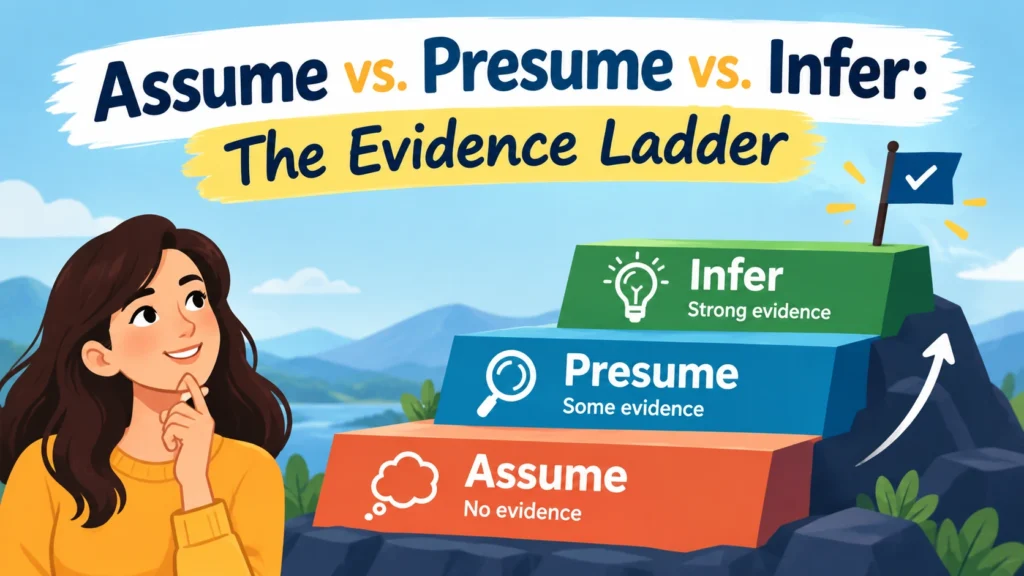
A simple evidence ladder can make these three verbs much easier to remember.
CONCLUSION
▲
│
┌────────┴────────┐
│ INFER │
│ Evidence → │
│ conclusion │
└────────┬────────┘
│
┌────────┴────────┐
│ PRESUME │
│ Reasonable │
│ likelihood │
└────────┬────────┘
│
┌────────┴────────┐
│ ASSUME │
│ Accept without │
│ confirmation │
└─────────────────┘
This diagram is a memory aid, not a strict rulebook.
Real English is messier than a three-step staircase.
No Supporting Evidence: Assume
You accept something as true without checking.
“I assumed the office was closed.”
Reasonable Grounds: Presume
You believe something is probably true because circumstances make it likely.
“I presumed the office was closed because all the lights were off and the doors were locked.”
Evidence-Based Conclusion: Infer
You use available information to reach a conclusion.
“I inferred that the office was closed after seeing the locked doors, dark windows, and posted closing notice.”
The examples overlap intentionally. The point is to show how the speaker frames the reasoning.
Important Limitation: The Ladder Is a Memory Aid
Don’t treat the ladder as a rigid scale where assume = weak, presume = medium, and infer = strong.
That’s too simplistic.
An assumption can be deliberate and well-founded. An inference can be weak. A presumption can be legally established rather than casually estimated.
The most useful distinction is how the belief or conclusion is formed.
How Evidence Changes the Verb You Should Use
Scenario: A Colleague Hasn’t Replied to an Email
Imagine you emailed Sarah at 9:00 a.m. She hasn’t replied by noon.
You might say:
I assume Sarah is busy.
This presents the idea as an assumption.
You could also say:
I presume Sarah is busy because she has three meetings today.
Now the statement highlights a reasonable basis.
Or you might say:
I inferred that Sarah was busy from her calendar and the fact that she hadn’t replied.
Here, the speaker explicitly connects evidence to a conclusion.
The situation stays the same. The framing changes.
Assume vs. Presume vs. Infer in Real-Life Situations
Scenario: A Dark and Wet Sidewalk
You leave your house and see a wet sidewalk.
You say:
I assume it rained.
You’re accepting a likely explanation.
You say:
I presume it rained.
You’re presenting rain as a reasonable explanation.
You say:
I infer that it rained from the wet pavement and puddles.
Now the evidence becomes central.
The third sentence is especially explicit about the reasoning process.
Scenario: A Student’s Test Result
A teacher sees that a student scored poorly.
The teacher shouldn’t automatically assume the student didn’t study.
There could be many explanations.
However, suppose the teacher sees several completed practice tests with repeated errors on the same topic. The teacher may infer that the student hasn’t mastered that concept.
The evidence changes the nature of the conclusion.
Scenario: Workplace Communication
Imagine a manager says:
“I assumed the project was finished.”
That may suggest the manager accepted the status without checking.
Now consider:
“I presumed the project was finished because the final review was scheduled for Friday.”
The manager gives a reason for the expectation.
Finally:
“I inferred that the project was finished from the completed checklist and final review notice.”
The third sentence emphasizes evidence.
Assume vs. Presume: Are They Interchangeable?
Where They Overlap
Yes, assume and presume can overlap.
Both can describe accepting something as true without absolute certainty.
For example:
“I assume she’ll arrive soon.”
and
“I presume she’ll arrive soon.”
can communicate a similar basic expectation.
However, the second can sound more formal or more explicitly based on likelihood.
When Presume Adds a Different Shade
Presume often highlights reasonable expectation.
For example:
“I presume the package has arrived since tracking says it was delivered.”
The speaker isn’t claiming direct knowledge.
Instead, the available circumstances make the conclusion seem likely.
When Assume Is More Natural
Assume generally fits ordinary conversation very comfortably.
You might say:
- “I assumed you knew.”
- “Don’t assume anything.”
- “Let’s assume he’s right.”
- “I assumed the store was open.”
These expressions sound natural and familiar.
When Presume Is More Natural
Presume becomes particularly useful in:
- Legal contexts
- Formal writing
- Formal correspondence
- Academic discussion
- Situations involving reasonable expectation
For instance:
The law presumes innocence until guilt is established.
That wording has a formal and specialized function.
Infer vs. Assume: The Critical Distinction
The difference becomes clearer when you ask one question:
Did you start with an accepted belief, or did you start with evidence?
Assume Starts With a Belief
“I assumed Mark was sick.”
The sentence doesn’t explain the evidence.
Maybe Mark looked tired. Maybe he stayed home. Maybe the speaker simply expected him to be sick.
Infer Starts With Evidence
“I inferred that Mark was sick from his message about having a fever.”
Now the evidence is visible.
Assume focuses on accepting an idea.
Infer focuses on drawing a conclusion.
That distinction is especially useful in academic and professional writing.
Infer vs. Imply: Don’t Mix Up the Two
One of the most persistent vocabulary mistakes involves infer and imply.
The words describe different directions.
Simple Rule
A speaker or writer implies. A listener or reader infers.
Cambridge makes this same distinction in its explanation of infer and imply.
Consider this conversation:
Maya: “It’s getting pretty late.”
Jordan: “Are you implying that I should leave?”
Maya: “I’m not saying that directly.”
If Jordan concludes that Maya wants him to leave, Jordan infers that meaning.
If Maya communicates the suggestion indirectly, Maya implies it.
Example Dialogue
Alex: “Your presentation is tomorrow morning.”
Chris: “Are you implying that I should practice?”
Alex: “I’m just reminding you.”
Chris may infer that Alex thinks more practice would help.
Alex may have implied that suggestion.
The direction matters.
Common Infer/Imply Error
Incorrect:
“The article inferred that prices would rise.”
If the article is communicating the idea, implied is generally the appropriate verb.
Better:
“The article implied that prices would rise.”
A reader can then infer the meaning from the article.
Common Mistakes With Assume, Presume, and Infer
Mistake: Using Infer for an Unsupported Guess
Incorrect:
“I inferred that Tom was home because I had no information about him.”
If there is genuinely no evidence, infer isn’t the best choice.
Better:
“I assumed that Tom was home.”
The difference is small in appearance but important in reasoning.
Mistake: Treating Assume and Presume as Perfect Synonyms
They overlap, but they’re not identical in every context.
Assume often emphasizes acceptance without confirmation.
Presume can emphasize likelihood or reasonable expectation.
The distinction becomes especially important in formal and legal language.
Mistake: Thinking Presume Means Certain
It doesn’t.
Cambridge explicitly defines presume as believing something because it is likely even though it isn’t certain.
So:
“I presume he’ll come.”
doesn’t mean:
“I know he’ll come.”
It means the speaker considers his arrival likely.
Mistake: Thinking Infer Means Know
Inference isn’t direct knowledge.
You might infer that someone is upset from their behavior. That doesn’t prove exactly what they’re feeling.
A useful distinction is:
Evidence can support a conclusion without making the conclusion infallible.
Mistake: Using Formal Words Just to Sound Intelligent
Sometimes writers reach for presume or infer when assume or think would be clearer.
That’s unnecessary.
Good writing isn’t a vocabulary obstacle course.
Choose the word that expresses the intended reasoning most accurately.
Assume, Presume, and Infer in Different Types of Writing
Casual Conversation
Assume usually feels the most natural.
“I assumed you were coming.”
Presume is possible but can sound more formal.
Infer works when you’re explicitly describing a conclusion drawn from clues.
“I inferred from his message that he was annoyed.”
Workplace Communication
Precision matters at work because assumptions can quickly become misunderstandings.
Compare:
“I assumed the deadline was Friday.”
with:
“I understood the deadline to be Friday. Could you confirm?”
The second version avoids presenting an unverified belief as an established fact.
When evidence matters:
“Based on the available data, we can infer that customer demand has changed.”
That wording clearly signals reasoning.
Academic Writing
Academic writing often distinguishes between:
- assumptions
- observations
- evidence
- interpretations
- conclusions
For example:
“The model assumes that the variables remain independent.”
That’s a methodological assumption.
Meanwhile:
“The results suggest that the two variables are related.”
And:
“From these results, researchers inferred that the treatment affected the outcome.”
The verbs help readers understand how the writer moves from evidence to conclusion.
News and Reporting
Careful reporting requires separating facts from conclusions.
A reporter may describe what a source said, what evidence showed, and what analysts inferred.
This distinction prevents a conclusion from being presented as though it were directly observed fact.
Legal Writing
Legal language gives presume a particularly important role.
Expressions involving presumption often carry technical significance.
For example:
presumed innocent
isn’t merely a fancy alternative to assumed innocent. It belongs to established legal language.
That is why context matters so much when comparing these verbs.
How Word Choice Changes the Meaning
Consider one basic idea:
He is home.
Now change the verb.
“I Assume He Is Home.”
The speaker accepts this as true without emphasizing proof.
“I Presume He Is Home.”
The speaker presents it as a likely or reasonable belief.
“I Infer He Is Home.”
The speaker indicates that some available information led to the conclusion.
Here’s the difference in compact form:
| Sentence | Main emphasis |
| I assume he is home. | Acceptance |
| I presume he is home. | Likelihood |
| I infer he is home. | Evidence-based conclusion |
That three-word distinction can make a sentence considerably more precise.
A Practical Memory Trick for Assume vs. Presume vs. Infer
The Evidence Test
Ask:
“What am I starting with?”
If you’re simply accepting something without confirmation:
Assume
If you’re treating something as likely because circumstances support it:
Presume
If you’re examining information and reaching a conclusion:
Infer
The Direction Test
Think of the verbs this way:
Assume → accept
Presume → expect
Infer → conclude
It’s simple, but simple memory hooks often work better than complicated grammar rules.
The Speaker-and-Reader Test
For imply vs. infer, remember:
The speaker implies. The listener infers.
The message travels outward through implication. The conclusion travels inward through inference.
Case Study: One Situation, Three Meanings

Imagine that David normally arrives at work at 8:30 a.m.
At 9:15, his desk is empty.
His phone goes to voicemail.
His car isn’t in the parking lot.
How might three different verbs describe the situation?
Using Assume
I assume David isn’t at work today.
This accepts the conclusion without explaining the evidence.
Using Presume
I presume David isn’t at work today because his car isn’t here.
Now the speaker offers a reason that makes the belief seem reasonable.
Using Infer
I inferred that David wasn’t at work from his empty desk, unanswered phone, and missing car.
This version explicitly describes the reasoning process.
What Changes When the Verb Changes?
| Feature | Assume | Presume | Infer |
| Confirmation | Not required | Not required | Evidence supports conclusion |
| Likelihood | May be implied | Often emphasized | Depends on evidence |
| Evidence | May be absent | Often some reasonable basis | Central to the meaning |
| Tone | Neutral and common | More formal in many contexts | Analytical or formal |
| Main idea | Accept | Expect | Conclude |
The key isn’t simply “how certain” the speaker sounds.
It’s how the speaker arrived at the conclusion.
How to Choose the Right Word in One Second
When you’re stuck between assume, presume, and infer, ask three questions.
Are You Accepting Something Without Confirmation?
Use assume.
“I assumed the appointment was canceled.”
Are You Treating Something as Likely Because the Circumstances Support It?
Use presume.
“I presumed the appointment was canceled because the office was closed and the staff had emailed clients.”
Are You Drawing a Conclusion From Evidence?
Use infer.
“I inferred that the appointment was canceled from the office closure notice and cancellation email.”
There’s another useful option: sometimes none of these words is the best choice.
You might need:
- think
- believe
- expect
- guess
- suspect
- conclude
- determine
For example:
“I think she’s busy.”
can sound more natural than:
“I presume she’s busy.”
Precision doesn’t always mean choosing the more sophisticated word.
Sometimes the plainest word is exactly right.
A Quick Decision Guide for Assume vs. Presume vs. Infer
Use this mental checklist:
Do you accept something as true?
│
▼
ASSUME
Do you believe it is likely based
on reasonable circumstances?
│
▼
PRESUME
Do available facts or clues lead
you to a conclusion?
│
▼
INFER
Then check the context.
If you’re writing a legal document, presume may have a specialized role.
If you’re discussing evidence, infer may be more precise.
If you’re describing an everyday belief, assume will often sound most natural.
Frequently Asked Questions About Assume vs. Presume vs. Infer
What Does Assume Mean in Simple Terms?
Assume means accepting something as true without confirmation or proof.
For example:
“I assumed the store was open.”
You believed it was open, but you didn’t necessarily verify it.
What Is the Difference Between Assume and Presume?
Both words can mean believing something is true without complete certainty.
Assume often emphasizes accepting something without confirmation.
Presume often suggests that something seems likely or reasonably expected.
Cambridge defines presume specifically in terms of believing something because it is likely, while assume can involve accepting something as true without question or proof.
Does Presume Mean You Are Certain?
No.
Presume does not mean absolute certainty.
It commonly expresses a belief that something is likely even though it hasn’t been established with certainty.
What Does Infer Mean in English?
Infer means reaching a conclusion from available information, facts, or clues.
For example:
“From the empty shelves, I inferred that the store had been busy.”
The empty shelves provide the evidence. The conclusion is the inference.
Does Infer Require Evidence?
Yes, in its ordinary reasoning-related sense, infer involves information or evidence from which a conclusion is drawn.
The evidence doesn’t have to be conclusive. Even indirect clues can support an inference.
Can Assume and Presume Be Used Interchangeably?
Sometimes.
They overlap when both describe accepting something as true without complete certainty. However, presume often carries a stronger sense of likelihood or reasonable expectation and appears frequently in formal or legal language.
The surrounding context should guide your choice.
What Is the Difference Between Infer and Imply?
The direction is the easiest way to remember it.
A speaker or writer implies something. A listener or reader infers something.
For example:
“She implied that she was unhappy.”
“I inferred from her comments that she was unhappy.”
The speaker communicates indirectly. The listener draws the conclusion.
Which Word Should You Use in Formal Writing?
There isn’t one universally “formal” choice.
Use the verb that accurately describes the reasoning.
Use assume for an assumption.
Use presume when reasonable likelihood or a formal presumption matters.
Use infer when a conclusion comes from evidence or information.
Accuracy matters more than making a sentence sound sophisticated.
Is an Inference the Same as a Fact?
No.
A fact is information presented as established or directly observable.
An inference is a conclusion drawn from information.
You can make a strong inference from excellent evidence, but the inference remains a conclusion rather than the evidence itself.
Read More : That’s vs. Thats: Which Is Correct? A Complete Guide to English Usage
What Is an Easy Way to Remember Assume, Presume, and Infer?
Use this three-part rule:
Assume = accept.
Presume = expect.
Infer = conclude from clues.
If evidence drives the reasoning, infer is usually the word to consider first.
If you’re simply accepting something as true, assume is usually the natural choice.
If something seems likely based on reasonable circumstances, presume may fit better.
Final Summary: Assume vs. Presume vs. Infer
The difference between assume, presume, and infer becomes much clearer once you focus on the reasoning behind each word.
Assume means accepting something as true without confirmation or proof. It’s common, flexible, and natural in everyday English.
Presume means believing something is true because it seems likely, although it isn’t certain. It often sounds more formal and has important uses in legal language.
Infer means reaching a conclusion from available information, facts, observations, or clues. It focuses on the movement from evidence to conclusion.
Here’s the final cheat sheet:
| If you mean… | Use… |
| Accept something without confirming it | Assume |
| Believe something is likely | Presume |
| Reach a conclusion from evidence | Infer |
| Communicate something indirectly | Imply |
The most useful question isn’t “Which word sounds more intelligent?”
Ask something better:
“How did I arrive at this conclusion?”
If you accepted it without confirmation, assume may fit.
If you consider it likely based on reasonable circumstances, presume may fit.
If evidence led you to the conclusion, infer is usually the precise choice.
Once that distinction clicks, these three verbs stop being a vocabulary maze and start working like clearly labeled tools. Each has a job. Choose the one that matches the reasoning behind your sentence.