
At first glance, “soo” and “so” look almost identical, but they don’t play the same role in everyday writing. The standard English word is “so,” while “soo” usually appears as an informal spelling used to stretch or emphasize the sound of “so.” Understanding this small difference can help you choose the right form for correct spelling, English grammar, and informal communication.
You’ll often see “so” in ordinary sentences such as “I’m so happy” or “That was so funny.” It can express degree, introduce a result, or connect ideas. By contrast, “soo” may appear in text messages, social media, online conversations, and playful dialogue when a writer wants extra emphasis, excitement, frustration, hesitation, or emotion.
That doesn’t automatically make “soo” a spelling mistake. Its acceptability depends on context and purpose. In formal essays, reports, business emails, and academic writing, standard English generally calls for “so.” In casual digital communication, however, “soo” can deliberately change the tone of writing without changing the basic meaning.
This guide breaks down Soo vs. So, explains when each form appears, and shows how context affects word choice, tone, and writing style. This distinction helps you write naturally and avoid spelling errors in the wrong context entirely.
Soo vs. So: The Quick Answer
If you’re wondering “Should I write so or soo?”, use so in standard English.
| Form | Standard English? | Typical use | Example |
| so | Yes | Standard writing and speech | She is so happy. |
| soo | Generally no as a spelling of so | Informal, expressive writing | I’m soo excited! |
| sooo | No | Stronger informal emphasis | That was sooo funny! |
| soooo | No | Highly exaggerated digital expression | I’m soooo hungry! |
The extra letters in soo normally communicate tone rather than a new dictionary meaning.
Think of it like stretching your voice when speaking. If you say, “That was so good,” the word can remain neutral. If you draw it out as “That was sooo good,” your voice can sound more enthusiastic. Online, writers sometimes reproduce that effect by adding letters.
So, the practical rule is easy:
Use “so” for standard English. Use “soo” only when you intentionally want an informal, expressive effect.
What Does “So” Mean in Standard English?
The word so is extremely versatile. It can function in several grammatical roles and can express degree, consequence, manner, agreement, and purpose.
That versatility explains why you see it everywhere.
Consider these examples:
- The coffee is so hot.
- She was tired, so she went home.
- I think so.
- Do it so.
- He left early so that he could catch the train.
- I don’t think so.
Although the spelling never changes, the grammatical job can change depending on the sentence.
Major dictionaries such as Merriam-Webster and Cambridge Dictionary document the many uses of so.
“So” as an Adverb
One of the most familiar uses of so is as an adverb.
Here, so often modifies an adjective or another adverb to indicate a high degree.
For example:
- The water is so cold.
- That movie was so interesting.
- She runs so quickly.
- You explained it so clearly.
In these sentences, so intensifies the word that follows it.
Compare:
The movie was interesting.
with:
The movie was so interesting.
The second sentence carries more emotional force. The speaker isn’t merely saying the movie was interesting. The word so adds emphasis.
“So” as a Conjunction
So can also connect two clauses and show a result or consequence.
For example:
It started raining, so we went inside.
The first clause gives the situation. The second clause gives the result.
Another example:
She studied every night, so she passed the exam.
The relationship becomes:
Cause → Result
It started raining
↓
We went inside
She studied every night
↓
She passed the exam
This use of so is especially common in everyday English because it creates a quick and natural connection between ideas.
“So” in Purpose Clauses
The expression so that often introduces a purpose or intended result.
For example:
I set an alarm so that I wouldn’t oversleep.
Here, setting the alarm has a purpose.
Another example:
She spoke quietly so that the baby could sleep.
The phrase doesn’t simply connect two events. It explains what someone wanted to achieve.
This is different from the simple result use:
The baby was sleeping, so she spoke quietly.
In the first sentence, speaking quietly is the action taken for a purpose. In the second, the sleeping baby explains the reason for the resulting action.
Common and Correct Uses of “So”
The word so appears in countless everyday constructions. Understanding its common patterns makes the Soo vs. So distinction much easier.
Showing Degree or Emphasis
The pattern so + adjective is one of the most common structures.
Examples include:
- You’re so kind.
- That house is so beautiful.
- This coffee is so strong.
- The instructions are so confusing.
You can also use so + adverb:
- She sings so beautifully.
- He answered so quickly.
- They worked so efficiently.
The word adds intensity without changing the basic adjective or adverb.
Showing Cause and Effect
Another major use of so is to introduce a consequence.
Examples:
The restaurant was full, so we chose another one.
I forgot my umbrella, so I got wet.
The battery was dead, so the phone wouldn’t turn on.
In each example, so connects an earlier situation to its result.
You can often replace it with therefore, although the tone changes.
The battery was dead, so the phone wouldn’t turn on.
sounds natural and conversational.
The battery was dead. Therefore, the phone wouldn’t turn on.
sounds more formal.
Linking Ideas Naturally
In conversation, so can also help move from one idea to another.
For example:
So, what are we doing tonight?
Here, so isn’t simply expressing degree or consequence. It helps introduce the next point.
You might hear:
So, let’s talk about the main problem.
or:
So, what happened after that?
This conversational use is extremely common in spoken English. It can signal a transition, conclusion, or shift in topic.
Expressing Agreement or Referring to Information
Some of the most useful expressions with so don’t fit neatly into the basic patterns above.
Consider:
I think so.
The word so refers back to something already mentioned.
For example:
“Will they arrive today?”
“I think so.”
The second speaker avoids repeating the entire idea.
Other common expressions include:
- I hope so.
- I guess so.
- I believe so.
- If so…
- So do I.
- So am I.
- So can she.
These constructions demonstrate why so isn’t merely an intensifier.
What Does “Soo” Mean?
Now we reach the heart of Soo vs. So.
In ordinary modern English, soo is generally not the standard spelling of the common word so. When people type soo in texts, comments, or social media, they usually intend to stretch the word for emphasis.
For example:
I am so excited!
is neutral standard spelling.
I am soo excited!
looks more emotional and informal.
And:
I am sooo excited!
pushes that effect even further.
The extra letters work almost like stage directions. They tell the reader, “Don’t hear this word in a flat voice.”
This is one reason informal digital writing can look surprisingly expressive despite having no actual sound.
Why Do People Write “Soo” Instead of “So”?
There isn’t a new grammar rule behind soo. Instead, several features of modern communication encourage this spelling.
Emotional Emphasis
Imagine saying:
“I missed you so much.”
Now imagine drawing out the word:
“I missed you soooo much!”
The meaning remains closely related, but the emotional delivery changes.
Online, writers can’t stretch their voice in the same physical way. Repeated letters provide a visual substitute.
You’ll see the same technique with other words:
- nooo!
- yesss!
- pleeease!
- whyyy?
- sooo cute!
These aren’t usually attempts to rewrite the English dictionary. They’re attempts to reproduce speech-like emotion in text.
Texting and Social Media Habits
Digital communication rewards speed, personality, and emotional immediacy.
A short message such as:
That’s so nice.
is perfectly clear.
But a friend might write:
That’s sooo nice!
The second version feels more animated.
Social media has made these expressive spellings particularly visible because posts and comments often imitate casual speech. Users also develop personal writing habits. Some people stretch vowels. Others repeat consonants. Some add multiple exclamation points.
These choices communicate personality as much as information.
Speed Over Precision
Texting doesn’t always follow the conventions of edited prose.
People abbreviate words, omit punctuation, use emojis, and intentionally bend spelling. The goal isn’t always grammatical precision. Often, it’s simply to communicate quickly and naturally.
That doesn’t make every informal spelling a mistake.
Context matters.
If someone writes:
I’m soo happy right now!
in a casual text, the intention is probably obvious.
If the same spelling appears in a formal report, however, the context changes the expectation.
Where “Soo” Actually Appears in Writing
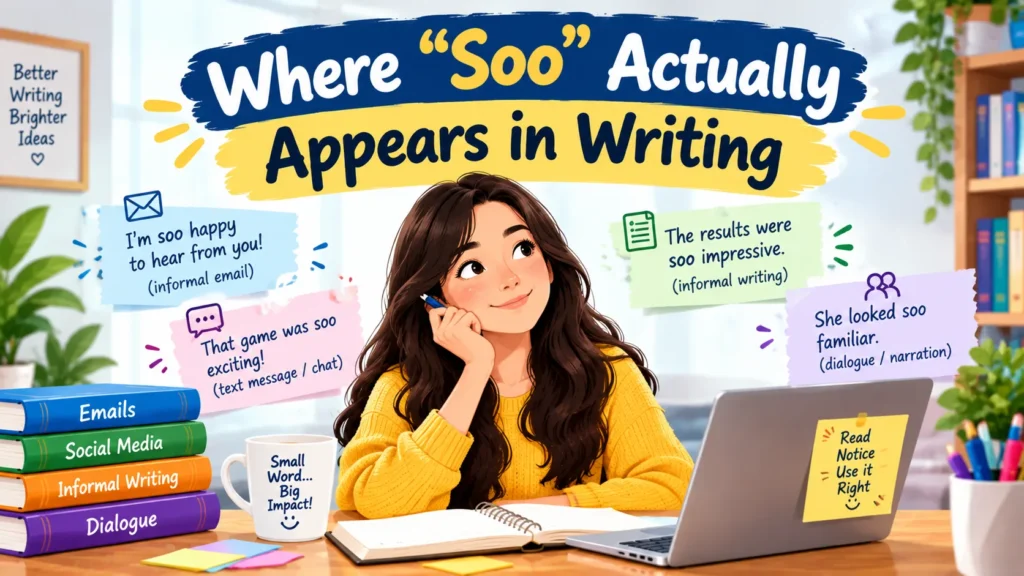
You are most likely to encounter soo in informal digital spaces.
Common Places “Soo” Appears
- Text messages
- Group chats
- Social media comments
- Direct messages
- Online forums
- Memes
- Informal posts
- Fan communities
- Casual creative dialogue
- Playful captions
The spelling often appears when someone wants to amplify emotion.
For example:
That puppy is soo cute.
The writer isn’t usually making a claim about a different word called soo. They’re stretching so for expressive effect.
Soo vs. So in Formal and Informal English
The biggest practical difference between soo vs. so concerns register.
Register means the style of language appropriate for a particular situation.
You don’t speak to a close friend exactly the way you write a job application. Likewise, you shouldn’t automatically transfer texting habits into formal documents.
Formal Writing and Professional Communication
In formal writing, choose so.
That includes:
- Academic essays
- Research papers
- Business reports
- Resumes
- Cover letters
- Professional emails
- Applications
- Official notices
- Documentation
- Client communication
For example:
The results were so significant that the researchers conducted a second analysis.
This is appropriate standard English.
Writing:
The results were soo significant…
would make the sentence look informal and potentially careless.
The problem isn’t that your reader won’t understand it. Most likely, they will. The issue is that formal writing has different expectations.
When precision matters, conventional spelling wins.
Informal Writing and Casual Conversation
In a personal text, the rules loosen.
You might write:
I’m soo hungry right now.
or:
That was sooo funny.
Here, the spelling communicates emotion.
However, even informal writing benefits from restraint. If every other word contains repeated letters, the effect can become noisy.
Compare:
That was sooo funnyyyy omg!!!
with:
That was sooo funny!
Both communicate excitement. The second is easier to read.
When You Should Always Use “So” Instead of “Soo”
When in doubt, choose so.
That’s especially true when your writing represents you professionally or academically.
Use so when:
- You are writing for school.
- You are preparing a professional document.
- You are sending a formal email.
- You are writing for customers.
- You are submitting an application.
- You are creating technical documentation.
- You are writing an article intended for a formal audience.
- You want conventional spelling.
- You aren’t deliberately expressing exaggerated emotion.
A useful rule is:
If you would expect a dictionary or style guide to recognize the spelling as standard English, use “so.”
That simple test solves most Soo vs. So questions.
When “Soo” Might Be Acceptable
There are situations where soo works perfectly well as a stylistic choice.
Acceptable Situations
Consider using it when you’re deliberately writing informal dialogue or casual digital communication.
For example:
I’m soo ready for the weekend!
That dress is sooo pretty.
Nooo, you didn’t!
In these examples, the unusual spelling carries part of the message.
It suggests that the writer isn’t speaking in a flat, neutral voice.
Still, acceptable here means stylistically understandable in an informal context. It doesn’t mean soo has become the standard spelling of so.
That’s an important distinction.
Soo vs. So in Real Examples
Seeing the two forms side by side makes the difference clearer.
| Sentence | What it communicates | Appropriate context |
| I’m so happy. | Strong but standard statement | Any context |
| I’m soo happy! | Extra enthusiasm | Casual |
| I’m sooo happy! | Very strong enthusiasm | Casual |
| The results were so impressive. | Formal emphasis | Academic/professional |
| The results were soo impressive. | Informal visual emphasis | Avoid in formal writing |
| Thank you so much. | Standard gratitude | Any context |
| Thank you sooo much! | Strong emotional gratitude | Casual |
| The weather was so cold that we stayed inside. | Degree + result | Standard writing |
Notice something important: the underlying meaning doesn’t suddenly change when one extra “o” appears.
The main change is the emotional presentation.
A Closer Look at “So” vs. “Soo” in Text Messages
Texting is where the distinction becomes especially interesting.
Suppose someone asks:
“Did you like the concert?”
You could respond:
So much!
That sounds positive and straightforward.
Or:
Sooo much!
Now the response feels more enthusiastic.
The spelling gives the reader a hint about your voice.
Similarly:
I’m so sorry.
sounds sincere and neutral.
I’m sooo sorry!
can sound more emotionally expressive. Depending on the situation, it could communicate genuine regret, playful exaggeration, or even sarcasm.
That’s why context matters more than the spelling alone.
How “Soo” Can Change Tone Without Changing the Basic Word

Consider this progression:
That’s so good.
That’s soo good!
That’s sooo good!
That’s soooo good!!!
The grammatical structure hasn’t changed.
The adjective good remains the same. The basic role of so remains the same.
What changes is the visual intensity.
It’s similar to changing your voice from:
“Really?”
to:
“Reaaally?!”
Written language often lacks facial expressions, gestures, and vocal pitch. Informal spelling sometimes fills that gap.
Common Mistakes With “Soo” and “So”
Mistake: Treating “Soo” as a Standard Alternative Spelling
One of the most common errors is assuming that soo is simply another correct spelling of so.
It isn’t the standard spelling for the ordinary English word.
If you’re writing:
The test was soo difficult.
in an essay, changing it to:
The test was so difficult.
fixes the spelling immediately.
Mistake: Using “Soo” in Professional Writing
A spelling that works in a group chat may look out of place in a business document.
Imagine a customer-service email saying:
We’re soo happy to help you!
The reader will understand the message. Yet the extended spelling makes the communication sound unusually casual.
A cleaner version is:
We’re so happy to help you!
The second sentence preserves warmth without sacrificing professionalism.
Mistake: Confusing Emphasis With Correctness
This distinction is worth remembering:
Something can be intentional without being standard.
A writer might deliberately spell a word incorrectly in dialogue to represent speech. That doesn’t mean the spelling has become standard English.
For example, fictional dialogue may contain:
Nooo! Don’t go!
The writer isn’t making a spelling mistake necessarily. The repeated o visually represents an elongated cry.
The same principle applies to soo.
Mistake: Confusing Informal Spelling With Grammar
Spelling and grammar aren’t the same thing.
Grammar determines how words function in sentences.
Spelling determines how those words are represented in writing.
The sentence:
I’m so tired.
uses standard spelling and grammar.
The sentence:
I’m soo tired.
keeps essentially the same grammatical structure while changing the spelling for expressive effect.
That’s why it’s useful to identify the problem correctly. The second sentence isn’t necessarily “bad grammar.” It’s nonstandard informal spelling.
Mistake: Adding Too Many Letters
Digital writing can quickly become exaggerated.
For example:
I’m soooooooo tired.
Sometimes that’s exactly the desired effect. In other cases, it becomes difficult to read.
A good informal writer uses repeated letters like seasoning. A little can add flavor. Too much overwhelms the dish.
Is “Soo” a Real English Word?
The answer needs a small qualification.
Soo is not normally the standard spelling of the common English word “so.” In ordinary modern English usage, if you mean the familiar adverb, conjunction, or related function word, the conventional spelling is so.
However, English contains dialectal words, proper names, place names, and specialized uses that can produce spellings such as Soo. Those unrelated uses shouldn’t be confused with someone typing soo to stretch so in a text message.
So when someone asks:
“Is soo a real word?”
the most useful answer is:
As an informal spelling of “so,” it isn’t standard English. In other specialized or proper-name contexts, “Soo” may occur independently.
That distinction prevents an overly broad claim that every appearance of soo is automatically meaningless or incorrect.
Read More : BBW Meaning in Text: What It Means, How It’s Used, and Why Context Matters
Does “Soo” Have the Same Pronunciation as “So”?
In informal writing, soo generally represents a drawn-out pronunciation of so.
Imagine saying:
“I’m so excited.”
Now lengthen the vowel:
“I’m soooo excited!”
The written repetition attempts to capture that extended sound.
It doesn’t create a standard new pronunciation rule.
English speakers don’t normally learn soo as a separate standard form of so. Instead, readers infer the intended stretched pronunciation from the spelling and context.
This is similar to writing:
Noooo!
instead of:
No!
The additional letters suggest that the speaker prolonged the sound.
What Does “Sooo” Mean in Texting?
The spelling sooo is simply a stronger version of the same informal strategy.
For example:
That movie was sooo good.
The writer probably means something like:
That movie was really good.
But the repeated vowel adds a more personal and emotional flavor.
Depending on context, sooo can express:
- Excitement
- Affection
- Surprise
- Frustration
- Exaggeration
- Playfulness
- Sarcasm
- Dramatic emphasis
The number of repeated letters doesn’t have a fixed mathematical meaning.
Three os don’t formally mean one level of excitement while five mean another. The reader interprets the exaggeration from context.
Soo vs. So in Creative Writing
Creative writers sometimes bend spelling intentionally.
Dialogue is a particularly natural place for this.
For example:
“I am sooo sorry!” Maya said, covering her face.
The extended spelling can help communicate how Maya says the word.
However, authors shouldn’t use unusual spelling simply because it looks lively. Too much phonetic spelling can distract readers and make dialogue harder to follow.
A strong stylistic choice should earn its place.
If standard so communicates the intended voice perfectly well, there may be no reason to stretch it.
A Simple Decision Rule for Soo vs. So
When you’re unsure which form to choose, ask yourself three questions:
Are You Writing Standard English?
If yes, choose so.
Are You Deliberately Representing Emotion or Drawn-Out Speech?
If yes, soo or sooo may work in an informal context.
Is the Audience Expecting Professional or Academic Language?
If yes, stick with so.
The decision tree is straightforward:
Soo vs. So
|
Are you writing
standard English?
/ \
Yes No
| |
Use “so” Is the spelling
intentionally expressive?
/ \
Yes No
| |
“soo/sooo” may Use “so”
work casually
Case Study: One Sentence, Three Different Contexts
Consider this sentence:
The presentation was so good.
Now imagine three settings.
Academic Report
The presentation was so effective that participants reported higher engagement.
Here, so works naturally.
The writing communicates a clear relationship between degree and result.
Text Message
Your presentation was sooo good!
Here, the extra letters make sense because the writer is expressing enthusiasm.
Workplace Email
Your presentation was so good. The examples made the main points especially clear.
This version remains warm while maintaining professional polish.
The lesson isn’t that informal spelling is always bad. The lesson is that good writing matches the situation.
Why Choosing “So” Over “Soo” Improves Standard Writing
Standard spelling gives your reader one less thing to interpret.
When you write:
The process was so effective.
the reader focuses on the meaning.
When you write:
The process was soo effective.
the reader may briefly wonder whether the spelling is intentional.
In casual communication, that uncertainty is usually harmless. In formal writing, unnecessary distractions can weaken the impression of precision.
Using so also makes your writing more consistent with dictionaries, grammar references, educational materials, and professional style conventions.
Standard spelling isn’t about making writing boring. It creates a dependable foundation. You can still make your prose energetic through vocabulary, rhythm, examples, sentence structure, and punctuation.
Soo vs. So: Quick Comparison Guide
| Feature | So | Soo |
| Standard spelling | Yes | No, when intended as so |
| Formal writing | Appropriate | Generally inappropriate |
| Academic writing | Appropriate | Avoid |
| Professional email | Appropriate | Avoid |
| Casual texting | Appropriate | Common as an expressive variant |
| Social media | Appropriate | Common |
| Emotional emphasis | Possible | Stronger visual emphasis |
| Drawn-out pronunciation | Not specifically indicated | Often implied |
| Dictionary-standard form of ordinary so | Yes | No |
| Main purpose | Meaning and grammar | Informal style and emotion |
How to Remember the Difference
Here’s an easy memory trick:
One “o” is standard. Extra “o”s are style.
If you’re writing an essay, report, email, application, or article, use:
so
If you’re texting a friend and want to stretch the sound, you might write:
soo or sooo
The extra letters act like a little theatrical gesture. They aren’t usually part of the standard spelling.
Frequently Asked Questions About Soo vs. So
Is “soo” a real English word?
Soo can occur in specialized, dialectal, or proper-name contexts. However, it isn’t the standard spelling of the ordinary English word so. In casual texting, soo usually represents an intentionally stretched form of so.
What does “so” mean in English?
So has several functions. It can express degree, introduce a result, connect ideas, refer back to information, and appear in purpose constructions such as so that. Its exact meaning depends on the sentence.
Is “soo” grammatically correct?
As the ordinary word so, soo isn’t the standard spelling. In informal digital writing, people may intentionally use it for emphasis. That makes it a stylistic choice rather than a standard spelling rule.
When should I use “so” instead of “soo”?
Use so whenever you are writing standard English. That includes academic work, professional communication, applications, reports, and formal correspondence. Use soo only when an informal and expressive tone is intentional.
Why do people spell “so” as “soo”?
People often add letters to imitate a drawn-out pronunciation. The extra letters can communicate excitement, affection, frustration, surprise, exaggeration, or humor.
Can “soo” be used in formal writing?
When soo is being used as an informal spelling of so, it generally shouldn’t appear in formal writing. Standard so is the appropriate choice in professional and academic contexts.
What does “sooo” mean in texting?
Sooo usually means that the writer is stretching the sound of so for emphasis. It can make a statement sound more excited, emotional, playful, or dramatic.
Does “soo” mean the same thing as “so”?
Usually, yes, when it appears in casual texting as a stretched spelling. The underlying word is still so. The additional letters mainly change the tone or emotional intensity.
Is “soo” a typo?
Not necessarily. A person might accidentally type soo, but they might also use it deliberately to emphasize emotion. Context usually reveals the writer’s intention.
Is “sooo” more correct than “soo”?
No. Neither spelling is the standard form of the ordinary word so. Both can function as informal expressive spellings, with sooo generally suggesting a more prolonged or exaggerated effect.
Can I use “soo” in social media posts?
Yes, if the post is intentionally casual and expressive. Social media often uses stretched spellings to communicate personality and emotion. If you’re publishing formal or professional content, standard so is the safer choice.
Is “so” always an adverb?
No. So can perform several grammatical functions. It can act as an adverb and can also function as a conjunction or appear in constructions such as so that and I think so.
Final Summary: Soo vs. So
The difference between soo vs. so is much easier once you separate standard English from informal digital style.
So is the standard spelling. It can express degree, connect causes and results, introduce transitions, indicate purpose in so that constructions, and refer back to information in expressions such as I think so.
Soo, on the other hand, is commonly used online as an expressive spelling. The extra o stretches the visual form of the word and can suggest stronger emotion or a drawn-out pronunciation.
The distinction can be summed up like this:
“So” carries the standard meaning and grammar. “Soo” usually carries extra emotion.
Use so when accuracy, clarity, and conventional English matter. Save soo and sooo for situations where the informal style is intentional, such as texts, social media, playful messages, or carefully crafted dialogue.
Once you recognize that difference, the Soo vs. So question stops being confusing. It’s less about choosing between two standard spellings and more about knowing when you’re writing English conventionally and when you’re deliberately bending the spelling to make your words sound more alive.