Have you ever paused over the phrase “its self” and wondered whether it should actually be written as “itself”? You’re not alone. The difference between its self or itself seems tiny, yet that extra space can completely change how a sentence works. In standard English, itself is the correct reflexive pronoun when you mean that an object, animal, organization, or other nonhuman subject refers back to itself. For example, “The machine shut itself down” uses the reflexive pronoun correctly. By contrast, its is a possessive determiner that shows ownership, as in “The company changed its policy.”
The confusion becomes even greater because English uses similar forms such as himself, herself, themselves, and yourself. These words function as reflexive pronouns, while its has a different grammatical role. Understanding the distinction between its vs. itself, possessive pronouns, and reflexive forms can help you avoid awkward wording in emails, essays, professional writing, and everyday conversation.
In this guide, you’ll learn when to use itself, why “its self” is usually incorrect, and how context determines the right choice. A few simple rules can make this grammar question much easier.
Its Self or Itself: The Quick Answer
The standard form is itself.
| Form | Main function | Standard use? | Example |
| itself | Reflexive pronoun | Yes | The dog hurt itself. |
| itself | Emphasis | Yes | The machine itself stopped. |
| its | Possession | Yes | The machine lost its power. |
| it’s | It is or it has | Yes | It’s working again. |
| its self | Possessive + noun | Rare and context-dependent | The writer explored its self as an idea. |
The important point is that its self and itself aren’t simply two spellings of the same word.
Compare these:
- The robot repaired itself. ✅
- The robot repaired its self. ❌ in ordinary modern English
The first sentence uses itself as a reflexive pronoun. The action of repairing returns to the robot.
The second sentence attempts to split that pronoun into two words. In ordinary grammar, that doesn’t work.
However, a sentence such as “The philosopher examined its self” can theoretically have a different structure if self is being treated as a noun. That usage is unusual and depends heavily on context.
What Does “Itself” Actually Mean?
Itself is the reflexive form of it.
A reflexive pronoun points back to the subject of a clause. When the subject is it and the object refers to the same thing, English normally uses itself.
Consider:
The cat washed itself.
Here, the cat performs the action. The cat also receives the action. The reflexive pronoun itself connects the two.
The structure looks like this:
The cat → washed → itself
The same pattern works with objects, animals, organizations, machines, situations, and ideas when English uses it to refer to them.
Examples:
- The dog injured itself.
- The computer restarted itself.
- The company introduced itself to new customers.
- The door locked itself.
- The problem eventually resolved itself.
- The software updated itself overnight.
Cambridge defines itself as the form used when the subject and object refer to the same thing, animal, situation, or idea.
“Itself” Can Also Add Emphasis
Itself doesn’t always function as the object of a verb.
Sometimes it simply emphasizes the noun or pronoun it follows.
For example:
The company itself announced the change.
The sentence doesn’t mean the company announced itself. Instead, itself highlights the company.
You could remove the word and still have a grammatical sentence:
The company announced the change.
The emphatic version gives extra focus to the company.
More examples include:
- The building itself is beautiful.
- The proposal itself isn’t controversial.
- The machine itself isn’t the problem.
- The president’s office itself issued the statement.
- The idea itself deserves more attention.
Cambridge also distinguishes this emphatic use from the reflexive use.
What Are Reflexive Pronouns?
Reflexive pronouns usually end in -self or -selves. They correspond to personal pronouns.
Here is the standard pattern:
| Subject pronoun | Reflexive pronoun |
| I | myself |
| you | yourself |
| he | himself |
| she | herself |
| it | itself |
| one | oneself |
| we | ourselves |
| you | yourselves |
| they | themselves |
This pattern explains why itself is written as one word.
English doesn’t normally create the reflexive form by taking a possessive determiner and placing self after it. Instead, itself is an established reflexive pronoun.
Cambridge’s grammar reference explicitly lists it → itself among the standard reflexive pairs.
That makes these forms parallel:
- I → myself
- he → himself
- she → herself
- it → itself
- they → themselves
So when you need the reflexive form of it, reach for itself.
How “Itself” Works in Real Sentences
Understanding the rule becomes easier when you see the word doing different jobs.
Reflexive Usage
The most basic use occurs when the subject and object refer to the same thing.
The puppy scratched itself.
The puppy performed the action and received it.
Another example:
The company blamed itself for the failure.
The company is the subject. The company is also the object of blamed. Therefore, itself is appropriate.
More examples:
- The bird cleaned itself.
- The phone switched itself off.
- The engine overheated itself? ❌
- The engine shut itself off. ✅
- The organization committed itself to the project.
- The system protects itself from overheating.
Notice that the verb matters. A reflexive pronoun isn’t inserted simply because the sentence contains an object. The pronoun must have the right grammatical relationship.
Formal Usage
You’ll find itself frequently in professional, academic, legal, and technical writing.
For example:
The software automatically updates itself when a new version becomes available.
Or:
The organization has committed itself to improving customer service.
These sentences don’t sound unusually formal. Itself is simply the normal grammatical form.
In technical writing, reflexive constructions can also make descriptions precise:
The system monitors itself for abnormal activity.
The system performs the monitoring and the monitoring concerns the system.
Emphatic Usage
Now consider:
The software itself isn’t expensive.
Here, itself emphasizes the software. It isn’t functioning as the object of isn’t expensive.
Compare:
The software isn’t expensive.
with:
The software itself isn’t expensive.
The second version draws attention to the software as opposed to something associated with it, such as installation, support, or hardware.
Why “Its Self” Is Usually Incorrect
The easiest way to understand its self is to separate the grammar of the two words.
“Its” Is Possessive
Its generally indicates that something belongs to or is associated with something already mentioned.
Examples:
- The dog wagged its tail.
- The company changed its policy.
- The phone lost its signal.
- The tree dropped its leaves.
In these examples, its comes before a noun.
“Self” Is a Noun
Self can function as an ordinary noun.
For example:
- personal self
- inner self
- public self
- private self
- authentic self
Because self is a noun, it is theoretically possible to place a possessive determiner before it:
its self
But that doesn’t automatically make the phrase a reflexive pronoun.
This distinction matters enormously.
Itself is one grammatical unit.
Its self consists of two separate words with separate grammatical roles.
That’s why you can’t normally replace itself with its self.
When “Its Self” Can Be Correct
This is where the subject gets interesting.
Although its self is not the normal reflexive form of it, the sequence can occur when self is deliberately being used as a noun.
Imagine a philosophical discussion about an abstract entity:
The theory distinguishes the system from its self.
Here, the writer may be treating self as a noun meaning something like the entity’s identity or essential nature.
That is very different from:
The system corrected itself.
In the first sentence, its modifies the noun self.
In the second, itself is a reflexive pronoun.
Philosophical or Psychological Contexts
The noun self often appears in discussions of identity, consciousness, personality, and personal experience.
For example:
The author explores the relationship between the machine and its self.
This construction is possible in specialized writing. However, many editors would choose a clearer alternative such as:
The author explores the machine’s sense of self.
or:
The author explores the machine’s identity.
The issue isn’t simply whether its self can ever occur. The bigger question is whether the phrase is natural and necessary in the sentence.
Literary Contexts
Writers sometimes manipulate ordinary grammar for stylistic reasons.
A literary writer might deliberately separate its self to make self feel like a tangible concept.
That doesn’t turn its self into the standard reflexive pronoun. It simply gives the two words their individual meanings.
Historical or Specialized Writing
Older texts, translations, philosophical works, and highly specialized discussions may contain constructions that don’t match modern everyday usage.
When analyzing such writing, context matters. A historical or literary occurrence shouldn’t automatically be treated as evidence that its self is the normal modern spelling of itself.
For contemporary writing, especially business, academic, educational, and general-purpose writing, itself is the safe standard when you mean the reflexive pronoun.
Its Self vs. Itself: Side-by-Side Examples
The difference becomes clearer when the sentences sit next to each other.
| Sentence | Correct? | Why |
| The dog scratched itself. | ✅ | Reflexive pronoun |
| The dog scratched its self. | ❌ | Incorrect attempt to split itself |
| The company promoted itself. | ✅ | The company is both subject and object |
| The company promoted its self. | ❌ | Not the standard reflexive construction |
| The building itself is historic. | ✅ | Emphatic use |
| The building has its own identity. | ✅ | Possessive construction |
| The philosopher discussed its self. | ⚠️ | Possible only with self as a separate noun |
| The machine repaired itself. | ✅ | Reflexive use |
The warning symbol matters. Its self isn’t automatically wrong because the words can never appear next to each other. It is usually wrong when someone is trying to write the reflexive pronoun.
Its vs. It’s: Another Common Grammar Trap
Once you’re dealing with itself, another confusion often appears: its versus it’s.
These words sound identical in ordinary speech. Their meanings and grammatical functions are different.
“Its” Means Possession
Its is the possessive form associated with it.
Examples:
The company changed its logo.
The dog hurt its paw.
The phone lost its connection.
Cambridge describes its as a possessive determiner used to refer to something belonging to or associated with something already mentioned.
Notice the pattern:
its + noun
- its logo
- its paw
- its connection
- its purpose
- its color
“It’s” Means “It Is” or “It Has”
It’s is a contraction.
It can represent:
- it is
- it has
Examples:
It’s cold outside.
= It is cold outside.
It’s been a long day.
= It has been a long day.
Cambridge confirms both meanings.
Why the Apostrophe Causes Trouble
English uses apostrophes in many contractions:
- I’m = I am
- don’t = do not
- she’s = she is
- they’re = they are
- it’s = it is / it has
Yet possessive its doesn’t use an apostrophe.
Compare:
The dog hurt its paw.
with:
It’s sleeping.
The first expresses possession. The second means it is.
Why “Its” Has No Apostrophe in Possession
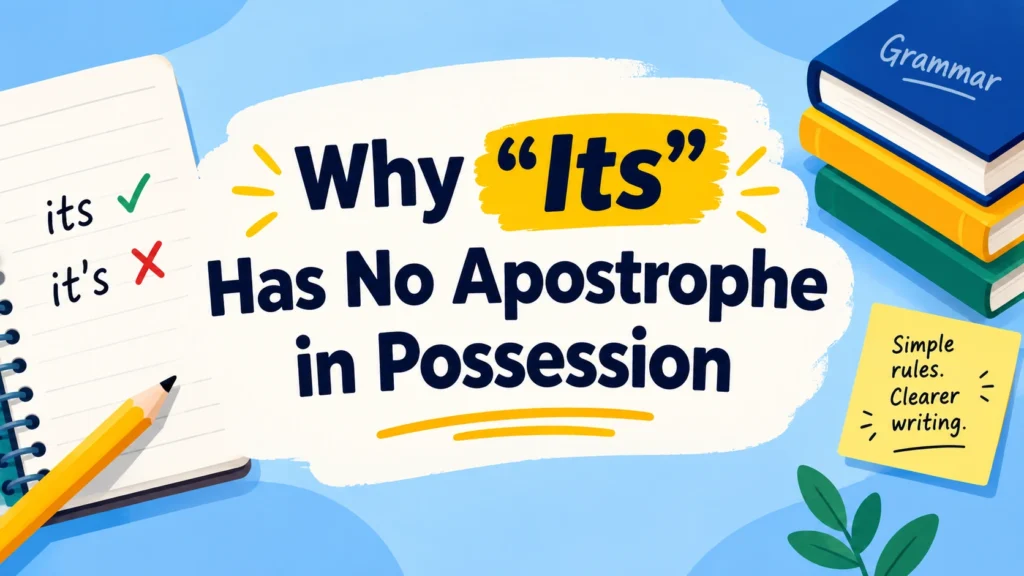
This rule feels strange because apostrophes often signal possession in English:
- Sarah’s book
- the dog’s collar
- the company’s office
But its is an established possessive form that does not take an apostrophe.
This is similar to other possessive forms that don’t use apostrophes:
- my
- your
- his
- her
- our
- their
- its
A useful comparison is:
The dog hurt its paw.
not:
The dog hurt it’s paw.
The second version would technically read as:
The dog hurt it is paw.
That clearly doesn’t work.
A Simple Test for Its, It’s, and Itself
When you’re editing quickly, three questions can solve most problems.
The “It Is” Test
Replace it’s with it is.
It’s raining.
→ It is raining.
The sentence works, so it’s is correct.
Try:
The company changed it’s policy.
→ The company changed it is policy.
That fails. Use its.
The Ownership Test
Ask whether the word shows possession or association.
The company changed its website.
Whose website?
The company’s.
Therefore, its is correct.
The Reflexive Test
Ask whether the action comes back to the subject.
The cat cleaned itself.
Who cleaned the cat?
The cat cleaned the cat.
Because the subject and object are the same, use itself.
A useful shortcut is:
Possession → its
It is / it has → it’s
Reflexive or emphasis → itself
Common Mistakes With “Its,” “It’s,” and “Itself”
These errors appear frequently because the forms look and sound similar.
Mistake: “The cat cleaned its self.”
Correct:
The cat cleaned itself.
The writer has incorrectly separated the reflexive pronoun.
Mistake: “The company changed it’s policy.”
Correct:
The company changed its policy.
Here, its shows possession or association.
Mistake: “The machine turned it’s self off.”
Correct:
The machine turned itself off.
This sentence needs the reflexive pronoun.
Mistake: “The phone fixed it’s settings.”
Correct:
The phone fixed its settings.
The settings belong to or are associated with the phone.
Mistake: “The device itself has lost its signal.”
Correct:
The device itself has lost its signal.
This sentence demonstrates two different functions in one sentence.
- itself = emphasis
- its = possession
That distinction is worth remembering.
Itself in Different Types of Writing
Itself in Casual Communication
You don’t need a special informal alternative to itself.
People may write casually:
My laptop restarted itself again.
That’s perfectly normal.
Informal writing doesn’t turn itself into its self. The spelling remains the same.
Itself in Academic Writing
Academic writers often use itself when discussing concepts, systems, theories, and institutions.
For example:
The theory itself does not explain the observed results.
Here, itself emphasizes the theory.
Another example:
The method can reproduce itself under controlled conditions.
Here, itself has a reflexive function.
Itself in Professional and Technical Writing
Technical documentation frequently uses reflexive constructions because machines and systems can perform actions automatically.
Examples:
- The application updates itself automatically.
- The device calibrates itself during startup.
- The system protects itself against unauthorized access.
- The program restarts itself after an error.
These sentences are concise and precise.
Common Expressions With “Itself”
Several expressions containing itself appear regularly in modern English.
By Itself
By itself can mean alone or without assistance.
The machine cannot operate by itself.
It can also describe an automatic action:
The door opened by itself.
Cambridge lists by itself with the meaning of being alone or without help.
In Itself
In itself often means considered independently or without adding other factors.
The idea isn’t bad in itself.
This means the idea, considered on its own, isn’t bad.
Another example:
The delay isn’t a major problem in itself.
Of Itself
Of itself is less common in everyday American English but can appear in formal or literary writing.
The problem will not disappear of itself.
Here, the expression suggests that the problem won’t disappear without an external cause or intervention.
To Itself
A thing can have something to itself when it has exclusive use of it.
The company kept the information to itself.
The phrase can also describe something being alone or separate.
A Practical Editing Case Study
Consider this sentence from a fictional product description:
“The security system monitors it’s self and alerts the user when something goes wrong.”
At first glance, the meaning seems obvious. The system monitors its own condition.
However, two separate errors appear.
First error: it’s should not be used for possession.
Second error: self should not be separated from itself.
The corrected version is:
The security system monitors itself and alerts the user when something goes wrong.
Now the grammar is clean.
Break the sentence apart:
- The security system = subject
- monitors = verb
- itself = reflexive object
- alerts = second verb
- the user = object
- when something goes wrong = time-related dependent clause
This example shows why proofreading the entire phrase matters. Fixing only one character wouldn’t solve the problem.
Real-World Examples of Itself
The following examples show how itself behaves in different contexts.
Animals
The kitten cleaned itself after eating.
The kitten is both the subject and the object.
Technology
The computer restarted itself after the update.
The computer performs the restarting action.
Organizations
The company presented itself as a leader in the industry.
The company presents the company.
Abstract Ideas
The problem eventually resolved itself.
The situation is described as resolving without a separate agent.
Emphasis
The building itself isn’t particularly large.
Here, itself emphasizes the building.
Independent Action
The door opened by itself.
The expression suggests that nobody intentionally opened it.
How to Tell Whether “Itself” Is Reflexive or Emphatic
There’s a quick trick.
Remove itself from the sentence.
If the sentence remains grammatical and essentially keeps its core meaning, itself may be emphatic.
The company itself announced the decision.
Remove it:
The company announced the decision.
The sentence still works. That points toward emphatic usage.
Now try:
The company blamed itself.
Remove it:
The company blamed.
The sentence no longer has the intended object.
That points toward reflexive usage.
This isn’t a universal test for every sentence. Still, it’s a useful editing tool.
“Itself” and “Its Self” in a Simple Diagram
Think of the difference like this:
IT
│
┌─────────┴─────────┐
│ │
POSSESSIVE REFLEXIVE
│ │
ITS ITSELF
│ │
its policy blamed itself
its color fixed itself
its purpose protected itself
The separate phrase its self belongs to another grammatical structure:
ITS + SELF
│ │
│ └── ordinary noun
└──────── possessive determiner
Possible specialized meaning:
“the self belonging to it”
That construction is possible in certain contexts. It isn’t the ordinary reflexive pronoun.
Practice Exercises: Its, It’s, Itself, or “Its Self”?
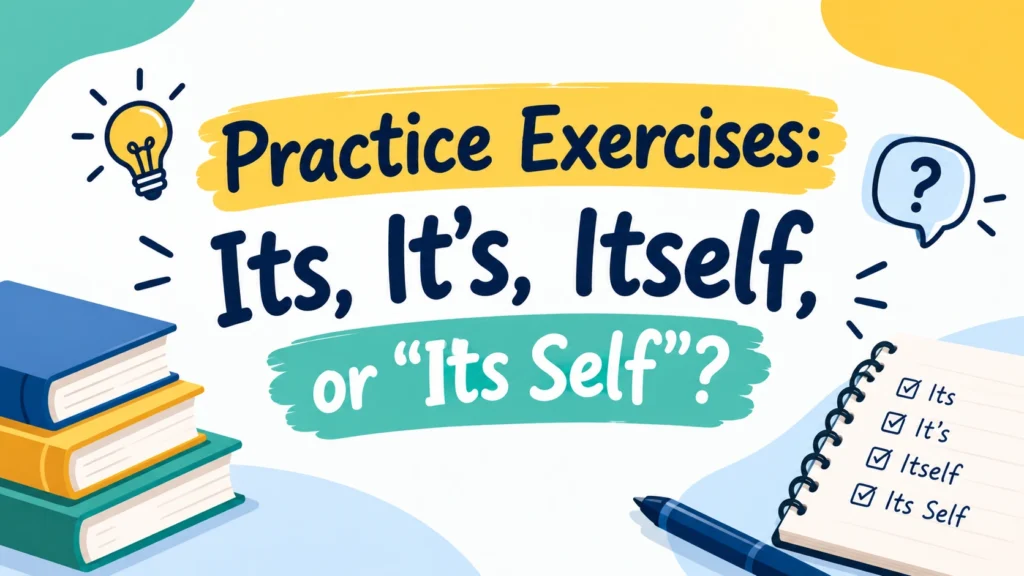
Choose the correct form.
Exercise
- The dog scratched ______ behind the ear.
- The company changed ______ privacy policy.
- ______ been raining all morning.
- The computer restarted ______.
- The building ______ isn’t very old.
- The phone lost ______ connection.
- ______ difficult to understand the instructions.
- The machine can shut ______ down automatically.
- The organization introduced ______ to the new partners.
- The writer examined the character’s sense of ______.
- The device protects ______ from overheating.
- The proposal ______ isn’t the problem.
Answers
- itself
- its
- it’s
- itself
- itself
- its
- it’s
- itself
- itself
- self
- itself
- itself
The tenth sentence is especially useful because self is functioning as a noun in the phrase sense of self. That’s completely different from trying to use its self as a substitute for itself.
Quick Reference: Its Self vs. Itself
| Word or phrase | Meaning | Example |
| its | belonging to or associated with it | The dog wagged its tail. |
| it’s | it is / it has | It’s getting late. |
| itself | reflexive form of it | The dog washed itself. |
| itself | emphatic form | The dog itself opened the gate. |
| its self | possessive + noun in specialized contexts | The text explores its self as an abstract concept. |
For everyday grammar, itself is the form you want when you mean “it + self” as a reflexive or emphatic pronoun.
Read More : Passerbyers vs. Passersby vs. Passerby: The Complete Grammar Guide
Expert Grammar Tip: Don’t Let the Spelling Fool You
One of the easiest ways to make a grammar mistake is to build a word from pieces that seem logically compatible.
Its + self looks as though it should produce the reflexive form of it.
But English has already established that form as itself.
The same pattern appears elsewhere:
- myself, not my self when used reflexively
- yourself, not your self
- himself, not his self
- herself, not her self
- ourselves, not our selves
- themselves, not their selves
There are specialized contexts where forms involving a possessive word and self can occur as separate words. For example, my own self and your true self use self as a noun. But that doesn’t make the separated form a replacement for the corresponding reflexive pronoun.
The practical rule is much simpler than the theory:
If you mean the reflexive pronoun corresponding to “it,” write “itself.”
Frequently Asked Questions About Its Self or Itself
Is “itself” one word or two?
Itself is one word when it functions as the reflexive or emphatic form of it.
For example:
The cat cleaned itself.
Don’t split the word in this sentence.
Is “its self” ever grammatically correct?
It can occur when its functions as a possessive determiner and self functions as a separate noun. Such constructions are uncommon and usually depend on specialized philosophical, literary, psychological, or theoretical context.
It should not be used as the normal reflexive form of it.
Should I write “the machine fixed itself” or “the machine fixed its self”?
Write:
The machine fixed itself.
Here, itself is the reflexive object referring back to the machine.
What is the difference between “its” and “itself”?
Its expresses possession or association:
The company changed its name.
Itself is reflexive or emphatic:
The company changed itself.
The first sentence says the name belongs to the company. The second says the company changed its own condition, structure, or identity.
What is the difference between “its” and “it’s”?
Its indicates possession:
The dog wagged its tail.
It’s means it is or it has:
It’s sleeping.
It’s been repaired.
Cambridge specifically distinguishes its as a possessive determiner from it’s as the contraction of it is or it has.
Why doesn’t possessive “its” use an apostrophe?
Because its is the established possessive form associated with it. The apostrophe belongs in it’s because it’s is a contraction.
So:
The bird spread its wings. ✅
but:
It’s flying. ✅
Can “itself” be used for emphasis?
Yes.
For example:
The restaurant itself isn’t very large.
Here, itself emphasizes the restaurant rather than functioning as an object.
What does “by itself” mean?
By itself can mean alone, without assistance, or automatically depending on context.
The child stayed by itself.
The machine turned on by itself.
Cambridge recognizes this established use of by itself.
Is “itself” a reflexive pronoun?
Yes. Itself is the reflexive form of it.
The standard pairing is:
it → itself
It can also have an emphatic function.
How can I quickly remember when to use “itself”?
Use this three-part rule:
its = possession
it’s = it is / it has
itself = reflexive or emphasis
If the subject is doing something to itself, use itself.
Conclusion: Its Self or Itself?
The “its self or itself” question becomes much easier once you separate the grammatical functions.
For normal modern English, itself is the standard form. Use it when the pronoun it refers back to the same thing, animal, situation, or idea that performs the action.
The dog hurt itself.
The computer restarted itself.
The company introduced itself.
Use itself for emphasis too:
The company itself announced the change.
By contrast, its expresses possession:
The company changed its policy.
And it’s is the contraction of it is or it has:
It’s ready.
It’s been repaired.
The separate words its self are a different grammatical construction. They can appear when self is intentionally treated as a noun and its modifies it. That usage is rare and context-specific. It isn’t the standard spelling of the reflexive pronoun.
When in doubt, remember the simplest rule:
If you mean the reflexive form of “it,” write “itself” — one word.
That single rule will eliminate the vast majority of its self vs. itself mistakes.