
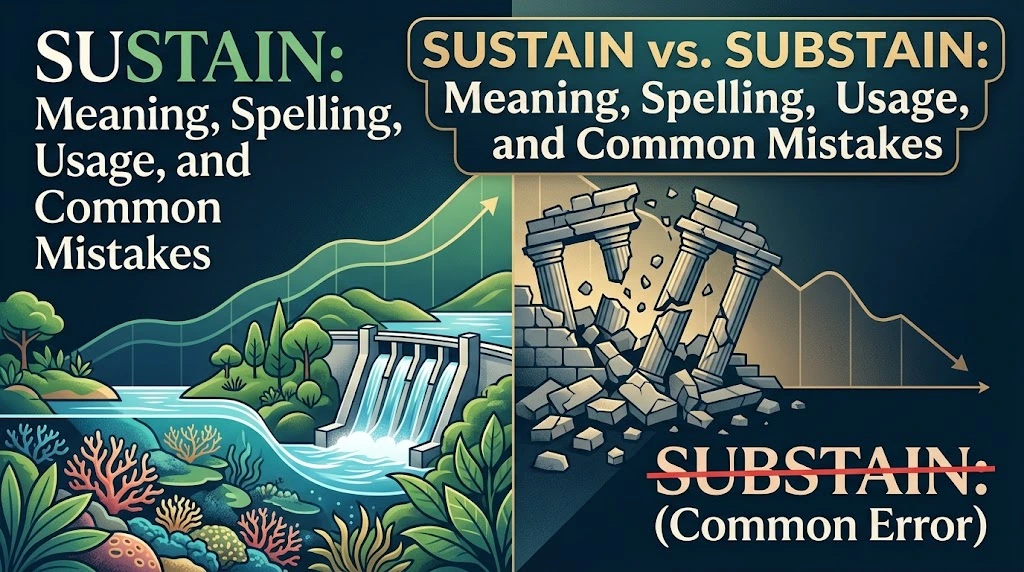
Choosing the correct word can make a big difference in clear and professional English. Sustain vs. Substain is a common spelling confusion because both forms look similar, but only one is a standard English word. Sustain is the correct spelling and is widely used to describe supporting, maintaining, continuing, or keeping something going over time. You may use it when discussing long-term support, maintaining something, continuing an activity, or preserving a condition. For example, “The company needs to sustain growth” means the company needs to keep its growth going.
In contrast, substain is generally considered a misspelling of sustain rather than a standard English word. The confusion may happen because English contains words beginning with sub-, such as substitute, substantial, and substance. However, those words do not make “substain” a correct spelling.
Understanding this difference can help you avoid spelling mistakes, improve your English vocabulary, and write more confidently in academic writing, business communication, professional documents, and everyday English. In this guide, you’ll learn the meaning of sustain, correct spelling, pronunciation, common uses, examples, and practical ways to remember the difference between sustain and substain.
Sustain vs. Substain: What Is the Difference?
The difference between sustain and substain is primarily a matter of standard spelling.
| Word | Standard English? | Main meaning | Example |
| Sustain | Yes | Support, maintain, endure, or receive | The company must sustain its growth. |
| Substain | No, in standard modern English for these meanings | Usually a misspelling of sustain | ❌ The company must substain its growth. |
Sustain is the correct spelling.
Substain usually appears because a writer has inserted a b that doesn’t belong there. The error can happen because English contains many words beginning with sub-, including substance, substantial, and substantiate. Those familiar words can make substain look plausible at first glance.
It isn’t the correct replacement for sustain, however.
Consider these examples:
- ❌ The program needs to substain public interest.
- ✅ The program needs to sustain public interest.
- ❌ He substained a serious injury.
- ✅ He sustained a serious injury.
- ❌ Farmers need to substain healthy soil.
- ✅ Farmers need to sustain healthy soil.
Once you understand the meanings of sustain, the correct spelling becomes much easier to remember.
What Does “Sustain” Mean?
The word sustain has several related meanings. Although those meanings may seem different, they share a central idea: something continues, remains supported, or survives over time.
For example, a business can sustain growth. An athlete can sustain effort. A person can sustain an injury. A musical instrument can sustain a note.
The surrounding words tell you which meaning applies.
Core Definition of Sustain
As a verb, sustain can mean to:
- support something physically or figuratively
- keep something going
- maintain something over time
- endure or withstand something
- receive or suffer something, particularly an injury or damage
- provide what is needed for continued life or existence
- allow a musical sound to continue
The word therefore has more range than the simpler verb support.
For example:
The bridge sustains the weight of the structure.
Here, sustain means support.
Now consider:
The company sustained strong sales throughout the year.
Here, it means maintained or kept something going.
In another sentence:
The player sustained a knee injury.
Here, it means received or suffered an injury.
The word stays the same. The context changes its precise meaning.
Sustain as a Verb
Sustain is primarily used as a verb.
Its basic forms are:
| Form | Example |
| sustain | We need to sustain this effort. |
| sustains | The system sustains thousands of users. |
| sustained | The company sustained its performance. |
| sustaining | They are sustaining the program through donations. |
Notice that sustain does not become substain in any of these forms.
The same spelling pattern remains:
sustain → sustains → sustained → sustaining
That makes the word family useful for learning the correct spelling.
Meaning of Sustain: To Support or Keep Something Going
One of the most common meanings of sustain is to support something so it can continue.
You can sustain a system, activity, effort, organization, or process.
For example:
Regular donations help sustain the community center.
The donations provide the support needed for the center to continue operating.
Similarly:
The team sustained its fundraising campaign for several months.
Here, the campaign continued because the team maintained its effort.
Other examples include:
- Technology can sustain efficient operations.
- Strong demand can sustain a business.
- Funding helps sustain public services.
- Good leadership can sustain organizational change.
- Reliable infrastructure can sustain economic activity.
This meaning often appears in professional and academic writing because sustain emphasizes continued support rather than temporary assistance.
Meaning of Sustain: To Maintain Something Over Time
Another important meaning is to maintain something at a particular level or condition.
Imagine turning on a machine and keeping it running for several hours. You aren’t merely starting it. You’re sustaining its operation.
The same idea works with less tangible things.
The speaker struggled to sustain the audience’s attention.
The speaker needs to keep that attention for an extended period.
You can also sustain:
- progress
- momentum
- interest
- concentration
- performance
- growth
- effort
- productivity
- pressure
- communication
For example:
The company has sustained steady growth for several years.
This means the growth has continued rather than disappearing after a short period.
Sustain vs. Maintain
Sustain and maintain often overlap, but they aren’t always interchangeable.
Maintain commonly emphasizes keeping something in its existing condition or state.
The technician maintains the equipment.
Sustain often emphasizes supporting something so it continues.
The funding sustains the program.
A useful distinction is:
Maintain = keep something in a particular state.
Sustain = keep something going or support its continued existence.
The distinction isn’t absolute. Native speakers sometimes use the words in overlapping ways.
Meaning of Sustain: To Endure Something Difficult
Sustain can also relate to enduring or withstanding something.
For example:
The structure was designed to sustain heavy pressure.
The structure must withstand the pressure without failing.
You might also read:
- sustain prolonged pressure
- sustain a demanding workload
- sustain difficult conditions
- sustain heavy use
- sustain repeated stress
This use is especially common when discussing physical structures, organizations, systems, or people operating under demanding conditions.
However, context matters.
The athlete sustained intense pressure during the final minutes.
This could mean the athlete experienced or endured that pressure.
Meanwhile:
The bridge sustained heavy pressure.
This suggests the bridge successfully bore or withstood the force.
Meaning of Sustain: To Receive an Injury or Damage
This meaning often surprises English learners.
Sustain can mean to suffer or receive an injury, wound, loss, or damage.
For example:
The player sustained a shoulder injury during the match.
This doesn’t mean the player maintained the injury. It means the player suffered or received it.
You may encounter:
- sustain an injury
- sustain injuries
- sustain damage
- sustain losses
- sustain a fracture
- sustain burns
Consider the difference:
The building sustained significant damage during the storm.
Here, sustained means the building received or suffered the damage.
This usage is especially common in news reports, medical writing, insurance documents, police reports, and formal descriptions of accidents.
Why Does “Sustain” Mean Something Negative Here?
At first, the meaning may seem opposite to “support.”
The connection becomes clearer when you think of sustain as something that happens to or is borne by a person or object.
A structure can sustain a load. A person can sustain an injury. Both constructions involve something being borne or supported.
English has developed several related senses from this central concept.
Meaning of Sustain: To Provide Nourishment
Sustain can also mean to provide what someone or something needs to continue living or functioning.
For example:
The crops provide enough food to sustain the village.
The food supports the community’s continued existence.
You might also see:
Plants need sunlight and water to sustain healthy growth.
Or:
The river has sustained communities for centuries.
This sense frequently appears in discussions about:
- food
- natural resources
- ecosystems
- agriculture
- survival
- human communities
It also connects naturally with the words sustainable and sustainability.
Sustain in Business and Professional English
If you read business reports, you’ll encounter sustain frequently.
Businesses use the word when discussing continued performance, growth, operations, or demand.
Common combinations include:
- sustain growth
- sustain profitability
- sustain operations
- sustain performance
- sustain demand
- sustain customer interest
- sustain productivity
- sustain competitive advantage
For example:
The company introduced new products to sustain customer demand.
The goal isn’t simply to create demand once. The company wants demand to continue over time.
Why “Sustain” Sounds More Formal Than “Keep”
Compare:
We need to keep sales growing.
with:
We need to sustain sales growth.
Both sentences can communicate a similar idea. The second sounds more formal and analytical.
That’s why sustain appears frequently in reports, proposals, research papers, corporate documents, and policy discussions.
In casual conversation, however, keep going or keep up may sound more natural.
Sustain in Environmental Writing
The words sustain, sustainable, and sustainability frequently appear together.
For example:
Communities need to sustain natural resources for future generations.
From the same word family, we get:
- sustain
- sustained
- sustaining
- sustainable
- sustainability
The basic concept remains connected to continuing something over time.
A sustainable practice is generally designed to continue without exhausting the resources or conditions it depends on.
That’s why you often see sustain in discussions about:
- ecosystems
- renewable resources
- agriculture
- energy
- conservation
- economic development
- environmental protection
Sustain in Law
Sustain has a specific and important use in legal language.
A judge can sustain an objection.
For example:
The judge sustained the objection.
In this context, sustained means the judge accepted the objection.
That doesn’t mean the judge physically supported it. Instead, the judge ruled in favor of the objection under the applicable legal rules.
The opposite expression is often:
The judge overruled the objection.
So in courtroom language:
sustain an objection = accept the objection
overrule an objection = reject the objection
This is a good example of why context matters when interpreting sustain.
Sustain in Music
Music gives sustain another specialized meaning.
In music, sustain refers to how long a note continues after it begins, particularly during the portion of a sound where the note remains audible.
For example, a singer can sustain a vowel or musical note for several seconds.
A guitarist can also use a technique or equipment that allows a note to continue ringing.
What Is a Sustain Pedal?
On a piano, the sustain pedal allows notes to continue sounding after the player releases the keys.
The pedal changes how long the strings remain acoustically active by controlling the instrument’s dampers.
That’s why you may hear a pianist described as using the sustain pedal to create a smoother, more connected sound.
Sustain in Electronic Instruments
The word also appears in synthesizers and electronic instruments.
In an ADSR envelope, sustain is one of four commonly discussed stages:
- Attack
- Decay
- Sustain
- Release
Here, sustain refers to the level at which a sound remains while a key or note is held after the attack and decay stages.
So the musical meaning still connects to the broader concept: the sound continues at a certain level rather than immediately disappearing.
Sustain vs. Substain: Why Do People Get Confused?
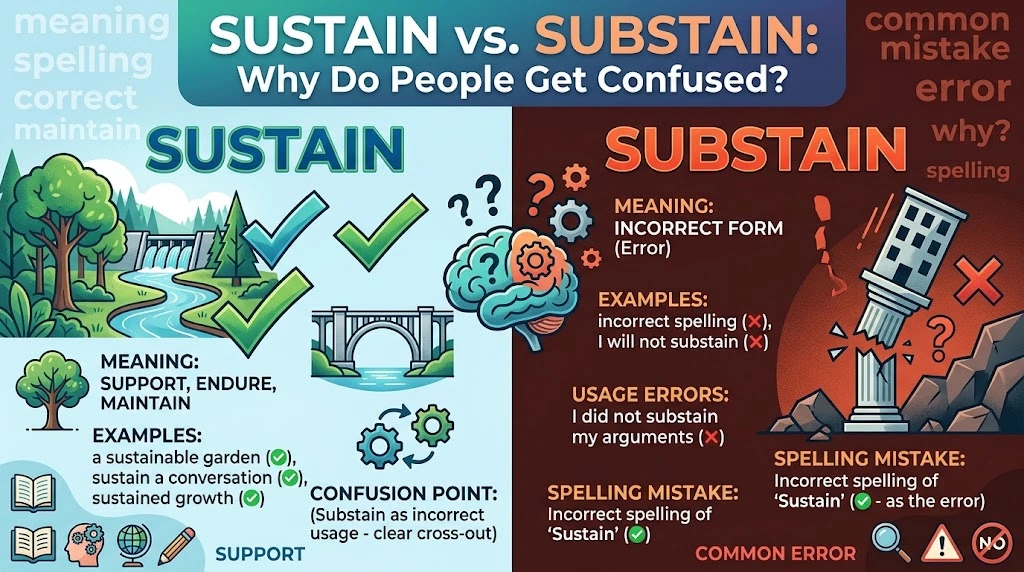
The spelling mistake is understandable because English contains several familiar words that begin with sub-.
The Extra “B” Problem
Words such as these are common:
- substance
- substantial
- substantiate
- subconscious
- substitute
- substandard
Because sub- appears in so many English words, the spelling substain can look believable.
But visual familiarity doesn’t make it correct.
The correct word is:
sustain
not:
substain
Related Words Can Create False Connections
Consider these words:
sustain
substance
substantial
substantiate
They look somewhat similar, but they aren’t simply different forms of the same word.
For example:
The argument has substantial evidence.
Here, substantial relates to having considerable size, importance, amount, or support.
But:
The evidence can sustain the argument.
Here, sustain means the evidence can support the argument.
The meanings can appear in the same sentence while the words remain completely different.
Is “Substain” a Real Word?
For standard modern English, substain should not be used as the spelling of the verb sustain.
If you’re writing an email, article, report, essay, business document, or academic paper, use sustain.
For example:
❌ The company hopes to substain its current growth.
Correct it to:
✅ The company hopes to sustain its current growth.
Likewise:
❌ The player substained an injury.
Correct:
✅ The player sustained an injury.
If you encounter substain somewhere online, the surrounding context may help explain what the writer intended. In ordinary English usage, however, it is best treated as a spelling error when the intended word is sustain.
Common Mistakes With Sustain and Substain
Mistake: Adding “B” to Sustain
The most direct error is writing:
❌ substain
instead of:
✅ sustain
The correction is simple. Remove the b.
Mistake: Confusing Sustain With Substance
The words sustain and substance are unrelated in the way many learners assume.
Compare:
The evidence sustains the argument.
with:
The material contains a chemical substance.
The first sentence concerns supporting an argument. The second concerns a particular material or matter.
Mistake: Assuming Similar-Looking Words Share a Spelling Pattern
English contains many words that look alike but have different histories and spellings.
Trying to spell a word by analogy can therefore backfire.
If you’re unsure about sustain, remember its established word family:
sustain → sustained → sustaining → sustainable → sustainability
That pattern provides a much stronger spelling anchor.
Sustain Synonyms and Related Words
Choosing a synonym depends heavily on context.
| Word | Meaning | Example |
| Support | Help something continue or function | The funds support the project. |
| Maintain | Keep something in a particular condition | They maintain the equipment. |
| Continue | Keep doing or happening | The meeting continued. |
| Endure | Continue despite difficulty | She endured the hardship. |
| Withstand | Resist damaging force or pressure | The wall withstood the storm. |
| Preserve | Keep something from being damaged or lost | The policy preserves the habitat. |
| Uphold | Maintain or support a principle, decision, or standard | The court upheld the ruling. |
Sustain vs. Support
These words often overlap.
The charity supports the community.
The charity sustains the community program.
The first sentence emphasizes assistance. The second places more emphasis on helping the program continue over time.
Sustain vs. Maintain
These are also close.
The company maintains its equipment.
This focuses on keeping the equipment in good working condition.
The company sustains its operations.
This focuses more on keeping the operation going.
Sustain vs. Endure
These words can describe continuation under difficult circumstances, but their grammatical roles differ.
The workers endured difficult conditions.
They experienced something difficult and continued despite it.
The system sustained heavy pressure.
The system bore or withstood the pressure.
Sustain vs. Withstand
Withstand strongly emphasizes resistance.
The building withstood the earthquake.
Sustain can emphasize receiving or bearing the force.
The building sustained significant damage.
The difference becomes particularly clear in those two examples.
Common Collocations With Sustain
Learning common word combinations can make the correct usage much easier.
Business and Economics
- sustain growth
- sustain profitability
- sustain operations
- sustain demand
- sustain investment
- sustain productivity
- sustain economic activity
Personal and Academic Contexts
- sustain attention
- sustain effort
- sustain interest
- sustain concentration
- sustain motivation
- sustain an argument
Physical and Medical Contexts
- sustain an injury
- sustain injuries
- sustain damage
- sustain a fracture
- sustain burns
Environmental Contexts
- sustain ecosystems
- sustain biodiversity
- sustain communities
- sustain natural resources
- sustain healthy growth
These combinations also show why sustain cannot be replaced by one synonym in every sentence.
Real-World Examples of Sustain
The best way to understand sustain is to see how its meaning shifts with context.
Business Examples
The company needs to sustain revenue growth without increasing costs sharply.
Here, sustain means maintain over time.
New investment helped sustain the factory’s operations.
Here, it means provide enough support for continued operation.
Academic Examples
The researcher presented evidence to sustain the proposed explanation.
Here, sustain means support.
Students often struggle to sustain concentration during long lectures.
Here, it means maintain.
Medical Examples
The cyclist sustained a fractured wrist in the accident.
Here, sustained means received or suffered.
Environmental Examples
Healthy wetlands can sustain diverse plant and animal communities.
Here, sustain means support life and continued existence.
Legal Examples
The judge sustained the objection.
Here, sustained means accepted the objection.
Music Examples
The vocalist sustained the final note for several seconds.
Here, sustained means kept the note continuing.
Correct and Incorrect Sentence Examples
| Incorrect | Correct | Why |
| The company wants to substain growth. | The company wants to sustain growth. | Sustain is the correct spelling. |
| She substained an injury. | She sustained an injury. | The standard past tense is sustained. |
| The program must substain public interest. | The program must sustain public interest. | Sustain means maintain. |
| The bridge can substain heavy loads. | The bridge can sustain heavy loads. | Sustain means support or bear. |
| The song has a long substain. | The song has a long sustain. | Sustain is the musical term. |
A useful proofreading trick is to search your document for “substain.” If you find it, check whether you intended “sustain.”
Case Study: A Spelling Error in a Professional Document

Imagine a company preparing a business proposal.
The original sentence reads:
“Our strategy will help substain long-term customer growth.”
The writer intended to say that the strategy would maintain customer growth over time.
The problem isn’t merely cosmetic. A spelling error in a formal proposal can distract readers and weaken the impression of careful editing.
The corrected version is:
“Our strategy will help sustain long-term customer growth.”
Notice how little needs to change. The entire problem comes from one unnecessary letter.
This is why proofreading common word confusions matters. A document doesn’t need dozens of errors to appear careless. Sometimes one conspicuous mistake is enough to interrupt an otherwise polished piece of writing.
How to Avoid the “Substain” Spelling Mistake
Remember the Core Spelling
Write:
S-U-S-T-A-I-N
There is no B after the first three letters.
Connect It With “Sustainable”
Think of the word family:
sustain → sustainable → sustainability
Seeing the same sustain- beginning repeatedly reinforces the correct spelling.
Connect the Word With Its Meaning
Think:
Sustain = keep something going.
A business sustains growth. A person sustains an effort. A system sustains activity.
That mental connection makes the word easier to recall.
Don’t Build the Word From “Sub-”
If you find yourself thinking:
“It sounds like substance, so maybe it’s substain…”
Stop there.
The correct word is simply:
sustain
Sustain Word Family
Learning related forms can strengthen both spelling and vocabulary.
| Word | Meaning | Example |
| Sustain | Support or maintain | We must sustain progress. |
| Sustains | Third-person singular form | The system sustains demand. |
| Sustained | Past or past participle | The company sustained growth. |
| Sustaining | Present participle | They are sustaining the program. |
| Sustainable | Capable of continuing over time | We need sustainable practices. |
| Sustainability | The quality or condition of being sustainable | Sustainability requires long-term planning. |
Notice the consistent beginning:
sustain-
That consistency makes the spelling easier to memorize.
Read More : Myself vs. My Self: The Complete Guide to Meaning, Grammar, Identity, and Real-World Usage
Sustain vs. Substain: A Quick Decision Guide
When you’re unsure which word to type, use this simple process.
Are you talking about supporting, maintaining, continuing, enduring, or receiving something?
→ Use sustain.
Are you thinking about substance or something substantial?
→ You may need a different word such as substance, substantial, or substantiate.
Are you about to type “substain”?
→ Stop and check it. In ordinary standard English, you almost certainly mean sustain.
Here’s the shortcut:
Support it → sustain it.
Maintain it → sustain it.
Endure it → sustain it.
Receive an injury → sustain it.
A Practical Comparison: Sustain vs. Substain
| Question | Sustain | Substain |
| Is it the standard spelling? | Yes | No for the intended meanings discussed here |
| Can it mean “support”? | Yes | No |
| Can it mean “maintain”? | Yes | No |
| Can it describe receiving an injury? | Yes | No |
| Is it used in music? | Yes | No |
| Does it have forms like “sustained”? | Yes | No |
| Is it related to “sustainable”? | Yes | No |
Frequently Asked Questions
Is “substain” a real word?
Substain is generally a misspelling when someone intends the standard English word sustain. In ordinary writing, use sustain instead.
Is “sustain” the correct spelling?
Yes. Sustain is the standard spelling.
For example:
The organization needs to sustain its services.
Not:
❌ The organization needs to substain its services.
What does sustain mean?
Sustain has several meanings. It can mean support, maintain, keep going, endure, withstand, receive an injury or damage, or provide nourishment.
The exact meaning depends on context.
Why do people confuse sustain and substain?
The confusion likely comes from the many English words beginning with sub-, including substance, substantial, and substantiate. The visual similarity can make the incorrect b feel natural.
Pronunciation can also make spelling less obvious.
How do you pronounce sustain?
In standard American English, sustain is commonly pronounced approximately:
suh-STAYN
The second syllable carries the main stress.
The spelling contains no b, regardless of how the word may look or sound to a learner.
What are the main meanings of sustain?
The major meanings include:
- support something
- keep something going
- maintain something over time
- endure or withstand something
- receive or suffer an injury or damage
- provide nourishment
- keep a musical sound continuing
What is the difference between sustain and maintain?
Both words can describe continuation.
Maintain often means keeping something in a particular condition.
Sustain often emphasizes supporting something so it continues over time.
For example:
The technician maintains the equipment.
The funding sustains the project.
The distinction can overlap depending on context.
What is the difference between sustain and support?
Support often means helping something succeed or function.
Sustain can carry the additional idea of continued support over time.
For example:
The grant supports the project.
The grant sustains the project.
Both can work, but the second emphasizes continued existence or operation.
What does sustain mean in music?
In music, sustain refers to the continuation of a sound or note. It also describes a stage in an electronic sound envelope and appears in terms such as sustain pedal.
Is sustainable related to sustain?
Yes. Sustainable belongs to the same word family as sustain.
The shared idea involves something being capable of continuing or being maintained over time.
What is the past tense of sustain?
The past tense is sustained.
For example:
The company sustained strong growth.
The athlete sustained a serious injury.
The spelling remains based on sustain, not substain.
Can sustain mean “suffer” or “receive”?
Yes. In formal contexts, sustain can mean receive or suffer something such as an injury, damage, or loss.
For example:
The vehicle sustained significant damage.
The player sustained a leg injury.
Conclusion
The sustain vs. substain confusion becomes much easier once you separate the correct word from the spelling error.
Sustain is the standard English word. It can mean support, maintain, continue, endure, withstand, receive damage or injury, provide nourishment, or allow a sound to continue.
The context determines the precise meaning.
You’ll see sustain in business writing, academic English, environmental discussions, legal language, medical reports, and music terminology. Its broad usefulness comes from one central idea: helping something continue or bearing something over time.
The most important spelling lesson is simple:
Sustain has no “b.”
Remember the word family:
sustain → sustained → sustaining → sustainable → sustainability
If you remember that pattern, “substain” becomes much easier to spot as an error.
When you’re writing about continued support, maintenance, endurance, injury, damage, or musical continuation, choose sustain. It’s the word that belongs there.