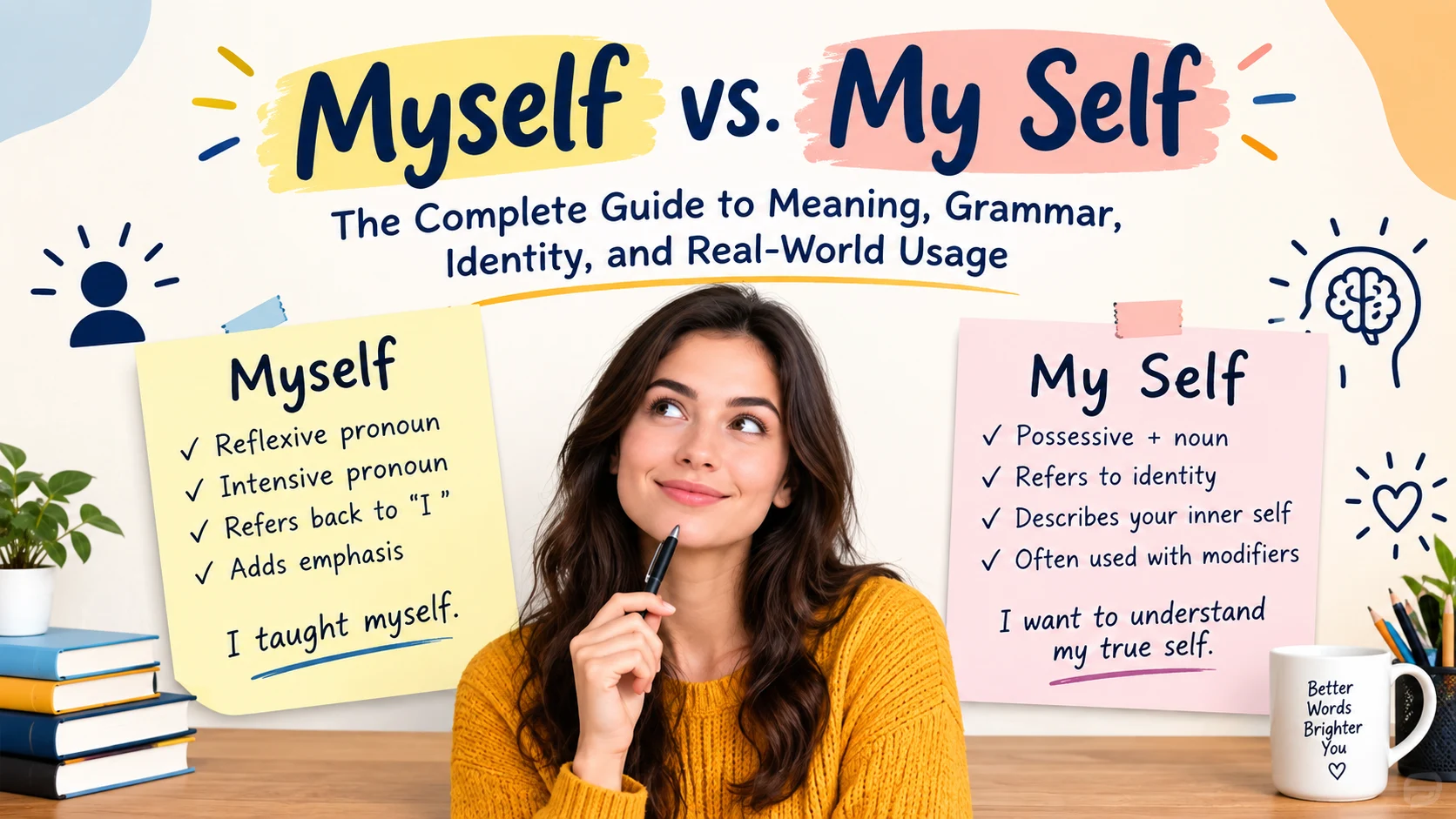
The difference between myself and my self may look like a tiny spacing issue, but the two forms can serve very different grammatical purposes. In everyday English, myself is the standard reflexive pronoun used when the subject and object of a sentence refer to the same person. For example, “I taught myself Spanish” and “I made the cake myself.” It can also add emphasis to the speaker.
By contrast, my self consists of the possessive determiner my and the noun self. This form is uncommon in ordinary conversation and usually appears when self is being treated as a separate noun, often in discussions about identity, personality, inner nature, personal growth, or self-awareness. For example, “I am trying to understand my self” has a different structure and meaning from “I hurt myself.”
Understanding this distinction becomes easier when you look at reflexive pronouns, possessive words, pronoun usage, grammar rules, and sentence structure. In most everyday situations, myself is the form you need. However, my self is not automatically wrong; its meaning depends heavily on context.
Myself vs. My Self: What’s the Real Difference?
The simplest way to remember the difference is this:
“Myself” is a pronoun. “My self” is a possessive phrase containing the noun “self.”
Although the two forms look similar, they don’t perform the same grammatical job.
| Form | Structure | Main function | Example |
| myself | One word | Reflexive pronoun | I blamed myself. |
| myself | One word | Intensive pronoun | I myself checked the figures. |
| my self | Two words | Possessive determiner + noun | I want to understand my true self. |
The difference becomes especially obvious when you examine the surrounding sentence.
In “I blamed myself,” the subject is I and the object is myself. Both refer to the same person.
In “I checked the figures myself,” the word myself emphasizes that I personally performed the action.
But in “I want to understand my true self,” the word self behaves like a noun. The adjective true can modify it, just as an adjective can modify other nouns.
You can say:
- my true self
- my inner self
- my future self
- my authentic self
You generally wouldn’t replace those noun phrases with the single pronoun myself without changing the structure.
What Does “Myself” Really Mean in English?
Myself belongs to the family of English -self pronouns.
Other examples include:
- yourself
- himself
- herself
- itself
- ourselves
- yourselves
- themselves
These forms can perform two related but distinct grammatical functions.
“Myself” as a Reflexive Pronoun
A reflexive pronoun usually refers back to the subject of the same clause.
For example:
I blamed myself for the mistake.
The person doing the blaming is I. The person receiving the action is also me. Because the subject and object refer to the same person, myself fits the sentence.
Compare:
I blamed Sarah for the mistake.
Sarah isn’t the same person as the subject. Therefore, myself wouldn’t work.
Here are more natural reflexive examples:
- I taught myself Spanish.
- I accidentally cut myself.
- I reminded myself to buy milk.
- I introduced myself to the new manager.
- I promised myself that I’d stay calm.
- I asked myself an important question.
The basic pattern is:
I → action → myself
The action starts with the subject and comes back to the same person.
Two Main Functions of “Myself”
The two major uses are reflexive and intensive.
A reflexive myself is grammatically connected to the action:
I hurt myself.
An intensive myself adds emphasis:
I myself checked the report.
Remove the intensive pronoun and the sentence remains structurally complete:
I checked the report.
That’s a useful clue.
Reflexive vs. Intensive “Myself”
The spelling doesn’t change between the two functions. The grammatical job does.
| Type | Purpose | Example | Can you remove “myself”? |
| Reflexive | Refers back to the subject | I hurt myself. | Usually no |
| Intensive | Adds emphasis | I myself wrote it. | Yes |
| Reflexive | Receives the action | I taught myself. | Usually no |
| Intensive | Stresses who performed the action | I wrote it myself. | Yes |
Here’s another helpful comparison.
Reflexive
I introduced myself to the director.
Without myself, the sentence becomes:
I introduced to the director.
Something is missing. The verb introduced needs an object in this construction.
Intensive
I myself spoke to the director.
Remove myself:
I spoke to the director.
The sentence still works perfectly. The only thing lost is emphasis.
This simple removal test can help you identify many intensive uses.
When Should You Use “Myself” in a Sentence?
The safest approach is to look at the grammatical relationship before choosing the word.
When “Myself” Refers Back to “I”
Use myself when the subject and the relevant object refer to the same person.
Examples include:
I reminded myself to lock the door.
I promised myself I’d finish the project.
I accidentally injured myself while playing basketball.
I taught myself how to use the software.
I asked myself whether the decision was sensible.
In every example, I performs the action and myself refers back to that same person.
“Myself” With Prepositions
Reflexive pronouns can also appear after prepositions when they refer back to the appropriate subject.
For example:
I kept the secret to myself.
I was talking to myself.
I bought a gift for myself.
I was proud of myself.
Here, the relationship is still clear. Myself points back to I.
However, don’t assume that every sentence containing a preposition requires myself.
For example:
Please send the document to me.
Not:
Please send the document to myself.
The recipient isn’t the subject performing the sending action. Me is the ordinary object pronoun required here.
When “Myself” Adds Emphasis
Sometimes myself doesn’t receive an action at all. Instead, it highlights the person who performed it.
I myself designed the website.
I checked the figures myself.
I myself witnessed the event.
I made the entire presentation myself.
The emphasis can appear in different positions.
I myself made the decision.
I made the decision myself.
Both versions emphasize personal involvement.
This is why intensive myself can add a little punch to a sentence. It tells the reader that the action wasn’t merely associated with you. You personally did it.
Common Expressions With “Myself”
Some expressions make particularly natural use of the word.
“By Myself”
By myself commonly means alone or without assistance, depending on context.
I finished the assignment by myself.
This can mean that you completed it without anyone helping you.
I stayed home by myself.
Here, it more clearly means that you were alone.
Context determines the exact shade of meaning.
“Be Myself”
You may also see myself after the verb be:
I’m finally feeling like myself again.
I wasn’t myself yesterday.
I want to be myself around other people.
In these constructions, myself refers to one’s normal or familiar identity rather than functioning like the object in a simple action sentence.
That use is standard and common.
When “Myself” Is Incorrect
One of the biggest mistakes occurs when writers treat myself as a more sophisticated version of me.
It isn’t.
Myself does not mean “formal me.”
Consider:
Please send the report to myself.
In standard edited English, this should normally be:
Please send the report to me.
Why? Because me is the object of the preposition to. There is no grammatical reason for a reflexive pronoun.
Using “Myself” Instead of “I”
Another common mistake appears when people use myself as a subject.
Incorrect in standard English:
Myself and David attended the meeting.
Better:
David and I attended the meeting.
The subject is the person performing the action. Therefore, the appropriate subject pronoun is I.
A useful trick is to remove the other person’s name:
Myself attended the meeting. ❌
I attended the meeting. ✅
The answer becomes obvious.
Using “Myself” Instead of “Me”
Consider:
The manager spoke with Sarah and myself.
In standard edited English, the natural form is:
The manager spoke with Sarah and me.
Again, remove Sarah:
The manager spoke with myself. ❌
The manager spoke with me. ✅
This method works remarkably well with compound constructions.
“Myself” Just to Sound Formal
This mistake appears frequently in professional communication.
Someone may think:
me → casual
myself → formal
That’s not how English grammar works.
Compare:
Please contact me if you have questions.
with:
Please contact myself if you have questions.
The first sentence is clear and natural. The second uses the reflexive pronoun where an ordinary object pronoun belongs.
Formal writing doesn’t require fancy pronouns. Accuracy and clarity matter more than making a sentence sound grand.
“My Self”: When Two Words Are Correct
Now we reach the more interesting half of the myself vs. my self question.
My self can be grammatically correct when self functions as a separate noun.
The structure is:
my + self
That’s similar to:
- my house
- my character
- my identity
- my personality
- my nature
- my self
The word my identifies possession or association. The noun self identifies the person or identity being discussed.
What Does “My Self” Mean?
In contexts where the two-word form is appropriate, my self can refer to aspects of your identity, inner nature, personality, or personal being.
For example:
I want to understand my true self.
The experience forced me to confront my inner self.
I spent years trying to discover my authentic self.
Notice something important: the noun self can take modifiers.
You can say:
- my true self
- my inner self
- my future self
- my younger self
- my authentic self
That behavior clearly shows that self is functioning as a noun.
In ordinary English, these expanded forms are much more natural than treating my self as a replacement for myself.
“My Self” in Everyday, Reflective, and Specialized Writing

The two-word phrase becomes especially useful when someone is discussing identity rather than grammar.
Psychology and Personal Development
Words built around self are common when discussing personal identity.
Examples include:
- self-awareness
- self-image
- self-esteem
- self-concept
- self-perception
- sense of self
A sentence such as:
I’m trying to understand my sense of self.
focuses on identity.
Likewise:
I want to reconnect with my authentic self.
Here, self functions as a noun.
That doesn’t make myself incorrect in other sentences. It simply means the grammatical structures serve different purposes.
Philosophy
Philosophical writing often examines questions about identity, consciousness, personhood, and subjective experience.
For example:
What makes my present self different from my younger self?
Here, self clearly behaves as a noun.
Philosophical writing may also deliberately manipulate spacing, repetition, or familiar expressions for stylistic effect. That kind of usage should be interpreted according to its context rather than treated as an ordinary grammar rule.
Literature
Writers sometimes use language creatively to explore identity.
A novelist might write:
I barely recognized my old self.
That’s a straightforward noun phrase.
A poet might use unusual wording for rhythm, contrast, or symbolism. Literary language doesn’t always follow the same conventions as ordinary practical writing.
The important point is simple: a stylistic use of “my self” doesn’t turn it into an alternative spelling of “myself.”
Why “Myself” and “My Self” Sound the Same
Pronunciation creates much of the confusion.
In ordinary speech, myself and my self are generally pronounced the same way.
You hear the same sequence of sounds. You don’t hear the space between written words.
Writing, however, makes grammatical structure visible.
Compare:
I blamed myself.
with:
I wanted to understand my self.
The pronunciation doesn’t provide much help. The sentence structure does.
That’s why you should decide based on function and meaning, not sound.
Myself vs. My Self: How Spacing Changes Meaning
A tiny space can signal a major grammatical difference.
Think of the two structures like this:
MYSELF
↓
one pronoun
↓
reflexive or intensive function
MY SELF
↓
MY + SELF
↓
possessive determiner + noun
↓
identity, character, or inner being
This distinction is especially useful when editing articles, essays, personal reflections, and academic writing.
If you mean:
I did the task personally.
Use:
I did the task myself.
If you mean:
I want to understand my identity.
A phrase involving self as a noun may be appropriate:
I want to understand my true self.
The second construction gives self a noun role that the first doesn’t have.
Common Errors With “Myself” and “My Self”
“Myself and John” vs. “John and I”
Use I when the pronoun belongs to the subject.
John and I went to lunch.
Not:
Myself and John went to lunch.
The position of the names doesn’t change the grammatical role.
“Between You and Myself” vs. “Between You and Me”
The standard expression is:
Between you and me
not:
Between you and myself.
The word between is a preposition. The pronoun following it normally takes the object form.
You can test it by removing you:
Between me and the manager.
Not:
Between myself and the manager.
The reflexive form isn’t required simply because the sentence sounds formal.
“Please Send It to Myself”
This is another common business-writing error.
Use:
Please send it to me.
Use myself when the sentence establishes the reflexive relationship:
I sent myself a copy.
Here, I and myself refer to the same person.
“I Did It Myself”
This sentence is completely different.
I did it myself.
Here, myself emphasizes personal responsibility or involvement.
Remove the word:
I did it.
The sentence still works. That’s the hallmark of the intensive use.
“I Hurt Myself”
Now compare:
I hurt myself.
Remove myself:
I hurt.
The meaning changes substantially because myself serves as the object of the action.
That’s a reflexive use.
Myself vs. My Self in a Quick Comparison
| Sentence | Correct? | Why |
| I hurt myself. | ✅ | Reflexive pronoun |
| I did it myself. | ✅ | Intensive pronoun |
| I taught myself to cook. | ✅ | Reflexive pronoun |
| Myself and James went home. | ❌ | Use “James and I” |
| Please contact myself. | ❌ | Use “contact me” |
| Between you and myself, it’s difficult. | Usually ❌ | Use “between you and me” |
| I want to understand my true self. | ✅ | “Self” is a noun |
| I want to discover my inner self. | ✅ | “Self” is a noun |
| I blamed my self. | ❌ in ordinary usage | Use “myself” |
| I did the work by myself. | ✅ | Established reflexive/intensive construction |
How to Tell Which Form You Need
When you’re stuck between myself vs. my self, don’t stare at the two spellings. Look at the sentence.
The Reflexive Pronoun Test
Ask:
Does “myself” refer back to “I”?
If yes, myself may be the correct reflexive pronoun.
I reminded myself.
The subject is I. The reflexive object is myself.
The Emphasis Test
Remove myself.
If the sentence remains grammatically complete but loses emphasis, myself is probably functioning intensively.
I personally checked the figures.
becomes:
I checked the figures.
The grammar still works.
Therefore:
I checked the figures myself.
is an intensive use.
The Noun Test for “My Self”
Ask whether self is actually being treated as a noun.
Can you modify it?
my true self
my inner self
my younger self
my future self
If yes, you’re dealing with the noun self, not the reflexive pronoun myself.
A Simple Decision Guide for “Myself vs. My Self”
Use this quick flow:
Do you mean the reflexive/intensive pronoun?
│
YES
↓
MYSELF
│
NO
↓
Is “self” functioning as a separate noun?
│
YES
↓
MY SELF
There is one important practical detail: in normal everyday English, you usually won’t need the bare phrase my self. Instead, you’ll often see a fuller noun phrase such as my true self, my inner self, or my future self.
The One-Line Rule
Use “myself” for the standard pronoun. Use “my self” only when “self” is functioning as a separate noun.
That rule handles most situations you’ll encounter.
Real-World Examples and Micro Case Studies

Case Study: A Workplace Email
Imagine a manager writes:
Please send the completed form to myself before Friday.
The sentence may sound formal, but myself isn’t required.
A cleaner version is:
Please send the completed form to me before Friday.
Now imagine a different sentence:
I will review the completed forms myself.
Here myself adds emphasis. The manager is stressing personal involvement.
The difference isn’t about politeness. It’s about grammar.
Case Study: A Personal Journal
Consider:
Today I finally understood my younger self.
Here self is a noun. The writer is reflecting on a former version of their identity.
Compare that with:
Today I finally understood myself.
Now myself functions as a pronoun.
Both sentences can be meaningful, but they don’t express exactly the same idea.
Case Study: A Classroom Grammar Exercise
A student writes:
Myself and my brother completed the project.
The teacher can correct it by identifying the sentence’s subject:
My brother and I completed the project.
The problem isn’t that myself is too informal or too formal. It simply isn’t the correct subject pronoun in standard English.
Case Study: A Personal Development Context
Consider:
After years of change, she wanted to reconnect with her true self.
Here self works as a noun and true modifies it.
Now compare:
She reminded herself to slow down.
This sentence needs the reflexive pronoun because herself refers back to she.
The surrounding grammar makes the distinction clear.
Read More : Its Self or Itself? The Complete Guide to Correct Usage
A Few Tricky Sentences Explained
“I introduced myself.”
Correct.
Myself receives the action and refers back to I.
“I introduced myself to the audience myself.”
Also grammatically possible, although the repeated emphasis can sound awkward.
The first myself is reflexive. The second is intensive.
“I completed the assignment myself.”
Correct.
The second myself emphasizes who completed the assignment.
“Myself completed the assignment.”
Not standard English.
Use:
I completed the assignment.
“I need to rediscover myself.”
Correct.
Myself functions reflexively.
“I need to rediscover my true self.”
Correct.
Self functions as a noun modified by true.
The meaning also shifts slightly. The first focuses on rediscovering oneself. The second emphasizes a particular conception or version of one’s identity.
Why People Overuse “Myself”
The word often sounds more formal than me or I.
That’s precisely why people sometimes overuse it.
Someone may think:
“Please contact me” sounds ordinary.
“Please contact myself” sounds professional.
But grammar doesn’t work according to a formality scale.
Myself isn’t a deluxe version of me.
It’s a different grammatical form.
Compare:
She called me.
She called myself.
The first sentence uses the ordinary object pronoun correctly. The second doesn’t have the reflexive relationship needed for myself.
The same issue appears in business communication:
The director met with James and me.
That’s perfectly professional.
You don’t need to replace me with myself to make the sentence sound polished.
“Myself” vs. “Me” vs. “I”
Understanding these three forms makes the entire issue easier.
| Pronoun | Typical role | Example |
| I | Subject | I finished the report. |
| me | Object | She called me. |
| myself | Reflexive/intensive | I reminded myself. / I did it myself. |
Think of them as different tools.
You wouldn’t use a screwdriver because it looks more professional than a hammer. You use the tool that fits the job.
Pronouns work the same way.
Subject: “I”
I wrote the article.
Object: “Me”
The editor called me.
Reflexive: “Myself”
I reminded myself about the deadline.
Intensive: “Myself”
I wrote the entire article myself.
Once you understand these roles, many “myself” mistakes disappear automatically.
Is “My Self” Always Wrong?
No.
That’s an important distinction.
My self isn’t automatically a spelling mistake. It can be grammatically meaningful when self functions as a noun.
For example:
I want to understand my true self.
She struggled to accept her former self.
He wanted to reconnect with his younger self.
These sentences use self as a noun.
However, you shouldn’t treat my self as an alternative spelling of myself.
For example:
I hurt my self.
In ordinary English, this is not the normal spelling of the reflexive pronoun.
Write:
I hurt myself.
The space changes the grammatical structure.
Is “Myselves” Correct?
For standard English, myselves isn’t the plural form of myself.
The standard form is:
myself → singular
ourselves → plural
Examples:
I prepared myself.
We prepared ourselves.
The form myselves doesn’t function as the standard plural counterpart of myself.
This follows the broader pattern of English reflexive pronouns:
| Subject | Reflexive |
| I | myself |
| you | yourself |
| he | himself |
| she | herself |
| it | itself |
| we | ourselves |
| you | yourselves |
| they | themselves |
The important pair is:
I → myself
we → ourselves
Common Questions About Myself vs. My Self
Is “myself” always one word?
When myself functions as the standard reflexive or intensive pronoun, it is written as one word.
Examples:
- I blamed myself.
- I taught myself.
- I did it myself.
Is “my self” grammatically correct?
It can be correct when self functions as a separate noun.
For example:
I want to understand my true self.
However, my self isn’t an alternative spelling of the reflexive pronoun myself.
Should I say “myself and John” or “John and I”?
Use:
John and I
when the pair functions as the subject.
For example:
John and I attended the meeting.
Don’t use myself simply because it sounds more formal.
Should I say “between you and me” or “between you and myself”?
The standard expression is:
between you and me
For example:
Between you and me, I think we need more time.
Myself isn’t needed because the phrase doesn’t establish the required reflexive relationship.
Can “myself” replace “me”?
Generally, no.
Use me when the ordinary object pronoun is required:
She called me.
Use myself when the reflexive or intensive function calls for it:
I called myself.
Those sentences have very different grammatical structures.
Is “I did it myself” correct?
Yes.
Here myself is an intensive pronoun. It emphasizes that I personally performed the action.
Is “I hurt myself” correct?
Yes.
Here myself is reflexive because the subject and object refer to the same person.
Can “my self” be used in philosophical writing?
Yes. In discussions of identity, consciousness, personhood, or inner experience, self can function as a noun.
Context matters because philosophical and literary writing sometimes uses language more deliberately than ordinary conversation.
Is “myself” more formal than “me”?
Not in the sense of being a formal replacement.
Myself has specific grammatical functions. Using it unnecessarily doesn’t automatically make writing more professional.
Final Takeaway: Myself vs. My Self
The difference between myself vs. my self may look tiny, but the grammar behind it is surprisingly clear.
Myself is the standard one-word pronoun. Use it reflexively when it refers back to I, as in:
I reminded myself.
Use it intensively when you want to emphasize your personal involvement:
I completed the project myself.
My self is different. It consists of my + self, with self functioning as a noun. You’ll see this structure when writers discuss identity, personality, inner nature, or different versions of a person:
I want to understand my true self.
The easiest rule to remember is this:
If you’re using the reflexive or intensive pronoun, write “myself.” If “self” is a separate noun, “my self” can be grammatically possible.
When you’re unsure, don’t judge the word by how it sounds. Look at its job in the sentence.
Is it referring back to I?
Myself.
Is it describing or naming a particular aspect of identity?
My self may be appropriate, often with a modifier such as true, inner, younger, or future.
Once you focus on function instead of pronunciation, the mystery largely disappears.