
Entwined vs. Intertwined can be confusing because both words describe things that are closely connected, woven together, or deeply linked. In everyday English, entwined and intertwined are often used almost interchangeably. However, they can create slightly different shades of meaning depending on the context, relationship, or type of connection being described.
Entwined commonly suggests things that are wrapped around each other, twisted together, or strongly connected. It can describe vines, branches, hands, bodies, relationships, lives, or emotions. Intertwined often emphasizes the idea of two or more things becoming interconnected, interwoven, or closely linked with one another. It is especially common when discussing ideas, events, histories, cultures, systems, and relationships.
Understanding the difference between entwined meaning and intertwined meaning helps you choose the more natural word for your sentence. Both terms can describe physical connections and figurative connections, but their emphasis may differ.
In this guide, you’ll learn the definition, usage, meaning, differences, synonyms, examples, and common contexts of these two related words.
Entwined vs. Intertwined: Quick Comparison
The easiest way to understand entwined vs. intertwined is to compare their central ideas.
| Feature | Entwined | Intertwined |
| Basic meaning | Twisted, wrapped, or closely connected | Twisted, woven, or closely connected |
| Physical use | Very common | Very common |
| Figurative use | Common | Extremely common |
| Relationships | Natural | Natural |
| Ideas and systems | Possible | Especially natural |
| Main image | Things winding around or closely binding | Things crossing, weaving, or connecting with one another |
| Typical tone | Can feel vivid or literary | Often neutral, analytical, or descriptive |
| Strictly interchangeable? | Sometimes | Sometimes |
The overlap is substantial.
Dictionary definitions show that entwined can mean “closely connected or unable to be separated,” while intertwined can mean connected in a complicated way that makes separation difficult.
So don’t think of these words as two completely separate boxes. Think of them as overlapping circles with slightly different centers.
What Does “Entwined” Mean?
Entwined is the past tense and past participle of entwine. It can also function as an adjective.
The verb entwine means to twist or wrap something together or around something else. Cambridge gives examples involving lovers’ arms, creeping plants, and figurative connections between moviemaking and political and social life.
The word therefore works on two major levels:
- Literal: things physically twist or wrap together.
- Figurative: people, events, ideas, or histories become closely connected.
Definition of Entwined
In simple terms, entwined means twisted, wrapped, woven, or closely connected with something else.
Consider these examples:
- The vines were entwined around the fence.
- Their fingers remained entwined as they walked.
- Their families had become entwined over several generations.
- Money and politics were deeply entwined.
The first two examples create a physical image. The last two use the word metaphorically.
Dictionary.com similarly defines entwined as twisted, laced, or wound together and also recognizes its figurative use for events, themes, and characters that are closely involved with one another.
How “Entwined” Is Used Literally
The literal sense is easy to picture.
Imagine two vines growing around the same trellis. One vine may loop around the other. Their stems cross, curl, and wind through nearby spaces.
You can describe those vines as entwined.
The same idea works with:
- fingers
- arms
- branches
- roots
- vines
- hair
- wires
- ropes
- strands
- threads
For example:
The tree’s roots were entwined beneath the soil.
The word creates a visual sense of close physical contact.
Another example:
She wore a bracelet made from entwined strands of silver.
Here, the strands physically wind around one another.
How “Entwined” Is Used Figuratively
This is where the word becomes more interesting.
English speakers don’t use entwined only for things that you can physically touch. The word can describe abstract relationships as well.
You might write:
Their childhoods were entwined by years of shared experiences.
No physical thread connects two childhoods. Instead, the word creates a metaphorical image of lives woven together.
You can also describe:
- histories
- identities
- traditions
- relationships
- memories
- ambitions
- cultures
- stories
- economic interests
- personal experiences
Cambridge’s examples include entwined histories, entwined learning and employee development, and money and power becoming more closely entwined.
That evidence matters because it shows that entwined isn’t restricted to romantic or poetic writing.
Connotations of Entwined
Entwined can carry a slightly vivid or evocative quality because its literal meaning suggests physical twisting.
Compare:
Their lives were connected.
with:
Their lives were entwined.
The first sentence simply states a relationship.
The second creates an image. It suggests that the two lives have become so closely connected that separating them would be difficult.
Depending on context, entwined can suggest:
- intimacy
- attachment
- closeness
- complexity
- dependence
- emotional connection
- inseparability
However, don’t assume the word always describes something positive.
The company’s finances became entwined with a failing supplier.
That’s not romantic or pleasant. It simply describes a difficult connection.
Example Sentences Using “Entwined”
Here are several practical examples:
Physical:
The roses were entwined around the wooden arch.
Romantic:
The couple sat quietly with their fingers entwined.
Historical:
The two families’ histories became deeply entwined.
Professional:
Her career became entwined with the company’s rapid expansion.
Abstract:
Memory and identity are often entwined in personal storytelling.
The common thread is close connection through twisting, binding, or association.
What Does “Intertwined” Mean?
Intertwined is the past tense and past participle of intertwine, and it also functions as an adjective.
Cambridge defines intertwine as twisting things together or being connected so closely that they become difficult to separate.
The word has two especially important senses:
- Things physically twist or weave together.
- Things become deeply connected in a figurative sense.
That second sense makes intertwined especially useful in analytical writing.
Definition of Intertwined
In straightforward language, intertwined means woven, twisted, or closely connected with one another.
For example:
The branches were intertwined above the path.
That’s physical.
Now consider:
The country’s economy and political system are deeply intertwined.
That’s figurative.
The two systems aren’t literally tangled like branches. Their relationships are so close that changes in one affect the other.
Cambridge provides examples involving countries’ destinies, energy dependence and global warming, technology and cinema, and the intertwined history of Europe and Africa.
How “Intertwined” Is Used Literally
Like entwined, intertwined can describe physical objects.
Common examples include:
- branches
- vines
- fingers
- threads
- ropes
- wires
- strands
- roots
- ribbons
For example:
The two cables were intertwined beneath the desk.
The cables cross and weave around one another.
Another example:
The artist created a pattern of intertwined branches.
The word emphasizes the way the branches cross and connect.
How “Intertwined” Is Used Figuratively
This is where intertwined has a particularly broad reach.
Writers frequently use it for concepts that influence one another or become difficult to separate.
Examples include:
- intertwined histories
- intertwined cultures
- intertwined economies
- intertwined interests
- intertwined identities
- intertwined problems
- intertwined causes
- intertwined relationships
- intertwined traditions
- intertwined events
Consider:
Technology and modern communication are deeply intertwined.
The sentence suggests more than simple association. The two areas have developed alongside and through one another.
That’s why intertwined fits naturally into academic, journalistic, business, and analytical writing.
Connotations of Intertwined
Intertwined often emphasizes mutual connection.
Imagine several threads in a piece of fabric. Each thread crosses and interacts with others. Pulling one thread may affect the structure around it.
That’s the conceptual strength of intertwined.
The word can suggest:
- interdependence
- mutual influence
- complexity
- close association
- inseparability
- overlapping development
For instance:
Climate policy and energy security are intertwined.
The sentence presents two issues whose outcomes affect each other.
Example Sentences Using “Intertwined”
Physical:
The branches became intertwined as the trees grew.
Personal:
Their lives remained intertwined long after they left school.
Historical:
The two nations have an intertwined history.
Economic:
Global markets are increasingly intertwined.
Scientific:
Genetics and environmental factors can be intertwined in complex ways.
Social:
Language and cultural identity are deeply intertwined.
The word works particularly well whenever several elements form a complicated network of connections.
The Real Difference Between Entwined and Intertwined
Here’s the part that matters most.
There isn’t a rigid grammar rule saying that one situation requires entwined while another requires intertwined.
Instead, the difference often involves emphasis.
Both Words Describe Close Connection
The words overlap because both come from twine and both describe things being twisted or closely joined.
The historical roots are revealing.
Entwine dates from the 1590s and developed from en- + twine. Intertwine dates from the 1640s and combines inter- + twine.
The prefix inter- carries the idea of “between” or “among.” That helps explain why intertwined often feels especially natural when multiple elements interact.
“Entwined” Often Highlights Wrapping or Close Attachment
Picture a vine winding around a tree.
The vine is entwined with the tree.
The image centers on the vine’s winding movement and close attachment.
This doesn’t mean that intertwined would necessarily be wrong. It simply means entwined can put more visual emphasis on the wrapping relationship.
“Intertwined” Often Highlights Mutual Interconnection
Now picture several branches crossing in a dense canopy.
The branches are intertwined.
The focus is less on one object wrapping around another and more on the elements weaving through each other.
That same idea works beautifully with abstract concepts:
Economic growth and technological innovation are intertwined.
The relationship is mutual. Each factor can affect the other.
Where the Two Words Overlap
This distinction isn’t absolute.
Consider:
Their fingers were entwined.
and:
Their fingers were intertwined.
Both are natural.
Likewise:
Their lives were entwined.
and:
Their lives were intertwined.
Again, both work.
The difference is subtle. Entwined may sound slightly more evocative or focused on close binding. Intertwined can emphasize reciprocal connection and complexity.
The practical lesson is simple:
Don’t force a distinction where normal English allows overlap.
Entwined vs. Intertwined in Literal and Figurative Writing
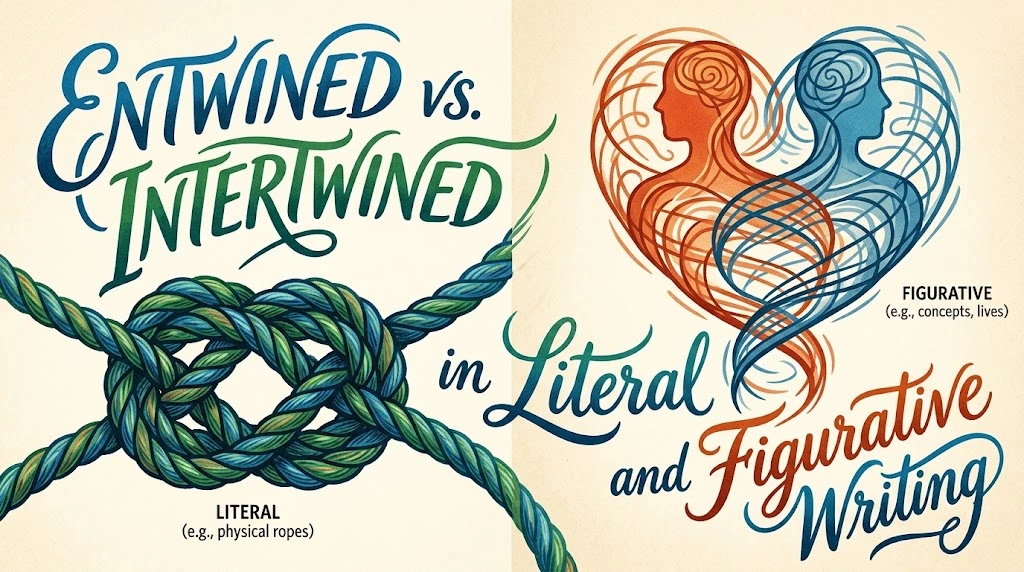
The context often gives you the best clue.
Physical Objects
For physical objects, both words are useful.
The vines were entwined around the gate.
The vines were intertwined around the gate.
Both sentences can work.
If you’re describing one thing winding around another, entwined can feel especially natural.
If you’re emphasizing several elements weaving together, intertwined may provide a clearer image.
People and Relationships
Both words can describe people and relationships.
Their fingers were entwined.
sounds intimate and visually descriptive.
Their lives were intertwined.
sounds broader and focuses on the relationship between their lives.
That’s an important distinction in writing.
Entwined often works beautifully for a specific physical or emotional image.
Intertwined often works well for the larger network of connections.
Ideas, Events, and Systems
When the subject involves several abstract elements, intertwined is often a particularly natural choice.
For example:
The country’s economic and political histories are intertwined.
The sentence describes a relationship between two complex systems.
You could use entwined, too:
The country’s economic and political histories are entwined.
That sentence isn’t grammatically wrong. It simply has a somewhat more literary flavor.
Grammar and Word Forms You Should Know
Understanding the underlying verbs makes these words easier to use.
Entwine, Entwined, and Entwining
The basic forms are:
| Form | Example |
| Base verb | entwine |
| Third-person singular | entwines |
| Past tense | entwined |
| Past participle | entwined |
| Present participle | entwining |
Examples:
The vines entwine around the support.
The vines entwined around the support.
The vines are entwining themselves around the support.
Their histories have become entwined.
Intertwine, Intertwined, and Intertwining
The corresponding forms are:
| Form | Example |
| Base verb | intertwine |
| Third-person singular | intertwines |
| Past tense | intertwined |
| Past participle | intertwined |
| Present participle | intertwining |
Examples:
The branches intertwine above the trail.
The branches intertwined as they grew.
Their stories are intertwining.
Their careers have become intertwined.
Both words follow regular English verb patterns.
Common Collocations With Entwined and Intertwined
Collocations are words that commonly appear together. They can help you make a more natural choice.
Common Collocations With “Entwined”
You may encounter:
- entwined lives
- entwined fingers
- entwined roots
- entwined vines
- entwined histories
- entwined stories
- entwined interests
- entwined relationships
- entwined identities
Common Collocations With “Intertwined”
Common combinations include:
- intertwined lives
- intertwined histories
- intertwined cultures
- intertwined economies
- intertwined interests
- intertwined relationships
- intertwined identities
- intertwined problems
- intertwined causes
- intertwined traditions
- intertwined events
Cambridge’s examples particularly demonstrate intertwined with concepts such as destinies, problems, identities, economies, technology, and history.
That pattern tells you something useful: intertwined is highly comfortable in abstract contexts.
Common Mistakes With Entwined and Intertwined
Assuming One Word Is Always Correct
This is the biggest mistake.
There isn’t a universal rule saying:
“Use entwined for physical things and intertwined for abstract things.”
That’s too simplistic.
Both words can describe physical and figurative relationships.
Treating Them as Perfect Synonyms
The opposite mistake is assuming that they never differ.
They do differ in emphasis.
Entwined can evoke wrapping, binding, and close attachment.
Intertwined often evokes crossing, weaving, mutual involvement, and complex interconnection.
The distinction is subtle rather than absolute.
Using “Intertwined” When “Connected” Would Be Clearer
Sometimes writers choose sophisticated vocabulary when a simpler word communicates the idea more precisely.
Compare:
The two departments are connected.
The two departments are intertwined.
The second sentence suggests a deeper relationship. Their activities may overlap or influence one another.
If that’s what you mean, intertwined adds useful information.
If not, connected may be better.
Assuming “Entwined” Is Only Romantic
Because phrases such as entwined fingers and entwined lives are common, some writers associate the word primarily with romance.
That’s too narrow.
You can write about entwined histories, interests, cultures, economies, and ideas as well. Dictionary examples confirm that figurative usage extends well beyond relationships.
Confusing “Intertwined” With “Interrelated”
These words overlap, but they aren’t identical.
Interrelated means connected or related to one another.
Intertwined carries a stronger image of things being woven, mixed, or deeply connected.
Compare:
The factors are interrelated.
This is broad and neutral.
The factors are intertwined.
This suggests a more complex and inseparable relationship.
Entwined vs. Intertwined in Formal and Academic Writing
Both words can appear in formal writing.
Using “Entwined” in Formal Writing
There’s nothing inherently informal about entwined.
For example:
The development of transportation became entwined with the expansion of urban centers.
That’s perfectly suitable for serious writing.
However, depending on your field, intertwined may sound more analytical when you’re describing systems or mutually dependent factors.
Using “Intertwined” in Academic Writing
Intertwined is especially useful when discussing interconnected phenomena.
For example:
Economic development and environmental policy are deeply intertwined.
Or:
The region’s political and cultural histories remain intertwined.
These sentences communicate more than simple association.
They suggest that separating the subjects would oversimplify their relationship.
Choosing Based on Precision and Tone
A useful rule is:
Choose the word that best represents the relationship you want readers to picture.
If you want vivid imagery, entwined can be excellent.
If you want to emphasize complex mutual connections, intertwined is often a strong fit.
Neither word automatically makes writing more sophisticated.
Precision does.
How Common Are Entwined and Intertwined?
Frequency shouldn’t become a grammar rule.
A word being more common in one genre doesn’t make its alternative incorrect.
Still, usage patterns can help writers understand how these words behave.
Where “Entwined” Commonly Appears
Entwined appears comfortably in:
- literary prose
- descriptive writing
- relationship writing
- historical discussion
- narrative nonfiction
- physical descriptions
Its imagery can give a sentence a more textured feel.
Where “Intertwined” Commonly Appears
Intertwined appears frequently in:
- journalism
- academic writing
- economics
- history
- cultural analysis
- business writing
- social science
- discussions of technology and society
Cambridge’s corpus examples include intertwined political issues, economic relationships, personal data and customer relationships, science, modernity, and lifestyles.
So if you’re writing an analytical article, intertwined may often feel like the more expected choice.
Visual Guide: How to Picture Entwined vs. Intertwined
A mental picture can make this distinction much easier.
Mental Image for “Entwined”
Picture two vines.
One curves around a wooden post. Another loops through it. Their stems remain closely bound.
That’s entwined.
The dominant image is wrapping and close attachment.
Mental Image for “Intertwined”
Now picture several vines growing through the same garden frame.
They cross above, below, and around one another. Pulling one strand may disturb several others.
That’s intertwined.
The dominant image is mutual weaving and connection.
A Simple Conceptual Diagram
ENTWINED
Vine A ─────╮
╰────╮
╰──── Vine B
Focus: close twisting, wrapping, or attachment
INTERTWINED
Strand A ───╲────╱───
╲──╱
Strand B ────╱──╲────
╱ ╲
Strand C ───╱────╲───
Focus: multiple elements weaving through one another
This diagram isn’t a grammatical rule. It’s simply a memory aid.
Practical Decision Guide: Which Word Should You Choose?
When you’re stuck between entwined vs. intertwined, ask what the sentence emphasizes.
Choose “Entwined” When…
Use entwined when:
- something wraps around something else
- you want a vivid physical image
- two things become closely bound
- you’re describing intimate physical contact
- the writing has a literary or evocative quality
- you want to emphasize attachment
For example:
The ivy was entwined around the old stone wall.
Choose “Intertwined” When…
Use intertwined when:
- several elements weave together
- two or more systems affect each other
- you’re describing complex relationships
- you’re discussing history or culture
- you’re writing about economic or social connections
- separation would be difficult because the elements influence one another
For example:
Technology and education are increasingly intertwined.
When Either Word Works
Sometimes there is no need to agonize over the choice.
Consider:
Their histories were entwined.
and:
Their histories were intertwined.
Both are natural.
The first can feel more literary. The second can put more emphasis on interconnected development.
Context decides the finer shade.
A Five-Second Memory Trick
Try this simple mental shortcut:
Entwined → think “wrapped.”
Intertwined → think “woven together.”
This isn’t an absolute rule. It’s simply a useful starting point when you’re choosing between the two.
Read More : Drove vs. Driven: The Complete Guide to Using These Words Correctly
Real-World Usage Examples and Mini Case Studies
Case Study: A Romantic Relationship
Imagine two people holding hands.
Their fingers were entwined.
This sentence creates a close physical image. You can almost see their fingers wrapped around one another.
Now shift the subject:
Their lives were intertwined.
The sentence expands beyond physical contact. It suggests that their histories, experiences, decisions, and futures have become connected.
The change in word mirrors the change in scale.
Case Study: Historical Events
Suppose you’re discussing two major historical developments.
The history of trade was entwined with the development of coastal cities.
This has a literary quality and suggests a close historical connection.
Now:
The history of trade was intertwined with the development of coastal cities.
This sounds more analytical. It emphasizes the way the two developments influenced and shaped each other.
Both can work.
Case Study: Plants and Physical Objects
Consider vines growing through a garden fence.
The vines became entwined around the fence.
This emphasizes the vines winding around the structure.
Now imagine multiple stems crossing in a dense pattern:
The vines became intertwined across the fence.
The second version puts more attention on the network of overlapping stems.
Case Study: Business and Economics
Suppose two industries depend heavily on one another.
The industries are intertwined.
This is a natural choice because you’re describing an interconnected system.
You could say:
The industries are entwined.
That isn’t wrong, but it gives the statement a somewhat more figurative or literary quality.
In technical or analytical prose, intertwined may better communicate the idea of mutual dependence.
Case Study: Literary Description
Literary writing often benefits from sensory imagery.
Their shadows stretched across the wall, entwined beneath the fading light.
Here, entwined contributes atmosphere.
Replacing it with intertwined wouldn’t necessarily make the sentence incorrect. However, the original wording has a more intimate and visual quality.
That’s one reason skilled writers shouldn’t treat synonyms as interchangeable blocks.
A synonym can preserve the basic meaning while changing the texture of a sentence.
Entwined vs. Intertwined: Quick Reference Table
| Situation | Better natural fit | Reason |
| Vines wrapping around a fence | Entwined | Emphasizes winding or wrapping |
| Several branches crossing | Intertwined | Emphasizes mutual weaving |
| Fingers held together | Either | Both describe physical joining |
| Two people’s lives | Either | Both describe close connection |
| Economic systems | Intertwined | Strong sense of mutual dependence |
| Historical developments | Intertwined | Highlights interconnected development |
| Literary romantic description | Entwined | Often more evocative |
| Cultural relationships | Intertwined | Emphasizes complex connection |
| Roots growing through one another | Either | Both can describe physical weaving |
| Complicated social issues | Intertwined | Natural for overlapping factors |
Again, the table provides tendencies rather than rigid rules.
Entwined vs. Intertwined vs. Interwoven
Another useful comparison involves interwoven.
These three words overlap considerably.
Entwined
Focuses on things being twisted, wrapped, or closely bound.
The vines were entwined around the tree.
Intertwined
Focuses on things being woven or connected with one another.
Their histories were intertwined.
Interwoven
Often emphasizes things being woven together into a combined structure.
Several cultural traditions are interwoven throughout the festival.
A useful distinction is that interwoven can strongly evoke fabric, threads, patterns, or elements incorporated into a larger whole.
Still, these categories overlap. Natural English doesn’t always obey neat vocabulary boxes.
A Closer Look at the Prefixes
The word structures provide a helpful clue.
Entwine contains en- plus twine.
The verb dates to the 1590s.
Intertwine combines inter- with twine and dates to the 1640s. Historical sources record its early sense as uniting things by tying or twisting them together.
The prefix inter- means roughly “between,” “among,” or “with one another.”
That doesn’t create a strict modern grammar rule. However, it helps explain why intertwined so naturally describes several things that interact.
Think of it as a linguistic hint rather than a command.
Frequently Asked Questions About Entwined vs. Intertwined
What does “entwined” mean?
Entwined means twisted, wrapped, wound, or closely connected. It can describe physical objects such as vines and fingers as well as abstract subjects such as histories, relationships, and interests.
What does “intertwined” mean?
Intertwined means twisted or woven together or connected so closely that the elements become difficult to separate. It works with physical objects and abstract relationships.
Are “entwined” and “intertwined” synonyms?
Yes, they overlap substantially and can function as synonyms in many contexts. However, they can create slightly different emphasis. Entwined can highlight wrapping or close attachment, while intertwined often highlights mutual weaving or interconnectedness.
Can “entwined” and “intertwined” be used interchangeably?
Sometimes.
For sentences such as “Their fingers were entwined” and “Their fingers were intertwined,” both versions are natural.
In other contexts, one may better match the intended tone or relationship. Intertwined often works particularly well for complex systems, histories, ideas, and events.
Which word should I use for relationships?
Both can work.
Use entwined when you want to emphasize closeness, attachment, or an evocative image.
Use intertwined when you want to emphasize mutual involvement or the complex connection between people or their lives.
For example:
Their lives were entwined.
Their lives were deeply intertwined.
Both are correct.
Which word is better for ideas or events?
Intertwined is often a natural choice because ideas and events can influence one another in complex ways.
For example:
Economic policy and social change are intertwined.
However, entwined is also possible when the writer wants a more figurative or literary effect.
Is “entwined” appropriate in academic writing?
Yes.
Entwined is a legitimate English word and can appear in formal and academic prose. Cambridge’s examples include academic-style discussions of history, economics, politics, learning, and employee development.
The key is whether the word expresses your intended relationship precisely.
Is “intertwined” more formal than “entwined”?
Not necessarily.
Neither word is inherently formal or informal. However, intertwined frequently appears in analytical discussions of systems, history, economics, technology, and social relationships. That usage can make it feel especially natural in formal prose.
What is the difference between “entwined” and “interwoven”?
Both describe things being woven together.
Entwined often suggests twisting, winding, or close attachment.
Interwoven strongly suggests multiple elements being woven into one another or incorporated into a larger pattern.
For example:
The vines were entwined around the tree.
Several traditions are interwoven throughout the culture.
The distinction is one of emphasis rather than a hard grammatical boundary.
What is an easy way to remember the difference?
Think:
Entwined = wrapped or closely bound.
Intertwined = woven together or deeply interconnected.
Then check the sentence.
If you’re describing a complex relationship among several ideas, systems, events, or histories, intertwined will often feel natural.
If you’re creating a vivid image of something winding or binding around another thing, entwined may be the stronger choice.
Final Takeaway: Entwined vs. Intertwined
The difference between entwined vs. intertwined is real, but it isn’t a rigid either-or rule.
Both words describe things that become closely connected through twisting, weaving, wrapping, or association.
The most useful distinction is one of emphasis:
- Entwined often highlights twisting, wrapping, binding, or close attachment.
- Intertwined often highlights weaving, mutual connection, interdependence, or complexity.
- Both can describe physical objects and abstract relationships.
- Both can work with people, histories, ideas, events, and relationships.
- Neither word is automatically more correct than the other.
- Context and intended meaning should guide your choice.
When in doubt, picture what you’re trying to describe.
If you see vines wrapping around a tree, entwined may capture the image beautifully.
If you see several threads crossing into one complicated pattern, intertwined may express the relationship more clearly.
And when both sound natural, don’t overthink it. Choose the word that gives your reader the clearest picture and most precise shade of meaning.
That small distinction can make a sentence feel not merely correct, but carefully written.