
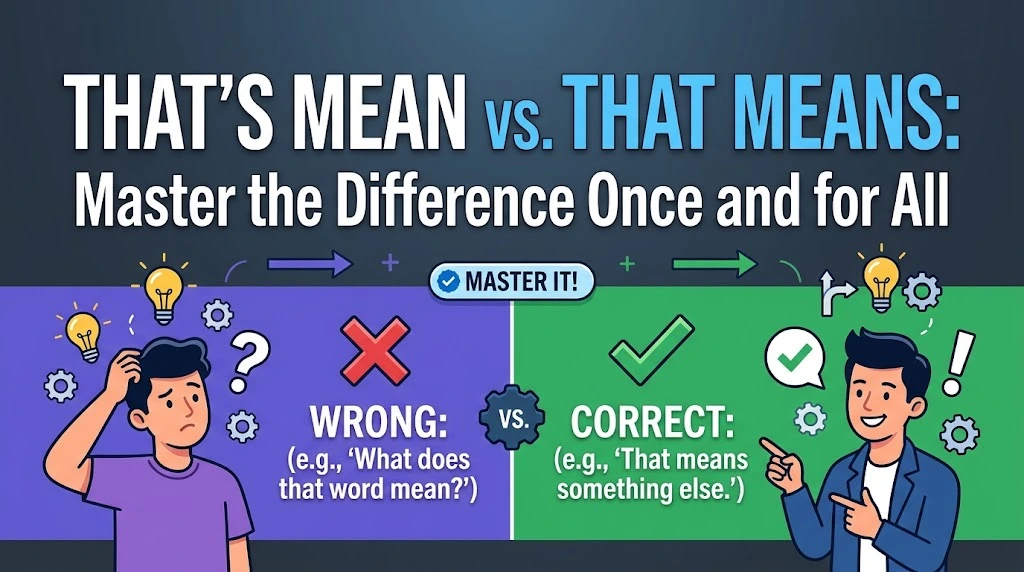
English can be tricky because two phrases may look almost identical while serving completely different purposes. That’s mean vs. that means is a perfect example. At first glance, “that’s mean” and “that means” differ by only one letter. However, their meaning, grammar, and sentence structure are quite different. Understanding this distinction can help you avoid common English grammar mistakes and make your everyday spoken English sound much more natural.
“That’s mean” usually means “that is mean” and describes something as unkind, cruel, or unpleasant. For example, “That’s mean” can be a reaction to someone’s rude comment or hurtful behavior. In contrast, “that means” uses means as a verb and generally expresses meaning, interpretation, consequence, or result. For example, “That means we have to leave now” explains what a situation implies.
This small difference becomes especially important in everyday English, English conversation, writing, and grammar usage. You may also encounter related expressions such as “what does that mean,” “what that means,” “that doesn’t mean,” and “this means.”
Once you understand the roles of mean and means, the distinction becomes much easier to remember.
The Core Difference Between “That’s Mean” and “That Means”
The fastest way to understand the difference is to identify the grammatical role of mean.
| Phrase | Meaning | Grammar | Example |
| That’s mean | That is unkind or hurtful | mean = adjective | “You made fun of her. That’s mean.” |
| That means | That indicates, signifies, or results in something | means = verb | “The road is closed. That means we need another route.” |
“That’s mean” = “That is unkind”
In that’s mean, the apostrophe matters.
That’s is a contraction of that is in this construction.
Therefore:
That’s mean.
= That is mean.
Here, mean describes something.
You could replace mean with other adjectives:
- That’s rude.
- That’s cruel.
- That’s unfair.
- That’s insensitive.
- That’s unkind.
- That’s harsh.
The grammar remains the same.
“That means” = “That indicates”
In that means, there is no apostrophe.
Here, means is a verb. It tells you what something signifies, indicates, or causes.
For example:
The lights are off. That means nobody is home.
You can often replace means with indicates:
The lights are off. That indicates nobody is home.
The wording changes slightly, but the underlying idea remains.
Cambridge Dictionary gives mean as a verb that can express an idea or fact and can also describe a particular result. For example, one fact can “mean” that another situation follows from it.
That’s the heart of the distinction.
What Does “That’s Mean” Mean?
“That’s mean” means “that is unkind, hurtful, or unpleasant.”
The phrase usually appears as a reaction to someone’s behavior, words, decision, or action.
For example:
“You told everyone about her secret. That’s mean.”
The speaker isn’t asking what the action signifies.
Instead, the speaker is judging the behavior as unkind.
Cambridge Dictionary defines mean as an adjective meaning “unkind or unpleasant” in this sense. It also provides examples involving behavior that hurts or disregards another person’s feelings.
The Grammar of “That’s Mean”
The structure is simple:
That + is + adjective
In this sentence:
- That = subject
- is = linking verb
- mean = adjective
So:
That’s mean.
becomes:
That is mean.
You can test the phrase by replacing mean with another adjective.
That’s rude.
That’s unfair.
That’s selfish.
That’s insensitive.
That’s mean.
All five sentences follow the same basic pattern.
What Does “Mean” Describe Here?
The adjective mean can describe behavior that seems unkind, unpleasant, or hurtful.
For example:
“You ignored her after promising to help. That’s mean.”
“Making fun of his accent was mean.”
“You ate the entire cake without asking. That’s mean.”
In each case, mean evaluates an action.
It doesn’t explain a meaning.
That’s an important clue.
If you can paraphrase the sentence as “That is unkind”, you probably need that’s mean.
“That’s Mean” Can Describe More Than Cruelty
The word mean doesn’t always describe something seriously cruel.
In everyday American English, speakers often use it for smaller acts of thoughtlessness.
For example:
“You didn’t save me any pizza? That’s mean!”
The speaker may not genuinely accuse the other person of cruelty. The phrase could simply express playful annoyance.
That brings us to tone.
The Emotional and Social Context of “That’s Mean”
“That’s mean” is often conversational and emotional.
It frequently appears when someone reacts immediately to something another person has said or done.
Imagine this exchange:
Maya: “I told everyone about your embarrassing nickname.”
Jordan: “That’s mean!”
The phrase expresses a social judgment.
The speaker believes the action crossed a line.
However, context determines how serious that judgment sounds.
Compare:
“You told everyone my secret. That’s mean.”
with:
“You ate the last cookie? That’s mean!”
The first statement sounds genuinely critical. The second might be playful.
“That’s Mean” Can Be Serious
When the action causes real emotional harm, the phrase can carry significant weight.
Examples include:
- humiliating someone publicly
- mocking someone’s mistake
- deliberately excluding someone
- insulting someone’s appearance
- revealing private information
- intentionally embarrassing a friend
For example:
“Making fun of her mistake in front of the entire class was mean.”
Here, mean clearly describes hurtful behavior.
“That’s Mean” Can Also Be Playful
English speakers often soften or exaggerate expressions for humor.
Consider:
“You finished the fries without me? That’s mean!”
Nobody necessarily believes the person committed a serious moral offense.
The phrase simply dramatizes the complaint.
Tone, facial expression, punctuation, and relationship all influence the interpretation.
A text message saying:
“Wow. That’s mean 😂”
may sound playful.
Meanwhile:
“That’s mean.”
with no additional context could sound much more serious.
Positive, Humorous, and Sarcastic Uses of “That’s Mean”
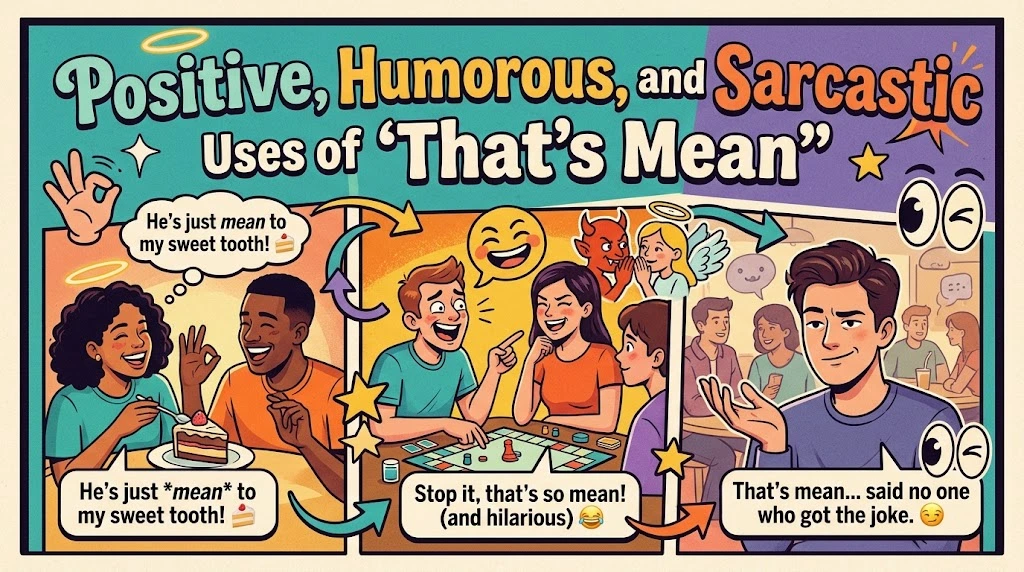
Although mean usually has a negative sense when it describes behavior, conversational English gives speakers plenty of room for humor.
Playful teasing
“You changed the Wi-Fi password and didn’t tell me? That’s mean.”
Mock outrage
“You ate my favorite candy? That’s mean!”
Sarcasm
“Oh, thanks for reminding me that I forgot the deadline. That’s mean.”
The literal meaning remains connected to unkindness. The speaker’s tone can make the expression humorous rather than genuinely hostile.
This is why dictionary definitions alone don’t always tell you exactly how a phrase will sound in conversation.
Context supplies the emotional volume.
What Does “That Means” Mean?
Now consider the other phrase.
“That means” explains what something indicates, signifies, implies, or results in.
For example:
“The office is closed today. That means we have to come back tomorrow.”
The phrase connects one piece of information with its consequence.
Here, means functions as a verb.
The Grammar Behind “That Means”
The basic structure is:
That + means + information
For example:
That means we’re late.
- That = subject
- means = verb
- we’re late = information being indicated
The verb mean changes to means because the subject that is singular.
Compare:
- I mean…
- You mean…
- We mean…
- They mean…
- That means…
- It means…
This is standard subject-verb agreement.
“That Means” Can Mean “That Indicates”
For example:
“The lights are off. That means the store is closed.”
The phrase tells you how to interpret the first fact.
You could rewrite it:
“The lights are off. That indicates the store is closed.”
Cambridge defines signify as meaning something or being a sign of something. That makes signify a useful formal alternative when explaining the function of means in this context.
“That Means” Can Express a Result
The phrase can also introduce a consequence.
“The flight was canceled. That means we’ll need another plan.”
Here, the phrase doesn’t simply define a word.
It connects a fact with what follows from that fact.
Other examples include:
- “The price increased. That means we’ll spend more.”
- “She missed the bus. That means she’ll be late.”
- “The deadline moved forward. That means we need to finish sooner.”
- “The restaurant is full. That means we’ll have to wait.”
In each example, that means introduces an interpretation or consequence.
Common Uses of “That Means”
The phrase appears in everyday conversation, professional communication, explanations, instructions, and academic writing.
Explaining information
“The word annual means once a year.”
A related structure is:
“The word appears twice. That means it is important.”
Explaining consequences
“The road is blocked. That means we’ll need another route.”
Interpreting evidence
“She hasn’t answered the phone. That means she may be busy.”
Notice that this kind of sentence expresses an inference. The conclusion isn’t necessarily certain.
The speaker is interpreting available information.
Clarifying a previous statement
“The meeting has been moved to Friday. That means we have two extra days.”
This construction is especially useful because it helps listeners understand why the previous information matters.
Signal Patterns That Help You Recognize “That Means”
Certain sentence patterns can make the distinction easier.
You will often see:
- That means you…
- That means we…
- That means I…
- That means it…
- That means there…
- That means they…
- That means the…
Examples:
“That means you need to sign the form.”
“That means we should leave early.”
“That means I misunderstood the instructions.”
“That means there won’t be enough seats.”
These structures usually introduce an explanation, implication, or consequence.
By contrast, “That’s mean” usually ends the thought or describes an action:
“You laughed at him. That’s mean.”
You can add more information:
“That’s mean of you.”
But the grammatical function remains descriptive.
“That’s Mean” vs. “That Means”: Side-by-Side Comparison
| Feature | That’s Mean | That Means |
| Expanded form | That is mean | That means |
| Main word | mean | means |
| Part of speech | Adjective | Verb |
| Main meaning | Unkind or unpleasant | Indicates, signifies, or results in |
| Apostrophe | Yes | No |
| Typical use | Reaction to behavior | Explanation or interpretation |
| Example | “That’s mean of you.” | “That means we’re late.” |
| Can replace with “indicates”? | No | Usually yes |
| Can replace with “unkind”? | Yes | No |
A simple contrast makes the difference memorable:
That’s mean = That is unkind.
That means = That indicates something.
If you remember those two substitutions, you’ll avoid most mistakes.
Why “That’s Mean” and “That Means” Are Easy to Confuse
The confusion isn’t surprising.
Both expressions contain the word mean. They also sound similar when spoken quickly.
Yet the grammar underneath them is different.
The Shared Word “Mean”
English gives mean several jobs.
It can function as:
- an adjective meaning unkind
- a verb meaning signify
- a verb meaning intend
- a verb meaning have a particular result
- a noun referring to a mathematical average
For this article, two meanings matter most:
mean = unkind
and
mean = signify or result in
Cambridge Dictionary confirms these different uses, including the adjective meaning “unkind or unpleasant” and the verb meanings involving expression, results, intention, and importance.
The surrounding grammar tells you which meaning is active.
The Role of the Apostrophe in “That’s”
This tiny punctuation mark does a lot of work.
That’s can be a contraction of that is or that has, depending on the sentence.
In “That’s mean,” it means:
That is mean.
It does not mean “that means.”
Compare:
That’s rude.
= That is rude.
That’s unfair.
= That is unfair.
That’s mean.
= That is mean.
The pattern is obvious once you expand the contraction.
A Useful Test
When you’re unsure, expand that’s.
If the expanded sentence makes sense, you probably have the right form.
That’s mean.
→ That is mean. ✓
That’s means we’re late.
→ That is means we’re late. ✗
The second version immediately exposes the problem.
Why “That Means” Has No Apostrophe
Means is simply the third-person singular present form of the verb mean.
Compare:
I mean it.
You mean it.
They mean it.
She means it.
That means something.
The -s belongs to the verb.
It isn’t a contraction.
Therefore, don’t write:
❌ That’s means we should leave.
Write:
✅ That means we should leave.
The first version incorrectly combines a contraction with a verb form that already has the required -s.
Common Mistakes With “That’s Mean” and “That Means”
Using “That’s Mean” When You Mean “That Means”
This is probably the most important mistake to avoid.
Suppose someone says:
“The meeting starts at 8 a.m.”
You want to explain the consequence.
Incorrect:
❌ “That’s mean we need to wake up early.”
Correct:
✅ “That means we need to wake up early.”
Why?
Because you’re saying:
“That indicates we need to wake up early.”
You’re not saying:
“That is unkind.”
Using “That Means” to Describe Unkind Behavior
Now reverse the situation.
Someone insults your friend.
Incorrect:
❌ “That means!”
If your intended message is “That is unkind,” use:
✅ “That’s mean!”
You could also say:
“That’s rude.”
“That’s unkind.”
“That’s hurtful.”
“That’s not nice.”
The key is that you’re describing behavior.
Confusing “That’s” With “Thats”
Another common writing error involves dropping the apostrophe.
The standard contraction is:
that’s
Not:
❌ thats
For example:
“That’s mean.”
“That’s exactly what I meant.”
“That’s why we’re leaving.”
The apostrophe marks the contraction.
In informal digital writing, people sometimes omit apostrophes. However, standard edited English still uses them.
Confusing “Mean,” “Means,” and “Meaning”
These forms look related because they are related. Their grammatical jobs differ.
| Form | Common grammatical role | Example |
| mean | Verb/adjective | “What does this word mean?” |
| means | Present-tense verb | “That means something.” |
| meaning | Noun/present participle | “What is the meaning?” |
Mean
“What does this sentence mean?”
Here, mean is a verb.
Means
“That means we need to hurry.”
Here, means is the present-tense verb used with singular that.
Meaning
“What is the meaning of this word?”
Here, meaning is a noun.
Don’t let the similar spelling blur these different functions.
Real-World Examples of “That’s Mean” vs. “That Means”
The easiest way to make the distinction stick is to see both phrases in realistic situations.
Casual Conversation
Situation: A friend eats the last slice of pizza.
“You knew I wanted that slice. That’s mean!”
The speaker is judging the action.
Now consider a different situation:
Situation: The pizza shop has sold out.
“They’re sold out. That means we’ll have to order something else.”
This sentence explains a consequence.
The difference
That’s mean → emotional judgment.
That means → explanation.
Workplace Communication
Imagine a manager says:
“The deadline has been moved to Friday.”
A coworker responds:
“That means we have two extra days.”
Here, that means connects the new deadline with its consequence.
Now imagine an employee deliberately takes credit for another person’s work.
A colleague might say:
“That’s mean.”
The phrase evaluates the behavior.
Notice how naturally the grammar follows the intended meaning.
Text Messages and Social Media
Digital communication creates another interesting layer because punctuation and tone can become less obvious.
For example:
“You posted that photo without asking 😂 That’s mean.”
The laughing emoji may soften the statement.
Compare:
“You posted that photo without asking. That’s mean.”
The second version can sound more serious.
Now consider:
“The concert is canceled. That means we need a new plan.”
No emotional judgment appears here.
The phrase simply explains the consequence.
Mini Case Studies: Choosing the Correct Phrase
Case Study: Responding to an Insult
Situation: Alex makes a joke about Sam’s appearance in front of several people.
Sam’s friend says:
“That’s mean.”
Why does this work?
Because the speaker describes Alex’s comment as unkind.
You could substitute:
“That’s rude.”
or:
“That’s hurtful.”
The grammatical structure remains the same.
Case Study: Explaining a Consequence
Situation: A train announcement says the service has been suspended.
A passenger says:
“That means we’ll need to take the bus.”
Here, the speaker interprets the announcement.
The meaning is:
“The suspension indicates that we need another form of transportation.”
So that means is the correct choice.
Case Study: One Letter Changes the Message
Compare these sentences:
That’s mean.
That means we’re late.
The difference looks tiny.
The meanings aren’t.
In the first sentence, mean is an adjective describing something as unkind.
In the second sentence, means is a verb connecting one fact with another conclusion.
Think of the two sentences as having different jobs:
That’s mean → judgment
That means → interpretation
That distinction is far more useful than simply memorizing spelling.
Related Expressions and Useful Alternatives
Sometimes you know which phrase is grammatically correct but want a more precise expression.
Alternatives to “That’s Mean”
Depending on the situation, you could say:
- That’s unkind.
- That’s rude.
- That’s hurtful.
- That’s harsh.
- That’s insensitive.
- That’s unfair.
- That’s not nice.
- That was unnecessary.
- That was a low blow.
Each expression carries a slightly different tone.
“That’s unkind”
This sounds relatively measured.
“That was an unkind thing to say.”
“That’s rude”
This focuses more directly on manners or social behavior.
“Interrupting someone while they’re speaking is rude.”
“That’s hurtful”
This emphasizes emotional impact.
“That comment was hurtful.”
“That’s harsh”
This can describe criticism that feels excessively severe.
“That’s a harsh way to put it.”
So, that’s mean is useful, but it isn’t your only option.
Alternatives to “That Means”
When explaining an idea, you can replace that means with several expressions.
That indicates
More formal:
“The warning light is flashing. That indicates a problem.”
That suggests
Useful when the conclusion isn’t certain:
“She hasn’t replied. That suggests she may be busy.”
That shows
Common and natural:
“The results improved. That shows the new method worked.”
In other words
Useful when restating an idea:
“The policy applies to everyone. In other words, nobody gets an exception.”
Therefore
More formal and logical:
“The road is closed. Therefore, we need another route.”
As a result
Useful for consequences:
“The flight was delayed. As a result, we arrived late.”
These alternatives don’t always have exactly the same nuance. Choose the one that matches the relationship between your facts.
“That Means” vs. “This Means”
Another nearby distinction involves that and this.
Both can refer to information.
For example:
“The company reduced its prices. This means customers will pay less.”
Here, this points directly to the information just mentioned.
You can also say:
“The company reduced its prices. That means customers will pay less.”
Both are possible in many contexts.
The choice often depends on how the speaker frames the information.
A useful general tendency is:
- this often points to something being introduced or immediately connected.
- that can point back to something already mentioned.
However, context matters, so this isn’t an absolute rule.
“That’s Mean” vs. “That’s Meaning”
These expressions shouldn’t be treated as interchangeable.
“That’s mean” has a clear and common structure:
That + is + adjective
For example:
“That’s mean.”
By contrast, “that’s meaning” normally doesn’t serve as a natural replacement.
You might encounter meaning in a sentence such as:
“That’s the meaning of the phrase.”
Here, meaning functions as a noun.
You might also see meaning in other grammatical constructions:
“The expression is meaningful.”
“What meaning does this symbol have?”
The important point is that mean and meaning don’t simply substitute for one another.
A Quick Decision Guide: “That’s Mean” or “That Means”?
When you’re writing quickly, use this simple test.
Are you describing something as unkind?
Use:
That’s mean.
Example:
“You embarrassed him in front of everyone. That’s mean.”
Are you explaining what something indicates?
Use:
That means.
Example:
“The store is closed. That means we’ll have to come back tomorrow.”
Can you replace “that’s” with “that is”?
If yes, that’s probably works.
That’s mean.
→ That is mean. ✓
Can you replace “means” with “indicates”?
If yes, that means probably works.
That means we’re late.
→ That indicates we’re late. ✓
This substitution test is quick and surprisingly reliable.
Read More : On the Plane or In the Plane? Which Is Correct? A Complete Guide to English Usage
Quick Memory Trick for “That’s Mean” vs. “That Means”
Here’s an easy way to remember the distinction:
That’s mean = That’s unkind.
That means = That indicates.
Think of that’s mean as a reaction.
Someone says something cruel.
You react:
“That’s mean.”
Think of that means as a bridge.
One fact leads you to another idea:
“The road is closed. That means we need another route.”
One judges.
The other explains.
That’s the mental shortcut worth remembering.
More Examples to Make the Difference Automatic
| Situation | Correct phrase | Why |
| Someone mocks a friend | “That’s mean.” | Describes unkind behavior |
| The store closes at five | “That means we need to hurry.” | Explains a consequence |
| Someone reveals your secret | “That’s mean.” | Judges the action |
| Your flight gets canceled | “That means we’re staying another night.” | Explains the result |
| Someone refuses to share deliberately | “That’s mean.” | Describes behavior |
| A sign says “No Entry” | “That means we can’t go inside.” | Interprets information |
| A friend makes a cruel joke | “That’s mean.” | Describes the joke |
| The deadline changed | “That means we have more time.” | Explains the implication |
The pattern becomes clear when you stop focusing on spelling and focus on function.
A Few Important Facts About “Mean”
The word mean has a surprisingly broad range of uses.
Mean can describe behavior
“Don’t be mean.”
Here, mean is an adjective.
Mean can express significance
“What does this word mean?”
Here, mean is a verb.
Mean can describe a result
“Higher costs mean higher prices.”
Here, mean functions as a verb expressing a result or consequence. Cambridge specifically identifies this use.
Mean can express intention
“I didn’t mean to hurt you.”
Here, mean expresses intention.
Cambridge also lists mean as a verb meaning to intend.
Mean can describe mathematical averages
“The mean of the numbers is 15.”
This is an entirely different meaning.
That variety explains why learners sometimes struggle with mean. The spelling stays almost unchanged while the grammatical role shifts.
Common Questions About “That’s Mean” vs. “That Means”
What does “That’s mean” mean?
“That’s mean” means “that is unkind, hurtful, or unpleasant.” It usually reacts to someone’s words or behavior.
Example:
“You made fun of her mistake. That’s mean.”
What does “that means” mean?
“That means” means that something indicates, signifies, implies, or leads to a particular result.
Example:
“The office is closed. That means we’ll have to return tomorrow.”
Is “That’s mean” grammatically correct?
Yes.
It is a contraction of “that is mean,” where mean functions as an adjective.
Why do people confuse “that’s mean” and “that means”?
The two phrases contain the same core word and sound similar in conversation. However, mean is an adjective in that’s mean, while means is a verb in that means.
Is “that’s” the same as “that means”?
No.
In “that’s mean,” that’s normally means that is.
In “that means,” means is the verb.
These constructions perform different grammatical functions.
Can “mean” be both a verb and an adjective?
Yes.
As an adjective:
“That’s mean.”
As a verb:
“What does that mean?”
English uses the same spelling for these different grammatical roles.
How can I quickly remember which phrase to use?
Use the substitution test:
That’s mean → That is unkind.
That means → That indicates.
If the first replacement works, choose that’s mean.
If the second works, choose that means.
What are good alternatives to “that’s mean”?
Depending on context, you can use:
- That’s unkind.
- That’s rude.
- That’s hurtful.
- That’s harsh.
- That’s insensitive.
- That’s unfair.
What are alternatives to “that means”?
Depending on your intended nuance:
- That indicates…
- That suggests…
- That shows…
- In other words…
- Therefore…
- As a result…
Is “that’s mean” always negative?
Usually, when mean describes behavior, it carries a negative sense because it refers to unkind or unpleasant behavior. However, everyday speakers can use “That’s mean!” playfully or sarcastically.
For example:
“You ate the last cookie? That’s mean!”
The speaker may be joking rather than making a serious accusation.
Final Takeaway: “That’s Mean” vs. “That Means”
The difference between “that’s mean” and “that means” becomes simple once you identify what mean is doing.
That’s mean describes something as unkind, hurtful, or unpleasant.
“You embarrassed her in front of everyone. That’s mean.”
That means explains what something indicates, signifies, implies, or results in.
“The store is closed. That means we’ll have to come back tomorrow.”
The apostrophe offers another useful clue.
That’s = that is in “that’s mean.”
Meanwhile, means is simply the third-person singular form of the verb mean.
So when you’re stuck, ask yourself one question:
Am I describing something as unkind, or am I explaining what something indicates?
If you’re describing unkind behavior, choose “that’s mean.”
If you’re explaining meaning or consequence, choose “that means.”
Once that distinction becomes automatic, this common English mix-up disappears pretty quickly.