
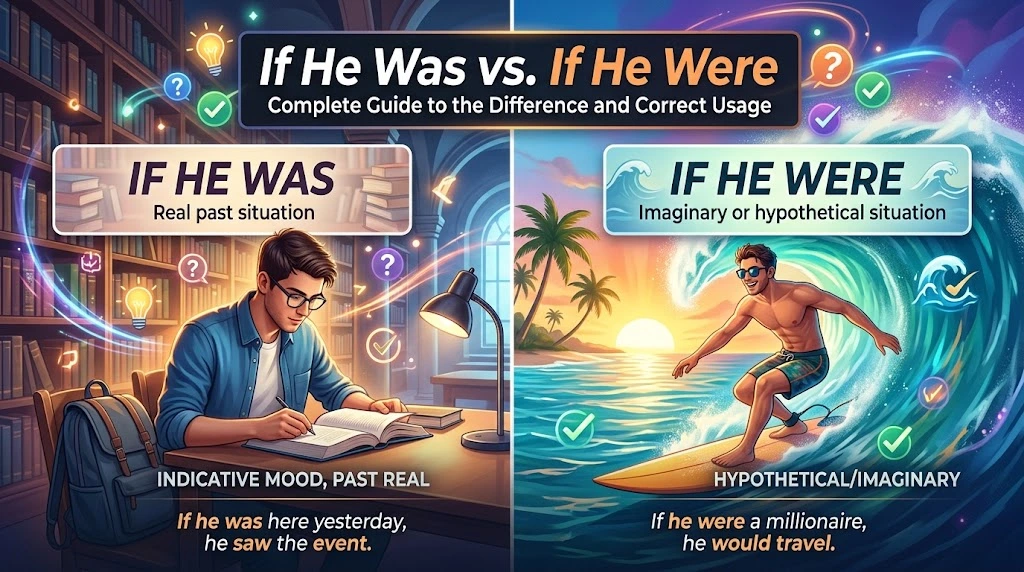
Have you ever stopped halfway through a sentence and wondered, “Should I say if he was or if he were?”
You’re not alone. The two phrases look almost identical, yet they can communicate different ideas. The tricky part is that both “if he was” and “if he were” can be grammatically correct. The right choice depends on what you mean.
Compare these sentences:
If he was at home, he probably heard the noise.
If he were at home, he would answer the phone.
The first sentence considers a possible past situation. The second imagines a hypothetical situation.
That small change from was to were can shift the meaning considerably.
The key is understanding whether you’re talking about something that may have been true or something you’re imagining as untrue, unlikely, or contrary to fact.
This guide explains if he was vs. if he were, including the subjunctive mood, everyday usage, formal writing, common mistakes, practical tests, and plenty of examples.
If He Was vs. If He Were: The Basic Difference
The simplest way to understand the distinction is to look at the speaker’s attitude toward the situation.
“If he was” usually introduces a condition that could have been true in the past.
“If he were” traditionally introduces a hypothetical, unreal, or contrary-to-fact condition.
| Expression | Typical meaning | Example |
| If he was | Possible or uncertain past situation | If he was tired, he probably went home. |
| If he were | Hypothetical or unreal situation | If he were tired, he would go home. |
| If he was | Something that may actually have happened | If he was at the meeting, I didn’t see him. |
| If he were | An imagined present condition | If he were here, he’d help us. |
The distinction isn’t simply about past versus present.
That’s an important point.
The word were in “if he were” often signals hypothetical meaning, not ordinary past tense. Meanwhile, was can describe an actual past condition even though the sentence begins with if.
A quick rule
Possible or uncertain past reality → “if he was”
Hypothetical or contrary-to-fact situation → “if he were”
This rule handles many everyday cases, although real English can be more nuanced.
What Does “If He Was” Mean?
“If he was” uses the ordinary past-tense form was.
Because he is a singular subject, we normally say:
- He was tired.
- He was at work.
- He was angry.
- He was in Chicago.
When you place an if clause before these statements, was can remain the natural choice when you’re considering whether something actually happened.
For example:
If he was at work yesterday, he probably saw the email.
The speaker doesn’t necessarily know whether he was at work. However, being at work is presented as a genuine possibility.
Another example:
If he was sick last week, that explains why he missed the meeting.
The speaker is considering a possible past fact. The illness may have happened. It may not have happened.
That’s why was fits naturally.
When to Use “If He Was”
Use “if he was” when the condition refers to a real or potentially real situation, particularly one in the past.
For example:
- If he was tired, he should have gone home.
- If he was at the restaurant, someone must have seen him.
- If he was angry about the decision, he didn’t mention it.
- If he was responsible for the report, he probably has the final copy.
- If he was there last night, I didn’t notice him.
In each sentence, the speaker considers the possibility that the condition was true.
The speaker isn’t necessarily imagining an impossible world. They’re examining what might have happened.
“If He Was” in Everyday Speech
You’ll hear “if he was” frequently in ordinary conversation.
Imagine two coworkers discussing a meeting:
“Was Daniel at the meeting?”
“I don’t know. If he was there, I didn’t see him.”
Here, if he was there refers to a genuine uncertainty. Daniel either attended the meeting or he didn’t.
Another example:
If he was upset, he hid it well.
The speaker doesn’t necessarily believe that he was upset. They simply don’t know.
This is a useful distinction because if doesn’t automatically make a sentence hypothetical in the special grammatical sense.
An if clause can introduce uncertainty about a real event:
If the package arrived, it’s probably at the front desk.
It can also introduce an imagined condition:
If the package were here, we could open it.
The word if starts both clauses. The meaning determines the grammatical pattern.
What Does “If He Were” Mean?
“If he were” traditionally uses the subjunctive mood to express a hypothetical, unreal, or contrary-to-fact situation.
Consider:
If he were here, we could ask him.
The natural interpretation is that he isn’t here.
The sentence imagines a different situation.
Another example:
If he were the manager, he would change the schedule.
This doesn’t normally mean that he actually is the manager. Instead, the speaker imagines what would happen under that condition.
That’s where were becomes especially useful.
Examples of “If He Were”
- If he were here, we’d ask him directly.
- If he were older, he could apply for the position.
- If he were my brother, I’d tell him the truth.
- If he were more careful, he wouldn’t make that mistake.
- If he were the owner, he might change the policy.
- If he were available, we’d invite him to the meeting.
Notice something interesting: these situations aren’t necessarily impossible.
A person could become older. Someone could theoretically become the owner. A person who isn’t here now could arrive later.
The important point is that the speaker presents the condition as hypothetical rather than established fact.
The Subjunctive Mood in “If He Were”
The word subjunctive sounds intimidating, but the underlying idea is fairly simple.
The subjunctive mood allows English speakers to talk about situations that are imagined, wished for, hypothetical, or contrary to reality.
One of the clearest examples is:
If I were you, I’d apologize.
Nobody literally becomes another person. The sentence creates an imagined perspective.
The same pattern works with he:
If he were you, he’d probably apologize.
And with she:
If she were here, she’d know what to do.
And with it:
If it were possible, we’d finish today.
Why “Were” With “He”?
Normally, he takes was in the past tense:
He was tired.
He was at home.
He was late.
However, in traditional English subjunctive constructions, were can appear with singular subjects:
If he were here…
If she were ready…
If it were possible…
This is sometimes called the irrealis were because it marks a situation as hypothetical or unreal rather than simply placing an event in the past.
That distinction explains why “if he were” isn’t simply an alternative spelling of “if he was.”
If He Was vs. If He Were: Same Situation, Different Meaning
One of the easiest ways to understand this difference is to put the two forms next to each other.
Example: Being at Home
If he was at home, he probably heard the noise.
This suggests that the speaker is considering whether he actually was at home.
Now compare:
If he were at home, he would answer the phone.
This presents being at home as a hypothetical condition. The implication may be that he isn’t home.
The difference becomes even clearer here:
If he was sick yesterday, that explains his absence.
The speaker is considering a possible past fact.
If he were sick today, he would stay home.
The speaker imagines a current hypothetical situation.
Another Pair
If he was angry, he didn’t show it.
This examines a possible emotional state in the past.
If he were angry, he’d probably tell us.
This imagines what would happen if he were angry.
The grammar follows the meaning.
If He Was vs. If He Were: A Side-by-Side Comparison
| Feature | If He Was | If He Were |
| Main use | Possible or uncertain reality | Hypothetical or unreal situation |
| Typical time | Often past | Often present or hypothetical future |
| Mood | Indicative | Subjunctive/irrealis in traditional grammar |
| Example | If he was sick, he missed work. | If he were sick, he’d stay home. |
| Implies the condition may be true? | Often yes | Usually not presented as established |
| Common in conversation? | Very common | Also common in specific hypothetical phrases |
| Formal hypothetical writing | Possible depending on meaning | Often preferred |
| Works with “If I were you” pattern? | No | Yes |
The most important column is meaning.
Don’t choose the verb simply because you see the word if.
Are “If He Was” and “If He Were” Interchangeable?
Not completely.
In some informal contexts, speakers use was where traditional grammar would use were. This creates some overlap in modern English.
For example, you’ll hear:
If he was here, he’d know what to do.
Some speakers use this naturally even when they mean a hypothetical situation.
Traditional edited English would generally prefer:
If he were here, he’d know what to do.
However, the two forms can also create a genuine difference in meaning.
Consider:
If he was at the office, he saw the announcement.
This concerns a possible past event.
Changing it to:
If he were at the office, he would see the announcement.
changes the sentence into a hypothetical scenario.
So, while modern speech sometimes blurs the distinction, the forms aren’t universally interchangeable.
Why “If He Was” Appears in Modern English
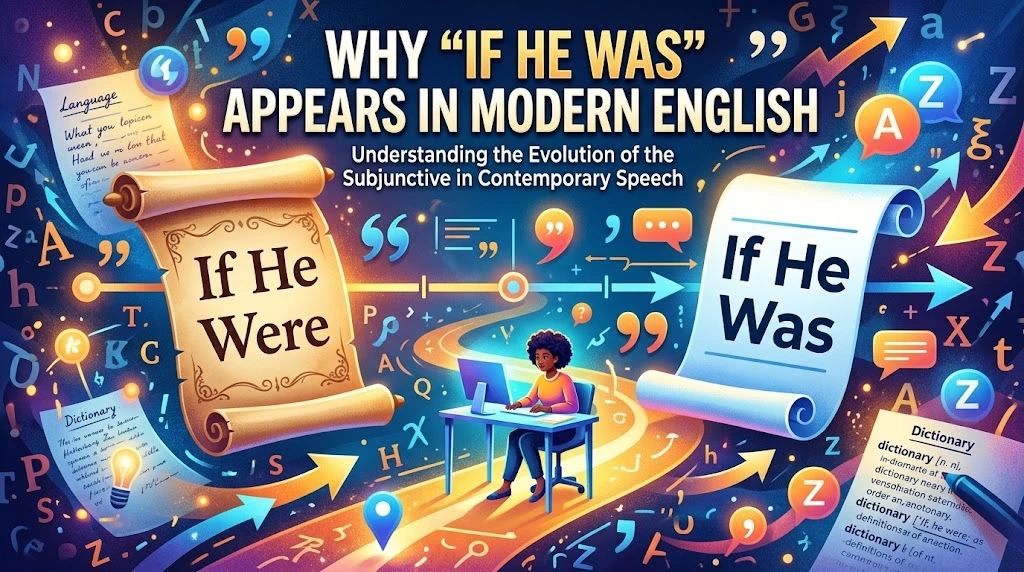
English changes over time.
Many older grammatical distinctions have weakened in everyday speech. The subjunctive is one area where this is especially noticeable.
Modern English has relatively few verb forms that clearly mark the subjunctive. The most recognizable surviving distinction is the use of were in hypothetical expressions:
- If I were…
- If he were…
- If she were…
- If it were…
Outside these constructions, English often relies heavily on context rather than verb endings.
That’s why “if he was” sometimes appears in informal hypothetical statements.
For example:
If he was here, he’d probably complain.
A speaker may use was without intending to make a grammatical statement about a real past event.
In formal edited writing, however, “if he were here” remains the clearer traditional choice when the situation is hypothetical.
Subtle Differences in Meaning
Sometimes the distinction is subtle rather than dramatic.
Consider:
If he was responsible for the mistake, he should explain it.
This leaves open the possibility that he actually was responsible.
Now compare:
If he were responsible for the mistake, he should explain it.
This sounds more hypothetical. Depending on context, it may suggest that the speaker doubts or denies that he was responsible.
The difference can therefore affect the speaker’s stance toward the condition.
“If He Was”
Often suggests:
- The event may have happened.
- The condition may have been true.
- The speaker doesn’t know for certain.
- The sentence discusses a real possibility.
“If He Were”
Often suggests:
- The condition is imagined.
- The situation isn’t currently true.
- The speaker is considering an alternative reality.
- The statement is hypothetical or contrary to fact.
These aren’t absolute rules. Context always matters.
When “If He Was” Is the Better Choice
Imagine a detective reviewing what happened yesterday:
If he was at the hotel, the security cameras may have captured him.
Using were would change the flavor:
If he were at the hotel, the security cameras would capture him.
The first sentence investigates a possible past fact.
The second constructs a hypothetical condition.
That distinction matters in journalism, academic writing, legal analysis, workplace communication, and ordinary conversation.
More Examples
- If he was driving, he may have seen the accident.
- If he was sleeping, he probably didn’t hear the alarm.
- If he was at the store, he bought the supplies.
- If he was involved, someone should ask him about it.
These sentences examine possibilities rather than inventing alternative realities.
When “If He Were” Is the Better Choice
Now imagine discussing a hypothetical employee:
If he were the supervisor, he’d handle the situation differently.
You’re not necessarily claiming he has ever been the supervisor.
You’re imagining the consequences of that condition.
Other examples include:
- If he were taller, he could reach the shelf.
- If he were more patient, he’d enjoy teaching.
- If he were available tomorrow, we’d ask him to join us.
- If he were in charge, the process might change.
- If he were here right now, he could answer that question.
The construction is particularly natural when the condition contradicts the known situation.
He’s not here. If he were here, he’d help us.
That’s a textbook example of hypothetical were.
A Practical Test: Ask the Reality Question
When you’re stuck between was and were, don’t panic over grammar terminology.
Ask one simple question:
Am I talking about something that may actually have happened, or am I imagining a different situation?
If the answer is “It may have happened”
Use was in many such past contexts.
If he was at the party, I didn’t see him.
If the answer is “I’m imagining it”
Use were in the traditional construction.
If he were at the party, he’d probably be talking to everyone.
This test won’t solve every possible conditional sentence, but it works remarkably well for the specific if he was vs. if he were problem.
A Second Test: Check the Imagination Level
Think of the two forms as two doors.
Was often opens the door to a possible reality.
Were often opens the door to an imagined reality.
For example:
If he was injured, the coach probably knew.
Possible reality.
If he were injured, the coach would replace him.
Hypothetical scenario.
The difference becomes especially obvious when the sentence describes something that contradicts what you already know.
He isn’t here. If he were here, we’d start the meeting.
The condition is clearly contrary to the present situation.
A Third Test: Look at Advice Statements
Hypothetical advice frequently uses were.
Consider:
If he were in your position, he’d probably wait.
The speaker isn’t claiming that he is actually in your position.
They’re imagining what he might do under those circumstances.
You can use the same pattern with:
- If he were the manager…
- If he were my friend…
- If he were in charge…
- If he were available…
- If he were older…
- If he were here…
This is why “if he were” appears naturally in advice, recommendations, imagined scenarios, and hypothetical discussions.
Common Mistakes With “If He Was” and “If He Were”
Mistake: Using “Were” for Every “If He” Sentence
Not every if he sentence is hypothetical.
For example:
If he was at the office yesterday, he probably saw Maria.
Using were here can change the intended meaning.
The speaker is investigating a possible past event.
Mistake: Using “Was” for Every Hypothetical Situation
The opposite mistake happens too.
Consider:
If he were here, he could help us.
This is a clear hypothetical situation.
In formal writing, replacing were with was can weaken the grammatical distinction.
Mistake: Thinking “Were” Always Means Past
This causes considerable confusion.
Ordinary were can be a past-tense form:
They were tired yesterday.
But subjunctive were works differently:
If he were here, we’d ask him.
The second sentence isn’t simply describing something in the past.
Mistake: Assuming “Would” Automatically Requires “Were”
This shortcut doesn’t always work.
Consider:
If he was at the office, he would have seen the email.
Here, was can be correct because the speaker is considering a possible past fact.
So don’t use would as your only test.
First determine what the condition means.
“If He Was” and “If He Were” in Formal Writing
Formal writing benefits from precision.
If you’re writing an academic paper, professional report, formal letter, or carefully edited article, “if he were” can clearly mark a hypothetical condition.
For example:
If he were responsible for the department, the policy would likely change.
The reader immediately recognizes the condition as hypothetical.
However, formal writing doesn’t mean replacing every was with were.
Consider:
If he was present during the interview, the records should confirm it.
Here, the writer is discussing a possible real event. Was is appropriate.
The goal isn’t to sound formal at all costs.
The goal is to communicate the intended meaning accurately.
“If He Was” and “If He Were” in Casual Speech
Casual speech tends to be more flexible.
Many speakers use was in hypothetical constructions:
If he was here, he’d know what to do.
In traditional edited grammar, were would generally be expected:
If he were here, he’d know what to do.
Neither form should be treated as mysterious. The difference reflects the tension between traditional grammatical distinctions and actual modern usage.
When writing for school, professional settings, publication, or formal communication, maintaining the distinction can make your meaning clearer.
In relaxed conversation, you’ll encounter variation.
Case Study: Academic vs. Casual Usage
Imagine a professor discussing a hypothetical research scenario:
If he were the lead researcher, he would need to disclose the conflict of interest.
The sentence clearly establishes an imagined condition.
Now imagine two friends discussing something that happened yesterday:
If he was at the library, he might have seen your message.
The first sentence is hypothetical.
The second considers a possible real event.
What the Case Study Shows
| Situation | Natural choice | Why |
| Possible event yesterday | was | The event may have occurred |
| Imagined present situation | were | The condition is hypothetical |
| Formal hypothetical analysis | were | Traditional subjunctive clearly marks the condition |
| Casual hypothetical speech | was may occur | Modern speech sometimes reduces the distinction |
The key isn’t whether the sentence sounds fancy.
It’s whether the verb communicates the intended relationship between reality and imagination.
Regional and Cultural Usage Differences
English varies across regions and communities.
The distinction between was and were remains recognizable throughout standard English, particularly in formal writing. However, speakers don’t always use the subjunctive consistently in casual conversation.
Some speakers preserve:
If he were here…
Others commonly say:
If he was here…
This variation doesn’t mean that the traditional distinction has disappeared.
Instead, it shows how spoken English can differ from carefully edited written English.
American English still uses “if he were” regularly in hypothetical constructions, especially in formal or careful contexts.
The famous phrase “If I were you” is a good example. Most English speakers recognize it immediately.
Is “If He Were” Outdated?
No.
“If he were” is not an outdated grammatical form.
It’s still used in contemporary English, particularly when writers and speakers want to make a hypothetical or contrary-to-fact meaning clear.
For example:
If he were available, we’d hire him.
That sentence sounds perfectly natural today.
Likewise:
If he were here, we’d ask for his opinion.
Nothing about the construction requires old-fashioned English.
What has changed is the consistency with which speakers use the subjunctive in everyday conversation.
Some people use was instead:
If he was here, we’d ask for his opinion.
You’ll encounter that version in modern speech. However, were remains an established and useful form, especially in formal writing and when the hypothetical meaning matters.
How to Remember “If He Was” vs. “If He Were”
You don’t need to memorize a page of grammar rules.
Use this simple mental shortcut:
Was = possible reality.
Were = imagined reality.
For example:
Possible reality:
If he was at work yesterday, he probably saw the email.
Imagined reality:
If he were at work today, he’d answer the phone.
Another useful memory anchor is:
If I were you…
You’ve probably heard this expression countless times.
It describes an imagined situation. You aren’t actually the other person.
Now apply the same idea:
If he were you…
If she were here…
If he were the manager…
The pattern becomes easier to recognize.
More Examples of “If He Was”
Here are several examples where was works naturally because the sentence considers a possible past reality:
- If he was sick yesterday, that explains his absence.
- If he was at the conference, I didn’t meet him.
- If he was driving home, he may have missed the call.
- If he was angry, he didn’t show it.
- If he was responsible for the project, he should have the files.
- If he was in the building, the security system may have recorded him.
- If he was tired, he probably went to bed early.
- If he was telling the truth, we need to investigate further.
In each case, the condition is presented as a possibility connected to reality.
More Examples of “If He Were”
Now consider these hypothetical examples:
- If he were here, we’d ask him directly.
- If he were taller, he could reach the top shelf.
- If he were the manager, he’d change the schedule.
- If he were more careful, he wouldn’t lose his keys.
- If he were available, we’d invite him.
- If he were my neighbor, I’d introduce myself.
- If he were in charge, the process might be different.
- If he were older, he could apply for the position.
These examples create imagined conditions rather than simply checking whether something happened.
Minimal-Pair Examples That Make the Difference Clear
At Home
If he was at home, he probably heard the argument.
Possible past reality.
If he were at home, he would answer the door.
Hypothetical present condition.
At Work
If he was at work yesterday, he saw the announcement.
Possible past event.
If he were at work today, he’d attend the meeting.
Imagined present condition.
Being the Manager
If he was the manager last year, he approved the changes.
Possible fact about the past.
If he were the manager, he’d approve the changes.
Hypothetical situation.
Being Responsible
If he was responsible for the error, the company should investigate.
Possible responsibility.
If he were responsible for the error, he’d probably admit it.
Hypothetical framing.
These minimal pairs demonstrate why the choice isn’t merely grammatical decoration. It can change the reader’s understanding of what the speaker believes.
Quick Decision Chart for “If He Was” vs. “If He Were”
Use this chart when you’re editing a sentence.
| Ask yourself | If yes | Likely choice |
| Could this have actually happened? | Yes | was |
| Am I discussing an uncertain past event? | Yes | was |
| Am I imagining a different present reality? | Yes | were |
| Is the condition contrary to what I know? | Yes | were |
| Am I giving hypothetical advice? | Yes | were |
| Am I discussing a possible past fact? | Yes | was |
| Am I writing a formal hypothetical statement? | Yes | were is often clearer |
Remember that context beats shortcuts.
A grammar rule should help you express meaning, not force you into an unnatural sentence.
Why Context Matters More Than the Word “If”
One common misunderstanding is that if automatically means the subjunctive.
It doesn’t.
Look at:
If he was tired, he went home.
This can describe a real possibility.
Now look at:
If he were tired, he would go home.
This creates a hypothetical condition.
The word if appears in both sentences. The crucial difference comes from how the speaker frames the condition.
That’s why memorizing “if + he = were” will lead to mistakes.
Instead, ask what the sentence actually means.
Read More : Segway vs. Segue: Meaning, Pronunciation, Differences, and Correct Usage
A Useful Grammar Diagram
You can think about the distinction like this:
IF HE…
|
┌─────────┴─────────┐
| |
Possible reality Hypothetical idea
| |
WAS WERE
| |
“It may have happened” “Imagine it were true”
| |
If he was there… If he were here…
The diagram isn’t a rigid formula for every conditional construction. It’s a practical way to understand the central distinction.
Common Questions About “If He Was” and “If He Were”
What is the main difference between “if he was” and “if he were”?
“If he was” usually refers to a possible or uncertain past condition. “If he were” traditionally expresses a hypothetical, unreal, or contrary-to-fact condition.
For example:
If he was at the office, he saw the email.
This considers a possible past fact.
If he were at the office, he would see the email.
This imagines a condition.
Is “If He Was” grammatically correct?
Yes.
“If he was” is completely correct when the sentence refers to a possible or uncertain past situation.
For example:
If he was sick yesterday, that explains why he stayed home.
The speaker doesn’t know whether he was sick. The condition remains a real possibility.
When should I use “If He Were”?
Use “if he were” when you’re expressing a hypothetical or contrary-to-fact situation, particularly in formal or careful English.
For example:
If he were here, he could help us.
The sentence imagines a condition that isn’t currently true.
Can “If He Was” describe a hypothetical situation?
Yes, especially in informal modern speech.
Some speakers naturally say:
If he was here, he’d know what to do.
Traditional edited grammar generally favors:
If he were here, he’d know what to do.
The variation reflects changes in everyday English usage.
Is “If He Were” still used in modern American English?
Yes.
“If he were” remains a normal construction in contemporary American English. It’s particularly common in formal writing, careful speech, and clearly hypothetical statements.
Is “If He Were” more formal than “If He Was”?
It can sound more formal because it preserves the traditional subjunctive distinction.
However, the difference isn’t simply about formality.
“If he were” also communicates a different relationship to reality when compared with “if he was.”
Why do we say “If I Were You”?
“If I were you” is a classic hypothetical construction.
You aren’t literally becoming another person. You’re imagining what you would do under someone else’s circumstances.
The same grammatical pattern appears in:
If he were you…
If she were here…
If it were possible…
Does “Would” Always Mean I Should Use “Were”?
No.
Don’t use would as your only test.
For example:
If he was there, he would have seen the accident.
Here, was can refer to a possible past fact.
Instead, consider whether the condition is being presented as a real possibility or a hypothetical situation.
How Can I Quickly Decide Between “If He Was” and “If He Were”?
Ask yourself:
“Am I considering something that may have happened, or am I imagining a different situation?”
If you’re considering a possible past event, was is often appropriate.
If you’re imagining an unreal or hypothetical situation, were is usually the traditional choice.
Final Takeaway: If He Was or If He Were?
The difference between “if he was” and “if he were” becomes much easier once you stop treating it as a simple verb-form puzzle.
Instead, focus on meaning.
Use “if he was” when you’re discussing a condition that may have actually existed, especially when you’re referring to a possible past event:
If he was at the meeting, he probably heard the announcement.
Use “if he were” when you’re imagining a condition, especially one that isn’t currently true or is contrary to fact:
If he were at the meeting, he would probably speak up.
Modern English sometimes blurs this distinction, particularly in casual speech. You’ll hear was used in hypothetical constructions. That doesn’t erase the traditional subjunctive pattern.
For formal and careful writing, “if he were” remains a clear and established way to signal a hypothetical condition.
The easiest memory trick is simple:
Was points toward possible reality. Were points toward imagined reality.
Once you learn to ask what the speaker actually means, choosing between “if he was” and “if he were” becomes far less confusing.