
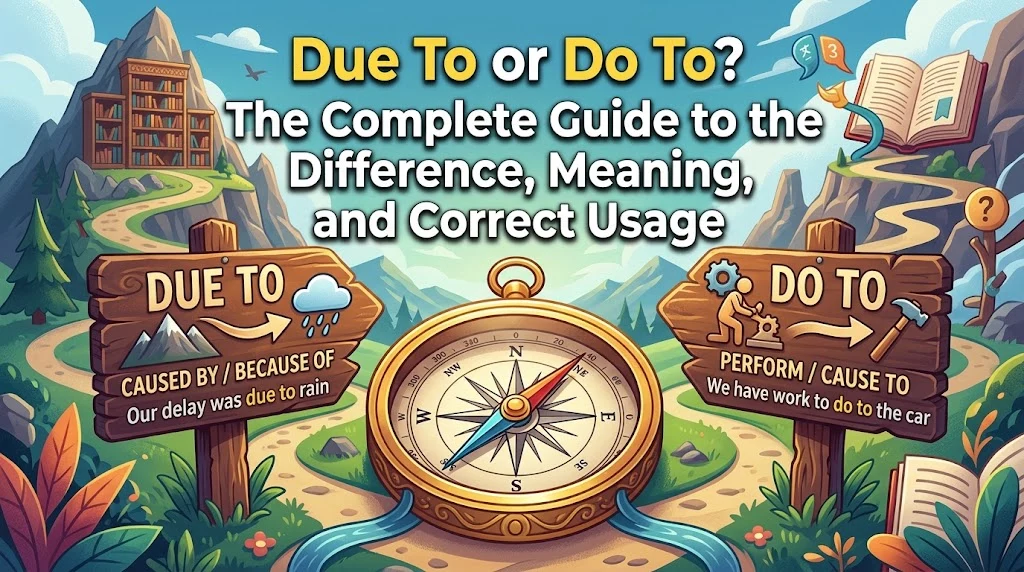
Have you ever typed “do to” when you meant “due to”?
You’re not alone. These two expressions look almost identical when written quickly, and they can sound remarkably similar in everyday speech. Yet they don’t carry the same meaning, and they don’t perform the same grammatical job.
The difference becomes much easier once you stop treating due to and do to as competing spellings. They’re actually two completely different constructions.
Due to commonly means “because of” or “as a result of.”
The flight was delayed due to bad weather.
Here, the phrase explains the reason for the delay.
Do to, on the other hand, consists of the verb do followed by to. It can appear naturally when to introduces an action, purpose, or another grammatical element.
What can I do to help?
The two examples may sound similar, but their grammar tells a very different story.
This guide explains due to or do to, when each form works, common mistakes, useful alternatives, and simple ways to choose the right expression without second-guessing yourself.
Due To or Do To: The Core Difference
The fastest way to understand the difference is to focus on meaning.
| Expression | Main function | Basic meaning | Example |
| due to | Expresses a cause or reason | because of | The match was canceled due to rain. |
| do to | Verb + to construction | perform an action toward a purpose or object | What can I do to help? |
The key distinction is simple:
Due to explains why something happened.
Do to usually describes an action involving “do” and another grammatical element introduced by “to.”
Cambridge Dictionary defines due to something as meaning “because of something” and provides examples involving delays, cancellations, funding, illness, and other causes.
That gives you a useful starting point. If you’re explaining a reason, due to is usually the phrase you’re looking for.
What “Due To” Means
Due to can mean because of, caused by, or resulting from.
For example:
- The game was canceled due to rain.
- The delay was due to heavy traffic.
- The error was due to incorrect information.
- The store closed early due to a power outage.
- Her success was partly due to years of practice.
In each sentence, due to introduces the reason behind a situation.
Cambridge also lists due to as an American English use meaning “because of,” with examples such as “Due to computer problems, the checks will be late” and “The flight was canceled due to bad weather.”
So when you see due to, think:
What caused this?
If the answer follows the phrase, due to may be the correct choice.
What “Do To” Means
Do to isn’t an alternative spelling of due to.
Instead, it occurs when do functions as a verb and to belongs to the grammatical structure that follows.
Consider:
What can I do to fix the problem?
Here, do means perform or take an action. The word to introduces the action fix.
Another example:
What did you do to solve the problem?
Again, do is the main verb. The phrase to solve explains the purpose or action connected with it.
You can find similar constructions in questions such as:
- What should I do to improve?
- What can we do to prevent this?
- What did she do to cause the problem?
- What can they do to help?
- I don’t know what to do to make things better.
These sentences don’t express the meaning “because of.”
That’s the giveaway.
When to Use “Due To” Correctly
The most common use of due to is to introduce a cause.
“Due To” for Cause and Reason
Suppose your flight didn’t leave because a storm moved through the area.
You could write:
The flight was delayed due to the storm.
The storm is the cause. The delay is the result.
This cause-and-effect relationship appears everywhere:
The meeting was postponed due to a scheduling conflict.
The road was closed due to flooding.
The website experienced problems due to a server failure.
The shipment arrived late due to customs delays.
The pattern is easy to spot:
result + due to + cause
That structure works particularly well when you want to identify the reason concisely.
Correct Usage Patterns for “Due To”
Here are several common structures worth remembering.
Noun + be + due to + cause
The delay was due to traffic.
Noun phrase + due to + cause
The cancellation due to severe weather affected hundreds of passengers.
Cause phrase at the beginning
Due to heavy rain, the event was postponed.
The last pattern deserves a little attention because traditional style advice has sometimes treated it differently.
Modern English commonly uses due to at the beginning of a sentence to mean because of. Cambridge accepts examples such as “Due to injury, the team captain was forced to withdraw.”
However, some formal style guides still distinguish between the adjective-like use of due to and the prepositional use of because of.
For example, the MLA Style Center recommends checking whether due to can be replaced by attributable to when determining whether it modifies an appropriate noun phrase.
The Chicago Manual of Style also notes that the older restriction on sentence-initial due to is losing ground to common usage.
So there are two realities worth knowing:
- Modern general English: sentence-initial due to is widely accepted.
- Strict or conservative formal style: because of or owing to may sometimes be preferred.
That distinction helps you write naturally without being surprised by a particular editor or style guide.
Important Notes About “Due To”
“Due To” Can Have More Than One Meaning
Don’t confuse the causal expression due to with other uses of due.
For example:
The train is due to arrive at 8:00.
Here, due to arrive means the train is expected to arrive.
That’s completely different from:
The train was delayed due to mechanical problems.
In the first sentence, due to + verb forms part of a construction describing an expected event.
In the second sentence, due to + noun phrase identifies a cause.
Cambridge specifically distinguishes these meanings. Be due to can describe something expected or planned to happen, while due to something can mean “because of something.”
Quick Style Tip
If you’re writing for a formal audience and aren’t sure whether a sentence-initial due to will be accepted by your style guide, use because of or owing to.
For example:
Because of heavy rain, the event was canceled.
This version is clear, direct, and difficult to misinterpret.
There’s no prize for making a sentence more complicated than necessary.
When to Use “Do To” Correctly
The phrase do to becomes correct when do is actually functioning as a verb.
“Do” + “To” in Questions
Consider this sentence:
What can I do to improve my writing?
The structure is:
do + to + verb
The speaker asks what action they can perform for the purpose of improving their writing.
Here are more examples:
- What can I do to make this clearer?
- What should I do to fix the error?
- What did you do to solve the problem?
- What can we do to reduce costs?
- What can she do to prepare for the exam?
Replacing do to with due to would completely destroy the meaning.
What can I due to improve my writing? ❌
That doesn’t work.
“Do To” Can Also Be Part of a Larger Construction
You may also encounter sentences such as:
I don’t know what that will do to the schedule.
Here, do to means something like affect or cause an effect on.
Another example:
We need to consider what the change will do to our budget.
The phrase doesn’t mean “because of.”
Instead, do describes an effect and to introduces the thing affected.
That distinction is crucial.
Due To or Do To: A Side-by-Side Comparison
When you’re unsure, compare the sentence’s intended meaning.
| If you mean… | Use… | Example |
| because of | due to | The delay occurred due to traffic. |
| caused by | due to | The error was due to a software problem. |
| resulting from | due to | The closure was due to flooding. |
| perform an action | do | What should I do? |
| perform an action for a purpose | do to | What can I do to help? |
| affect something | do to | What will this do to the schedule? |
A useful mental picture is this:
Due to → Cause
Do to → Action or effect
Once you see that distinction, the spelling becomes much less mysterious.
The Most Common “Do To” vs. “Due To” Mistake
The classic error looks like this:
The flight was delayed do to bad weather. ❌
The correct version is:
The flight was delayed due to bad weather. ✅
Why?
Because bad weather is the cause of the delay.
The sentence doesn’t describe an action that someone needs to perform. It explains why the delay happened.
More Incorrect Examples
The meeting was canceled do to technical problems. ❌
The meeting was canceled due to technical problems. ✅
The road was closed do to flooding. ❌
The road was closed due to flooding. ✅
The company lost money do to poor planning. ❌
The company lost money due to poor planning. ✅
The shipment arrived late do to bad weather. ❌
The shipment arrived late due to bad weather. ✅
The pattern remains the same every time.
If the phrase introduces a reason, write due to.
Why Do People Confuse “Due To” and “Do To”?
The mistake isn’t difficult to understand.
Similar Pronunciation
In many varieties of English, due and do can sound alike or extremely similar. Cambridge lists the American pronunciation of due as /duː/, which is the same basic vowel-and-consonant sequence represented by do.
That means your ears can’t always rescue you.
Writing has to do the job.
Fast Typing
When people type quickly, the familiar word do can appear automatically.
The brain often recognizes a familiar pattern before consciously checking each letter.
That’s why a quick proofreading pass matters.
Learning Through Speech
Someone who frequently hears:
“The delay was due to traffic.”
may understand the meaning perfectly while still being unsure how to spell the phrase.
English has plenty of these sound-based traps.
Your ears hear the sound. Your writing needs the structure.
The “Because Of” Test
One of the easiest ways to identify due to is to try replacing it with because of.
For example:
The concert was canceled due to rain.
Try:
The concert was canceled because of rain.
The meaning remains essentially the same.
That strongly indicates that due to is the intended phrase.
Try another:
The computer stopped working due to overheating.
Replace it:
The computer stopped working because of overheating.
Again, the basic meaning remains intact.
Why the Test Helps
The substitution test focuses on meaning instead of sound.
Ask yourself:
Does this sentence mean “because of”?
If yes, due to is probably what you’re looking for.
However, don’t treat the test as the only grammar rule. Traditional formal guidance can distinguish due to from because of based on what the phrase modifies. The MLA Style Center, for instance, recommends the “attributable to” test for the more traditional construction.
The “Attributable To” Test
For careful formal writing, try another substitution.
Replace due to with attributable to.
The delay was due to heavy traffic.
becomes:
The delay was attributable to heavy traffic.
That works naturally.
The MLA Style Center explains this as a useful test because due to, in the traditional construction, modifies a noun phrase.
Compare:
The delay was due to heavy traffic.
Here, due to heavy traffic relates to the delay.
But consider:
The train was delayed due to heavy traffic.
Some traditional editors may prefer:
The train was delayed because of heavy traffic.
or:
The train was delayed by heavy traffic.
Why? The older grammatical distinction treats due to as an adjective phrase rather than a general-purpose preposition.
Modern usage is broader, though. Major dictionaries recognize due to in this causal role, and style guidance increasingly acknowledges that common usage has moved beyond the older restriction.
“Due” vs. “Do”: Understanding the Words
Understanding the individual words makes the whole problem easier.
What “Due” Means
Due has several meanings in English.
It can describe something expected:
The train is due at 7:30.
It can describe something owed:
The payment is due Friday.
It can describe a cause:
The problem was due to a faulty connection.
It can also appear in expressions such as:
in due course
The word therefore carries meanings far beyond the phrase due to.
What “Do” Means
Do is primarily a verb.
It can mean:
- perform an action
- carry out a task
- complete something
- undertake an activity
- cause an effect in certain constructions
Examples include:
I need to do my homework.
What should we do next?
She did everything she could.
What will this change do to the schedule?
So due and do aren’t alternate spellings.
They are different words.
Real-World Examples of “Due To”

You’ll encounter due to in almost every kind of practical writing.
Workplace Writing
The report was delayed due to missing data.
The meeting was rescheduled due to a scheduling conflict.
Production slowed due to equipment maintenance.
Travel
The flight was delayed due to severe weather.
The train service was suspended due to flooding.
The road was closed due to an accident.
Education
The class was canceled due to a power outage.
The deadline was extended due to technical difficulties.
Everyday Conversation
I was late due to traffic.
The store closed early due to a power problem.
Although because of often sounds more conversational, due to is perfectly familiar in everyday English.
Real-World Examples of “Do To”
Now compare those examples with genuine do to constructions.
What can I do to help?
What should we do to prevent this?
What did he do to cause the problem?
What will the change do to our budget?
I don’t know what this will do to the schedule.
Notice the difference.
These sentences involve actions or effects, not reasons.
A useful way to visualize the grammar is:
DUE TO
↓
CAUSE / REASON
↓
Something happened because of X
DO TO
↓
ACTION / EFFECT
↓
Someone does something to achieve or affect X
That tiny diagram captures the central difference.
Common Incorrect Patterns to Avoid
Watch for these mistakes during proofreading:
| Incorrect | Correct |
| The delay was do to traffic. | The delay was due to traffic. |
| The event was canceled do to rain. | The event was canceled due to rain. |
| The error occurred do to a typo. | The error occurred due to a typo. |
| The problem was do to poor planning. | The problem was due to poor planning. |
| Flights were delayed do to fog. | Flights were delayed due to fog. |
The correction is not about making the sentence sound more formal.
It’s about using the correct word.
Alternatives to “Due To”
Although due to is common, it isn’t your only option.
Because Of
Because of is usually the clearest everyday alternative.
The game was canceled because of rain.
This version sounds natural in conversation and general writing.
Owing To
Owing to is more formal.
The event was postponed owing to severe weather.
It can work well in formal notices and professional writing.
As a Result Of
This phrase makes the cause-and-effect relationship particularly explicit.
The project was delayed as a result of missing information.
It’s longer, though, so don’t use it when a simpler expression will do.
On Account Of
On account of can also mean because of.
The match was canceled on account of heavy rain.
It has a somewhat more formal or deliberate tone.
Resulting From
This phrase is useful when you want to emphasize the source of a condition.
Problems resulting from poor planning caused additional delays.
Quick Comparison
| Alternative | Tone | Example |
| due to | Neutral/formal | The delay was due to rain. |
| because of | Natural/general | The delay happened because of rain. |
| owing to | Formal | The delay occurred owing to rain. |
| as a result of | Explicit/formal | The delay occurred as a result of rain. |
| on account of | Formal | The delay occurred on account of rain. |
The best choice depends on the sentence and audience.
“Due To” at the Beginning of a Sentence
You may have heard that starting a sentence with due to is wrong.
That rule is more complicated than many grammar websites suggest.
Modern dictionaries explicitly provide examples of due to at the beginning of sentences. Cambridge includes constructions such as “Due to injury, the team captain was forced to withdraw.”
However, some formal style traditions still prefer because of or owing to when the phrase modifies the entire clause.
For example:
Because of heavy rain, the game was canceled.
This is unquestionably clear.
You can also write:
The cancellation was due to heavy rain.
This version fits the traditional adjective-based construction especially neatly.
The practical lesson is simple: know your audience and follow the style guide when one applies.
For general US English, due to is widely recognized and used to express cause.
A Common Trap: “Due To the Fact That”
Another construction worth avoiding is:
due to the fact that
It’s grammatically possible in many contexts, but it’s often unnecessarily wordy.
Compare:
The meeting was canceled due to the fact that the manager was sick.
with:
The meeting was canceled because the manager was sick.
The second sentence is shorter and cleaner.
Good writing isn’t about squeezing more words into a sentence. It’s about delivering the meaning with enough precision and no unnecessary baggage.
Case Study: Fixing a Workplace Sentence
Imagine a workplace email contains this sentence:
“The project deadline was extended do to unexpected technical problems.”
There are two issues worth noticing.
First, do to is the wrong expression. The writer is explaining the reason for the deadline extension.
Second, the sentence can be made more direct.
Original
The project deadline was extended do to unexpected technical problems.
Corrected
The project deadline was extended due to unexpected technical problems.
More conversational
The project deadline was extended because of unexpected technical problems.
Why the correction works
The phrase introduces a cause.
The technical problems caused the deadline extension.
Therefore:
cause → due to → result
This is exactly the situation where due to belongs.
Case Study: When “Do To” Is Actually Correct
Now consider a completely different sentence:
“What can we do to prevent the problem from happening again?”
Someone might mistakenly change do to into due to.
That would produce:
What can we due to prevent the problem from happening again? ❌
The sentence collapses because do is a verb here.
The intended meaning is:
What action can we take to prevent the problem?
So the correct construction is:
What can we do to prevent the problem?
This example shows why spelling by sound can be dangerous.
The sentence’s meaning should guide the spelling.
How to Choose Between “Due To” and “Do To” in Seconds

When you’re proofreading, use this quick decision process.
Ask What the Phrase Means
Does it mean “because of”?
Use:
due to
Example:
The delay happened due to traffic.
Ask Whether “Do” Describes an Action
Does someone need to perform an action?
Use:
do
Example:
What can I do?
If to follows it because another action comes next, you may have:
do to
Example:
What can I do to fix this?
Look at the Word After “To”
If you see an action verb after to, you may have an infinitive:
do to help
do to improve
do to prevent
do to solve
That strongly suggests you’re dealing with the verb do, not due.
Run the “Because Of” Test
If replacing the phrase with because of preserves the meaning, you’re probably looking for due to.
The flight was delayed due to fog.
The flight was delayed because of fog.
Both express the same basic cause.
Read More : On Tuesday Morning vs. In the Tuesday Morning: Which Is Correct?
Memory Tricks for “Due To” or “Do To”
Grammar rules are useful, but a memorable shortcut can be even better.
The Cause Trick
Think:
Due to = Because of
If you’re explaining a cause, choose due to.
The Action Trick
Think:
Do = Action
If someone is performing or taking an action, use do.
Then to may follow:
do to help
do to improve
do to solve
The Two-Question Method
Ask:
Why did it happen?
→ due to
What can someone do?
→ do
It’s not a perfect grammatical formula, but it’s an excellent proofreading shortcut.
Due To or Do To: Quick Reference Guide
| Question | Answer |
| Does it mean “because of”? | due to |
| Does it identify a cause? | due to |
| Does “do” mean perform or take action? | do |
| Does “to” introduce a purpose? | do to can be correct |
| Does the sentence ask what action someone should take? | do to may be correct |
| Is “do to” being used to mean “because of”? | ❌ Use due to |
| Is a formal style guide involved? | Check whether it prefers because of/owing to in that construction |
Mini Quiz: Due To or Do To?
Choose due to or do to in each sentence.
Question 1
The flight was canceled ___ bad weather.
Question 2
What can I ___ make this sentence clearer?
Question 3
The delay was ___ a mechanical problem.
Question 4
What did you ___ cause the problem?
Question 5
The event was postponed ___ heavy rain.
Question 6
What will this change ___ our schedule?
Question 7
The error was ___ incorrect information.
Question 8
What should we ___ prevent this from happening again?
Question 9
The road was closed ___ flooding.
Question 10
What can the company ___ improve customer service?
Quiz Answers
1. due to
The flight was canceled due to bad weather.
Bad weather is the cause.
2. do to
What can I do to make this sentence clearer?
Do describes an action.
3. due to
The delay was due to a mechanical problem.
The phrase identifies the reason.
4. do to
What did you do to cause the problem?
Do is the main verb.
5. due to
The event was postponed due to heavy rain.
Heavy rain caused the postponement.
6. do to
What will this change do to our schedule?
The construction asks about an effect on the schedule.
7. due to
The error was due to incorrect information.
Incorrect information is the cause.
8. do to
What should we do to prevent this from happening again?
The phrase describes an action and its purpose.
9. due to
The road was closed due to flooding.
Flooding is the reason.
10. do to
What can the company do to improve customer service?
The sentence asks about an action the company can take.
Frequently Asked Questions About Due To or Do To
What Is the Correct Phrase: “Due To” or “Do To”?
If you mean “because of,” the correct phrase is due to.
The match was canceled due to rain.
Do to isn’t an alternative spelling of due to. It is correct only when do and to have separate grammatical roles.
What can I do to help?
Both forms can therefore be correct. The meaning determines which one you need.
Can “Do To” Ever Replace “Due To”?
No, not when you mean “because of.”
This is incorrect:
The delay was do to traffic. ❌
Use:
The delay was due to traffic. ✅
However, do to can be grammatically correct in sentences such as:
What can I do to help?
The two expressions aren’t interchangeable.
Is “Due To” Formal or Informal?
Due to works in both general and formal English.
It appears in everyday explanations as well as professional, academic, and official writing. Cambridge lists it as a standard expression meaning “because of.”
In casual conversation, because of can sometimes sound more natural:
I was late because of traffic.
In formal writing, due to and owing to are common alternatives.
How Can I Test If “Due To” Is Right?
First, try replacing due to with because of.
The cancellation was due to rain.
The cancellation was because of rain.
If the meaning remains intact, due to is likely the phrase you want.
For stricter formal editing, try attributable to as well. If that substitution works naturally, it supports the traditional noun-modifying construction described by the MLA Style Center.
Why Do People Confuse “Due To” and “Do To”?
The biggest reason is sound.
In American English, due and do are pronounced alike or very similarly. Cambridge gives the US pronunciation of due as /duː/.
Fast typing, autocorrect, and learning English primarily through speech can make the confusion even easier.
Is “Due To” Always Better Than “Because Of”?
Not necessarily.
Both can be correct, but they may create slightly different rhythms or levels of formality.
The delay was due to traffic.
The delay happened because of traffic.
The first feels somewhat more formal. The second often sounds more conversational.
Choose the one that fits the sentence rather than forcing one phrase everywhere.
Is “Due To” at the Beginning of a Sentence Wrong?
Not according to modern dictionary usage.
Cambridge provides sentence-initial examples of due to meaning “because of.”
However, some traditional and formal style guidance still prefers because of or owing to when the phrase modifies an entire clause. The Chicago Manual of Style notes that the older restriction is losing ground in common usage.
So the answer depends partly on the style standard you’re following.
What Is the Difference Between “Due To” and “Due To the Fact That”?
Due to can efficiently introduce a noun phrase:
The delay was due to rain.
Due to the fact that introduces a full clause:
The delay occurred due to the fact that it was raining.
The second version is usually wordier than necessary.
A cleaner sentence would be:
The delay occurred because it was raining.
Clear writing usually wins here.
Final Takeaway: Due To or Do To?
The difference between due to and do to becomes straightforward once you focus on the job each expression performs.
Due to commonly introduces a cause or reason.
The flight was delayed due to bad weather.
Think:
Due to = because of.
Do to, by contrast, appears when do acts as a verb and to belongs to the following grammatical structure.
What can I do to solve the problem?
Think:
Do = action.
The most reliable habit is to stop listening for the spelling and start looking at the meaning.
If you’re explaining why something happened, reach for due to.
If you’re talking about what someone can do, you may need do to.
And when formal writing demands extra grammatical precision, remember that style guides differ on some uses of due to. Modern dictionaries accept its causal use broadly, while conservative editorial guidance may favor because of or owing to in certain constructions.
Once that distinction clicks, the “due to or do to” confusion loses most of its bite. The words may sound alike, but their grammatical jobs are worlds apart.