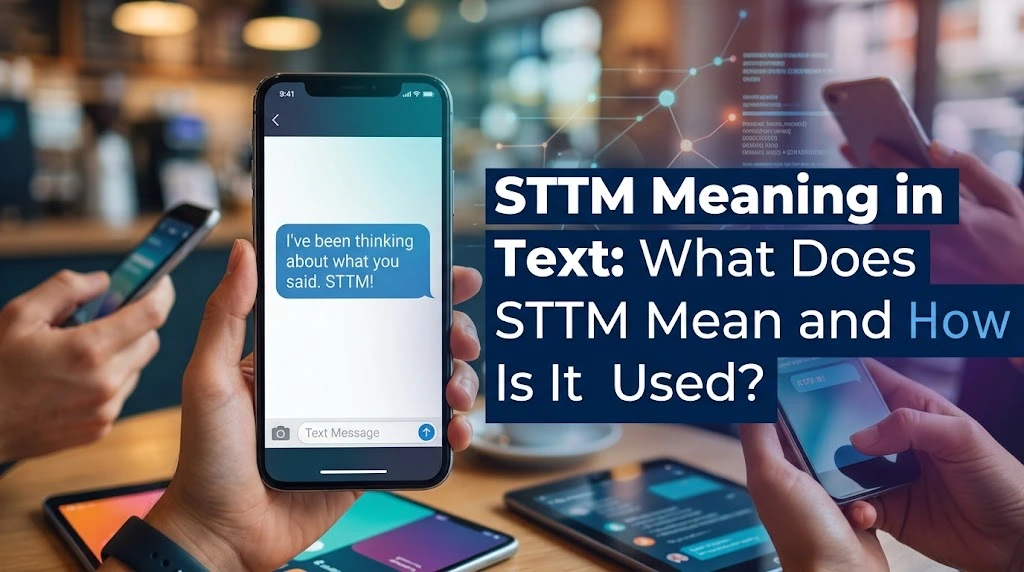
Seeing STTM in a text message can leave you scratching your head for a moment. Is it a request? A warning? A joke? Or simply another piece of internet shorthand?
The answer depends heavily on context.
In texting and online communication, STTM is commonly used to mean “Stop Talking To Me.” It can express irritation, frustration, anger, or a desire to end a conversation. However, abbreviations don’t always have one universal definition. A person may use the same letters differently depending on their community, conversation, or intended phrase.
That distinction matters.
If someone texts “STTM, I’m busy right now,” the meaning is fairly clear: they want the conversation to stop. On the other hand, seeing “What does STTM mean?” without any surrounding context isn’t enough to guarantee one interpretation.
This guide explains the STTM meaning in text, how people use it, what its tone can suggest, how to respond, and why context matters when interpreting internet abbreviations.
What Does STTM Mean in Text?
The most common texting interpretation of STTM is “Stop Talking To Me.”
It tells another person to stop communicating with the sender, at least for the moment. Depending on the relationship and wording around it, STTM can sound mildly annoyed, sharply dismissive, or genuinely angry.
For example:
“STTM. I don’t want to argue anymore.”
Here, the sender isn’t asking for information or requesting an item. They’re clearly telling the other person to stop talking to them.
Another example is:
“Please STTM for a while. I need some space.”
The abbreviation carries the same basic idea, but the surrounding language makes it sound less aggressive.
What Does STTM Stand For?
In its common texting use:
STTM = Stop Talking To Me
The letters represent the first letters of the words:
- S = Stop
- T = Talking
- T = To
- M = Me
Like many texting abbreviations, STTM compresses a complete phrase into a few characters.
That makes it fast to type, especially during an emotional or rapid conversation.
Why Do People Use STTM?
People generally use STTM because they want to communicate the message quickly.
It can be useful when someone doesn’t want to type a full sentence such as:
“Please stop talking to me right now.”
However, speed isn’t the only reason.
STTM can also make the message feel more forceful. A four-letter abbreviation can look abrupt on a screen. That’s especially true when the sender writes it by itself:
“STTM.”
Compare that with:
“Hey, could you give me some space for a little while?”
The second sentence sounds considerably softer.
So, while both messages may communicate a desire for distance, they don’t necessarily carry the same emotional weight.
How STTM Is Used in Texting and Online Chats
The STTM meaning in text becomes easier to understand when you look at actual conversational situations.
People may use it during disagreements, unwanted conversations, repeated messages, teasing, or moments when they simply need privacy.
STTM in Casual Text Messages
Imagine two friends having an argument:
Alex: You’re still mad about yesterday?
Jordan: Yes.
Alex: Come on, let’s talk about it.
Jordan: STTM right now. I need some time.
Here, STTM means “Stop Talking To Me.”
Jordan isn’t necessarily ending the friendship. The phrase may simply communicate a temporary boundary.
Context makes the difference.
Consider another exchange:
Alex: Why aren’t you answering me?
Jordan: STTM.
This version sounds much harsher because the sender provides no explanation or softening language.
A useful rule is:
The shorter the message, the more important the surrounding context becomes.
STTM in Social Media Comments and DMs
STTM can also appear in private messages or social-media conversations.
For example:
“You keep commenting on everything I post. STTM.”
The sender is telling the other person to stop communicating with them.
A person might also use it after receiving repeated unwanted messages:
“I’ve already answered you. STTM.”
In this situation, the abbreviation functions almost like a digital boundary marker.
It says, in effect, “This conversation needs to end.”
STTM in Gaming and Online Communities
Fast-moving online communities often develop their own shorthand. Gaming chats are especially dependent on abbreviations because players may need to communicate while simultaneously playing.
Someone might write:
“STTM, I’m trying to focus.”
The meaning remains “Stop Talking To Me.”
However, context becomes particularly important in gaming communities because players may use community-specific abbreviations that aren’t familiar to outsiders.
Never assume that every acronym has the same meaning everywhere.
STTM in Work or Professional Chats
The phrase is generally much less suitable for professional communication.
Sending:
“STTM.”
to a coworker, manager, customer, or client can sound unnecessarily hostile.
Even if the intention is simply to say, “I need some time before we continue this discussion,” the abbreviation may make the message appear dismissive.
A professional alternative would be:
“I need some time to focus right now. Let’s continue this conversation later.”
That version communicates the same basic boundary without creating unnecessary tension.
STTM Meaning Depends on Context
Acronyms don’t exist in a vacuum.
When you encounter STTM, look at the words before and after it, the relationship between the speakers, and the platform where the conversation occurs.
For example:
“STTM, I’m trying to study.”
This probably communicates frustration with a person who keeps interrupting.
Meanwhile:
“Okay, STTM 😂”
could have a completely different emotional flavor if two close friends are joking around.
The emoji, punctuation, relationship, and previous messages all influence interpretation.
STTM as an Internet Abbreviation
STTM fits into a much larger world of digital shorthand.
Texting abbreviations became popular partly because early mobile messaging encouraged brevity. Although modern messaging apps don’t impose the same strict character limits that older SMS systems did, abbreviated language remains common.
People still use short forms because they’re:
- Fast to type
- Easy to recognize within familiar groups
- Convenient during rapid conversations
- Useful when communicating casually
- Part of established internet culture
Yet familiarity varies widely.
Someone who spends hours in online communities may instantly recognize an abbreviation that another person has never seen.
That’s why context beats assumptions.
Other Meanings of STTM
Although “Stop Talking To Me” is an important texting interpretation, STTM can appear in other contexts as well.
Acronyms are not globally standardized. The same four letters can represent different phrases in specialized industries, organizations, technical documents, or niche communities.
That doesn’t mean every possible expansion should be treated as a texting definition.
If you see STTM in a medical paper, engineering document, software discussion, or company report, don’t automatically interpret it as “Stop Talking To Me.”
Instead, examine the surrounding material.
How to Identify the Intended STTM Meaning
Ask yourself:
- Where did you see it?
- Who wrote it?
- What was the conversation about?
- Does “Stop Talking To Me” make grammatical and contextual sense?
- Does the surrounding conversation suggest a specialized meaning?
For ordinary texting, the conversational context usually provides the strongest clue.
STTM Examples in Real Conversations
Examples make internet slang much easier to understand because tone can be difficult to capture through a dictionary definition alone.
Example: Someone Wants Space
Sam: Are you okay?
Taylor: I’m fine.
Sam: You don’t seem fine. Want to talk?
Taylor: Not right now. STTM for a bit, please.
Here, STTM communicates a request for space.
The word “please” softens the message considerably.
Example: During an Argument
Chris: You’re completely wrong about this.
Morgan: I don’t want to argue.
Chris: Then explain why—
Morgan: STTM.
In this case, STTM sounds blunt because the conversation is already tense.
Example: Repeated Messages
Jamie: Where are you?
Jamie: Hello?
Jamie: Why aren’t you answering?
Riley: I’m working. STTM.
Here, the sender appears frustrated by repeated messages.
Example: A Friendly Joke
Ben: You lost again 😂
Mike: STTM 😂
Between close friends, the phrase might function playfully rather than as a serious demand.
Still, you shouldn’t assume that every use is a joke. The relationship and previous conversation matter.
STTM in Group Chats
Group chats add another layer of ambiguity.
Suppose someone writes:
“STTM, I’m trying to finish this assignment.”
If the group has been flooding the chat with jokes or notifications, the sender may be expressing irritation.
But if the group consists of close friends, everyone may understand that the statement isn’t meant literally.
Tone is particularly difficult to read in text because spoken cues disappear. You can’t hear someone’s voice or see their facial expression.
That’s why punctuation and emojis sometimes matter.
Compare:
“STTM.”
with:
“STTM 😂”
and:
“Please STTM for a few minutes. I need to concentrate.”
The basic phrase remains the same, but the emotional signals differ dramatically.
STTM in DMs
Direct messages are another common setting for abbreviated language.
Someone may use STTM when they want to end a conversation privately.
For example:
“I’ve explained this already. STTM.”
This sounds firm and final.
A softer version could be:
“I’m honestly exhausted right now. Can we stop talking for a while?”
The second version is longer, but it leaves less room for misunderstanding.
That’s an important lesson about texting shorthand:
Brevity saves time, but clarity prevents conflict.
Is STTM Rude?
It can be.
The abbreviation itself isn’t automatically rude. Its tone depends on how and why someone uses it.
A message such as:
“STTM 😂”
between longtime friends may be playful.
But:
“STTM. Don’t message me again.”
is clearly much more serious.
Factors That Affect the Tone of STTM
| Factor | Softer Interpretation | Harsher Interpretation |
| Relationship | Close friend | Stranger or acquaintance |
| Context | Light teasing | Serious argument |
| Punctuation | Casual wording | “STTM.” |
| Extra words | “Please give me space” | “Don’t talk to me” |
| Emoji | 😂, 😅 | None or angry emoji |
| Timing | Temporary disagreement | Repeated unwanted contact |
The same four letters can therefore carry very different emotional meanings.
STTM vs. Similar Texting Abbreviations
Texting slang becomes confusing when several abbreviations appear similar.
Acronyms such as STTM, STM, and STT2M shouldn’t automatically be treated as interchangeable.
Their meanings can differ based on the source and context.
STTM vs. STM
STTM and STM aren’t necessarily the same expression.
STTM commonly represents:
Stop Talking To Me
STM is shorter and can represent different phrases depending on context.
Because STM has fewer letters, the surrounding conversation becomes especially important.
If someone writes:
“STTM, please.”
the intended phrase is much easier to identify.
If someone writes:
“STM.”
you may need additional context before deciding what they mean.
STTM vs. STT2M
STT2M uses “2” as a shorthand representation of “to.”
It may appear as an alternate internet-style construction for a phrase containing “to,” but usage isn’t as universal as more established abbreviations.
For readers, STTM is often easier to understand when the intended phrase is already clear from the conversation.
STTM vs. “DM Me”
These phrases serve different purposes.
“DM me” generally means:
Send me a direct/private message.
STTM commonly means:
Stop Talking To Me.
One invites further communication in a private channel. The other asks someone to stop communicating.
They’re practically opposites in many situations.
STTM vs. “Send It”
“Send it” is a direct request to send something.
For example:
“Send it when you’re ready.”
That has nothing inherently to do with ending a conversation.
If someone uses STTM to mean “Stop Talking To Me,” the two expressions have completely different purposes.
Comparison Table: STTM and Similar Expressions
| Term | Common meaning | Main purpose | Typical tone |
| STTM | Stop Talking To Me | End or pause communication | Direct |
| STM | Context-dependent | Varies | Context-dependent |
| STT2M | Context-dependent texting shorthand | Usually tied to a phrase containing “to” | Informal |
| DM me | Direct message me | Start private communication | Casual |
| Send it | Send the requested item | Request something | Direct |
| Please give me some space | Stop communicating temporarily | Set a boundary | Polite |
| Let’s talk later | Pause the conversation | Delay communication | Softer |
The key takeaway is simple: don’t substitute one abbreviation for another just because the letters look similar.
How to Respond When Someone Says STTM
Your response should depend on the situation.
If someone genuinely wants space, the best response may be no response at all.
Sometimes the most respectful reply is to step back.
If They Clearly Want Space
You can say:
“Okay. I’ll give you some space.”
Or:
“Understood. We can talk later.”
These responses acknowledge the boundary without escalating the argument.
If You Don’t Understand STTM
If the context is unclear, ask:
“What do you mean by STTM?”
That’s better than guessing.
Acronyms can be ambiguous. There’s no prize for confidently misunderstanding someone.
If the Person Sounds Angry
Avoid responding with another aggressive message.
Instead, try:
“Okay. I understand. I’ll leave you alone for now.”
This gives the conversation room to cool down.
If It Was Clearly a Joke
If you’re confident the person is joking, you might respond playfully:
“Fine, fine 😂.”
Still, context matters. Don’t treat an apparently serious boundary as a joke merely because STTM can sometimes be playful.
How to Use STTM Naturally
If you’re thinking about using STTM yourself, consider the audience first.
Texting shorthand works best when the recipient already understands casual internet language.
Use STTM When:
- You’re chatting casually.
- The person knows common texting abbreviations.
- The meaning is obvious from context.
- You want a short, direct expression.
- You’re comfortable with the possibility that it may sound blunt.
Avoid STTM When:
- Writing a formal email.
- Contacting a customer.
- Communicating with a manager.
- Writing an academic assignment.
- Speaking with someone unfamiliar with texting slang.
- The situation requires careful diplomacy.
In sensitive conversations, spelling out your meaning often works better.
STTM in Professional Communication
Imagine receiving this from a coworker:
“STTM. I’m busy.”
Even if the person simply means that they’re concentrating, the wording can sound hostile.
Now compare it with:
“I’m working on a deadline right now. Could we talk later?”
The second message protects the same basic boundary while preserving a professional relationship.
Better Alternatives to STTM at Work
Instead of:
“STTM.”
try:
- “Could we continue this conversation later?”
- “I need some uninterrupted time right now.”
- “I’m working on something urgent. Let’s reconnect afterward.”
- “Can we pick this up later?”
- “I need to focus for a little while.”
These alternatives don’t sacrifice clarity.
They simply deliver the message with more social cushioning.
Common Mistakes When Using STTM
Mistake: Assuming Everyone Knows STTM
Internet slang isn’t universal.
A teenager, a parent, a coworker, and someone who rarely uses social media may interpret the same abbreviation differently.
If clarity matters, write the complete phrase.
Mistake: Using STTM Without Context
Sending only:
“STTM”
can feel abrupt.
The recipient may understand the meaning, but they may not understand why you’re saying it.
Compare:
“STTM.”
with:
“I’m getting frustrated with this argument. Please STTM for a while.”
The second version gives the recipient useful context.
Mistake: Assuming STTM Always Sounds Angry
Not necessarily.
A close friend might use it jokingly. A sibling might say it during playful teasing.
However, because “Stop Talking To Me” is inherently direct, the phrase can easily sound serious.
Mistake: Using It in Formal Writing
Texting abbreviations aren’t automatically wrong. They’re simply designed for informal communication.
A job application isn’t the place to experiment with internet shorthand.
Neither is a formal business letter.
STTM Tone: Friendly, Direct, or Harsh?
One of the most interesting things about STTM meaning in text is how much tone depends on presentation.
Consider these three messages:
“STTM 😂”
“STTM for a minute, please.”
“STTM. Don’t contact me again.”
All contain the same abbreviation.
Yet they communicate very different emotional messages.
The first may be playful.
The second establishes a temporary boundary.
The third sounds serious and potentially final.
Why Short Messages Can Feel Stronger
Written communication removes vocal tone.
When someone says “Stop talking to me” aloud, their voice might make the statement playful, irritated, tired, or furious.
Text doesn’t provide that information automatically.
As a result, short messages can feel sharper than the sender intended.
That’s why a small addition such as “please,” “for a bit,” or “I’m overwhelmed” can completely change the perceived tone.
Case Study: Why Context Changes the STTM Meaning
Consider two conversations.
Conversation A: Serious Conflict
Person A: You need to apologize.
Person B: I already said I’m sorry.
Person A: Then explain what happened.
Person B: STTM.
Here, STTM appears at the end of an argument.
The likely interpretation is serious: “Stop Talking To Me.”
Conversation B: Friendly Teasing
Person A: You picked the worst movie again 😂
Person B: STTM 😂
Person A: Fine, I’ll choose next time.
Here, the same abbreviation may function as playful banter.
What Changed?
The letters didn’t change.
The context did.
That’s why interpreting online language requires more than expanding an acronym mechanically.
Why Context Matters So Much With Internet Slang
Digital communication is highly contextual.
People regularly shorten phrases, invent abbreviations, borrow slang from communities, and reuse terms in humorous ways.
A dictionary-style definition can tell you what an abbreviation commonly means. It can’t always tell you exactly what a particular person intended.
When interpreting STTM, consider:
- The previous messages
- The relationship between the people
- The platform
- Punctuation
- Emojis
- The topic
- The emotional state of the conversation
- Whether the person normally uses slang
This approach prevents many misunderstandings.
Read More : It Worth It or It Is Worth It? The Correct Grammar Explained
Is STTM Used on Social Media?
Yes, abbreviations such as STTM can appear in digital spaces where informal communication is common.
That includes:
- Text messages
- Direct messages
- Group chats
- Social-media conversations
- Online communities
- Gaming chats
However, frequency varies by community and individual.
There isn’t a reliable universal rule saying that every platform uses STTM in exactly the same way.
That distinction is important.
An abbreviation can be recognizable without being equally common everywhere.
Is STTM Trending?
It’s better not to treat STTM as a guaranteed platform-wide trend.
Internet slang changes quickly. Some abbreviations become widespread, while others remain limited to certain groups.
A term appearing repeatedly in one social-media community doesn’t automatically mean the entire internet has adopted it.
Instead of asking whether STTM is “trending,” a more useful question is:
Does the person you’re talking to understand it?
If the answer is uncertain, plain English wins.
STTM Meaning in Text: Quick Reference
| Question | Answer |
| What does STTM mean in text? | Commonly, “Stop Talking To Me.” |
| What does STTM stand for? | Stop Talking To Me. |
| Is STTM informal? | Yes, in its texting/slang use. |
| Can STTM sound rude? | Yes, depending on context and tone. |
| Can STTM be playful? | Yes, especially among close friends. |
| Should you use STTM in formal emails? | Generally, no. |
| Does STTM have other meanings? | It can in specialized contexts. |
| Should you assume every STTM means the same thing? | No. Context matters. |
| What is a polite alternative? | “I need some space right now.” |
Frequently Asked Questions About STTM
What does STTM mean in text?
STTM commonly means “Stop Talking To Me.” It tells someone to stop communicating with the sender. The tone can range from playful to seriously annoyed depending on context.
What does STTM stand for?
In common texting usage, STTM stands for “Stop Talking To Me.”
Each letter corresponds to the beginning of a word: Stop Talking To Me.
Is STTM slang or an abbreviation?
STTM is best understood as an informal texting abbreviation or initialism when used to mean “Stop Talking To Me.”
It belongs to the broader category of shortened language used in casual digital communication.
Is STTM rude?
It can sound rude or harsh because it directly tells someone to stop talking.
However, tone depends on context. Close friends may use STTM jokingly, while the same phrase during a serious argument can sound genuinely angry.
Can STTM mean something else?
Yes.
Acronyms can have multiple meanings in different industries, organizations, communities, and conversations. “Stop Talking To Me” is a common texting interpretation, but specialized contexts may use STTM differently.
Is STTM appropriate in a professional email?
Generally, no.
If you need to pause a workplace conversation, use a clearer and more professional sentence such as:
“I need some uninterrupted time right now. Could we continue this conversation later?”
How should I respond when someone says STTM?
If the person appears serious, respect the request for space.
You could reply:
“Okay. I’ll give you some space.”
If the meaning isn’t clear, ask what they mean rather than guessing.
What is the difference between STTM and “DM me”?
They communicate very different ideas.
STTM commonly means “Stop Talking To Me.”
DM me means “Direct message me.”
One asks someone to stop communicating. The other invites private communication.
Can STTM be used jokingly?
Yes.
Friends sometimes use direct phrases such as STTM as playful banter. Emojis, shared humor, and the surrounding conversation can make the playful intention clear.
Still, don’t assume it’s a joke when the conversation contains signs of genuine conflict.
Where might you see STTM?
You may encounter it in informal digital communication, including:
- Text messages
- Group chats
- Direct messages
- Social-media conversations
- Gaming chats
- Online communities
Its exact usage can vary between communities.
Final Takeaway: What Does STTM Mean in Text?
The most common STTM meaning in text is “Stop Talking To Me.”
It is an informal abbreviation used to tell someone to stop communicating, either temporarily or more seriously. Depending on the situation, it can sound playful, annoyed, blunt, or hostile.
The surrounding conversation is crucial.
“STTM 😂” between close friends may be harmless teasing. “STTM. Don’t contact me again.” carries a much stronger boundary.
For casual chats, STTM can be a quick way to express yourself. In professional or sensitive situations, though, spelling out what you mean is usually smarter. A sentence such as “I need some space right now” leaves far less room for confusion.
Most importantly, don’t assume that every four-letter acronym has one universal meaning. Context is the key that unlocks internet slang.