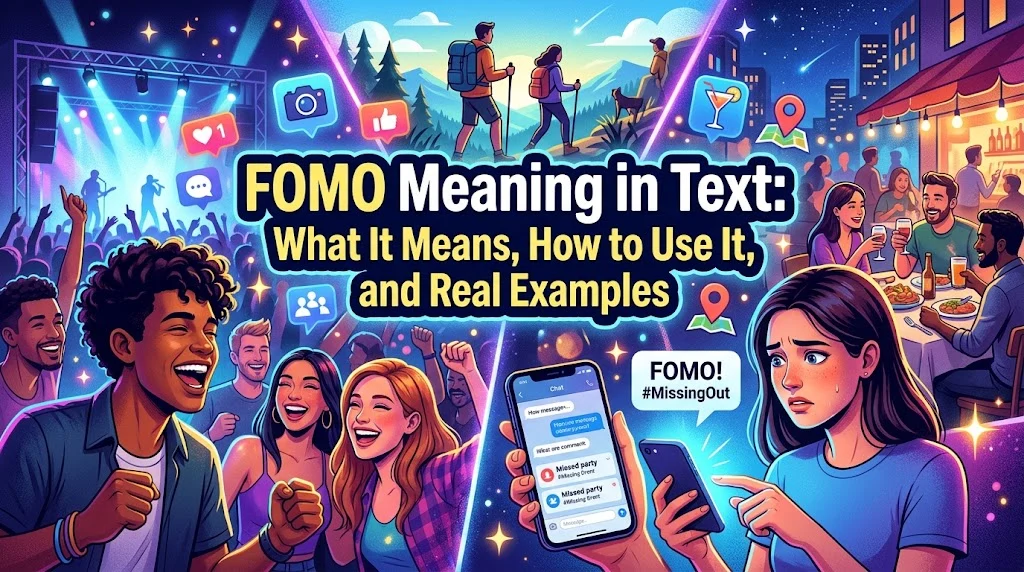
You’ve probably seen someone text, “I have FOMO 😭”, after watching friends head out without them. Maybe you’ve even typed it yourself after seeing a party, concert, trip, sale, or viral trend online.
But what does FOMO mean in text?
FOMO stands for “Fear of Missing Out.” In everyday texting, it describes the uneasy feeling that you might miss an enjoyable, important, exciting, or valuable experience while other people get to enjoy it.
Sometimes FOMO is serious. Other times, it’s just playful internet slang.
For example:
“Everyone’s going to the concert tonight. I’m getting major FOMO.”
The person probably isn’t describing a clinical condition. They’re simply saying they wish they could be there and don’t like the idea of missing out.
The term has also grown far beyond casual texting. You’ll see FOMO in discussions about social media, dating, marketing, shopping, investing, workplace decisions, and digital behavior.
This guide explains the FOMO meaning in text, its origins, common examples, related terms, psychological meaning, and how people actually use it in modern conversations.
What Does FOMO Mean in Text?
In text messages, FOMO means “Fear of Missing Out.”
It describes the feeling that something interesting or rewarding is happening without you. You may worry that friends are having fun, that an opportunity is passing you by, or that other people are experiencing something you aren’t.
The key idea is missing something that seems valuable.
That “something” could be almost anything:
- A party
- A concert
- A vacation
- A dinner with friends
- A relationship
- A social event
- A popular trend
- A limited-time sale
- A career opportunity
- A business opportunity
- An investment
- An online conversation
FOMO can also happen before you actually miss anything.
Imagine your friends invite you to two events happening on the same night. You choose one. Later, you start wondering whether the other event might be more fun.
That uncomfortable thought is classic FOMO.
FOMO in Simple Words
The simplest explanation is:
FOMO means worrying that you’re missing something good while other people are experiencing it.
It often combines curiosity, social comparison, uncertainty, and a desire to participate.
That’s why someone can have FOMO even when they don’t particularly care about the activity itself. Sometimes they mainly care about what they’re not experiencing.
FOMO Example in a Text Message
Friend: “We’re all going to Sarah’s place after dinner.”
You: “Wait, what? I didn’t know everyone was going 😭 I have serious FOMO now.”
Here, FOMO means the person feels left out and wishes they could participate.
Another example:
“I wasn’t even planning to buy the tickets, but seeing everyone’s stories gave me FOMO.”
In this case, social media changed the person’s desire to participate.
What Does “I Have FOMO” Mean?
When someone says “I have FOMO,” they usually mean:
“I feel like I’m missing out on something I wish I could experience.”
The phrase can be sincere or exaggerated for humor.
For example:
“I have FOMO because everyone is getting pizza.”
That’s probably playful.
Meanwhile:
“I keep checking everyone’s updates because I feel like I’m missing important things.”
That may describe a more persistent form of FOMO.
What Is the Full Form of FOMO?
FOMO = Fear of Missing Out.
The expression refers to concern that other people are enjoying rewarding experiences while you remain outside those experiences.
The term became especially prominent alongside social networking. A 2013 study by Andrew Przybylski and colleagues developed and evaluated a measure of FoMO and found associations with lower need satisfaction, mood, and life satisfaction as well as greater social-media engagement.
Here’s the basic breakdown:
| Term | Meaning | Typical Use |
| FOMO | Fear of Missing Out | Texting, social media, conversation |
| Fear of Missing Out | Concern about missing rewarding experiences or opportunities | Formal or explanatory writing |
| Have FOMO | Feel worried about missing something | Casual conversation |
| Get FOMO | Suddenly develop that feeling | Informal speech and texting |
| Give someone FOMO | Make someone wish they were participating | Social media and group chats |
FOMO is usually treated as an informal acronym. That’s why it fits naturally into texts, comments, captions, and online conversations.
What Does FOMO Mean Depending on Context?
The basic definition stays the same, but the object of the fear changes.
That distinction matters.
Someone saying “I have FOMO” after seeing a friend’s vacation photos isn’t necessarily experiencing the same kind of FOMO as someone who buys an investment because its price is rapidly rising.
FOMO in Casual Texting
In everyday messages, FOMO usually involves friends and social plans.
Examples include:
- “Are you guys going out tonight? I have FOMO.”
- “Don’t send pictures. You’re giving me FOMO.”
- “I skipped the party and now I have FOMO.”
- “Everyone’s hanging out without me 😭.”
- “FOMO made me change my mind.”
The tone is often lighthearted.
FOMO on Social Media
Social media can make FOMO especially noticeable because people receive a continuous stream of updates.
You might see:
- Friends at a restaurant
- Someone traveling
- A concert you skipped
- A party you weren’t invited to
- People attending an event
- A product everyone seems to own
- A trend spreading quickly
The problem isn’t simply seeing other people’s lives. It’s the comparison created by those updates.
A person may be sitting comfortably at home and suddenly feel dissatisfied after watching ten stories showing everyone else having fun.
Research has linked FoMO with greater social-media engagement, which helps explain why the concept became so closely associated with online platforms.
FOMO in Group Chats
Group chats create a different kind of FOMO.
Suppose you open your phone and discover that six friends made plans while you were asleep.
You might think:
“How did I miss this?”
The fear isn’t necessarily about the event itself. It may come from realizing that everyone else shared an experience without you.
FOMO in Dating
Dating can create FOMO too.
Someone might keep swiping because they worry that choosing one person means missing a better match.
Another person might hesitate to commit because they wonder whether a more exciting relationship could appear later.
That’s different from simply liking multiple people. FOMO enters the picture when fear of losing future possibilities influences the decision.
FOMO at Work or School
FOMO isn’t limited to parties.
You might experience it when coworkers attend a networking event, classmates join an important project, or colleagues discuss an opportunity you didn’t pursue.
For example:
“Everyone from the marketing team went to the conference. Now I have FOMO because they probably made some useful contacts.”
Here, the concern centers on a potential professional opportunity.
How People Use FOMO in Text Messages
FOMO has developed several common expressions that appear repeatedly in online conversations.
“I Have FOMO”
This means:
“I’m worried I’m missing something.”
Example:
“I said I didn’t want to go, but now I have FOMO.”
“Don’t Give Me FOMO”
This usually means:
“Stop showing me how much fun you’re having because now I wish I were there.”
Example:
“Please stop posting beach pictures. You’re giving me FOMO.”
It can be affectionate and humorous.
“FOMO Is Real”
This expression emphasizes that the feeling is strong.
Example:
“I wasn’t going to go to the festival, but FOMO is real.”
“FOMO Made Me Go”
This suggests that fear of missing the experience pushed someone to participate.
“I wasn’t planning to attend, but FOMO made me go.”
“No FOMO”
Someone may use this phrase to say they are perfectly comfortable missing an activity.
“You guys have fun. No FOMO over here.”
It can also be sarcastic.
FOMO Examples in Real Conversations
The easiest way to understand FOMO is to see how context changes its meaning.
Example With Friends
Alex: “We’re grabbing dinner downtown.”
Mike: “Without me?”
Alex: “You said you were tired!”
Mike: “I know, but now I have FOMO 😂.”
Mike isn’t necessarily experiencing serious anxiety. He’s joking that he wishes he had joined.
Example on Social Media
Sam: “I wasn’t interested in the festival.”
Jamie: “Then you saw everyone’s Instagram stories?”
Sam: “Exactly. Now I have massive FOMO.”
The social posts changed Sam’s perception of the event.
Example in a Group Chat
Taylor: “Wait, you guys already planned the trip?”
Chris: “Yeah, last night.”
Taylor: “How did I miss that conversation?”
Taylor’s FOMO comes from being excluded from a shared plan.
Example in Dating
Mia: “Why are you still using the apps if you like him?”
Rachel: “I don’t know. I guess I have FOMO about settling down too quickly.”
Here, FOMO relates to uncertainty about future romantic possibilities.
Example at Work
Daniel: “Are you going to the industry event?”
Chris: “I wasn’t planning to.”
Daniel: “The whole sales team is going.”
Chris: “Okay, now I have FOMO.”
The perceived networking opportunity changes the decision.
Is FOMO Always Negative?
No.
FOMO can range from a tiny moment of curiosity to a strong emotional reaction.
Sometimes it simply encourages participation.
You might hear about a friend’s hiking trip and realize you’d enjoy joining next time. That’s not necessarily harmful.
The issue becomes more concerning when FOMO repeatedly controls your behavior.
When FOMO Can Be Harmless
Mild FOMO can:
- Encourage you to socialize.
- Motivate you to try something new.
- Help you discover activities you genuinely enjoy.
- Remind you to reconnect with friends.
- Push you to take advantage of a meaningful opportunity.
In this form, FOMO can act like a small nudge.
When FOMO Can Become a Problem
FOMO becomes less helpful when you constantly act from fear rather than genuine preference.
Warning signs can include:
- Constantly checking social media.
- Feeling unable to relax when others are active.
- Spending money simply because others are buying.
- Joining plans you don’t actually want.
- Feeling anxious whenever you miss an event.
- Comparing your life with other people’s posts.
- Making rushed decisions because an opportunity seems temporary.
Research on FoMO has connected the phenomenon with social-media engagement and lower measures of psychological need satisfaction and life satisfaction.
That doesn’t mean every casual use of “FOMO” signals a mental-health problem. Context matters.
FOMO in Psychology and Everyday Behavior
FOMO has a more specific meaning in psychological research than it does in a casual text.
A widely cited 2013 formulation describes FoMO as a persistent concern that other people may be having rewarding experiences from which you are absent, combined with a desire to remain connected to what others are doing.
That definition explains why social connection sits at the center of FOMO.
People naturally care about belonging. When they believe other people are participating in rewarding experiences without them, that social gap can become uncomfortable.
Is FOMO a Psychological Term?
Yes.
Researchers use FoMO as a measurable psychological construct.
However, that does not mean FOMO itself is a mental disorder.
It is better understood as a psychological phenomenon or emotional experience.
That distinction is important because internet slang can make ordinary emotional experiences sound more clinical than they really are.
Someone saying “I have FOMO” in a group chat usually isn’t making a psychological diagnosis.
Why Social Media Can Trigger FOMO
Social media combines several ingredients that can make FOMO easier to experience:
Constant visibility: You can see what people are doing throughout the day.
Social comparison: You can compare your activities with other people’s experiences.
Selective presentation: People tend to share particular moments rather than every boring or difficult part of their day.
Instant feedback: Likes, comments, views, and reactions provide visible signals of social activity.
Endless alternatives: There always seems to be another event, destination, product, trend, or conversation happening somewhere.
Research has found a relationship between FoMO and social-media engagement, although that relationship doesn’t mean every social-media user experiences problematic FOMO.
Where Did FOMO Come From?
The history of FOMO is more interesting than the claim that it was simply “invented by social media.”
The underlying idea existed before modern social platforms. The expression became associated with contemporary social-networking behavior in the 2000s and became much more widely used during the following decade.
A review of the research literature notes that the term emerged around 2004, became extensively used from around 2010, and entered the Oxford English Dictionary in 2013.
The 2013 psychological research by Przybylski and colleagues was particularly influential because it turned FOMO into a concept that researchers could measure and study systematically.
FOMO Timeline
| Period | Development |
| Early 2000s | The expression begins appearing as a named concept |
| Around 2004 | The term is associated with early discussions of the phenomenon |
| 2010s | Social media helps push FOMO into mainstream vocabulary |
| 2013 | Major psychological research provides a formal measure of FoMO |
| 2013 | FOMO enters the Oxford English Dictionary |
| 2020s | FOMO becomes common in social media, marketing, investing, dating, and everyday language |
| 2026 | Researchers continue studying FOMO in digital advertising and consumer behavior |
So, FOMO isn’t merely “TikTok slang.” It has a documented history in psychology, marketing, and consumer research.
FOMO on Different Social Media Platforms
FOMO can look slightly different depending on the platform.
FOMO on Instagram
Instagram can trigger FOMO through:
- Stories
- Reels
- Travel photos
- Parties
- Restaurant visits
- Concert posts
- Product recommendations
- Influencer content
A friend posting “Best night ever!” can create FOMO even when the viewer wasn’t originally interested in the event.
FOMO on TikTok
TikTok can create rapid trend cycles.
A trend can appear repeatedly until users feel that everyone is participating.
That can create FOMO around:
- Challenges
- Memes
- Products
- Restaurants
- Travel destinations
- Events
- Fashion
- Viral experiences
The speed matters. A trend can feel urgent because its cultural relevance may disappear quickly.
FOMO on Snapchat
Snapchat’s emphasis on personal and temporary updates can make FOMO especially social.
Seeing friends together in real time can produce a very direct reaction:
“Why wasn’t I invited?”
The feeling becomes less about an abstract trend and more about immediate social participation.
FOMO on X
On X, FOMO often centers on information rather than physical events.
People may worry about missing:
- Breaking news
- Trending conversations
- Live events
- Viral posts
- Community discussions
- Major announcements
This can create a different kind of FOMO: informational FOMO.
FOMO on Discord and Reddit
Community-based platforms can create FOMO through fast-moving conversations.
You might miss:
- A live discussion
- An online gaming session
- An announcement
- A community event
- An inside joke
- A rapidly developing thread
The result can be the same: other people seem to know or experience something that you missed.
FOMO on WhatsApp
WhatsApp FOMO usually happens through private groups.
For example:
“Wait, everyone met up last night?”
The person may feel left out because the group made plans without them.
FOMO in Marketing and Advertising
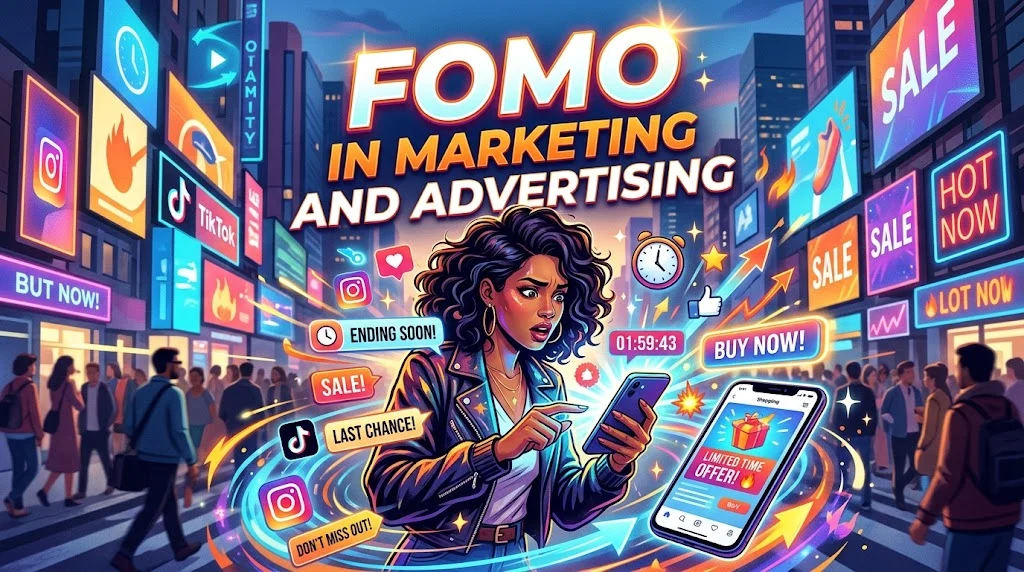
Marketers understand that people don’t like losing valuable opportunities.
That’s where FOMO marketing comes in.
Common FOMO tactics include:
- “Only 3 left.”
- “Sale ends tonight.”
- “Last chance.”
- “Limited-time offer.”
- “Early-bird pricing ends Friday.”
- “Join thousands of customers.”
- “Registration closes soon.”
These messages can create pressure by making an opportunity appear temporary or scarce.
Recent research continues to examine how scarcity, urgency, and social signals influence FOMO in online consumer behavior. A 2026 study found that perceived scarcity had a strong relationship with urgency and that urgency amplified fear of missing attractive opportunities.
FOMO Marketing Examples
Imagine two product descriptions.
Version A:
“This jacket is available for $80.”
Version B:
“Limited release. Only a few jackets remain at $80.”
The second version adds scarcity.
If the scarcity is genuine, it provides useful information. If it is fabricated simply to pressure people into buying, the tactic becomes much more questionable.
FOMO vs Legitimate Urgency
Real urgency exists when an opportunity genuinely has a deadline.
Examples include:
- A ticket sale ending at a stated time.
- Registration closing on a specific date.
- A limited event with fixed capacity.
- A real seasonal promotion.
FOMO marketing becomes manipulative when businesses create false scarcity or misleading pressure.
Research published in 2025 found that FOMO appeals can encourage immediate purchasing while also producing negative cognitive and emotional responses after purchase among FOMO-prone consumers.
That finding matters because getting the click isn’t the same as creating a good customer experience.
FOMO in Finance and Investing
The phrase FOMO has become common in financial conversations too.
In investing, FOMO usually means buying an asset because you fear missing a profitable price move.
Imagine a stock rises sharply for several days.
You see people online celebrating their gains.
You weren’t interested at $50.
Now it’s $75.
Suddenly you feel that you need to buy because it might reach $100.
That’s investment FOMO.
What Does FOMO Mean in Crypto and Investing?
In crypto and other highly volatile markets, FOMO can become especially visible because prices and online discussions can change rapidly.
Someone might think:
“Everyone is making money from this. If I don’t buy now, I’ll miss my chance.”
The emotional pressure comes from anticipated regret.
The person isn’t necessarily making a decision based on careful analysis. They’re reacting to the possibility that other people will profit while they sit on the sidelines.
FOMO Trading
FOMO trading can involve:
- Chasing sudden price increases.
- Buying after seeing viral posts.
- Entering a position simply because others appear profitable.
- Ignoring personal risk limits.
- Making decisions without adequate research.
FOMO isn’t itself an investing strategy. It’s an emotional factor that can influence decision-making.
Common Misunderstandings About FOMO
FOMO gets thrown around so casually that its meaning sometimes becomes blurred.
FOMO Doesn’t Always Mean Jealousy
Jealousy and FOMO can overlap, but they’re not identical.
You can feel FOMO without wanting what another person owns.
For example:
“Everyone went hiking today and I wish I had gone.”
That’s FOMO.
Jealousy usually involves a perceived threat to something you value, especially a relationship or position.
FOMO Doesn’t Always Mean Peer Pressure
Peer pressure involves influence from other people.
FOMO doesn’t require anyone to pressure you.
You can experience FOMO simply by seeing a social-media post.
Nobody has to say:
“You should come.”
You might still think:
“I wish I were there.”
FOMO Doesn’t Mean You Literally Missed Something
FOMO can happen before an event.
For example:
“I’m not sure whether I should go. What if everyone has an amazing time without me?”
Nothing has been missed yet.
The fear concerns a possible future experience.
FOMO Isn’t Always Serious
People often use FOMO dramatically for humor.
“You guys ordered fries without me? Massive FOMO.”
The person probably isn’t suffering significant distress.
Context and tone matter.
FOMO vs Similar Terms
| Term | Main Idea | Key Difference |
| FOMO | Fear of missing out | Focuses on missing an experience or opportunity |
| Jealousy | Fear of losing something or someone | Often involves relationships or perceived threats |
| Envy | Wanting what someone else has | Centers on another person’s advantage |
| Insecurity | Doubting yourself or your position | Broader and not necessarily tied to missing experiences |
| Peer pressure | Influence from others | Requires social influence |
| Loneliness | Lack of meaningful connection | Doesn’t necessarily involve a specific missed opportunity |
| Curiosity | Desire to know or experience something | Doesn’t inherently involve fear |
FOMO vs Jealousy
FOMO: “Everyone went without me, and I wish I had gone.”
Jealousy: “Why is my partner spending so much time with that person?”
FOMO focuses on missing participation.
Jealousy often focuses on threat or perceived loss.
FOMO vs Envy
Envy involves wanting something another person has.
FOMO can happen even when you don’t want exactly what another person has.
For example:
“I don’t even want that job, but everyone from my class is attending the conference and now I wish I were going.”
That’s closer to FOMO than envy.
FOMO vs Insecurity
Insecurity is a much broader concept.
Someone might feel insecure about their appearance, abilities, career, relationship, or social position.
FOMO specifically involves concern about missing rewarding experiences or opportunities.
FOMO vs Peer Pressure
Peer pressure means other people influence your behavior.
FOMO can exist without direct pressure.
You can scroll through social media alone and experience FOMO.
What Is the Opposite of FOMO?
The popular opposite of FOMO is JOMO, meaning Joy of Missing Out.
JOMO describes feeling comfortable, satisfied, or even happy about choosing not to participate.
Instead of thinking:
“Everyone is going out. I need to go.”
A person experiencing JOMO might think:
“Everyone is going out. I’m staying home, and I’m completely fine with that.”
FOMO vs JOMO
| FOMO | JOMO |
| Fear of missing something | Comfort with missing something |
| Focuses on what others are doing | Focuses on your own priorities |
| Can create pressure | Can create relief |
| Often driven by comparison | Often driven by personal choice |
| “Should I be there?” | “I’m happy where I am.” |
JOMO doesn’t mean avoiding every social experience.
It means choosing based on what you actually want rather than automatically reacting to what everyone else is doing.
How to Reply When Someone Says “I Have FOMO”
Your response should match the tone.
If your friend is joking, a playful reply works.
If they genuinely feel excluded, empathy matters more.
Casual Replies
- “Come with us next time!”
- “You should’ve come!”
- “There’s always next weekend.”
- “You’re not missing that much 😂.”
- “Next time you’re definitely coming.”
Funny Replies
- “FOMO is doing overtime today.”
- “That’s what you get for staying home.”
- “Your FOMO has entered the chat.”
- “Too late. The fries are already gone.”
- “Should’ve trusted the group chat.”
Supportive Replies
- “I get it. I would’ve felt the same way.”
- “You didn’t miss everything. We’ll do something together soon.”
- “Don’t beat yourself up over it.”
- “We can plan something with you next time.”
Reassuring Replies
If someone is genuinely anxious:
“You don’t have to be part of everything to still be included.”
That response addresses the underlying concern rather than simply dismissing the feeling.
Serious Responses
When FOMO seems to be affecting someone’s choices repeatedly, a more thoughtful response works better:
“It sounds like you’re feeling pressured to be everywhere at once. You don’t have to say yes to every opportunity.”
The goal isn’t to shame the person.
It’s to separate genuine desire from fear-driven decision-making.
How to Use FOMO Correctly in a Sentence
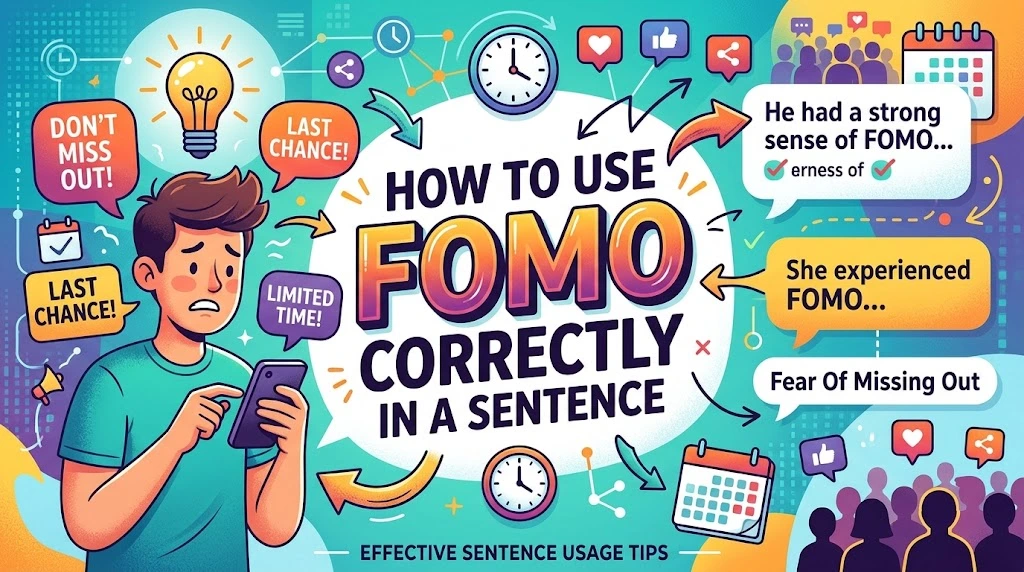
FOMO usually appears as a noun in informal communication.
Common structures include:
- I have FOMO.
- I’m getting FOMO.
- That gave me FOMO.
- You’re giving me FOMO.
- FOMO made me go.
- I’m experiencing FOMO.
- Social media can trigger FOMO.
- I bought it because of FOMO.
Correct Examples
“I have FOMO because everyone is at the beach.”
“Your vacation pictures are giving me FOMO.”
“I didn’t plan to attend, but FOMO changed my mind.”
“The limited-time offer created FOMO.”
“He experienced FOMO after seeing the group photos.”
Common Awkward Uses to Avoid
Because FOMO is an acronym, people sometimes force it into sentences where “fear of missing out” would sound clearer.
For formal writing, this can be better:
“The campaign exploits consumers’ fear of missing out.”
Instead of:
“The campaign exploits consumers’ FOMO.”
Both can be understandable. The first simply sounds more formal.
Read More : DND Meaning in Text: What Does DND Mean When Someone Texts You?
Is FOMO Formal or Informal?
FOMO is primarily informal, but it has become widely recognized beyond casual slang.
It’s perfectly natural in:
- Text messages
- Social-media posts
- Online comments
- Group chats
- Blogs
- Marketing discussions
- Informal workplace communication
- Everyday conversation
In formal academic or professional writing, spelling out “fear of missing out” on first use is usually clearer.
For example:
“Fear of missing out (FOMO) can influence online consumer behavior.”
After defining it, the abbreviation can be used throughout the rest of the document.
That approach gives readers both the full expression and the shorter term.
Why Is FOMO So Common Today?
FOMO isn’t new. Digital technology has simply made the trigger more immediate.
Constant Social Updates
Before smartphones, you couldn’t instantly see what hundreds of people were doing.
Today, updates arrive continuously.
That changes the experience from:
“I wonder what everyone is doing.”
to:
“I can literally see what everyone is doing.”
The second situation makes comparison much easier.
Social Comparison
People naturally compare their experiences with those of others.
Online platforms can intensify this because users often see carefully selected highlights.
A ten-second video might show a spectacular vacation.
It doesn’t show the delayed flight, argument, exhaustion, financial cost, or boring afternoon that came with it.
Endless Choices
Modern life offers an enormous number of possible experiences.
There are always:
- More restaurants
- More shows
- More events
- More destinations
- More products
- More careers
- More communities
- More trends
- More investments
You can’t experience all of them.
FOMO partly emerges from confronting that uncomfortable reality.
Fear of Being Left Out
At its heart, FOMO often involves belonging.
You don’t necessarily want every experience.
You want to feel that you’re connected to the people and opportunities that matter to you.
That helps explain why FOMO can feel especially strong when close friends make plans without you.
How to Deal With FOMO
You don’t need to eliminate every feeling of FOMO.
The more useful goal is to avoid letting it make every decision for you.
Identify What You’re Actually Missing
Ask yourself:
“Do I genuinely want this, or do I only want it because other people are doing it?”
That one question can expose a surprising amount of FOMO.
Limit Constant Checking
If you repeatedly check social media because you’re afraid something is happening without you, consider taking intentional breaks.
You don’t need to monitor every update.
Focus on Your Current Choice
Every choice closes some doors.
If you attend one event, you may miss another.
If you stay home, you may miss a party.
That’s normal.
A satisfying life doesn’t require experiencing everything.
Stop Comparing Highlight Reels
Remember what social media usually shows: selected moments.
You’re comparing your complete everyday life with someone else’s edited highlights.
That’s an uneven contest.
Practice JOMO
Instead of asking:
“What am I missing?”
Try asking:
“What am I gaining by choosing this?”
Maybe you’re getting:
- Rest
- Time with family
- Privacy
- Focus
- Money saved
- Better sleep
- Time for a hobby
Missing one thing can create room for another.
FOMO Meaning in Text: Quick Reference
| Question | Answer |
| What does FOMO stand for? | Fear of Missing Out |
| What does FOMO mean in texting? | Feeling worried or uncomfortable about missing something others are experiencing |
| Is FOMO slang? | It’s an informal acronym widely used in everyday and online communication |
| Is FOMO always negative? | No. Mild FOMO can motivate participation |
| What does “I have FOMO” mean? | “I feel like I’m missing something I want to experience” |
| What does “you’re giving me FOMO” mean? | “Your posts or stories are making me wish I were there” |
| What is the opposite of FOMO? | JOMO, or Joy of Missing Out |
| Can FOMO happen before an event? | Yes |
| Is FOMO a mental disorder? | No. FOMO is a psychological phenomenon, not a standalone mental disorder |
| Can FOMO happen in dating? | Yes |
| Can FOMO influence buying decisions? | Yes |
| Can FOMO affect investing? | Yes, especially when people chase opportunities because others appear to be profiting |
FAQs About FOMO Meaning in Text
What does FOMO mean in simple words?
FOMO means “Fear of Missing Out.” In simple terms, it means worrying that you’re missing something fun, important, exciting, or valuable while other people are experiencing it.
What does “I have FOMO” mean?
“I have FOMO” means “I feel like I’m missing out.”
For example:
“Everyone’s at the concert, and I have FOMO.”
The speaker wishes they could participate.
What does FOMO mean on social media?
On social media, FOMO usually describes the feeling you get when seeing other people’s activities makes you wish you were participating too.
Posts about vacations, parties, concerts, products, events, and trends can all trigger it.
Is FOMO a real psychological term?
Yes.
Researchers study FoMO as a psychological phenomenon involving concern about missing rewarding experiences and a desire to stay connected with what others are doing. A major 2013 study developed a measure of FoMO and examined its links with social-media engagement and well-being.
However, FOMO is not itself a standalone mental disorder.
Is FOMO good or bad?
It can be either.
Mild FOMO might encourage you to attend an event or reconnect with friends. Persistent FOMO can become unhelpful when it drives compulsive checking, unnecessary spending, constant comparison, or decisions you don’t actually want to make.
What is the opposite of FOMO?
The commonly used opposite is JOMO, meaning Joy of Missing Out.
JOMO describes being comfortable with staying out of something instead of feeling pressured to participate.
What does FOMO mean in dating?
Dating FOMO means worrying that choosing one person, relationship, or path could cause you to miss a better future option.
It can make someone hesitate to commit even when they genuinely like their current partner.
What does FOMO mean in investing?
In investing, FOMO describes buying or entering a market because you fear missing a profitable opportunity after seeing other people appear to make money.
The emotional driver is often the fear of being left behind.
How do you respond to someone who says they have FOMO?
Match the situation.
For casual FOMO, you can say:
“You should’ve come!”
For genuine distress, try:
“I get why you feel that way. You don’t have to be part of everything to still be included.”
How can you stop feeling FOMO?
Start by asking whether you genuinely want the opportunity or simply don’t want to feel left out.
Then limit unnecessary social-media checking, focus on your current priorities, and become more comfortable with intentionally missing things.
Conclusion
The FOMO meaning in text is simple: FOMO stands for “Fear of Missing Out.”
When someone says they have FOMO, they usually feel that they’re missing an enjoyable, meaningful, exciting, or potentially valuable experience while other people are participating.
In casual texting, FOMO can be completely playful:
“Everyone ordered pizza without me. Major FOMO 😂.”
But the concept goes deeper than internet slang. Researchers study FoMO as a psychological phenomenon, and research has connected it with social-media engagement, psychological need satisfaction, mood, and life satisfaction.
FOMO also appears in marketing, shopping, dating, workplace decisions, and investing. In digital marketing especially, scarcity and urgency can intensify concerns about missing an opportunity. Recent research continues to examine how these mechanisms affect consumer decisions.
The most important distinction is this: FOMO isn’t simply jealousy, insecurity, or peer pressure. It centers on the concern that you’re missing something rewarding or valuable.
And sometimes, the best answer to FOMO isn’t joining the crowd.
It’s realizing that you don’t have to experience everything.
That’s where JOMO—the Joy of Missing Out—comes in.