Ever received a message that simply said “DND” and wondered whether the person wanted space, was ignoring you, or had changed a setting on their phone?
In most texting situations, DND means “Do Not Disturb.” It usually tells you that someone doesn’t want notifications, calls, or other interruptions at that moment. However, the exact meaning depends on the context.
For example, when someone says, “I’m on DND. I’ll text you later,” they probably mean they have enabled a Do Not Disturb setting or are intentionally limiting interruptions. In another conversation, particularly among gamers, DND can refer to Dungeons & Dragons. Context is the key.
Modern smartphones make the distinction especially important. Do Not Disturb generally manages notifications and interruptions, not the underlying delivery of messages. Apple explains that users can stop notifications for Messages while continuing to receive the texts themselves. Android likewise lets users control which people, apps, and interruptions can break through Do Not Disturb.
So, if someone texts you “DND,” don’t automatically assume you’ve been blocked or deliberately ignored. The person may simply be taking a break from their phone.
DND Meaning in Text
The most common DND meaning in text is “Do Not Disturb.”
People use the abbreviation because texting favors short, fast expressions. Instead of typing “I don’t want to receive notifications right now,” someone can simply write:
“I’m on DND.”
That short message can communicate several related ideas:
- “I don’t want interruptions right now.”
- “I may not see your notification immediately.”
- “I’m focusing on something else.”
- “I’ll respond later.”
- “Please don’t expect an immediate reply.”
Dictionary.com lists DND as an abbreviation for “do not disturb” and notes its use in digital communications and device functions. It also lists Dungeons and Dragons as another meaning.
What Does “DND” Mean When Someone Texts You?
When somebody sends “DND” in an ordinary conversation, the safest interpretation is usually “Do Not Disturb.”
Consider these examples:
Friend: “Want to call tonight?”
You: “Maybe later. I’m on DND while I study.”
Here, DND communicates temporary unavailability.
Now consider:
Friend: “Why didn’t you answer?”
You: “Sorry, I had DND on.”
In this case, the sender is explaining why they didn’t notice or respond to an incoming notification.
A third example changes the tone:
“DND for the next two hours. If it’s urgent, call twice.”
That message establishes a clear boundary while also providing an exception.
DND Meaning in Text vs. DND as a Phone Setting
There’s an important distinction between using DND as an abbreviation and turning on Do Not Disturb as a device feature.
Someone can say “DND” casually without actually activating a phone setting. They might simply mean:
“Don’t disturb me right now.”
On the other hand, they could literally have Do Not Disturb enabled on an iPhone or Android device.
That difference matters because a person’s message doesn’t tell you exactly which settings they have configured.
DND Meaning on Phones and Messaging Apps
The DND meaning in text becomes clearer when you understand what Do Not Disturb actually does.
At its core, Do Not Disturb is designed to limit interruptions. Modern phones can filter calls, messages, app notifications, and other alerts according to rules chosen by the user.
Android’s current help documentation explains that Do Not Disturb can be configured to control notifications from people and apps. Users can also choose exceptions, schedules, and other interruption settings.
Apple similarly provides controls for managing notifications, including situations where messages continue arriving even though the user isn’t receiving normal alerts.
What Does Do Not Disturb Actually Do?
Depending on the device and configuration, DND can:
- Silence incoming calls.
- Silence message notifications.
- Reduce app alerts.
- Filter which people can interrupt you.
- Allow selected contacts to break through.
- Follow a schedule.
- Hide or limit certain visual notifications.
- Let important alerts remain available.
Android, for example, allows users to choose which people, apps, and types of interruptions can get through. It can also allow repeat callers under certain configurations.
That’s why DND doesn’t have one identical behavior on every phone.
The setting is more like a gatekeeper than a brick wall. It decides which interruptions get your attention.
Does DND Stop Text Messages From Arriving?
Usually, no.
This is one of the biggest misconceptions about DND.
Turning on Do Not Disturb generally affects how you’re notified, not whether someone can send you a message.
Apple explicitly explains that users can stop notifications from the Messages app while continuing to receive messages.
Android also separates messaging from notification controls. Its notification system allows users to determine whether conversations produce alerts, remain silent, or receive priority treatment.
Think of it this way:
Message delivery:
Someone sends → the message reaches the service or device.
Notification:
The phone alerts → you immediately notice the message.
DND mainly deals with the second part.
So if your friend has DND enabled, your message may still be waiting for them when they check their phone.
How DND Is Used in Everyday Texting
The phrase DND meaning in text can change slightly depending on the situation.
People often use it as a quick digital boundary. It’s especially common when someone wants uninterrupted time without explaining everything in detail.
DND in Casual Conversations
Imagine your friend is preparing for an exam.
“Going into study mode. DND until 10.”
That doesn’t necessarily mean:
“Don’t ever contact me.”
It means:
“I’m unavailable for normal interruptions until 10.”
The same idea works for sleeping:
“I’m putting my phone on DND. Good night!”
Or working:
“DND during the meeting. I’ll call afterward.”
The abbreviation saves time while communicating a fairly clear expectation.
DND in Group Chats
Group chats can produce dozens of notifications in a short period.
Instead of leaving the group, someone may simply enable DND or mute the conversation.
For example:
“This group is wild today 😂. I’m on DND for a while.”
The person hasn’t necessarily left the group. They may still read everything later.
This distinction matters because DND is about interruption management, whereas leaving a group changes your participation in the conversation.
DND in Social Media and Online Messaging
People also use DND informally in DMs and online communities.
You might see:
“DND rn.”
Here, “rn” means “right now.”
The full idea is essentially:
“I’m unavailable right now. Please don’t expect a response.”
However, DND isn’t necessarily a universal status label across every social platform. A person may simply be borrowing the familiar abbreviation from smartphone settings.
DND Meaning in Professional Communication
In workplace communication, DND can be useful when used clearly.
A short status such as:
“DND during client calls. Available after 3 PM.”
gives colleagues useful information without requiring a long explanation.
However, professional communication benefits from clarity. If your coworkers aren’t familiar with the abbreviation, writing “Do Not Disturb” or “Unavailable until 3 PM” may work better.
A useful rule is simple:
Use DND when your audience already understands it. Use plain language when there’s room for confusion.
Professional Examples
Casual workplace chat:
“On DND for the next hour. I’ll catch up afterward.”
Team communication:
“I’m on DND while presenting. Please send anything non-urgent in the team chat.”
Client-facing communication:
“I’m currently unavailable and will respond as soon as I’m free.”
The last version sounds more polished because clients may not interpret abbreviations the same way coworkers do.
DND in Gaming and Online Communities
Gaming introduces an important wrinkle.
In gaming communities, DND can mean “Do Not Disturb,” but it can also mean “Dungeons & Dragons.”
Dictionary.com lists DND as a variant of D&D for Dungeons and Dragons.
Context makes the difference.
Example: Do Not Disturb
“I’m streaming for the next hour. DND.”
Here, the likely meaning is Do Not Disturb.
Example: Dungeons & Dragons
“We’re playing DND tonight.”
Here, the abbreviation almost certainly refers to Dungeons & Dragons.
The surrounding words act like a signpost.
If someone mentions dice, campaigns, characters, dragons, a dungeon master, or a tabletop session, DND probably refers to the game.
If they mention notifications, calls, sleep, work, meetings, or phones, it almost certainly means Do Not Disturb.
DND Meaning in Different Contexts
The phrase Do Not Disturb existed long before smartphone notification settings. Today, it appears in several physical and digital environments.
DND in Hotels
Hotels commonly use Do Not Disturb signs on guest-room doors.
A guest places the sign outside the room to tell housekeeping or other hotel staff not to enter under normal circumstances.
In this context, DND isn’t slang. It’s a literal instruction.
The basic message remains the same:
Please don’t disturb me.
DND in Healthcare
Healthcare environments may use “Do Not Disturb” language in specific operational contexts, such as quiet areas, patient privacy, or facility procedures.
However, healthcare also contains many specialized abbreviations. Therefore, you shouldn’t automatically interpret every occurrence of DND as “Do Not Disturb” without checking the surrounding context.
DND in Aviation and Military Settings
Aviation, military, and other operational environments use many abbreviations. Some are highly specialized.
If DND appears in a technical document, radio procedure, or operational message, context matters far more than everyday texting conventions.
The same three letters can carry different meanings across industries.
DND in Studios and Corporate Settings
Recording studios, offices, meeting rooms, and other workplaces may use Do Not Disturb signs or indicators.
For example:
RECORDING — DO NOT DISTURB
The goal is practical: prevent interruptions during a task where concentration matters.
How to Tell What Someone Means by “DND”
Three clues usually solve the mystery.
Look at the Conversation Context
Ask yourself what you were discussing.
If the conversation involves:
- Phones
- Notifications
- Sleep
- Work
- Studying
- Meetings
- Calls
- Being unavailable
then DND probably means Do Not Disturb.
If the conversation involves:
- Dungeons
- Dragons
- Dice
- Campaigns
- Characters
- Tabletop games
then DND may mean Dungeons & Dragons.
Pay Attention to the Wording
Certain phrases strongly suggest the meaning.
| Phrase | Most likely meaning |
| “I’m on DND.” | Do Not Disturb |
| “My phone is on DND.” | Do Not Disturb |
| “DND until tomorrow.” | Do Not Disturb |
| “DND during the meeting.” | Do Not Disturb |
| “We’re playing DND tonight.” | Dungeons & Dragons |
| “Our DND campaign starts Friday.” | Dungeons & Dragons |
The phrase “my phone is on DND” leaves almost no room for confusion.
Meanwhile, “We’re playing DND” points toward the tabletop game.
When DND Could Mean Something Else
Abbreviations rarely live in isolation.
The same letters can represent different expressions in different communities. That’s why context beats guesswork.
If you’re unsure, a simple question works:
“Do you mean Do Not Disturb?”
There’s no need to turn a three-letter abbreviation into a detective case.
Common Misunderstandings About DND
Several myths surround the DND meaning in text.
Myth: DND Means the Person Is Ignoring You
Not necessarily.
Someone can enable DND because they’re sleeping, driving, studying, working, exercising, attending a meeting, or simply taking a break.
DND doesn’t tell you why someone isn’t responding.
It only suggests that interruptions are being limited.
Of course, someone could also use DND while intentionally avoiding messages. The setting itself can’t reveal their intentions.
Myth: Messages Don’t Get Delivered
Usually false.
DND generally manages notifications rather than deleting or preventing incoming messages.
Apple states that messages can continue arriving even when message notifications are disabled.
Android also allows users to configure how message notifications behave under Do Not Disturb.
Myth: DND Equals Airplane Mode
No.
Airplane Mode and Do Not Disturb serve different purposes.
Airplane Mode is primarily designed to disable or restrict wireless communication functions. DND focuses on controlling interruptions and notifications.
You can therefore have a phone connected to a network while DND is active.
Myth: DND Works the Same Way Everywhere
Definitely not.
The behavior depends on:
- Device
- Operating system
- Version
- Notification settings
- Allowed contacts
- App behavior
- Scheduled modes
- User preferences
Android’s documentation specifically notes that settings can vary by device.
DND vs. Similar Terms
Understanding the difference between related settings makes the DND meaning in text much easier to grasp.
| Term | What it generally means | Main purpose |
| DND | Do Not Disturb | Limit interruptions |
| Silent Mode | Silence device sounds | Reduce audible alerts |
| Airplane Mode | Restrict wireless connections | Disconnect or limit communications |
| Block | Prevent communication from selected sources | Stop unwanted contact |
| Mute | Silence a particular conversation or source | Reduce specific notifications |
| Focus Mode | Filter distractions according to rules | Concentrate on selected tasks |
DND vs. Silent Mode
Silent Mode primarily deals with sound.
DND can go further by controlling which people, apps, calls, or notifications can interrupt you.
So:
Silent Mode: “Don’t make noise.”
DND: “Don’t interrupt me unless you’ve been allowed through.”
The exact behavior varies by device.
DND vs. Airplane Mode
Airplane Mode concerns connectivity.
DND concerns interruptions.
That’s the cleanest distinction.
Someone can use DND while continuing to browse the internet, receive messages, use Wi-Fi, and perform other connected activities.
DND vs. Block
Blocking is much more targeted.
If someone blocks you, communication from you may be prevented or restricted depending on the service.
DND doesn’t necessarily target you at all.
A person may have DND enabled for everyone except selected contacts.
DND vs. Muted Chats
Muting is often narrower.
For example, you might mute a busy group chat while leaving other notifications untouched.
DND can apply across a much broader range of interruptions.
Android’s conversation notification controls allow individual conversations to be configured differently, including settings where certain conversations remain important even when DND is active.
DND vs. Focus Mode
Focus Mode and related features are designed around reducing distractions.
On Android, for example, Digital Wellbeing’s Focus mode can pause selected apps and prevent notifications from those apps while the mode is active.
Modern smartphones increasingly treat interruption management as a customizable system rather than a simple on/off switch.
How to Respond When Someone Texts “DND”
The best response depends on the situation.
If They Simply Mean They’re Unavailable
Keep it simple.
“No worries. Talk later.”
Or:
“Sure, take your time.”
There’s usually no reason to send several follow-up messages.
If It’s a Friend or Someone Close
You can keep the tone relaxed.
“Got it 😂 I’ll leave you alone.”
Or:
“Okay, message me when you’re free.”
The goal isn’t to make the person feel guilty for using DND.
If It’s Professional
Use a respectful and practical response:
“Understood. I’ll follow up later.”
If the issue is time-sensitive:
“Understood. I’ll send the details here. Please review them when you’re available.”
This avoids creating unnecessary pressure.
If It’s Urgent
If the person has already explained how to reach them during DND, follow that instruction.
For example:
“DND except emergencies. Call twice.”
In that situation, calling twice may be appropriate.
Without such an instruction, don’t assume that an urgent issue automatically overrides someone’s boundary.
Natural Text Examples Using DND
Real examples make the DND meaning in text much easier to recognize.
Example: Going to Sleep
Alex: “Still awake?”
Jordan: “Nope 😂 Going on DND. Good night.”
Meaning: Jordan is limiting interruptions while sleeping.
Example: Studying
Alex: “Want to play later?”
Jordan: “After 9. DND until then.”
Meaning: Jordan doesn’t want normal notifications to interrupt study time.
Example: Working
Alex: “Can I call?”
Jordan: “In a meeting. DND for 30 minutes.”
Meaning: Jordan is temporarily unavailable.
Example: Taking a Break
Alex: “You disappeared!”
Jordan: “I put my phone on DND and went for a walk.”
Meaning: Jordan intentionally stepped away from notifications.
Example: Group Chat
Alex: “Why aren’t you replying?”
Jordan: “DND 😂 Catching up later.”
Meaning: Jordan isn’t currently monitoring the chat.
Example: Gaming
Alex: “Why isn’t Sam answering?”
Jordan: “He said DND while streaming.”
Meaning: Sam doesn’t want interruptions during the stream.
Example: Dungeons & Dragons
Alex: “What are you doing Saturday?”
Jordan: “Playing DND with the group.”
Meaning: Here, DND means Dungeons & Dragons, not Do Not Disturb.
That final example shows why context matters so much.
Common Phrases With DND
These expressions are natural in casual digital communication.
“I’m on DND.”
This usually means the person has activated Do Not Disturb or is treating themselves as unavailable.
“I’m on DND while I finish this project.”
“My phone is on DND.”
This strongly suggests an actual device setting.
“Sorry I missed your call. My phone was on DND.”
“I have DND on.”
This is another straightforward reference to the phone setting.
“I have DND on during work hours.”
“I’ll be on DND for a while.”
This communicates a temporary period of limited availability.
“I’ll be on DND for a while. I need to focus.”
“Sorry, I was on DND.”
This phrase often explains a delayed response.
“Sorry, I was on DND during the meeting.”
“Put your phone on DND.”
This is a direct suggestion.
“We’re going into the movie. Put your phone on DND.”
DND Meaning in Text: A Practical Case Study
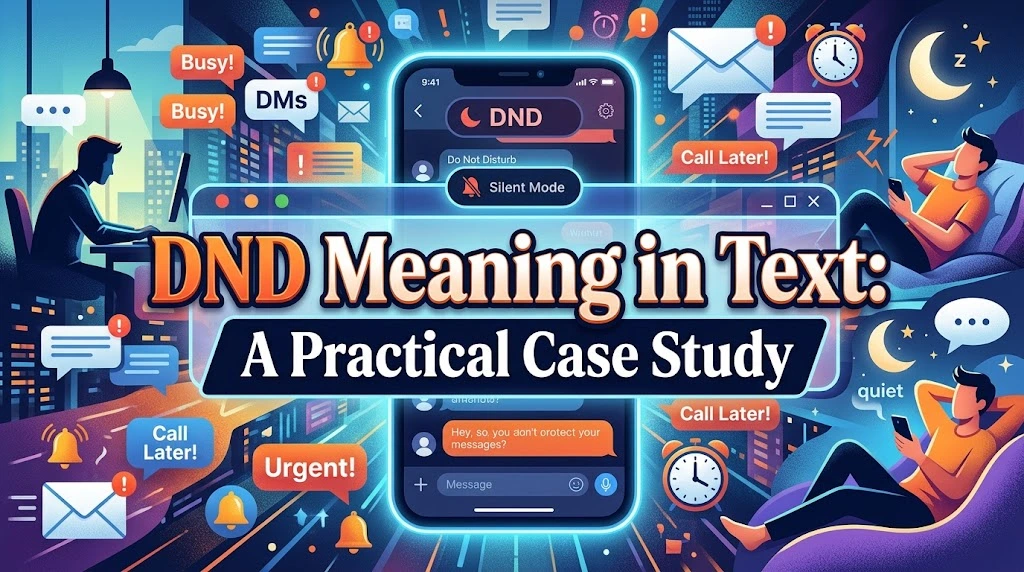
Consider a simple situation.
Maya sends a message to Chris at 8:15 PM:
Maya: “Can you call me?”
Chris doesn’t respond.
At 9:30 PM, he writes:
Chris: “Sorry! I was on DND while studying.”
Maya might initially wonder whether Chris ignored her.
But the phrase “I was on DND” provides an important clue. Chris is saying that he intentionally limited interruptions while studying.
Now change the scenario.
Maya: “Are you playing DND tonight?”
Chris: “Yep. Session starts at 8.”
Here, interpreting DND as Do Not Disturb would make no sense.
The phrase “playing” and the word “session” point toward Dungeons & Dragons.
The Lesson
Don’t interpret abbreviations based on the letters alone.
Instead, consider:
- What are you talking about?
- What words appear around the abbreviation?
- Is the person discussing technology or an activity?
- Does one interpretation make more grammatical sense?
That method usually solves the ambiguity quickly.
Read More : 17+ Other Ways to Say “As You Can See” (With Examples)
DND Meaning in Text: Quick Reference
| Question | Answer |
| What does DND mean in texting? | Usually “Do Not Disturb.” |
| What does “I’m on DND” mean? | The person is limiting interruptions or notifications. |
| Does DND block messages? | Generally, no. It mainly controls notifications and interruptions. |
| Does DND mean someone is ignoring you? | Not necessarily. |
| Is DND the same as Airplane Mode? | No. They serve different purposes. |
| Is DND the same as Silent Mode? | No. DND generally provides broader interruption controls. |
| Can DND allow exceptions? | Yes, depending on the device and settings. |
| Can DND mean something else? | Yes. It can refer to Dungeons & Dragons in gaming contexts. |
| Should you keep texting someone on DND? | Usually, give them space unless the matter is genuinely urgent. |
Frequently Asked Questions About DND Meaning in Text
What does DND mean in texting?
DND usually means “Do Not Disturb.” In texting, someone may use it to say they’re unavailable, limiting notifications, or asking not to be interrupted.
What does DND mean when someone texts “I’m on DND”?
It usually means the person has activated Do Not Disturb or is intentionally limiting interruptions.
For example:
“I’m on DND until morning.”
The person probably doesn’t want to deal with notifications until then.
Does DND block text messages?
Generally, no. DND normally controls notifications and interruptions rather than preventing messages from being sent.
Apple explains that messages can continue arriving while notifications are turned off.
Can someone still receive my messages while on DND?
Yes. In many configurations, the message can still arrive even though the recipient doesn’t receive a normal alert.
The exact behavior depends on the device, app, and notification settings.
Is DND the same as Airplane Mode?
No.
DND limits interruptions. Airplane Mode primarily manages wireless connectivity.
A phone can remain connected while Do Not Disturb is active.
Is DND the same as Silent Mode?
No.
Silent Mode mainly reduces or removes sounds. DND can control a wider range of interruptions, including calls, messages, apps, and selected contacts.
Does DND mean someone is ignoring me?
Not necessarily.
Someone might be asleep, studying, working, driving, exercising, attending a meeting, or simply taking a break from notifications.
DND tells you about availability or interruption settings, not someone’s feelings toward you.
Can DND allow calls from certain people?
Yes, depending on the device and configuration.
Android, for example, allows users to choose which people or types of interruptions can get through DND.
What should I reply when someone says they’re on DND?
A simple response works best:
“No worries. Message me when you’re free.”
If it’s urgent, follow any instructions the person has given for emergencies or important calls.
Can DND mean something other than Do Not Disturb?
Yes.
In gaming conversations, DND can mean Dungeons & Dragons. Dictionary.com lists it as a form of the abbreviation for the tabletop role-playing game.
What does DND mean in gaming?
It depends on the conversation.
If players are discussing campaigns, characters, dice, or dungeon masters, DND probably means Dungeons & Dragons.
If they’re talking about phones, notifications, or being unavailable, it probably means Do Not Disturb.
Is DND different from D&D?
When referring to the tabletop game, D&D is the more familiar styling for Dungeons & Dragons. However, DND is also used as a variant abbreviation.
Conclusion: What DND Really Means in Text
The most common DND meaning in text is “Do Not Disturb.”
When someone says “I’m on DND,” they usually mean they’re limiting interruptions or won’t be checking notifications normally. It doesn’t automatically mean they’ve blocked you, rejected you, or deliberately ignored your message.
The biggest distinction to remember is this:
DND usually manages your attention, not the existence of the message.
Your message may still arrive while the recipient’s phone stays quiet.
DND also differs from Airplane Mode, Silent Mode, blocking, muting, and Focus modes. Modern smartphones give users increasingly detailed control over which people and apps can interrupt them. Android, for example, lets users customize notification filters and exceptions, while Apple allows messages to continue arriving even when message notifications are disabled.
Finally, context matters. In an ordinary text conversation, DND almost always points to Do Not Disturb. In a tabletop gaming conversation, however, it can mean Dungeons & Dragons.
So when you see those three letters, don’t jump to conclusions. Look at the conversation around them. Usually, the meaning becomes obvious within a few seconds.