
The phrase “as you can see” is useful, but it can become repetitive quickly. You might use it in a presentation, email, report, classroom discussion, or everyday conversation to point someone toward information that supports your point.
The problem isn’t that the phrase is wrong. It’s that the best alternative depends on what you’re pointing to and how formal you want to sound.
For example, “as shown” works naturally with a chart, while “as demonstrated” fits a process or experiment. In a casual presentation, “you’ll notice that” may sound warmer. Meanwhile, “as indicated” can give a report a more precise tone.
This guide explores the best other ways to say “as you can see”, including their meanings, tones, grammar, and practical examples.
What Does “As You Can See” Mean?
“As you can see” means as is apparent from the information, evidence, image, situation, or example being discussed.
The word “see” doesn’t always refer to literal eyesight. It can also mean understand, recognize, or observe.
Consider these examples:
As you can see, the graph rises sharply in June.
Here, the reader can literally look at the graph.
Now consider:
As you can see, customer demand increased after the price reduction.
The reader isn’t necessarily looking at a physical object. Instead, they can understand the conclusion from the data.
The phrase therefore acts as a bridge between a claim and supporting information.
Simple Definition
In simple terms, “as you can see” tells someone to look at or consider something that makes a statement apparent.
It can refer to:
- A chart
- A photograph
- A diagram
- A document
- A table
- A physical object
- A situation
- A result
- A set of statistics
- An earlier explanation
- An obvious fact
For example:
As you can see, the two designs are almost identical.
As you can see from the table, sales increased in every quarter.
As you can see, this approach saves considerable time.
Grammar and Sentence Structure
“As you can see” commonly appears as an introductory dependent clause.
For example:
As you can see, the results are improving.
A comma separates the introductory clause from the main clause.
You can also expand the phrase by specifying what provides the evidence:
As you can see from the chart, revenue increased significantly.
As you can see in Figure 2, the temperature remained stable.
As you can see below, the three options have different costs.
The construction usually follows this pattern:
As you can see + evidence/source + main observation
However, the phrase isn’t always necessary. If the source is already obvious, removing it can make your sentence sharper.
Instead of:
As you can see from the graph, sales increased.
You could simply write:
The graph shows that sales increased.
The second version puts the evidence itself in control rather than telling the reader what they can see.
Examples in Different Contexts
The phrase adapts easily to different situations.
Conversation:
“As you can see, I wasn’t exaggerating about the traffic.”
Presentation:
“As you can see on this slide, revenue grew throughout the year.”
Business report:
“As you can see in Table 3, operating costs declined.”
Email:
“As you can see from the attached report, the requested changes have been completed.”
Classroom:
“As you can see from this example, changing one variable affects the final result.”
The grammar remains straightforward. The tone changes with the surrounding language.
When Should You Use “As You Can See”?
“As you can see” works best when you genuinely want to direct someone’s attention toward supporting information.
That distinction matters.
If you’re pointing toward a chart, the phrase makes sense. If you’re simply making a claim that doesn’t involve something observable, another construction may work better.
When Referring to Visual Information
This is probably the most natural use.
You can use “as you can see” with:
- Charts
- Graphs
- Photos
- Maps
- Diagrams
- Screenshots
- Tables
- Documents
- Physical objects
For example:
As you can see from the chart, website traffic peaked in December.
As you can see in the photograph, the damage extends across the entire roof.
As you can see on the map, the two locations are relatively close.
In each example, the audience has something concrete to inspect.
When Pointing to Evidence or Results
You can also use the phrase when the audience can understand something from evidence.
As you can see from the results, the second method performed better.
As you can see from the data, customer retention improved after the update.
Here, “see” means something closer to recognize from the available evidence.
When Explaining Something During a Presentation
Presenters frequently use the phrase to guide an audience through slides.
For example:
As you can see on this slide, our costs fell considerably during the second quarter.
It works because presentations often involve visual information.
Still, repetition can make a presentation sound mechanical. Instead of saying “as you can see” every few minutes, alternate it with precise phrases:
- This chart shows…
- Notice how…
- You’ll notice that…
- The data indicates…
- This comparison highlights…
- The results show…
That small change can make your delivery feel much more natural.
When It Can Sound Unnecessary
Sometimes the phrase adds no useful information.
Compare:
As you can see, the blue line is higher than the red line.
with:
The blue line is higher than the red line.
If the difference is immediately visible, the second sentence gets to the point faster.
The same principle applies to professional writing. Don’t announce that something can be seen when you can simply state what the evidence demonstrates.
Is “As You Can See” Professional?
Yes. “As you can see” is grammatically correct and professionally acceptable.
You can use it in business presentations, reports, emails, training materials, and many other professional settings.
However, professional doesn’t always mean optimal.
The phrase can occasionally sound dismissive when you use it to describe something that you assume everyone should already understand.
When It Works Well Professionally
The phrase is generally safe when you’re referring to specific evidence.
As you can see in the attached report, all requested revisions have been completed.
As you can see from the quarterly figures, operating expenses declined.
As you can see in Figure 4, the two trends move in opposite directions.
These sentences identify the source of the information. That makes the reference clear.
When It May Sound Dismissive or Condescending
Problems arise when “as you can see” implies that the other person should already understand something.
For example:
As you can see, this is obviously the better option.
The problem isn’t the first phrase alone. The combination with “obviously” creates a stronger, more judgmental tone.
Another example:
As you can see, you entered the wrong information again.
That could sound accusatory.
A more neutral version would be:
The form shows that the information in this field doesn’t match the required format.
The revised sentence focuses on the evidence instead of the person’s mistake.
How to Make It Sound More Neutral
Be specific about the source.
Instead of:
As you can see, sales are improving.
Try:
The latest sales figures show steady improvement.
Instead of:
As you can see, the system is working properly.
Try:
The test results confirm that the system is working properly.
This approach gives your sentence more precision while reducing the risk of sounding patronizing.
“As You Can See” vs. “As Shown” vs. “As Demonstrated”
These expressions overlap, but they aren’t perfect substitutes.
| Phrase | Main idea | Best context | Tone |
| As you can see | Directs attention | General visual information | Neutral, conversational |
| As shown | Refers directly to displayed information | Charts, tables, figures | Concise, professional |
| As demonstrated | Refers to something proven or performed | Tests, processes, examples | Formal, analytical |
| As illustrated | Points to an illustration or example | Diagrams, examples | Formal, descriptive |
| As indicated | Points to a sign, figure, or piece of evidence | Data and reports | Formal, precise |
| You’ll notice that | Directs attention conversationally | Presentations, explanations | Friendly |
| As evidenced by | Points to supporting evidence | Analysis and formal writing | Formal |
Choosing the right phrase is less about finding a synonym and more about identifying what the evidence actually does.
Other Ways to Say “As You Can See”
There isn’t one universal replacement for “as you can see.” Each alternative has a slightly different job.
As Shown
“As shown” is one of the cleanest professional alternatives.
It works especially well with charts, tables, graphs, illustrations, and figures.
As shown in Figure 2, customer complaints declined after the update.
As shown below, the three plans have different pricing structures.
It also eliminates direct reference to the reader.
Compare:
As you can see from the chart, revenue increased.
As shown in the chart, revenue increased.
The second version sounds more objective.
As Shown Below
Use “as shown below” when the relevant information appears immediately afterward.
As shown below, the revised process requires fewer steps.
The differences are clear, as shown below.
It’s particularly useful in documents containing tables, diagrams, examples, or screenshots.
One caution: avoid “below” if the content might move during editing or appear elsewhere in a responsive digital format. A specific reference such as “as shown in Table 2” can be more durable.
As Demonstrated
“As demonstrated” works when something has been proven, tested, performed, or illustrated through action.
As demonstrated during the trial, the new system reduces processing time.
As demonstrated by the experiment, temperature affects reaction speed.
This phrase is stronger than “as you can see.”
You aren’t merely directing attention. You’re pointing toward a demonstration that supports a conclusion.
As Illustrated
Use “as illustrated” when referring to a diagram, example, visual explanation, or conceptual representation.
As illustrated in the diagram, the two systems share several components.
As illustrated by the example above, small changes can produce different outcomes.
The word “illustrated” can refer to more than literal artwork. An example can illustrate an idea, too.
As Indicated
“As indicated” works particularly well when information, measurements, signs, or data point toward a conclusion.
As indicated by the survey results, most respondents preferred the second option.
As indicated in the report, delivery times have improved.
This alternative has a more formal flavor than “as you can see.”
It fits naturally into analytical and professional writing.
As Highlighted
Use “as highlighted” when you want to draw attention to something that has been emphasized.
As highlighted in the report, customer satisfaction remains a major concern.
As highlighted above, the contract contains several important conditions.
This phrase is especially useful when the information has already received visual or textual emphasis.
As Evidenced by
“As evidenced by” explicitly connects a conclusion to evidence.
As evidenced by the survey results, customer preferences have changed.
As evidenced by the sharp decline in errors, the training program was effective.
This expression is more formal and analytical.
It may sound excessive in casual conversation, so use it when the context calls for a stronger evidence-based tone.
As Reflected In
“As reflected in” works well when information appears in records, figures, statistics, or outcomes.
As reflected in the latest financial report, operating costs have decreased.
As reflected in the survey data, customer satisfaction improved.
It suggests that the information is represented by or visible through a particular source.
As Confirmed By
Use “as confirmed by” when the evidence verifies something.
As confirmed by the inspection report, the equipment meets the required standards.
As confirmed by the laboratory results, the sample contained no detectable contamination.
This is more specific than “as you can see.” It implies verification, not merely observation.
As the Data Shows
For statistics and quantitative information, “as the data shows” can be clearer than “as you can see.”
As the data shows, mobile traffic has increased steadily.
As the data shows, the largest increase occurred in May.
In formal analytical writing, you may also see:
The data show that mobile traffic has increased steadily.
That construction is especially direct because the data become the grammatical subject.
As the Results Show
This phrase works particularly well with experiments, tests, studies, and evaluations.
As the results show, the revised method produced fewer errors.
As the results show, participants responded more quickly under the second condition.
It tells readers exactly what they’re being asked to consider: the results.
You’ll Notice That
“You’ll notice that” is a natural conversational alternative.
You’ll notice that the second column contains fewer errors.
You’ll notice that both options use the same basic structure.
This works particularly well in:
- Presentations
- Tutorials
- Training
- Meetings
- Conversations
It sounds more engaging because it guides the listener without sounding overly formal.
Clearly
“Clearly” can replace “as you can see” when the point is genuinely obvious.
Clearly, the second option offers better value.
However, be careful.
“Clearly” can sound like you’re implying that anyone who disagrees simply isn’t paying attention.
Compare:
Clearly, this is the best solution.
with:
The results clearly favor the second solution.
The second version is stronger because it connects “clearly” to evidence.
It Is Clear That
“It is clear that” works well when introducing a conclusion.
It is clear that customer expectations have changed.
It is clear from the results that the new method performs better.
This expression doesn’t necessarily require something visual. You can use it when evidence makes a conclusion reasonably apparent.
As Outlined Above
Use “as outlined above” when referring to information already explained earlier in a document.
As outlined above, the project has three major stages.
The proposed changes address the issues outlined above.
This is not a direct synonym for “as you can see.” It serves a more specific purpose: pointing backward to previously presented information.
As Noted Above
“As noted above” is another useful written alternative.
As noted above, the deadline cannot be extended.
As noted above, these requirements apply to all applicants.
It’s especially common in formal documents, reports, policies, and academic writing.
As Explained Earlier
Use this phrase when you’re referring to an explanation that appeared earlier.
As explained earlier, the two methods use different measurement standards.
As explained earlier, this approach reduces unnecessary processing.
Again, the focus is not necessarily visual. The phrase refers to previously communicated information.
Best Alternatives to “As You Can See” by Context
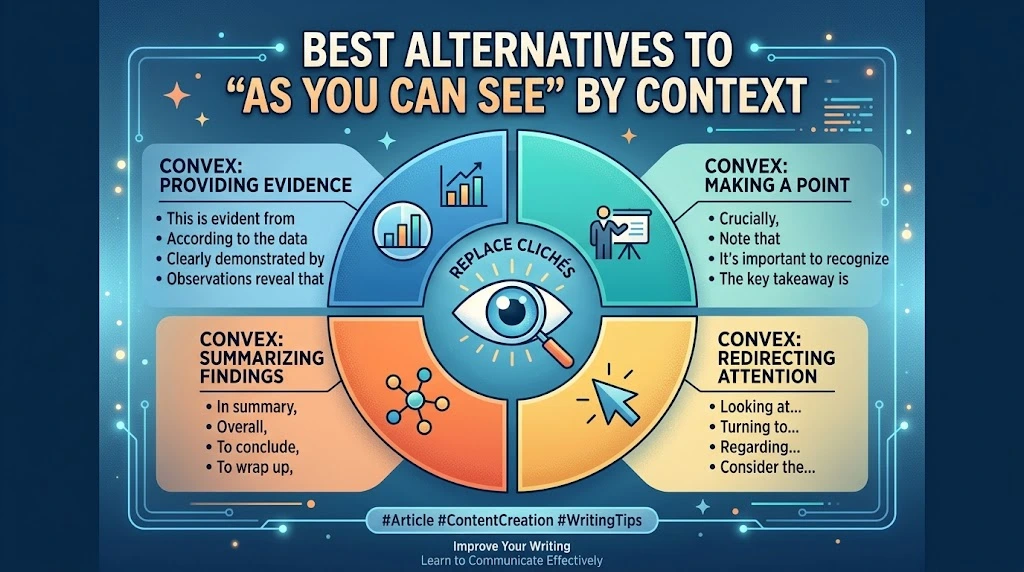
Different environments call for different levels of formality.
For Professional Emails
For workplace emails, clarity usually matters more than fancy wording.
Good choices include:
- As shown in the attached report
- As indicated in the document
- As noted above
- As outlined below
- The attached report shows…
- The data indicates…
- The results confirm…
For example:
The attached report shows that all requested changes have been completed.
This often sounds cleaner than:
As you can see from the attached report, all requested changes have been completed.
For Business Reports
Reports benefit from precise references.
Strong options include:
- As shown in Figure 3
- As indicated by the data
- As reflected in the results
- As demonstrated by the analysis
- The results show
- The data indicates
- The figures confirm
For example:
As shown in Figure 3, production increased during the final quarter.
That’s more informative than simply saying:
As you can see, production increased.
For Academic Writing
Academic writing generally benefits from avoiding unnecessary direct address.
Instead of:
As you can see, the results support the hypothesis.
Consider:
The results support the hypothesis.
Or:
As demonstrated by the results, the hypothesis is supported.
Or:
The findings indicate support for the hypothesis.
The best option depends on the discipline and the claim you’re making.
For Presentations
Presentations are different because you’re speaking directly to an audience.
Natural choices include:
- As you can see…
- You’ll notice that…
- Notice how…
- This chart shows…
- The data shows…
- Look at what happens when…
- This comparison highlights…
For example:
You’ll notice that the blue line begins to rise sharply after July.
That can sound more engaging than repeatedly saying:
As you can see…
For Everyday Conversation
Keep it simple.
You might say:
- As you can see…
- Clearly…
- You can tell that…
- You’ll notice…
- It’s obvious from…
- Look at…
For example:
You can tell that he’s been practicing.
This sounds much more natural in casual speech than:
As demonstrated by his performance, he has practiced extensively.
Context matters. A phrase can be grammatically correct and still sound wildly out of place.
“As You Can See” Alternatives: Formality and Tone Comparison
The following table makes the differences easier to spot.
| Alternative | Formality | Tone | Best Used For |
| As you can see | Neutral | Conversational | General explanations |
| As shown | Neutral/Formal | Direct | Charts and figures |
| As shown below | Formal | Concise | Tables and examples |
| As demonstrated | Formal | Analytical | Tests and processes |
| As illustrated | Formal | Descriptive | Diagrams and examples |
| As indicated | Formal | Precise | Data and evidence |
| As highlighted | Formal | Emphatic | Important information |
| As evidenced by | Formal | Analytical | Supporting evidence |
| As reflected in | Formal | Analytical | Records and results |
| As confirmed by | Formal | Definitive | Verification |
| You’ll notice that | Neutral | Friendly | Presentations |
| Clearly | Neutral/Formal | Strong | Obvious conclusions |
| It is clear that | Formal | Direct | Conclusions |
| As outlined above | Formal | Referential | Previous information |
| As noted above | Formal | Referential | Earlier statements |
| As explained earlier | Neutral/Formal | Explanatory | Earlier explanations |
The important point is simple: don’t choose an alternative just because it sounds more sophisticated. Choose it because it describes the relationship between your claim and your evidence accurately.
Alternatives to Avoid Depending on Context
Some phrases look like replacements for “as you can see,” but they can create unwanted tones.
Obviously
“Obviously” can sound dismissive.
Obviously, the first option is better.
That sentence may imply that disagreement is foolish.
A more neutral version:
The results indicate that the first option is more effective.
If something genuinely is obvious, you can still use the word. Just consider whether the audience will interpret it as criticism.
Clearly
“Clearly” has a similar issue.
Clearly, you didn’t read the instructions.
That’s likely to sound hostile.
A professional alternative:
The instructions specify a different procedure.
Now the focus is on the instructions rather than the person’s supposed failure.
As Everyone Can See
This expression can put social pressure on the audience.
As everyone can see, this is the only reasonable solution.
It suggests that disagreement would make someone an outsider.
A better approach:
The available evidence strongly supports this solution.
As You Should Know
This phrase can sound patronizing.
As you should know, the deadline is Friday.
Even when the information is genuinely established, the wording can feel like a reprimand.
Try:
As noted in the project schedule, the deadline is Friday.
That’s more neutral and more useful.
Before-and-After Examples
Seeing the difference in context makes these choices easier.
Workplace Email
Less effective:
As you can see, the attached report contains the updated figures.
Better:
The attached report contains the updated figures.
Why? The sentence doesn’t need to tell the recipient that they can see an attachment.
Business Report
Less precise:
As you can see, revenue increased during the final quarter.
Better:
As shown in Figure 4, revenue increased during the final quarter.
Why? The second version identifies exactly where the evidence appears.
Presentation
Standard:
As you can see, sales increased sharply after June.
More engaging:
You’ll notice that sales begin rising sharply after June.
Why? The second version sounds more like natural spoken guidance.
Academic Writing
Less direct:
As you can see, the experiment produced different results under the two conditions.
More objective:
The experiment produced different results under the two conditions.
Why? The evidence can speak for itself.
Referring to Previous Information
Less suitable:
As you can see, the project has three main stages.
Better:
As outlined above, the project has three main stages.
Why? The second phrase correctly indicates that the information appeared earlier in the document.
Case Study: Choosing the Right Alternative
Imagine a marketing team has analyzed website traffic for six months.
The report contains a graph showing monthly visits.
A weak sentence might say:
As you can see, traffic improved.
The reader knows something happened, but the sentence doesn’t identify the source or explain the trend.
A stronger version is:
As shown in Figure 2, monthly website traffic increased steadily from January through June.
That version gives the reader three useful pieces of information:
- Where the evidence appears: Figure 2
- What happened: traffic increased
- How it happened: the increase was steady
Now imagine you’re presenting the same graph to an audience.
A natural spoken version might be:
You’ll notice that traffic begins climbing steadily in January and continues through June.
The underlying information hasn’t changed. The communication context has.
That’s the real key to choosing alternatives to “as you can see.”
A Quick Decision Guide
When you’re unsure which phrase to use, identify what you’re referring to.
| If you’re referring to… | Try… |
| A chart | As shown in the chart |
| A table | As shown in Table 2 |
| A diagram | As illustrated in the diagram |
| A process | As demonstrated |
| Statistical evidence | As indicated by the data |
| Research findings | As the results show |
| Verified information | As confirmed by |
| Earlier information | As noted above |
| An earlier explanation | As explained earlier |
| A highlighted point | As highlighted in the report |
| A presentation slide | You’ll notice that |
| An obvious conclusion | Clearly |
| A formal conclusion | It is clear that |
| General conversation | As you can see |
This approach is more reliable than memorizing a list of synonyms.
How to Avoid Repeating “As You Can See”
Repetition is often the real reason writers search for alternatives.
If every paragraph starts with “as you can see,” readers eventually stop noticing the phrase.
Instead, vary your sentence structure.
For example:
As shown in Figure 1, customer demand increased.
Then:
The following table reveals a similar pattern.
Then:
You’ll notice that the largest increase occurred in May.
Then:
The results confirm the same trend.
Then:
This pattern becomes particularly clear in the final quarter.
Notice what happens here. The writing doesn’t rely on five synonyms for the same phrase. Each sentence performs a slightly different function.
That creates more natural prose.
Read More : Swap vs. Swop: What’s the Real Difference?
“As You Can See” vs. “Obviously”
These phrases are sometimes treated as interchangeable, but they’re not.
“As you can see” points toward evidence.
“Obviously” comments on how apparent something is.
Compare:
As you can see from the chart, sales declined.
The chart provides evidence.
Now:
Obviously, sales declined.
This emphasizes the supposed obviousness of the conclusion.
The first is generally safer in professional communication because it identifies a source.
“As You Can See” vs. “Clearly”
The same distinction applies to “clearly.”
As you can see from the results, the second method performed better.
This directs attention toward evidence.
Clearly, the second method performed better.
This emphasizes certainty.
If your audience might reasonably question the conclusion, the first construction is usually more useful.
“As You Can See” vs. “As Shown”
These two phrases are close, but their style differs.
“As you can see” directly addresses the reader.
As you can see, the two lines follow different patterns.
“As shown” removes the reader from the sentence.
As shown in Figure 5, the two lines follow different patterns.
That’s one reason “as shown” appears frequently in formal reports and technical writing.
It sounds concise and evidence-focused.
Common Mistakes When Using “As You Can See”

Using It Without a Clear Reference
As you can see, the system works better.
Better:
As shown in the test results, the system processes requests faster.
Give readers something concrete to inspect.
Using It Too Often
Repeated phrases make writing predictable.
Instead of using the phrase throughout a report, alternate between:
- As shown…
- The data indicates…
- The results show…
- As demonstrated…
- You’ll notice…
- The comparison highlights…
- The figures confirm…
Using a Formal Alternative in a Casual Situation
Don’t say:
As evidenced by your facial expression, you’re tired.
when you’re talking casually to a friend.
Just say:
You look tired.
Good writing isn’t about using the most formal phrase available. It’s about using the phrase that fits.
Treating Every Alternative as an Exact Synonym
This is perhaps the biggest mistake.
“As confirmed by” implies verification.
“As illustrated” points toward an illustration or example.
“As noted above” points backward.
“As demonstrated” suggests a demonstration.
“Clearly” emphasizes obviousness.
These phrases overlap with “as you can see,” but they don’t all mean exactly the same thing.
Frequently Asked Questions About Other Ways to Say “As You Can See”
What is another way to say “as you can see”?
Useful alternatives include “as shown,” “as demonstrated,” “as illustrated,” “as indicated,” “as highlighted,” “you’ll notice that,” and “as evidenced by.”
The best choice depends on the context.
For a chart, “as shown” works well. For a presentation, “you’ll notice that” sounds natural.
What is a professional way to say “as you can see”?
Professional alternatives include:
- As shown in the report
- As indicated by the data
- As demonstrated by the results
- As reflected in the figures
- As outlined above
- The results show
- The data indicates
For business writing, specific references usually sound stronger than vague ones.
Is “as you can see” formal or informal?
“As you can see” is neutral.
It isn’t strongly informal or highly formal. You can use it in everyday conversation and professional presentations.
However, formal documents may benefit from more precise alternatives such as “as shown,” “as indicated,” or “as demonstrated.”
Is “as you can see” polite in an email?
Yes. “As you can see” can be perfectly polite in an email.
The surrounding wording matters.
This sounds neutral:
As you can see from the attached report, the requested changes have been completed.
This can sound less friendly:
As you can see, you entered the wrong information.
When correcting someone, focus on the evidence rather than suggesting that their mistake should have been obvious.
Can “as you can see” sound condescending?
Yes, depending on context.
The phrase can sound condescending when it implies that the reader should already understand something or has failed to notice something obvious.
For example:
As you can see, this is the correct answer.
can sound unnecessarily forceful if someone has just challenged the conclusion.
A more neutral version might be:
The evidence supports this answer.
What is the best alternative to “as you can see” in academic writing?
There isn’t one universal replacement.
Depending on the situation, academic writers might use:
- As shown in Figure 2
- As demonstrated by the results
- The findings indicate
- The data show
- The results suggest
- As illustrated in Table 1
Often, the strongest academic choice is to remove the phrase entirely and state the finding directly.
What can I say instead of “as you can see” in a presentation?
Try:
- You’ll notice that…
- Notice how…
- This chart shows…
- The data shows…
- This comparison highlights…
- Look at what happens when…
These alternatives help vary your delivery and keep the audience focused.
Is “as shown” better than “as you can see”?
Not always.
“As shown” is usually more concise and objective. It’s especially useful in reports, technical documents, charts, and academic writing.
“As you can see” feels more direct and conversational, making it a good choice for presentations and spoken explanations.
The right phrase depends on the audience and context.
Conclusion
“As you can see” is a useful phrase, but it doesn’t need to carry every explanation on its back.
When you’re pointing to a chart, “as shown” may be cleaner. When you’re discussing a process, “as demonstrated” can be more accurate. For diagrams, “as illustrated” fits naturally. When you’re presenting information aloud, “you’ll notice that” creates a more conversational connection.
The strongest alternative isn’t necessarily the most formal one. It’s the phrase that tells readers exactly how the evidence supports your point.
Before replacing “as you can see,” ask one simple question:
What exactly am I asking the reader to notice?
If it’s a chart, name the chart. If it’s evidence, identify the evidence. If it’s an earlier explanation, refer to that explanation. If nothing needs pointing out, remove the phrase entirely.
That’s the real trick. Clear writing doesn’t merely tell readers what they can see. It helps them understand why what they’re seeing matters.