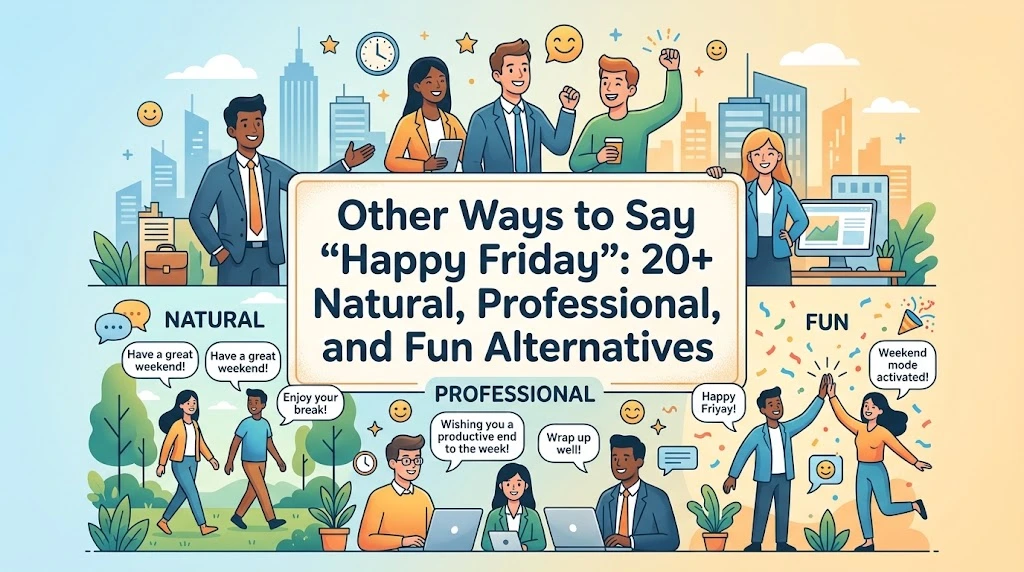
Friday has a different rhythm.
For many people, it marks the final stretch of the workweek and the doorway to the weekend. That makes “Happy Friday” a natural greeting for coworkers, friends, family members, and online communities.
Still, repeating the same two words every Friday can get stale. Sometimes you also need a phrase that sounds warmer, more professional, more playful, or simply more appropriate for the person receiving your message.
That’s where other ways to say “Happy Friday” come in.
You might write to a client who prefers polished business communication. You might message a coworker after a hectic week. Or perhaps you’re texting a friend who has been counting down the hours until the weekend.
The situation changes. Your wording should change with it.
This guide explains what “Happy Friday” means, whether it works in professional communication, and 20+ alternatives to “Happy Friday” with examples you can actually use.
What Does “Happy Friday” Mean?
“Happy Friday” is a friendly expression used to acknowledge that Friday has arrived and to wish someone a pleasant day.
The phrase often carries more meaning than the words themselves suggest. In everyday American English, it can communicate:
- Excitement that Friday has arrived
- Relief that the workweek is ending
- Anticipation of the weekend
- Friendly workplace camaraderie
- A cheerful or relaxed mood
- A simple wish for someone to have a good day
For example:
“Happy Friday! I hope you have a relaxing weekend.”
The speaker isn’t necessarily celebrating Friday itself. Instead, the phrase recognizes the social significance of Friday as the end of the traditional workweek.
That makes it similar to expressions such as “Happy Monday,” “Happy Holidays,” or “Happy New Year.”
However, “Happy Friday” has a distinctly casual flavor.
Is “Happy Friday” Grammatically Correct?
Yes. “Happy Friday” is grammatically acceptable as a greeting.
It follows a familiar English pattern:
Happy + day or occasion
Examples include:
- Happy Monday!
- Happy Friday!
- Happy birthday!
- Happy New Year!
- Happy holidays!
The phrase is technically an elliptical expression. In other words, some words are understood rather than spoken.
“Happy Friday” can be understood as something close to:
“I hope you have a happy Friday.”
You don’t need to add those extra words, though. The shorter version is perfectly natural in everyday communication.
For example:
Natural:
Happy Friday, everyone!
Also natural:
Have a great Friday, everyone!
The difference lies mainly in tone and emphasis, not grammatical correctness.
When Should You Say “Happy Friday”?
The best time to use “Happy Friday” depends on the relationship and communication setting.
At Work
“Happy Friday” can work well in relaxed workplaces where colleagues regularly use casual language.
For example:
Happy Friday, team! Let’s wrap up the week strong.
It can also appear naturally in internal chats, especially on platforms such as Teams or Slack.
However, don’t assume every workplace has the same communication culture. A casual technology startup and a highly formal legal organization may have very different expectations.
With Friends and Family
This is where “Happy Friday” feels especially natural.
You might text:
Happy Friday! Any plans for tonight?
Or:
Happy Friday! We finally made it.
There is little risk of sounding too formal here. You can also make the message more playful with expressions such as “Cheers to Friday!” or “We made it to Friday!”
With Customers and Clients
This situation requires more judgment.
“Happy Friday” isn’t inherently unprofessional. Indeed, professional communication guides recognize it as a possible time-specific greeting.
Still, a client email should focus on the purpose of the message. If the email concerns a contract deadline, billing problem, urgent project, or sensitive issue, opening with “Happy Friday!” may feel disconnected.
Compare these examples:
Happy Friday! I wanted to follow up on the contract.
versus:
Thank you for following up on the contract. I’ve attached the revised version for your review.
The second version gets straight to the point.
A friendly Friday reference can still work at the end:
Thank you again. Wishing you a pleasant weekend.
In Spoken English vs. Written English
“Happy Friday” works in both spoken and written English.
Spoken:
“Happy Friday! How’s your morning going?”
Email:
“Happy Friday, Sarah. I wanted to send over the updated report.”
Team chat:
“Happy Friday, everyone! One last push.”
Social media:
“Happy Friday! Hope everyone has a fantastic weekend.”
The difference is mainly contextual. Spoken English gives you facial expression and tone of voice. Written communication doesn’t. Therefore, your choice of words carries more weight in an email or message.
Is “Happy Friday” Professional?
The short answer is sometimes.
“Happy Friday” sits somewhere between casual and professional-friendly English. It isn’t slang. It isn’t grammatically informal in the way highly colloquial expressions can be. Yet it isn’t a particularly formal business expression either.
Indeed, professional email guidance lists “Happy Friday” among possible time-specific greetings while emphasizing that email greetings should match the context.
When It Works Professionally
You can comfortably use “Happy Friday” when:
- You know the recipient well.
- Your workplace has a relaxed culture.
- You’re communicating internally.
- The conversation is already friendly.
- The message isn’t about a serious or sensitive issue.
- Your organization commonly uses casual greetings.
For example:
Happy Friday, Mike! Just wanted to send you the final numbers before the weekend.
That sounds friendly without being unprofessional.
When to Choose Something More Formal
A more neutral phrase may be better when you’re writing to:
- A new client
- A senior executive you don’t know well
- A government official
- A formal business contact
- Someone involved in a serious matter
- A recipient whose communication style you haven’t established
Instead of:
Happy Friday!
you could write:
I hope your week is wrapping up well.
Or:
Wishing you a pleasant end to the week.
These alternatives preserve warmth without sounding overly casual.
One Important Consideration: Not Everyone Is Having a “Happy Friday”
There’s another reason to use Friday greetings thoughtfully.
A 2025 Fast Company article argued that “Happy Friday” can sometimes feel insensitive because it assumes the recipient is having a good day. The article specifically points out that people may be dealing with deadlines, stress, illness, or difficult personal circumstances.
That doesn’t make the phrase wrong.
It simply highlights an important communication principle:
A cheerful phrase works best when it fits the emotional context.
If someone just told you they’re overwhelmed by a deadline, “Hope you have a relaxing Friday” may sound tone-deaf.
A better response would be:
Hope you get through the deadline smoothly. Take care when you get a chance to step away.
The wording acknowledges the actual situation instead of forcing a cheerful Friday mood onto it.
Other Ways to Say “Happy Friday”
There isn’t one perfect replacement.
Each alternative changes the tone slightly. Some sound professional. Others are warm, celebratory, playful, or encouraging.
Here are the most useful options.
Have a Great Friday
“Have a great Friday” is one of the easiest replacements for “Happy Friday.”
It keeps the same positive meaning while sounding slightly more like a genuine well-wish.
Example:
Have a great Friday, and I’ll see you Monday!
Best for: coworkers, friends, casual emails, and everyday conversation.
Tone: Friendly and neutral.
Have a Fantastic Friday
If “great” doesn’t feel enthusiastic enough, “Have a fantastic Friday” turns up the energy.
It’s cheerful without becoming overly silly.
Example:
Have a fantastic Friday! You’ve earned a relaxing weekend.
This works especially well when the recipient has finished an important project or reached a milestone.
Tone: Warm and enthusiastic.
Enjoy Your Friday
“Enjoy your Friday” feels simple and natural.
It can also sound slightly softer than “Happy Friday.”
Example:
Thanks for your help this week. Enjoy your Friday!
This makes it particularly useful as an email closing.
Best for: coworkers, clients you know well, friends, and professional-friendly communication.
Tone: Warm and polite.
Have a Wonderful Friday
For a slightly more polished alternative, try “Have a wonderful Friday.”
It carries more warmth than “Have a great Friday” while remaining straightforward.
Example:
Thank you for your time today. Have a wonderful Friday!
This can work well in customer service, professional emails, and personal messages.
Wishing You a Wonderful Friday
“Wishing you a wonderful Friday” sounds more deliberate.
Because of the structure, it often feels better suited to written communication than casual conversation.
Example:
Wishing you a wonderful Friday and a relaxing weekend ahead.
It’s a useful choice when you want warmth without sounding overly familiar.
Best for: professional emails, client messages, thank-you notes, and polite correspondence.
Hope You Have a Great Friday
This version sounds conversational because it begins with “Hope.”
It also avoids the slightly celebratory feeling of “Happy Friday.”
Example:
Hope you have a great Friday and an even better weekend.
It’s especially natural when you’re already having a conversation with the recipient.
Hope Your Friday Is Going Well
Sometimes you don’t want to wish someone a Friday. You want to check in on how their Friday is going.
That’s where this phrase shines.
Hope your Friday is going well so far.
It works particularly well in an email or message sent during the middle of the day.
Unlike “Happy Friday,” it doesn’t assume the person is celebrating.
Enjoy the Rest of Your Friday
This phrase is ideal for later in the day.
If you’ve just finished a meeting at 3:00 p.m., saying “Happy Friday” may feel a little late. “Enjoy the rest of your Friday” fits the timing naturally.
Example:
Thanks for meeting with me today. Enjoy the rest of your Friday!
It works beautifully as a workplace sign-off.
Have a Great End to the Week
This is one of the more professional alternatives.
It doesn’t focus on happiness or celebration. Instead, it recognizes that the week is coming to a close.
Example:
Thanks for the update. Have a great end to the week.
This sounds especially appropriate in business communication.
Enjoy the Start of the Weekend
For many people, Friday is effectively the beginning of the weekend.
If that’s the meaning you want to emphasize, this phrase works better than “Happy Friday.”
Example:
Enjoy the start of the weekend. You’ve had a busy week!
It’s friendly and positive without being overly informal.
Cheers to Friday
Now the tone becomes much more casual.
“Cheers to Friday!” expresses celebration. It works well among friends, close coworkers, and relaxed teams.
Example:
Cheers to Friday! We made it through another busy week.
Avoid this phrase in highly formal correspondence. It has too much personality for some business settings.
Friday Is Here!
This is short, energetic, and unmistakably casual.
Friday is here! Time to finish strong.
It’s excellent for team chats, social media posts, and informal conversations.
We Made It to Friday!
This phrase adds a sense of shared experience.
It suggests that the week was demanding and everyone survived it together.
We made it to Friday! Great work this week, everyone.
That makes it particularly effective for team communication.
It isn’t simply a greeting. It can also recognize collective effort.
Have a Fabulous Friday
“Have a fabulous Friday” is cheerful and playful.
It’s a good choice when you want personality rather than corporate neutrality.
Have a fabulous Friday! Don’t forget to celebrate the little wins.
The word “fabulous” makes the phrase more expressive. That also makes it less suitable for formal business writing.
Make It a Great Friday
This version has an encouraging quality.
Make it a great Friday!
Rather than simply wishing someone well, it encourages them to shape the day positively.
It’s particularly natural in team chats or messages to friends.
Wishing You a Great Start to the Weekend
This alternative shifts attention from Friday itself to the weekend.
Wishing you a great start to the weekend!
It’s polished enough for many professional settings while remaining warm.
Enjoy Your Weekend
Sometimes the best alternative to “Happy Friday” isn’t another Friday phrase at all.
If you’re sending a message near the end of the workday, “Enjoy your weekend” may be more natural.
For example:
Thanks for everything this week. Enjoy your weekend!
The message focuses on what the recipient is actually looking forward to.
Have a Wonderful Weekend
This is another excellent choice for professional communication.
Thank you for your help this week. Have a wonderful weekend.
It feels warmer than a bare “Have a good weekend” while remaining completely natural.
Wishing You a Relaxing Weekend
This phrase works especially well after a busy week.
You’ve had a packed schedule this week. Wishing you a relaxing weekend.
Notice the difference. The phrase becomes more thoughtful because it connects to the person’s circumstances.
Have a Well-Deserved Weekend
This is a particularly useful phrase after hard work.
Great job getting the project across the finish line. Have a well-deserved weekend!
It recognizes effort instead of simply acknowledging the calendar.
That small change can make a message feel much more personal.
Quick Comparison of Other Ways to Say “Happy Friday”
| Alternative | Tone | Best Context | Formality |
| Have a Great Friday | Friendly | General use | Neutral |
| Have a Fantastic Friday | Enthusiastic | Friends and coworkers | Casual |
| Enjoy Your Friday | Warm | Emails and conversations | Neutral |
| Have a Wonderful Friday | Polished | Work and personal messages | Neutral-professional |
| Wishing You a Wonderful Friday | Warm | Professional emails | Professional |
| Hope You Have a Great Friday | Conversational | Messages and emails | Neutral |
| Hope Your Friday Is Going Well | Thoughtful | Midday check-ins | Neutral |
| Enjoy the Rest of Your Friday | Friendly | Afternoon emails | Professional-friendly |
| Have a Great End to the Week | Polished | Business communication | Professional |
| Enjoy the Start of the Weekend | Cheerful | Casual workplace | Neutral |
| Cheers to Friday | Celebratory | Friends and teams | Casual |
| Friday Is Here! | Energetic | Chats and social media | Casual |
| We Made It to Friday! | Playful | Teams and friends | Casual |
| Have a Fabulous Friday | Playful | Friends and social media | Casual |
| Make It a Great Friday | Encouraging | Coworkers and friends | Casual-neutral |
| Wishing You a Great Start to the Weekend | Warm | Emails | Professional-friendly |
| Enjoy Your Weekend | Simple | End-of-week messages | Neutral |
| Have a Wonderful Weekend | Polite | Professional and personal | Neutral |
| Wishing You a Relaxing Weekend | Thoughtful | Busy coworkers or clients | Professional-friendly |
| Have a Well-Deserved Weekend | Appreciative | After demanding work | Neutral-professional |
How to Choose the Right Alternative to “Happy Friday”
The smartest choice isn’t always the most creative one.
Instead, think about relationship, purpose, timing, and tone.
Consider Who You’re Talking To
A phrase that sounds perfect with your best friend may sound strange in an executive’s inbox.
Use this general guide:
Friend:
Cheers to Friday!
Coworker:
We made it to Friday!
Manager:
Hope you have a great Friday.
Client:
Wishing you a pleasant end to the week.
Customer:
Thank you for reaching out. Have a wonderful weekend.
The closer the relationship, the more personality you can usually add.
Consider the Communication Channel
Different platforms encourage different levels of informality.
| Channel | Good Choices |
| Text message | Cheers to Friday! |
| Group chat | We made it to Friday! |
| Slack or Teams | Have a great Friday, team! |
| Internal email | Enjoy your Friday! |
| Client email | Wishing you a pleasant end to the week. |
| Formal correspondence | Have a pleasant weekend. |
| Social media | Friday is here! |
The same sentence doesn’t have to work everywhere.
Consider the Time of Day
Timing matters more than people realize.
Friday morning:
Have a great Friday!
Friday afternoon:
Hope your Friday is going well.
End of workday:
Enjoy the rest of your Friday!
Before the weekend:
Have a wonderful weekend!
This creates a natural progression. You’re not simply swapping synonyms. You’re matching your words to the moment.
Match the Energy
Think of Friday expressions as sitting on a tone spectrum:
Professional → Neutral → Friendly → Playful → Celebratory
For example:
Wishing you a pleasant end to the week.
sits toward the professional end.
Meanwhile:
We made it to Friday!
is much more playful.
And:
Cheers to Friday!
leans toward celebration.
Choose the point on that spectrum that matches your relationship.
Other Ways to Say “Happy Friday” in Emails
Friday greetings can work in emails, but they shouldn’t replace the actual purpose of the message.
Indeed’s current email guidance emphasizes that professional messages should provide context and make the purpose or required action clear.
Professional Email Example
Hi Sarah,
I’ve attached the revised proposal for your review.
Please let me know if you have any questions or would like me to make any changes.
Wishing you a wonderful Friday,
James
The Friday phrase appears at the end rather than taking up valuable space at the beginning.
Friendly Coworker Email
Hi Daniel,
The final numbers are attached. Everything looks good on my end.
Enjoy your Friday!
This works because the relationship is already established.
Client Email
Hi Michael,
Thank you for your feedback on the proposal. I’ve incorporated the requested changes and attached the updated version.
Please let me know if anything else needs attention.
Wishing you a pleasant end to the week,
Sarah
This version feels professional without becoming cold.
Team Chat
Happy Friday, team!
Great work getting through the launch. Let’s finish the last few tasks and enjoy the weekend.
This is a case where the cheerful phrase makes sense because the group shares the same work context.
Read More : Double Check or Double Confirm? Meaning, Differences, and Correct Usage
Case Studies: Choosing the Right Friday Phrase
Case Study: A Busy Coworker
Imagine your coworker is trying to finish a major presentation by 5 p.m.
Sending:
Happy Friday! Enjoy the weekend!
might sound dismissive.
A better option would be:
Hope you get the presentation wrapped up smoothly. Have a relaxing weekend when you’re done.
The second message recognizes the person’s immediate reality.
Case Study: A Long-Term Client
You’ve worked with a client for three years. Your emails are friendly but professional.
You could write:
Happy Friday!
There’s nothing inherently wrong with that.
However, a more polished option might be:
Wishing you a great end to the week.
Or:
Have a wonderful weekend, and thanks again for your help this week.
The latter feels more intentional because it connects the greeting to the relationship.
Case Study: A Close Friend
Your friend just finished a difficult week.
A formal phrase would sound robotic:
Wishing you a pleasant end to the week.
Instead:
We made it to Friday! Go enjoy that weekend.
That’s a much better match for the relationship.
Case Study: A Sensitive Conversation
Suppose you’re emailing someone about a delayed payment or serious workplace issue.
Opening with:
Happy Friday!
could create an awkward tonal mismatch.
A better approach is to skip the Friday greeting entirely and address the matter directly.
This illustrates an important principle:
Not every email needs a cheerful greeting.
Sometimes professionalism means knowing when to leave the pleasantries out.
Common Mistakes to Avoid
Using an Overly Casual Phrase With a Formal Client
“Cheers to Friday!” may sound perfectly normal among coworkers. It can feel too relaxed with a new corporate client.
When you’re uncertain, choose a neutral option:
Wishing you a pleasant end to the week.
Forcing a Friday Phrase Into Every Email
Friday doesn’t need to become a mandatory greeting.
If the email already has a clear opening and purpose, adding “Happy Friday!” can become filler.
A 2025 Fast Company article made this exact criticism, arguing that generic Friday greetings can distract from the purpose of professional correspondence.
A useful rule is simple:
Add the Friday greeting when it contributes warmth. Skip it when it contributes nothing.
Using “Happy Friday” During a Serious Situation
If someone is dealing with a crisis, deadline, illness, or major problem, a cheerful Friday greeting may miss the emotional context.
Instead, acknowledge what they’re dealing with.
For example:
I know this has been a demanding week. I hope things ease up soon.
That’s more empathetic than automatically saying “Happy Friday.”
Confusing a Friday Greeting With a Weekend Wish
These expressions aren’t identical.
“Happy Friday” focuses on Friday.
“Have a great weekend” focuses on the time after the workweek.
“Enjoy the rest of your Friday” focuses on the remaining hours of Friday.
The distinction is small, but it helps you sound more precise.
A Simple Formula for Writing Better Friday Messages
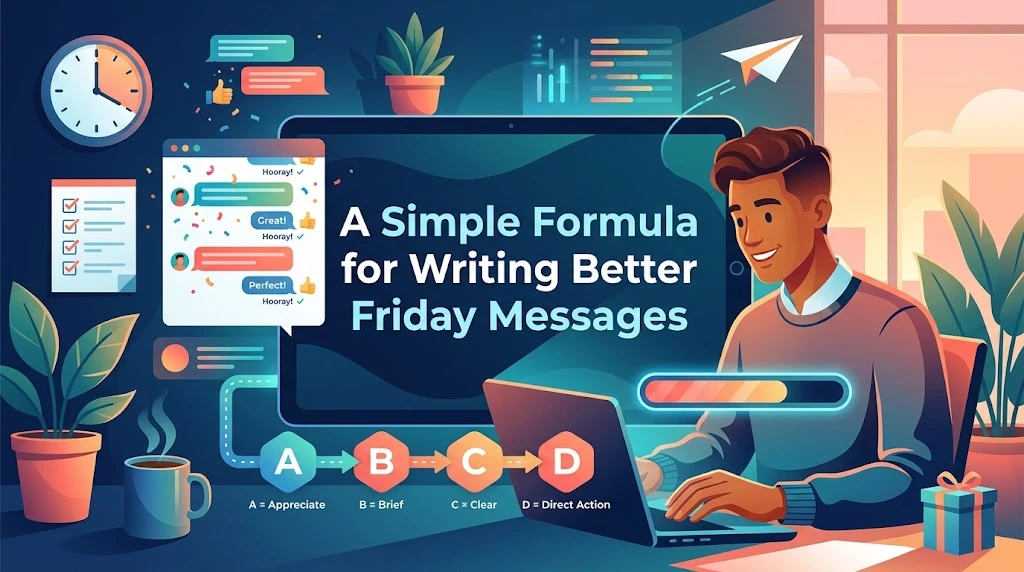
If you’re unsure what to write, use this formula:
Context + positive wish + optional appreciation
For example:
Thanks for getting the report over so quickly. Hope you have a great Friday!
Or:
Great work on the presentation this week. Enjoy a well-deserved weekend!
Or:
Thanks for your feedback. Wishing you a smooth end to the week.
This approach sounds more personal because the Friday wish has a reason to be there.
FAQs About Other Ways to Say “Happy Friday”
What are other ways to say “Happy Friday”?
Some natural alternatives include:
- Have a great Friday.
- Have a fantastic Friday.
- Enjoy your Friday.
- Have a wonderful Friday.
- Wishing you a wonderful Friday.
- Hope you have a great Friday.
- Hope your Friday is going well.
- Enjoy the rest of your Friday.
- Have a great end to the week.
- Cheers to Friday.
- We made it to Friday.
- Enjoy the start of the weekend.
- Have a wonderful weekend.
- Wishing you a relaxing weekend.
The best option depends on the tone you want.
What is a professional way to say “Happy Friday”?
For professional communication, try:
Wishing you a pleasant end to the week.
Other good choices include:
Have a great end to the week.
Wishing you a wonderful Friday.
Have a wonderful weekend.
These expressions retain warmth without sounding overly casual.
Can you say “Happy Friday” in a work email?
Yes.
“Happy Friday” can work in internal emails and relaxed workplace communication. Professional email guidance also recognizes it as a possible time-specific greeting.
However, context matters. For formal external communication, a neutral phrase such as “Wishing you a pleasant end to the week” may be safer.
What can I say to my boss instead of “Happy Friday”?
Try:
Hope you have a great Friday.
or:
Wishing you a wonderful weekend.
If your workplace is very casual, “Have a great Friday!” is also perfectly reasonable.
The key is to follow the communication style your manager already uses.
What is a casual way to say “Happy Friday”?
For casual conversations, try:
- Cheers to Friday!
- We made it to Friday!
- Friday is here!
- Finally, Friday!
- Have a fabulous Friday!
- Enjoy the weekend!
- Let’s finish strong!
These work especially well in texts, group chats, and relaxed workplace conversations.
What is a fun way to say “Happy Friday”?
For something playful, try:
We made it to Friday!
Cheers to Friday!
Friday is finally here!
Make it a great Friday!
You can also use “Fri-yay!” in very casual settings. It’s a playful blend of “Friday” and “yay,” so it isn’t appropriate for formal professional communication.
What can I say to a client instead of “Happy Friday”?
For a client, consider:
Wishing you a pleasant end to the week.
Hope your week is wrapping up well.
Have a wonderful weekend.
Wishing you a relaxing weekend ahead.
These choices sound warm without assuming a highly casual relationship.
Is “Have a great Friday” better than “Happy Friday”?
Neither phrase is universally better.
“Happy Friday” is shorter and more cheerful.
“Have a great Friday” sounds more like a direct wish.
If you want a casual greeting, “Happy Friday” works well. If you want something slightly more neutral, “Have a great Friday” may be the better choice.
Final Thoughts on Other Ways to Say “Happy Friday”
“Happy Friday” is perfectly natural English. You don’t need to avoid it simply because it’s common.
The real trick is knowing when to use it and when another phrase will communicate your meaning better.
For a close coworker, “We made it to Friday!” can create a sense of shared accomplishment.
For a client, “Wishing you a pleasant end to the week” provides a more polished tone.
For a friend, “Cheers to Friday!” adds personality.
For someone who has had an exhausting week, “Have a well-deserved weekend” can show genuine appreciation.
And sometimes the best choice is no Friday greeting at all. If the conversation concerns an urgent problem or sensitive subject, focus on the person and the purpose of the message.
Ultimately, other ways to say “Happy Friday” aren’t about collecting fancy synonyms. They’re about choosing language that fits the moment.
The right phrase should sound natural, match the relationship, and add something useful to the conversation.
When those three pieces line up, even a simple Friday wish can feel thoughtful rather than routine.