Have you ever typed “double confirm” in an email, paused, and wondered whether “double-check” would sound better?
The confusion makes sense. Both expressions deal with certainty. Both can appear when someone wants to avoid a mistake. And both may show up in workplace messages, travel arrangements, customer service conversations, and everyday speech.
Yet they aren’t quite the same.
In standard US English, double-check is the established expression for examining something again to make sure it is correct or safe. Cambridge defines double-check as making certain that something is correct or safe, usually by examining it again.
Double confirm, meanwhile, is understandable but isn’t the usual fixed expression in standard US English. It does occur in regional varieties of English, including Singaporean English and Hong Kong workplace code-mixing, where speakers use it to emphasize confirmation or certainty.
That distinction matters because natural English isn’t always the same thing as technically understandable English.
If you’re checking a date, number, spelling, address, or calculation again, double-check is usually the phrase you want.
If something has already been confirmed and you need confirmation again, reconfirm is often the cleaner choice.
Let’s break down exactly why.
Double Check vs. Double Confirm at a Glance
The easiest way to understand double check or double confirm is to separate the actions behind the words.
| Expression | Meaning | Standard US English | Best use |
| double-check | Examine something again | Yes | Reviewing information for accuracy |
| confirm | Establish that something is true, correct, or definite | Yes | Giving or obtaining confirmation |
| reconfirm | Confirm something again | Yes | Repeating an earlier confirmation |
| double confirm | Confirm again or emphasize certainty | Understandable but less idiomatic in US English | Regional or informal usage |
The important point is that double-check and reconfirm aren’t simply two versions of the same verb.
Consider these sentences:
I’ll double-check the address.
You plan to look at the address again.
I’ll reconfirm the reservation.
You plan to confirm an existing reservation again.
Those actions overlap, but the focus differs.
One centers on checking information. The other centers on renewing confirmation.
What Does “Double Check” Mean?
Definition of Double Check
Double-check means to examine something again to make sure it is correct, accurate, complete, or safe.
Cambridge specifically describes it as making certain something is correct or safe, usually through another examination. Its US English entry gives examples involving checking whether something was done correctly or safely.
For example:
- Double-check the address before you send the package.
- I’ll double-check the figures before submitting the report.
- Please double-check your spelling.
- She double-checked the flight time.
- Let’s double-check that everyone received the email.
The first check may have been perfectly adequate. The second check simply adds another layer of assurance.
Think of it like looking at a locked door before leaving home. You already turned the key. Still, you glance back and make sure the lock actually caught.
That’s a double-check.
Is “Double Check” Correct English?
Yes. Double-check is a well-established English verb.
Cambridge lists it as a verb in both general and business English. Dictionary.com also defines the verb as checking twice or again and lists established forms such as double-checks, double-checked, and double-checking.
The word has also become deeply established in ordinary professional and everyday usage.
You’ll find it in contexts involving:
- documents
- calculations
- safety procedures
- travel
- research
- emails
- schedules
- financial information
- technical work
- personal decisions
For example:
Before publishing the report, the editor double-checked every figure.
The meaning is straightforward: the editor reviewed the figures again.
Grammar and Sentence Structure of “Double Check”
When used as a verb, double-check can take a direct object:
Double-check the numbers.
It can also appear with a clause:
Double-check that the door is locked.
Another common construction uses whether:
I’ll double-check whether the payment went through.
You can also use with when you consult another person or source:
I’ll double-check with the manager before making a decision.
Common patterns include:
| Pattern | Example |
| double-check + noun | Double-check the figures. |
| double-check + that-clause | Double-check that the file is attached. |
| double-check + whether-clause | Double-check whether the payment arrived. |
| double-check with + person/source | I’ll double-check with Sarah. |
| double-check to make sure | Double-check to make sure the gate is locked. |
That last construction deserves attention.
Double-check to make sure can look repetitive because both parts express certainty. However, it is a normal and widely used construction. Cambridge’s examples include similar wording such as “double-check to make sure” in ordinary English.
The Hyphen in “Double-Check”
When double-check functions as a verb, the hyphenated form is common in edited English:
Please double-check the attachment.
I need to double-check these figures.
However, English compound-word spelling can vary by grammatical function and style guide. Dictionary.com, for example, distinguishes the hyphenated verb double-check from the separate chess noun double check.
For ordinary writing, the safest practical rule is simple:
Use “double-check” when you’re using it as the verb.
Examples:
- Please double-check the form.
- I’ll double-check the address.
- We double-checked the calculation.
- She is double-checking the results.
What Tone Does “Double-Check” Have?
Despite the word double, the phrase doesn’t sound dramatic or overly cautious.
It’s completely normal in professional communication.
Compare:
I’ll double-check the schedule and get back to you.
with:
I’ll verify the schedule through a second review before proceeding.
The second sentence sounds considerably heavier.
Sometimes plain English wins.
Double-check is useful precisely because it communicates caution without turning a simple action into a bureaucratic ceremony.
Real-World Examples of “Double Check”
Workplace
Please double-check the invoice total before sending it to the client.
Travel
I’ll double-check the departure time before we leave.
School
Double-check your answers before submitting the test.
Research
The team double-checked the data before analyzing the results.
Everyday life
I always double-check that I’ve locked the car.
Cambridge’s Business English examples similarly use double-check for checking facts, figures, and information before relying on them.
What Does “Double Confirm” Mean?
The Literal Meaning of “Double Confirm”
Taken literally, double confirm suggests confirming something twice or confirming something again.
That’s why the expression sounds perfectly understandable.
If:
- confirm = establish something as certain
- double = twice or additionally
then:
- double confirm = confirm again or confirm with extra emphasis
The problem isn’t that the listener can’t understand it.
The issue is idiomaticity.
English speakers don’t create every possible combination of words simply because the combination makes logical sense. Some combinations become established expressions while others remain uncommon or regional.
That’s where double confirm differs from double-check.
Is “Double Confirm” Standard English?
In standard US English, double confirm isn’t the usual established expression for repeated confirmation.
Major learner and general dictionaries readily list double-check as an established verb. Oxford also lists reconfirm as a standard verb meaning to check again that something is definitely correct or arranged as previously agreed.
That doesn’t mean double confirm is meaningless.
Far from it.
People use the expression in certain English varieties and multilingual environments. For example, usage references document double confirm as part of Singaporean English and as workplace code-mixing in Hong Kong.
So three ideas should not be confused:
Understandable ≠ standard US English ≠ universally wrong
A phrase can be meaningful and widely used in one linguistic community while still sounding unusual to speakers of another variety.
Why Did “Double Confirm” Become Popular?
Language doesn’t develop inside a vacuum.
In multilingual workplaces, speakers often combine English vocabulary with patterns from other languages. Repetition can also serve a pragmatic purpose: it adds emphasis.
Sources documenting regional usage describe double confirm as an expression associated with emphatic confirmation in Singaporean English and workplace English in Hong Kong.
In those settings, the phrase can communicate something stronger than a bare confirm:
“I want to make absolutely sure this is settled.”
That communicative purpose helps explain why the expression survives.
It’s not necessarily useful to think of every nonstandard expression as a random mistake. Sometimes a phrase develops a particular social or regional function.
The key question is different:
Will your intended audience expect this expression?
If you’re writing for a broad US audience, reconfirm, confirm again, or double-check will usually communicate your meaning more naturally.
What Tone Does “Double Confirm” Have?
The tone depends heavily on the community using it.
In a regional variety where double confirm is established, it may sound completely ordinary.
In standard US professional writing, however, it can sound unusual.
For example:
Can you double confirm the meeting time?
Most American readers will understand the sentence immediately. Yet many would naturally expect:
Can you confirm the meeting time again?
or:
Can you reconfirm the meeting time?
If what you actually mean is checking the calendar rather than obtaining confirmation from another person, an even better choice may be:
Can you double-check the meeting time?
The intended action determines the best verb.
Double Check vs. Double Confirm: What’s the Difference?
The Core Difference
The simplest distinction is this:
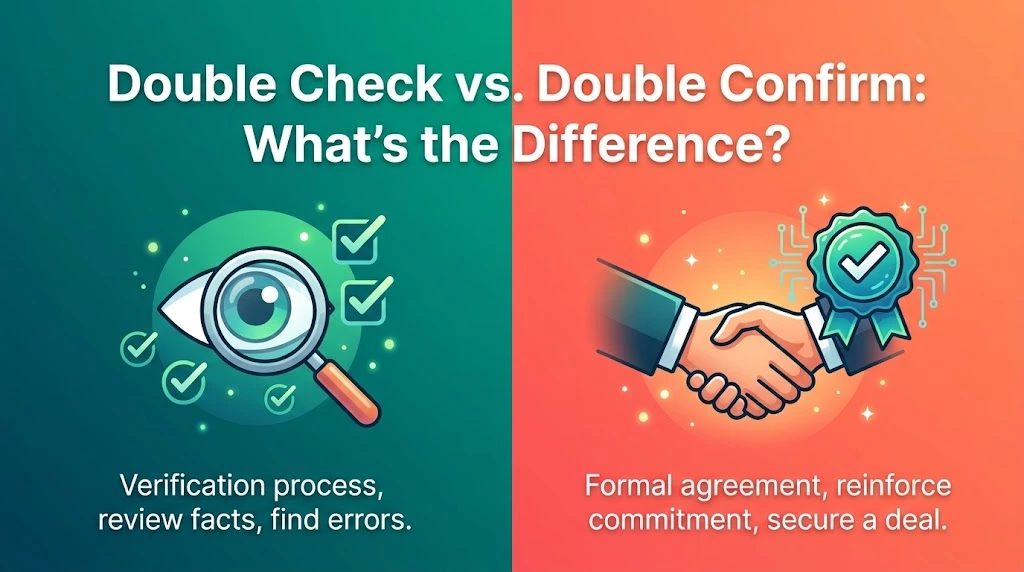
Double-check = examine again.
Confirm = establish or state that something is certain.
Reconfirm = confirm again.
That gives you three related but distinct ideas.
Suppose someone tells you that your meeting starts at 2:00 p.m.
You open your calendar and look again.
You double-check the meeting time.
Then you message the organizer and ask whether the meeting is still scheduled for 2:00 p.m.
You confirm the meeting time.
Suppose the organizer already confirmed it yesterday and you now ask for confirmation again.
You reconfirm the meeting time.
Those verbs describe different stages of the same situation.
Double Check vs. Double Confirm in Identical Situations
Let’s put the expressions side by side.
| Situation | Natural sentence | Why |
| Looking at a calendar again | I’ll double-check the meeting time. | You’re examining information |
| Asking the organizer again | I’ll reconfirm the meeting time. | You’re obtaining confirmation again |
| Asking whether a booking remains valid | I’ll reconfirm the reservation. | The booking was previously confirmed |
| Reviewing a booking document | I’ll double-check the reservation details. | You’re checking information |
| Asking someone to verify a number | Please double-check the number. | You’re asking for another examination |
| Saying “confirm again” informally | Double confirm may occur regionally | Understandable but less idiomatic in US English |
This distinction becomes especially useful at work.
Consider:
I’ll double-check with the client.
This means you’ll check with the client to verify information.
Now compare:
I’ll reconfirm with the client.
This suggests the client has already confirmed something and you’re seeking confirmation again.
Both can be correct. The context changes the emphasis.
Double Check, Confirm, and Reconfirm Compared
The three standard expressions form a useful little vocabulary system.
| Verb | Main action | Example |
| check | Examine | Check the address. |
| double-check | Examine again | Double-check the address. |
| confirm | Establish as certain | Confirm the address with the customer. |
| reconfirm | Confirm again | Reconfirm the address before delivery. |
| verify | Establish accuracy or truth | Verify the address against the database. |
Notice how each verb answers a slightly different question.
Check: “What does the information say?”
Double-check: “Does the information still look correct?”
Confirm: “Can we establish that this is definite?”
Reconfirm: “Can we establish that again?”
Verify: “Can we establish that this information is accurate or true?”
That distinction is much more useful than memorizing a single “correct” phrase.
Double Check or Double Confirm: Which Should You Use?
Use “Double-Check” When You Mean “Verify Again”
Choose double-check when you plan to inspect information another time.
Use it for:
- names
- dates
- numbers
- addresses
- spelling
- calculations
- documents
- instructions
- schedules
- settings
- safety information
Examples:
Please double-check the client’s name before printing the contract.
I’ll double-check the calculations.
Double-check the address before ordering the delivery.
She double-checked the instructions before starting the procedure.
The central action is examination.
Use “Confirm” When You Mean “Establish Certainty”
Use confirm when the purpose is to establish that something is true, agreed upon, or definite.
Examples include:
Please confirm your attendance.
The hotel confirmed our reservation.
Can you confirm the appointment time?
Please confirm that you received the document.
Here, you aren’t necessarily reviewing a document yourself.
You are establishing certainty.
That’s an important difference.
Use “Reconfirm” When You Mean “Confirm Again”
Reconfirm is the cleanest standard-English alternative when something has already been confirmed and needs confirmation again.
Oxford defines reconfirm as checking again that something is definitely correct or remains as previously arranged. Its example involves reconfirming a flight before traveling.
Examples:
Please reconfirm your reservation 24 hours before arrival.
We need to reconfirm the appointment.
The airline asked passengers to reconfirm their flight details.
I’ll reconfirm the order with the supplier.
Notice how naturally the prefix re- handles the meaning of “again.”
There’s no need to force double into the sentence.
When “Double-Check” and “Reconfirm” Aren’t Interchangeable
This is where many sentences go off track.
Consider:
I’ll double-check the reservation.
This could mean you’ll inspect the booking details.
Now:
I’ll reconfirm the reservation.
This suggests you’ll establish again that the reservation remains confirmed.
The first action is closer to reviewing.
The second is closer to renewing certainty.
Another example makes the distinction clearer.
I’ll double-check the flight number.
You’re looking at the information again.
I’ll reconfirm the flight.
You’re confirming that the flight arrangement remains in place.
The words aren’t interchangeable simply because both reduce uncertainty.
Common Errors With Double Check and Double Confirm
Treating Them as Perfect Synonyms
This is the biggest mistake.
Double-check doesn’t simply mean “be extra sure.”
It specifically carries the idea of another examination.
Reconfirm carries the idea of another confirmation.
That distinction matters when precision matters.
Using “Double Confirm” in Formal US English Without Considering Alternatives
If you’re writing a professional email for an international or American audience, consider what you’re actually trying to say.
Instead of:
Please double confirm the details.
Choose:
Please double-check the details.
if you want the person to review them.
Or:
Please reconfirm the details.
if the details were already confirmed and you want confirmation again.
Or:
Please confirm the details again.
if you want plain, transparent wording.
The goal isn’t to make your sentence sound fancier.
It’s to make the intended action unmistakable.
Adding Unnecessary Repetition
Some combinations create genuine redundancy:
I’ll double-confirm it again.
The word again repeats the same idea that double is trying to express.
A cleaner version would be:
I’ll reconfirm it.
Or:
I’ll confirm it again.
Likewise, double-check again can be redundant when double-check already means checking again.
Still, context matters. Speakers sometimes use extra words for emphasis in casual conversation. Not every redundant expression creates a serious grammar problem.
In polished writing, however, unnecessary repetition usually adds weight without adding meaning.
Confusing the Verb and Noun Forms
Compare:
Please double-check the figures.
Here, double-check is a verb.
Now:
The second review served as a double-check on the figures.
Here, double-check functions as a noun.
Dictionary sources recognize both verbal and nominal uses of double-check.
This distinction helps explain why spelling can vary by grammatical role and style.
Hyphenation Errors
For everyday US English, write the verb as:
double-check
Examples:
- double-check the form
- double-check your work
- double-checked the results
- double-checking the figures
The hyphen visually signals that double-check operates as a compound verb.
However, don’t assume every appearance of double check without a hyphen is automatically an error. Compound-word treatment varies according to grammatical function and editorial style.
Better Alternatives to “Double Confirm”
Sometimes the best solution isn’t choosing between the two phrases.
Sometimes you should replace double confirm altogether.
Reconfirm
Use reconfirm when something has already been confirmed.
Please reconfirm your appointment.
This is concise and precise.
Oxford recognizes reconfirm as a standard verb.
Confirm Again
If your audience includes English learners or you simply want maximum clarity, confirm again works beautifully.
Please confirm the booking again before Friday.
There’s nothing complicated about it.
The meaning is transparent.
Verify Again
Use verify again when the emphasis falls on accuracy or factual correctness.
Please verify the figures again before publication.
This sounds more procedural than double-check.
That’s useful in technical or formal contexts.
Verify
Sometimes you don’t need the idea of repetition at all.
Please verify the account information.
The sentence focuses on establishing accuracy rather than explaining how many times someone checks it.
Make Sure
For casual conversation, make sure is often the most natural option.
Let me make sure the address is correct.
Can you make sure the meeting is still on?
This phrase is especially useful when you want a friendly, conversational tone.
Double Check vs. Double Confirm in Real-World Situations
Workplace Emails and Messages
Workplace writing rewards clarity.
Suppose you’re reviewing an invoice.
Please double-check the invoice total before sending it.
That’s natural because the recipient needs to examine the number again.
Now imagine an appointment that was already confirmed last week:
Please reconfirm the appointment with the client.
That’s more precise.
A weaker version would be:
Please double confirm the appointment.
The reader can understand it. Yet reconfirm tells the reader exactly what action you want.
Travel, Reservations, and Logistics
Travel produces plenty of situations where these verbs matter.
You might say:
I’ll double-check the departure time.
You’re reviewing the information.
You might say:
I’ll reconfirm the hotel reservation.
You’re confirming an existing arrangement again.
You might say:
I’ll confirm the pickup location with the driver.
You’re obtaining certainty from another person.
These aren’t merely stylistic alternatives. They describe different actions.
Academic and Research Writing
Academic writing often requires careful distinctions.
For example:
The researchers double-checked the data before running the analysis.
This means they examined the data again.
Another sentence could say:
The researchers reconfirmed the result in a second experiment.
Now the meaning changes.
The second experiment provides another basis for confirming the result.
That is much more specific than simply saying they “double confirmed” it.
Customer Service and Business Communication
Customer service often involves confirmation and verification.
Consider an order:
I’ll double-check your order number.
The employee is reviewing information.
Now:
I’ll confirm your delivery address.
The employee is establishing the address.
And:
I’ll reconfirm your delivery appointment tomorrow.
The employee is confirming an arrangement that already exists.
Three situations. Three useful verbs.
Casual Conversation
Informal conversation gives speakers more freedom.
You may encounter:
I just want to double confirm that we’re meeting at six.
The sentence is understandable.
Depending on the speaker’s regional variety, it may also sound completely normal. Usage references document double confirm in Singaporean English and Hong Kong workplace English.
For a broad US audience, however, these versions are generally more idiomatic:
I just want to double-check that we’re meeting at six.
or:
I just want to confirm that we’re meeting at six.
or, if it was already confirmed:
I just want to reconfirm that we’re meeting at six.
Case Study: One Small Word Changes the Action

Imagine a project manager preparing for an important client presentation.
The manager has three tasks.
First, she reviews the presentation and notices that the revenue figure looks unusual. She checks the spreadsheet again.
She double-checks the figure.
Next, she asks the finance team whether the figure is officially approved.
She confirms the figure with finance.
Later, finance had already approved the number but the presentation was delayed for two weeks. The manager asks whether the approval still stands.
She reconfirms the figure with finance.
Now imagine writing:
She double confirmed the figure.
The reader can probably understand the intention. But the sentence doesn’t tell us which of those actions occurred.
Did she inspect the number?
Did she ask finance?
Did she seek approval again?
That’s the hidden value of precise word choice.
Good vocabulary doesn’t merely sound natural. It preserves the details of the action.
Side-by-Side Sentence Examples
| Less natural or less precise | Better choice | Reason |
| Please double confirm the address. | Please double-check the address. | Review the address |
| Please double confirm your attendance. | Please reconfirm your attendance. | Confirm attendance again |
| I’ll double confirm the numbers. | I’ll double-check the numbers. | Examine the numbers |
| I’ll double confirm the booking. | I’ll reconfirm the booking. | Confirm an existing booking |
| Can you double confirm this information? | Can you verify this information? | Establish accuracy |
| I’ll double confirm with John. | I’ll confirm with John again. | Obtain another confirmation |
| Double confirm that the file was sent. | Double-check that the file was sent. | Verify the fact |
| We need to double confirm the agreement. | We need to reconfirm the agreement. | Confirm an existing agreement again |
The replacement depends on the intended action.
That is the key.
Read More : Persue or Pursue? Learn the Correct Spelling, Meaning, and Usage
A Practical Decision Guide for Double Check or Double Confirm
When you’re stuck between double check or double confirm, don’t focus on the words first.
Focus on what you’re actually doing.
Are You Looking at Information Again?
Use double-check.
I’ll double-check the date.
Are You Establishing Something as Certain?
Use confirm.
Please confirm the delivery address.
Was It Already Confirmed?
Use reconfirm.
Please reconfirm the reservation.
Are You Checking Accuracy?
Use verify.
Please verify the account number.
Do You Want a Plain, Conversational Expression?
Use make sure.
Let me make sure everything is correct.
Quick Decision Table
| What you mean | Best choice |
| Look at something again | double-check |
| Review information for accuracy | double-check |
| Establish that something is definite | confirm |
| Confirm an existing arrangement again | reconfirm |
| Establish accuracy or truth | verify |
| Use very plain conversational English | make sure |
| “Confirm again” in transparent wording | confirm again |
| “Double confirm” for broad US professional writing | Usually choose one of the alternatives above |
A useful mental shortcut is:
Check → double-check.
Confirm → reconfirm.
It isn’t a perfect rule for every sentence. Still, it solves most everyday cases.
Why Natural English Matters More Than Literal Logic
Here’s a subtle lesson behind the entire double check vs. double confirm debate.
Language isn’t mathematics.
You can’t always create a natural English phrase by combining words whose individual meanings seem logical.
For example, double confirm makes semantic sense. You can interpret it as “confirm twice.”
Yet English already has reconfirm for that job.
Likewise, double-check became an established compound expression. Dictionaries recognize it as a normal verb used across everyday, business, and academic contexts.
This is why language learners benefit from studying collocations, not just individual word definitions.
A collocation is a combination of words that naturally occur together.
You don’t only learn that:
- double means twice
- check means examine
- confirm means establish as certain
You also learn which combinations English speakers actually use.
That is where fluent writing begins to sound effortless rather than assembled word by word.
Frequently Asked Questions
What does “double check” mean?
Double-check means to examine something again to make sure it is correct, accurate, or safe. Cambridge specifically defines it as making certain something is correct or safe, usually through another examination.
For example:
Double-check the address before sending the package.
Is “double confirm” correct English?
Double confirm is understandable and does occur in English, especially in some regional and multilingual varieties. However, it isn’t the usual established expression in standard US English.
If you mean confirm again, use reconfirm or confirm again.
If you mean check something again, use double-check.
Is “double confirm” standard in US English?
It isn’t the usual standard US expression for repeated confirmation.
That doesn’t make every occurrence meaningless or incomprehensible. Regional varieties can develop their own established expressions. Sources document double confirm in Singaporean English and Hong Kong workplace code-mixing.
For broad US professional communication, reconfirm or confirm again is usually clearer.
Should I use “double check” or “double confirm”?
Use double-check when you mean examine something again.
I’ll double-check the figures.
Use reconfirm when you mean confirm something again.
I’ll reconfirm the appointment.
That’s a more useful distinction than simply memorizing one phrase as “correct” and the other as “incorrect.”
Is “reconfirm” the same as “double confirm”?
They can express a similar intended meaning, especially when someone uses double confirm to mean “confirm again.”
However, reconfirm is the established standard-English verb. Oxford defines it as checking again that something is definitely correct or remains as previously arranged.
Is “double-check” hyphenated?
As a verb, double-check is commonly written with a hyphen:
Please double-check the figures.
Its noun usage can differ, and compound-word styling can vary by context and editorial style. Dictionary sources recognize double-check as both a verb and noun.
Can “double-check” and “verify” be used interchangeably?
Sometimes, but not always.
Double-check emphasizes another examination.
Verify emphasizes establishing that something is accurate, true, or valid.
Compare:
Double-check the calculation.
with:
Verify the calculation against the original data.
The second sentence can suggest a more formal or systematic validation process.
What is the most natural way to say “confirm again”?
In standard US English, the strongest choices are usually reconfirm and confirm again.
For example:
Please reconfirm your appointment.
or:
Please confirm your appointment again.
The first is concise. The second is especially transparent.
Conclusion
The choice between double check or double confirm becomes much easier once you stop treating them as interchangeable phrases.
Double-check is the established expression for examining something again to make sure it is correct, accurate, or safe. Major dictionary sources recognize it as a standard verb with broad everyday and professional use.
Confirm has a different core job. It establishes that something is certain, correct, agreed upon, or definite.
When that confirmation needs to happen again, reconfirm is usually the most precise standard-English choice. Oxford specifically defines it around checking again that something remains correct or arranged as before.
Double confirm is a different story. People do use it, and the expression has recognizable regional uses. Singaporean English and Hong Kong workplace English provide documented examples. But for broad US professional or academic writing, it isn’t the usual idiomatic choice.
So keep this simple distinction in mind:
Review it again? Double-check it.
Confirm it again? Reconfirm it.
Need straightforward wording? Confirm it again.
Once you match the verb to the actual action, the confusion largely disappears. Your writing becomes shorter, clearer, and much more natural at the same time.