
Have you ever written disfunction when you actually meant dysfunction? You’re not alone. These two spellings look remarkably similar, but when you’re talking about something that isn’t working properly, dysfunction is the standard and correct spelling in modern English. The confusion often comes from the pronunciation and the way the word is built.
Dysfunction refers to the improper functioning or failure to function normally. You can use it when discussing a machine, organization, system, relationship, or part of the body. For example, you might describe a computer with a technical problem as having system dysfunction, or discuss organizational dysfunction when a workplace struggles with communication and decision-making.
The spelling disfunction does appear in some historical or specialized contexts, but it isn’t the usual spelling for the modern noun meaning a failure or abnormality in function. That makes the distinction especially important when you’re writing an academic paper, professional document, medical text, or everyday message.
In this guide, you’ll learn the difference between disfunction and dysfunction, how dysfunction is used in sentences, why the spelling causes confusion, and how to choose the right word with confidence.
Disfunction vs. Dysfunction at a Glance
The fastest way to settle the question is to compare the two forms directly.
| Feature | Dysfunction | Disfunction |
| Standard modern spelling | Yes | Generally no |
| Part of speech | Noun | Nonstandard/variant noun |
| Basic meaning | Impaired or abnormal functioning | Intended to mean the same thing |
| Standard adjective | Dysfunctional | Disfunctional is generally nonstandard |
| Common contexts | Medical, psychological, social, organizational, technical | Usually a spelling error or variant form |
| Recommended in formal writing | Yes | No |
| Prefix | dys- | dis- |
The important point is that dysfunction isn’t simply a random spelling convention. The dys- prefix contributes to the word’s meaning.
Dictionary.com dates the English word dysfunction to the early 20th century and gives its formation as dys- + function.
That structure gives you a useful clue: when something is functioning abnormally or poorly, English uses dys- in dysfunction.
What Does Dysfunction Mean?
Simple Definition of Dysfunction
Dysfunction means impaired, abnormal, or ineffective functioning.
The word usually describes something that should perform a particular function but isn’t doing so normally.
Think of a system as a machine with several connected parts. If one part doesn’t work properly, the entire system may perform poorly. That problem can be described as dysfunction.
For example:
- A damaged nerve can cause nerve dysfunction.
- A hormonal problem can result in endocrine dysfunction.
- Persistent communication problems can create relationship dysfunction.
- Poor decision-making can contribute to organizational dysfunction.
The word doesn’t necessarily mean that something has stopped working completely. That’s an important distinction.
A body system may continue working while performing poorly. A company may continue operating while suffering from severe internal dysfunction. A family may remain together while struggling with unhealthy patterns.
In other words:
Dysfunction describes impaired functioning rather than necessarily complete failure.
Dictionary.com includes medical, general, and sociological meanings of dysfunction. In medical use, it can describe malfunctioning of an organ or body structure. In broader use, it can refer to a malfunctioning part or element and to social patterns that undermine the stability of a group.
The Linguistic Origin of “Dysfunction”
The Prefix “Dys-”
The spelling becomes easier to remember when you understand dys-.
The prefix dys- comes from Greek and carries meanings associated with something being bad, difficult, abnormal, impaired, or faulty. English uses it in a range of technical and medical terms.
Consider these examples:
- dysfunction — impaired functioning
- dysfunctional — functioning abnormally
- dyslexia — a condition involving difficulties with reading and language processing
- dysphagia — difficulty swallowing
- dyspnea — difficult or uncomfortable breathing
- dysregulation — abnormal or disrupted regulation
The meanings aren’t identical. Still, the prefix repeatedly points toward some form of difficulty, abnormality, or impairment.
That’s why dysfunction makes sense as a word formation.
The basic structure is:
dys- + function → dysfunction
The first element modifies the idea of function. Instead of ordinary or effective function, the word describes impaired function.
Why “Dis-” Doesn’t Work Here
The confusion partly comes from the English prefix dis-.
English uses dis- in many words, including:
- disagree
- disconnect
- disapprove
- disable
- dislike
- disorganize
- distrust
Depending on the word, dis- can express ideas such as separation, reversal, negation, or removal.
That doesn’t mean you can attach dis- to any word and create a standard English term.
For example, English has disagree, but it doesn’t follow that disfunction must be the standard form simply because function can appear after dis- visually.
This is an important lesson about English spelling:
Prefixes aren’t interchangeable building blocks.
You can’t always determine a word’s correct spelling by choosing the prefix that looks most familiar.
Why “Disfunction” Feels Right but Isn’t the Preferred Form
Familiar “Dis-” Words Create the Trap
The spelling disfunction feels reasonable because dis- is extremely common.
When you see the word function, your brain may connect it with familiar dis- words. The result looks visually convincing:
dis + function = disfunction
Unfortunately, English doesn’t work like a completely free mathematical formula.
Established words often preserve particular historical forms. Dysfunction belongs to the dys- family.
Dictionary.com specifically explains disfunction as arising through confusion between dys- and dis-.
Pronunciation Doesn’t Give You the Answer
Another reason the spelling causes trouble is pronunciation.
In standard American English, dysfunction and disfunction can sound essentially the same to ordinary listeners. That means you can’t reliably solve the spelling problem by simply saying the word aloud.
This is similar to many English spelling problems involving words that share sounds but differ in written form.
When you hear the word, remember the meaningful word family:
dysfunction → dysfunctional → dys-
That connection is more useful than trying to hear whether the first syllable should be spelled dis- or dys-.
Is “Disfunction” Ever Correct?
This question deserves a careful answer.
Disfunction does occur in real writing. It isn’t an imaginary spelling invented by modern learners. Dictionary.com lists disfunction and defines it as dysfunction. It also identifies its origin as confusion between dys- and dis-.
You may even find the spelling in published sources. Dictionary.com provides examples from news and other publications that contain disfunction.
That doesn’t mean you should normally choose it.
For contemporary standard English, especially in polished writing, dysfunction is the better choice.
Practical Rule
If you’re writing your own sentence and mean impaired or abnormal functioning, write:
“dysfunction”
not:
“disfunction.”
The existence of occasional variant usage doesn’t change the standard recommendation.
The Prevalence and Modern Use of “Dysfunction”
Dysfunction is firmly established across several fields.
It appears in medical terminology, psychology, sociology, family studies, business writing, technology, and ordinary conversation.
The word’s flexibility comes from its basic concept. Almost any system can theoretically function well or poorly.
Consider a few examples:
- sexual dysfunction
- kidney dysfunction
- thyroid dysfunction
- immune dysfunction
- nerve dysfunction
- family dysfunction
- organizational dysfunction
- social dysfunction
This broad use doesn’t make the word vague. Context tells you what system or process isn’t working properly.
Medical Contexts: How Dysfunction Is Used in Healthcare

Medical writing provides some of the clearest examples of dysfunction.
Healthcare professionals use the term when an organ, body system, nerve, physiological process, or other function doesn’t operate normally.
For example, MedlinePlus describes hypothalamic dysfunction as a problem involving the hypothalamus. The hypothalamus helps regulate functions such as appetite, body temperature, growth, emotions, sleep, and hormonal control.
Similarly, MedlinePlus describes basal ganglia dysfunction as a problem involving deep brain structures that help initiate and control movement.
These examples show something important: dysfunction identifies a problem with function without necessarily naming its ultimate cause.
Common Medical Uses
Here are several established medical expressions:
| Expression | What it describes |
| Hypothalamic dysfunction | Impaired functioning involving the hypothalamus |
| Basal ganglia dysfunction | Problems involving brain structures that control movement |
| Radial nerve dysfunction | Problems involving the radial nerve |
| Sexual dysfunction | Problems involving sexual functioning |
| Thyroid dysfunction | Abnormal thyroid function |
| Muscle dysfunction | Abnormal or impaired muscle function |
MedlinePlus, for example, uses radial nerve dysfunction for a problem involving the radial nerve and explains that nerve damage can interfere with movement and sensation.
Likewise, MedlinePlus uses sexual dysfunction as a medical term for problems involving sexual functioning that cause concern or distress.
Why Accuracy Matters in Medical Writing
Spelling matters even more in technical writing because readers rely on terminology to understand specific concepts.
Compare:
The patient developed thyroid dysfunction.
with:
The patient developed thyroid disfunction.
The second sentence may still be understandable. However, the spelling error makes the writing look less reliable and can interfere with professional credibility.
More importantly, dysfunction itself shouldn’t be treated as a complete diagnosis. It often describes a problem with functioning while the underlying cause requires further investigation.
For example, MedlinePlus notes that hypothalamic dysfunction can have multiple causes, including surgery, brain injury, tumors, radiation, nutritional problems, infections, and certain genetic conditions.
So the term identifies impaired function. It doesn’t automatically explain why the impairment exists.
Psychological and Emotional Contexts
The word dysfunction also appears outside strictly physical medicine.
Psychological and social discussions may use terms such as:
- emotional dysfunction
- behavioral dysfunction
- family dysfunction
- relationship dysfunction
These expressions describe patterns that interfere with healthy or expected functioning.
However, context matters.
Calling a family dysfunctional shouldn’t become a casual label for every family disagreement. Families argue. Couples disagree. Parents and children sometimes misunderstand each other.
Those ordinary problems don’t automatically amount to dysfunction.
The word becomes more appropriate when recurring patterns significantly interfere with communication, relationships, roles, boundaries, or everyday functioning.
A Simple Example
Imagine a family where everyone occasionally argues about household responsibilities.
That’s conflict.
Now imagine a long-running pattern in which family members refuse to communicate, blame one another for every problem, repeatedly violate boundaries, and cannot make ordinary decisions without escalating into serious conflict.
Describing that pattern as family dysfunction may be more appropriate because the issue involves the way the family system operates.
The distinction is useful:
Conflict can be an event. Dysfunction describes a persistent problem in how something functions.
Social and Organizational Contexts
The concept works surprisingly well in workplaces and organizations.
A business might have talented employees and sufficient funding yet still struggle because its internal processes don’t work properly.
For example, imagine a company where:
- managers give contradictory instructions
- departments refuse to share information
- responsibilities remain unclear
- meetings end without decisions
- employees repeatedly solve the same problem
- leaders blame staff instead of fixing broken processes
The organization still functions in the basic sense. People arrive. Work gets completed. Customers receive products or services.
Yet the system suffers from organizational dysfunction.
That’s why the word is stronger than simply saying the company is “having a bad week.”
Dysfunction Doesn’t Always Mean Total Collapse
This distinction is worth remembering.
A dysfunctional organization may continue making money.
A dysfunctional relationship may continue for years.
A body system with dysfunction may still perform some of its normal functions.
A computer network may remain online while suffering from serious functional problems.
The word describes impaired operation, not necessarily complete destruction.
Dysfunction vs. Dysfunctional
These words belong to the same family, but they don’t play the same grammatical role.
Dysfunction Is a Noun
Dysfunction is a noun.
It names the problem or condition.
Examples:
- “The hospital identified cardiac dysfunction.”
- “The company has serious organizational dysfunction.”
- “Communication dysfunction affected the team.”
- “The condition can cause neurological dysfunction.”
You can usually replace dysfunction with another noun such as problem, impairment, or malfunction when the context allows.
Dysfunctional Is an Adjective
Dysfunctional is an adjective.
It describes something that isn’t functioning normally.
Examples:
- “The organization is dysfunctional.”
- “They developed a dysfunctional communication pattern.”
- “The system became dysfunctional after repeated failures.”
- “The family has a dysfunctional pattern of communication.”
Dictionary.com defines dysfunctional as describing something that isn’t functioning normally or that contains a malfunctioning part or element. It also documents social uses involving relationships and families.
Side-by-Side Comparison
| Noun | Adjective |
| dysfunction | dysfunctional |
| Names the problem | Describes the thing with the problem |
| “The system has a dysfunction.” | “The system is dysfunctional.” |
| “Organizational dysfunction is costly.” | “The organization is dysfunctional.” |
| “The doctor identified organ dysfunction.” | “The organ is dysfunctional.” |
A useful memory rule is simple:
Dysfunction names it. Dysfunctional describes it.
How to Use “Dysfunction” Correctly in a Sentence
The noun works naturally in several sentence patterns.
“Dysfunction in” + Noun
Use this structure when you want to identify the system or area affected.
“The study examined dysfunction in the nervous system.”
“The manager noticed dysfunction in the decision-making process.”
“Dysfunction of” + Noun
This pattern works when the affected function or structure follows.
“The condition can cause dysfunction of the thyroid gland.”
“The injury resulted in dysfunction of the affected nerve.”
Adjective + Dysfunction
English frequently places a more specific adjective before the noun.
Examples include:
- sexual dysfunction
- organizational dysfunction
- neurological dysfunction
- family dysfunction
- immune dysfunction
- cognitive dysfunction
What to Avoid
Avoid replacing dysfunction with disfunction simply because the latter looks familiar.
Incorrect:
“The department has serious disfunction.”
Standard:
“The department has serious dysfunction.”
Also avoid using dysfunction when a more precise word would communicate the idea better.
For instance, if a printer stops working because its motor breaks, malfunction may be more precise.
If two employees disagree about a project, conflict may be more accurate.
Good writing doesn’t use a complicated word merely because it sounds impressive.
Common Errors Writers Make With Dysfunction
Spelling It “Disfunction”
This remains the most obvious mistake.
Wrong: disfunction
Standard: dysfunction
Writing “Disfunctional”
The same prefix confusion appears in the adjective.
Wrong: disfunctional
Standard: dysfunctional
If you remember the noun, the adjective becomes easier:
dysfunction → dysfunctional
Treating Dysfunction as Complete Failure
Dysfunction doesn’t necessarily mean something has stopped working.
A system can continue operating while functioning poorly.
That’s one reason the word differs from failure.
Calling Every Problem Dysfunction
This can make your writing vague.
Consider the difference:
- A delayed email may be an inconvenience.
- A broken server may be a malfunction.
- Two coworkers disagreeing may be a conflict.
- A department with persistent structural problems may have organizational dysfunction.
Choosing the narrowest accurate word usually makes your writing stronger.
Dysfunction vs. Related Words
Dysfunction vs. Malfunction
These terms overlap, but they aren’t always interchangeable.
Malfunction often refers to a failure or defect in how something operates.
For example:
“The machine experienced a malfunction.”
Dysfunction has a broader reach and often appears in medical, biological, psychological, and organizational contexts.
“The patient developed neurological dysfunction.”
You can use malfunction for machines and systems. Dysfunction works across a much wider range of contexts.
Dysfunction vs. Disorder
A disorder is not simply another spelling for dysfunction.
In medicine, disorder can refer to a recognized condition or disturbance involving a particular system.
Dysfunction emphasizes the fact that functioning is impaired.
The terms can overlap in real medical contexts. However, their focus differs.
Dysfunction vs. Inefficiency
Inefficiency means something doesn’t use time, resources, effort, or capacity effectively.
A company can be inefficient without being broadly dysfunctional.
For example, a team that takes three hours to complete a task that should take one hour may be inefficient.
If its communication, leadership, decision-making, responsibilities, and internal processes repeatedly break down, organizational dysfunction may better describe the larger problem.
Dysfunction vs. Failure
Failure suggests that something has failed to perform its required function.
Dysfunction is often less absolute.
A heart, organization, relationship, or computer system can continue operating while functioning poorly.
That difference makes dysfunction especially useful when describing partial or impaired operation.
Real-World Comparison: Correct vs. Incorrect Usage
The easiest way to reinforce the spelling is to see it in context.
| Incorrect | Correct | Why |
| “The patient has kidney disfunction.” | “The patient has kidney dysfunction.” | Standard medical spelling |
| “The team suffers from communication disfunction.” | “The team suffers from communication dysfunction.” | Standard noun form |
| “The company is disfunctional.” | “The company is dysfunctional.” | Standard adjective |
| “The injury caused nerve disfunction.” | “The injury caused nerve dysfunction.” | Dys- is the established prefix |
| “Family disfunction affected the children.” | “Family dysfunction affected the children.” | Standard spelling |
| “The system became disfunctional.” | “The system became dysfunctional.” | Correct adjective form |
Case Study: A Workplace Example
Consider a fictional company with a growing customer-service department.
At first, the company has one simple problem: employees occasionally miss internal messages.
Calling that organizational dysfunction might be too strong.
After several months, however, the company develops a pattern. Managers give conflicting instructions. Teams don’t know who owns important decisions. Employees duplicate work. Customer complaints move between departments without resolution.
Now the problem goes beyond individual mistakes.
The organization has developed dysfunction in its internal processes.
Notice how the term describes the way the system operates. It doesn’t claim that every employee is incompetent. It identifies a broader failure in how the organization functions.
How to Permanently Fix the “Disfunction” Error
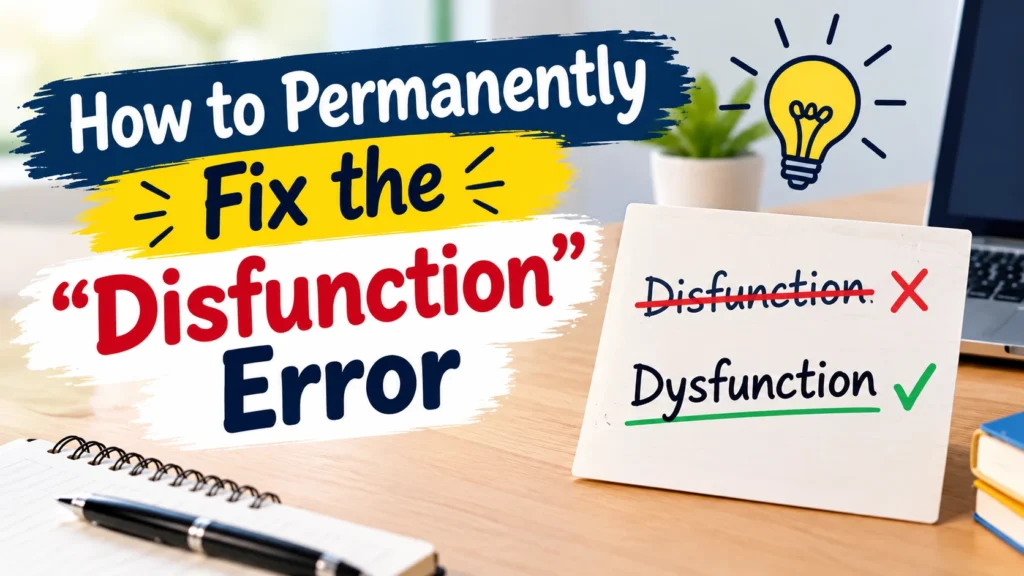
Learn the Word Family
Instead of memorizing one isolated spelling, memorize the family:
dysfunction → dysfunctional → dysfunctionally
Once you recognize dys- as part of the family, disfunction begins to look unusual.
Connect “Dys-” With Abnormal Function
Use this simple mental association:
Dys- = something isn’t functioning normally.
Then connect it with related words:
- dys-function
- dys-regulation
- dys-phagia
- dys-pnea
You don’t need to memorize the entire Greek history of the prefix. You simply need to recognize the established pattern.
Use Spell-Check as a Final Safety Net
Modern writing software can catch many spelling mistakes. Still, spell-check shouldn’t replace understanding.
A dictionary or reputable style resource can help when you’re uncertain about whether a rare form is standard.
For ordinary professional writing, though, the rule is straightforward:
Choose dysfunction.
Read More : Impatient vs. Inpatient: Meaning, Differences, Usage, and Common Mistakes
Why Accuracy With Dysfunction Matters
A single spelling mistake rarely destroys meaning. Readers can usually understand what disfunction means.
Still, accuracy matters for several reasons.
Professional Credibility
In an academic paper, medical report, business article, or professional document, repeated spelling errors can make readers question the care taken with the rest of the material.
Correct terminology signals precision.
Technical Clarity
Medical language often depends on small distinctions.
For example, MedlinePlus uses terms such as hypothalamic dysfunction, basal ganglia dysfunction, and radial nerve dysfunction when discussing specific problems with body systems or structures.
Using the established spelling helps readers recognize those terms immediately.
Better Searchability
Standard spelling also matters online.
If you search for dysfunction, you’ll encounter established medical, academic, and general references using that spelling. Standard terminology makes it easier to connect your writing with the vocabulary readers already recognize.
Quick Reference: Dysfunction at a Glance
| Question | Answer |
| Correct spelling? | Dysfunction |
| Common incorrect spelling? | Disfunction |
| Part of speech? | Noun |
| Adjective form? | Dysfunctional |
| Basic meaning? | Impaired or abnormal functioning |
| Prefix? | dys- |
| Medical use? | Yes |
| Psychological/social use? | Yes |
| Organizational use? | Yes |
| Does it always mean complete failure? | No |
| Best choice in formal writing? | Dysfunction |
The One Rule to Remember
If you mean impaired or abnormal functioning, spell the word:
dysfunction
The adjective is:
dysfunctional
Not disfunction and not disfunctional in standard contemporary usage.
Frequently Asked Questions About “Disfunction” vs. “Dysfunction”
What Is the Correct Spelling: Dysfunction or Disfunction?
Dysfunction is the standard spelling.
Disfunction occurs in real-world writing and is listed as a variant by Dictionary.com. However, it is associated with confusion between dys- and dis- and isn’t the preferred form for standard contemporary writing.
Is “Disfunction” a Real Word?
It appears as a recorded variant and can be found in published sources.
However, that doesn’t make it the best spelling to use yourself. If you’re writing formal or professional English, choose dysfunction.
Why Is It Spelled With “Dys-” Instead of “Dis-”?
The word comes from dys- + function.
The prefix dys- is associated with abnormality, difficulty, or impaired functioning. English uses the same prefix in several medical and technical words.
The spelling disfunction results from confusion between the two prefixes.
What Does Dysfunction Mean?
Dysfunction means impaired, abnormal, or ineffective functioning.
It can describe a physical system, organ, psychological process, relationship, organization, or other system.
What Does Dysfunction Mean in Medical Terms?
In medical contexts, dysfunction generally refers to abnormal or impaired functioning of an organ, structure, system, or physiological process.
For example, MedlinePlus discusses hypothalamic dysfunction and basal ganglia dysfunction as problems involving specific areas of the body and brain.
Is Dysfunction Only a Medical Term?
No.
Although medical writing uses the term frequently, dysfunction also appears in discussions of families, relationships, organizations, social systems, technology, and other areas.
The underlying idea remains the same: something isn’t functioning as expected.
What Is the Difference Between Dysfunction and Dysfunctional?
Dysfunction is a noun.
“The organization has dysfunction.”
Dysfunctional is an adjective.
“The organization is dysfunctional.”
A simple way to remember it is:
Dysfunction names the problem. Dysfunctional describes the thing with the problem.
Is Dysfunction the Same as Malfunction?
Not always.
Malfunction often refers to a specific failure or defect in operation. Dysfunction has a broader meaning and frequently describes impaired functioning in medical, psychological, social, and organizational contexts.
Can You Say “Disfunctional”?
The standard adjective is dysfunctional.
The same dys- spelling appears in both forms:
dysfunction → dysfunctional
How Can You Remember the Spelling of Dysfunction?
Think:
Dys- means abnormal or impaired function.
Then remember the word family:
dysfunction → dysfunctional
Once you associate the meaning with the dys- prefix, the spelling becomes much easier to recall.
Final Takeaway
The “disfunction vs. dysfunction” question has a straightforward answer.
Dysfunction is the standard spelling.
The word describes impaired, abnormal, or ineffective functioning. It works in medical terminology as well as everyday discussions about relationships, families, workplaces, organizations, and social systems.
The spelling comes from dys- + function. The prefix dys- carries the idea of abnormality or difficulty. That’s why dysfunction is not simply a matter of choosing between two interchangeable prefixes.
The alternative disfunction does appear in published material and is recorded as a variant. Dictionary.com specifically connects it with confusion between dys- and dis-.
For your own writing, however, the choice is easy:
Use dysfunction.
And when you need the adjective, use:
dysfunctional.
One final distinction is worth keeping in mind. Dysfunction doesn’t necessarily mean complete failure. Something can continue operating while working poorly, abnormally, or inefficiently. That’s why the word fits such a wide range of contexts.
Whether you’re describing an organ, a relationship, a workplace, or a larger system, dysfunction is the standard word for impaired functioning.