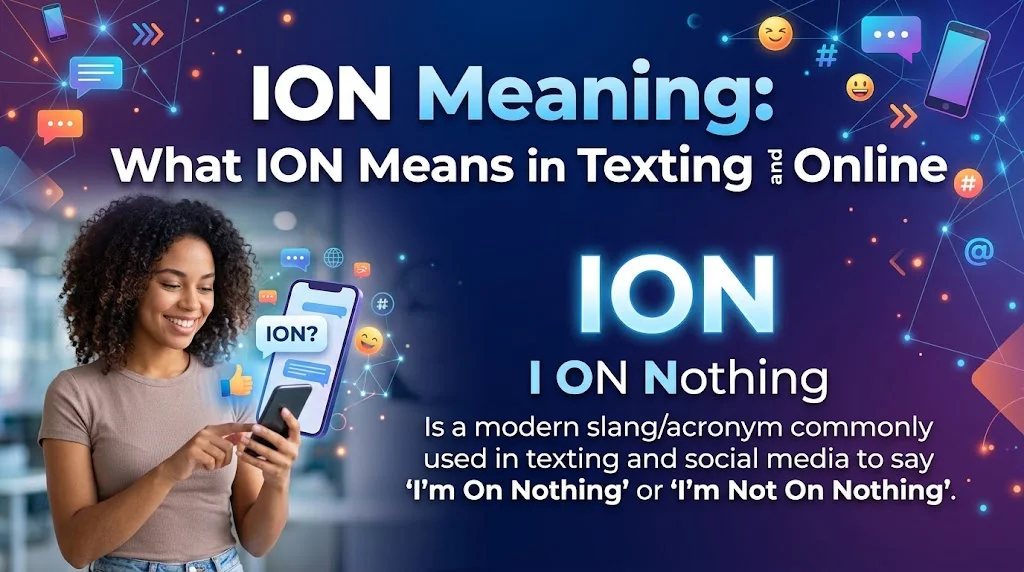
ION Meaning is commonly understood as “I don’t” in texting, social media, and casual online conversations. It’s a shortened form that helps people type faster while keeping messages relaxed and informal. You may see ION in text messages, Instagram captions, Snapchat chats, TikTok comments, and other digital conversations.
In everyday texting slang, ION can appear at the beginning of a sentence, especially when someone wants to express that they don’t agree, don’t know, don’t want something, or simply aren’t interested. For example, “ION know” usually means “I don’t know,” while “ION want to go” means “I don’t want to go.” The exact meaning depends on the surrounding conversation and context.The abbreviation has become part of modern internet slang and social media language, particularly in casual communication.
However, ION can sometimes have other meanings. In science, for example, an ion is an electrically charged atom or molecule.Understanding the difference between texting abbreviations, online slang, and scientific terminology makes ION easier to interpret. Therefore, when you encounter ION in a message, look at the words around it before deciding what the sender means.
Quick Answer
ION Meaning in American texting most commonly means “I don’t.” It can also mean “in other news,” so the sentence and conversation determine the intended meaning.
TL;DR
- ION commonly means “I don’t” in casual American texting.
- It can also stand for “in other news.”
- The “I don’t” meaning is especially common in social-media slang.
- ION developed from informal pronunciation and digital abbreviation.
- Capital letters don’t always indicate a formal acronym.
- Context is the best way to understand ION.
What Does ION Mean in Texting?
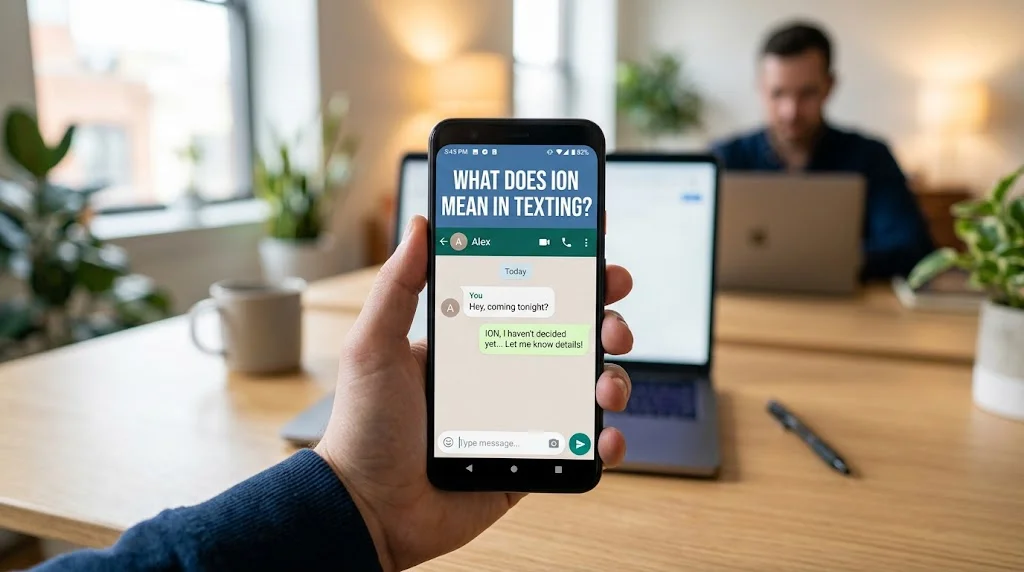
ION is usually a casual abbreviation rather than a traditional symbol. In many American online conversations, it represents the spoken phrase “I don’t.”
The spelling reflects the way “I don’t” can sound when spoken quickly. Digital communication often turns pronunciation into shortened spellings, especially when users want their messages to feel natural and conversational.
ION as “I Don’t”
When ION means “I don’t,” it usually appears near the beginning of a sentence.
For example:
“ION know what you mean.”
This means:
“I don’t know what you mean.”
Likewise, someone might write:
“ION wanna go.”
That means:
“I don’t want to go.”
The abbreviation can make a message sound informal, relaxed, and conversational.
ION as “In Other News”
ION can also mean “in other news.” This meaning works differently because it introduces a new subject.
For example:
“ION, did you see the game last night?”
Here, ION signals a topic change. The writer is essentially saying, “In other news…”
This version is more dependent on context than the “I don’t” interpretation.
Why Does ION Mean “I Don’t”?
The “I don’t” meaning comes from informal digital spelling. People often write words according to how they sound rather than according to standard spelling rules.
American slang has long included shortened pronunciations. Texting simply gives those pronunciations a written form.
Pronunciation and Informal Speech
In quick speech, “I don’t” can sound compressed. Online communities may represent that sound as ion.
This process is common in informal internet language. People aren’t necessarily trying to create a formal acronym. Instead, they’re reproducing the rhythm of everyday speech.
Why Short Forms Become Popular
Online language rewards expressions that are quick and recognizable.
ION fits that pattern because it replaces two spoken words with three letters. It also gives messages a distinctly casual tone.
Common reasons include:
- Faster typing during casual conversations
- Reproducing natural speech patterns
- Creating a relaxed online voice
- Showing familiarity with current slang
What Does ION Mean on Social Media?
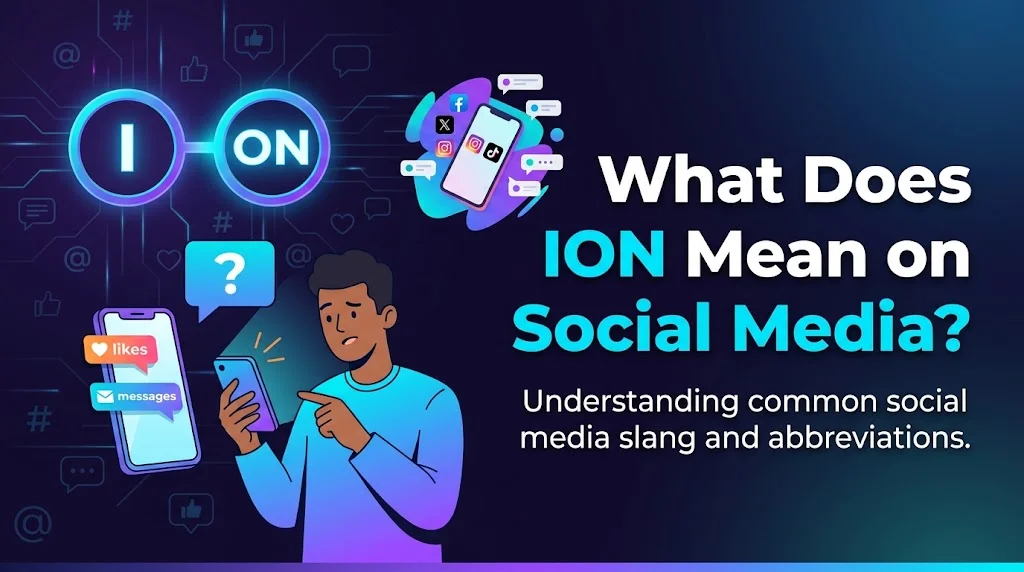
On social media, ION frequently appears as a casual form of “I don’t.” Its meaning becomes especially clear when it appears before verbs such as “know,” “want,” or “care.”
Platforms built around short posts and quick messages encourage this kind of language. Users often borrow expressions from conversations and transform them into recognizable online shorthand.
Examples on Social Media
Consider these examples:
“ION even know what happened.”
Meaning:
“I don’t even know what happened.”
Another example is:
“ION care anymore.”
That means:
“I don’t care anymore.”
The expression can also appear in captions, comments, direct messages, and short posts.
Tone Matters
ION normally feels informal. It can make a sentence sound more conversational than standard written English.
However, it isn’t appropriate for every situation. A school assignment, professional email, or formal business document would normally use “I don’t” instead.
ION Meaning in American Slang
American slang is shaped by pronunciation, music, regional speech, youth culture, and online communities. ION fits into this larger tradition of turning spoken language into written slang.
The expression is particularly recognizable in informal digital communication.
Connection to Spoken Language
Unlike many technical abbreviations, ION isn’t primarily about saving information. It reflects how people communicate in relaxed speech.
This distinction is important. The meaning isn’t necessarily based on the dictionary meaning of the letters I, O, and N.
Instead, the spelling imitates a familiar spoken expression.
American Online Communication
In the United States, social platforms have helped slang travel quickly between communities. A phrase can begin in one group and become familiar to a much larger audience.
That doesn’t mean every user understands it in exactly the same way. Slang remains strongly influenced by age, community, platform, and context.
Historical Roots of ION Slang
ION doesn’t have an ancient symbolic history like a cross, circle, eagle, or flower. Its history belongs to modern informal language and digital communication.
That difference matters because trying to give ION an ancient spiritual meaning would create a misleading interpretation.
Before Modern Texting
People shortened words long before smartphones existed. Informal writing has always included contractions, abbreviations, phonetic spellings, and clipped expressions.
However, these forms became much more visible with chat rooms, text messaging, and social media.
The Rise of Digital Slang
During the late 1990s and 2000s, internet chat and mobile texting encouraged shorter messages. Abbreviations became a normal part of online communication.
Later, social media gave these forms an even larger audience. ION became part of the broader collection of informal spellings used in American online speech.
Read More:HY Meaning: What HY Means in Texting and Slang
ION Meaning in American Culture
In the United States, ION is best understood as a language marker, rather than a traditional cultural symbol. It can signal informality, familiarity with online communication, and a conversational style.
Its meaning also depends on who is using it and where it appears.
Language and Identity
Online slang can communicate more than literal information. Word choice can signal that someone is relaxed, humorous, youthful, or connected to a particular digital culture.
ION may therefore carry a social meaning beyond “I don’t.”
However, readers shouldn’t assume someone’s identity simply because they use the abbreviation. Slang spreads across communities and changes quickly.
Context in American Conversations
| Context | Likely ION Meaning | Common Association | Notes |
| Text message | I don’t | Casual conversation | Usually followed by a verb |
| Social-media caption | I don’t | Informal slang | Often imitates speech |
| Comment section | I don’t | Quick reaction | Meaning depends on surrounding words |
| Topic change | In other news | Conversation shift | Less common in some contexts |
| Formal writing | Usually avoided | Standard English | “I don’t” is clearer |
Spiritual Meaning of ION
ION doesn’t have one universally accepted spiritual meaning. Unlike established religious symbols, it isn’t traditionally associated with a specific belief system.
Some websites may assign symbolic meanings to individual letters. Those interpretations are personal or modern rather than established meanings of the slang expression.
Avoiding Symbolic Confusion
It’s useful to separate slang meaning from symbolic meaning.
When someone writes ION in a text, they usually aren’t expressing an ancient spiritual concept. They’re using shorthand within a particular language context.
Broader Spiritual Contexts
Different cultures and spiritual traditions may use abbreviations, sacred letters, or symbolic sounds. Those systems should not automatically be connected to the modern slang ION.
The similarity of letters doesn’t establish a historical relationship.
Emotional and Psychological Meaning of ION
Although ION has no fixed psychological meaning, its use can affect the emotional tone of a message.
Because it resembles casual speech, it often makes a sentence feel less formal.
What ION Can Signal
Depending on the sentence, ION may communicate:
- Casualness rather than formal writing
- Emotional distance from a subject
- Humor or playful speech
- Strong personal opinion
- Familiarity with internet slang
- A conversational online personality
These associations aren’t universal. A person’s broader message provides the real emotional context.
Why Context Is Important
Consider:
“ION know.”
This could sound confused, dismissive, joking, or genuinely uncertain.
The abbreviation alone doesn’t tell you which emotion is intended. Punctuation, previous messages, and the relationship between speakers all matter.
ION Meaning in Text Messages and Chats
Text messaging is one of the easiest places to encounter ION. People often use it because texting encourages speech-like writing.
Unlike formal prose, messages can contain incomplete sentences, slang, phonetic spellings, and shortened expressions.
Common Examples
Here are several natural examples:
“ION wanna argue about it.”
Meaning: “I don’t want to argue about it.”
“ION think that’s right.”
Meaning: “I don’t think that’s right.”
“ION know where she went.”
Meaning: “I don’t know where she went.”
These examples show why the surrounding verb is useful for identifying the meaning.
When It Means “In Other News”
Consider:
“ION, what are you doing this weekend?”
Here, “I don’t” doesn’t fit grammatically. “In other news” makes much more sense.
This simple test can help readers determine the intended interpretation.
ION in TikTok, Instagram, and Online Culture
Short-form social platforms have helped slang spread rapidly across the United States. ION can appear in captions, comments, messages, and conversational posts.
However, its popularity can vary between communities and over time.
Digital Language Changes Quickly
Online expressions rarely remain fixed. A term can become popular, develop another meaning, or fade from everyday use.
ION illustrates this flexibility because different communities may use the same three letters differently.
Why Younger Users Use It
Younger internet users often experiment with spelling and pronunciation. They may also prefer language that feels closer to spoken conversation.
As a result, expressions such as ION can become recognizable even when they don’t follow standard grammar.
ION in Tattoos, Fashion, and Personal Identity
ION is less commonly treated as a traditional tattoo symbol than symbols such as stars, hearts, snakes, or flowers.
Still, people may use short slang expressions in tattoos, clothing, graphics, or personal artwork.
Modern Personal Expression
When used visually, ION can represent a personal connection to online language or a particular phrase.
Its meaning would usually come from the person’s intended message rather than from a universal symbolic tradition.
Design and Context
Typography can change how an abbreviation feels. Lowercase “ion” may look conversational, while uppercase “ION” can resemble a formal acronym.
However, appearance alone doesn’t establish the intended meaning. The surrounding design or accompanying words usually provide the clue.
Common Misunderstandings About ION
ION is easy to misunderstand because the same letters can represent different expressions.
This is especially true when someone encounters the abbreviation outside a familiar online community.
ION Isn’t Always an Acronym
One common mistake is assuming every letter must represent a separate word.
In the “I don’t” usage, ION is better understood as a phonetic or informal spelling. It doesn’t necessarily stand for three separate words.
ION Can Have Different Meanings
The two major interpretations discussed here are:
- “I don’t” in informal online speech
- “In other news” when introducing another topic
- A context-specific abbreviation in specialized communities
- A personal shorthand created by an individual
Therefore, context should always come before a fixed definition.
How ION Has Changed Over Time
Internet slang evolves as communication technology changes. Expressions that once belonged to chat rooms can later appear on social media and messaging apps.
ION reflects that broader movement from formal written language toward speech-like digital communication.
From Abbreviations to Phonetic Slang
Early digital communication often favored obvious abbreviations. Later online communities increasingly used spellings that represented pronunciation.
This created a wider range of expressions that look unusual but sound natural when spoken.
The Meaning Today
As of August 24, 2026, ION remains recognizable in informal online communication, especially when the sentence clearly supports “I don’t.”
Still, slang is fluid. The exact frequency and meaning can differ between platforms and communities.
How to Tell Which ION Meaning Is Intended
When you see ION in a message, don’t immediately assume it has one fixed definition.
Instead, read the entire sentence and test both common meanings.
A Simple Context Test
Ask yourself:
Does “I don’t” fit naturally?
If yes, that’s probably the intended meaning.
If not, ask:
Does “in other news” make sense as a topic transition?
This approach works better than interpreting the three letters alone.
Examples of the Context Test
“ION like that song.”
“I don’t like that song” makes sense.
“ION, did you hear about the new restaurant?”
“In other news” makes sense.
The grammar provides a strong clue.
Conclusion
ION Meaning is most often “I don’t” when used in casual texting and online conversations. It’s a convenient piece of internet slang that makes digital communication shorter and more natural. Still, its meaning can change depending on the context, especially because “ion” also has a scientific meaning.If you see ION in a Snapchat message, TikTok comment, Instagram DM, or text, check the surrounding sentence. In most casual situations, it simply represents “I don’t” and helps express a thought quickly.
FAQs
What does ION mean in texting?
ION usually means “I don’t” in casual texting and online conversations.
What does ION mean on Snapchat?
On Snapchat, ION commonly means “I don’t.” Its exact interpretation depends on the message.
What does ION mean on TikTok?
On TikTok, ION is often used as informal texting slang meaning “I don’t.”
Is ION an abbreviation for “I don’t”?
Yes. In casual online language, ION is commonly used as a shortened form of “I don’t.”
Does ION have other meanings?
Yes. In science, an ion is an atom or molecule with an electrical charge. The surrounding context determines which meaning applies.
How do you use ION in a sentence?
You might see phrases such as “ION know” for “I don’t know” or “ION want that” for “I don’t want that.”