Have you ever confused rend with rent? You’re not alone. These two words differ by just one letter, yet their meanings can be surprisingly different. One usually describes tearing something apart, while the other brings to mind apartments, monthly payments, and rental agreements.
However, there’s an interesting twist. Rent can also be the past tense and past participle of rend. This older grammatical usage makes the distinction more complicated than it first appears.
Understanding the difference between rend and rent will help you choose the right word in everyday writing, formal documents, and literary contexts. You’ll also learn why a sentence such as “The explosion rent the air” can be correct even though it has nothing to do with paying for something.
Let’s explore the meanings, grammar rules, examples, and practical tips that make these words easier to understand.
What Does Rend Mean?
The word rend is a verb that means to tear, rip, or split something forcefully. It often suggests a sudden, violent, or powerful action rather than a small tear in a piece of paper.
For example, imagine a strong wind ripping an old flag apart. You could describe that action by saying the wind rent or rended the flag, depending on the form and usage. In modern everyday English, however, most people would simply say that the wind tore the flag.
Unlike tear and rip, which appear regularly in casual conversation, rend often sounds formal, dramatic, or literary. Writers use it to give physical destruction or emotional pain greater force.
Definition of Rend
According to its standard dictionary meaning, rend refers to tearing or splitting something apart, often with considerable force.
The word can describe both physical damage and emotional distress.
Physical meaning: To tear an object, material, or structure apart.
- The powerful wind threatened to rend the old sail.
- The sharp metal edge could rend the fabric.
- The explosion seemed to rend the wooden structure apart.
Figurative meaning: To cause intense emotional pain, division, or disruption.
- Grief appeared to rend her heart.
- The scandal threatened to rend the organization apart.
- The argument seemed to rend the family into opposing sides.
In figurative expressions, the word doesn’t always describe a literal tear. Instead, it emphasizes the severity of an experience or conflict.
For instance, when someone says that grief rent their heart, they mean the pain felt overwhelming. Their heart hasn’t physically split open. The expression communicates the intensity of their sorrow.
How to Use Rend in a Sentence
The easiest way to understand rend is to look at the action described by each sentence.
Consider these examples:
| Sentence | Meaning |
| The storm could rend the old sail. | The storm could tear the sail apart. |
| His desperate cry seemed to rend the silence. | His cry dramatically broke the quiet. |
| The dispute threatened to rend the community. | The dispute could divide the community. |
| The sharp rock might rend the thin material. | The rock could tear the material. |
| The news seemed to rend her heart. | The news caused intense emotional pain. |
Notice that rend often creates a stronger impression than tear. It suggests a forceful action or a major emotional impact.
Still, you don’t need to use rend whenever something tears. In everyday writing, tear is usually the more natural choice.
For example, “I tore my shirt on a nail” sounds more conversational than “I rent my shirt on a nail.” The second sentence is also confusing because rent usually refers to payment or temporary use.
Common Expressions and Figurative Uses of Rend
Writers often use rend in vivid expressions that describe sounds, emotions, and social divisions.
Here are a few useful examples.
Rend the air: To produce a loud or piercing sound that seems to break through the surrounding quiet.
Example: A sudden scream rent the air.
Rend someone’s heart: To cause deep emotional suffering.
Example: The heartbreaking farewell seemed to rend his heart.
Rend the fabric of society: To damage the relationships, shared values, or institutions that hold a community together.
Example: The conflict threatened to rend the fabric of the nation.
Rend something apart: To tear or divide something forcefully.
Example: The powerful blast could rend the wooden door apart.
These expressions appear most naturally in literary writing, journalism, speeches, and descriptions of intense events. They help readers picture a forceful action or feel the weight of an emotional experience.
What Does Rent Mean?
The word rent has two common everyday roles: it can be a noun or a verb. It also has a less familiar role as the past tense and past participle of rend.
When people use rent in ordinary conversation, they usually mean money paid to use a property or item temporarily, or the act of paying for that use.
For example, someone might rent an apartment, rent a car for a weekend, or ask how much rent a landlord charges each month.
The surrounding words usually make this meaning clear.
Rent as a Noun
As a noun, rent means the payment someone makes in exchange for the right to use property or another item for an agreed period.
The most familiar examples involve housing. A tenant pays rent to a landlord in exchange for living in an apartment or house under the terms of a rental agreement.
However, the word isn’t limited to housing.
You can also encounter rent in connection with:
- Cars and other vehicles.
- Office space and commercial buildings.
- Tools and construction equipment.
- Storage units.
- Event spaces and certain types of machinery.
Consider these sentences:
- Our monthly rent is due on the first day of the month.
- The landlord increased the rent when the lease was renewed.
- We split the rent equally among three roommates.
- The equipment rental company charged an additional fee.
- She set aside part of her paycheck to cover next month’s rent.
In each example, rent identifies a payment rather than an act of tearing.
Example in context:
“Daniel found a small apartment near his workplace. The rent was affordable, so he signed a lease.”
Here, rent refers to the money Daniel pays to live in the apartment. It has no connection to ripping, splitting, or damaging anything.
Rent as a Verb
As a verb, rent describes the arrangement of paying for temporary use or allowing someone else to use property in exchange for payment.
The precise meaning depends on the subject of the sentence.
When a tenant rents an apartment, the tenant pays to live there. When a landlord rents out an apartment, the landlord allows someone to live there in exchange for payment.
Examples include:
- We rent a house near the city center.
- I rented a car for my vacation.
- They plan to rent office space next year.
- The landlord rents the upstairs apartment to a young couple.
- She wants to rent out her spare room.
The verb changes form according to the sentence’s tense:
| Verb form | Example |
| Base form: rent | I rent a small apartment. |
| Third-person singular: rents | He rents a room near campus. |
| Present participle: renting | We are renting a car today. |
| Simple past: rented | They rented a cabin last summer. |
| Past participle: rented | We have rented this office for years. |
In everyday English, rented is the usual past-tense form of the rental-related verb rent.
For example, “We rented a car yesterday” clearly describes a completed rental arrangement.
This distinction matters because rented and rent can look related while serving very different grammatical purposes in other contexts.
Rent as the Past Tense of Rend
Here’s the part that often surprises English learners: rent is also a traditional past-tense and past-participle form of rend.
In this older usage, rent means tore or split apart. It doesn’t refer to a rental payment.
For example:
- The blast rent the air with a deafening roar.
- The sharp blade rent the fabric.
- The violent struggle left the material rent and damaged.
These sentences use rent in the sense of tearing or splitting.
The form appears especially often in literary descriptions, older writing, and dramatic expressions. You might encounter it in a novel, historical account, or newspaper article that uses elevated language.
The word rended is also used as a past-tense form of rend, but it is much less common than the traditional form rent in established literary usage. In contemporary everyday conversation, people generally prefer tore as the simple past tense of tear.
For clarity, compare these three sentences:
- Present: The storm may rend the sail.
- Past, literary: The storm rent the sail.
- Past, everyday alternative: The storm tore the sail.
All three describe the same basic action, but their tone differs.
The first sounds formal or literary. The second uses the traditional past tense of rend. The third sounds natural in ordinary conversation.
Why Context Matters When You See Rent
The spelling alone doesn’t always tell you what rent means. You need to examine the surrounding sentence.
Compare these examples:
“We rent a house near the beach.”
Here, rent is a verb describing a housing arrangement.
“The explosion rent the air.”
Here, rent is the past tense of rend. It describes a loud sound that seemed to break through the air.
“The monthly rent is expensive.”
Here, rent is a noun referring to a payment.
The spelling stays the same, but the meaning changes with the grammatical role and context.
This is a useful reminder that English contains many words whose meanings depend on how they’re used. When a word seems confusing, look at the entire sentence rather than interpreting it in isolation.
Rend vs. Rent: Key Differences
Although rend and rent look similar, they serve different purposes in most modern writing.
The main distinction is straightforward: rend means to tear or split something, while rent usually refers to payment for temporary use or the act of leasing something.
The exception is the traditional past-tense form of rend, which is also spelled rent.
Meaning and Definition: Rend vs. Rent
The following comparison summarizes their main meanings.
| Feature | Rend | Rent |
| Main meaning | To tear or split forcefully | Payment for temporary use or the act of leasing |
| Typical part of speech | Verb | Noun or verb |
| Common context | Physical destruction, emotional pain, dramatic writing | Housing, vehicles, equipment, payments |
| Everyday frequency | Relatively uncommon | Very common |
| Example | The blast may rend the door. | We rent a small house. |
| Past-tense relationship | Traditionally becomes rent | Also serves as the traditional past tense of rend |
The difference becomes clearer when you focus on what the sentence describes.
If someone discusses a lease, an apartment, or a monthly payment, rent probably has its ordinary rental meaning.
If someone describes something tearing apart, rend may be appropriate. If the sentence uses rent in that same tearing context, it may be the past tense of rend.
Grammar and Word Forms
Understanding the grammar of both words will help you avoid common mistakes.
Rend is primarily a verb. Its traditional forms include:
- Base form: rend.
- Third-person singular: rends.
- Present participle: rending.
- Traditional simple past: rent.
- Traditional past participle: rent.
Some writers also use rended as the past tense or past participle, although rent is the established traditional form in many literary contexts.
The rental-related word rent has its own forms:
- Noun: rent.
- Base verb: rent.
- Third-person singular: rents.
- Present participle: renting.
- Simple past: rented.
- Past participle: rented.
These patterns explain why the sentence “The fabric was rent” can be grammatically correct. In that sentence, rent is the past participle of rend, not a reference to payment.
By contrast, “The fabric was rented” would usually suggest that someone rented the fabric from another person or business.
The extra syllable and the surrounding context change the meaning.
Pronunciation and Spelling: Rend vs. Rent
In standard American English, rend and rent share the same short vowel sound. Both begin with the same consonant and contain a single vowel between the opening and final consonants.
The key spelling difference appears at the end:
- Rend ends with d.
- Rent ends with t.
A simple spelling check can help when you’re writing quickly. Before choosing either word, ask yourself what you want to express.
If you mean tearing, use rend for the present-tense verb or consider tear for a more natural everyday alternative. If you mean a rental payment or arrangement, use rent.
However, remember the literary exception: rent can also describe something that was torn.
When Should You Use Rend or Rent?
Choose rend when you want to describe a forceful tearing action or use a dramatic figurative expression.
For example:
- The sharp edge could rend the material.
- The news seemed to rend her heart.
- The dispute threatened to rend the group apart.
Choose rent when you’re talking about payment or leasing.
For example:
- We rent an apartment.
- The monthly rent is due soon.
- She plans to rent a car for the trip.
Use rent as the past tense of rend when the context clearly describes tearing, especially in literary or formal writing.
For example:
- The explosion rent the air.
- The blade rent the cloth.
In most casual situations, you can avoid confusion by choosing familiar alternatives. Use tear for the act of ripping and rented for the past tense of a rental arrangement.
Rend vs. Rent Examples in Real Sentences
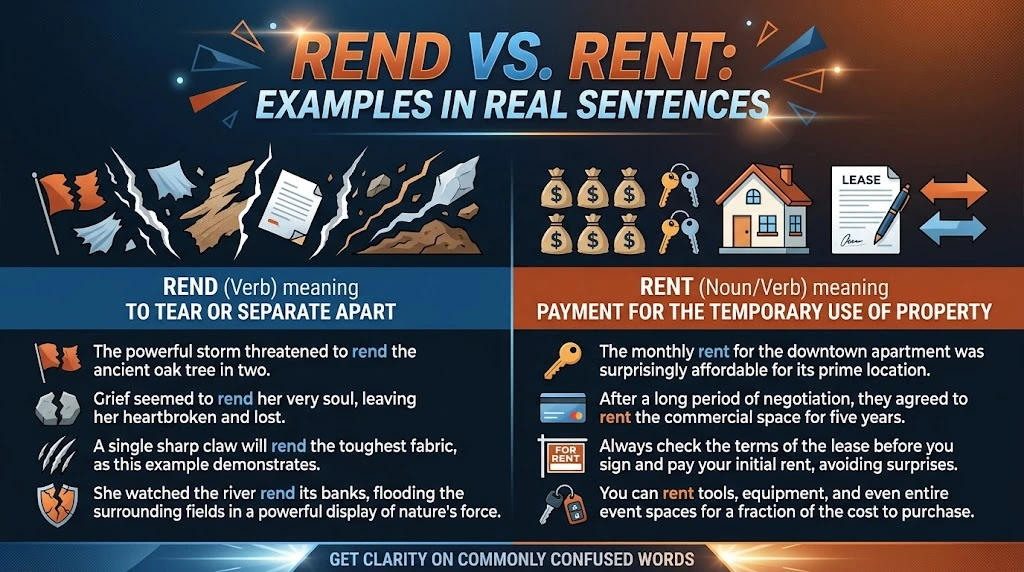
Definitions are useful, but examples show how the words behave in actual sentences. The following sections cover literal tearing, figurative language, ordinary rental situations, and the less common past-tense usage.
Examples of Rend
Here are several examples that demonstrate the main uses of rend.
| Example sentence | Explanation |
| The powerful wind could rend the old sail. | The wind could tear the sail apart. |
| The sharp metal edge might rend the cloth. | The edge could split or rip the material. |
| The news seemed to rend her heart. | The news caused intense emotional pain. |
| The dispute threatened to rend the community. | The dispute could divide the community. |
| The roar appeared to rend the silence. | The sound dramatically broke the quiet. |
The first two examples describe physical tearing. The remaining examples use the word figuratively to communicate emotional pain, division, or a sudden interruption.
Notice that rend often appears with strong nouns and adjectives, such as storm, blast, violent, and heartbreaking. These combinations reinforce the sense of force.
In everyday writing, however, don’t force the word into a sentence where a simpler option works better.
For example, “I tore the envelope” sounds more natural than “I rent the envelope” when describing a present action. The latter uses a different grammatical form and may confuse the reader.
Examples of Rent in Everyday English
The ordinary rental-related meaning of rent appears in many familiar situations.
As a noun:
- The rent on our apartment increased this year.
- She pays her rent on time every month.
- We divided the rent equally among the roommates.
- The landlord explained the rent and other charges before signing the lease.
As a verb:
- They rent a house outside the city.
- I need to rent a truck for moving day.
- The company rents office space in a downtown building.
- We rented a cabin for our family vacation.
These examples are straightforward because they involve a payment or an agreement to use something temporarily.
The word rent may also appear in broader business and property contexts. For example, a business might rent a warehouse or a contractor might rent specialized equipment instead of buying it.
The underlying idea remains the same: someone pays for the right to use something for a period of time.
Examples of Rent as the Past Tense of Rend
The past-tense form can be more difficult to recognize because it looks identical to the familiar rental word.
Consider the following examples:
- The explosion rent the air with a deafening roar.
- The sharp blade rent the thick fabric.
- The force of the impact rent the damaged material apart.
- The sudden cry rent the silence of the room.
In these sentences, rent describes a past action of tearing, breaking through, or forcefully interrupting. It does not describe a payment or lease.
The expression rent the air is particularly useful to recognize. Writers often use it to describe a scream, explosion, roar, or other loud sound.
For example, “A piercing scream rent the air” means that a piercing scream suddenly broke the surrounding silence.
Although this construction is grammatically valid, it may sound old-fashioned or dramatic to modern readers. In a casual conversation, you might say, “A piercing scream broke the silence.”
Incorrect Usage and Corrections
Some mistakes happen because writers assume rend and rent are interchangeable. Others occur when someone uses the past-tense form without considering the sentence’s intended meaning.
Here are a few examples.
| Incorrect or confusing sentence | Better version | Why |
| I rent the paper in half. | I tore the paper in half. | Rent is not the ordinary present-tense verb for tearing. |
| She will rent the cloth apart. | She will tear the cloth apart. | The sentence describes tearing, not leasing. |
| We rent a house last year. | We rented a house last year. | The rental verb requires its regular past-tense form. |
| The monthly rend is due tomorrow. | The monthly rent is due tomorrow. | The sentence refers to a payment. |
| The storm rented the sail apart. | The storm tore the sail apart. | Rented ordinarily describes a past rental arrangement. |
There’s one important qualification: a sentence such as “The storm rent the sail” can be correct in literary English because rent is the traditional past tense of rend. However, it may confuse readers who know only the everyday meaning of rent.
For general audiences, tore is often the clearest option.
A Practical Case Study: Rent Clothes vs. Rend Clothes
Imagine reading two sentences in a story:
Sentence A: “The actors rent their clothes for the performance.”
Sentence B: “The actors rent their clothes during the struggle.”
At first glance, the sentences appear almost identical. Yet their meanings can differ substantially depending on context.
In Sentence A, rent is the ordinary verb associated with payment. The actors obtain costumes temporarily and return them afterward.
Sentence B is more ambiguous. If the story describes a violent struggle and uses an old-fashioned literary style, rent may be the past tense of rend. The intended meaning would be that the actors’ clothes were torn during the struggle. However, as written, the sentence lacks enough grammatical and contextual clues to make that reading clear.
A clearer modern version would be:
“The actors’ clothes tore during the struggle.”
Or, in a more dramatic literary style:
“The struggle rent their clothes.”
What Does This Case Study Teach Us?
The example highlights three practical lessons.
- Context matters. The words surrounding rent help determine whether it refers to payment or tearing.
- Grammar matters. The form rented usually signals a past rental arrangement, while rent can function as the traditional past tense of rend.
- Clarity matters. If your audience may misunderstand a literary word, choose a simpler alternative or rewrite the sentence.
When writing for a general audience, clarity should usually come first. You can still use vivid language without making readers stop to decode an unfamiliar word.
How to Remember the Difference Between Rend and Rent
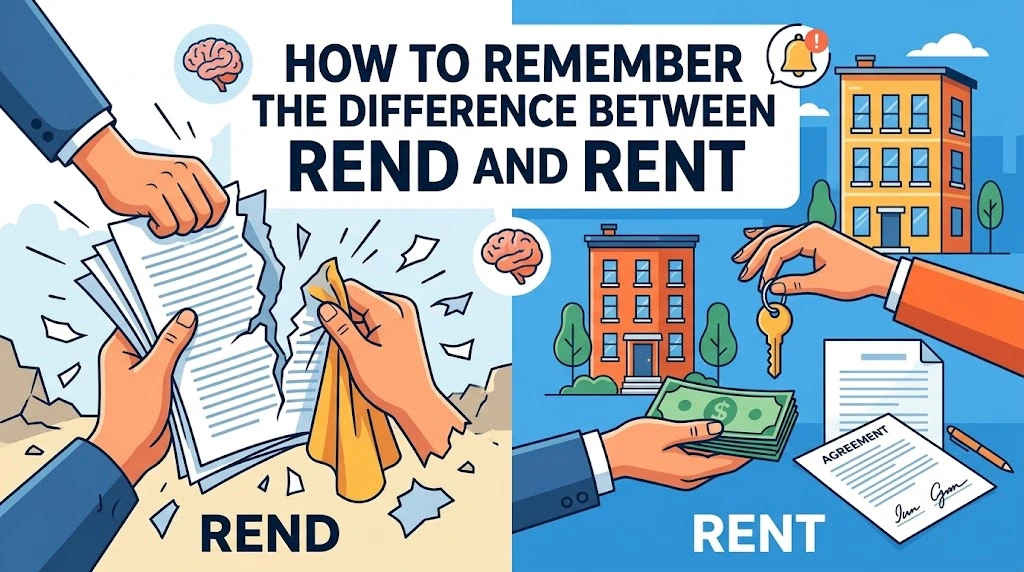
You don’t need to memorize a long list of grammar rules to distinguish these words. A few practical associations can make the difference easier to remember.
Associate Rend With Ripping
Think of rend as a forceful action that tears something apart.
You might picture a sheet of paper ripping, a flag splitting in a storm, or a dramatic scene in which a loud cry breaks the silence.
Remember this connection:
Rend = tear or split.
If the sentence describes physical damage, emotional anguish, or a forceful division, rend may be the right word.
For everyday writing, remember that tear is usually the more familiar alternative.
Associate Rent With Rental Payments
Connect rent with familiar situations such as paying for an apartment, hiring a car, or borrowing equipment for a fee.
For example:
- You pay rent to live in an apartment.
- You rent a car for a weekend.
- A business rents equipment for a construction project.
Remember this connection:
Rent = payment or temporary use.
This mnemonic covers the most common modern meaning of the word.
Check the Sentence Context
When neither association seems to fit, examine the sentence’s tense and surrounding details.
Ask yourself:
- Does the sentence describe a rental payment?
- Does someone pay to use a property or item?
- Does the sentence describe tearing or splitting?
- Is the writing literary or historical?
If the sentence describes tearing in the past, rent might be the traditional past tense of rend.
For example, “The blast rent the air” describes a past event. The context makes the literary meaning clear.
Read More : BB Meaning in Text: What Does “BB” Mean in Chats, Texts, and Social Media?
Practice Exercises: Rend or Rent?
Ready to test your understanding? Fill in each blank with the correct word or form. Pay attention to meaning and tense.
Fill-in-the-Blank Questions
Choose from: rend, rent, rents, rented, rent (past tense of rend), or tore.
- We decided to _____ an apartment near the university.
- The powerful storm could _____ the old sail.
- The landlord collects the monthly _____ on the first day.
- She _____ a car during her vacation last summer.
- The explosion _____ the air with a tremendous roar.
- The sharp edge might _____ the thin fabric.
- He _____ the paper in half while opening the package.
- The company plans to _____ additional office space next year.
- The tragic news seemed to _____ her heart.
- The sudden blast _____ the damaged material apart.
Answer Key and Explanations
| No. | Answer | Explanation |
| A | rent | The sentence describes paying to use an apartment. |
| B | rend | The sentence describes the possibility of tearing a sail. |
| C | rent | Here, rent is a noun referring to a payment. |
| D | rented | The sentence describes a completed rental arrangement in the past. |
| E | rent | This is the traditional past tense of rend. |
| F | rend | The sentence describes tearing material. |
| G | tore | This is the natural everyday past tense of tear. |
| H | rent | The company intends to lease additional space. |
| I | rend | The figurative expression describes intense emotional pain. |
| J | rent | This is a literary past-tense use of rend. |
The key is to focus on meaning rather than spelling alone. Once you identify what the sentence describes, the correct word usually becomes much easier to choose.
Frequently Asked Questions About Rend vs. Rent
What Does Rend Mean?
Rend means to tear, rip, or split something forcefully. It can describe physical damage, as in “The storm could rend the sail,” or figurative emotional pain, as in “The loss seemed to rend her heart.”
The word often appears in formal, literary, or dramatic writing. In casual conversation, tear is usually more common.
What Is the Difference Between Rend and Rent?
The main difference is that rend means to tear something apart, while rent commonly refers to a payment or the act of leasing something temporarily.
However, rent also serves as the traditional past tense and past participle of rend. In that less common usage, it describes tearing rather than payment.
Is Rent the Past Tense of Rend?
Yes. Rent is the traditional past tense and past participle of rend.
For example, “The explosion rent the air” means that the explosion produced a loud sound that seemed to break through the silence.
This usage is less common in everyday conversation. Many speakers would choose a simpler alternative, such as “The explosion broke the silence.”
Can Rent Be Both a Noun and a Verb?
Yes. As a noun, rent refers to payment for temporary use, such as the monthly payment for an apartment.
As a verb, rent can mean to pay for temporary use or to let someone use property in exchange for payment.
Examples include “The rent is due tomorrow” and “We rent a car for vacations.”
Is Rend Commonly Used in Everyday English?
No. Although rend remains a valid English verb, it is less common in ordinary conversation than tear or rip.
You are more likely to encounter it in literature, formal descriptions, dramatic expressions, and figurative writing.
For example, “The news rent her heart” sounds literary. “The news broke her heart” is more familiar to most readers.
Is Rended a Correct Word?
Yes. Rended is used as a past-tense and past-participle form of rend. However, the traditional form rent is also established and often appears in literary usage.
For everyday communication, the verb tear is usually simpler: tear, tore, torn.
How Can You Easily Remember the Difference Between Rend and Rent?
Remember two basic associations: rend means tear, while rent usually means payment or leasing.
If you encounter rent in a sentence about a loud explosion, a torn object, or intense emotional pain, consider whether it is the past tense of rend.
Always check the context before deciding what the writer means.
Conclusion: Rend vs. Rent
The difference between rend and rent becomes much easier once you understand their meanings and grammatical roles.
Rend means to tear or split something forcefully. It often appears in formal, literary, and figurative writing. Rent, on the other hand, usually refers to a payment or the act of leasing property or an item temporarily.
There’s one important exception: rent is also the traditional past tense and past participle of rend. That’s why a sentence such as “The explosion rent the air” can be grammatically correct even though it has nothing to do with a rental agreement.
When you’re unsure which word to use, start with the meaning you want to express. If you mean tearing, rend may fit a formal or dramatic sentence, while tear is often better for everyday writing. If you mean payment or temporary use, rent is the correct choice.
Keep the context in mind, and these two similar-looking words won’t be nearly as confusing.