
Emasculate vs. demasculate can look like a simple prefix problem. After all, English contains many words beginning with de- that describe removal, reversal, or reduction. So it seems reasonable to assume that demasculate should mean the opposite or a variation of emasculate.
There’s a catch.
Emasculate is an established English word with several well-documented meanings. It can refer to castration, a loss of strength or effectiveness, a perceived loss of masculine identity, and even a specific procedure used in plant breeding. Demasculate, meanwhile, does appear in some English usage, but it remains uncommon and isn’t the standard word most major English dictionaries recommend for these meanings.
That distinction matters when you’re writing an essay, article, report, academic paper, or professional message.
If you’re wondering “emasculate or demasculate?”, the safest general answer is emasculate. When you don’t mean emasculation specifically, a more precise verb such as weaken, undermine, disempower, or reduce may be even better.
Let’s look at the difference closely.
Emasculate vs. Demasculate: What’s the Real Difference?
The simplest way to understand emasculate vs. demasculate is to separate established usage from word formation that merely looks logical.
Emasculate is a standard English verb. It has been used in English since the early seventeenth century and comes from Latin emasculare, meaning to castrate or deprive of male functions. Its modern meanings have expanded beyond the literal sense.
For example:
The new rules emasculated the committee by taking away its authority.
Here, nobody is talking about biological sex. Emasculated means weakened or deprived of effective power.
The word also has a specialized botanical meaning. In plant breeding, scientists can emasculate a flower by removing its stamens or anthers to prevent unwanted self-pollination during controlled crosses.
Demasculate is different. The form is understandable because English speakers can easily interpret de- as a removal prefix. Some modern lexical sources even record demasculate with the meaning “to remove the masculinity from” someone. However, it remains far less established and far less useful in standard general writing than emasculate.
The quick answer
| Word | Status | Main meanings | Best choice? |
| Emasculate | Established English word | Castrate, weaken, deprive of power or traditionally masculine identity, remove stamens in botany | Yes |
| Demasculate | Rare/uncommon English formation | Intended to mean removing masculinity | Usually avoid in formal writing |
| Weaken | Established | Make less strong or effective | Yes when strength is the intended meaning |
| Undermine | Established | Gradually weaken authority, confidence, or effectiveness | Yes when appropriate |
| Disempower | Established | Take away power or authority | Yes when power is the intended meaning |
So while demasculate isn’t meaningless, it isn’t the normal replacement for emasculate.
What Does “Emasculate” Mean?
Emasculate has more than one meaning, and context determines which sense readers understand.
In its literal biological sense, it means to castrate or deprive a male of reproductive function.
In a broader figurative sense, it can mean to make someone or something weaker, less powerful, less effective, or less authoritative. Oxford defines the verb as making someone or something less powerful or effective. It also identifies a specific figurative sense involving a man’s perceived loss of a male role or qualities.
Cambridge similarly gives three broad areas of use: reducing effectiveness, making a man feel less male by taking away power or confidence, and the specialized biological meaning involving male reproductive parts.
That gives us three useful categories:
- Literal: castrate or remove male reproductive function.
- Figurative: weaken someone’s power, confidence, authority, or perceived masculinity.
- Technical botanical: remove male reproductive structures from a flower to control pollination.
The third meaning often surprises people.
Where Does “Emasculate” Come From?
The history of emasculate explains why replacing its beginning with de- doesn’t work as neatly as it might seem.
The word comes from Latin emasculare, related to masculus, meaning male or masculine. The Latin formation involved ex-/e- and masculus. English adopted the word around the beginning of the seventeenth century.
The important point is this:
Emasculate isn’t simply a modern English construction made by putting a prefix in front of “masculate.”
That’s why the existence of masculine doesn’t automatically make demasculate an equally established counterpart.
Emasculate: A Brief Historical Timeline
| Period | Development |
| Latin period | Emasculare developed around the idea of depriving a male of reproductive function |
| Early 1600s | English begins using emasculate |
| 1600s onward | Figurative meanings involving strength and vigor develop |
| Modern English | The word commonly means weaken or deprive of power in figurative contexts |
| Modern science | Emasculation remains a technical term in plant breeding |
Historical sources also show that emasculation developed as a noun in the seventeenth century. The word could describe literal castration and more broadly the removal of vigor or strength.
The Literal Meaning of Emasculate
The oldest core meaning of emasculate concerns male reproductive function.
In biological or historical contexts, the verb can mean to castrate a male person or animal. Collins lists this literal meaning alongside the broader sense of destroying strength or force.
For example:
The procedure emasculated the animal.
That sentence uses the word literally, although in modern medical or veterinary writing a more specific term such as castrate may often be clearer.
The choice depends on the context. Scientific writing generally benefits from precise terminology because emasculate can carry figurative associations that aren’t relevant to a technical procedure.
Emasculate vs. Castrate
These words overlap, but they aren’t always interchangeable in every context.
Castrate is highly specific to removing or disabling male reproductive capability.
Emasculate can carry that literal meaning, but it also has broader meanings involving strength, effectiveness, and masculinity.
Consider the difference:
- The veterinarian castrated the animal. — precise biological description.
- The policy emasculated the organization. — figurative description of lost power.
- The breeder emasculated the flower. — specialized botanical meaning.
The surrounding noun tells you which sense is intended.
Emasculate in Botany: A Technical Meaning
One of the most important meanings of emasculate has nothing to do with human masculinity.
In plant breeding, emasculation means removing the male reproductive structures of a flower so unwanted self-pollination doesn’t occur. The process is particularly important when breeders want to cross two selected parent plants.
A typical flower may contain both male and female reproductive structures. The stamens produce pollen while the pistil contains the female reproductive structures.
If pollen from the same flower reaches the stigma, self-pollination can occur.
That can ruin a planned cross.
So the breeder removes the relevant male structures before pollen is released. The flower can then receive pollen from the chosen parent.
What Does Emasculation Mean in Plant Breeding?
In plant breeding, emasculation is a controlled technique rather than a metaphor.
Its primary purpose is to prevent self-fertilization when breeders want to create a specific cross.
The basic idea looks like this:
Selected female parent
↓
Remove male reproductive structures
↓
Prevent unwanted pollen transfer
↓
Apply pollen from selected male parent
↓
Fertilization
↓
Seeds from the intended cross
University teaching materials describe emasculation as removing stamens or anthers, or otherwise eliminating pollen, while leaving the female reproductive structures intact. The procedure generally occurs before the anthers mature and release pollen.
That timing is crucial.
If pollen has already been released, removing the anthers may come too late because unwanted pollen could already have reached the stigma.
How Emasculation Works in Botany
The exact method varies according to the plant species and flower structure.
For flowers that are large enough to handle easily, breeders can often remove anthers manually with forceps or another suitable tool.
The general process involves:
- Selecting a flower at the correct developmental stage.
- Opening or exposing the flower carefully.
- Identifying the stamens or anthers.
- Removing the male structures before pollen release.
- Protecting the flower from unwanted pollen.
- Applying pollen from the selected male parent.
- Allowing fertilization and seed development.
Agricultural teaching resources describe hand emasculation as removing anthers before anther dehiscence, meaning before the anthers release their pollen.
The exact timing isn’t universal. Different crops have different flower structures and reproductive schedules.
Botanical Emasculation: Step-by-Step
| Stage | What happens | Why it matters |
| Flower selection | A suitable flower is chosen | The breeder needs the correct developmental stage |
| Male-structure identification | Stamens or anthers are located | These structures produce pollen |
| Emasculation | Anthers or stamens are removed | Prevents unwanted self-pollination |
| Isolation | The flower may be covered or protected | Reduces accidental pollen transfer |
| Controlled pollination | Desired pollen is applied | Creates the intended cross |
| Seed development | Fertilization occurs | Seeds can carry traits from both parents |
Plant breeders can use different emasculation techniques depending on the species. Some crops allow straightforward hand removal while others require specialized methods.
The principle remains the same: control which pollen reaches the female reproductive structure.
The Figurative Meaning of Emasculate
The figurative meaning is where emasculate becomes more complicated.
When someone says a person has been emasculated, they may mean that the person feels stripped of power, confidence, authority, independence, or traditionally masculine status.
Oxford specifically describes the figurative use as making a man feel that he has lost his male role or qualities.
But the word can also describe institutions, laws, plans, reports, or organizations.
For example:
The amendments emasculated the bill by removing its strongest provisions.
Here, the bill hasn’t become “less masculine.” Instead, it has become less powerful or effective.
Cambridge gives a similar use involving a report whose recommendations have been weakened.
This distinction is important because the figurative meaning doesn’t always involve gender.
Common Figurative Uses of Emasculate
1. Reducing authority
The new structure emasculated the department by removing its decision-making powers.
The department still exists, but it has much less authority.
2. Weakening legislation
Several amendments emasculated the proposal.
The proposal remains intact in name, but its practical force has been reduced.
3. Damaging confidence
Constant criticism left him feeling emasculated.
Here, the word describes an emotional experience connected to confidence and identity.
4. Reducing effectiveness
Excessive restrictions emasculated the program.
The program became less capable of achieving its purpose.
Notice how different these examples are. The same verb can describe a person, institution, policy, or idea.
Why Does “Emasculate” Feel So Emotional?

The emotional weight comes from the word’s connection to male identity and reproductive power.
When someone says that a man was “emasculated,” the statement may suggest more than ordinary weakness. It can imply that he feels stripped of a quality that his culture associates with manhood.
Historically, ideas about masculinity have often connected men with strength, authority, independence, protection, and economic provision.
As a result, losing those qualities can be described as emasculating.
That doesn’t mean those qualities are inherently male. Rather, the word reflects a long-standing cultural association between masculinity and certain forms of power.
This is why context matters.
For example:
Losing his job left him feeling emasculated.
This may suggest more than financial hardship. The sentence can imply that unemployment challenged his sense of independence or his expected role as a provider.
A different sentence would avoid that gendered implication:
Losing his job left him feeling powerless and discouraged.
Both can describe a similar emotional experience. The second version simply makes the meaning more specific.
Is “Demasculate” a Real Word?
Here’s where the emasculate vs. demasculate debate gets interesting.
It would be too simplistic to say that demasculate is completely imaginary. The word has been recorded in some English lexical sources with the meaning to remove masculinity from someone.
However, recording a word somewhere doesn’t make it equally established across standard English.
Demasculate is rare and uncommon compared with emasculate.
Major general dictionaries prominently define emasculate while established dictionary treatment of demasculate is much more limited. That makes demasculate a poor choice when you want conventional, broadly recognized English.
This distinction is useful:
A word can be understandable without being the best standard word.
Readers can probably work out what demasculate means. The problem is that they may stop and wonder whether the writer intended emasculate.
In formal writing, that hesitation is avoidable.
Why Does “Demasculate” Sound Like a Real Word?
The construction looks perfectly plausible.
English uses de- in words such as:
- deactivate
- deconstruct
- decentralize
- devalue
- defrost
- demotivate
- deregulate
Because de- often suggests removal, reversal, or reduction, de + masculate looks logical.
There’s another reason.
The adjective masculine is familiar. A reader can easily understand demasculate as “remove masculinity.”
The trouble is that English vocabulary isn’t built entirely through predictable mathematical formulas.
You can’t always create a standard word by taking a familiar root and adding a productive-looking prefix.
That’s especially true with older words borrowed from Latin.
Emasculate vs. Demasculate: Key Differences
The difference becomes clearer when the words are placed side by side.
| Feature | Emasculate | Demasculate |
| Established in English | Yes | Much less established |
| Historical origin | Latin | Appears to be a later English formation |
| Literal biological meaning | Yes | Not the standard term |
| Figurative meaning | Yes | Intended meaning can be understood |
| Botanical meaning | Yes | Not an established botanical term |
| Common in formal writing | Yes | Usually avoid |
| Common dictionary recognition | Strong | Limited |
| Best general choice | Yes | Usually no |
One especially important distinction involves botany.
You should write:
The breeder emasculated the flower.
Not:
The breeder demasculated the flower.
The botanical term is established as emasculation. Plant-breeding literature specifically uses it for removing stamens, anthers, or pollen to prevent self-fertilization.
Why People Confuse Emasculate and Demasculate
Several forces push people toward demasculate.
The Prefix Trap
The first source of confusion is the prefix.
People see:
emasculate
and mentally connect it with:
masculine
They then reason that de- should mean “remove masculinity.”
It sounds logical.
Language doesn’t always reward that kind of word-building, though.
The Masculine Connection
The second problem is that emasculate isn’t visually transparent to modern readers.
Someone who doesn’t know its history may interpret it as a strange version of masculine.
But its historical structure comes from Latin emasculare, not from a modern English process of simply attaching e- to masculate.
Online Language Growth
The internet makes unusual formations more visible.
Once a person writes demasculate, another writer may repeat it. A third reader may assume the word is standard because they’ve seen it multiple times.
That’s how understandable but uncommon forms can spread.
Repeated exposure doesn’t necessarily turn a nonstandard or rare expression into the preferred form.
Emasculate vs. Demasculate: Which Word Should You Use?
If you’re deciding between these two words, emasculate is normally the better choice.
Use emasculate when:
- You mean to castrate or remove male reproductive function.
- You’re discussing plant breeding.
- You mean to weaken someone’s power or effectiveness.
- You’re describing a perceived loss of masculine identity.
- You’re writing formal or academic English.
However, there’s an important second question:
Do you actually need the word emasculate?
Sometimes the answer is no.
If your meaning is simply “make weaker,” then weaken is usually clearer.
If your meaning is “take away authority,” then disempower or undermine may work better.
If your meaning is “damage someone’s confidence,” then discourage, humiliate, or undermine might communicate the idea more precisely.
Better Alternatives to Demasculate
| Intended meaning | Better choice |
| Make something weaker | Weaken |
| Reduce effectiveness | Undermine |
| Take away authority | Disempower |
| Damage confidence | Discourage |
| Humble or degrade someone | Humiliate |
| Reduce force | Diminish |
| Remove influence | Marginalize |
| Reduce strength or vigor | Enervate |
| Challenge someone’s traditional masculine identity | Emasculate |
The best synonym depends on the exact meaning.
For example:
The reforms emasculated the agency.
This is grammatical, but:
The reforms stripped the agency of its authority.
may be more precise.
Good writing isn’t about choosing the fanciest word. It’s about choosing the word that carries the exact idea.
When Should You Use “Emasculate”?
Use emasculate when the context supports one of its established meanings.
Literal use
The historical account describes the forced emasculation of prisoners.
The word has its literal reproductive meaning here.
Figurative use
The restrictions emasculated the committee.
The committee lost practical authority.
Masculinity-related use
He felt emasculated after being publicly humiliated.
The sentence describes an emotional response involving his sense of masculine identity or power.
Botanical use
The breeder emasculated the flower before controlled pollination.
This is a technical plant-breeding use.
These meanings are all established. The surrounding context tells readers which one applies.
When Should You Avoid “Demasculate”?
Avoid demasculate when you’re writing for a general audience and want conventional English.
That includes:
- Academic papers.
- Business reports.
- Educational articles.
- Professional emails.
- Grammar explanations.
- Technical documentation.
- Published essays.
- Formal journalism.
Even if a reader understands the word, an uncommon formation can distract from the point.
Instead, select an established term that describes the intended action.
For example:
The policy demasculated the agency.
Better:
The policy weakened the agency.
Or:
The policy stripped the agency of its authority.
The revision doesn’t merely sound more conventional. It tells the reader exactly what changed.
Common Mistakes With Emasculate
The word creates several recurring problems.
Mistake: Treating Emasculate and Demasculate as Exact Synonyms
They aren’t equally established forms.
Emasculate has a long documented history and several recognized meanings. Demasculate is much rarer.
Mistake: Assuming “De-” Automatically Works
English prefixes aren’t interchangeable building blocks.
You can’t assume that changing e- to de- creates a standard synonym.
Mistake: Using Emasculate When “Weaken” Is Better
Consider:
The committee was emasculated by the new rules.
This is understandable.
But if the writer simply means that the committee lost authority, then:
The new rules weakened the committee.
is plainer.
Mistake: Missing the Botanical Meaning
In plant science, emasculation has a precise technical meaning.
It isn’t a metaphor. It refers to removing male reproductive structures or otherwise preventing pollen from producing unwanted self-fertilization.
Mistake: Assuming Every Figurative Use Refers to Men
Not necessarily.
Collins notes that emasculate can mean to destroy strength or force. It can describe an organization, policy, report, or institution rather than an individual man.
That broader meaning is easy to overlook.
Real-World Examples: Emasculate vs. Demasculate
Seeing the words in context makes the distinction much easier.
| Question | Less suitable wording | Better wording | Why |
| An agency loses authority | The reform demasculated the agency | The reform emasculated/weakened the agency | Emasculate is established; weakened is even plainer |
| A man loses confidence | He was demasculated | He felt emasculated | Established figurative usage |
| Plant breeding | The flower was demasculated | The flower was emasculated | Established botanical terminology |
| General loss of strength | The plan was demasculated | The plan was weakened | More precise and natural |
| Loss of authority | The manager was demasculated | The manager was disempowered | Clearly identifies the problem |
Example: Workplace Authority
Imagine a department head once had complete control over a budget. New rules remove that authority.
You could say:
The new policy emasculated the department head’s authority.
That works figuratively.
A clearer alternative might be:
The new policy stripped the department head of budgetary authority.
The second version removes ambiguity.
Example: Plant Breeding
Suppose a breeder wants pollen from Plant A to fertilize Plant B.
If Plant B can self-pollinate, the breeder needs to prevent that from happening.
The breeder may remove the anthers from Plant B before pollen release.
That is emasculation.
The term is technical and has nothing to do with cultural ideas about masculinity. Plant-breeding resources explicitly define the process in terms of removing male reproductive structures to prevent self-fertilization.
Cultural and Social Dimensions of Emasculation
The figurative use of emasculate carries cultural baggage because it connects power with masculinity.
For centuries, many societies have associated traditional manhood with qualities such as:
- physical strength
- independence
- authority
- economic provision
- sexual potency
- emotional control
- leadership
When a man loses one of these socially valued roles, people may describe him as emasculated.
That doesn’t mean the underlying assumption is universally accepted.
In modern discussions of gender, the term can itself become part of the debate. Someone might argue that a man shouldn’t have to prove masculinity through dominance, wealth, physical strength, or control.
The word therefore has two layers:
Dictionary meaning: a person feels deprived of masculine identity or power.
Cultural implication: society may be defining certain forms of power as inherently masculine.
Those layers explain why emasculate can feel much stronger than a simple word such as weaken.
Read More : Tomatoes or Tomatos? The Correct Spelling and Plural of Tomato
Modern Shifts in Perspective
Modern English increasingly distinguishes between losing power and losing masculinity.
That distinction can improve word choice.
If someone loses authority, say:
He lost authority.
If someone loses confidence, say:
She undermined his confidence.
If an organization loses effectiveness, say:
The restrictions weakened the organization.
If the point specifically concerns a man’s sense of masculine identity, then:
He felt emasculated.
The final sentence carries a particular social meaning that the others don’t.
This is why precision matters more than simply searching for a synonym.
A Simple Decision Guide for Emasculate vs. Demasculate
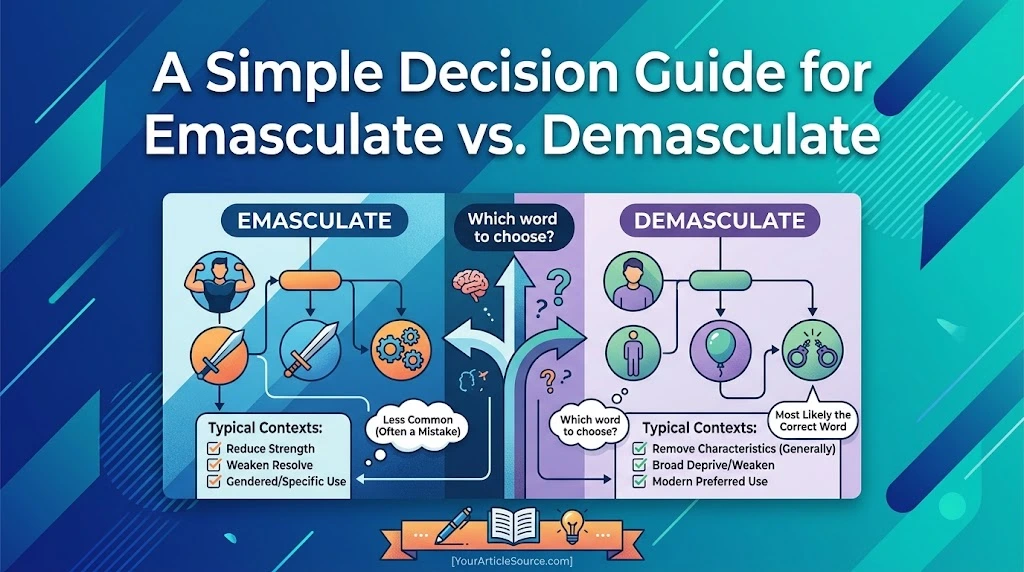
When you’re unsure which word to use, follow this quick guide.
Do you mean “remove male reproductive structures”?
|
YES
↓
EMASCULATE
NO
↓
Do you mean “remove or weaken masculine identity”?
|
YES
↓
EMASCULATE
NO
↓
Do you mean “make weaker or less effective”?
|
YES
↓
WEAKEN / UNDERMINE
NO
↓
Do you mean “take away authority or power”?
|
YES
↓
DISEMPOWER / UNDERMINE
If the choice is strictly emasculate vs. demasculate, choose emasculate in standard formal English.
Emasculate vs. Demasculate: Quick Reference
| If you want to say… | Use… |
| Castrate a male | Emasculate |
| Remove male reproductive structures from a flower | Emasculate |
| Make something less effective | Emasculate or weaken |
| Take away institutional authority | Emasculate, weaken, or disempower |
| Make a man feel deprived of masculine identity | Emasculate |
| Remove masculinity using an uncommon formation | Demasculate is possible in rare usage but usually not the best choice |
| Write clear formal English | Prefer emasculate or a more precise established synonym |
The easiest memory trick is simple:
Emasculate is the established word. Demasculate may look logical, but it isn’t the usual standard choice.
Frequently Asked Questions About Emasculate vs. Demasculate
What does “emasculate” mean?
Emasculate can mean to castrate or deprive a male of reproductive function. Figuratively, it can mean to make someone or something weaker, less effective, less powerful, or less authoritative. It can also describe a perceived loss of masculine identity.
Is “demasculate” a real word?
Demasculate does appear in some English lexical sources with a meaning related to removing masculinity. However, it is rare and much less established than emasculate. For formal or general writing, emasculate or a more precise synonym is usually the safer choice.
Is “demasculate” the opposite of “emasculate”?
No. English doesn’t treat these words as a clean opposite pair.
Demasculate may look as though it should be formed as the opposite or alternative of emasculate, but emasculate has its own Latin historical development. It isn’t simply a modern word created from masculate with an e- prefix.
Where does “emasculate” come from?
It comes from Latin emasculare, related to masculus, meaning male or masculine. English began using the word around the early seventeenth century.
What does “emasculate” mean in botany?
In botany and plant breeding, emasculate means to remove stamens, anthers, or other pollen-producing male structures from a flower to prevent unwanted self-pollination. Breeders use the technique when they want controlled crosses between selected plants.
Why do plant breeders emasculate flowers?
The main purpose is to prevent self-fertilization.
If a breeder wants pollen from one selected plant to fertilize another plant, pollen from the female parent must not interfere with the planned cross. Removing the male structures helps control which pollen reaches the flower’s female reproductive structures.
What is the difference between emasculate and castrate?
Castrate specifically refers to removing or disabling male reproductive capability.
Emasculate can include that literal meaning but also has broader figurative and botanical meanings.
So castrate is often more precise in a strictly biological context.
Can “emasculate” mean “weaken”?
Yes.
Modern dictionaries recognize the figurative meaning of emasculate as making someone or something less powerful or effective. For example, a law can be emasculated if amendments strip away much of its practical force.
Is “emasculate” always about men?
No.
The figurative verb can describe organizations, laws, policies, reports, institutions, and other things that have been weakened.
For example:
The amendments emasculated the proposal.
That sentence refers to the proposal’s effectiveness rather than anyone’s gender.
Is “emasculate” offensive?
Not automatically.
It is an established dictionary word with legitimate literal, figurative, and technical uses. However, its figurative connection to masculinity can make it sensitive in discussions about gender roles.
If the intended meaning is simply “weaken,” weaken may be clearer and less loaded.
What word should I use instead of “demasculate”?
It depends on your meaning.
Use:
- weaken for reduced strength
- undermine for reduced confidence or effectiveness
- disempower for lost authority
- diminish for reduced importance or force
- emasculate when the established word genuinely fits
Don’t choose a synonym merely because it sounds sophisticated. Choose the one that tells readers exactly what happened.
Conclusion: Emasculate vs. Demasculate
The difference between emasculate vs. demasculate becomes much easier once you stop treating the words as a simple prefix puzzle.
Emasculate is the established English word. It has a long history dating to Latin and has several recognized meanings. It can describe literal castration, figurative loss of power or effectiveness, perceived loss of masculine identity, and a specialized process in plant breeding.
Demasculate is far less common. Some sources record it as an English formation meaning to remove masculinity, so calling it completely nonexistent would be too absolute. Still, it isn’t the normal choice for formal or general English.
The best rule is therefore straightforward:
When choosing between “emasculate” and “demasculate,” use “emasculate” unless you have a specific reason to use the rare form.
And when emasculate itself feels too broad or emotionally loaded, don’t force a synonym into the sentence. Choose the precise word that matches the idea: weaken, undermine, disempower, diminish, or reduce.
That’s the real difference. Good word choice isn’t about picking the most complicated term. It’s about making the intended meaning impossible to miss.