
Have you ever wondered whether the correct plural is tomatoes or tomatos? You’re not alone. This small spelling question often causes confusion because many English nouns ending in -o form their plurals by simply adding -s. However, tomato follows a different pattern. The correct plural spelling is tomatoes, while tomatos is considered incorrect in standard English.
Understanding this spelling isn’t just about memorizing one word. It also helps you understand English plural rules, plural nouns, and the way certain words ending in -o change when they become plural. Words such as potato, hero, echo, and cargo commonly follow a similar pattern by taking -es.
At the same time, English contains plenty of exceptions. Words such as photo, piano, radio, and video normally take -s instead. That’s why the pluralization of nouns ending in -o can seem inconsistent.
In this guide, you’ll learn why tomatoes is correct, why tomatos is wrong, how the plural of tomato is formed, and which other English nouns follow similar spelling patterns. By the end, you’ll have a simple rule you can confidently apply in your writing.
Tomatoes vs. Tomatos: Which Spelling Is Correct?
Let’s settle the main question first.
Tomatoes is correct.
Tomatos is incorrect in standard English.
The basic forms look like this:
| Form | Correct? | Meaning |
| tomato | ✅ Yes | One tomato |
| tomatoes | ✅ Yes | More than one tomato |
| tomatos | ❌ No | Nonstandard spelling |
So if you’re writing a recipe, school assignment, article, menu, grocery list, or professional document, use tomatoes.
For example:
- I bought three tomatoes.
- These tomatoes are ripe.
- She added two chopped tomatoes to the sauce.
- The garden produced hundreds of tomatoes this summer.
Notice the spelling carefully. The plural isn’t formed by attaching s directly to tomato. Instead, English uses -es:
tomato → tomatoes
Cambridge’s grammar guidance specifically lists tomato → tomatoes among nouns ending in -o that take -es.
Why Is the Plural of Tomato “Tomatoes”?
The spelling tomatoes comes from an established English plural pattern. Some nouns ending in -o take -es when they become plural.
For example:
- tomato → tomatoes
- potato → potatoes
- hero → heroes
- echo → echoes
- cargo → cargoes
- torpedo → torpedoes
However, English refuses to make things quite that easy.
Other nouns ending in -o take only -s:
- photo → photos
- piano → pianos
- radio → radios
- video → videos
- memo → memos
- disco → discos
Cambridge notes this distinction directly, giving tomato, echo, cargo, and hero as examples that take -es, while video, disco, piano, and photo take -s.
That’s why the rule shouldn’t be reduced to:
“Every word ending in -o gets -es.”
That statement is simply wrong.
A better way to understand it is this:
Some English nouns ending in -o traditionally form their plurals with -es, while others take -s. The plural form depends on the individual word and its established usage.
And tomato is firmly in the -es group.
The Spelling Rule for Words Ending in -O
English pluralization usually begins with a straightforward rule: add -s to a regular singular noun.
For example:
- book → books
- car → cars
- table → tables
- garden → gardens
But spelling patterns can change the ending. English sometimes adds -es rather than simply adding -s.
For nouns ending in certain sounds, -es helps create the regular plural form. Words ending in -s, -x, -z, -ch, and -sh, for example, commonly take -es. Cambridge’s grammar guidance explains these standard plural patterns.
Words ending in -o are different. They form a mixed category.
Consonant + O Words That Commonly Take -ES
Several familiar words ending in a consonant plus -o traditionally form their plurals with -es.
Examples include:
| Singular | Plural |
| tomato | tomatoes |
| potato | potatoes |
| hero | heroes |
| echo | echoes |
| cargo | cargoes |
| torpedo | torpedoes |
The pattern is especially familiar with tomato and potato.
That’s why the pair makes a useful comparison:
tomato → tomatoes
potato → potatoes
Both words use -es in their standard plural forms.
Words Ending in -O That Take Only -S
Now consider these:
| Singular | Plural |
| photo | photos |
| piano | pianos |
| radio | radios |
| video | videos |
| memo | memos |
| disco | discos |
| zoo | zoos |
Here, adding -s is standard.
Cambridge lists examples such as radios and videos as exceptions to the common -o + -es pattern.
This difference matters because learners sometimes create spellings such as photoses or pianoes after learning that tomato becomes tomatoes. Those forms don’t follow standard modern English usage.
Why the Rule Has Exceptions
The reason English behaves this way is historical.
English has borrowed thousands of words from other languages. Those words entered the language at different times and often retained or developed different plural patterns. Over centuries, spelling conventions also became more standardized.
As a result, modern English contains several overlapping patterns.
Think of English pluralization like an old neighborhood. Most houses follow familiar building plans, but a few were built decades earlier under different rules. You can spot the general pattern, but you can’t always predict every detail from the street alone.
That’s exactly what happens with nouns ending in -o.
Tomato, Tomatoes, and Tomatos: A Side-by-Side Comparison
The easiest way to eliminate confusion is to compare the three forms directly.
| Word | Status | Explanation |
| tomato | Correct | Singular noun |
| tomatoes | Correct | Standard plural noun |
| tomatos | Incorrect | Not the standard English plural |
“Tomato” Means One
Use tomato when you’re referring to one fruit or plant.
Examples:
I sliced one tomato for the sandwich.
The tomato is still green.
She planted a tomato in the backyard.
“Tomatoes” Means More Than One
Use tomatoes when you’re referring to two or more.
Examples:
I bought six tomatoes.
The tomatoes are ready to harvest.
Add the chopped tomatoes to the pan.
“Tomatos” Is Not the Standard Plural
The spelling tomatos might look logical because many English plurals simply add -s.
However, standard dictionaries don’t use it as the plural of tomato. Cambridge lists tomatoes as the plural form.
So this:
We bought five tomatos.
should be:
We bought five tomatoes.
That extra e is part of the standard spelling.
Where the Word “Tomato” Comes From
The history of tomato helps explain why English spelling sometimes feels less predictable than it should.
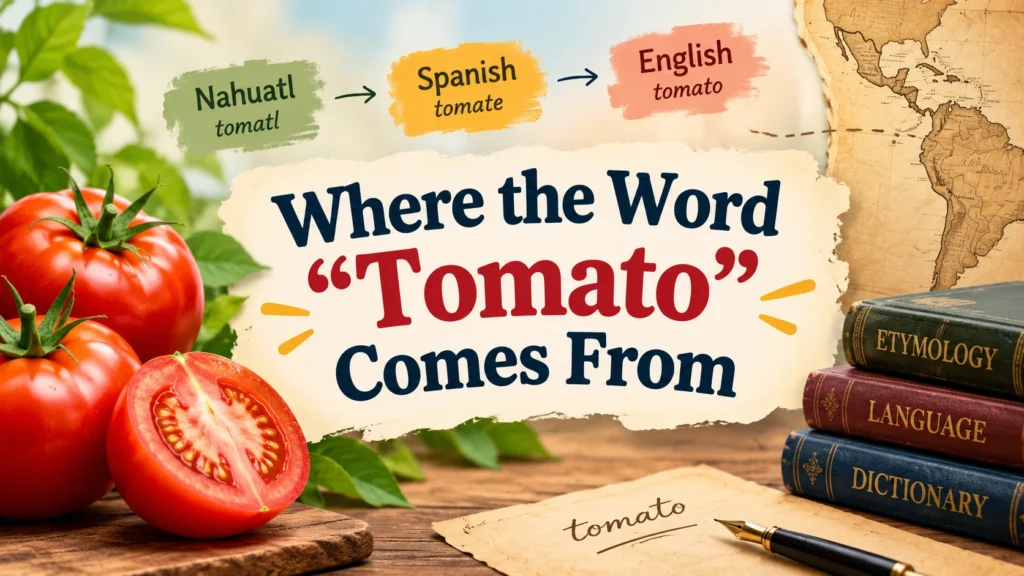
The modern English word dates to the eighteenth century. The earlier English form tomate came from Spanish tomate, which came from tomatl, a Nahuatl word associated with the fruit. The Online Etymology Dictionary dates the English form tomato to 1753 and the earlier English tomate to around 1600.
The word traveled across languages before settling into its modern English form.
A simplified path looks like this:
Nahuatl tomatl → Spanish tomate → English tomate → English tomato
The modern spelling may also have been influenced by potato, which was already established in English.
That connection is particularly interesting because potato and tomato now share the same familiar plural pattern:
potato → potatoes
tomato → tomatoes
The history doesn’t mean that the plural tomatoes directly comes from Nahuatl or Spanish. English created its plural according to English grammatical conventions after adopting the noun.
How to Use “Tomatoes” Correctly in a Sentence
Knowing the spelling is only half the job. You also need to know how the plural behaves in a sentence.
“Tomatoes” as a Plural Noun
Use tomatoes when the noun refers to multiple individual tomatoes.
Examples:
- The farmer harvested tomatoes this morning.
- We need four tomatoes for the recipe.
- Fresh tomatoes taste excellent in salads.
- The market sells several varieties of tomatoes.
Because tomatoes is countable, you can use numbers directly with it:
- one tomato
- two tomatoes
- ten tomatoes
- fifty tomatoes
“Tomato” as a Singular Noun
Use the singular form when referring to one tomato.
Examples:
- I cut one tomato into slices.
- This tomato is unusually large.
- She planted a tomato in the garden.
- He picked a ripe tomato.
The article also changes naturally with the number:
a tomato
but:
three tomatoes
You wouldn’t write a tomatoes because the article a requires a singular countable noun.
“Tomatoes” in Different Sentence Positions
The plural can appear almost anywhere a noun can appear.
As the subject:
Tomatoes grow well in warm conditions.
As the object:
She washed the tomatoes before cooking.
After a preposition:
The sauce was made with fresh tomatoes.
With an adjective:
The ripe tomatoes filled the basket.
With a quantity:
We purchased twelve tomatoes.
This makes the distinction practical rather than merely grammatical. Once you recognize whether you’re talking about one or several, the correct form becomes much easier to choose.
Common Mistakes With “Tomatoes”
Even though the correct spelling is straightforward, several mistakes appear regularly.
Writing “Tomatos” Instead of “Tomatoes”
This is the most direct error.
The writer knows that tomato needs a plural ending but applies the ordinary -s pattern:
tomato + s = tomatos
That seems logical at first glance. Unfortunately, English doesn’t use that form.
The standard spelling is:
tomato + es = tomatoes
The safest approach is to treat tomatoes as the established plural rather than trying to reconstruct it every time.
Assuming Every -O Word Uses the Same Plural Rule
This mistake comes from learning an oversimplified grammar rule.
Someone learns:
“Words ending in -o take -es.”
Then they encounter:
- photo → photos
- piano → pianos
- radio → radios
Suddenly the rule falls apart.
The better lesson is that -o nouns have mixed plural patterns.
| -ES Plural | -S Plural |
| tomato → tomatoes | photo → photos |
| potato → potatoes | piano → pianos |
| hero → heroes | radio → radios |
| echo → echoes | video → videos |
| cargo → cargoes | memo → memos |
Cambridge’s grammar resources make the same distinction and recommend using a good learner’s dictionary when a plural is uncertain.
Confusing Spelling With Pronunciation
Another source of confusion is the assumption that spelling must perfectly mirror pronunciation.
English doesn’t work that way.
Plural endings can change pronunciation depending on the final sound of the singular word. The written -es in tomatoes shouldn’t be treated as a simple “add an extra sound” rule that applies identically to every noun.
The important point for spelling is simpler:
tomatoes is the established written plural form.
Don’t try to spell the word by guessing from how the ending sounds.
Relying on Autocorrect
Spellcheck can catch many mistakes, but it isn’t a grammar teacher.
If you’re unsure whether a plural is tomatoes, tomatos, or another form, consult a reliable dictionary. Dictionary entries provide the established form rather than forcing you to guess from a general rule.
Other Common Nouns Like “Tomato”
Tomato isn’t an isolated example.
Several common English nouns ending in -o use -es in their standard plurals.
Potato → Potatoes
This is probably the closest spelling comparison.
one potato
two potatoes
Because tomato and potato have such similar endings, learning them together can make the spelling easier to remember.
Hero → Heroes
The plural of hero is heroes.
The heroes saved the town.
The spelling doesn’t become heros in standard English.
Echo → Echoes
The standard plural is echoes.
We heard several echoes in the canyon.
Cargo → Cargoes
The plural cargoes is also established.
The ships carried different cargoes.
Torpedo → Torpedoes
The standard plural torpedoes follows the same general pattern.
These examples show why tomatoes isn’t an arbitrary spelling. It belongs to a recognizable group of English nouns.
Read More : ION Meaning: What ION Means in Texting and Online
Important Exceptions: -O Words That Form Plurals With -S
Here’s where the topic gets more interesting.
Not every noun ending in -o follows the tomato → tomatoes pattern.
Consider photo.
The plural is:
photo → photos
Not photoes.
The same applies to:
piano → pianos
radio → radios
video → videos
memo → memos
disco → discos
Cambridge explicitly identifies these -s plurals alongside nouns such as tomato and potato, which take -es.
Why Does English Have Both Patterns?
Several factors have influenced these patterns over time, including word history, borrowing, spelling conventions, and established usage.
There’s no single modern rule that perfectly predicts every plural.
That’s why this advice works better than memorizing a rigid formula:
Learn the common pattern, then check the individual word when you’re unsure.
This approach saves you from forcing every noun into the same grammatical box.
What About “Volcanos” and “Volcanoes”?
Volcano is an especially useful example because both volcanoes and volcanos occur in English.
This differs from tomato, where tomatoes is the standard plural.
That’s an important distinction.
English sometimes allows more than one plural form for a noun. Other words have one strongly established standard form.
So you shouldn’t use volcano to argue that tomatos must also be acceptable.
These are separate lexical questions:
- tomato → tomatoes
- potato → potatoes
- photo → photos
- piano → pianos
- volcano → volcanoes / volcanos
The existence of alternative plural forms for one word doesn’t automatically create alternatives for another.
Is “Tomatos” Ever Correct?
For standard modern English, no. If you’re asking for the normal plural of tomato, use tomatoes.
You may encounter tomatos on websites, social media posts, handwritten notes, product listings, or informal messages. Its appearance doesn’t make it a standard plural.
Online writing contains plenty of spelling mistakes. Search engines can also index incorrect forms because people actually use them.
That creates an important distinction:
A spelling appears online ≠ the spelling is standard English.
For formal writing, use the dictionary-supported form:
tomatoes
American English vs. British English: Is the Spelling Different?
No major spelling difference exists here.
American English and British English both use:
tomato → tomatoes
The singular pronunciation can differ between major varieties of English, but the plural spelling remains tomatoes.
Cambridge’s dictionary entry gives tomato with both UK and US pronunciation information and lists tomatoes as the plural.
So you don’t need to worry about choosing between tomatoes and tomatos based on whether you’re writing for an American or British audience.
Tomatoes works in both.
A Simple Way to Remember “Tomatoes”
The best memory trick doesn’t require an elaborate acronym.
Think of the pair:
tomato → tomatoes
Then connect it with:
potato → potatoes
The two words share the same familiar plural ending.
Another useful comparison is:
tomato ≠ photo
Why?
Because:
tomato → tomatoes
photo → photos
This contrast reminds you that English doesn’t treat every -o noun identically.
The Most Reliable Memory Pattern
If you’re unsure, remember these four:
| Singular | Plural |
| tomato | tomatoes |
| potato | potatoes |
| photo | photos |
| piano | pianos |
This tiny table captures the important point better than a long list of artificial mnemonics.
A Practical Case Study: How the Error Happens
Consider someone writing a grocery list:
6 tomatos
2 cucumbers
1 lettuce
The writer understands the meaning perfectly. The problem is simply that they have applied the most common English plural pattern mechanically.
They know:
tomato + s
should mean more than one tomato.
That reasoning works for countless English nouns:
- apple → apples
- orange → oranges
- carrot → carrots
- cucumber → cucumbers
But tomato belongs to a different plural pattern.
The corrected list becomes:
6 tomatoes
2 cucumbers
1 lettuce
This example shows why spelling mistakes often come from reasonable guesses based on incomplete rules. The writer isn’t confused about the noun’s meaning. They’re applying a rule that works in many other cases.
That’s why learning the exception—or more accurately, the established pattern—is more useful than simply memorizing that tomatos looks wrong.
Tomatoes in Real-World Writing
The plural tomatoes appears in many everyday contexts.
Recipes
Chop four tomatoes and add them to the pan.
Gardening
These tomatoes need plenty of sunlight.
Grocery Lists
Buy onions, garlic, and tomatoes.
Restaurant Menus
Grilled tomatoes served with roasted vegetables.
Food Writing
Fresh tomatoes add acidity and sweetness to the dish.
Academic or Technical Writing
The study examined how environmental conditions affected tomatoes during cultivation.
In each case, tomatoes functions as an ordinary plural noun.
The word doesn’t become tomatos simply because the context changes.
Quick Reference: Tomato Plural Rules
Here’s the entire lesson in one table.
| Question | Correct Answer |
| Singular of tomatoes | tomato |
| Plural of tomato | tomatoes |
| Is tomatos standard? | No |
| Plural ending used | -es |
| US spelling | tomatoes |
| UK spelling | tomatoes |
| Similar plural | potato → potatoes |
| Contrasting example | photo → photos |
| Another -es example | hero → heroes |
| Another -s example | piano → pianos |
The key distinction is easy to remember:
tomato → tomatoes
not:
tomato → tomatos
Why “Tomatoes” Is Better Than a Simple “Add S” Rule
English learners often want a single formula that solves every spelling problem.
Unfortunately, English pluralization doesn’t offer one.
The broad rule is:
Add -s to many regular nouns.
But certain endings trigger different spelling patterns. Some nouns ending in -o take -es while others take -s. Cambridge’s grammar guidance explicitly documents both patterns.
This means the most accurate approach combines rules with vocabulary knowledge.
You can learn the general pattern:
Some -o nouns take -es.
Then learn common examples:
tomato → tomatoes
potato → potatoes
hero → heroes
And recognize common exceptions:
photo → photos
piano → pianos
radio → radios
That approach reflects how English actually works rather than pretending the language is more regular than it is.
Frequently Asked Questions About Tomatoes
Is “tomatos” a correct spelling?
No. Tomatos isn’t the standard English plural of tomato. The correct plural is tomatoes. Cambridge lists tomatoes as the plural form.
What is the plural of tomato?
The plural of tomato is tomatoes.
one tomato
two tomatoes
Why does tomato become tomatoes?
Tomato belongs to a group of nouns ending in -o that traditionally form their plurals with -es. English also has many -o nouns that take only -s, so the rule isn’t universal.
Why isn’t the plural simply “tomatos”?
Because English has established tomatoes as the standard plural spelling. Although adding -s works for many nouns, it doesn’t work for every noun ending in -o.
Do American and British English use “tomatoes”?
Yes. Tomatoes is the standard plural in both American and British English.
What is the plural of potato?
The plural of potato is potatoes.
This makes potato a useful comparison when remembering tomato → tomatoes.
Do all words ending in -o take -es?
No.
Some take -es:
- tomato → tomatoes
- potato → potatoes
- hero → heroes
- echo → echoes
Others take -s:
- photo → photos
- piano → pianos
- radio → radios
- video → videos
Cambridge documents both patterns.
What are some words ending in -o that take -s?
Common examples include photos, pianos, radios, videos, memos, and discos.
Is “volcanos” or “volcanoes” correct?
Both volcanos and volcanoes are used in English. This is an example of a noun with alternative plural forms. It shouldn’t be used as evidence that tomatos is a standard alternative to tomatoes.
How can I remember the spelling of tomatoes?
Pair it with potatoes:
tomato → tomatoes
potato → potatoes
Then remember that not every -o word follows the same pattern. For example, photo → photos.
Conclusion: Tomatoes Is the Correct Plural of Tomato
The answer to “tomatoes or tomatos?” is clear: tomatoes is the correct standard plural spelling.
Use:
tomato for one
and:
tomatoes for more than one.
The spelling follows an established English plural pattern in which some nouns ending in -o take -es. Other nouns ending in -o take only -s, which is why the broader rule has to be learned with its exceptions.
The most useful examples are easy to keep together:
| Singular | Plural |
| tomato | tomatoes |
| potato | potatoes |
| hero | heroes |
| photo | photos |
| piano | pianos |
So if tomatos ever looks tempting, stop before dropping that final e.
The correct spelling is simply:
Tomato → Tomatoes.
Once that pattern becomes familiar, this common spelling question becomes one less little trap in English.