

Complete vs. Completed may seem like a small grammar distinction, but these two words don’t always work in the same way. Both are connected to the idea of something being whole, done, or finished, yet their grammar, meaning, and sentence structure can differ. Understanding that difference can make your English writing, grammar, and everyday communication much clearer.
Complete is commonly used as an adjective to describe something that is whole, finished, or containing all necessary parts. For example, you might say, “The report is complete.” It can also function as a verb, as in “Please complete the application.” Completed, on the other hand, is the past tense and past participle of the verb complete. It normally describes an action that has been carried out or something that has reached its finished state.
The distinction becomes especially useful when you’re choosing between complete and completed in a sentence. Factors such as verb tense, sentence structure, subject, and context can determine which form sounds natural.
In this guide, you’ll learn the meaning of complete, the meaning of completed, their grammatical differences, common examples, and simple ways to choose the correct word.
Complete vs. Completed — Why Are These Words Confusing?
The confusion starts because complete has more than one grammatical role.
As a verb, complete means to finish something or provide the remaining part needed to make something whole. Cambridge Dictionary gives examples involving completing studies, forms, projects, and collections.
As an adjective, complete can mean whole, containing all the necessary parts, or finished. For example:
The report is complete.
Here, complete describes the report’s current condition.
By contrast, completed is the past simple and past participle form of the verb complete.
For example:
Maria completed the report yesterday.
The sentence describes an action that happened in the past.
This creates the central distinction:
| Word | Common grammatical role | Basic idea |
| complete | Verb | Finish or make something whole |
| complete | Adjective | Whole, finished, or containing all parts |
| completed | Simple past verb | Finished an action in the past |
| completed | Past participle | Used with auxiliary verbs or in passive constructions |
| completed | Adjectival use | Describes something that has been finished |
The tricky part is that meaning alone doesn’t always tell you which word to choose. Grammar does.
Complete vs. Completed: The Core Difference at a Glance
Here’s the quickest comparison:
| Sentence | What it does | Focus |
| I complete the report every Friday. | Uses complete as a verb | Habitual action |
| Please complete the form. | Uses complete as a verb | Instruction |
| The report is complete. | Uses complete as an adjective | Current state |
| I completed the report yesterday. | Uses completed as a past-tense verb | Past action |
| I have completed the report. | Uses completed as a past participle | Completed action with present relevance |
| The report was completed yesterday. | Uses completed in passive voice | Past completion |
| The report has been completed. | Uses completed in present perfect passive | Completed action with present relevance |
A useful shortcut is this:
If you’re describing something as whole or finished, “complete” may be the adjective you need. If you’re describing the action of finishing something, “completed” may be the verb form required by the tense.
But don’t turn that shortcut into an absolute rule. Context still matters.
Understanding “Complete”
Complete as an Adjective
When complete works as an adjective, it describes a noun.
It can mean whole, finished, or containing all the required parts. Cambridge Dictionary lists complete as an adjective meaning “with all the parts,” and it also recognizes a finished-state meaning.
Consider these examples:
- The collection is complete.
- We need a complete list of participants.
- The report is complete.
- She bought the complete set.
- The application is complete.
- The explanation was complete and easy to follow.
Notice something important: complete doesn’t always mean an activity has just ended.
In “a complete set,” the word means the set contains all the expected pieces.
In “the report is complete,” it means the report has reached the required state.
In “a complete explanation,” it can mean the explanation covers everything necessary.
That’s why complete has a broader meaning than simply “finished.”
Complete as an Adjective: Whole vs. Finished
The context can slightly shift the meaning.
Compare:
I bought the complete collection.
Here, complete means the collection contains all the relevant items.
Now compare:
The report is complete.
Here, complete means the report has reached a finished state.
The same word works naturally in both sentences because the underlying idea is nothing essential is missing.
Everyday Examples of “Complete” as an Adjective
You’ll encounter adjective complete in everyday and professional English.
At work
The proposal is complete and ready for review.
At school
Your assignment is complete.
In shopping
We finally have the complete set.
In documentation
The form must be complete before submission.
In conversation
My collection is finally complete.
The word often appears after forms of be:
- is complete
- are complete
- was complete
- were complete
It can also appear before nouns:
- complete report
- complete application
- complete set
- complete collection
- complete record
Complete as a Verb
Now the picture changes.
As a verb, complete means to finish something or provide what is necessary to make something whole. Cambridge specifically defines it as finishing something and as making something whole.
For example:
Please complete the application.
Here, complete isn’t describing the application. It’s telling someone what action to perform.
Other examples include:
- Complete the assignment before Friday.
- She needs to complete the training.
- We must complete the project this month.
- He completed the final section of the form.
- They completed the bridge ahead of schedule.
The verb is usually transitive, meaning it normally takes an object:
complete the form
complete the project
complete the assignment
complete the course
That structure makes the action easy to identify.
Conjugation of the Verb “Complete”
The main forms are straightforward:
| Form | Example |
| Base form | complete |
| Third-person singular | completes |
| Present participle | completing |
| Simple past | completed |
| Past participle | completed |
For example:
- I complete the report each week.
- She completes the report each week.
- They are completing the final stage.
- He completed the report yesterday.
- We have completed the report.
The important point is that completed is not merely an alternative spelling of complete. It is the past form and past participle of the verb.
Cambridge’s American English entry explicitly identifies completed as both the past tense and past participle of complete.
Understanding “Completed”
Completed as the Simple Past Verb
The simplest use of completed is the simple past.
She completed the assignment yesterday.
The action happened in the past.
The sentence has this basic structure:
Subject + completed + object
Examples:
- James completed the training last week.
- The team completed the installation on Monday.
- We completed the survey yesterday.
- They completed the final inspection in June.
Past-time expressions often reinforce this meaning:
- yesterday
- last night
- last week
- last year
- two days ago
- in 2025
- on Monday
For example:
The company completed the project in March.
The sentence focuses on an action that occurred at a past point.
Completed as a Past Participle
Completed also serves as the past participle of complete.
That’s why you see it after auxiliary verbs such as have, has, and had.
Present perfect
She has completed the course.
Present perfect passive
The course has been completed.
Past perfect
She had completed the course before the semester ended.
Past perfect passive
The course had been completed before the audit began.
The form completed stays the same. The auxiliary verbs establish the tense and voice.
This distinction is crucial.
In:
She completed the course.
Completed carries the simple past tense.
In:
She has completed the course.
Has carries the present-tense auxiliary function while completed is the past participle.
Completed as an Adjective
Past participles can also appear in adjective-like positions. Cambridge notes that many English past and present participles can function adjectivally.
Consider:
The completed project was presented to the client.
Here, completed tells us which project we’re talking about: the one that has reached completion.
Compare it with:
The complete project was presented to the client.
This sentence can also be grammatical. However, the emphasis can differ.
Completed project naturally highlights the fact that the project has been finished.
Complete project can emphasize that the project is whole or contains all required components.
The distinction isn’t always dramatic. Native English usage allows some overlap. Still, understanding the difference helps you choose the word deliberately.
Complete vs. Completed: How Grammar Shapes Meaning
The biggest difference between complete vs. completed often comes down to state versus action.
State: “Complete”
The project is complete.
You’re describing the project’s condition.
The project has reached the required state. Nothing essential remains.
Action: “Completed”
The team completed the project.
You’re describing what the team did.
The subject performed the action.
This distinction becomes even clearer when you compare:
The project is complete.
with:
The project was completed by the team.
The first sentence focuses on the resulting state.
The second focuses more directly on the completion event and uses passive voice.
Neither sentence is automatically “better.” They simply organize information differently.
“The Project Is Complete” vs. “The Project Was Completed”
These sentences look similar because both communicate that the project reached its endpoint.
However, their grammatical structures differ.
The project is complete
Here, complete is an adjective.
The structure is:
Subject + linking verb + adjective
The project + is + complete.
The sentence describes the project’s state.
The project was completed
Here, completed is part of a passive verb construction.
The structure is:
Subject + be + past participle
The project + was + completed.
The sentence presents the project as something that someone completed.
That distinction matters when you want to emphasize who did something or when an action occurred.
Complete vs. Completed: Tense-Based Usage Guide
Simple Present: “Complete” or “Completes”
Use the simple present when discussing routines, repeated actions, general facts, or instructions.
I complete my weekly report every Friday.
She completes the final review before lunch.
For instructions, use the base form:
Complete the form below.
The simple present doesn’t automatically mean that something is happening right now. It often describes a repeated or general action.
Simple Past: “Completed”
Use completed when you describe a finished action in the past.
I completed the report yesterday.
They completed construction last year.
The action belongs to a completed past period.
Present Perfect: “Has/Have Completed”
Use has completed or have completed when the action happened before now and remains relevant to the present situation.
She has completed the required training.
This sentence connects the past action with the present.
For example, someone may now be eligible for the next stage because the training is finished.
Compare:
She completed the training in June.
This sentence gives a specific past event.
She has completed the training.
This sentence emphasizes the current relevance of that completion.
Past Perfect: “Had Completed”
Use had completed when one past action happened before another past event.
The team had completed the testing before the product launched.
There are two past events:
- The team completed the testing.
- The product launched.
The past perfect identifies which happened first.
Passive Voice: “Is Completed” and “Was Completed”
The passive construction uses a form of be + completed.
Examples include:
- is completed
- was completed
- has been completed
- had been completed
- will be completed
For example:
The application was completed by the applicant.
The passive voice puts the application in the subject position.
Compare:
The applicant completed the application.
That’s active voice.
The meaning remains closely related, but the grammatical focus changes.
Complete vs. Completed: “Is Complete” vs. “Is Completed”
This is one of the most common trouble spots.
“Is complete”
The report is complete.
Here, complete is an adjective.
It describes the report’s condition.
“Is completed”
The report is completed by the research team.
Here, completed forms part of a passive construction.
It presents the report as something that is completed through an action.
In ordinary modern English, the first version is often especially natural when you simply want to report status:
The report is complete.
The second can make sense when the sentence needs a passive construction or when the context emphasizes the process or action.
Complete vs. Completed in Questions
Questions make the distinction easier to see.
Asking about current condition
Is the application complete?
You’re asking whether all necessary information or components are present.
Asking whether someone performed the action
Did you complete the application?
You’re asking whether the person finished it.
Asking about present relevance
Have you completed the application?
You’re asking whether the action has been completed by now.
Asking about passive completion
Has the application been completed?
You’re asking whether the application has reached completion without necessarily focusing on who completed it.
These questions may refer to the same form. Yet each one puts the spotlight somewhere different.
Complete vs. Finished: Why They Aren’t Always the Same

Complete and finished overlap heavily. In many situations, either word can work.
For example:
I completed my homework.
I finished my homework.
Both sentences naturally communicate that the homework is done.
Cambridge defines finished as completed, final, or brought to an end.
Still, complete can carry a stronger sense of wholeness or having all required parts.
Consider:
We have a complete set of dishes.
Replacing complete with finished would change the meaning and sound unnatural.
Likewise:
Please complete this form.
is standard and natural.
You could say:
Please finish this form.
That can work in conversation. However, complete is particularly natural for forms, applications, questionnaires, and documents.
The Cambridge Dictionary specifically lists complete for writing all required details on a form or document.
Complete vs. Completed in Project Management
Project management provides a perfect example of how these forms interact.
Imagine a software team preparing a new application.
At 3 p.m., the project manager sends this message:
The development work is complete.
The manager is reporting the project’s current status.
Later, a report might say:
The development team completed the work on September 10.
Now the focus is on the action and its date.
A formal project report might instead state:
The development work was completed on September 10.
That’s passive voice.
A status dashboard could simply display:
Development: Complete
That isn’t a full sentence. It’s a concise status label.
Useful project-management distinctions
| Expression | Main focus |
| Task complete | Current status |
| Task completed | Finished task/status label |
| The team completed the task | Person/team performing the action |
| The task was completed | Passive action |
| The task has been completed | Completed action with present relevance |
| The project is complete | Overall current state |
These differences may seem tiny. In project documentation, though, precision prevents confusion.
Complete vs. Completed in Business Writing
Professional communication often needs to distinguish status from action.
For example:
The report is complete and ready for approval.
This tells the reader the report has reached a usable state.
Now consider:
The analyst completed the report on Tuesday.
This gives information about the action and its timing.
Or:
The report has been completed and submitted for approval.
This connects completion with the current status of the document.
Common professional examples
- Please complete the attached form.
- The application is complete.
- We completed the review yesterday.
- The review has been completed.
- The required documents are complete.
- The final report was completed on schedule.
The right choice depends on the message you need to deliver.
Complete vs. Completed in Education and Academic Writing
Academic contexts use both forms frequently.
Consider:
The student completed the assignment.
This describes an action.
Now:
The assignment is complete.
This describes the assignment’s status.
And:
The assignment has been completed.
This presents completion as an accomplished action with relevance to the current situation.
You might also see:
Students must complete all required coursework.
Here, complete is the base-form verb following must.
That’s an important grammar clue.
After modal verbs such as must, can, should, will, and may, English normally uses the base form:
- must complete
- can complete
- should complete
- will complete
- may complete
Not:
- must completed
- can completed
- should completed
For example:
Students must complete the assignment by Friday.
Complete vs. Completed in Everyday Conversation
Everyday speech tends to favor straightforward structures.
You might hear:
Are you complete?
This is generally not what you want when asking whether someone has finished a task. For a person, the natural question is usually:
Are you finished?
Or:
Have you completed it?
However, for an object or document, complete works naturally:
Is the form complete?
You could also say:
Did you complete the form?
The first asks about the form’s condition.
The second asks whether someone performed the action.
That small distinction is useful far beyond grammar exercises.
Common Mistakes With Complete vs. Completed
Mistake: Using “Completed” After a Modal Verb
Incorrect:
You must completed the form.
Correct:
You must complete the form.
Why?
Because must is a modal verb and it takes the base form.
Mistake: Using “Complete” for a Definite Past Action
Incorrect:
She complete the assignment yesterday.
Correct:
She completed the assignment yesterday.
The word yesterday establishes a past time, so the verb needs the simple past form.
Mistake: Confusing “Is Complete” With “Has Completed”
These aren’t interchangeable.
The report is complete.
The report is in a completed state.
The analyst has completed the report.
The analyst performed the action.
The subject itself changes the meaning.
Mistake: Confusing “Has Completed” With “Has Been Completed”
Compare:
The manager has completed the report.
Active voice. The manager performed the action.
The report has been completed.
Passive voice. The report receives the action.
Both can describe the same underlying event. They simply foreground different information.
Mistake: Assuming “Completed” Is Always Simple Past
This is a common misconception.
Completed can be:
- Simple past
- Past participle
- Adjectival
For example:
She completed the course.
Simple past.
She has completed the course.
Past participle.
The completed course materials were archived.
Adjectival use.
The surrounding grammar tells you which role completed plays.
A Quick Decision Guide for Complete vs. Completed
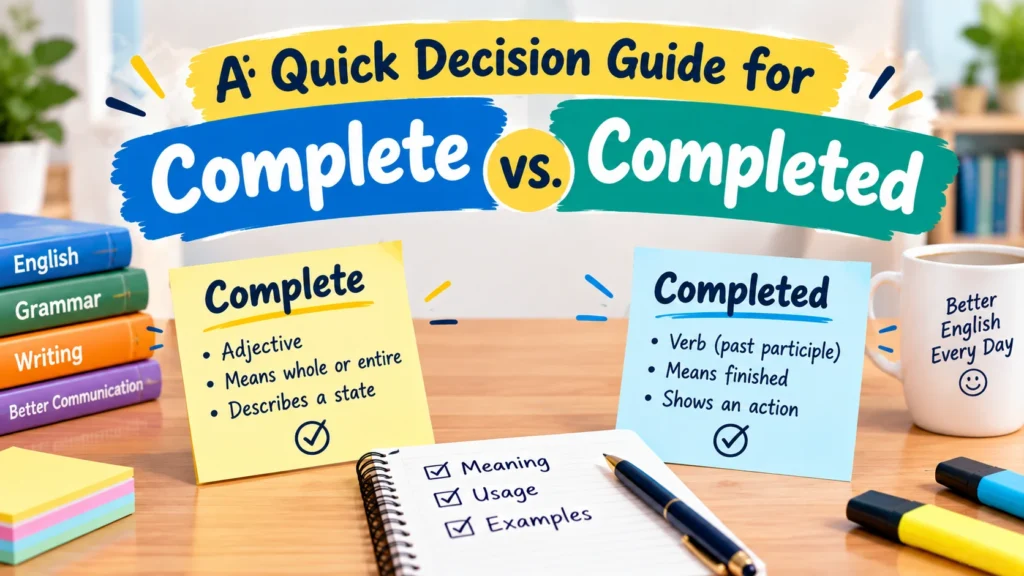
When you’re stuck, ask yourself what you’re trying to say.
Are you telling someone to finish something?
Use complete.
Complete the application.
Are you describing something as whole or finished?
Use complete as an adjective.
The application is complete.
Did someone finish something in the past?
Use completed.
She completed the application yesterday.
Are you using the present perfect?
Use completed after has/have.
She has completed the application.
Are you using the past perfect?
Use completed after had.
She had completed the application before the deadline.
Are you using the passive voice?
Use completed after the appropriate form of be.
The application was completed yesterday.
This simple decision process handles most everyday cases.
Real-World Sentence Comparison
The easiest way to master complete vs. completed is to compare related sentences.
| Sentence | What it emphasizes |
| Complete the checklist. | Instruction |
| The checklist is complete. | Current state |
| She completed the checklist. | Past action |
| She has completed the checklist. | Completed action with present relevance |
| The checklist was completed. | Passive past action |
| The checklist has been completed. | Passive completion with present relevance |
| She had completed the checklist before the meeting. | Earlier past action |
Think of these as different camera angles.
The event stays roughly the same. The grammar changes where the camera points.
Case Study: A Project Nearing Launch
Imagine a company preparing to launch a new website.
The design team has finished the interface. The development team has finished coding. The quality-assurance team has finished testing.
The project manager could write:
The website project is complete.
This communicates the current overall status.
A project report might say:
The development team completed the website on September 12.
Now the report focuses on the team’s action and its date.
A status update could say:
The final testing has been completed.
This emphasizes that testing is now finished.
A formal report might say:
All required testing was completed before launch.
That version places the completed testing in a past context.
What changes?
The underlying situation remains closely connected. The grammar changes the emphasis:
State → The project is complete.
Active action → The team completed the project.
Present perfect → The team has completed the project.
Passive action → The project was completed.
Present perfect passive → The project has been completed.
That’s the heart of the distinction.
Read More : Assume vs. Presume vs. Infer: What’s the Difference and When Should You Use Each?
Practical Exercises: Complete vs. Completed
Choose the form that best fits each sentence.
Fill in the blanks
The instructions are ______.
a) completed
b) complete
She ______ the application yesterday.
a) complete
b) completed
Please ______ every section of the form.
a) complete
b) completed
They have ______ the final inspection.
a) complete
b) completed
The final inspection was ______ before the launch.
a) complete
b) completed
The collection is finally ______.
a) complete
b) completed
Answers
The instructions are complete.
Here, complete is an adjective describing the instructions.
She completed the application yesterday.
The time expression yesterday requires the simple past.
Please complete every section of the form.
This is an instruction, so the base form follows please.
They have completed the final inspection.
The word completed is the past participle used with have.
The final inspection was completed before the launch.
This is a passive construction.
The collection is finally complete.
The adjective describes the collection as whole.
Correct These Common Errors
Error
He has complete the assignment.
Correction
He has completed the assignment.
The present perfect requires the past participle.
Error
She completed the form every Monday.
This could be grammatically possible in a special context. However, if you’re describing a current routine, the natural form is:
She completes the form every Monday.
The simple present expresses a repeated routine.
Error
The report is completed and contains all the required information.
This sentence can be grammatical. However, if the intended meaning is simply that the report is in a finished state, the more direct wording is often:
The report is complete and contains all the required information.
Context determines which emphasis makes sense.
Complete vs. Completed: Quick Reference Table
| Feature | Complete | Completed |
| Base verb | Yes | No |
| Simple past | No | Yes |
| Past participle | No | Yes |
| Adjective | Yes | Can function adjectivally |
| Can mean “whole” | Yes | Less commonly the main focus |
| Can describe a current state | Yes | Yes in suitable adjectival/passive contexts |
| Used for past action | No by itself | Yes |
| Used after has/have/had | No | Yes |
| Used in passive constructions | Not as the participle | Yes |
The most important distinction is simple:
Complete can describe a state or perform the action of finishing. Completed usually marks the finished action through past tense, past participle, or an adjective-like use.
Frequently Asked Questions About Complete vs. Completed
What Is the Main Difference Between “Complete” and “Completed”?
Complete can be an adjective or the base form of the verb. Completed is the simple past and past participle form of complete.
For example:
The project is complete.
describes a state.
The team completed the project.
describes a past action.
Can “Complete” and “Completed” Be Used Interchangeably?
Not generally.
They can overlap in meaning when talking about something that has reached its endpoint. However, grammar determines which form fits the sentence.
The report is complete.
The report was completed yesterday.
Both communicate completion, but the first describes a state while the second uses a passive past construction.
Is “Complete” an Adjective or a Verb?
It can be both.
As an adjective:
The application is complete.
As a verb:
Please complete the application.
Cambridge Dictionary lists both adjective and verb uses.
Is “Completed” Only Used in the Past Tense?
No.
It is the simple past and past participle of complete.
For example:
She completed the task.
Simple past.
She has completed the task.
Past participle.
The completed task was reviewed.
Adjectival use.
What Is the Difference Between “Is Complete” and “Is Completed”?
Is complete uses complete as an adjective:
The report is complete.
It describes the report’s condition.
Is completed uses completed as part of a passive construction:
The report is completed by the research team.
It presents the report as receiving the completion action.
What Is the Difference Between “Has Completed” and “Has Been Completed”?
The first is active:
The engineer has completed the inspection.
The engineer performed the action.
The second is passive:
The inspection has been completed.
The inspection receives the action.
Is “Complete” More Formal Than “Finished”?
The two words overlap, but they aren’t identical in every context.
Finished commonly describes something that has ended or been completed. Complete can also mean whole or containing all necessary parts.
For example:
I finished my homework.
sounds perfectly natural.
But:
I bought the complete set.
uses complete in its “whole set” sense. Finished set would not normally communicate the same meaning.
Which Is Correct: “The Work Is Complete” or “The Work Is Completed”?
Both can be grammatical depending on context.
The work is complete uses complete as an adjective and describes the current state.
The work is completed uses completed in a passive construction and focuses more on the action of completion.
If you’re simply reporting status, “The work is complete” is a direct and natural construction.
If you’re discussing the completion process or using a passive structure, “The work is completed” may fit the context.
Conclusion: Complete vs. Completed Made Simple
The difference between complete vs. completed becomes much easier once you stop looking only at the -ed ending.
Complete has several jobs. It can work as a verb meaning “finish” or “make whole.” It can also work as an adjective describing something whole, finished, or containing all necessary parts.
Completed is the simple past and past participle of complete. That makes it the form you need in sentences such as “She completed the assignment” and “She has completed the assignment.”
The most useful distinction to remember is this:
Complete can describe the state of something or express the action of finishing it. Completed marks the past or participial form of that action and can also describe something as finished.
When you’re unsure, look at the surrounding grammar.
Are you giving an instruction?
Complete the form.
Are you describing a current state?
The form is complete.
Are you talking about a past action?
She completed the form.
Are you using the present perfect?
She has completed the form.
Are you using the passive?
The form was completed.
Once you see those patterns, complete vs. completed stops being a guessing game. The words aren’t competing with each other. They’re different grammatical tools that let you describe actions, states, time, and focus with much greater precision.