
Have you ever written something that seemed clear to you but left your readers completely unmoved? The word resonate describes the kind of connection that goes beyond simply being understood. It can mean producing or filling something with sound, but it can also describe an idea, story, message, or experience that creates a strong emotional connection or continues to have a powerful effect on people.
That’s where the confusion between resignate or resonate often begins. Although these words may look and sound similar, they aren’t interchangeable. Resonate is the established English verb used when something connects with an audience, creates an emotional response, or has lasting meaning. For example, you might say, “Her story resonated with thousands of readers.” The spelling resignate is generally not the word you want when expressing this idea.
Understanding the difference matters in professional writing, academic writing, content creation, creative writing, and everyday communication. Choosing the right word can make your sentence sound natural and precise.
In this guide, you’ll learn what resonate means, why resignate causes confusion, how to use resonate in a sentence, and which common expressions you should remember. By the end, you’ll have a simple rule for avoiding this spelling mistake and making your writing sound more polished.
Resignate vs. Resonate: Which Word Is Correct?
The short answer is simple:
Use “resonate,” not “resignate,” when you mean to create a strong emotional, intellectual, or auditory effect.
Here is the basic comparison:
| Word | Standard choice for this meaning? | Meaning | Example |
| resonate | Yes | Create a continuing sound or have a strong effect or connection | “Her story resonated with me.” |
| resignate | No, for the intended modern meaning | Not the standard form to use in ordinary English | “Her story resignated with me.” ❌ |
Oxford lists resonate as a verb with several established meanings, including producing a deep, continuing sound and reminding someone of something or matching what they think or believe.
Cambridge likewise treats resonate as an established verb and includes both sound-related and figurative meanings.
That gives you a useful rule:
If you mean “connect,” “strike a chord,” “have a meaningful effect,” or “produce a continuing sound,” use resonate.
A Few Quick Examples
- “The speaker’s message resonated with the audience.”
- “That song really resonates with me.”
- “Her voice resonated throughout the theater.”
- “The old church resonated with music.”
- “The novel’s central theme resonated with younger readers.”
In all of these sentences, resonate fits naturally.
Why Do People Confuse Resignate and Resonate?
The confusion isn’t mysterious. English contains countless words that look as though they should follow a particular spelling pattern. Sometimes that pattern works. Sometimes it leads you straight into a linguistic pothole.
Similar Sounds and Spelling Patterns
Resonate has a structure that can encourage spelling mistakes.
The word is pronounced roughly as REZ-uh-nayt in American English. Cambridge gives the U.S. pronunciation as /ˈrez.əˌneɪt/.
When someone encounters the word primarily through conversation, they don’t see the spelling. They hear the sounds and later attempt to reconstruct the word.
That can create forms that look plausible.
For example, English speakers know words such as:
- resign
- resignation
- designate
- originate
- coordinate
- resonate
Because English has many verbs ending in -ate, a speaker may unconsciously build a different-looking form from a familiar word family.
The problem is that similar-looking words don’t necessarily belong to the same word family.
Influence of “Resign” and “Resignation”
Another possible source of confusion is the familiar word resign.
Resign means to voluntarily leave a job or position. Its noun form is resignation. Those words are completely different in meaning from resonate.
Compare them:
- “The manager decided to resign.”
- “Her resignation surprised the staff.”
- “Her speech resonated with the staff.”
The first two sentences concern leaving a position. The third concerns creating a strong response or connection.
The spelling overlap at the beginning can make the words feel related when they aren’t.
Hearing the Word Before Seeing It
Spoken language creates another trap.
Imagine hearing someone say:
“That idea really resonated with me.”
If you’ve never seen resonate written down, you might remember only its sound. Later, you could reconstruct the spelling incorrectly.
This happens frequently with unfamiliar vocabulary. Your brain isn’t simply copying letters. It’s trying to predict what the word should look like based on patterns it already knows.
That’s why spelling errors can sometimes look strangely reasonable.
Assumptions About English Word Formation
English often allows speakers to create new words by analogy.
For example:
- educate → educator
- operate → operation
- communicate → communication
- decorate → decoration
Because English contains productive patterns, speakers sometimes assume that a similar-looking form must also exist.
But vocabulary isn’t a perfectly engineered machine.
Some forms became established historically. Others never did. A word can look completely plausible while remaining nonstandard in the intended sense.
Social Spread
Once a spelling mistake appears frequently online, it can become easier for other people to recognize and reproduce.
Someone sees resignate in a post. They don’t necessarily stop to verify it. Later, they use the same spelling themselves.
The cycle can continue.
Search engines and social platforms can expose readers to enormous amounts of user-generated writing. Not everything published online follows standard dictionary usage. Online visibility doesn’t automatically establish a word as standard English.
That distinction matters.
Is “Resignate” a Real English Word?
This question needs a little precision.
It’s tempting to say that resignate is simply “not a word” and leave it there. A better explanation is more useful: it isn’t the standard English verb for the meanings people normally intend when they contrast it with “resonate.”
Major learner dictionaries document resonate, including its sound-related and figurative meanings. Oxford also identifies its grammatical forms and word origin.
So if you’re trying to write:
“The message had a powerful effect on me.”
You should write:
“The message resonated with me.”
Not:
“The message resignated with me.”
The second version doesn’t use the standard verb.
Why “Resignate” Should Not Replace “Resonate”
A word doesn’t become standard merely because people occasionally type it.
Standard English usage depends on established patterns of vocabulary, grammar, dictionaries, edited writing, and broad conventional use.
For ordinary writing, the practical rule is therefore straightforward:
Choose “resonate.”
You don’t need to invent an alternative form.
What Does “Resonate” Mean?
Resonate has both literal and figurative meanings. Understanding both makes the word much easier to use.
Resonate as a Sound-Related Verb
In its literal sense, resonate describes a deep, clear, or continuing sound.
Oxford defines it in one sense as making a deep, clear sound that continues for a long time.
For example:
“Her voice resonated through the theater.”
Here, resonated refers to an actual sound.
Other examples include:
- “The drums resonated through the valley.”
- “His voice resonated inside the empty hall.”
- “The bell resonated through the building.”
- “The instrument resonated beautifully in the chamber.”
The setting can also resonate with sound.
For example:
“The room resonated with the chatter of the crowd.”
Oxford specifically includes this construction.
Resonate as an Emotional or Intellectual Verb
The figurative meaning is probably the one you encounter most often in everyday writing.
When something resonates with you, it connects strongly with your feelings, experiences, values, memories, or beliefs.
For example:
“Her story resonated with me.”
That doesn’t mean her story literally produced an echo inside you.
Instead, the story felt meaningful because something in it connected with your own experience.
Cambridge describes this use in terms of something feeling true or meaningful to someone.
Consider these examples:
- “The character’s struggle resonated with readers.”
- “His advice resonated with me.”
- “The song resonated with a generation of listeners.”
- “That message really resonated with the team.”
- “The film’s theme resonated with audiences around the world.”
Resonate With Someone or Something
One of the most important grammar patterns is:
resonate with + person, group, idea, experience, or thing
Examples:
- resonate with me
- resonate with readers
- resonate with customers
- resonate with an audience
- resonate with young people
- resonate with that idea
- resonate with my experience
So you can say:
“That message resonates with me.”
You generally shouldn’t replace the construction with:
“That message resonates me.”
The preposition with carries an important part of the intended meaning.
Resonate With an Idea, Experience, or Audience
The object of with doesn’t have to be a person.
An idea can resonate with another idea.
An experience can resonate with a memory.
A theme can resonate with an audience.
For example:
“The novel’s theme resonates with modern readers.”
The theme has something in common with the readers’ experiences, concerns, or perspectives.
That’s the heart of the figurative meaning: something strikes a meaningful connection.
Resonate: Meaning, Forms, and Grammar
Because resonate is a regular verb, its basic forms are easy to learn.
| Form | Example |
| Base form: resonate | “Stories resonate with people.” |
| Third-person singular: resonates | “The message resonates with readers.” |
| Past tense: resonated | “The speech resonated with the audience.” |
| Present participle: resonating | “The idea is resonating with younger readers.” |
| Past participle: resonated | “The message has resonated with thousands of people.” |
Oxford lists resonate, resonates, resonated, and resonating as the standard forms.
Base Form: Resonate
Use resonate after modal verbs and in infinitive constructions.
Examples:
- “The story should resonate with readers.”
- “This message needs to resonate with customers.”
- “The goal is to resonate with the audience.”
Third-Person Singular: Resonates
Use resonates with singular third-person subjects.
Examples:
- “The story resonates with me.”
- “Her message resonates with young professionals.”
- “The theme resonates across generations.”
A common mistake is dropping the -s:
“The story resonate with me.” ❌
Correct:
“The story resonates with me.” ✅
Past Tense: Resonated
The past tense is simply resonated.
Examples:
- “The speech resonated with the audience.”
- “His words resonated with me years later.”
- “The song resonated with listeners.”
Present Participle: Resonating
The -ing form is resonating.
Examples:
- “The message is resonating with customers.”
- “Her story is resonating across social media.”
- “The themes remain resonating with modern audiences.”
The first two examples are especially natural because they describe an effect that is currently developing or continuing.
Common Collocations With Resonate
Learning common word combinations can make your writing sound more natural.
| Collocation | Example |
| resonate with me | “That experience resonates with me.” |
| resonate with readers | “The story resonates with readers.” |
| resonate with an audience | “The message resonates with the audience.” |
| resonate deeply | “Her words resonated deeply with me.” |
| resonate strongly | “The theme resonated strongly with viewers.” |
| resonate emotionally | “The film resonates emotionally with its audience.” |
| resonate across generations | “The song continues to resonate across generations.” |
These combinations are particularly common in discussions of stories, communication, culture, music, marketing, and personal experiences.
Resonate vs. Resound: What’s the Difference?
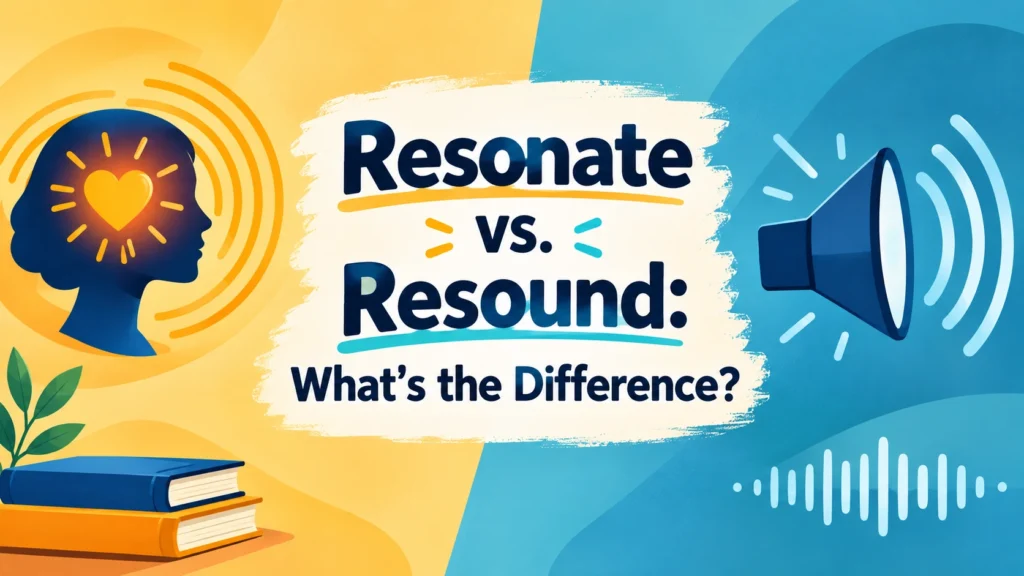
Resonate and resound overlap when you’re talking about sound, but they aren’t identical in every context.
Resound strongly emphasizes a sound echoing, reverberating, or being heard clearly.
Resonate can describe similar physical sound effects, but it also has a well-established figurative meaning involving emotional or intellectual connection.
Compare:
“Her voice resounded through the hall.”
This emphasizes the sound carrying or echoing.
“Her story resonated with the audience.”
This emphasizes the audience’s response.
Oxford explicitly gives resound as a synonym in one sound-related sense of resonate.
Quick Comparison
| Word | Main idea | Example |
| resonate | Produce continuing sound or create meaningful impact | “The story resonated with me.” |
| resound | Echo or carry strongly | “Her voice resounded through the hall.” |
| echo | Repeat or reflect a sound, idea, or feeling | “His comments echoed earlier concerns.” |
The figurative overlap can be subtle. Context decides which word sounds most natural.
Resonate vs. Relate: Are They Interchangeable?
These words can overlap, especially when you’re talking about personal experiences.
Consider:
“I relate to her story.”
This means you identify with the experience or understand it because of something in your own life.
Now compare:
“Her story resonates with me.”
This emphasizes the emotional or meaningful effect the story creates.
The distinction isn’t absolute. In many everyday situations, either sentence may communicate a similar idea.
Still, the emphasis differs.
Relate focuses strongly on identification.
Resonate focuses strongly on impact and connection.
For example:
“I relate to his experience of moving to a new city.”
This emphasizes shared experience.
“His story about starting over resonated with me.”
This emphasizes the emotional significance of the story.
How to Use “Resonate” Correctly in Everyday English
Once you understand the basic meaning, the word becomes remarkably flexible.
In Casual Conversation
You might say:
- “That song really resonates with me.”
- “Her advice resonated with me.”
- “I think that message will resonate with people.”
- “That character resonated with me because I went through something similar.”
These sentences sound natural because they connect resonate to a specific feeling, memory, or experience.
In Professional Communication
The word frequently appears in workplace communication.
For example:
“The presentation resonated with the sales team.”
This means the presentation had a strong effect on them or connected with their concerns.
You could also write:
“The campaign needs to resonate with its target audience.”
That’s a common communication goal.
However, don’t use resonate merely because it sounds sophisticated. If connect, appeal, or matter communicates the idea more clearly, use the simpler word.
For example:
“The message connected with customers.”
Sometimes that’s better than:
“The message resonated with customers.”
Both can work. The best choice depends on the nuance you want.
In Academic and Analytical Writing
Resonate works particularly well when discussing literature, history, culture, art, and ideas.
Examples:
- “The novel’s themes continue to resonate with contemporary readers.”
- “The poem resonates with modern concerns about identity.”
- “The historical event still resonates in the country’s cultural memory.”
In analytical writing, however, don’t stop at the word resonate.
Explain why.
Instead of:
“The novel resonates with readers.”
Try:
“The novel resonates with readers because its themes of isolation and belonging remain familiar today.”
The second sentence gives the reader something concrete.
In Marketing and Content Writing
Marketing professionals often talk about messages that resonate with audiences.
For example:
“Brands often use personal stories to create messages that resonate with customers.”
The expression works because it describes relevance and emotional connection.
Still, beware of vague marketing language.
“This content resonates with everyone” makes a sweeping claim without explaining anything.
A stronger statement identifies the audience and the reason:
“The campaign resonates with first-time homeowners because it addresses the uncertainty of buying a first property.”
That’s much more informative.
In Literature and Media
A movie, novel, song, painting, or character can resonate with an audience.
For example:
“The film’s themes of family and forgiveness resonated with viewers.”
The meaning isn’t that the film literally echoed.
Instead, its themes created a meaningful response.
Oxford also recognizes this broader figurative use of resonate, including the idea of reminding someone of something or matching what they think or believe.
Resonate vs. Resignate: Correct and Incorrect Examples
Seeing the forms side by side makes the distinction easier to remember.
| Incorrect/nonstandard in the intended sense | Correct | Explanation |
| “The story resignated with me.” | “The story resonated with me.” | Use resonated for the past tense. |
| “Her message resignates with readers.” | “Her message resonates with readers.” | Use resonates for a singular subject. |
| “I resignate with that idea.” | “I resonate with that idea.” | The standard verb is resonate. |
| “The movie really resignated with audiences.” | “The movie really resonated with audiences.” | The standard past form is resonated. |
| “His words are resignating with people.” | “His words are resonating with people.” | The present participle is resonating. |
A Simple Correction Trick
Whenever you find yourself typing resignate, stop and ask:
Am I trying to say “resonate”?
If the answer is yes, replace it.
That one habit can eliminate the error immediately.
The Etymology of “Resonate”
The history of resonate explains why the modern word has such a strong connection to sound.
The Latin Root Resonare
Oxford traces resonate to Latin resonare, meaning essentially “to sound again” or “resound.” Oxford explains the formation as re-, expressing an intensive force, plus sonare, meaning “to sound.”
That same Latin root helps explain related words such as:
- resonance
- resonant
- resound
The underlying concept is sound returning, continuing, or becoming strongly noticeable.
From Physical Sound to Figurative Meaning
The word’s earliest sense was closely tied to literal sound.
Etymonline dates resonate to the 19th century and notes that its early use was literal. It also dates the figurative sense involving feelings and emotions to the late 20th century.
That development is fascinating because the modern figurative meaning is really a metaphor built on the physical one.
Think about what happens when a sound resonates.
It doesn’t simply appear and vanish.
It continues.
It fills space.
It interacts with its surroundings.
That physical idea provides a powerful metaphor for something that continues to affect a person’s thoughts or emotions.
Related Words From the Same Family
Resonance is the noun.
For example:
“The speech had emotional resonance.”
Oxford defines resonance in sound-related terms and also as the power of writing, music, or other material to bring images and feelings to someone’s mind.
Resonant is the adjective.
For example:
“He has a deep, resonant voice.”
It can also describe something that evokes memories or feelings.
The family looks like this:
resonate → resonance → resonant
Learning the whole family can make the spelling easier to remember.
How “Resonate” Works in Different Contexts
The word becomes even clearer when you see how its meaning shifts according to context.
Music and Sound
In music, resonate can describe the quality or continuation of sound.
Examples include:
- “The guitar resonated in the small room.”
- “Her voice resonated across the auditorium.”
- “The instrument resonated beautifully.”
This is the most literal use.
Emotions and Personal Experiences
This is the modern conversational use you’ll encounter constantly.
Examples:
- “His experience resonated with me.”
- “The character’s loneliness resonated with viewers.”
- “Her story resonated with anyone who had experienced loss.”
The important idea is personal relevance.
Ideas and Messages
Ideas can resonate too.
For example:
“The message resonated with young entrepreneurs.”
The sentence means that the message connected with their interests, experiences, beliefs, or concerns.
Literature, Film, and Art
Art often resonates because it captures something people already understand or feel.
A film about grief might resonate with someone who has experienced loss.
A novel about starting over might resonate with someone beginning a new chapter.
A song about childhood might resonate with listeners because it evokes memories.
The word works particularly well here because it combines the ideas of echo, persistence, and emotional response.
How to Make Your Writing Resonate With Readers

The phrase “make your writing resonate” is common. But what does it actually mean?
It doesn’t mean sprinkling emotional words across a page.
It means creating a meaningful connection between your message and your reader.
Know What Your Reader Cares About
Before writing, understand the reader’s actual problem.
If you’re explaining grammar, your reader probably wants a clear answer quickly.
If you’re writing a personal essay, the reader may want emotional insight.
If you’re writing marketing copy, the audience may want evidence that a product solves a real problem.
Relevance comes before decoration.
Use Specific Examples
Specificity gives abstract ideas a heartbeat.
Compare:
“Mistakes can be frustrating.”
with:
“You’ve typed the same word three times, yet the spelling still looks wrong.”
The second example creates recognition.
Readers can picture themselves in the situation.
Tell Short, Relevant Stories
Stories help readers connect with information because they give abstract ideas a human context.
You don’t need a five-page anecdote.
Sometimes three sentences are enough.
For example:
A student hears the word resonate in conversation for months. Then she finally sees it written down and realizes why she kept spelling it incorrectly.
That tiny scenario makes the spelling issue memorable.
Choose Clear and Precise Language
Fancy words don’t automatically make writing stronger.
In fact, unnecessary complexity can create distance between you and your reader.
If connect says exactly what you mean, use it.
If resonate captures a deeper sense of emotional or intellectual connection, use that instead.
Good writing isn’t about using the longest available word.
It’s about choosing the right word.
Create Emotional or Intellectual Relevance
A message can resonate emotionally.
It can also resonate intellectually.
For example:
“The argument resonated with me because it challenged an assumption I’d never questioned.”
That sentence describes an intellectual connection rather than an emotional one.
Use Strong Verbs and Concrete Details
Compare:
“The story was very impactful.”
with:
“The story stayed with readers long after they finished it.”
The second version shows the effect rather than hiding behind a vague adjective.
Common Mistakes With “Resonate”
Writing “Resignate” Instead of “Resonate”
This is the central mistake.
Incorrect:
“The message resignated with me.”
Correct:
“The message resonated with me.”
Using the Wrong Preposition
The figurative construction commonly uses with.
Correct:
“The idea resonated with me.”
Correct:
“The story resonated with readers.”
Less natural for the intended meaning:
“The idea resonated me.”
When you’re describing a meaningful connection, remember:
resonate + with
Using “Resonate” as a Transitive Verb
In ordinary figurative English, resonate is commonly used intransitively.
You don’t normally say:
“The story resonated me.”
Instead:
“The story resonated with me.”
Oxford labels the figurative construction resonate with somebody/something.
Using “Resonate” Without Explaining the Connection
A sentence such as:
“This idea resonates.”
may be grammatically fine, but it can be vague.
With a little more information, it becomes stronger:
“This idea resonates with readers who have struggled with perfectionism.”
Now the reader understands the connection.
Confusing “Resonate” With “Resound”
If you’re talking about a sound echoing or carrying through a space, resound may be a better choice.
If you’re talking about emotional or intellectual connection, resonate is usually the natural choice.
Read More : Its Self or Itself? The Complete Guide to Correct Usage
Resonate Synonyms and When to Use Them
No synonym is a perfect replacement in every sentence.
| Word | Main emphasis | Example |
| connect with | Personal or audience connection | “The message connected with readers.” |
| strike a chord | Strong emotional response | “Her story struck a chord with viewers.” |
| appeal to | Attract or interest | “The design appeals to younger buyers.” |
| relate to | Identify with an experience or idea | “I can relate to his experience.” |
| echo | Reflect or repeat an idea, feeling, or sound | “The speech echoed earlier concerns.” |
| reverberate | Continue or spread strongly | “The decision reverberated across the industry.” |
| move | Cause an emotional response | “The story moved the audience.” |
For instance, relate to and resonate with often overlap, but they aren’t identical.
“I relate to her experience” emphasizes identification.
“Her experience resonates with me” emphasizes the effect that experience has on you.
That small distinction can make your writing more precise.
A Quick Reference: Resignate or Resonate?
When you’re unsure, use this guide.
| If you mean… | Use… |
| Create a deep or continuing sound | resonate |
| Fill a place with sound | resonate |
| Create a strong emotional connection | resonate |
| Feel meaningful to someone | resonate with |
| Match someone’s beliefs or experiences | resonate with |
| Echo strongly | resonate or resound, depending on context |
| Identify personally with something | relate to may be more precise |
| Use “resignate” as the intended standard verb | Avoid it |
The easiest memory trick is this:
A message resonates. A person resonates with the message.
For example:
“The message resonated with me.”
That structure is worth remembering.
Practice: Can You Choose the Correct Word?
A little practice makes the distinction stick.
Fill in the Blank
Choose the correct form of resonate.
1. The speaker’s message ______ with the audience.
2. Her story ______ deeply with me.
3. The bells ______ through the valley.
4. The campaign is ______ with younger customers.
5. The film’s central theme has ______ with viewers for years.
Answers
1. resonates
“The speaker’s message resonates with the audience.”
2. resonated
“Her story resonated deeply with me.”
3. resonated
“The bells resonated through the valley.”
4. resonating
“The campaign is resonating with younger customers.”
5. resonated
“The film’s central theme has resonated with viewers for years.”
Notice that the root stays the same. The ending changes according to the grammatical context.
Correct the Mistake
Try correcting these sentences:
- “That speech resignated with me.”
- “The story resignates with readers.”
- “Her experience is resignating with thousands of people.”
- “The movie has resignated with audiences.”
Correct versions:
- “That speech resonated with me.”
- “The story resonates with readers.”
- “Her experience is resonating with thousands of people.”
- “The movie has resonated with audiences.”
Choose Between Resonate, Resound, and Relate
Consider these examples:
“I really ______ to his experience.”
Relate fits best because the sentence focuses on personal identification.
“Her voice ______ through the empty hall.”
Resonated or resounded can work because the sentence concerns sound.
“The story ______ with millions of readers.”
Resonated fits naturally because the sentence describes a strong connection with an audience.
A Practical Case Study: Why the Right Word Matters
Imagine a company preparing a customer newsletter.
The first draft says:
“Our new campaign is designed to resignate with customers.”
The writer clearly means that the campaign should create a meaningful connection.
The problem isn’t the campaign strategy. It’s the word choice.
The corrected sentence is:
“Our new campaign is designed to resonate with customers.”
Now the sentence uses standard English and communicates the intended idea clearly.
But there’s another improvement available.
Instead of leaving the claim vague, the writer could say:
“Our new campaign uses real customer stories to resonate with first-time buyers.”
This version tells readers how the campaign aims to create a connection.
That’s an important writing lesson: correcting resignate to resonate fixes the vocabulary problem, but adding specificity can improve the sentence even more.
Why “Resonate” Has Become So Useful in Modern English
The popularity of the figurative meaning makes sense when you look at how people communicate today.
We constantly discuss whether:
- an idea connects with people
- a story feels relevant
- a message creates an emotional response
- a brand appeals to customers
- a theme remains meaningful
- a cultural reference still matters
Resonate gives writers a compact way to express many of these ideas.
It also carries a useful metaphor.
Something that resonates doesn’t simply exist. It continues to vibrate in the listener’s mind, so to speak.
That makes the word particularly effective in discussions of art, communication, culture, storytelling, and personal experience.
Frequently Asked Questions About Resignate vs. Resonate
Is “resignate” a real English word?
For the meaning normally intended in the resignate vs. resonate comparison, resignate is not the standard English verb. Resonate is the established word used for producing continuing sound and for creating a strong emotional or intellectual connection.
Is “resonate” the correct word?
Yes. Resonate is the standard word in sentences such as “The story resonated with me” and “Her message resonates with readers.” Oxford and Cambridge both document the verb and its major meanings.
What does “resonate” mean?
Resonate can mean to produce or continue a deep, clear sound. Figuratively, it can mean to have a strong effect, feel meaningful, or connect with someone’s thoughts, beliefs, memories, or experiences.
What does “resonate with someone” mean?
Resonate with someone means that something creates a strong sense of connection or meaning for that person.
For example:
“Her story resonated with me.”
This suggests that something in her story felt personally meaningful or familiar.
How do you use “resonate” in a sentence?
The most common figurative pattern is:
subject + resonate/resonates/resonated + with + person or group
Examples:
- “The message resonates with readers.”
- “The story resonated with me.”
- “Her advice resonated with the team.”
What is the difference between “resonate” and “resound”?
Both can describe sound that continues or echoes. Resound places more emphasis on sound carrying or echoing, while resonate also has a common figurative meaning involving emotional or intellectual connection.
What is the difference between “resonate” and “relate”?
Relate to usually emphasizes identifying with or understanding something from personal experience. Resonate with emphasizes the meaningful effect or connection something creates.
What is the past tense of “resonate”?
The past tense is resonated.
Example:
“The speaker’s words resonated with the audience.”
Oxford lists resonated as the standard past form.
What is the origin of “resonate”?
Resonate comes from Latin resonare, meaning “to sound again” or “resound.” Oxford traces the word to Latin through its past-participle form, while Etymonline records its 19th-century English history and later development of its figurative sense.
Can a song resonate with someone?
Absolutely.
For example:
“That song resonates with me because it reminds me of my childhood.”
Here, resonate describes an emotional or personal connection rather than literal sound.
Can an idea resonate?
Yes.
For example:
“The idea resonated with the audience.”
It means the idea connected strongly with their beliefs, interests, concerns, or experiences.
Can a person resonate with something?
Yes. English commonly uses:
“I resonate with that idea.”
In this construction, the person is expressing a sense of personal connection with an idea, experience, or perspective.
Conclusion: Resonate Is the Standard Choice
When you’re deciding between resignate or resonate, the answer is straightforward: resonate is the standard English word for the meanings discussed here.
Use resonate when something produces a deep or continuing sound:
“Her voice resonated through the theater.”
Use resonate with when something creates a meaningful emotional or intellectual connection:
“Her story resonated with me.”
The word’s history makes the modern figurative meaning easier to remember. It comes from Latin resonare, connected with the idea of sounding again or resounding. Over time, that physical idea of sound continuing developed into a metaphor for ideas, stories, emotions, and experiences that continue to affect people.
So if resignate appears in your draft, take a second look.
In most cases, the word you’re searching for is resonate.
And once you remember the phrase “resonate with”, the distinction becomes much harder to forget.