
Have you ever wondered whether you should write “year old” or “years old”? The answer depends on how the phrase functions in your sentence. Although both forms describe age, they follow different grammar rules. Knowing when to use each one can make your writing sound much more natural and precise.
The basic distinction is simple: use “years old” when you describe someone’s age after a linking verb, such as is, was, or are. For example, “My daughter is five years old.” However, when the age appears directly before a noun as a compound modifier, the standard form is singular and hyphenated: “My five-year-old daughter.”
This small change creates a surprisingly common English grammar problem. Writers often add an unnecessary -s or forget the hyphens when using an age as a modifier. The same principle applies to phrases such as two-year-old child, ten-year-old student, and twenty-year-old building.
Understanding the difference between singular and plural forms, compound adjectives, age expressions, and hyphenation rules will help you avoid these mistakes. Once you learn the pattern, choosing between year old and years old becomes quick and straightforward.
Quick Answer: Year Old vs. Years Old
Here’s the rule you can remember immediately:
- Before a noun: use year-old as a hyphenated compound modifier.
- After a linking verb: use years old when the age is more than one year.
- Year stays singular inside a compound modifier.
- Years becomes plural in a normal age statement when the number is greater than one.
- Don’t add hyphens to a normal expression such as She is 12 years old.
- When the expression itself becomes a noun, use the hyphenated form: a 12-year-old.
For example:
She is a 12-year-old student.
But:
She is 12 years old.
Both sentences describe the same age. The grammar changes because the age expression performs a different job.
The Chicago Manual of Style specifically distinguishes “fourteen years old” from an age expression that modifies another word, such as “a fourteen-year-old grudge.”
Quick Reference Table: Year Old vs. Years Old
| Form | Use | Example |
| year-old | Before a noun as a compound modifier | a 7-year-old child |
| years old | After a linking verb | The child is 7 years old. |
| year-old | As a noun describing a person | a 7-year-old |
| years-old | Usually incorrect for a standard age statement | He is 7-years-old. ❌ |
| 7-year-old | Age used adjectivally | a 7-year-old house |
| 7 years old | Age used predicatively | The house is 7 years old. |
| one-year-old | Singular age | a one-year-old puppy |
| one year old | Singular age after a verb | The puppy is one year old. |
The key isn’t simply the number. Position and grammatical function matter.
The Core Grammar Rule Behind “Year Old” vs. “Years Old”
The difference becomes much easier once you stop thinking about hyphens first.
Instead, ask:
What job is the age expression doing in the sentence?
If it directly describes a noun before that noun appears, it acts as a compound modifier.
If it comes after the subject and a linking verb, it normally acts as a subject complement or predicative expression.
Compare these sentences:
A 16-year-old athlete won the race.
The athlete is 16 years old.
In the first sentence, 16-year-old describes athlete.
In the second, 16 years old tells you the age of the athlete.
The meaning remains nearly identical. The grammatical structure changes.
What Happens Before a Noun?
When you put an age immediately before a noun, the words work together as one descriptive unit.
Consider:
a five-year-old dog
Without the hyphens, the reader has to work harder to see how the words relate.
The hyphens visually bind five, year, and old into one modifier.
That’s why these forms are standard:
- a three-year-old child
- a seven-year-old car
- a twenty-year-old building
- a fifty-year-old company
- a two-year-old contract
What Happens After a Verb?
After a linking verb such as is, was, or became, the expression isn’t functioning as a compound modifier placed before a noun.
Therefore, you normally write:
- She is eight years old.
- He was four years old.
- The building is 150 years old.
- The company became 25 years old.
- My dog is six years old.
Notice what happens to year.
It becomes years when the number is greater than one.
That’s because you’re talking about a quantity of years rather than using year as part of a compound modifier.
Attributive vs. Predicative Age Expressions
Two grammar terms make this distinction easier to understand: attributive and predicative.
An attributive adjective or modifier appears directly with a noun:
a 10-year-old boy
A predicative expression follows a linking verb and describes the subject:
The boy is 10 years old.
This distinction explains most of the confusion surrounding year old vs. years old.
Attributive Age Modifier
The age appears before the noun:
a nine-year-old girl
a 30-year-old bridge
a 200-year-old tradition
The complete age expression works as a single modifier.
Predicative Age Expression
The age follows the subject:
The girl is nine years old.
The bridge is 30 years old.
The tradition is 200 years old.
Here, the phrase doesn’t need the same compound-adjective hyphenation.
The Chicago Manual of Style gives the same basic distinction and states that an age phrase such as “fourteen years old” doesn’t require hyphens when it stands independently.
Compound Adjective Mechanics
The phrase 10-year-old is a compound adjective.
It combines several elements into one descriptive unit:
10 + year + old
Together, they answer the question:
What kind of child?
A 10-year-old child is a child who is 10 years old.
This structure resembles many other English compounds:
- a five-mile hike
- a two-hour meeting
- a three-story building
- a ten-dollar bill
- a four-week course
Notice something important: the measurement noun often stays singular inside the compound.
You write:
a two-hour meeting
not:
a two-hours meeting
Likewise:
a 10-year-old student
not:
a 10-years-old student
The singular year isn’t an accident. It is part of the compound modifier.
Why “Years” Is Wrong in “10-Years-Old”
A common mistake is to transfer the plural form from the normal age statement into the compound.
Someone sees:
The child is 10 years old.
Then they create:
a 10-years-old child
But the two structures aren’t interchangeable.
The correct compound form is:
a 10-year-old child
The noun year becomes singular because the entire expression functions as one compound modifier.
Singular vs. Plural Forms in Age Expressions
The number also matters.
When the age stands independently, singular and plural forms follow ordinary number rules.
One Year
Use year:
She is one year old.
The puppy is one year old.
More Than One Year
Use years:
She is two years old.
The puppy is three years old.
The building is 100 years old.
But the compound modifier remains singular:
a one-year-old puppy
a three-year-old puppy
a 100-year-old building
This gives you a useful contrast:
| Normal age expression | Compound modifier |
| one year old | one-year-old |
| two years old | two-year-old |
| five years old | five-year-old |
| 18 years old | 18-year-old |
| 100 years old | 100-year-old |
The pattern is remarkably consistent.
When to Use “Year-Old” With Hyphens
Use year-old when the entire expression directly modifies a following noun.
For example:
a six-year-old child
an 18-year-old student
a 40-year-old house
a 75-year-old tradition
a 500-year-old manuscript
The hyphens prevent ambiguity and show that the words belong together.
Year-Old as a Noun
The same construction can also stand as a noun.
For example:
The 10-year-old scored the winning goal.
Here, the implied noun might be child, boy, or girl.
You don’t need to repeat it because the context makes the meaning clear.
Chicago style treats this noun use as hyphenated as well.
So these are standard:
- a five-year-old
- two five-year-olds
- several 10-year-olds
- an 18-year-old
The plural s attaches to old, not year.
That’s another point worth remembering:
five-year-olds ✅
not:
five-years-old ❌
When to Use “Years Old” Without Hyphens
Use years old when you’re simply stating someone’s or something’s age.
Examples include:
My daughter is six years old.
The car is 12 years old.
That building is 80 years old.
The company is 35 years old.
The manuscript is more than 500 years old.
No hyphens are needed in these ordinary age statements.
The Most Common Pattern
The structure is usually:
subject + linking verb + number + years old
For example:
The house + is + 75 years old.
The dog + was + 12 years old.
The company + is + 40 years old.
This construction is straightforward once you separate it from the compound modifier.
Year Old vs. Years Old: Side-by-Side Examples
Seeing the structures together makes the distinction almost automatic.
| ❌ Incorrect | ✅ Correct | Why |
| a 7 years old boy | a 7-year-old boy | Age modifies noun |
| He is 7 year-old | He is 7 years old | Normal age statement |
| a 50 years old building | a 50-year-old building | Compound modifier |
| The building is 50 year old | The building is 50 years old | Predicative age |
| a 12-years-old student | a 12-year-old student | year stays singular |
| She is 12-years-old | She is 12 years old | No hyphens after the verb |
| three-years-old children | three-year-old children | Compound modifier |
| three year olds | three-year-olds | Noun form needs hyphens |
These errors often happen because writers remember one part of the rule but forget the other.
The easiest solution is to identify the structure before editing the spelling.
Numbers, Numerals, and Style Guide Nuances
The grammar rule and the number-formatting rule are related, but they aren’t the same issue.
You can write an age with numerals:
a 12-year-old student
Or spell it out:
a twelve-year-old student
Both can be grammatically correct. The choice depends on the publication’s style.
Different style guides make different recommendations about when to spell out numbers.
For example, a discussion comparing Chicago and AP conventions notes that Chicago traditionally spells out ages below 100 while AP style generally uses numerals for ages.
So don’t confuse:
grammar
with:
style preference.
The hyphenation principle stays the same.
Numerals vs. Words
Compare:
a seven-year-old child
a 7-year-old child
The structure is identical.
The only difference is the representation of the number.
For web articles, journalism, medical writing, technical documentation, and business content, numerals can often improve scanning.
For literary or formal prose, spelling out smaller numbers may fit the publication’s house style better.
The important thing is consistency.
If your publication follows a specific style guide, use its number rules rather than mixing conventions randomly.
Hyphenation in Age Ranges
Age ranges create a slightly trickier problem.
Suppose you’re describing children between five and seven years old.
You could write:
children five to seven years old
This is clear and natural.
If the entire range works as a modifier before a noun, the construction becomes more complicated:
five-to-seven-year-old children
Chicago specifically recommends forms such as 25-to-30-year-old when an age range acts as a compound modifier.
For example:
a 5-to-7-year-old program
However, many awkward age-range constructions can be rewritten.
Instead of forcing a long string of hyphens, you might write:
a program for children ages 5 to 7
That’s often clearer.
Age Range as a Noun
When the range itself describes people as a noun, the whole construction can remain hyphenated:
five-to-seven-year-olds
The MLA Style Center also gives examples such as nine-to-ten-year-olds and distinguishes these noun forms from compound modifiers such as five-to-ten-minute intervals.
Two Different Ages vs. an Age Range
Don’t confuse a range with two alternatives.
Compare:
a 25-to-30-year-old tree
This suggests an age range.
But:
a 25- or 30-year-old tree
means the tree is either 25 or 30 years old.
Chicago recommends the suspended-hyphen construction for separate alternatives.
Special Case: “A Year Old” Without a Number
Not every use of year-old includes a number.
For example:
a year-old case
This means a case that is one year old.
You can also write:
a one-year-old case
The shorter year-old construction works because the implied number is one.
However, don’t confuse this with:
The case is a year old.
Here, a year old is an ordinary age expression after the noun and verb. It doesn’t need the same compound-modifier hyphenation.
Compare:
a year-old case
The case is a year old.
The position changes the punctuation.
Age Expressions for Buildings, Companies, and Objects
The rule doesn’t apply only to people.
You can describe the age of almost any countable thing in the same way.
Buildings
a 200-year-old church
The church is 200 years old.
Companies
a 50-year-old company
The company is 50 years old.
Cars
a 15-year-old car
The car is 15 years old.
Traditions
a centuries-old tradition
The tradition is centuries old.
Documents and Artifacts
a 300-year-old manuscript
The manuscript is 300 years old.
The underlying principle doesn’t change.
Before a noun, the age becomes a compound modifier.
After a linking verb, it becomes an ordinary age expression.
Age Expressions With Animals
Animals follow the same grammar pattern.
a three-year-old dog
The dog is three years old.
a 12-year-old horse
The horse is 12 years old.
a six-month-old kitten
The kitten is six months old.
Notice that the same rule works with month-old.
You can say:
a six-month-old kitten
but:
The kitten is six months old.
This shows that the principle isn’t really about the word year alone. It’s part of a broader English pattern for measurement-based compound modifiers.
Age Expressions in Legal and Formal Documents
Legal, governmental, medical, and administrative documents often need precise age wording.
A form might state:
The applicant must be 18 years old or older.
A descriptive document might say:
The policy applies to 18-year-old applicants.
The first sentence gives an age requirement.
The second uses age as a modifier.
Formal writing also benefits from avoiding unnecessary ambiguity. If a long compound becomes difficult to read, rewrite it rather than piling on punctuation.
For example:
applicants between 18 and 21 years old
may be easier to understand than an extremely long compound construction.
The goal isn’t to win a hyphen-counting contest. Clarity comes first.
Age Expressions in Marketing and Product Copy
Marketing copy often uses age expressions to describe products, services, customers, or traditions.
For example:
Discover a 100-year-old recipe with a modern twist.
Here, 100-year-old modifies recipe.
But:
This recipe is 100 years old.
uses the ordinary age construction.
Product descriptions can become especially confusing when age is used alongside other modifiers.
For example:
a 20-year-old whiskey
and:
whiskey that is 20 years old
follow the same fundamental pattern.
When the modifier becomes long or crowded, rewriting often produces cleaner copy.
Conversational English and Social Media
People frequently drop punctuation in informal digital writing.
You might see:
My dog is 12 years old!
That’s perfectly normal.
You may also see:
My 12 year old dog is hilarious.
In casual messages, people often omit the hyphens. However, standard edited English generally uses them when the age expression comes before the noun:
My 12-year-old dog is hilarious.
Informal writing doesn’t necessarily follow formal punctuation conventions. If you’re writing an article, résumé, report, academic paper, or professional post, standard hyphenation is the safer choice.
Common Mistakes With “Year Old” and “Years Old”
Mistake: Using “Years” Inside the Compound
❌ a 10-years-old boy
✅ a 10-year-old boy
The compound modifier uses singular year.
Mistake: Hyphenating a Normal Age Statement
❌ She is 10-years-old.
✅ She is 10 years old.
The age follows the linking verb, so the phrase doesn’t need those hyphens.
Mistake: Removing Every Hyphen
❌ a 10 year old boy
✅ a 10-year-old boy
The three-word modifier should be bound together.
Mistake: Forgetting the Hyphen When the Age Becomes a Noun
❌ The 10 year old won the competition.
✅ The 10-year-old won the competition.
Here, the age expression functions as a noun phrase.
Mistake: Confusing Age With an Age Range
❌ children 5-years-old to 7-years-old
Better:
✅ children 5 to 7 years old
Or:
✅ 5-to-7-year-old children
Choose the version that fits the sentence naturally.
A Practical Case Study: One Age, Three Structures
Consider a child named Maya.
Sentence A
Maya is eight years old.
This simply states her age.
Sentence B
Maya is an eight-year-old student.
Now the age modifies student.
Sentence C
The eight-year-old won the spelling competition.
Now the compound age expression stands in for a noun such as child or student.
The underlying fact hasn’t changed.
Maya’s age remains eight.
Only the grammatical role of the age expression changes.
That’s the heart of year old vs. years old.
Another Case Study: A Historic Building
Imagine a historic building that is 150 years old.
You could write:
The courthouse is 150 years old.
Here, you’re stating its age.
You could also write:
The city restored the 150-year-old courthouse.
Now the age modifies courthouse.
You could even write:
The 150-year-old survived several major renovations.
Here, the age expression stands as a noun phrase with the noun implied by context.
Three sentences. One age. Three grammatical structures.
What Style Guides Say About Age Hyphenation
Style authorities generally agree on the fundamental distinction.
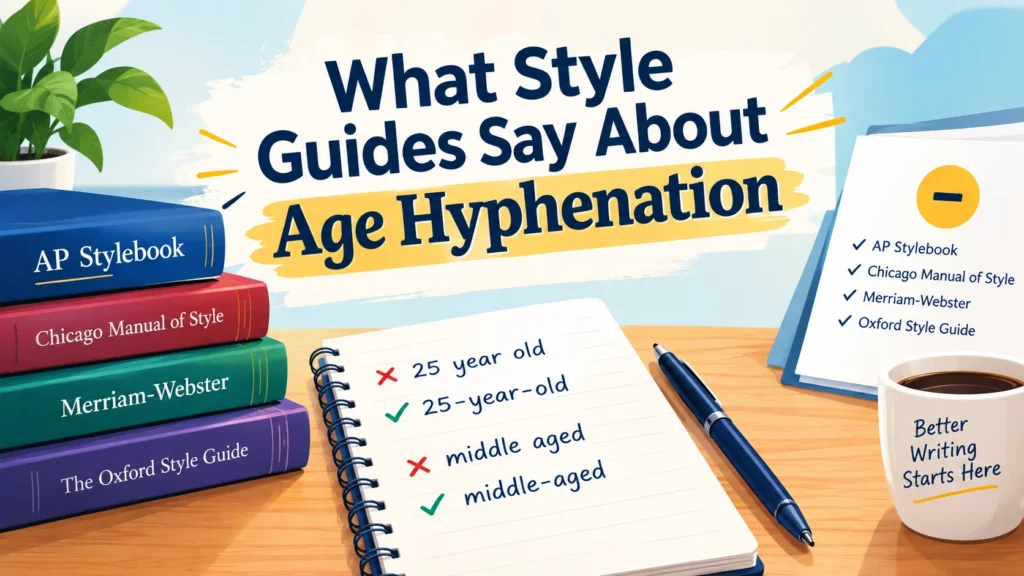
The Chicago Manual of Style gives examples such as a three-year-old, a five-year-old child, and seven years old in its age-term guidance.
Chicago also addresses more complicated forms such as age ranges. Its current guidance recommends 25-to-30-year-old for an age range used as a compound modifier.
The MLA Style Center follows Chicago’s approach for number-range compound modifiers and gives forms such as five-to-ten-minute and nine-to-ten-year-olds.
So while individual publications may have preferences about numerals, the central grammatical pattern is stable:
Before the noun: hyphenated compound modifier.
After the verb: ordinary age expression.
A Note About “Years-Old”
The form years-old isn’t normally what you want when stating someone’s age.
For example:
❌ The boy is 12-years-old.
Standard edited English uses:
✅ The boy is 12 years old.
However, Chicago points out that years-old can occur in unusual constructions when the phrase itself modifies another expression.
That means the broad statement “years-old can never appear” is too simplistic.
English sometimes creates unusual compound structures.
For everyday writing, however, you can safely remember:
12 years old after the verb.
12-year-old before a noun or when used as a noun.
That covers the overwhelming majority of cases.
“Year Old” vs. “Years Old” With Fractions
Fractional ages add another wrinkle.
You might write:
The baby is two and a half years old.
When the phrase modifies a noun, write:
a two-and-a-half-year-old baby
The compound modifier binds the components together.
Chicago’s guidance on compounds also distinguishes ordinary expressions such as two and a half months from situations where the phrase functions as a compound modifier.
So compare:
The program is two and a half years old.
with:
a two-and-a-half-year-old program
Again, grammatical position controls the structure.
A Simple Memory Trick
If you’re proofreading quickly, use this question:
Is the age sitting directly in front of a noun?
If yes, use the compound form:
10-year-old child
If no, ask whether you’re simply stating an age.
If you are:
10 years old
This two-step test solves most problems.
The “Before or After?” Rule
Before noun → year-old
a six-year-old child
After verb → years old
The child is six years old.
Used as a noun → year-old
The six-year-old smiled.
That’s the cheat code.
Read More : Lunchtime vs. Lunch Time: Which Form Should You Use?
Quick Style Checklist for Year Old vs. Years Old
Before publishing your sentence, check these points:
- Before a noun? Use year-old.
- After a linking verb? Usually use years old.
- More than one year? Use plural years in the normal age expression.
- Compound modifier? Keep year singular.
- Age used as a noun? Hyphenate the compound.
- Age range? Check whether the entire range functions as a modifier.
- Long construction? Consider rewriting for clarity.
- Publication has a house style? Follow it consistently.
- Using numerals or words? Apply your chosen style consistently.
- Proofreading a professional document? Don’t rely on informal social-media punctuation.
One-Minute Cheat Sheet
| If you mean… | Write… |
| A person’s age | She is 10 years old. |
| Age before a noun | a 10-year-old girl |
| Age used as a noun | a 10-year-old |
| One-year age | He is one year old. |
| One-year modifier | a one-year-old child |
| Building’s age | The building is 100 years old. |
| Building as modifier | a 100-year-old building |
| Age range | children 5 to 7 years old |
| Age-range modifier | 5-to-7-year-old children |
| Fractional age | two and a half years old |
| Fractional modifier | a two-and-a-half-year-old child |
Frequently Asked Questions About Year Old vs. Years Old
Is “3 years old” or “3-year-old” correct?
Both are correct, but they perform different grammatical jobs.
Use 3 years old when stating someone’s or something’s age:
The dog is 3 years old.
Use 3-year-old when the age modifies a noun or functions as a noun:
a 3-year-old dog
The 3-year-old won the race.
Why is “year” singular in “10-year-old”?
Because 10-year-old is a compound modifier.
The words work together as one descriptive unit. English commonly keeps the measurement noun singular in these constructions:
- a 10-mile race
- a two-hour meeting
- a 10-year-old child
Therefore, 10-years-old child is not the standard compound form.
Do I always need hyphens in an age expression?
No.
Use hyphens when the age expression functions as a compound modifier or noun:
a 15-year-old student
a 15-year-old
Don’t hyphenate a normal age statement:
The student is 15 years old.
Is “10 years old boy” correct?
No, not in standard edited English.
Write:
a 10-year-old boy
The phrase 10-year-old functions as the modifier for boy.
Is “10-years-old” ever possible?
It can occur in specialized or unusual compound constructions, but it isn’t the normal form for stating age. Chicago notes that unusual structures can produce years-old when the phrase itself modifies another expression.
For ordinary writing, stick with:
10 years old
or:
10-year-old
How do you pluralize “year-old”?
When the expression becomes a noun, pluralize old:
one 10-year-old
two 10-year-olds
several 10-year-olds
Don’t write:
❌ 10-years-olds
The compound remains 10-year-old and the plural ending goes on old.
How should you write an age range?
For a simple age statement, write:
children 5 to 7 years old
When the entire range modifies a noun, a form such as this can be used:
5-to-7-year-old children
Chicago specifically recommends the latter structure for age ranges functioning as compound modifiers.
Should you write “one year old” or “one-year-old”?
Both can be correct.
Use one year old when stating age:
The puppy is one year old.
Use one-year-old before a noun:
a one-year-old puppy
Can “year-old” describe things besides people?
Absolutely.
You can describe:
- buildings
- cars
- companies
- traditions
- manuscripts
- products
- institutions
- artifacts
- recipes
- contracts
- technologies
For example:
a 200-year-old building
a 50-year-old company
a 300-year-old manuscript
The grammar doesn’t change simply because the subject isn’t human.
Conclusion: Mastering Year Old vs. Years Old
The difference between year old vs. years old becomes simple once you focus on grammatical position.
When the age comes before a noun, turn it into a compound modifier:
a 12-year-old student
Keep year singular and connect the elements with hyphens.
When you state someone’s or something’s age, use the ordinary phrase:
The student is 12 years old.
Use plural years when the number is greater than one and don’t add unnecessary hyphens.
The same pattern works for buildings, animals, businesses, objects, traditions, and other things with measurable ages.
If a sentence starts looking crowded with hyphens, don’t force it. Rewrite it.
For example, instead of:
a 5-to-7-year-old education program
you might write:
an education program for children ages 5 to 7
Good grammar isn’t merely about following rules. It’s about making the meaning easy to see.
Once you remember before the noun = year-old and after the verb = years old, this common grammar problem becomes much easier to handle.