

Choosing between “there have been” and “there has been” can seem tricky, especially when a sentence begins with there instead of a clear subject. The good news is that the rule becomes simple once you identify the real subject of the sentence. The choice depends on whether that subject is singular or plural.
Use “there has been” with a singular noun or an uncountable noun. For example, “There has been a problem with the website” and “There has been some confusion about the instructions.” Use “there have been” with a plural noun, such as “There have been several problems with the website.”
This distinction matters in English grammar, subject-verb agreement, and everyday written communication. Writers sometimes choose the verb based on the word there, but there isn’t the grammatical subject in these constructions. The noun that follows has been or have been determines the correct form.
Understanding present perfect tense, singular nouns, plural nouns, countable nouns, and uncountable nouns will help you make the right choice quickly. Once you learn to identify the real subject, phrases such as there has been a change and there have been changes become much easier to use correctly.
The Core Rule: There Has Been vs. There Have Been
Start with the simplest distinction:
There has been + singular noun or uncountable noun
There have been + plural noun
Consider these examples:
- There has been a problem.
- There has been significant progress.
- There have been several problems.
- There have been major changes.
The difference comes from the noun phrase that follows been.
| Noun after “been” | Correct construction | Example |
| Singular count noun | There has been | There has been a delay. |
| Plural count noun | There have been | There have been delays. |
| Uncountable noun | There has been | There has been confusion. |
| Several plural items | There have been | There have been several complaints. |
This pattern reflects ordinary subject–verb agreement in the existential there + be construction. English uses there to introduce the existence or occurrence of something. The British Council similarly explains that singular nouns take the singular form while plural nouns take the plural form in there is/there are constructions.
The easiest shortcut
When you aren’t sure, look past there has/have been and find the noun that you’re talking about.
Ask:
Is it one thing, an uncountable thing, or several things?
- One thing → has been
- Uncountable noun → has been
- More than one thing → have been
For example:
There has been a mistake.
Mistake is singular.
There have been three mistakes.
Mistakes is plural.
That small distinction solves most cases.
Understanding “There + Has/Have Been”
The construction becomes easier when you understand what each part does.
“There”
In sentences such as “There has been a problem,” there introduces something that exists, occurs, or has occurred.
It isn’t functioning like the location word in:
The documents are there.
In the first sentence, there is part of an existential construction. Cambridge describes there as a possible dummy subject used when English needs a subject position but the meaningful noun phrase appears later in the clause.
Compare:
There has been a problem.
with:
The problem has been there for hours.
These sentences contain the same word, but there has a different grammatical role.
“Has” or “Have”
The choice between has and have carries the agreement distinction.
For present perfect constructions, English uses:
- has with third-person singular subjects
- have with plural subjects and first- and second-person subjects
Cambridge gives the present-perfect pattern as have/has + past participle.
“Been”
Been is the past participle of be.
So:
There has been a problem.
contains the present-perfect auxiliary has followed by been.
Likewise:
There have been several problems.
uses have + been.
What “Has Been” and “Have Been” Mean
The expressions has been and have been form part of the present perfect.
The present perfect connects a past event, situation, or state with the present. Cambridge describes it as a form used for events that happened during a period extending up to now or for past events that connect with the present.
That connection explains why these sentences sound natural:
There has been a change in the policy.
The change happened in the past, but the policy is relevant now.
There have been several complaints this week.
The complaints happened during a period that continues up to the present.
“Has Been” With Singular Nouns
Use has been when the following noun is singular:
- a problem
- a change
- an accident
- a delay
- an improvement
- a mistake
- a discussion
Examples:
There has been a significant improvement in sales.
There has been a delay in processing the order.
There has been an unexpected change in the schedule.
“Have Been” With Plural Nouns
Use have been when the noun is plural:
- problems
- changes
- accidents
- delays
- improvements
- mistakes
- discussions
Examples:
There have been several improvements to the website.
There have been three delays this morning.
There have been many changes since January.
The important point is that been itself doesn’t determine the choice. The auxiliary has/have changes according to agreement.
Why English Uses the Present Perfect

The present perfect isn’t simply another way to say “something happened.”
It highlights a relationship between the past and the present.
To Show Continuity
Sometimes the construction describes a situation that started in the past and continues or remains relevant now.
There has been a shortage of qualified workers for several months.
The shortage began earlier and still matters now.
Another example:
There has been considerable uncertainty since the announcement.
The uncertainty began after the announcement and continues into the present.
For duration, English commonly combines the present perfect with for and since.
To Show Past Experiences or Events Up to Now
You can also use the present perfect to discuss events within an unfinished period.
There have been several major developments this year.
The year isn’t necessarily over. The sentence looks back from the present.
Compare:
There were several major developments last year.
Here, last year is a finished period.
There have been several major developments this year.
Here, this year connects the events to the current period.
To Show Recent Events With Present Impact
The present perfect frequently describes something that happened recently and matters now.
There has been an accident on the highway.
The accident happened earlier, but its consequences are still relevant.
There have been several updates to the software.
Those updates happened recently and affect the current version.
Cambridge notes that the present perfect commonly expresses recent completed events and past events with present results.
When to Use “There Has Been”
Use there has been when the noun phrase that follows is singular or uncountable.
Singular Countable Nouns
There has been a misunderstanding.
There has been an increase in demand.
There has been one major setback.
There has been a noticeable improvement.
Each noun represents one countable item or event.
Uncountable Nouns
Uncountable nouns generally take singular agreement.
There has been some confusion.
There has been a lot of research on the subject.
There has been little progress.
There has been considerable evidence supporting the theory.
Words such as information, advice, research, progress, evidence, equipment, traffic, and confusion generally aren’t treated as plural count nouns in standard English.
Therefore:
There has been some research.
Not:
There have been some research.
If you want a plural form, change the noun:
There have been several studies.
That distinction is extremely useful in academic and professional writing.
Negative Forms
The negative form is:
There hasn’t been + singular/uncountable noun
Examples:
There hasn’t been a final decision.
There hasn’t been enough evidence.
There hasn’t been much progress.
Questions
Use:
Has there been…?
Examples:
Has there been a change in the schedule?
Has there been any progress?
Has there been a response from the client?
Notice the inversion:
Has + there + been
When to Use “There Have Been”
Use there have been when the noun phrase is plural.
Plural Countable Nouns
There have been several complaints.
There have been many changes.
There have been two accidents.
There have been multiple attempts to solve the issue.
Multiple Events or Situations
The plural form is especially common when you’re describing a series of events.
There have been several delays this week.
There have been three meetings about the project.
There have been numerous reports of the problem.
Negative Forms
Use:
There haven’t been + plural noun
Examples:
There haven’t been any complaints.
There haven’t been many opportunities.
There haven’t been enough volunteers.
Questions
Use:
Have there been…?
Examples:
Have there been any updates?
Have there been any complaints?
Have there been further developments?
The Special Case of Uncountable Nouns
This is where many learners stumble.
An uncountable noun may describe something that consists of many individual elements, but English grammar still treats the noun as singular.
For example:
There has been a lot of information.
Even though information can contain hundreds of facts, information itself is uncountable.
Compare:
| Uncountable | Countable alternative |
| information | facts/details |
| research | studies |
| advice | suggestions |
| progress | improvements |
| evidence | pieces of evidence |
| equipment | machines/devices |
| confusion | misunderstandings |
Now look at the agreement:
There has been more information.
There have been several facts.
There has been more research.
There have been several studies.
The noun—not the quantity of material behind the noun—determines the grammatical pattern.
Subject–Verb Agreement in “There” Constructions
The phrase there has/have been can feel unusual because the noun appears after the verb.
In a normal sentence, the subject usually comes before the verb:
Several problems have occurred.
But an existential construction changes the arrangement:
There have been several problems.
The noun phrase comes later. That positioning can make agreement harder to spot.
Cambridge notes that subjects are typically noun phrases and that there can serve as a dummy subject in constructions where another noun phrase appears later.
Singular Noun + Singular Verb
There has been a delay.
The core noun is delay.
Plural Noun + Plural Verb
There have been several delays.
The core noun is delays.
Why “There” Doesn’t Make the Decision
Don’t think:
There = singular
or:
There = plural
Instead, identify what follows.
Think of there as opening the door:
There has been a problem.
There have been several problems.
The noun phrase tells you which form fits.
How Prepositional Phrases Create Confusion
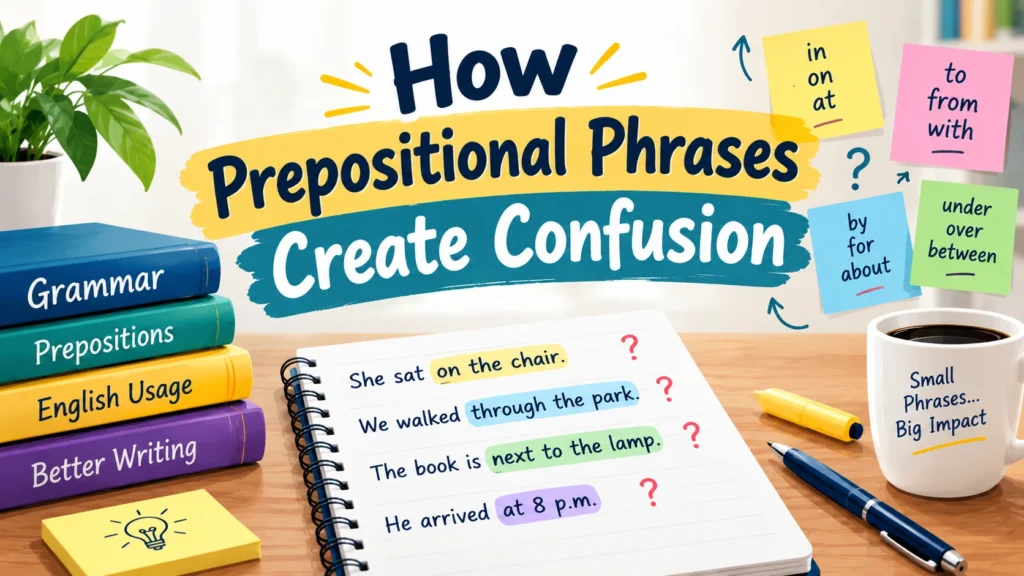
Long noun phrases can hide the word controlling agreement.
Consider:
There has been a series of unexpected problems.
At first glance, problems looks plural. But the head noun is series, which is singular.
Therefore:
There has been a series of unexpected problems.
The phrase of unexpected problems gives additional information about series. It doesn’t turn series into a plural noun.
Now compare:
There have been several unexpected problems.
Here, problems is the head noun and it’s plural.
The Head Noun Is What Matters
Consider:
a group of employees
The head noun is group.
several employees
The head noun is employees.
So:
There has been a group of employees waiting outside.
But:
There have been several employees waiting outside.
The difference becomes much easier once you stop focusing on the nearest noun.
Don’t Let Nearby Plural Nouns Mislead You
Compare these:
There has been a series of problems.
There have been several problems.
The word problems appears in both sentences. Yet the first sentence uses has because series is singular.
That’s one of the most useful lessons in this entire topic.
“A Number of” vs. “The Number of”
This pair deserves special attention because it creates frequent agreement errors.
“A Number of”
A number of + plural noun generally means several or many.
Therefore:
There have been a number of complaints.
The important idea is the plural noun phrase complaints.
“The Number of”
The number of + plural noun refers to the quantity itself.
That quantity is singular.
There has been an increase in the number of complaints.
The head noun in the number of complaints is number, which is singular.
Compare:
| Expression | Meaning | Example |
| a number of complaints | several complaints | There have been a number of complaints. |
| the number of complaints | the quantity of complaints | There has been an increase in the number of complaints. |
This distinction is easy to overlook but extremely important in formal writing.
Compound and Coordinated Structures
What happens when more than one noun appears?
If separate nouns are joined by and, the construction usually takes plural agreement.
There have been delays and cancellations.
There have been complaints and requests.
There have been errors and inconsistencies.
Here, multiple noun phrases contribute to a plural subject.
Mixed Structures
Some sentences contain a singular noun and an uncountable noun:
There has been a delay and some confusion.
The construction can become more complex because the coordinated material isn’t simply one ordinary singular noun.
For polished writing, the clearest approach is often to restructure an awkward sentence when agreement becomes difficult:
There has been a delay, and there has also been some confusion.
This isn’t always necessary, but clarity matters more than forcing a complicated sentence into a single structure.
Adverbs in “There Has Been” and “There Have Been”
Adverbs can appear inside the verb phrase without changing the basic agreement rule.
Common examples include:
- already
- recently
- just
- never
- always
- still
- previously
Examples:
There has already been a change.
There have recently been several updates.
There has never been a formal complaint.
There have already been three meetings.
The adverb adds timing or emphasis. It doesn’t change has to have.
Common Word Order Patterns
| Pattern | Example |
| There has been… | There has been a problem. |
| There have been… | There have been several problems. |
| There has already been… | There has already been a response. |
| There have recently been… | There have recently been several changes. |
| There hasn’t been… | There hasn’t been a decision. |
| There haven’t been… | There haven’t been any updates. |
“There Has Been” vs. “There Had Been”
Don’t confuse has been with had been.
They belong to different perfect tenses.
There Has Been
There has been uses the present perfect.
It connects a past event or situation with the present.
There has been a significant change in the policy.
The change matters now.
There Had Been
There had been uses the past perfect.
It places one past situation before another past point or event.
There had been several complaints before the company changed its policy.
First, the complaints happened. Later, the company changed its policy.
That’s the key timeline:
Earlier past → Later past
The present perfect instead connects the past to now.
Past → Present
Present Perfect vs. Past Perfect: Side-by-Side Comparison
| Structure | Form | Main purpose | Example |
| Present perfect | has/have + been | Past connected to present | There have been several changes. |
| Past perfect | had + been | Earlier past before another past event | There had been several changes before the review. |
One useful point stands out here: had doesn’t change between singular and plural.
You say:
There had been a problem.
and:
There had been several problems.
Not:
There have had been several problems.
The perfect auxiliary for the past perfect is had regardless of number. Cambridge likewise distinguishes have/has for the present perfect from had for the past perfect.
“There’s Been” and Informal English
You may hear:
There’s been a problem.
This is simply the contraction of:
There has been a problem.
It’s extremely common in conversation.
The British Council notes that there’s is commonly used as the contraction of there is in speech.
With there has been, the same written contraction appears:
There’s been a problem.
There’s been some confusion.
The complication comes when speakers use there’s been before plural nouns:
There’s been several complaints.
This pattern occurs in informal speech, but standard formal writing generally follows the agreement pattern:
There have been several complaints.
So if you’re writing an academic paper, business report, formal email, or professional article, there have been is the safer standard form before a plural noun.
Common Mistakes With “There Has Been” and “There Have Been”
Mistake: Using “Has” With a Plural Noun
❌ There has been several issues.
✅ There have been several issues.
Why?
Issues is plural.
Mistake: Using “Have” With a Singular Noun
❌ There have been a problem.
✅ There has been a problem.
Why?
Problem is singular.
Mistake: Letting a Nearby Noun Control the Verb
❌ There have been a series of unexpected delays.
✅ There has been a series of unexpected delays.
Why?
The head noun is series, not delays.
Mistake: Treating an Uncountable Noun as Plural
❌ There have been some useful information.
✅ There has been some useful information.
Why?
Information is uncountable in standard English.
A plural alternative would be:
There have been several useful details.
Mistake: Confusing Present Perfect With Past Perfect
❌ There had been several changes this year. (if the intended meaning connects the changes to now)
✅ There have been several changes this year.
But:
There had been several changes before the new manager arrived.
Here, had been works because the sentence establishes an earlier past period.
Mistake: Assuming “There” Determines Agreement
❌ There has been several reasons.
✅ There have been several reasons.
The word there isn’t the reason you choose has or have.
Look at reasons.
Tricky Examples That Test the Rule
Some sentences look simple until you examine their noun phrases.
“A Series of”
There has been a series of technical problems.
The head noun is series.
Even though problems is plural, a series is singular.
“A Number of”
There have been a number of technical problems.
Here, a number of means several. The following noun is plural.
“More Than One”
There has been more than one complaint.
Although the phrase means multiple complaints, more than one + singular noun normally takes singular agreement in standard English.
“Little Evidence”
There has been little evidence of wrongdoing.
Evidence is uncountable, so singular agreement fits.
“Several Pieces of Evidence”
There have been several pieces of evidence presented.
Here, the countable noun pieces is plural.
That gives you an important pattern:
There has been evidence.
but:
There have been pieces of evidence.
“There Has Been” and “There Have Been” in Real-World Writing

Grammar becomes easier when you see how these structures function in actual situations.
Workplace Communication
Imagine a project manager updating a team:
There has been a delay in the testing phase.
The writer identifies one delay.
Now suppose several problems occurred:
There have been three delays in the testing phase.
The noun delays is plural.
A longer update might say:
There have been several delays this week, but the team has completed the remaining testing tasks.
The present perfect works naturally because this week connects the events to the current period.
Customer Support
A support representative might write:
There has been a temporary issue with your payment.
That’s one issue.
If multiple customers experienced problems:
There have been several reports of payment failures.
The distinction is straightforward once you identify the noun.
A polished response could say:
We apologize for the inconvenience. There has been a temporary processing issue, and our team is investigating it.
Academic Writing
Academic writing often contains uncountable nouns:
There has been considerable research into language acquisition.
Here, research is uncountable.
But if the writer refers to individual studies:
There have been several studies on language acquisition.
The shift from research to studies changes the agreement.
This is an excellent example of how grammar and word choice work together.
News and Formal Reporting
A news-style report might say:
There has been a significant increase in housing costs.
The noun increase is singular.
Compare:
There have been significant increases in housing costs across several regions.
Now increases is plural.
The sentence structure changes because the writer has changed the noun.
Read More : Resignate or Resonate? Understanding the Correct Word and How to Use It
Case Study: Workplace Communication
Imagine a manager writing a weekly project report.
The first draft says:
There has been several delays in the project.
The problem is several delays.
Because delays is plural, the corrected sentence is:
There have been several delays in the project.
Now consider a different sentence:
There have been a series of delays in the project.
That looks plausible because delays is plural. However, series is the head noun.
The standard form is:
There has been a series of delays in the project.
The lesson is simple:
Don’t automatically choose the verb based on the closest noun. Find the head noun.
Case Study: Customer Support Replies
Suppose a customer writes:
My refund hasn’t arrived. What happened?
A support representative might respond:
There has been a processing delay with your refund.
That’s singular because the noun is delay.
Now suppose several customers have reported similar problems:
There have been several reports of delayed refunds.
Here, reports is plural.
The two sentences communicate related information but require different forms.
| Situation | Correct sentence |
| One delay | There has been a delay. |
| Several delays | There have been several delays. |
| One processing issue | There has been a processing issue. |
| Several reports | There have been several reports. |
Case Study: Academic Report
Consider these two statements:
There has been considerable research on second-language learning.
There have been several studies on second-language learning.
Both sentences can describe a similar research area. However, their grammatical structures differ.
Research is uncountable, so use has.
Studies is plural, so use have.
This distinction is particularly useful when writing research papers, essays, reports, and literature reviews.
A Simple Decision Guide: Has or Have?
When you’re stuck, don’t guess.
Use this quick process.
Find the noun
Look immediately after been and identify the main noun phrase.
Check whether it’s singular or plural
Ask whether you’re talking about:
- one item
- an uncountable substance or concept
- multiple items
Choose the form
Singular → has
There has been a mistake.
Uncountable → has
There has been progress.
Plural → have
There have been mistakes.
Check for hidden head nouns
If you see a phrase such as:
- a series of
- a group of
- the number of
- a collection of
don’t automatically use the noun after of.
Look at the head noun.
There has been a series of problems.
There has been an increase in the number of complaints.
There have been several complaints.
This method handles most difficult examples.
Comparison Table: There Has Been vs. There Have Been
| Feature | There Has Been | There Have Been |
| Singular count noun | ✓ | |
| Plural count noun | ✓ | |
| Uncountable noun | ✓ | |
| One event | ✓ | |
| Several events | ✓ | |
| One problem | ✓ | |
| Several problems | ✓ | |
| Negative | There hasn’t been | There haven’t been |
| Question | Has there been…? | Have there been…? |
| Example | There has been a delay. | There have been several delays. |
Practical Examples You Can Use
Present Perfect: “There Has Been”
There has been a change in the schedule.
There has been an unexpected problem.
There has been significant progress.
There has been a lot of discussion.
There has been some confusion about the instructions.
There has already been a response.
There hasn’t been enough time.
Has there been any improvement?
Present Perfect: “There Have Been”
There have been several changes.
There have been many complaints.
There have been two meetings this week.
There have been significant improvements.
There have recently been several updates.
There haven’t been any problems.
Have there been any developments?
Past Perfect: “There Had Been”
There had been a misunderstanding before the meeting.
There had been several warnings before the accident.
There had been little progress before the new team arrived.
There had been several attempts to resolve the issue.
Practice: Choose “Has Been,” “Have Been,” or “Had Been”
Try these before checking the answers.
Questions
- There ___ been a significant change in the schedule.
- There ___ been several complaints this week.
- There ___ been considerable progress.
- There ___ been three meetings since Monday.
- There ___ been a series of technical problems.
- There ___ been several studies on the subject.
- There ___ been an increase in demand.
- There ___ been many delays before the new system was installed.
- There ___ been some confusion about the instructions.
- There ___ been a number of complaints from customers.
- There ___ been an issue with the payment system.
- There ___ been several attempts before the team found a solution.
Answers
| Sentence | Answer | Why |
| There ___ been a significant change. | has | Change is singular. |
| There ___ been several complaints. | have | Complaints is plural. |
| There ___ been considerable progress. | has | Progress is uncountable. |
| There ___ been three meetings. | have | Meetings is plural. |
| There ___ been a series of problems. | has | Series is singular. |
| There ___ been several studies. | have | Studies is plural. |
| There ___ been an increase. | has | Increase is singular. |
| There ___ been many delays before… | had | The delays occurred before another past event. |
| There ___ been some confusion. | has | Confusion is uncountable. |
| There ___ been a number of complaints. | have | “A number of” means several. |
| There ___ been an issue. | has | Issue is singular. |
| There ___ been several attempts before… | had | Earlier past events precede another past event. |
A Few Facts Worth Remembering
Here are the rules worth keeping in your mental toolbox:
- There has been a problem.
- There have been problems.
- There has been progress.
- There have been improvements.
- There has been a series of problems.
- There have been a number of problems.
- There has been an increase in complaints.
- There have been several complaints.
- There had been several complaints before the meeting.
The biggest trap is assuming that the nearest noun controls the verb.
It doesn’t always.
The head noun matters.
Frequently Asked Questions
Is it “there has been” or “there have been”?
Both are correct. The choice depends on the noun phrase.
Use there has been with a singular or uncountable noun.
Use there have been with a plural noun.
There has been a problem.
There have been several problems.
When should I use “there has been”?
Use there has been with a singular count noun or an uncountable noun.
Examples:
There has been a delay.
There has been some confusion.
There has been significant progress.
When should I use “there have been”?
Use there have been with plural count nouns.
Examples:
There have been several delays.
There have been many changes.
There have been three complaints.
Can “there has been” be used with plural nouns?
In standard formal English, use there have been before a plural noun.
There have been several problems.
You may hear singular there’s constructions with plural nouns in informal speech, but formal writing should normally maintain standard agreement.
Is “there’s been several problems” grammatically correct?
It’s common in informal spoken English, but there have been several problems follows standard subject–verb agreement and is preferable in formal writing.
Does “there” affect subject–verb agreement?
There introduces the existential construction, but the noun phrase that follows determines the singular or plural pattern.
Compare:
There has been a problem.
There have been problems.
Do uncountable nouns use “has been”?
Generally, yes.
There has been information about the issue.
There has been research on the subject.
There has been progress.
If you change the noun to a plural countable form, use have been:
There have been several studies.
What is the difference between “there has been” and “there had been”?
There has been is present perfect. It connects a past event or situation with the present.
There had been is past perfect. It places an earlier event before another past reference point.
There has been a change.
There had been a change before the meeting.
What is the difference between “there has been” and “there have been” in questions?
The same agreement rule applies.
Singular or uncountable:
Has there been a problem?
Plural:
Have there been any problems?
Why is “there have been a number of…” correct?
In a number of + plural noun, the phrase means several or many.
Therefore:
There have been a number of complaints.
But compare:
There has been an increase in the number of complaints.
In the second sentence, number is singular.
Conclusion: There Has Been or There Have Been?
The difference between there has been and there have been becomes much easier once you focus on the noun phrase instead of the word there.
Use:
There has been + singular or uncountable noun
Use:
There have been + plural noun
So you can write:
There has been a problem.
but:
There have been several problems.
Watch out for phrases such as a series of, a number of, and the number of. They can hide the noun that actually controls agreement.
When a sentence looks complicated, slow it down. Find the head noun. Then choose has, have, or, when you’re placing one past event before another, had.
Once that habit becomes automatic, there has been vs. there have been stops being a guessing game and becomes a quick grammar decision.