
Have you ever wondered whether you should say “on the plane” or “in the plane”? Both expressions can be grammatically correct, but they do not always communicate the same idea. The difference comes down to how English uses prepositions, especially when talking about air travel, aircraft, and passengers.
In everyday American English, “on the plane” is the standard expression when you mean that someone is traveling aboard an aircraft. You would naturally say, “I’m on the plane,” “She is on the plane,” or “We met on the plane.” The expression focuses on being a passenger or being aboard the aircraft.
By contrast, “in the plane” emphasizes being physically inside the aircraft. It can be appropriate when discussing the interior of the plane, objects inside an aircraft, aircraft equipment, or a specific physical location.
Understanding this distinction can make your English grammar, spoken English, and everyday communication sound much more natural. In this guide, we’ll explore plane prepositions, air travel vocabulary, common English mistakes, on board, inside the aircraft, get on the plane, and get in the plane, so you can confidently choose the right expression in different situations.
“On the Plane” vs. “In the Plane” at a Glance
The simplest rule is this:
Use “on the plane” when you mean aboard the aircraft as a passenger or traveler. Use “in the plane” when you want to emphasize something physically inside the aircraft.
Here’s a quick comparison:
| Phrase | Main meaning | Typical use | Example |
| on the plane | Aboard the aircraft | Passengers and travel | “I’m on the plane.” |
| in the plane | Inside the aircraft | Physical interior or contents | “There was smoke in the plane.” |
| by plane | Using an airplane as transportation | Method of travel | “We traveled by plane.” |
| aboard the plane | On or inside the aircraft as a passenger/crew member | Formal or polished usage | “All passengers are aboard the plane.” |
| on board | Aboard a vehicle | Travel, announcements, formal contexts | “Everyone is on board.” |
The important point is that on and in aren’t simply interchangeable alternatives.
Compare these sentences:
- “I’m on the plane.”
- “There’s a strange smell in the plane.”
The first sentence tells you about someone’s status as a traveler. The second points toward something occurring within the aircraft’s interior.
Why “On the Plane” Is the Standard Choice for Passengers
When English speakers talk about being aboard a plane, on is the conventional preposition.
You can say:
- “I’m on the plane.”
- “She’s already on the plane.”
- “We’ll be on the plane for six hours.”
- “I met him on the plane.”
- “I left my jacket on the plane.”
- “They’re waiting on the plane.”
- “She fell asleep on the plane.”
Notice how the focus isn’t necessarily the physical walls, seats, floor, or ceiling. The expression treats the airplane as a means of transportation that you are aboard.
This pattern isn’t unique to airplanes.
“On” Means Aboard a Means of Transportation
English commonly uses on with larger forms of public or shared transportation.
| Transportation | Common expression |
| Airplane | on the plane |
| Bus | on the bus |
| Train | on the train |
| Subway | on the subway |
| Ferry | on the ferry |
| Ship | on the ship |
| Cruise ship | on the cruise ship |
For example:
- “She’s on the bus.”
- “We’re on the train.”
- “They were on the ferry.”
- “I’ll call you when I’m on the plane.”
English doesn’t always choose prepositions according to physical logic. A person is physically inside a bus or train, yet English normally says on the bus or on the train.
That’s because transportation expressions develop conventional patterns. Native speakers learn these patterns through use rather than calculating the physical geometry of the vehicle.
When “On the Plane” Is the Natural Choice
Talking About Your Current Flight
If someone asks where you are shortly before departure, you can simply say:
“I’m on the plane.”
This means you’ve boarded and are aboard the aircraft.
You might also say:
- “I’m on the plane now.”
- “We’re already on the plane.”
- “She’s still on the plane.”
- “I’ll text you when I’m on the plane.”
These sound natural in everyday conversation.
Talking About Something You Left Behind
Suppose you land and suddenly realize you left your headphones behind.
You’d normally say:
“I left my headphones on the plane.”
You wouldn’t normally say:
“I left my headphones in the plane.”
Although the headphones are physically inside the aircraft, on the plane is the conventional expression when referring to something left aboard the vehicle.
The same pattern appears with:
- “I left my passport on the plane.”
- “Someone left a bag on the plane.”
- “She forgot her phone on the plane.”
- “I found a wallet on the plane.”
The phrase focuses on the aircraft as the place where the item was left during travel.
When “In the Plane” Is Correct
Now for the important exception: “in the plane” isn’t grammatically incorrect.
It simply has a different focus.
When in appears, the speaker often emphasizes the aircraft as an enclosed physical space.
For example:
“There was smoke in the plane.”
Here, the speaker isn’t mainly talking about traveling aboard the aircraft. The important information is that smoke existed inside the aircraft.
Other examples include:
- “There was a strange smell in the plane.”
- “The temperature in the plane was extremely cold.”
- “There were several tools in the plane.”
- “A technician found the problem in the plane.”
- “There was water in the plane.”
- “The equipment in the plane needs inspection.”
In these examples, in highlights the interior.
Focusing on the Interior
Imagine that you’re discussing the design of an aircraft.
You might say:
“There are emergency exits in the plane.”
The sentence focuses on where those exits are located.
Likewise:
“The seats in the plane were unusually comfortable.”
Here, the speaker describes the interior and its contents.
However, there’s an important distinction between “the seats in the plane” and “I was on the plane.”
The first describes something contained within the aircraft.
The second describes someone’s relationship to the aircraft as transportation.
Talking About People or Objects Physically Inside
In the plane can also work when physical location matters.
For example:
“There were three technicians in the plane.”
This sentence could make sense if the speaker wants to emphasize that the technicians were physically inside the aircraft, perhaps while inspecting it.
Similarly:
“There was a large piece of equipment in the plane.”
The focus is physical placement.
If you’re simply talking about passengers traveling, however, on the plane remains much more natural.
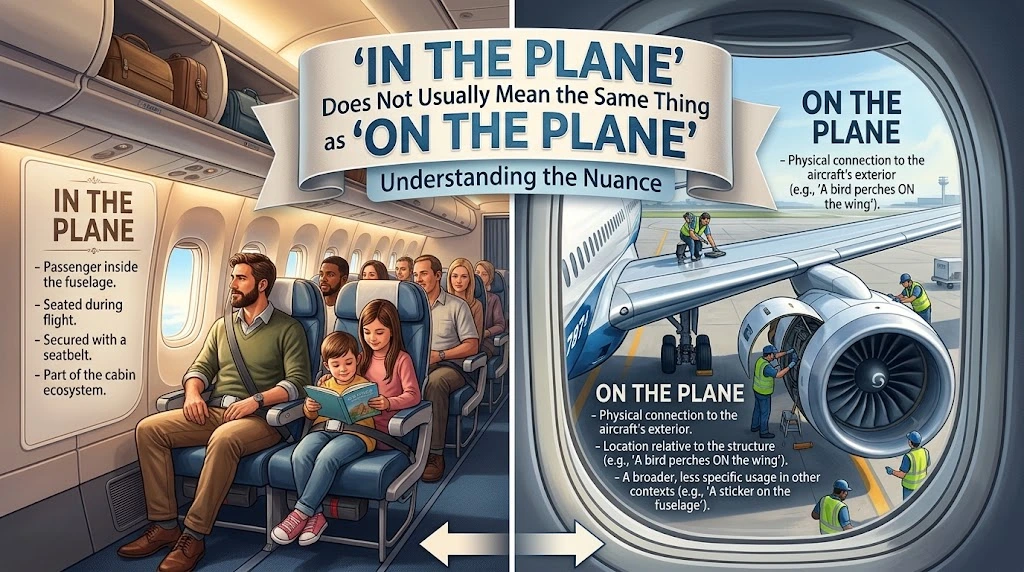
“In the Plane” Does Not Usually Mean the Same Thing as “On the Plane”
This is where many learners get confused.
Consider:
“I’m on the plane.”
This normally means:
I’m aboard the aircraft and traveling or preparing to travel.
Now consider:
“I’m in the plane.”
This can mean:
I’m physically inside the aircraft.
The second sentence isn’t necessarily wrong. It simply sounds more focused on physical location.
For everyday travel conversation, the first version is much more idiomatic.
Compare These Examples
| Sentence | What it emphasizes |
| “I’m on the plane.” | Being aboard/traveling |
| “I’m in the plane.” | Being physically inside |
| “There is smoke in the plane.” | Something inside the aircraft |
| “I left my bag on the plane.” | The bag remained aboard |
| “We traveled by plane.” | The method of transportation |
This distinction is subtle but useful.
The Transportation Rule: On, In, By, and Aboard
Understanding the larger transportation system makes on the plane or in the plane much easier.
When English Uses “On”
English commonly uses on for larger vehicles that people board as passengers.
Examples include:
- on the plane
- on the bus
- on the train
- on the subway
- on the ferry
- on the ship
You can think of on here as meaning aboard rather than literally touching the vehicle’s surface.
That’s why the phrase doesn’t conflict with the fact that passengers sit inside the aircraft.
When English Uses “In”
English commonly uses in for smaller vehicles in which people occupy an enclosed personal space.
Examples include:
- in a car
- in a taxi
- in a van
- in an SUV
For example:
“I’m in the car.”
You wouldn’t normally say:
“I’m on the car.”
That would usually suggest you’re physically on top of the car.
The distinction between on and in therefore isn’t based solely on whether a person is physically inside a vehicle. Conventional usage matters.
“By Plane” Has a Different Meaning
By plane doesn’t describe where you are.
Instead, it describes how you travel.
Compare:
“We traveled by plane.”
This tells us the method of transportation.
Now:
“We were on the plane.”
This tells us where we were.
You can combine the two ideas:
“We traveled by plane, and we spent nearly seven hours on the plane.”
That’s perfectly natural because each phrase performs a different job.
“Aboard the Plane” and “On Board”
If you want a more formal or polished alternative to on the plane, you can use aboard the plane.
For example:
“All passengers are now aboard the plane.”
Aboard means on or into a ship, train, aircraft, or other vehicle.
You may also hear:
“All passengers are on board.”
This is particularly common in announcements and formal travel language.
Compare the tone:
- “I’m on the plane.” → everyday and conversational
- “I’m aboard the plane.” → more formal or literary
- “All passengers are on board.” → common in travel announcements
None of these changes the basic idea.
“Get On the Plane” vs. “Get In the Plane”
The same distinction appears with movement verbs.
Why “Get On the Plane” Is Normal
When telling passengers to board an aircraft, English normally uses get on.
For example:
“We need to get on the plane before boarding closes.”
Other natural examples include:
- “Hurry up and get on the plane.”
- “They got on the plane at 8:15.”
- “We were the last passengers to get on the plane.”
- “She got on the plane just before the doors closed.”
Here, get on means board.
Why “Get In the Plane” Sounds Different
Get in the plane can be understood literally. It emphasizes entering the aircraft’s physical interior.
However, it isn’t the usual phrase for ordinary passenger boarding.
Compare:
“Get on the plane. We’re about to leave.”
with:
“Get in the plane and check the equipment.”
The second sentence could make sense in an aviation or technical setting where the speaker is emphasizing physically entering the aircraft.
For ordinary travelers, get on the plane is the natural choice.
“Get Off the Plane” vs. “Get Out of the Plane”
The same pattern continues after landing.
Passengers normally say:
“We need to get off the plane.”
You might also hear:
- “Everyone got off the plane.”
- “She was the last person to get off the plane.”
- “We got off the plane at midnight.”
Get out of the plane can also be grammatically meaningful, but it emphasizes physically exiting an enclosed space.
For example:
“The pilot told everyone to get out of the plane.”
This could occur in an emergency or a situation where physical evacuation matters.
The distinction is similar to:
- get on → board
- get off → leave a vehicle
- get in → physically enter an enclosed space
- get out of → physically exit an enclosed space
Common Sentences: Which Preposition Should You Use?
Here are some practical examples you can save.
| What you mean | Best expression | Example |
| You are traveling | on the plane | “I’m on the plane.” |
| You have boarded | on the plane | “We’re already on the plane.” |
| You left something aboard | on the plane | “I left my phone on the plane.” |
| Something exists inside | in the plane | “There’s smoke in the plane.” |
| Describing the interior | in the plane | “The lights in the plane are bright.” |
| Explaining travel method | by plane | “We traveled by plane.” |
| Formal passenger wording | aboard the plane | “The passengers are aboard the plane.” |
| Formal/general aboard expression | on board | “Everyone is on board.” |
Common Mistakes With “On the Plane” and “In the Plane”
Mistake: Assuming “In” Must Be Correct Because You’re Physically Inside
This is the most understandable mistake.
If you’re sitting inside an airplane, why wouldn’t you say in the plane?
Because English transportation expressions don’t always follow literal physical logic.
You are physically inside a bus, yet you say:
“I’m on the bus.”
You’re physically inside a train, yet you say:
“I’m on the train.”
The same convention applies to airplanes.
Mistake: Using “In the Plane” for Every Passenger Situation
A learner might say:
“I’m in the plane. Call me later.”
It’s understandable, but “I’m on the plane” sounds much more natural in ordinary American English.
Likewise:
“She is on the plane.”
is the normal way to describe a passenger who has boarded.
Mistake: Confusing “On the Plane” With “By Plane”
These expressions answer different questions.
How did you travel?
“I traveled by plane.”
Where were you?
“I was on the plane.”
Mixing them up can make a sentence sound awkward.
Mistake: Confusing “On the Plane” With “In the Air”
These expressions describe completely different ideas.
On the plane means aboard the aircraft.
In the air means airborne or above the ground.
For example:
“We’re on the plane, but we’re not in the air yet.”
That’s perfectly possible while passengers wait at the gate or on the runway.
Mistake: Assuming “In the Plane” Is Always Wrong
This is the opposite error.
In the plane can be completely natural when you’re talking about something located inside the aircraft.
For example:
“There was a lot of smoke in the plane.”
Trying to replace every occurrence of in with on would actually change the intended meaning.
How Context Changes the Best Choice
Context often decides which preposition sounds most natural.
Passenger Conversation
Imagine a friend asks:
“Where are you?”
You answer:
“I’m on the plane.”
That’s the standard conversational answer.
Emergency Situation
Now imagine smoke begins filling the cabin.
You might say:
“There’s smoke in the plane.”
The focus has shifted. You’re describing something inside the aircraft.
Maintenance or Inspection
A technician might say:
“There’s a problem in the aircraft.”
Here, the discussion concerns the aircraft’s physical systems rather than passenger travel.
In technical writing, aircraft can also sound more precise than plane.
Describing Objects
Consider these two sentences:
“I left my bag on the plane.”
and:
“There was water in the plane.”
The first treats the plane as the vehicle aboard which the bag remained.
The second describes water physically present inside the aircraft.
That difference is small but meaningful.
“Aircraft” vs. “Plane”: Does the Preposition Change?
Changing plane to aircraft doesn’t automatically change the preposition.
You can say:
“The passengers are on the aircraft.”
You can also say:
“There was smoke in the aircraft.”
The same basic distinction remains.
However, aircraft often appears more frequently in technical, professional, regulatory, and aviation contexts.
For everyday conversation, plane is usually simpler:
“I’m on the plane.”
For a technical report, you might encounter:
“The equipment installed in the aircraft requires inspection.”
The vocabulary becomes more formal because the context changes.
Regional and Register Differences

The basic distinction between on the plane and in the plane is not primarily an American-versus-British difference.
Both American and British English commonly use on the plane for passengers traveling aboard an aircraft.
You may encounter differences in vocabulary or style, but the core transportation pattern remains familiar across major varieties of English.
Register matters more than geography.
For example:
Casual:
“I’m on the plane.”
Formal:
“The passengers are aboard the aircraft.”
Technical:
“The equipment installed in the aircraft requires inspection.”
The speaker chooses the expression based on the situation and intended meaning.
Real-Life Case Studies
Case Study: Calling From the Airport
Maria has passed through security and boarded her flight. Her brother calls and asks where she is.
She says:
“I’m on the plane now. I’ll call you after we land.”
This is the natural choice because Maria is describing her status as a passenger.
Best expression: on the plane
Case Study: Finding a Lost Phone
James arrives at his destination and realizes he can’t find his phone.
He tells an airline employee:
“I think I left my phone on the plane.”
Again, on the plane is the normal expression because the phone was left aboard the aircraft.
Best expression: on the plane
Case Study: Reporting Smoke
A passenger notices smoke inside the cabin.
They tell a flight attendant:
“There’s smoke in the plane.”
Here, in makes sense because the speaker is describing something physically present inside the aircraft.
Best expression: in the plane
Case Study: Aviation Maintenance
A technician is discussing a component located inside an aircraft.
They might say:
“The replacement unit is already in the aircraft.”
The focus is physical location rather than passenger travel.
Best expression: in the aircraft
Case Study: Explaining How You Traveled
A coworker asks:
“How did you get to Chicago?”
You answer:
“I went by plane.”
The question concerns the method of transportation.
Best expression: by plane
Read More : Resignate or Resonate? Understanding the Correct Word and How to Use It
A Practical Decision Guide
When you’re unsure about on the plane or in the plane, ask yourself what you’re trying to describe.
Are you talking about being a passenger or traveling?
Use:
on the plane
Example:
“She’s on the plane.”
Are you describing something physically inside the aircraft?
Use:
in the plane
Example:
“There’s a strange noise in the plane.”
Are you explaining your method of travel?
Use:
by plane
Example:
“We traveled by plane.”
Do you want a more formal expression for being aboard?
Use:
aboard the plane or on board
Example:
“All passengers are now on board.”
Are you talking about boarding?
Use:
get on the plane
Example:
“We need to get on the plane.”
Are you talking about leaving after the flight?
Use:
get off the plane
Example:
“We got off the plane at 9 p.m.”
“On the Plane” vs. “In the Plane” Cheat Sheet
Keep this quick guide handy:
| If you mean… | Use… |
| A passenger is traveling | on the plane |
| Someone has boarded | on the plane |
| An item was left aboard | on the plane |
| Someone met another passenger during a flight | on the plane |
| Something is physically inside the aircraft | in the plane |
| You are describing the aircraft’s interior | in the plane |
| You traveled using an airplane | by plane |
| You want formal aboard wording | aboard the plane |
| You mean aboard generally | on board |
| You are boarding | get on the plane |
| You are leaving the aircraft | get off the plane |
A useful rule to remember is:
For passengers, “on the plane” is usually the natural choice. For physical contents or conditions inside the aircraft, “in the plane” can be appropriate.
Frequently Asked Questions About “On the Plane” vs. “In the Plane”
Is “on the plane” or “in the plane” correct?
Both can be correct, but they serve different purposes. On the plane is the standard expression for being aboard an aircraft as a passenger. In the plane usually emphasizes physical location inside the aircraft.
Why do we say “on the plane” instead of “in the plane”?
English uses on with many larger forms of transportation. We say on the bus, on the train, on the ship, and on the plane.
The preposition reflects conventional English usage rather than simply describing physical position.
Is “in the plane” grammatically correct?
Yes. It isn’t inherently incorrect.
For example:
“There was smoke in the plane.”
This sentence naturally emphasizes something occurring inside the aircraft.
Can I say “I’m in the plane”?
Yes, people can understand the sentence. However, if you’re simply telling someone that you’ve boarded your flight, “I’m on the plane” is the more natural everyday expression.
Should I say “get on the plane” or “get in the plane”?
For ordinary passenger boarding, say “get on the plane.”
For example:
“We need to get on the plane.”
Get in the plane can work when the physical act of entering the aircraft matters, especially in a technical or unusual context.
Is “by plane” the same as “on the plane”?
No.
By plane describes the method of transportation:
“We traveled by plane.”
On the plane describes being aboard the aircraft:
“We spent five hours on the plane.”
Is “aboard the plane” more formal than “on the plane”?
Generally, yes. Aboard the plane has a more formal or polished tone. On the plane is more common in ordinary conversation.
Do Americans and British speakers use these phrases differently?
Both varieties commonly use on the plane when referring to passengers traveling aboard an aircraft. The basic distinction isn’t a major American-British grammar divide.
Which is correct: “on the aircraft” or “in the aircraft”?
Both can be correct depending on meaning.
Use on the aircraft when referring to being aboard the aircraft. Use in the aircraft when emphasizing something physically located inside it.
Should I say “get off the plane” or “get out of the plane”?
For normal passenger disembarkation, get off the plane is the natural expression.
Get out of the plane emphasizes physically exiting the aircraft and may be especially appropriate in an emergency or technical context.
Final Takeaway: On the Plane or In the Plane?
The difference between “on the plane” and “in the plane” becomes much clearer once you stop treating the two prepositions as simple synonyms.
For everyday travel, on the plane is the standard choice. Say “I’m on the plane,” “She was on the plane,” or “I left my bag on the plane.”
Use in the plane when the sentence focuses on the aircraft as an enclosed physical space. Statements such as “There was smoke in the plane” or “The equipment in the plane needs inspection” naturally emphasize what’s happening inside.
Then there is by plane, which serves a different purpose altogether. It tells someone how you traveled rather than where you were.
The easiest rule is worth remembering:
Passenger or travel context? Use “on the plane.” Physical interior context? “In the plane” may be the better choice. Method of travel? Use “by plane.”
Once you learn that distinction, choosing the right preposition becomes much less of a guessing game.